
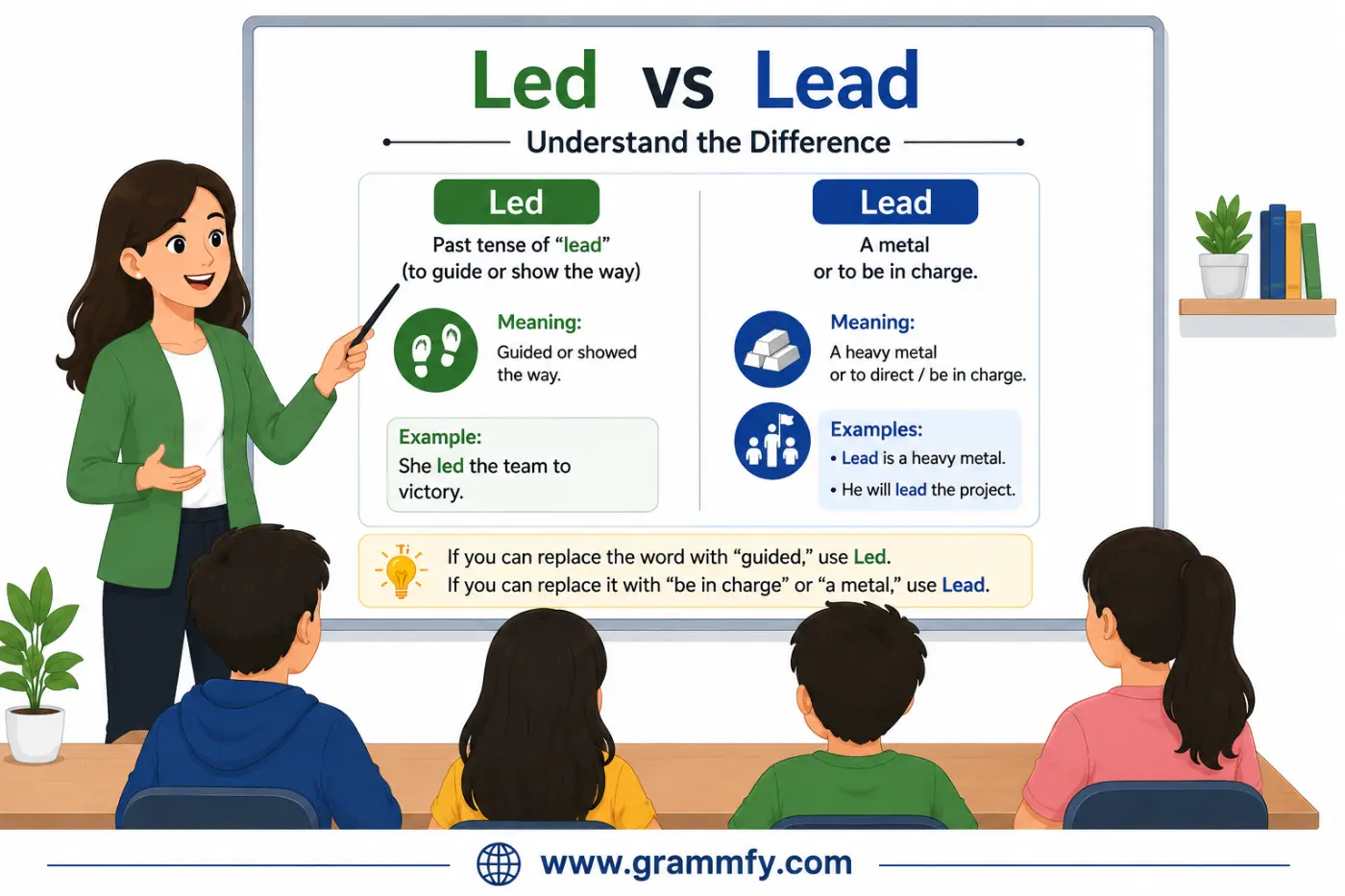
Have you ever typed a sentence in an email, essay, resume, or text and stopped at led vs lead? You’re not alone. These two words look almost identical, but they don’t always sound the same or mean the same thing.
Quick answer: Led is the past tense of lead. Lead is usually pronounced “leed” when it means to guide, but it can also be pronounced “led” when it refers to the metal.
The confusion mostly comes from pronunciation. For example, you write, “She led the team yesterday,” but led sounds like the metal lead. Meanwhile, “She will lead the team tomorrow” uses the same spelling but a different pronunciation.
In this guide, you’ll learn the difference between led vs lead, how to pronounce each word, when to use them, common mistakes, and simple examples that make the difference easy to remember.
Another commonly confused pair worth knowing is [lose vs loose].
What Does “Led” Mean?
Led is the past tense and past participle of the verb lead.
It tells us that someone guided, directed, or was in charge of people or something in the past.
Simple Definition
Led = already guided, already directed, or already took charge.
Examples
- She led the discussion yesterday.
- Our teacher led the science project.
- They led the team to victory.
- He led us through the museum.
- Sarah led the meeting last Friday.
In every example, the action has already happened.
What Does “Lead” Mean?
Lead is the base form and present tense of the verb.
It describes an action that happens now, happens regularly, or will happen in the future.
Simple Definition
Lead = guide, direct, or be in charge now or later.
Examples
- I lead a small marketing team.
- She will lead the meeting tomorrow.
- Good teachers lead by example.
- Who will lead today’s discussion?
- They always lead with confidence.
The action is happening now or is expected to happen later.
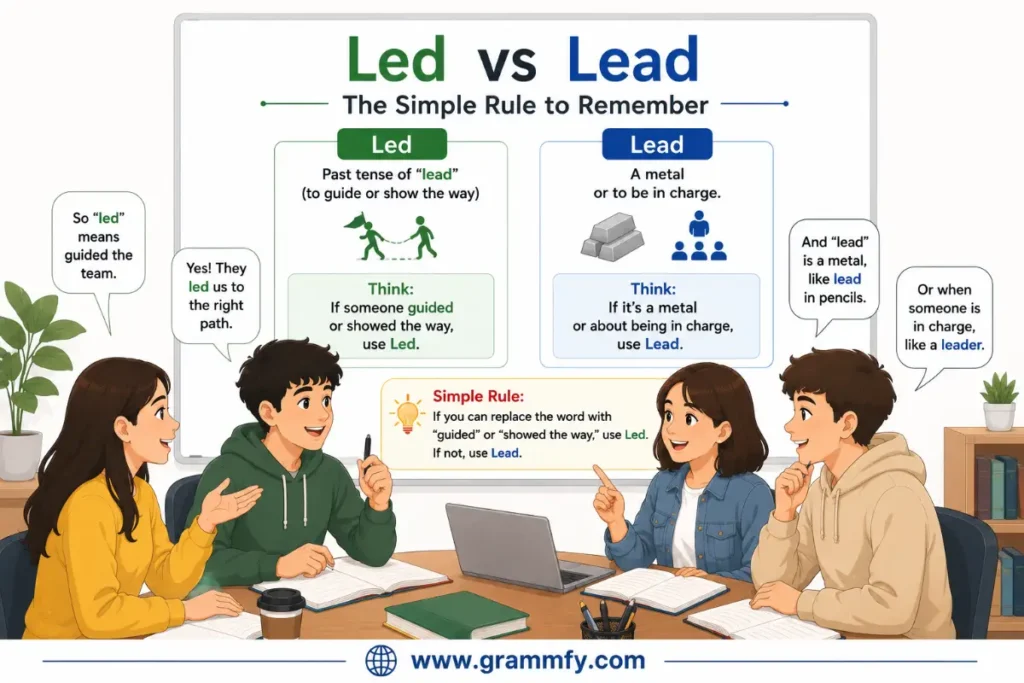
The Simple Rule to Remember “Led vs Lead”
If the action happened before now, use led.
If the action is happening now or in the future, use lead.
Think about the time of the action first. That one question usually gives you the correct answer.
| Time | Correct Word | Example |
|---|---|---|
| Present | Lead | I lead the group every Monday. |
| Past | Led | I led the group yesterday. |
| Future | Lead | I will lead the group tomorrow. |
| Present Perfect | Led | I have led this team for five years. |
This is the easiest way to master led vs lead.
Where Do These Words Come From “Led vs Lead”?
Most articles explain only the grammar, but knowing the history makes the words easier to remember.
The verb lead comes from Old English lǣdan, which meant to guide, bring, or show the way. People have used it for more than a thousand years.
Over time, English changed the past tense from older forms into led.
That’s why today’s verb forms are:
- Lead
- Leads
- Leading
- Led
Even though lead and led look different, they belong to the same verb.
Why Is “Led vs Lead” So Confusing?
There are several reasons people mix them up.
1. The spelling is almost the same.
Only one letter changes.
- Lead
- Led
When you’re typing quickly, it’s easy to choose the wrong one.
2. The pronunciation changes.
The verb lead sounds like leed.
The word led sounds exactly like it is spelled.
Since the sounds are different, many learners wonder if they’re completely different words.
3. “Lead” Is Also a Noun
Here’s where things become even more confusing.
The word lead can also be a noun.
For example:
- The pipe contains lead.
- Lead is a heavy metal.
In this case, lead is pronounced led, not leed.
That means the same spelling has two different pronunciations depending on its meaning.
| Word | Part of Speech | Pronunciation | Meaning |
|---|---|---|---|
| Lead | Verb | Leed | Guide someone |
| Led | Verb | Led | Past tense of lead |
| Lead | Noun | Led | A metal |
Understanding this difference helps you avoid mistakes when comparing led vs lead.
Verb Forms of “Lead”
Learning all the verb forms together makes them much easier to remember.
| Verb Form | Word | Example |
|---|---|---|
| Base Form | Lead | I lead the team. |
| Third Person | Leads | She leads the project. |
| Present Participle | Leading | They are leading the class. |
| Past Tense | Led | He led the meeting. |
| Past Participle | Led | She has led many teams. |
Notice that both the past tense and the past participle are led.
How to Remember the Difference
Here are a few simple memory tricks.
Trick 1: Yesterday Means “Led”
If you can add the word yesterday, use led.
- I led the meeting yesterday.
- She led the class yesterday.
Trick 2: Today Means “Lead”
If it’s happening today, use lead.
- I lead the team today.
- They lead the discussion every week.
Trick 3: Think About Time
Ask yourself one question.
Has the action already happened?
If yes, write led.
If not, write lead.
“Led vs Lead” in Real Life
Let’s look at common situations.
At School
Correct:
- Emily led the debate competition last week.
- Our teacher will lead tomorrow’s class.
Wrong:
- Emily lead the debate competition last week.
At Work
Correct:
- David led the project successfully.
- Maria will lead the new department.
Wrong:
- David lead the project successfully.
In Sports
Correct:
- The captain led the team to victory.
- She will lead the warm-up session.
In Daily Conversation
Correct:
- Dad led us through the city.
- Mom will lead the family meeting.
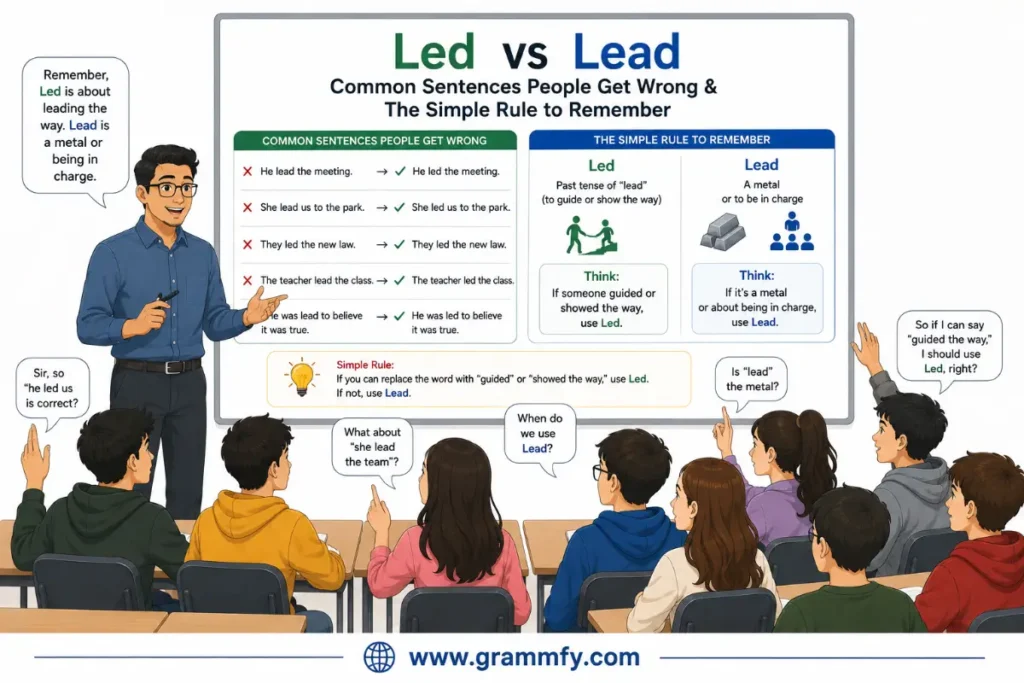
Common Sentences People Get Wrong “Led vs Lead”
Here are some mistakes that appear often.
❌ She lead the meeting yesterday.
✅ She led the meeting yesterday.
❌ He has lead several successful teams.
✅ He has led several successful teams.
❌ They lead us to the museum last weekend.
✅ They led us to the museum last weekend.
❌ Sarah led the meeting every Monday.
✅ Sarah leads the meeting every Monday.
Always check if you’re talking about the past or the present.
Master Synonym List
The verb lead can mean several things, such as guiding people, taking charge, directing work, influencing others, or showing the way. Because of that, different situations call for different synonyms.
Simple and Everyday Synonyms
| Word | Meaning | Tone | Example |
|---|---|---|---|
| Guide | Show the way | Neutral | She guided us through the park. |
| Direct | Give directions | Neutral | He directed the visitors to the office. |
| Show | Help someone find the way | Casual | I’ll show you the classroom. |
| Help | Assist someone | Casual | She helped the new student. |
| Teach | Show how to do something | Neutral | He taught the class well. |
| Support | Give help | Friendly | Good leaders support their teams. |
| Assist | Help someone | Neutral | The coach assisted new players. |
| Point | Show a direction | Casual | She pointed us toward the exit. |
| Bring | Take someone somewhere | Casual | Dad brought us to the station. |
| Take | Move someone somewhere | Casual | She took the group inside. |
Formal Synonyms
| Word | Meaning | Tone | Example |
|---|---|---|---|
| Manage | Control work or people | Formal | She managed the department well. |
| Supervise | Watch over work | Formal | He supervised the staff carefully. |
| Oversee | Monitor a project | Formal | She oversees daily operations. |
| Coordinate | Organize people | Formal | He coordinated the event. |
| Conduct | Carry out an activity | Formal | She conducted the interview. |
| Administer | Manage officially | Formal | The director administered the program. |
| Govern | Rule or control | Formal | The committee governs the organization. |
| Command | Be in charge | Formal | The officer commanded the unit. |
| Head | Be the leader | Formal | She heads the finance team. |
| Chair | Lead a meeting | Formal | He chaired the conference. |
More Formal Synonyms
| Word | Meaning | Tone | Example |
|---|---|---|---|
| Preside | Be in charge of a meeting | Formal | She presided over the ceremony. |
| Control | Have authority over something | Formal | The manager controlled the process. |
| Organize | Arrange people or tasks | Formal | He organized the event. |
| Influence | Affect others’ actions | Formal | Good teachers influence students. |
| Mentor | Guide with advice and experience | Formal | She mentored new employees. |
| Pioneer | Be the first to develop something | Formal | They pioneered a new teaching method. |
Informal or Slang Alternatives
These words don’t always mean exactly the same as lead, but people often use them in casual speech.
| Word | Meaning | Tone | Example |
|---|---|---|---|
| Run | Be in charge of | Casual | She runs the store. |
| Boss | Tell people what to do | Informal | He likes to boss everyone around. |
| Steer | Guide in a direction | Casual | She steered the conversation back on topic. |
| Take charge | Become the leader | Casual | Someone needs to take charge. |
| Call the shots | Make the decisions | Informal | The coach calls the shots. |
| Show the way | Guide others | Casual | He showed the way through the forest. |
Synonyms by Intensity
Sometimes you need a word that’s stronger or softer than lead.
| Level | Words |
|---|---|
| Mild | Help, Assist, Support, Show |
| Moderate | Guide, Direct, Coordinate, Organize |
| Strong | Manage, Supervise, Command, Govern, Control |
Choose the word that matches the situation. A manager usually supervises employees, while a tour guide guides visitors.
Synonyms by Part of Speech
Verbs
- Lead
- Guide
- Direct
- Manage
- Supervise
- Coordinate
- Organize
- Conduct
- Control
- Govern
- Mentor
- Influence
- Head
- Chair
- Command
Nouns
- Leader
- Guide
- Director
- Manager
- Supervisor
- Captain
- Coach
- Chief
- Head
- Chairperson
Adjectives
- Leading
- Influential
- Responsible
- Authoritative
- Senior
Does US vs. UK English Change the Rule?
No.
The grammar rule is exactly the same in both American and British English.
| US English | UK English | Correct |
|---|---|---|
| I lead the team. | I lead the team. | ✅ |
| I led the team yesterday. | I led the team yesterday. | ✅ |
The difference between led and lead never changes because of the country.
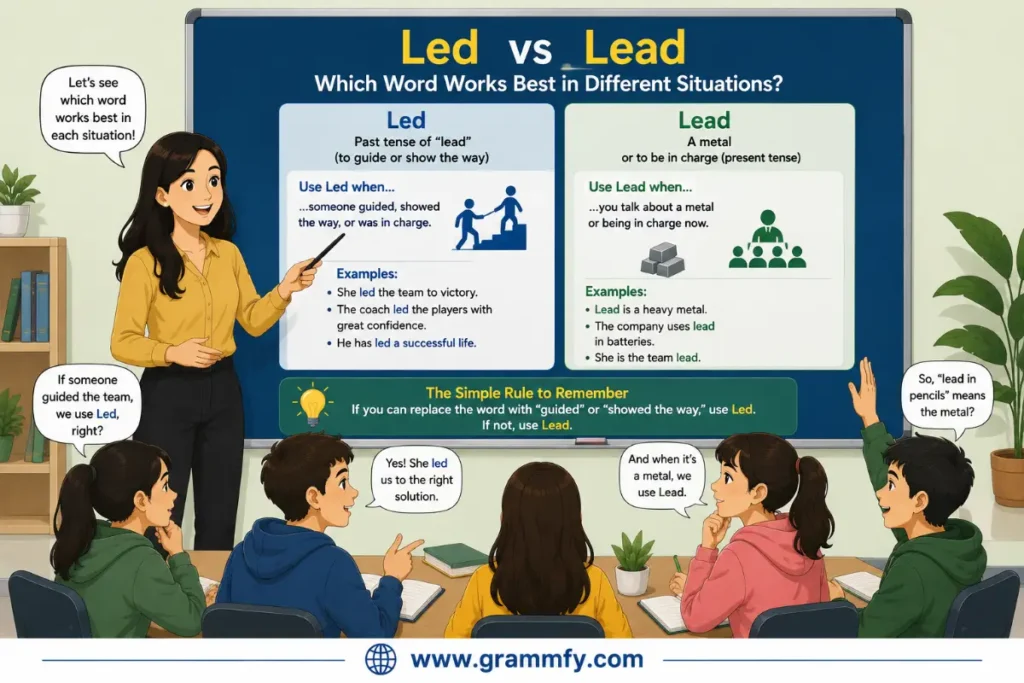
Which Word Works Best in Different Situations “Led vs Lead”?
On a Resume
Employers like action verbs.
Examples:
- Led a team of 12 employees.
- Led a successful marketing campaign.
- Led customer service improvements.
Avoid writing:
- Lead a team of 12 employees. (unless the job is current)
In an Essay
Academic writing should use the correct verb tense.
Example:
- The scientist led several important studies.
If you’re writing about something happening now:
- The professor leads the research team.
In an Email
Use the tense that matches the time.
Example:
- I’ll lead tomorrow’s meeting.
- Sarah led yesterday’s presentation very well.
In Text Messages
People often shorten sentences, but the grammar rule stays the same.
Examples:
- I’ll lead the game tonight.
- You led us the wrong way!
In Speaking
Native speakers naturally switch between lead and led based on time.
- Who will lead?
- Who led yesterday?
Real-Life Example Sentences of “Led vs Lead”
Here are more examples to help you remember the difference.
- Emma led the volunteer group last weekend.
- My brother will lead the family meeting tomorrow.
- The coach led the players to an easy win.
- Great teachers lead by example.
- Our guide led us through the old city.
- Jessica leads the customer support team.
- The firefighter led everyone to safety.
- I hope you lead today’s discussion.
- She has led many successful projects.
- They led the parade through downtown.
- Good parents lead with patience.
- The engineer led the design process.
- Who will lead the presentation?
- Our captain led the team during a difficult season.
- Strong leaders lead with honesty instead of fear.
Close Comparisons
Lead vs Guide
| Lead | Guide |
|---|---|
| Often means being in charge. | Usually means showing someone the way. |
| Can describe leadership at work. | Often used for giving help or directions. |
Examples:
- She led the company.
- She guided visitors through the museum.
Lead vs Manage
| Lead | Manage |
|---|---|
| Focuses on inspiring people. | Focuses on organizing work. |
| Leadership comes first. | Administration comes first. |
Examples:
- A coach leads a team.
- A manager manages schedules and budgets.
Many great managers also lead people, but the words are not always interchangeable.
Common Mistakes
Using “Lead” for Past Actions
❌ She lead the meeting yesterday.
✅ She led the meeting yesterday.
Using “Led” for Present Actions
❌ I led the team every Monday.
✅ I lead the team every Monday.
Confusing the Metal with the Verb
Remember:
- Lead (verb) = guide
- Lead (noun) = a heavy metal
They share the same spelling but have different pronunciations and meanings.
Forgetting the Past Participle
After has, have, or had, use led.
Correct:
- She has led many teams.
Incorrect:
- She has lead many teams.
Antonyms
Words with the opposite meaning include:
- Follow
- Obey
- Trail
- Copy
- Imitate
- Yield
- Submit
- Listen
- Accept direction
- Comply
Example:
Instead of leading the group, he chose to follow.
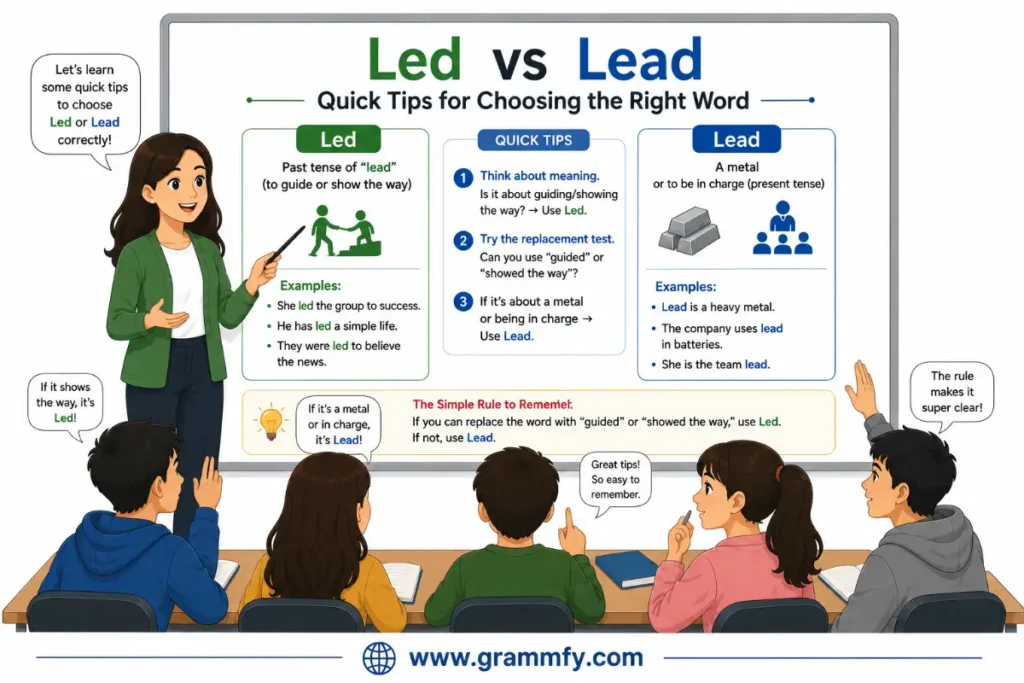
Quick Tips for Choosing the Right Word “Led vs Lead”
- Think about time first.
- If it happened yesterday, use led.
- If it happens today, use lead.
- After has, have, or had, always use led.
- Don’t confuse the verb with the metal called lead.
- Read the sentence aloud if you’re unsure.
- Practice with real examples instead of memorizing rules.
Conclusion
Understanding led vs lead is easier than it first seems. The key is to focus on when the action happens. If the action is happening now or will happen later, use lead. If it already happened, use led. Remember that lead can also be the name of a metal, but that has a different pronunciation and meaning. The more you read, write, and practice these words in real sentences, the more natural they will become. Keep this simple rule in mind whenever you write an email, essay, resume, or message, and you’ll be able to choose the correct word with confidence every time.
Frequently Asked Questions
Is “led” the past tense of “lead”?
Yes. Led is the past tense and past participle of the verb lead.
Why is “lead” pronounced differently?
When lead is a verb, it’s pronounced leed. When lead is the metal, it’s pronounced led.
Can I write “has lead”?
No. The correct form is has led.
Which is correct: “lead the team” or “led the team”?
Both are correct, depending on time. This is the main difference in led vs lead. Use lead for the present or future and led for the past.
What’s another way to say “lead”?
You can use words like guide, direct, manage, coordinate, mentor, head, or supervise, depending on the situation.
Is the rule different in British English?
No. Both American and British English use the same grammar rule.
