
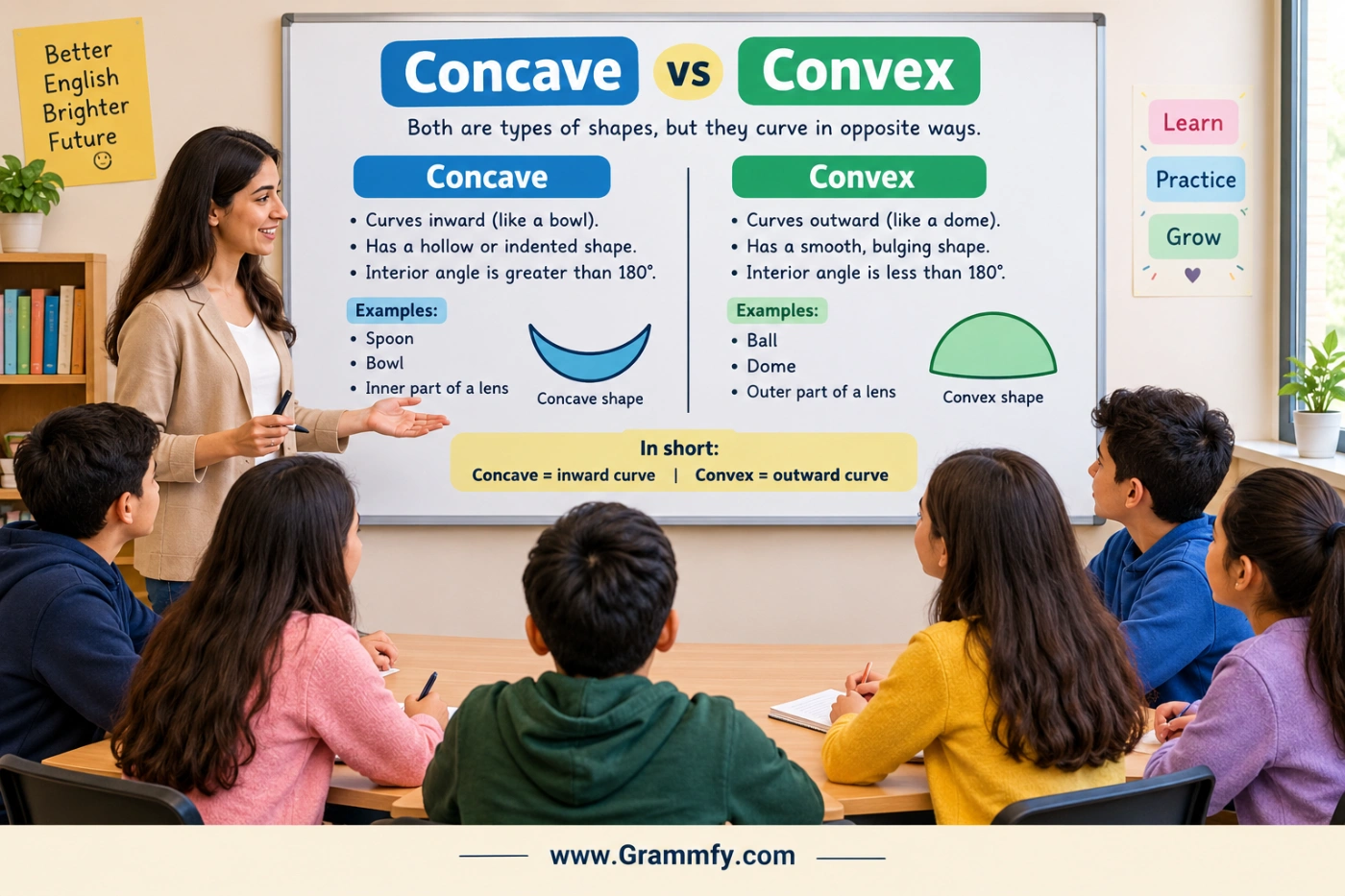
Concave vs Convex can be confusing, but understanding how each shape curves makes the difference easy to remember.
Have you ever looked at a curved mirror, lens, bowl, or graph and wondered which way the curve goes? If you’re writing a science answer, solving a geometry problem, or simply trying to remember the difference, the terms can feel confusing at first. The key is to look at which way the surface or shape curves.
Concave shapes curve inward, like the inside of a bowl. Convex shapes curve outward, like the outside of a ball. This simple idea works across geometry, optics, mirrors, lenses, and many everyday objects.
- Answer box: Concave means curved inward, while convex means curved outward. A concave shape looks like it has a hollow or cave-like center; a convex shape bulges outward.
The difference becomes much easier when you connect the words to real objects. A spoon, magnifying glass, bowl, and road can all help you remember the two ideas. In this guide, we’ll cover their meanings, origins, geometry, lenses, mirrors, examples, common mistakes, related terms, and the easiest ways to choose the right word.
These words are easy to mix up, so read our guide to the difference between Preform vs Perform to see their meanings and examples side by side.
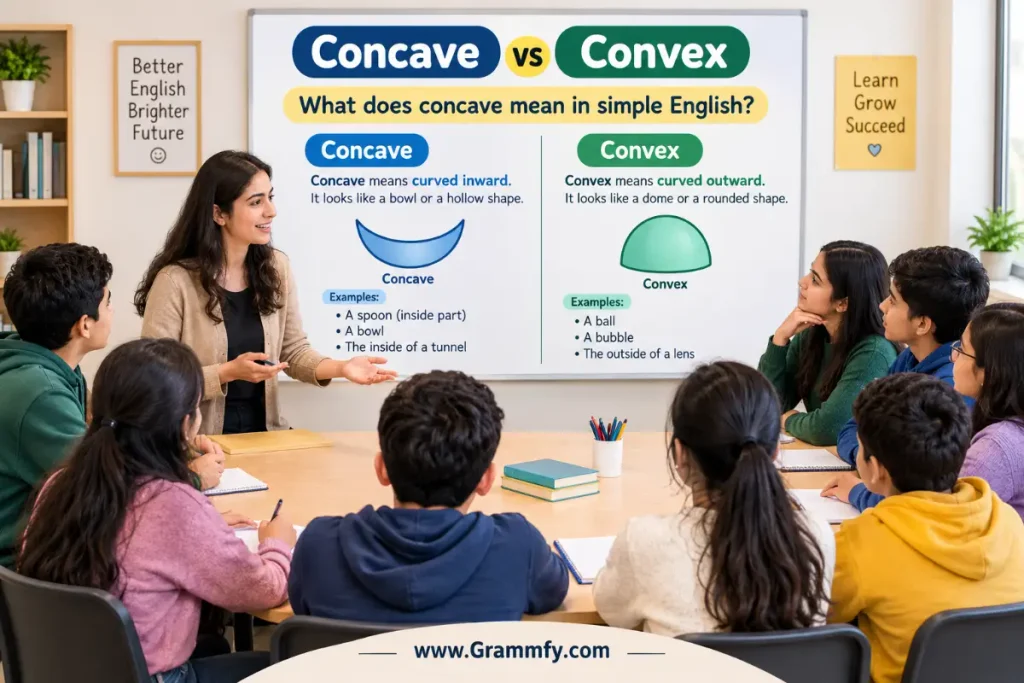
What does concave mean in simple English?
Concave describes a surface or shape that curves inward. Imagine pressing your thumb into a soft ball. The dent you create is concave because the surface bends toward the inside.
A simple way to remember it is:
Concave = curves inward.
Think about the inside of a bowl. The middle part is lower than the edges, creating a hollow area. That inward curve is concave.
The word can describe both two-dimensional shapes and three-dimensional surfaces.
What are examples of concave shapes?
Common examples include:
- The inside of a bowl
- The inside of a spoon
- A cave opening
- A concave mirror
- A concave lens
- The inward side of a curved surface
- Some valleys or curved boundaries
- Certain parts of a graph
A shape doesn’t have to look exactly like a bowl to be concave. What matters is the direction of the curve.
What does convex mean in simple English?
Convex describes a surface or shape that curves outward. Think of the outside of a ball. Instead of creating a hollow, the surface pushes outward.
A simple way to remember it is:
Convex = curves outward.
The top of a rounded hill is a familiar example. It rises outward from the surrounding area rather than creating a hollow.
What are examples of convex shapes?
Examples include:
- The outside of a ball
- The outside of a spoon
- A dome
- A convex mirror
- A convex lens
- A rounded hill
- A bubble
- The outward side of a curved surface
- Many simple rounded objects
The easiest visual trick is to ask whether the surface is caving in or bulging out.
Concave vs Convex: what’s the simple difference?
The main difference is the direction of the curve.
| Feature | Concave | Convex |
|---|---|---|
| Basic meaning | Curves inward | Curves outward |
| Visual idea | Hollow or dented | Bulging or rounded |
| Memory image | Inside of a bowl | Outside of a ball |
| Surface direction | Toward the inside | Toward the outside |
| Mirror example | Concave mirror | Convex mirror |
| Lens example | Concave lens | Convex lens |
| Common appearance | Cave-like | Dome-like |
| Geometry | Often bends inward | Often bends outward |
If you only remember one rule, remember inward = concave and outward = convex.
Where did the words Concave vs Convex come from?
The origins of these words give you a useful memory trick.
Concave comes from the Latin concavus, meaning hollow or hollowed out. The idea is closely connected with something that curves inward.
Convex comes from the Latin convexus, associated with a rounded or vaulted shape. It developed into the modern idea of a surface that curves outward.
The historical meanings match the modern geometry meanings surprisingly well.
Why does the word concave sound like “cave”?
This is a useful memory trick, even though concave and cave are not the same word.
A cave creates a hollow space that goes inward. When you see concave, think:
Cave → hollow → inward.
That isn’t a complete linguistic explanation of the word’s history, but it is an effective way to remember its meaning.
How can I remember convex?
For convex, imagine something that comes out toward you.
Picture a ball, bubble, or dome. Its surface pushes outward.
Try this memory pair:
- Concave → cave → inward
- Convex → bulge → outward
This works especially well when you’re studying for a geometry or science test.
What is the difference in geometry?
In geometry, the terms have a more precise meaning than simply “curved.”
A concave shape has an inward indentation. A convex shape has no inward indentation and bends outward in the relevant sense.
For polygons, the distinction is especially important.
A convex polygon has all of its interior angles less than 180 degrees. A concave polygon has at least one interior angle greater than 180 degrees.
What is a convex polygon?
A polygon is convex if every line segment connecting two points inside the shape stays inside the shape.
A simple rectangle is convex.
A regular pentagon is also convex.
A triangle is always convex because none of its interior angles can exceed 180 degrees.
What is a concave polygon?
A concave polygon has an inward “dent.”
Imagine an arrow-shaped polygon. One section points inward, creating an indentation. That shape can be concave.
At least one interior angle is greater than 180 degrees.
This is one of the most important differences to remember in geometry:
Convex polygons have no inward dent. Concave polygons have at least one inward dent.
How do Concave vs Convex curves behave?
A curve can be described as concave or convex based on how it bends.
For basic school-level geometry, it’s helpful to think visually rather than starting with complicated formulas.
Imagine a road:
- If the road bends inward like the inside of a bowl, it has a concave appearance.
- If it rises or bends outward like the top of a dome, it has a convex appearance.
In higher mathematics, concavity is connected to the way a function’s slope changes. The terms can become more technical there, so the visual rule should be treated as a starting point rather than the entire mathematical definition.
What do Concave vs Convex mean for mirrors?
Mirrors provide one of the best real-world examples.
A concave mirror curves inward, while a convex mirror curves outward.
What is a concave mirror?
A concave mirror has a reflecting surface that curves inward.
Think about the inside of a spoon. The inner surface has a concave shape.
Concave mirrors can bring reflected light rays together under suitable conditions. Because of this property, they are used in applications such as:
- Makeup mirrors
- Shaving mirrors
- Some headlights
- Telescopes
- Reflecting instruments
The image produced by a concave mirror can change depending on where the object is placed.
What is a convex mirror?
A convex mirror curves outward.
Think about the outside of a spoon. The reflecting surface bulges away from the center.
Convex mirrors spread reflected light outward and provide a wider field of view. That’s why they’re useful in places where seeing a larger area matters.
Common examples include:
- Vehicle side mirrors
- Security mirrors
- Mirrors used around corners
- Parking-area mirrors
A convex mirror generally produces an upright, reduced image.
What do Concave vs Convex mean for lenses?
The same words are also used for lenses.
A concave lens is thinner in the middle and thicker near its edges. It curves inward on its surfaces.
A convex lens is generally thicker in the middle and thinner near its edges. It curves outward.
What does a concave lens do?
A concave lens causes parallel light rays to spread apart, or diverge.
Because of this property, concave lenses are used in certain optical systems and eyeglasses designed for specific vision needs.
The easiest visual memory is:
Concave lens → thin center → spreads light.
What does a convex lens do?
A convex lens generally brings parallel light rays toward a common region, or converges them.
Convex lenses are used in:
- Magnifying glasses
- Cameras
- Microscopes
- Telescopes
- Some eyeglasses
- Optical instruments
The basic memory rule is:
Convex lens → thick center → brings light together.
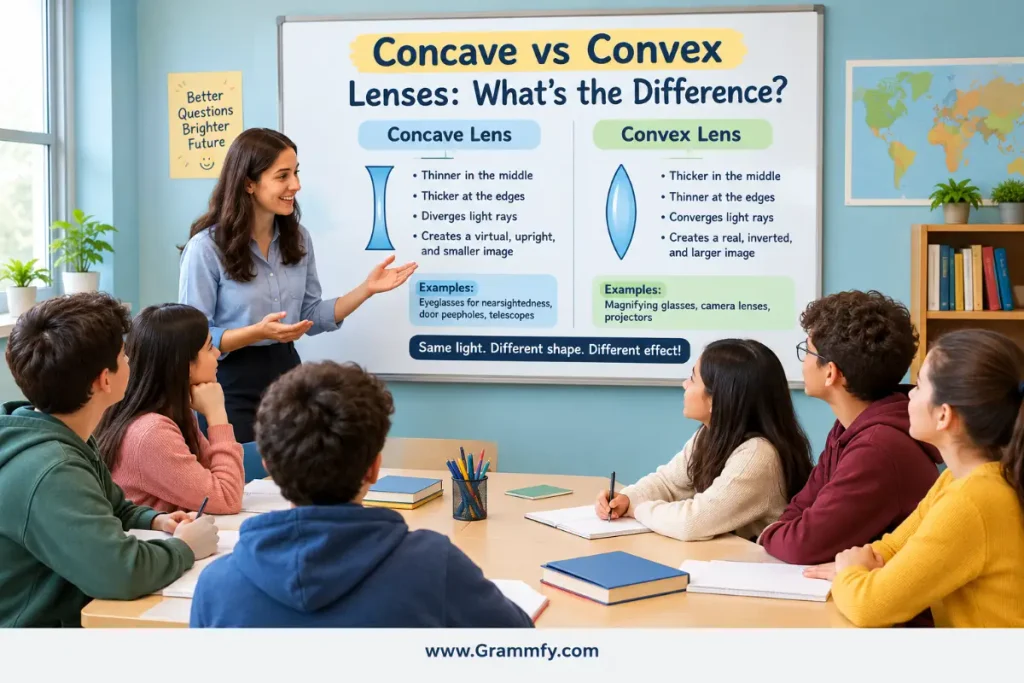
Concave vs Convex lenses: what’s the difference?
| Feature | Concave lens | Convex lens |
|---|---|---|
| Center | Thinner | Thicker |
| Edges | Thicker | Thinner |
| Basic light effect | Diverges light | Converges light |
| Shape | Curves inward | Curves outward |
| Common example | Some corrective lenses | Magnifying glass |
| Typical visual effect | Spreads rays | Brings rays together |
Be careful, though. The words describe the shape, while terms such as converging and diverging describe what happens to light.
That’s an important distinction.
What does concave mean on a graph?
In mathematics, concave can describe the shape of a graph.
For example, a graph may bend upward or downward depending on how its slope changes.
At a basic level, students often learn visual descriptions such as:
- Concave up: the graph has a cup-like shape.
- Concave down: the graph has a cap-like shape.
This can seem confusing because “concave” isn’t always used exactly like the everyday inward/outward rule.
The important point is that mathematical concavity describes the behavior of a curve, not simply whether an object looks hollow.
For more advanced work, derivatives are used to determine concavity.
Is a U-shaped graph concave up?
Yes. A typical U-shaped parabola is concave up.
For example:
y = x²
has a U-shaped graph. Its slope increases as you move from left to right, which is why it is described as concave up.
Is an upside-down U-shaped graph concave down?
Yes. A graph such as:
y = -x²
has an upside-down U shape and is concave down.
So when studying calculus, don’t rely only on the “inside versus outside” trick. Pay attention to how your textbook defines concavity for functions.
What is the difference between a concave and convex polygon?
This is a common geometry question.
A convex polygon has no inward indentation. A concave polygon has at least one inward indentation.
| Test | Convex polygon | Concave polygon |
|---|---|---|
| Inward dent | No | Yes |
| Interior angle over 180° | No | At least one |
| Diagonals | Stay inside | At least one may leave the shape |
| Simple visual | Bulging outward | Has an indentation |
Example of a convex polygon
A square is convex.
Choose any two points inside the square and draw a straight line between them. The line remains inside the square.
Example of a concave polygon
An arrow-shaped polygon can be concave.
Some pairs of points inside the shape may be connected by a line segment that passes outside the polygon. That happens because of its inward indentation.
Master related-word list for concave vs convex
Strictly speaking, concave and convex do not have 20–30 perfect synonyms. They are technical geometry terms with specific meanings. Instead, the following list gives closely related words and phrases that help explain the same visual ideas in different contexts.
| Word or phrase | Meaning | Tone | Example |
|---|---|---|---|
| Inward | Toward the inside | Simple | The surface curves inward. |
| Outward | Toward the outside | Simple | The surface curves outward. |
| Hollow | Having an empty or lowered center | Everyday | The bowl has a hollow center. |
| Dented | Pressed inward | Everyday | The metal looks dented. |
| Bulging | Pushing outward | Everyday | The surface is bulging outward. |
| Rounded | Having a curved form | Everyday | The edge is rounded. |
| Curved | Not straight | Simple | The surface is curved. |
| Indented | Pressed or curved inward | Everyday | The shape has an indentation. |
| Protruding | Sticking outward | Formal | The surface is protruding outward. |
| Recessed | Set farther inward | Formal | The panel is recessed. |
| Arched | Curved like an arch | Everyday | The doorway is arched. |
| Dome-shaped | Rounded outward | Everyday | The roof is dome-shaped. |
| Bowl-shaped | Curved inward | Everyday | The dish is bowl-shaped. |
| Cupped | Shaped like a cup | Everyday | The surface is cupped inward. |
| Spherical | Related to a sphere | Formal | The object has a spherical surface. |
| Convexity | Outward curvature | Formal | The convexity is visible. |
| Indentation | An area that goes inward | Formal | The polygon has an indentation. |
| Bulge | An outward swelling | Everyday | There is a small bulge. |
| Hollowed | Made or shaped inward | Everyday | The center is hollowed out. |
| Inset | Positioned inside a surrounding surface | Formal | The panel is inset. |
| Diverging | Moving apart | Formal/scientific | The rays are diverging. |
These words shouldn’t be treated as interchangeable replacements in every sentence. For example, recessed, bulging, concavity, and convexity have different levels of precision.
Which related word is mildest and which is strongest?
The best word depends on how much detail you need.
Mild and general
Use:
- Curved
- Rounded
- Inward
- Outward
- Hollow
- Bulging
These are useful in everyday conversation.
Example:
“The surface curves inward.”
More descriptive
Use:
- Indented
- Bowl-shaped
- Dome-shaped
- Recessed
- Protruding
- Cupped
These give the reader a clearer visual picture.
Example:
“The panel is slightly recessed into the wall.”
Technical and formal
Use:
- Concavity
- Convexity
- Curvature
- Converging
- Diverging
- Spherical
These work better in geometry, physics, mathematics, and science writing.
Example:
“The convex lens causes parallel rays to converge.”
What are the best words by part of speech?
Understanding related forms can help you write accurately.
| Part of speech | Word | Example |
|---|---|---|
| Adjective | Concave | The mirror is concave. |
| Adjective | Convex | The lens is convex. |
| Noun | Concavity | The graph has concavity. |
| Noun | Convexity | The surface has convexity. |
| Noun | Curvature | The curvature is easy to see. |
| Verb | Curve | The surface curves inward. |
| Adjective | Curved | It has a curved surface. |
| Adjective | Indented | The panel is indented. |
| Adjective | Bulging | The surface is bulging outward. |
| Adjective | Recessed | The button is recessed. |
Don’t replace concave with curved when precision matters. Every concave surface is curved in the relevant sense, but not every curved surface is concave.
Is there a US vs UK difference?
There is no major US-versus-UK difference in the basic meanings of concave and convex.
Students in the United States, United Kingdom, Canada, Australia, and other English-speaking regions generally use these technical terms in the same way.
The spelling is also normally the same:
- concave
- convex
- concavity
- convexity
Differences may appear in classroom terminology or pronunciation, but the geometry concepts do not change.
What is the best word for a resume Concave vs Convex?
A resume usually doesn’t need concave vs convex unless you’re describing a technical project, design, engineering task, mathematics, optics, or manufacturing process.
For a general resume, use a more specific professional term when appropriate.
Example
Instead of:
- “Worked with curved designs.”
You might write:
- “Designed convex surfaces for optical components.”
If you’re discussing a technical skill, convex, concave, curvature, or optical design may be more precise.
What is the best word for an essay Concave vs Convex?
For an academic essay, use concave vs convex when the subject is geometry, mathematics, physics, architecture, optics, or another technical field.
Example
“A convex lens is thicker at the center and changes the path of incoming light.”
If you’re writing for a general audience, explain the term the first time you use it.
For example:
“The convex, or outward-curving, surface reflects light in a wider range of directions.”
This gives readers both the technical word and its plain-English meaning.
What is the best word for texting Concave vs Convex?
In a text message, simple language is usually better.
Instead of: “The object has a convex surface.”
You could say: “It curves outward.”
If you’re texting someone about homework, however, the technical term may be exactly what you need.
“Remember: concave = inward, convex = outward.”
That’s short and clear.
What is the best word for email Concave vs Convex?
For a professional or school email, choose the word based on your audience.
If the reader understands geometry: “The diagram shows a convex shape.”
If they may not know the term: “The diagram shows a shape that curves outward.”
The second version is more accessible.
What is the best word for speaking Concave vs Convex?
In everyday speech, curves inward and curves outward are often easier than the technical terms.
You can also combine them: “It’s concave, so it curves inward.”
That approach is useful when speaking to someone who may not know the vocabulary.
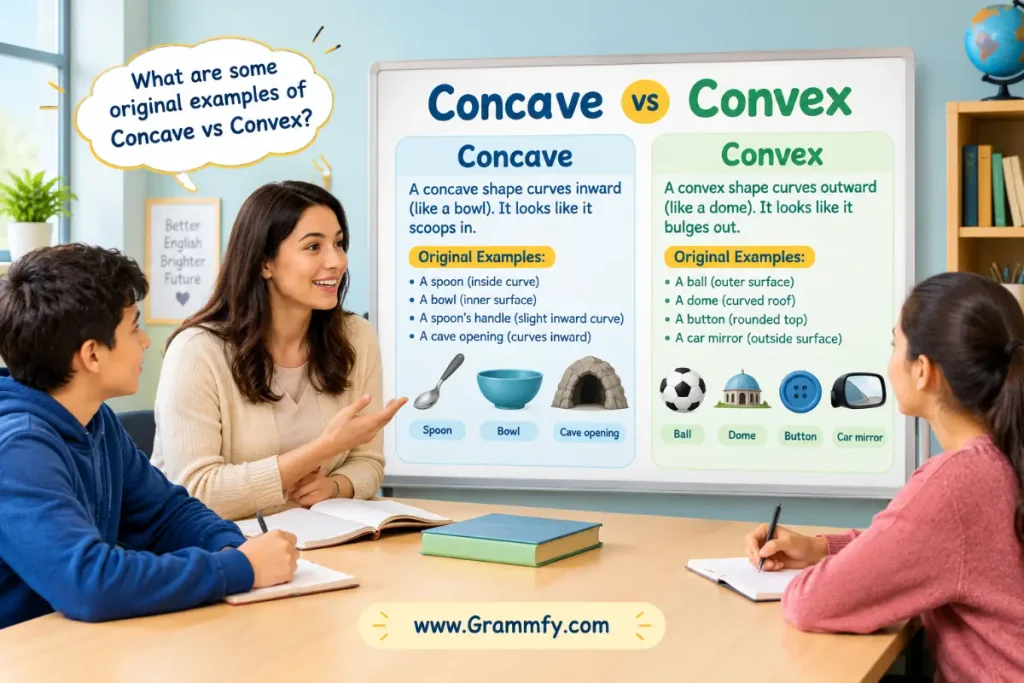
What are some original examples of Concave vs Convex?
Here are examples from different situations.
- The inside of the bowl is concave because it curves inward.
- The outside of the ball is convex because it bulges outward.
- A concave mirror curves inward toward the reflecting side.
- A convex mirror curves outward and provides a wider field of view.
- The magnifying glass uses a convex lens to bend light toward a common region.
- The concave lens is thinner in the center than at the edges.
- The arrow-shaped polygon is concave because one part of its boundary bends inward.
- A square is convex because it has no inward indentation.
- The dome has a convex outer surface.
- The inside of the spoon looks concave when viewed from above.
- The outside of the spoon has a convex shape.
- The designer used a recessed, concave surface to create space for the button.
- The security mirror is convex, allowing people to see a larger area.
- The graph is concave up because it has a cup-like shape.
- The graph is concave down because it bends like an upside-down cup.
- The engineer measured the curvature of the convex surface.
- The cave entrance provides an easy visual example of an inward curve.
- The rounded roof forms a convex curve when viewed from outside.
Concave vs indented: what’s different?
Concave is a technical term for a surface or shape that curves inward. Indented is a broader everyday word for something that has been pushed or set inward.
For example:
- “The shape is concave.”
This sounds mathematical or scientific.
- “The metal is indented.”
This sounds like the metal has been pushed inward.
A surface can be indented without needing to be described as mathematically concave.
So don’t automatically replace one with the other.
| Concave | Indented |
|---|---|
| Technical | General |
| Describes curvature | Describes a depression or mark |
| Common in geometry | Common in everyday speech |
| Precise shape terminology | Broader physical description |
Convex vs rounded: what’s different?
Rounded simply means something has a curved or smooth shape. Convex gives a more specific description of the direction of curvature.
For example:
- “The object has a rounded edge.”
This doesn’t tell us exactly how the surface curves.
“The surface is convex.”
This gives a more precise geometric description.
Think of rounded as a broad visual word and convex as a technical word.
Concave vs depressed: what’s different?
A depressed surface is lower than the surrounding area. A concave surface curves inward.
These ideas can overlap, but they aren’t identical.
For example, a shallow dent may be described as a depression. A mathematically defined inward-curving surface may be called concave.
In science or geometry, choose concave when curvature is the important feature.
What are common mistakes with Concave vs Convex?
These words are easy to mix up, especially when you’re studying mirrors and lenses.
Mistake 1: Thinking concave means “outside”
This is the most common memory error.
Remember:
Concave → cave → inward.
Mistake 2: Thinking convex means “inside”
Convex is the outward one.
Think of a ball or bubble pushing outward.
Mistake 3: Confusing mirror and lens rules
A concave mirror and a concave lens are both concave in shape, but their optical behavior isn’t identical.
Don’t assume: “Concave always means the same light behavior.”
Instead, learn the specific properties of each optical device.
Mistake 4: Calling every curved shape concave
Not every curved shape should simply be called concave.
A curve may be convex, concave, or change its curvature depending on the context.
Mistake 5: Using “concave” when you mean “concave up”
In calculus, concave up and concave down describe the behavior of a graph.
That’s different from simply saying an object curves inward.
Mistake 6: Assuming convex means perfectly round
A convex shape doesn’t have to be a perfect circle or sphere.
It can have many different forms as long as it meets the relevant geometric definition.
When should you NOT use concave vs convex?
Avoid these technical terms when your audience doesn’t need them.
For example, if you’re giving simple directions to someone:
- “Put the curved side facing down.”
may be clearer than:
- “Put the concave side facing down.”
Likewise, in casual conversation, bulging outward may be easier to understand than convex.
Use the technical term when accuracy matters.
Good situations include:
- Geometry homework
- Physics
- Optics
- Engineering
- Architecture
- Mathematics
- Scientific writing
- Technical design
- Manufacturing
For a young reader or general audience, define the word first.
What are the antonyms of Concave vs Convex?
The clearest opposite pair is:
- Concave ↔ Convex
However, ordinary words can have context-dependent opposites.
For concave, possible contrasting ideas include:
- Outward
- Bulging
- Protruding
- Convex
For convex, possible contrasting ideas include:
- Inward
- Hollow
- Indented
- Concave
The most accurate technical opposite is still concave vs convex.
What is the easiest memory trick?
Use the cave and ball trick.
Concave
Think:
CAVE → goes inward
Imagine standing inside a cave. The surrounding surface curves around you.
Convex
Think:
BALL → bulges outward
Imagine looking at the outside of a ball. The surface pushes outward.
Then repeat:
Concave = inward.
Convex = outward.
This is probably the fastest way to remember the pair.
Can a shape be both Concave vs Convex?
In ordinary elementary geometry, a single simple shape is generally classified as either concave or convex according to the definition being used.
However, a complicated curve or object can have different portions with different types of curvature.
This is where context matters.
For example, a curve may be concave in one region and convex in another. In calculus, the concavity of a function can change at an inflection point.
So don’t assume that every complicated object must have only one type of curvature everywhere.
How do you identify a concave or convex polygon quickly?
Use the dent test.
Step 1: Look for an inward dent
If you see an obvious indentation, the polygon is likely concave.
Step 2: Check the interior angles
If at least one interior angle is greater than 180 degrees, the polygon is concave.
Step 3: Check the diagonals
For a convex polygon, every diagonal stays inside the polygon.
For a concave polygon, at least one diagonal can pass outside the polygon.
This gives you several ways to confirm your answer instead of relying on appearance alone.
How do you identify a concave or convex mirror?
Look at the reflecting surface.
- If it curves inward, it’s a concave mirror.
- If it curves outward, it’s a convex mirror.
A spoon is a useful demonstration.
Look at the inside of the spoon: concave.
Turn it around and look at the outside: convex.
This single object can help you remember both terms.
How do you identify a concave or convex lens?
Look at the thickness of the lens.
A typical:
- Concave lens → thinner in the middle and thicker at the edges.
- Convex lens → thicker in the middle and thinner at the edges.
Then connect shape to light behavior:
- Concave → diverges light.
- Convex → converges light.
These two rules are often tested together.
Quick tips for choosing the right word
Use these quick checks before answering a question.
Tip 1: Ask “in or out?”
If the surface goes in, choose concave.
If it comes out, choose convex.
Tip 2: Think of a cave
Cave = concave = inward.
Tip 3: Think of a ball
The outside of a ball is convex.
Tip 4: Don’t confuse shape with behavior
Concave and convex describe shape or curvature. Converging and diverging describe what light does.
Tip 5: Watch the context
Geometry, mirrors, lenses, and calculus may use these words in slightly different technical ways.
Tip 6: Use plain English when possible
For general readers, “curves inward” and “curves outward” are often clearer.
Tip 7: For tests, learn the pair together
Don’t study concave alone.
Memorize:
Concave = inward
Convex = outward
The contrast makes both words easier to recall.
Concave vs Convex in one quick comparison
| Question | Concave | Convex |
|---|---|---|
| Which way does it curve? | Inward | Outward |
| What does it resemble? | Cave or bowl | Ball or dome |
| Does it have a hollow appearance? | Often | No |
| Does it bulge outward? | No | Yes |
| Polygon indentation? | Yes, at least one | No |
| Mirror | Curves inward | Curves outward |
| Typical lens | Thin center | Thick center |
| Light behavior of typical lens | Diverges | Converges |
| Easy memory | Cave | Bulge |
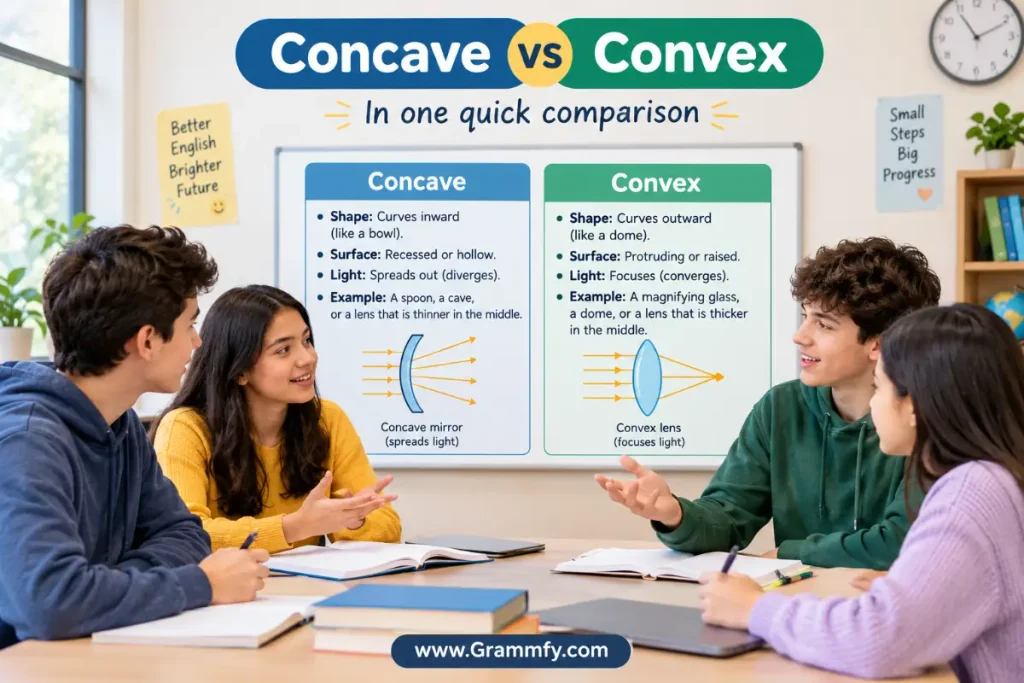
Conclusion
The easiest way to understand Concave vs Convex is to focus on direction. Concave describes an inward curve, while convex describes an outward curve. A cave, bowl, or dent can help you remember concave; a ball, bubble, or dome can remind you of convex.
These terms become more precise in geometry, optics, and calculus. A concave polygon has an inward indentation, while a convex polygon has none. In optics, concave and convex mirrors and lenses have different shapes and different effects on light. The best approach is to learn the basic inward-versus-outward rule first, then add the technical details for each subject.
Once you connect the words to familiar objects, the difference becomes much easier to spot and remember.
Frequently Asked Questions
What is the difference between concave and convex?
Concave means curved inward, while convex means curved outward. A bowl’s inside is a useful concave example, while the outside of a ball is convex.
Is concave inward or outward?
Concave means inward. Think of a cave or the inside of a bowl to remember the direction.
Is convex inward or outward?
Convex means outward. A ball, bubble, or dome provides an easy visual example.
What’s another way to say concave?
You can describe a concave shape as inward-curving, hollowed, indented, recessed, or bowl-shaped, depending on the context. These aren’t perfect synonyms, so use concave when you need precise geometry terminology.
What’s another way to say convex?
You can describe a convex shape as outward-curving, bulging, dome-shaped, or protruding, depending on the situation. Convex remains the more precise technical term.
How can I remember Concave vs Convex quickly?
Remember “concave = cave = inward” and “convex = bulging outward.” The cave-and-ball trick is useful for quick recall.
Is a bowl concave or convex?
The inside of a bowl is concave because it curves inward. The outside surface of the same bowl can be convex where it bulges outward.

Tylerbrooks is a US-based English grammar writer and contributor at Grammfy. He writes helpful articles about grammar, spelling, commonly confused words, and vocabulary. His goal is to explain English topics in simple language with clear examples and practical tips. Through his articles, he helps readers improve their writing and everyday English skills.