
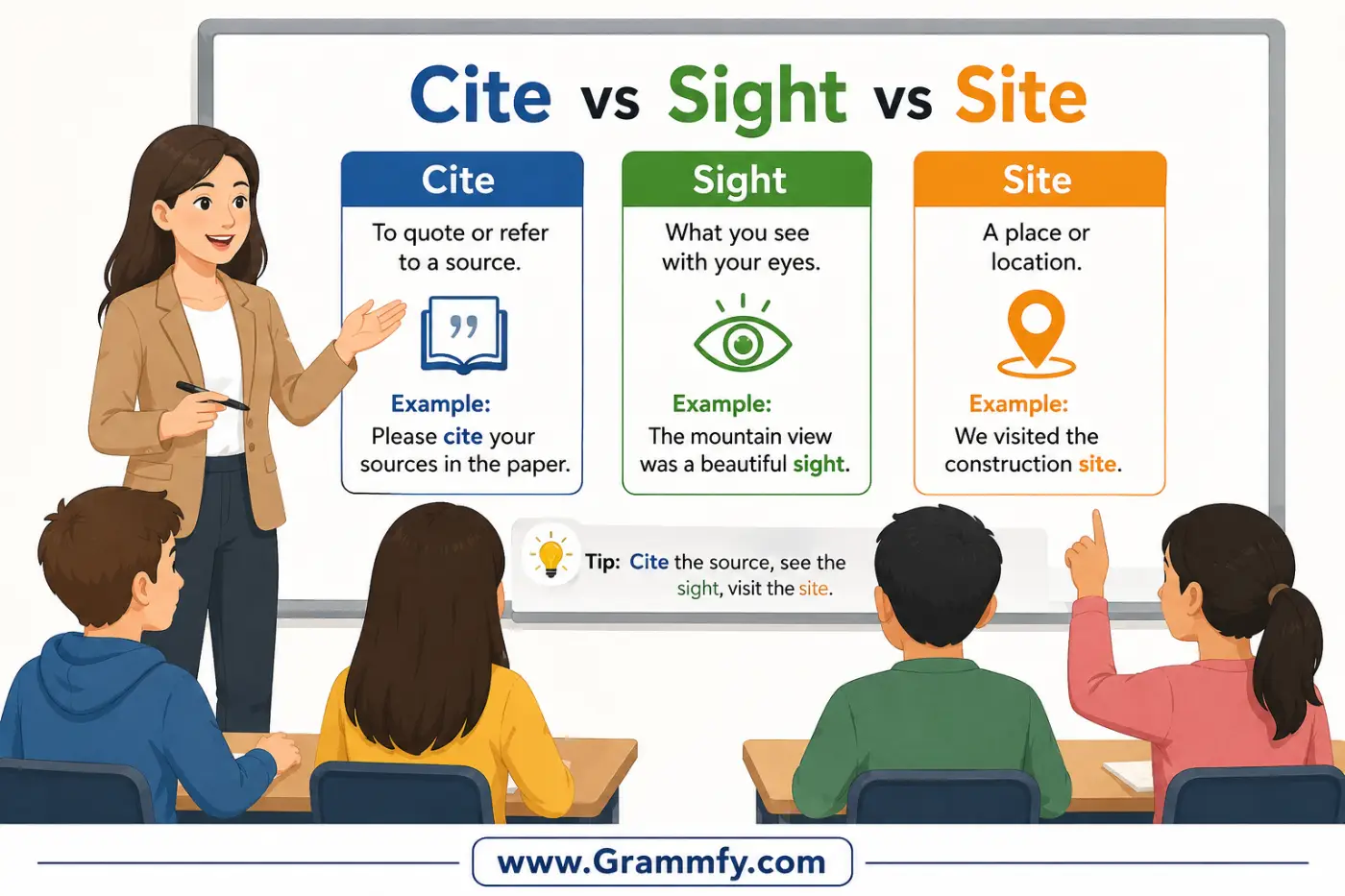
If you’re writing an email, essay, resume, text, or school assignment, you may pause when you need to choose between Cite vs Sight vs Site. They sound almost the same, but their meanings are completely different. Knowing which spelling to use can make your writing much clearer.
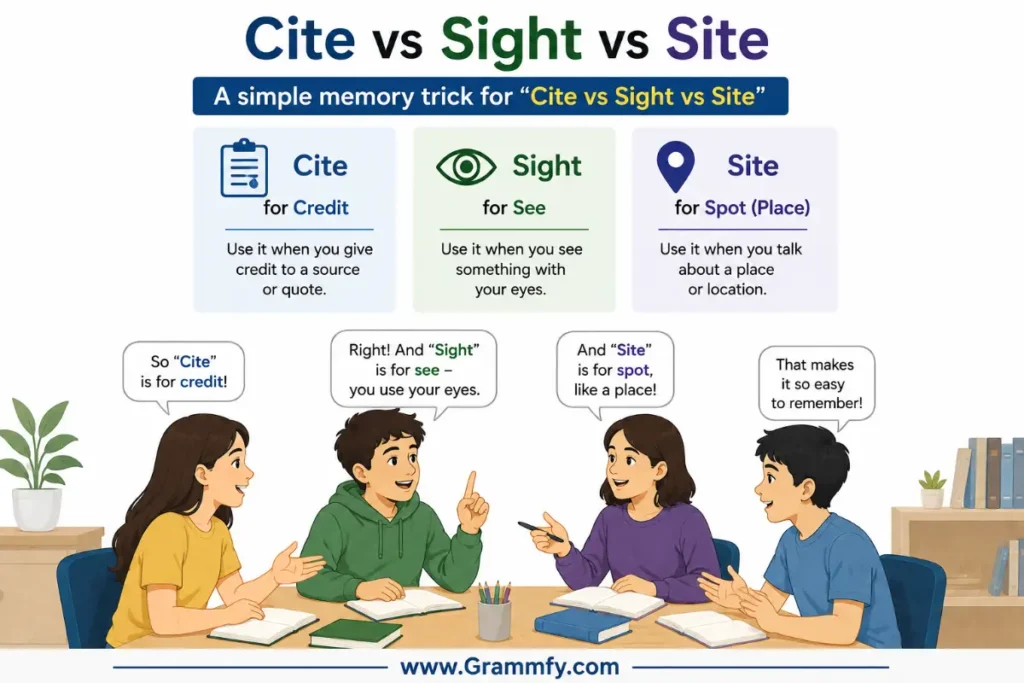
The easiest way to remember cite vs sight vs site. is to connect each word with its main meaning. Cite means to mention or refer to a source. Sight relates to seeing or something you see. Site means a place or location.
Answer: Cite means to refer to a source or give an example, sight means the ability to see or something seen, and site means a place or location.
This guide breaks down their meanings, origins, synonyms, grammar, common mistakes, real-world examples, and the best choice for different types of writing. You’ll also get quick memory tricks and practice examples.
For a closer look at another confusing word pair, explore [every day vs everyday].
What is the difference between “Cite vs Sight vs Site”?
The main difference is meaning and grammatical function.
| Word | Basic meaning | Common use | Example |
|---|---|---|---|
| Cite | Refer to a source or give an example | Writing and research | Please cite your sources. |
| Sight | Seeing or something seen | Vision and observation | The mountain was a beautiful sight. |
| Site | A place or location | Physical places and websites | The construction site is closed. |
These words are homophones. That means they sound alike or nearly alike but have different spellings and meanings.
Consider these three sentences:
Please cite the article in your essay.
The doctor tested my sight.
The company chose a new site for its office.
The pronunciation may be similar, but the meaning changes completely.
What does cite mean in plain English?
Cite means to mention, point to, or refer to something as evidence or support.
You will often see this word in:
- Essays
- Research papers
- Academic writing
- Legal writing
- News articles
- Reports
- Professional documents
For example:
You should cite the book you used for your research.
This means you should identify the book as a source.
Cite can also mean to mention someone or something as an example.
The teacher cited the student as an example of excellent work.
It can also be used in legal contexts:
The officer cited the driver for speeding.
Here, the meaning is different again. The officer officially issued a citation or violation notice.
Common forms of cite
| Form | Example |
|---|---|
| Cite | Please cite the source. |
| Cites | The article cites three studies. |
| Cited | She cited the report. |
| Citing | He is citing several sources. |
| Citation | Add a citation after the quote. |
The noun citation is especially common in academic writing.
The professor asked for a citation.
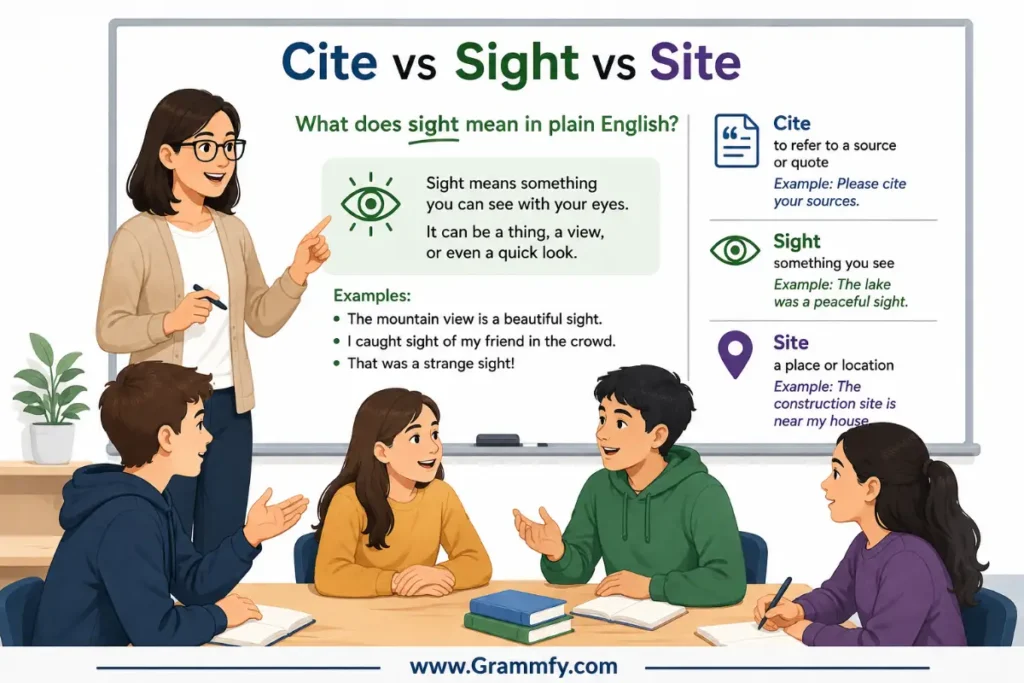
What does sight mean in plain English?
Sight is connected to seeing.
It can refer to:
- The ability to see.
- Something that is seen.
- The act or experience of seeing.
- A view or visual scene.
- A person or thing that comes into view.
For example:
My sight has improved.
Here, “sight” means the ability to see.
But:
The waterfall was an amazing sight.
Here, “sight” means something impressive that you can see.
Common expressions with sight
English has many expressions containing sight.
- in sight
- out of sight
- at first sight
- lose sight of
- catch sight of
- within sight
- a beautiful sight
- a shocking sight
- sight unseen
Examples:
The finish line is finally in sight.
I caught sight of my friend across the room.
She fell in love with the painting at first sight.
What does site mean in plain English?
Site means a place or location where something exists, happens, or is built.
Common examples include:
- construction site
- work site
- archaeological site
- school site
- campsite
- building site
- website
- historical site
- accident site
For example:
Workers arrived at the construction site early.
The word can refer to a physical location:
The company bought a site for its new headquarters.
It can also refer to a digital location:
I found the information on a government site.
Site and website
One of the most common modern uses of site is in website.
A website is a location on the internet where information, services, pages, or other digital content can be found.
Visit the company website for more information.
You may also hear people shorten “website” to “site”:
I found it on that site.
In this context, site still means a place, but the place is digital rather than physical.
Why are “Cite vs Sight vs Site” so easy to confuse?
The biggest reason is pronunciation.
Cite, sight, and site are homophones in standard American English. They sound the same even though they have different spellings.
This creates a special problem when you’re learning English. You can often hear the correct word but can’t determine the spelling from sound alone.
That’s why meaning is more useful than pronunciation.
Think of the three words as three different mental pictures:
- Cite → source
- Sight → eyes
- Site → place
If you remember those three ideas, the spelling becomes much easier.
Where did “Cite vs Sight vs Site” come from?
The three words have different histories even though their modern pronunciation is similar.
Origin of cite
Cite comes from Latin roots related to calling, summoning, or bringing forward. English adopted the word through French and developed its modern meanings around referring to something or someone.
That history connects naturally with the modern idea of citing a source: you’re calling attention to a source and telling your reader where information came from.
The related noun citation is used for a reference to a source.
Origin of sight
Sight comes from Old English siht, which was related to seeing and vision.
Its history is directly connected to the human sense of vision.
That’s why modern expressions such as these all involve seeing:
- sight
- eyesight
- foresight
- hindsight
- insight
Although these words have developed different meanings, they all retain a connection to seeing, either literally or figuratively.
Origin of site
Site comes through French from Latin situs, connected with position or location.
Its basic idea has remained stable: a particular place or position.
That’s why we use site for locations such as:
- building sites
- historical sites
- websites
- research sites
- accident sites
The origins are different, even though the words eventually came to share a pronunciation.
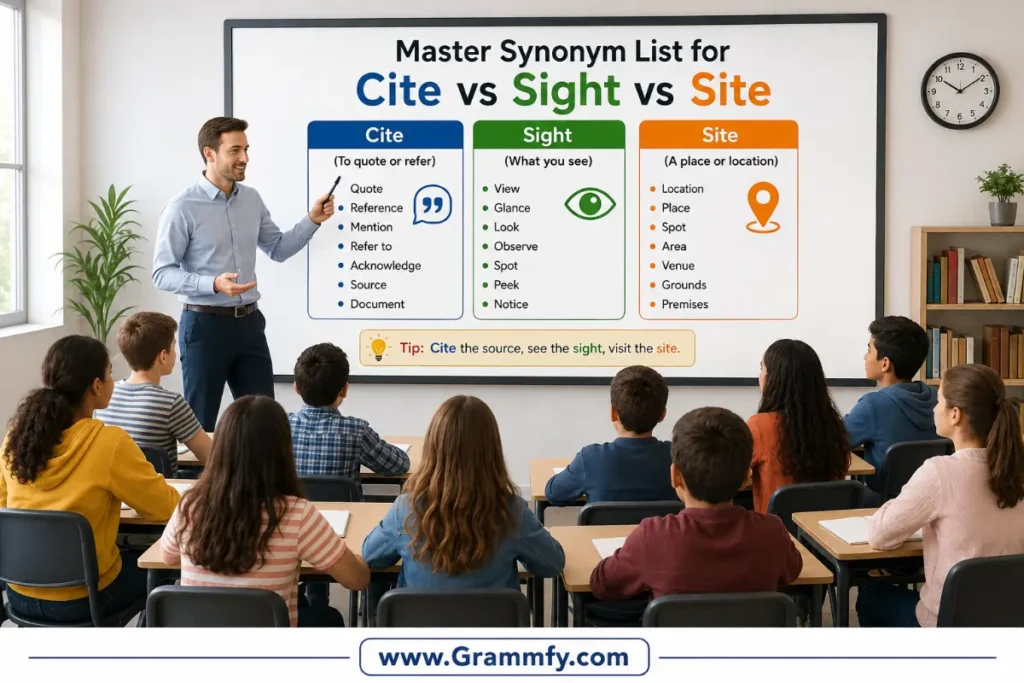
Master synonym list for “Cite vs Sight vs Site”
There isn’t one single synonym list for all three words because each has a different meaning. The following groups show useful related words and phrases for each meaning.
Simple synonyms and related words
| Word | Meaning | Tone | Example |
|---|---|---|---|
| Refer | Point to something | Neutral | The author refers to a study. |
| Mention | Say or write about something | Neutral | She mentioned the report. |
| Quote | Repeat someone’s exact words | Neutral | He quoted the researcher. |
| Name | Identify someone or something | Simple | The article names its sources. |
| Source | Where information comes from | Neutral | Check the source. |
| View | What someone sees | Neutral | We had a great view. |
| Vision | Ability to see | Neutral | His vision is clear. |
| Look | Direct your eyes toward something | Simple | Take a look outside. |
| See | Notice with your eyes | Simple | I can see the mountain. |
| Scene | Something visible in a place | Neutral | It was a strange scene. |
| Place | A particular location | Simple | This is a quiet place. |
| Location | A particular position | Neutral | Send me the location. |
| Area | A particular part of a place | Neutral | The area is closed. |
| Spot | A particular place | Casual | This is a good spot. |
| Position | Where something is located | Neutral | Mark the position on the map. |
Everyday alternatives and related expressions
| Word | Meaning | Tone | Example |
|---|---|---|---|
| Point to | Direct attention to something | Everyday | She pointed to the chart. |
| Mention | Briefly talk about something | Everyday | He mentioned the study. |
| Refer to | Direct attention to a source or idea | Neutral | The writer refers to the report. |
| Look at | Direct your eyes toward something | Everyday | Look at that view. |
| View | What can be seen | Everyday | The hotel has a great view. |
| Scene | A visible situation or setting | Everyday | The scene was surprising. |
| Place | A location | Everyday | We found a quiet place. |
| Spot | A particular location | Casual | Meet me at that spot. |
| Location | A specific place | Neutral | Share your location. |
| Website | An online location | Everyday | Visit the website. |
Formal alternatives
| Word | Meaning | Tone | Example |
|---|---|---|---|
| Reference | Point to a source or idea | Formal | The report references recent data. |
| Document | Provide written evidence | Formal | The records document the change. |
| Attribute | Identify a source or author | Formal | The quote is attributed to the researcher. |
| Substantiate | Support a claim with evidence | Formal | The data substantiate the claim. |
| Corroborate | Confirm with additional evidence | Formal | The second study corroborates the finding. |
| Evidence | Information supporting a claim | Formal | The evidence supports the conclusion. |
| Observation | Something noticed or recorded | Formal | The observation was recorded carefully. |
| Location | A specific place | Formal/Neutral | The location was documented. |
| Premises | A building and its surrounding property | Formal | Visitors must leave the premises. |
| Venue | A place where an event occurs | Formal | The venue is near downtown. |
Casual and slang-related expressions
| Word/Phrase | Meaning | Tone | Example |
|---|---|---|---|
| Give a shout-out | Mention or praise someone publicly | Casual | She gave the team a shout-out. |
| Point out | Draw attention to something | Casual | He pointed out the mistake. |
| Check out | Look at or visit something | Casual | Check out this website. |
| Take a look | Look at something | Casual | Take a look at this photo. |
| Hangout spot | Place where people spend time | Casual | That’s our favorite hangout spot. |
| Hot spot | Popular place | Casual | It’s a popular tourist hot spot. |
| Look | A visual appearance or view | Casual | Take a look at this. |
| Go-to spot | Favorite or reliable place | Casual | This is my go-to spot for coffee. |
These aren’t interchangeable with cite, sight, or site in every sentence. They are related vocabulary choices that can help you avoid repetition or express a more precise idea.
Synonyms by intensity: mild to strong
Word choice can change the strength of a sentence.
For citing information
A rough scale might look like this:
Mention → refer to → cite → quote → substantiate → corroborate
These words have different functions.
- Mention: briefly talk about something.
- Refer to: direct attention toward something.
- Cite: identify a source or example.
- Quote: reproduce someone’s exact words.
- Substantiate: provide evidence that supports a claim.
- Corroborate: confirm something with additional evidence.
For example:
The article mentions climate research.
This is weaker and less specific than:
The article cites three climate studies.
And that differs from:
The article quotes a climate scientist.
For visual experiences
You can move from a neutral description toward stronger emotional language:
View → sight → scene → spectacle
- A view is what you can see.
- A sight is something seen, often with emphasis.
- A scene is a visible setting or situation.
- A spectacle is an impressive or unusual sight.
Example:
We enjoyed the view.
The fireworks were an amazing sight.
The accident created a disturbing scene.
The festival was a spectacular spectacle.
For locations
Location words can also have different levels of specificity:
Place → spot → area → location → site → premises
Each word has a slightly different use.
- Place is broad and natural.
- Spot often means a particular place.
- Area means a broader region.
- Location focuses on where something is.
- Site often refers to a place connected to an activity, building, event, or purpose.
- Premises usually refers to a building and its property.
Synonyms by part of speech
Understanding grammar helps you choose a replacement correctly.
Verbs related to cite
Cite is a verb.
Related verbs include:
- mention
- refer to
- quote
- identify
- acknowledge
- document
- reference
- attribute
- point out
- support
Example:
The student cited two books.
You could rewrite it as:
The student referenced two books.
or:
The student mentioned two books.
However, “cited” is more precise in an academic context.
Nouns related to sight
Sight is usually a noun.
Related nouns include:
- vision
- view
- scene
- appearance
- spectacle
- observation
- glimpse
- image
Examples:
The mountain was a beautiful sight.
We had a wonderful view.
She caught a glimpse of the bird.
Nouns related to site
Site is primarily a noun.
Related nouns include:
- place
- location
- spot
- area
- venue
- position
- premises
- grounds
- property
Examples:
The building site is near the river.
The event venue is downtown.
We need a new location for the office.
When should you use cite in a resume?
Use cite carefully on a resume. It’s most useful when describing research, documentation, or evidence-based work.
Resume example
Cited industry reports to support quarterly market analysis.
This sounds natural because the action involves identifying sources.
Other strong options include:
- Referenced industry data in client reports.
- Documented findings from customer research.
- Analyzed and cited relevant market studies.
- Supported recommendations with published research.
- Referenced official records when preparing reports.
If you’re describing ordinary work, cite may not be the right verb.
Instead of:
Cited customer requests.
you may actually mean:
Documented customer requests.
Choosing the exact verb makes a resume more credible.
When should you use sight in a resume?
Sight is less common on a resume unless the job involves vision, visual inspection, photography, design, security, aviation, or another visual field.
Examples:
Performed visual inspections to identify defects.
Maintained accurate visual records of product conditions.
Instead of forcing the noun sight into professional writing, use more specific terms such as visual inspection, observation, or vision when appropriate.
When should you use site in a resume?
Site is common in resumes for construction, engineering, IT, logistics, real estate, manufacturing, and field work.
Examples:
Managed daily operations at three construction sites.
Conducted safety inspections across multiple work sites.
Coordinated site deliveries and contractor schedules.
Provided on-site technical support.
Here, site is useful because it clearly refers to a physical location where work takes place.
When should you use cite in an essay?
Cite is extremely common in essays, especially research and academic writing.
For example:
Researchers have found similar results in recent studies (Smith, 2025).
The exact citation style depends on your assignment. Your teacher may require APA, MLA, Chicago, or another format.
You can also use the verb directly:
Smith cites several studies to support this argument.
A strong essay doesn’t cite sources just to add citations. Sources should support specific claims, facts, quotations, or ideas.
When should you use sight in an essay?
Sight works naturally when you’re discussing vision, observation, literature, description, or imagery.
Examples:
The character loses his sight after the accident.
The author describes the city as a frightening sight.
At first sight, the house appears abandoned.
In literary analysis, “sight” can also have a symbolic meaning connected to knowledge, awareness, or perception.
When should you use site in an essay?
Use site when writing about a physical or digital location.
Examples:
Archaeologists discovered artifacts at the ancient site.
The website became an important research site for the project.
The company selected the site because it was close to major roads.
Don’t use site just because you mean “place” in a general sense. Sometimes place, location, or setting is more natural.
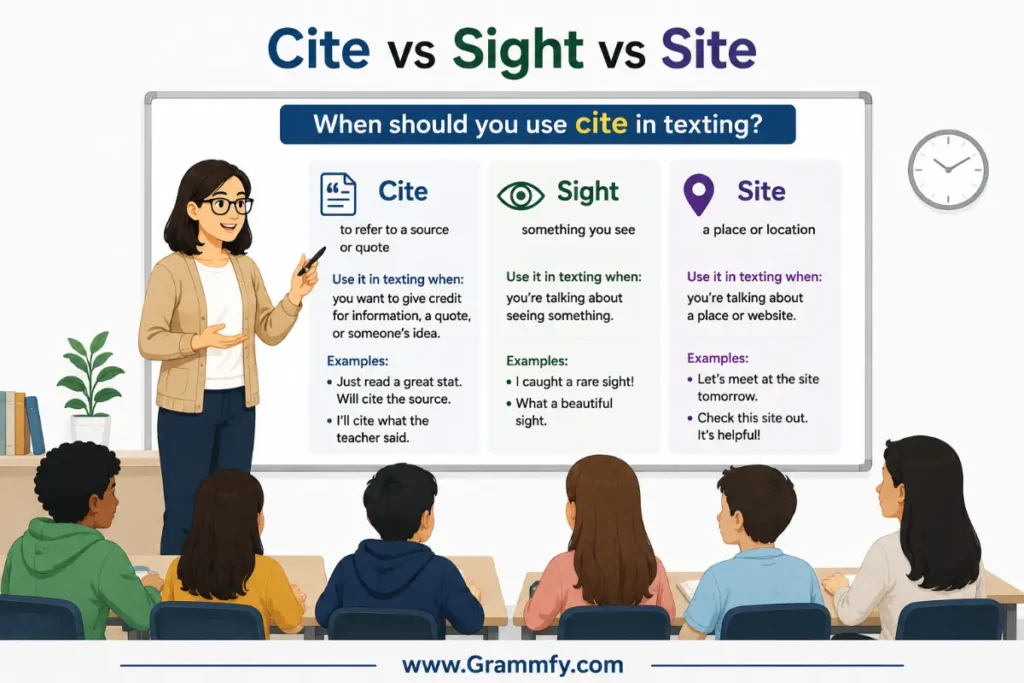
When should you use cite in texting?
In casual texting, cite is usually related to sources, references, or formal situations.
For example:
Can you cite where you got that statistic?
Or:
I need to cite this article for my homework.
In casual conversation, people may say:
Where did you get that information?
That’s often more natural than:
What source can you cite?
The right choice depends on the situation.
When should you use sight in texting?
Sight is common in casual messages when talking about something visible.
What a beautiful sight!
I caught sight of him at the store.
The sunset was an amazing sight.
You may also use the phrase out of sight:
Keep the snacks out of sight!
When should you use site in texting?
Site commonly appears in texts about locations or websites.
What’s the site address?
I’ll send you the website.
Meet me at the work site.
In casual texting, “website” is often clearer when you mean an online platform.
When should you use cite in an email?
Use cite when you’re asking someone to identify or refer to a source.
Please cite the source for this statistic.
Could you cite the study you mentioned?
I’ve cited the relevant reports below.
In a professional email, reference can sometimes sound more natural:
Please reference the attached report.
But don’t treat reference and cite as perfect substitutes. Academic citation has a specific meaning.
When should you use sight in an email?
Use sight when you’re describing something seen or discussing vision.
The mountain was a beautiful sight from the office.
The patient reported changes in her sight.
For professional communication, more precise terms may be better.
For example, a medical context may prefer vision rather than sight, depending on the situation.
When should you use site in an email?
Use site when discussing a location, especially a work or project location.
The equipment will arrive at the site tomorrow.
Please confirm the site address.
The team will visit the construction site on Monday.
For websites, website is often clearer:
Please visit our website for the latest information.
When should you use these words in speaking “Cite vs Sight vs Site”?
In spoken English, pronunciation doesn’t help much because all three words sound alike.
Instead, listen to the context.
For English learners, this is an important reminder: homophones have to be understood through context when you’re listening.
15+ original example sentences across real situations “Cite vs Sight vs Site”
Here are examples that show the three words in different settings.
Academic situations
- Students must cite every source used in the research paper.
- The professor asked us to cite the original study.
- At first sight, the painting looks simple.
- The ancient archaeological site attracts thousands of visitors.
Workplace situations
- Please cite the report that supports this number.
- The manager asked the team to document and cite its sources.
- The new office site is closer to public transportation.
- Workers must wear helmets while they are on the construction site.
Travel situations
- The Grand Canyon was an unforgettable sight.
- We visited a historical site during our trip.
- The guide cited several facts about the ancient city.
Technology
- I found the information on the company’s official site.
- The researcher cited data from several online sources.
- The error was difficult to detect at first sight.
Everyday conversations
- What a beautiful sight!
- I’ll send you the site where I found those tickets.
- Can you cite your source for that claim?
- The old building is a strange sight at night.
- The team chose the empty lot as the project site.
- The article cites several experts.
Legal and official contexts
- The officer cited the driver for violating the speed limit.
- The historical site is protected by law.
- The document cites the relevant regulation.
Cite vs quote: what’s different?
Cite and quote are related, but they aren’t the same.
| Cite | Quote |
|---|---|
| Identifies or refers to a source | Repeats someone’s exact words |
| Can involve paraphrased information | Usually uses the original wording |
| Common in research writing | Common when exact wording matters |
| Example: Cite the study | Example: Quote the researcher |
For example:
The study shows that sleep affects memory (Smith, 2025).
This is information from a source, so you cite the study.
But:
Smith writes, “Sleep plays a major role in memory.”
This is a direct quotation, so you quote the author’s exact words and cite the source.
You can quote and cite the same source, but the actions are different.
Sight vs vision: what’s different?
Sight and vision overlap, but they can have different uses.
| Sight | Vision |
|---|---|
| Ability to see or something seen | Ability to see, or a planned idea |
| Often common in everyday expressions | Common in medical and professional contexts |
| A beautiful sight | Poor vision |
| Out of sight | Vision test |
| At first sight | Long-term vision |
Examples:
My sight is getting better.
My vision is getting better.
Both can work in some contexts, but vision is often preferred when discussing eyesight medically.
“Vision” also has a completely different figurative meaning:
The company has a clear vision for the future.
You couldn’t normally replace that with sight.
Site vs location: what’s different?
Site and location are close, but their uses aren’t identical.
| Site | Location |
|---|---|
| Often connected to a specific purpose or activity | General word for where something is |
| Construction site | Office location |
| Archaeological site | Exact location |
| Work site | Store location |
| Website | GPS location |
For example:
The company chose a new site for the factory.
This suggests a place selected for development or a specific purpose.
The company’s new location is downtown.
This simply identifies where the company is located.
Common mistakes with cite
Mistake: confusing cite with site
Incorrect:
Please site your sources.
Correct:
Please cite your sources.
The word is cite because you’re referring to sources.
Mistake: confusing cite with quote
Not every citation is a quotation.
You can cite a source without copying its exact words.
Mistake: using citation as a verb
Incorrect:
Please citation this source.
Correct:
Please cite this source.
Citation is a noun.
Common mistakes with sight
Mistake: confusing sight with site
Incorrect:
The mountain was an amazing site.
Correct:
The mountain was an amazing sight.
You’re talking about something you saw.
Mistake: using sight when you mean website
Incorrect:
Check our sight for details.
Correct:
Check our site for details.
Or, even clearer:
Check our website for details.
Mistake: forgetting fixed expressions
Some phrases specifically use sight:
- at first sight
- in sight
- out of sight
- lose sight of
- catch sight of
Changing the spelling changes the meaning.
Common mistakes with site
Mistake: writing sight for a website
Incorrect:
Visit our sight.
Correct:
Visit our site.
Or:
Visit our website.
Mistake: using site for a visual experience
Incorrect:
The sunset was a beautiful site.
Correct:
The sunset was a beautiful sight.
Mistake: using cite for a location
Incorrect:
The construction cite is closed.
Correct:
The construction site is closed.
The construction location is a site.
When should you not use cite?
Don’t use cite when you simply mean “see” or “look at.”
Incorrect:
Cite the beautiful sunset.
Unless you’re talking about a source, citation, or formal reference, cite is probably wrong.
Use:
Look at the beautiful sunset.
or:
See the beautiful sunset.
Don’t use cite just because it sounds like sight or site.
When should you not use sight?
Don’t use sight when you mean a location.
Incorrect:
We chose the best sight for the new building.
If you’re talking about a place where the building will be constructed, use:
We chose the best site for the new building.
But if you’re talking about the view from the building, sight may be correct:
The view from the new building is an amazing sight.
When should you not use site?
Don’t use site when you mean a source reference.
Incorrect:
You need to site this journal article.
Correct:
You need to cite this journal article.
Also don’t use site when you mean something visually impressive:
The fireworks were an incredible sight.
Antonyms for cite, sight, and site
These words don’t all have simple one-word antonyms, but useful contrasts exist.
Opposites related to cite
If cite means to refer to or mention, possible contrasts include:
- omit
- ignore
- exclude
- conceal
- leave out
Example:
The report omitted several important sources.
Opposites related to sight
If sight means the ability to see, contrasts can include:
- blindness
- darkness
- obscurity
If sight means something visible, a contrast might be:
- invisibility
- hiddenness
- concealment
Opposites related to site
Because site means a location, it doesn’t have one exact antonym. Depending on the sentence, you might contrast it with:
- nowhere
- absence of location
- displacement
- relocation
For example:
The equipment was removed from the site.
Here, removal is the relevant contrast rather than a direct antonym.
A quick decision guide
When you see a sentence with a blank, ask what idea you’re trying to express.
| If you mean… | Choose |
|---|---|
| Refer to a source | Cite |
| Give a source reference | Cite |
| Mention evidence | Cite |
| See something | Sight |
| Ability to see | Sight |
| Something impressive to see | Sight |
| A physical location | Site |
| A construction location | Site |
| An archaeological location | Site |
| An internet location | Site |
This makes cite vs sight vs site. much easier to remember.
A simple memory trick for “Cite vs Sight vs Site”
Try these three associations:
Cite = Citation
Think:
Cite → citation → source
If you’re talking about a book, article, study, quote, or evidence, think cite.
Sight = See
Think:
Sight → see → eyes
If you’re talking about vision, views, or something you can see, think sight.
Site = Spot
Think:
Site → spot → place
If you’re talking about a location, think site.
So the shortcut is:
Cite = source
Sight = see
Site = place
How to proofread these words in your writing “Cite vs Sight vs Site”
Because spellcheck may not catch these errors, you need to proofread by meaning.
A spellchecker can see that sight, site, and cite are all correctly spelled words. It may not know that you’ve chosen the wrong one.
When proofreading, search for each word and ask:
- Am I talking about a source?
- Am I talking about seeing?
- Am I talking about a location?
For example:
Please site your sources.
Ask: Is this about a location?
No.
It’s about references.
Change it to:
Please cite your sources.
This type of proofreading catches homophone mistakes that ordinary spellcheck can miss.
How context changes the correct word
Context is especially important with homophones.
Consider:
The researcher found the old site.
Here, site means location.
Now:
The researcher found the old sight.
This could mean the researcher saw something, but the sentence sounds incomplete or unusual.
And:
The researcher found the old cite.
This doesn’t normally make sense.
The surrounding words tell you what meaning is intended.
Another example:
The website contains the information.
Here, “website” clearly means an online location.
The website cites three studies.
Now cites means refers to sources.
One paragraph can naturally contain multiple forms because each word performs a different job.
What about “Cite vs Sight vs Site” in SEO writing?
For online content, all three words can appear naturally, but they shouldn’t be treated as interchangeable keywords.
For example:
The article cites several reliable sources.
The historical site attracts visitors.
The mountain is an impressive sight.
Each sentence targets a different meaning.
This distinction matters because readers want useful information, not repeated variations of the same word. Clear semantic relationships also make content easier to understand.
If you’re writing a glossary, grammar article, or educational page, define each word clearly and then show it in context.
What about these words in AI and voice search?
Voice search makes homophones especially interesting because speech recognition may hear cite, sight, and site as the same sound.
That’s why answers should make the meaning explicit.
For example, if someone asks:
“What’s the difference between cite, sight, and site?”
A useful answer should immediately identify:
- Cite = refer to a source
- Sight = something seen or the ability to see
- Site = a location
This is also why clear headings, definitions, examples, and comparison tables are useful in educational content. They answer the user’s question directly instead of making the reader search through a long paragraph.
Practice quiz: choose cite, sight, or site
Try these sentences without looking at the answers.
- Please ______ the article you used.
- The waterfall was an incredible ______.
- The workers arrived at the construction ______.
- The paper ______ several recent studies.
- My ______ is getting worse.
- We chose the location as the project ______.
- The report ______ government statistics.
- The old castle was an impressive ______.
- Please visit our official ______.
- The student forgot to ______ the book.
Answers
- cite
- sight
- site
- cites
- sight
- site
- cites
- sight
- site
- cite
Why the answers work
The first, fourth, seventh, and tenth sentences involve sources or references, so they use cite.
The second, fifth, and eighth involve seeing or something visible, so they use sight.
The third, sixth, and ninth involve places or locations, so they use site.
A three-word cheat sheet
| Word | Think of | Remember |
|---|---|---|
| Cite | Source | Citation |
| Sight | Eyes | See |
| Site | Place | Location |
If you remember only one thing, remember this table.
Final proofreading checklist
Before publishing an essay, email, report, or web page, check each use.
- You’re referring to a source.
- You’re identifying evidence.
- You’re mentioning an authority.
- You’re giving an academic reference.
- You’re formally issuing a violation in certain legal contexts.
- You’re talking about seeing.
- You’re discussing eyesight.
- You’re describing something visible.
- You’re talking about a view or visual scene.
- You’re using expressions such as “at first sight.”
- You’re describing a location.
- You’re discussing construction.
- You’re referring to a historical or archaeological place.
- You’re talking about a work location.
- You’re referring to a website or online location.
Conclusion
The key to cite vs sight vs site. is to focus on meaning rather than sound. Cite belongs with sources, references, evidence, and formal mentions. Sight belongs with seeing, vision, views, and things that appear before your eyes. Site belongs with places, locations, construction areas, historical locations, and websites.
When you’re unsure, use the three-word memory trick: cite = source, sight = see, site = place. Then look at the words around the blank and ask what idea the sentence needs. This quick check works in essays, resumes, emails, texts, and professional documents. With a little practice, these homophones become much easier to distinguish, and your writing will be more precise without sounding complicated.
Frequently Asked Questions
What is the easiest way to remember cite, sight, and site?
Remember “cite = source, sight = see, and site = place.” These three associations cover most common uses.
What’s the difference between cite and site?
Cite means to refer to a source, while site means a place or location. For example, you cite a research paper, but you visit a construction site.
Is sight the same as vision?
Sight and vision can both refer to the ability to see, but vision is often more common in medical or technical contexts. Sight can also mean something that you see, such as a beautiful sight.
What’s another way to say cite?
“Refer to” and “reference” are common alternatives to cite. “Quote” is related but specifically suggests repeating someone’s exact words.
How do I know whether to use sight or site?
Use sight for seeing and site for a location. Think “sight = eyes” and “site = place.”
Is cite used only in academic writing?
No, cite is also used in legal, professional, journalistic, and general contexts. Its core idea is referring to or officially mentioning something.
Why do cite, sight, and site sound the same?
They are homophones in standard American English. Their spellings and meanings differ even though their pronunciation is the same.
