
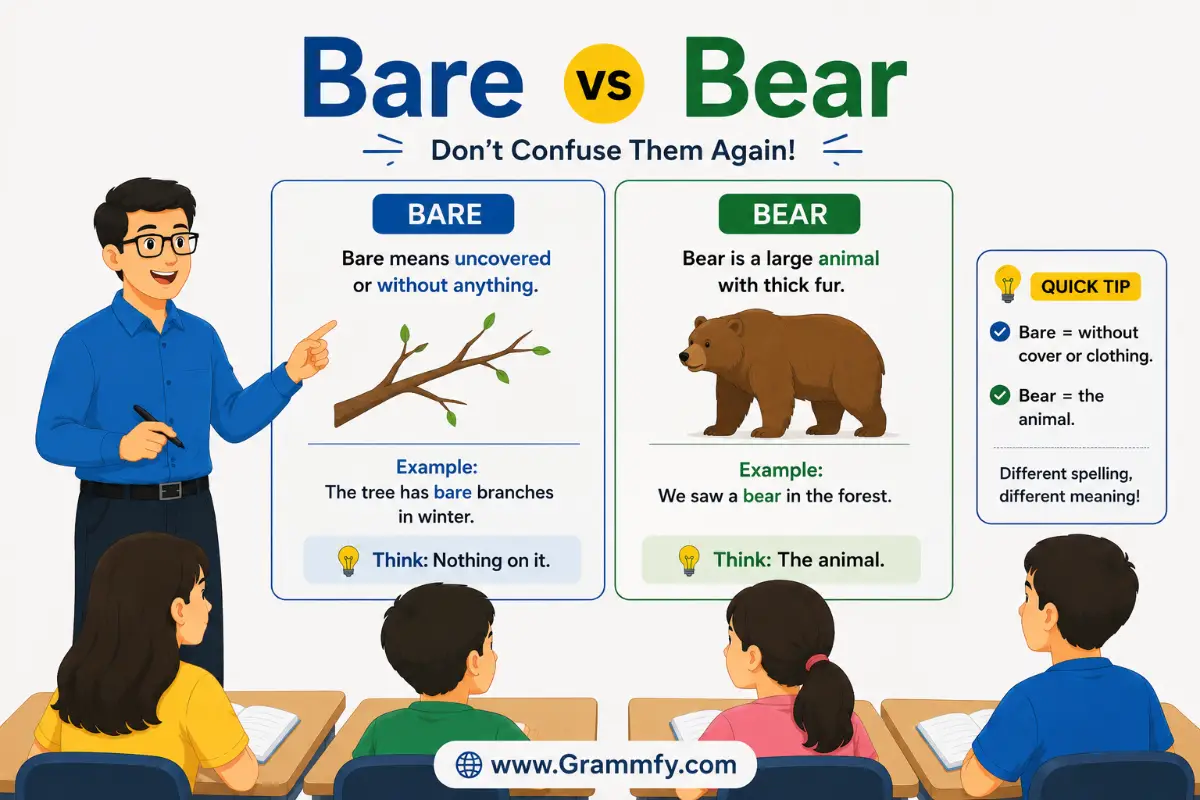
Have you ever stopped while writing an email, school paper, resume, or even a quick text because you couldn’t remember whether to write bare or bear? You’re not alone. These two words sound exactly the same, but they have very different meanings. That’s why bare vs bear is one of the most searched English grammar questions.
Many people mix them up because English has lots of homophones—words that sound alike but have different spellings and meanings. Once you learn the difference, though, choosing the right word becomes much easier.
Quick Answer:
Bare usually means uncovered, empty, or reveal. Bear usually means carry, endure, support, or the large wild animal. The spelling changes because the meanings are completely different.
In this guide, you’ll learn where these words came from, what they mean in plain English, how to remember the difference, common mistakes to avoid, dozens of synonyms, real-life examples, and the best word to use in different situations.
For more help with commonly confused words, check out [buy vs by vs bye].
What Does “Bare vs Bear” Mean?
The question bare vs bear is about choosing the correct word for your sentence.
Here’s the simple difference.
| Word | Main Meaning | Easy Memory Trick |
|---|---|---|
| Bare | Uncovered, empty, reveal | Think of bare feet with no shoes. |
| Bear | Carry, tolerate, support, produce, or the animal | Think of carrying a heavy load like a bear. |
Bare Meaning
The word bare usually describes something without a covering.
It can also mean revealing something that was hidden.
Examples:
- bare hands
- bare walls
- bare branches
- bare minimum
- bare facts
- bare your soul
Bear Meaning
The word bear is much more flexible. It can be a noun or a verb.
As a verb, it often means:
- carry
- support
- tolerate
- endure
- accept
- produce
As a noun, it means the large furry animal.
Examples:
- bear the weight
- bear responsibility
- can’t bear the pain
- bear children
- polar bear
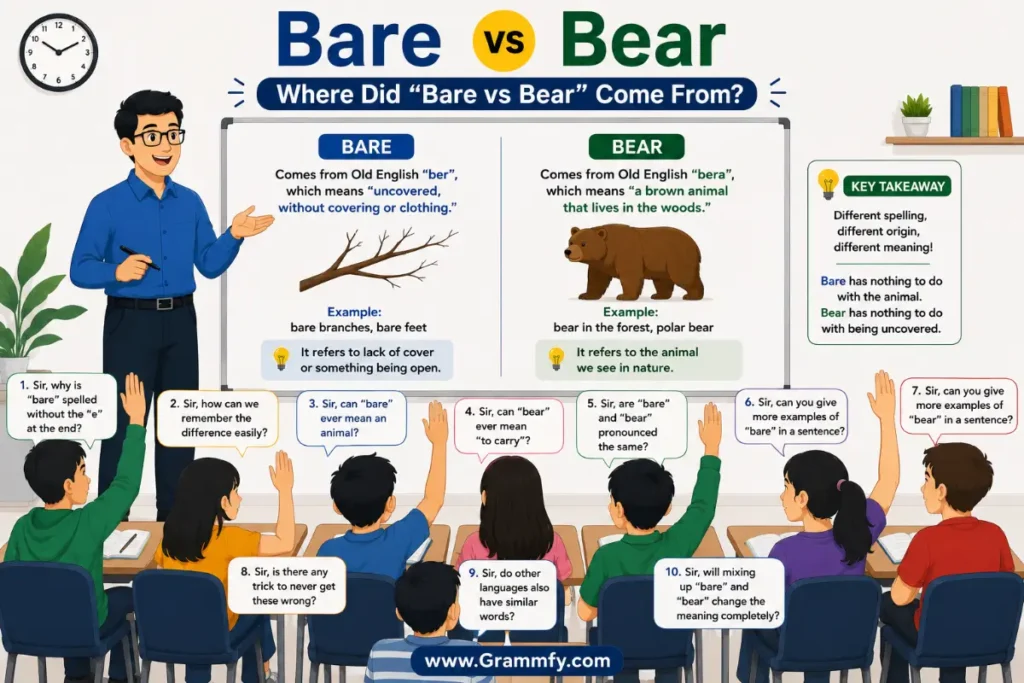
Where Did “Bare vs Bear” Come From?
Many grammar guides explain the meanings but skip the history. Knowing where these words came from makes them easier to remember.
Origin of Bare
The word bare comes from Old English bær. It meant uncovered, exposed, or without clothing.
That original meaning has stayed almost unchanged for hundreds of years.
Today, we still use it in phrases like:
- bare skin
- bare floor
- bare tree
- bare head
The idea is always something exposed or lacking a covering.
Origin of Bear
The verb bear comes from Old English beran, meaning “to carry” or “to bring.”
Over time, people started using it for carrying physical things as well as emotional burdens.
That’s why we say:
- bear responsibility
- bear the cost
- bear a child
- bear the burden
- bear witness
The animal name has a different historical origin, even though it shares the same spelling.
Bare Meaning in Plain English
Think of bare whenever something is uncovered, exposed, empty, or stripped down.
You can often replace it with words like:
- uncovered
- exposed
- empty
- plain
- simple
Common Expressions with Bare
- bare feet
- bare arms
- bare shoulders
- bare walls
- bare room
- bare branches
- bare minimum
- bare essentials
- bare facts
- bare hands
- bare ground
- bare skin
- lay bare the truth
- bare one’s feelings
Notice that every example relates to something being uncovered or revealed.
Bear Meaning in Plain English
Think of bear whenever someone carries something, survives something difficult, supports something, or accepts something.
Common Uses of Bear
Carry
- bear a load
- bear supplies
Support
- this bridge can bear heavy trucks
- the chair can bear your weight
Endure
- I can’t bear the noise.
- She bore the pain quietly.
Accept
- bear responsibility
- bear the blame
Produce
- apple trees bear fruit
- plants bear flowers
Animal
- black bear
- brown bear
- polar bear
Although these meanings seem different, they all connect back to the idea of carrying or producing.
Master Synonym List for Bare
The right synonym depends on what you mean. Here are many useful alternatives.
Simple and Everyday Synonyms
| Word | Meaning | Tone | Example |
|---|---|---|---|
| uncovered | not covered | Neutral | The table was uncovered. |
| open | not closed | Everyday | Leave the window open. |
| empty | without contents | Everyday | The room looked empty. |
| plain | simple | Everyday | She wore a plain shirt. |
| simple | not fancy | Everyday | We kept the design simple. |
| exposed | visible | Neutral | The wires were exposed. |
| clear | easy to see | Everyday | The path was clear. |
| visible | can be seen | Neutral | The damage was visible. |
| stripped | covering removed | Neutral | The walls were stripped. |
| natural | unchanged | Everyday | She likes a natural look. |
Formal Synonyms
| Word | Meaning | Tone | Example |
|---|---|---|---|
| reveal | show | Formal | The report revealed errors. |
| disclose | make known | Formal | They disclosed the results. |
| unveil | reveal publicly | Formal | The company unveiled its plan. |
| expose | make visible | Formal | The article exposed fraud. |
| uncover | discover | Formal | Workers uncovered ancient coins. |
| manifest | make obvious | Formal | His actions manifested confidence. |
| transparent | open and honest | Formal | The process was transparent. |
Casual or Informal Alternatives
| Word | Meaning | Tone | Example |
|---|---|---|---|
| open up | share feelings | Casual | He finally opened up. |
| show | reveal | Casual | Show me what happened. |
| strip down | remove extras | Casual | They stripped down the design. |
| peel back | reveal layers | Casual | The documentary peeled back the story. |
| lay out | explain clearly | Casual | She laid out the facts. |
Synonyms That Fit Specific Meanings
- exposed
- uncovered
- naked
- open
- stripped
- visible
- expose
- disclose
- unveil
- uncover
- present
- share
- reveal
- explain
- basic
- simple
- modest
- limited
- essential
- minimal
- plain
Master Synonym List for Bear
Since bear has several meanings, its synonyms depend on the context.
Carry or Support
| Word | Meaning | Tone | Example |
|---|---|---|---|
| carry | move something | Everyday | Carry the bag. |
| hold | support | Everyday | Hold the ladder. |
| support | keep up | Neutral | The beam supports the roof. |
| sustain | continue supporting | Formal | The system sustained growth. |
| transport | move | Formal | Trucks transport goods. |
| lift | raise | Everyday | Lift the box carefully. |
| shoulder | accept responsibility | Neutral | She shouldered the burden. |
| handle | manage | Everyday | He handled the task. |
Endure or Tolerate
| Word | Meaning | Tone | Example |
|---|---|---|---|
| endure | survive | Neutral | They endured the storm. |
| tolerate | accept | Formal | I can’t tolerate rude behavior. |
| survive | continue living | Everyday | Many families survived the flood. |
| withstand | resist | Formal | The wall withstood the wind. |
| accept | receive | Everyday | Accept the decision. |
| face | deal with | Everyday | Face the challenge. |
| cope with | manage | Everyday | She coped with stress well. |
| live with | accept | Casual | We learned to live with it. |
Produce
| Word | Meaning | Tone | Example |
|---|---|---|---|
| produce | make | Neutral | Trees produce fruit. |
| yield | create | Formal | The farm yielded wheat. |
| generate | create | Formal | Solar panels generate electricity. |
| provide | supply | Neutral | The project provided jobs. |
Animal-Related Words
These aren’t direct synonyms but related words.
- grizzly
- polar bear
- black bear
- brown bear
- cub
- wildlife
- mammal
- predator
Synonyms by Strength (Mild → Strong)
Sometimes you want a softer or stronger word than bear or bare.
| Mild | Medium | Strong |
|---|---|---|
| show | uncover | expose |
| mention | reveal | disclose |
| share | present | unveil |
| Mild | Medium | Strong |
|---|---|---|
| accept | tolerate | endure |
| manage | withstand | survive |
| face | cope with | overcome |
If You Mean “Simple”
| Mild | Medium | Strong |
|---|---|---|
| plain | simple | bare |
| modest | basic | stripped |
| ordinary | minimal | empty |
Synonyms by Part of Speech
Because bare and bear can play different roles in a sentence, it’s helpful to group their synonyms by part of speech.
Bare as an Adjective
| Synonym | Meaning | Example |
|---|---|---|
| uncovered | Without a cover | The floor was uncovered. |
| exposed | Open to view | Exposed wires are dangerous. |
| plain | Simple | She wore a plain dress. |
| empty | Without contents | The shelves looked empty. |
| stripped | Having coverings removed | The walls were stripped. |
| open | Not covered | The field remained open. |
| minimal | Only the essentials | We worked with minimal supplies. |
| simple | Not decorated | The design is simple. |
Bare as a Verb
| Synonym | Meaning | Example |
|---|---|---|
| reveal | Show | She revealed the truth. |
| uncover | Find or expose | Workers uncovered old ruins. |
| expose | Make visible | The report exposed mistakes. |
| disclose | Make known | The company disclosed the data. |
| unveil | Reveal publicly | They unveiled the new logo. |
Bear as a Verb
| Synonym | Meaning | Example |
|---|---|---|
| carry | Transport | Carry the groceries inside. |
| support | Hold up | The beam supports the roof. |
| endure | Put up with | She endured the long trip. |
| tolerate | Accept | I can’t tolerate loud music. |
| withstand | Resist | The building withstood the storm. |
| shoulder | Accept responsibility | He shouldered the blame. |
| manage | Handle | She managed the pressure well. |
| produce | Create | The tree produces apples. |
US vs. UK Usage Notes
Good news: there is almost no difference between American and British English when it comes to bare vs bear.
Both countries use the same spellings and meanings.
Examples used in both the US and UK include:
- bare feet
- bare minimum
- bear responsibility
- bear in mind
- can’t bear it
- bear the cost
The only differences you may notice are in writing style or vocabulary around these phrases, not in the words themselves.
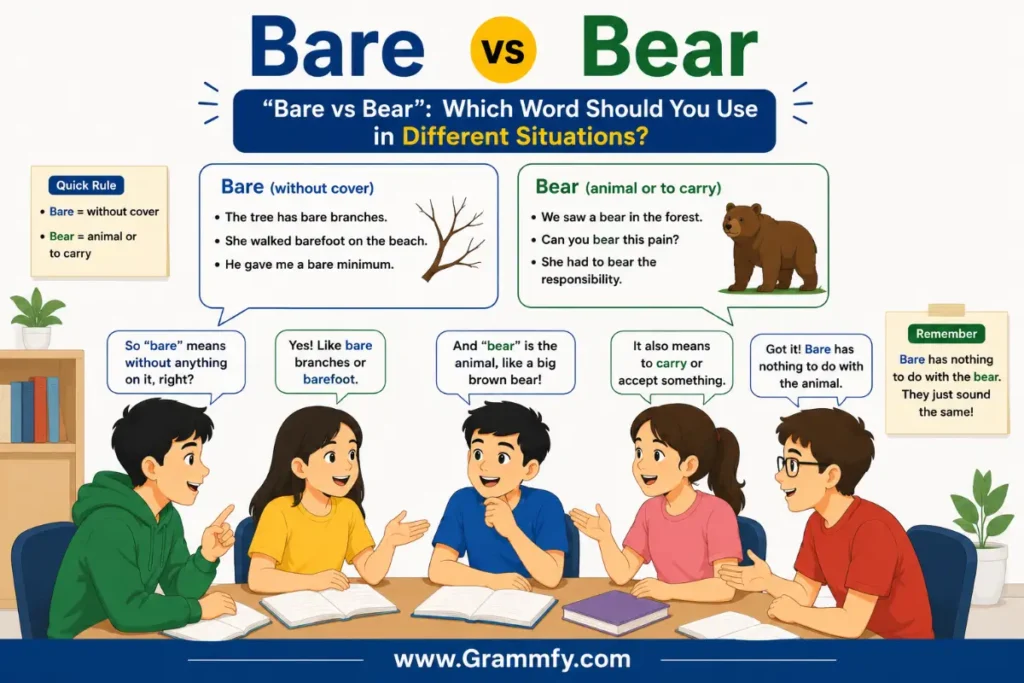
“Bare vs Bear”: Which Word Should You Use in Different Situations?
Choosing between bare and bear depends entirely on what you want to say.
Best Word for a Resume
Professional writing should always be clear.
Use bear when talking about responsibilities.
Example:
- I bore responsibility for managing a team of 20 employees.
Use bare only if you’re literally talking about something uncovered, which is uncommon in resumes.
Best Word for an Essay
Essays often use both words.
Examples:
- The evidence laid bare several problems.
- Citizens must bear the consequences of poor decisions.
Choose the word that matches the intended meaning rather than the sound.
Best Word for Emails
Emails usually need simple language.
Examples:
- Please bear with us while we fix the issue.
- The investigation will bear results next month.
- The room was left bare after the move.
Short, direct sentences help avoid confusion.
Best Word for Text Messages
In casual texts, people often type quickly and make spelling mistakes.
Correct examples:
- I can’t bear waiting any longer.
- I’m walking around with bare feet.
- Please bear with me for five minutes.
Autocorrect doesn’t always catch the mistake because both words are real.
Best Word When Speaking
Since the words sound identical, listeners rely on context.
For example:
“I can’t bear this.”
Everyone understands you’re talking about tolerating something, not an uncovered object.
When writing, however, spelling matters.
Original Example Sentences “Bare vs Bear”
Here are real-life examples showing each word in context.
- The children ran across the beach with bare feet.
- The trees stood bare after winter ended.
- Please bear with us during the software update.
- I can’t bear listening to that alarm every morning.
- She bore the responsibility with confidence.
- The bridge can bear thousands of cars every day.
- The report laid bare several financial mistakes.
- He carried the heavy box with his bare hands.
- Apple trees bear fruit every autumn.
- The room looked bare after we moved the furniture.
- The hikers spotted a black bear near the trail.
- Parents often bear many responsibilities for their children.
- The detective uncovered facts that laid bare the truth.
- This shelf cannot bear much weight.
- Even on cold mornings, he preferred to walk with bare feet.
Bare vs Naked — What’s the Difference?
These words are close in meaning, but they aren’t always interchangeable.
| Bare | Naked |
|---|---|
| Means uncovered in general. | Usually refers to a person without clothing. |
| Often used for objects. | Mostly used for people or animals. |
| Sounds more neutral. | Can sound more personal or emotional. |
Examples:
- bare walls ✔
- bare trees ✔
- naked trees ✘
- naked child ✔
- bare child ✔ (less common)
Think of bare as the broader word.
Endure vs Bear — What’s the Difference?
These words overlap but aren’t identical.
| Bear | Endure |
|---|---|
| Can mean tolerate, carry, or support. | Mainly means survive or tolerate hardship. |
| Has several meanings. | Focuses on difficult experiences. |
| Common in everyday English. | Slightly more formal. |
Examples:
“I can’t bear the noise.”
This sounds natural in conversation.
“I endured the noise.”
This emphasizes lasting through the experience.
Carry vs Bear — What’s the Difference?
Many learners wonder whether these words always mean the same thing.
| Carry | Bear |
|---|---|
| Usually means physically move something. | Can mean carry physically or emotionally. |
| Very common in daily speech. | Often appears in formal or written English. |
Compare these examples:
- Carry the groceries inside.
- Bear the burden of leadership.
The first is literal.
The second is often emotio
These mistakes appear often in emails, essays, and social media posts.
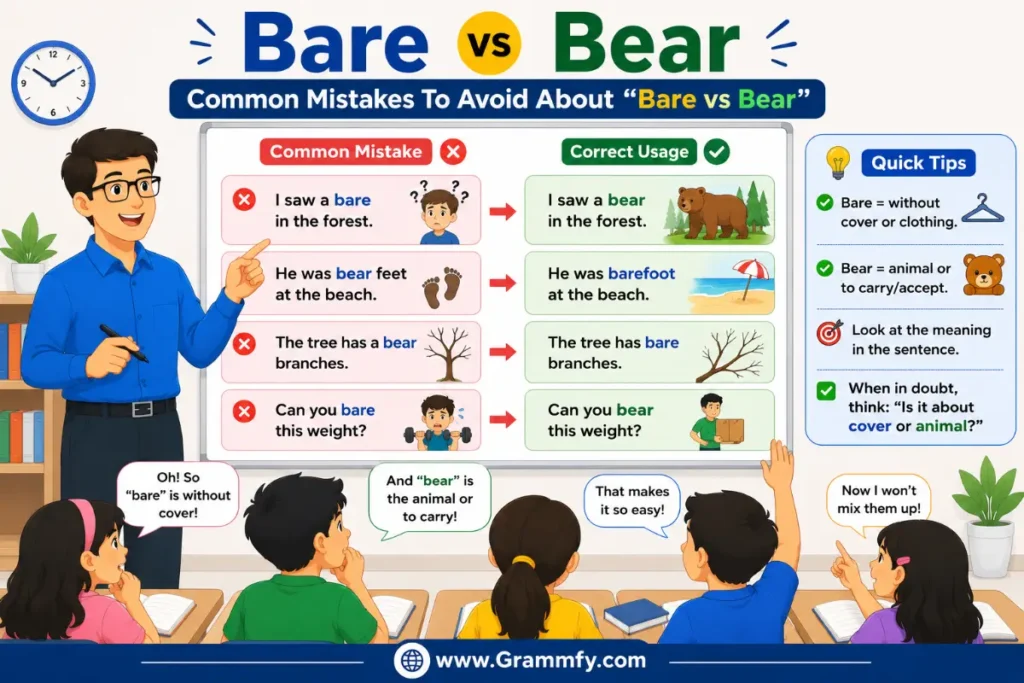
Common Mistakes To Avoid About “Bare vs Bear”
Mistake 1
❌ I can’t bare the pain.
✔ I can’t bear the pain.
You are talking about enduring pain.
Mistake 2
❌ Please bare with me.
✔ Please bear with me.
The phrase means “be patient.”
Mistake 3
❌ The room was bear after we moved.
✔ The room was bare after we moved.
Here you’re describing an empty room.
Mistake 4
❌ The bridge can’t bare heavy trucks.
✔ The bridge can’t bear heavy trucks.
The bridge supports weight.
Mistake 5
❌ He walked on the beach with bear feet.
✔ He walked on the beach with bare feet.
Feet are uncovered, not furry.
When Should You NOT Use Bare?
Avoid bare when talking about:
- responsibility
- pain
- patience
- emotional struggles
- carrying weight
- supporting structures
Wrong:
- bare responsibility
- bare the burden
- bare with me
Correct:
- bear responsibility
- bear the burden
- bear with me
When Should You NOT Use Bear?
Don’t use bear when something is uncovered or empty.
Wrong:
- bear walls
- bear floor
- bear branches
Correct:
- bare walls
- bare floor
- bare branches
Antonyms
Opposites of Bare
- covered
- hidden
- concealed
- protected
- decorated
- furnished
- clothed
- full
Opposites of Bear (Carry or Endure)
- avoid
- abandon
- reject
- refuse
- surrender
- escape
- quit
- ignore
Conclusion
Understanding bare vs bear becomes much easier once you connect each word with its meaning instead of its sound. Use bare when you’re talking about something uncovered, exposed, empty, or revealed. Use bear when you mean to carry, support, endure, accept responsibility, produce something, or refer to the animal. Although they sound exactly the same, they aren’t interchangeable. A quick check before you hit send on an email, submit an essay, or post on social media can help you avoid a common spelling mistake. The more you read and write, the more natural the difference between bare vs bear will become. Keep the simple memory trick in mind—bare relates to being uncovered, while bear relates to carrying or enduring—and you’ll choose the right word with confidence every time.
Frequently Asked Questions
1. What is the difference between bare and bear?
The main difference in bare vs bear is their meaning. Bare means uncovered, exposed, or to reveal something, while bear means to carry, support, endure, produce, or refers to the large wild animal.
2. Is it “bear with me” or “bare with me”?
The correct phrase is “bear with me.” It means “please be patient with me.” “Bare with me” is only correct if you’re literally talking about removing clothing together, which is almost never the intended meaning.
3. What does “bare” mean in a sentence?
Bare usually describes something uncovered or empty. For example: The children walked across the sand with bare feet.
4. What does “bear” mean as a verb?
As a verb, bear means to carry, support, tolerate, endure, accept responsibility, or produce something. For example: The bridge can bear heavy traffic.
5. How can I remember the difference between bare and bear?
A simple trick is to think of bare feet with no shoes. If something is uncovered, use bare. If you’re talking about carrying, enduring, or supporting something, use bear.
6. Is “bare minimum” correct?
Yes. Bare minimum is the correct expression because it refers to the smallest or simplest amount needed. “Bear minimum” is incorrect.
7. Can “bear” mean tolerate?
Yes. One common meaning of bear is to tolerate or endure something difficult. For example: I can’t bear the loud noise.
8. Which is correct: “bare responsibility” or “bear responsibility”?
The correct phrase is bear responsibility because bear means to carry or accept responsibility. “Bare responsibility” is incorrect.
9. Why do people confuse bare and bear?
People confuse these words because they are homophones—they sound exactly the same but have different spellings and meanings. This makes bare vs bear a common spelling mistake in English.
10. What’s another way to remember bare vs bear?
Remember this easy rule: bare = uncovered and bear = carry or endure. If you can replace the word with uncovered, choose bare. If you can replace it with carry, support, or tolerate, choose bear.
