
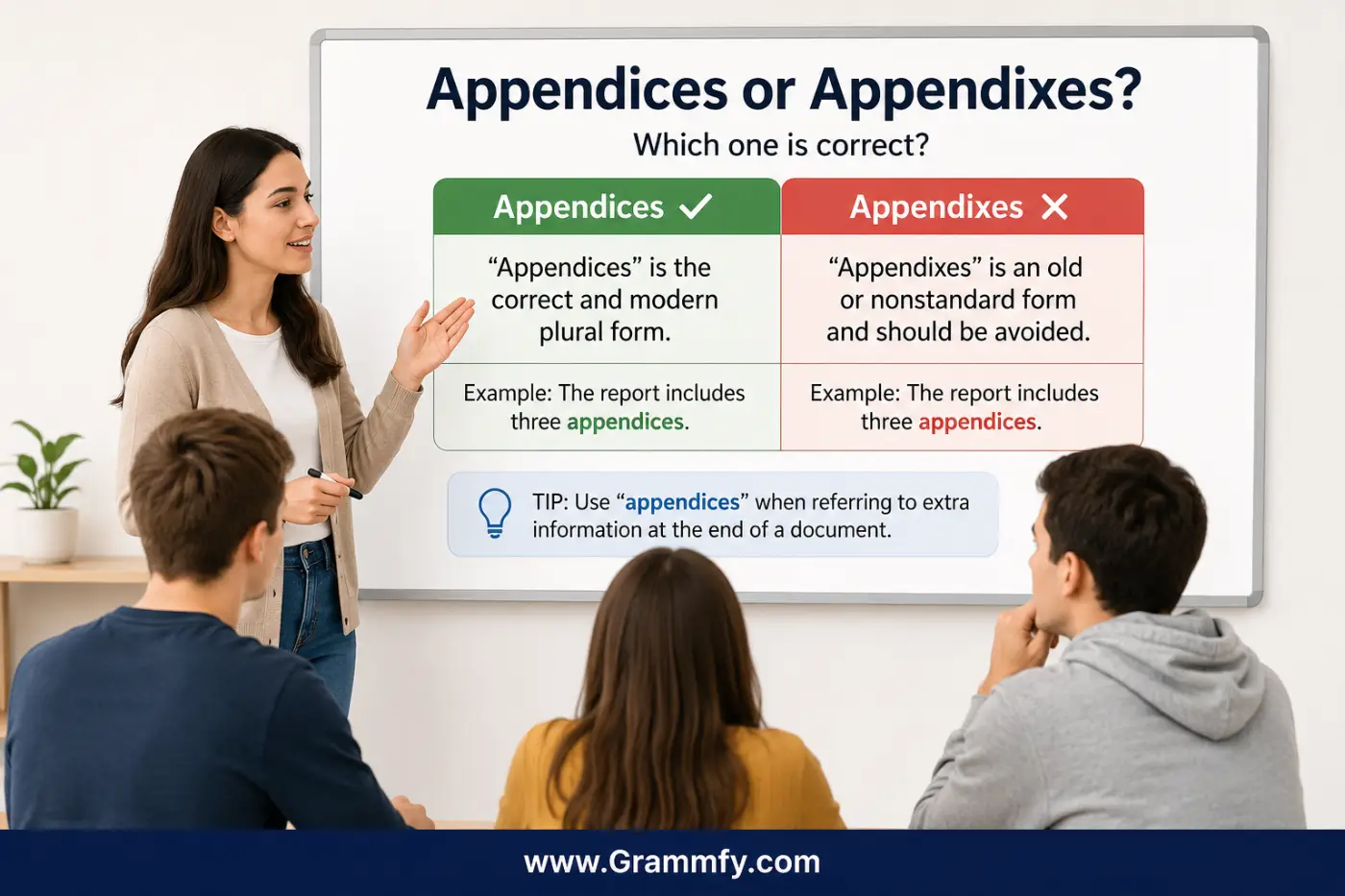
You’re finishing an essay, report, thesis, or research paper and reach the section at the back. You want to refer to more than one appendix, but then you pause: Appendices or Appendixes—which plural form is correct?
Both appendices and appendixes are correct plural forms of appendix. The difference is mainly one of style, tradition, and context. Appendices is the more traditional and widely preferred form, especially in academic and formal writing. Appendixes is also standard English and is often used in American English, particularly when referring to supporting sections in documents.
Answer box: Appendices and appendixes are both correct plurals of appendix. Use appendices for a traditional formal style, while appendixes is also acceptable, especially in American English.
The choice becomes easier when you know what an appendix is and how each plural form developed. This guide explains the meanings, origins, style differences, examples, synonyms, regional preferences, common mistakes, and the best choice for essays, resumes, emails, reports, and everyday writing. You’ll also learn when a supporting section should be called an appendix rather than something else.
For more examples of correct spelling and plural forms, see [lier or liar] .
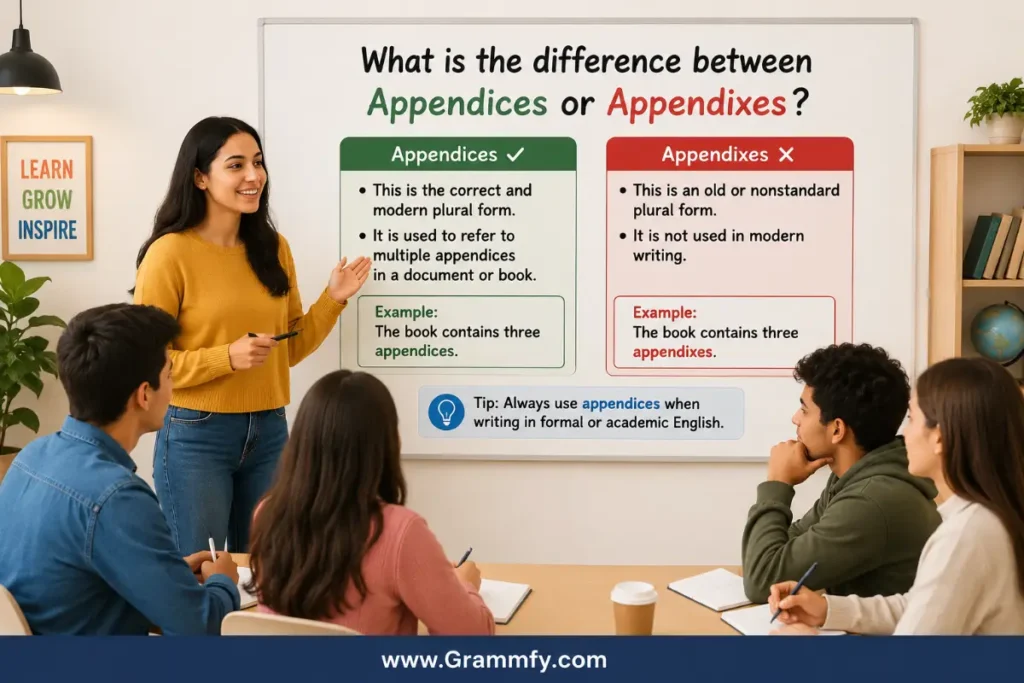
What is the difference between “Appendices or Appendixes”?
The main difference is not meaning. Both words refer to more than one appendix.
An appendix is an additional section placed at the end of a document. It usually contains useful supporting information that would make the main text too long or distracting.
For example, a research report might contain:
- Appendix A: Survey Questions
- Appendix B: Raw Data
- Appendix C: Interview Transcripts
Together, these are the appendices or appendixes.
| Singular | Plural | Meaning |
|---|---|---|
| appendix | appendices | More than one appendix |
| appendix | appendixes | More than one appendix |
The difference is therefore mostly about plural formation and style preference, not definition.
Is appendices correct?
Yes. Appendices is completely correct.
It comes from the traditional Latin plural form of appendix. This form is especially common in academic, scientific, medical, and formal writing.
Example:
The appendices contain the full survey results.
Is appendixes correct?
Yes. Appendixes is also correct.
It uses the regular English plural ending -es.
Example:
The report includes three appendixes.
Although some readers prefer appendices, appendixes isn’t a spelling error.
Which is more common: Appendices or Appendixes?
Appendices is generally the more familiar and traditional form, especially in formal and academic contexts.
Appendixes is also established English and can be a good choice when following a style guide that prefers regular English plurals.
If you’re writing a thesis, dissertation, academic paper, scientific report, or formal research document, appendices is often the safest choice because readers expect it.
If you’re writing general American English, appendixes is also acceptable.
| Situation | Good choice |
|---|---|
| Academic paper | appendices |
| Thesis | appendices |
| Dissertation | appendices |
| Scientific report | appendices |
| Formal report | appendices |
| General US English | appendices or appendixes |
| Informal document | appendices or appendixes |
| Style-guide controlled document | Follow the required style guide |
When a school, university, publisher, or employer gives you a style guide, follow that guide instead of choosing based only on personal preference.
What does “Appendix” mean?
An appendix is a section added to the end of a document to provide extra information.
It supports the main content but usually isn’t necessary for understanding every main point.
An appendix may include:
- detailed tables
- survey questions
- raw research data
- interview transcripts
- charts
- technical information
- calculations
- questionnaires
- supporting documents
- long examples
- source material
- research instruments
- additional statistics
For example, a student might write a 20-page research paper and place a 10-page questionnaire at the end. The questionnaire can go into an appendix.
The main text can then remain focused and easier to read.
Why do documents have Appendices?
Appendices help writers separate important supporting material from the main discussion.
Imagine a research paper about student study habits. The writer may want to include the full survey used in the research.
Putting every survey question in the main body could interrupt the discussion.
Instead, the writer can say:
The full questionnaire appears in Appendix A.
The reader can check it if needed without losing the flow of the main paper.
What usually belongs in an Appendix?
Good appendix material often includes information that is:
- useful
- detailed
- supporting
- too long for the main text
- relevant but not central
- helpful for verification
For example:
Appendix A contains the survey questionnaire.
Appendix B provides the complete data table.
Appendix C includes interview transcripts.
What should not go in an Appendix?
Don’t put information in an appendix simply because you don’t know where else to place it.
The material should support the main document.
Avoid putting:
- unrelated facts
- random notes
- unnecessary explanations
- information never mentioned in the main text
- material with no connection to the research or report
An appendix should have a clear purpose.
Where does the word “Appendix” come from?
Appendix comes from Latin appendix, meaning something attached or added.
The word is related to the Latin verb appendere, meaning “to hang upon” or “attach.”
That original idea fits the modern meaning well. An appendix is something attached to the main document.
The traditional plural appendices also comes from Latin.
English, however, often adapts borrowed words into regular English plural patterns. That’s why appendixes developed as another accepted plural form.
The two forms therefore reflect two different approaches:
- appendices preserves the traditional Latin-style plural
- appendixes uses the regular English plural ending
Why are there two plural forms?
English has many words borrowed from Latin and Greek. Some keep traditional plural forms, while others develop regular English plurals.
For example:
| Singular | Traditional plural | Regular English plural |
|---|---|---|
| appendix | appendices | appendixes |
| index | indices | indexes |
| formula | formulae | formulas |
| antenna | antennae | antennas |
| syllabus | syllabi | syllabuses |
Not every pair is used equally often.
In the case of appendix, both appendices and appendixes have a place in standard English.
Is appendices more formal than appendixes?
Generally, appendices has a more traditional and formal feel.
That’s why it appears frequently in:
- academic writing
- scholarly books
- research papers
- technical reports
- dissertations
- scientific publications
- legal documents
Appendixes isn’t incorrect or necessarily informal. It simply uses the regular English plural ending and may sound more natural to some readers.
Compare:
See Appendices A–C for supporting data.
and:
See Appendixes A–C for supporting data.
Both are grammatical.
The first may feel more traditional in a university or research setting.
Is Appendices or Appendixes better for academic writing?
For most academic writing, appendices is a strong choice.
Universities often use Appendix A, Appendix B, and Appendices as standard terminology.
For example:
The complete interview transcripts are provided in the appendices.
If your university has a formatting guide, use the form it recommends.
Why do academic writers prefer appendices?
Academic writing often follows established terminology. Appendices has been used for a long time in scholarly documents, so many readers recognize it immediately.
This doesn’t make appendixes wrong. It simply makes appendices a conventional choice.
What are synonyms for Appendices?
There isn’t a perfect synonym for appendices because the word identifies a specific document section. However, depending on the context, several related terms can describe supporting material.
Simple alternatives
| Word | Meaning | Tone | Example |
|---|---|---|---|
| attachments | Extra items added to a document | Simple | See the attachments for details. |
| extras | Additional material | Casual | The extras appear at the end. |
| additions | Material added to the main work | Neutral | The additions provide more information. |
| supplements | Material that supports the main text | Neutral | The supplements contain more data. |
| add-ons | Additional material | Casual | The report includes several add-ons. |
| supporting material | Information that backs up the main text | Neutral | Supporting material is provided separately. |
| additional information | Extra facts or details | Neutral | Additional information appears at the end. |
Everyday alternatives
| Word | Meaning | Tone | Example |
|---|---|---|---|
| extra sections | Sections added beyond the main text | Everyday | The extra sections contain charts. |
| supporting documents | Documents that provide evidence or details | Everyday | Supporting documents are attached. |
| additional sections | Sections added for more information | Neutral | Additional sections explain the methods. |
| background material | Information that gives extra context | Everyday | Background material appears at the end. |
| reference material | Material used for checking details | Neutral | Reference material is included separately. |
| additional resources | Extra useful information | Neutral | Additional resources appear after the report. |
| supporting details | Details that strengthen the main content | Neutral | Supporting details are included at the end. |
Formal alternatives
| Word | Meaning | Tone | Example |
|---|---|---|---|
| supplementary material | Extra material supporting a main work | Formal | Supplementary material is provided separately. |
| supplementary data | Additional data supporting research | Formal | Supplementary data appear online. |
| supporting documentation | Documents that provide evidence | Formal | Supporting documentation is available upon request. |
| ancillary material | Additional but related material | Formal | Ancillary material is included after the main report. |
| supplemental material | Material added to support the main work | Formal | Supplemental material contains the full dataset. |
| exhibits | Items presented as evidence or supporting material | Formal/Legal | The exhibits were submitted to the court. |
| enclosures | Documents included with another document | Formal | Please review the enclosures. |
| schedules | Detailed supporting lists or tables | Formal | The schedules provide financial details. |
| addenda | Additional material added after completion | Formal | The addenda contain later corrections. |
Informal alternatives
| Word | Meaning | Tone | Example |
|---|---|---|---|
| extras | Additional information | Informal | Check the extras at the back. |
| add-ons | Added material or features | Informal | The report has several add-ons. |
| bonus material | Extra content | Informal | Bonus material appears at the end. |
| extra pages | Pages added beyond the main document | Informal | The extra pages contain charts. |
| additional stuff | Extra material | Very casual | The additional stuff is at the back. |
| back matter | Material at the end of a document | Casual/Publishing | The back matter includes references. |
These aren’t exact replacements in every sentence. Appendix is a specific structural term, while words such as attachments, exhibits, and supplements can describe different types of material.
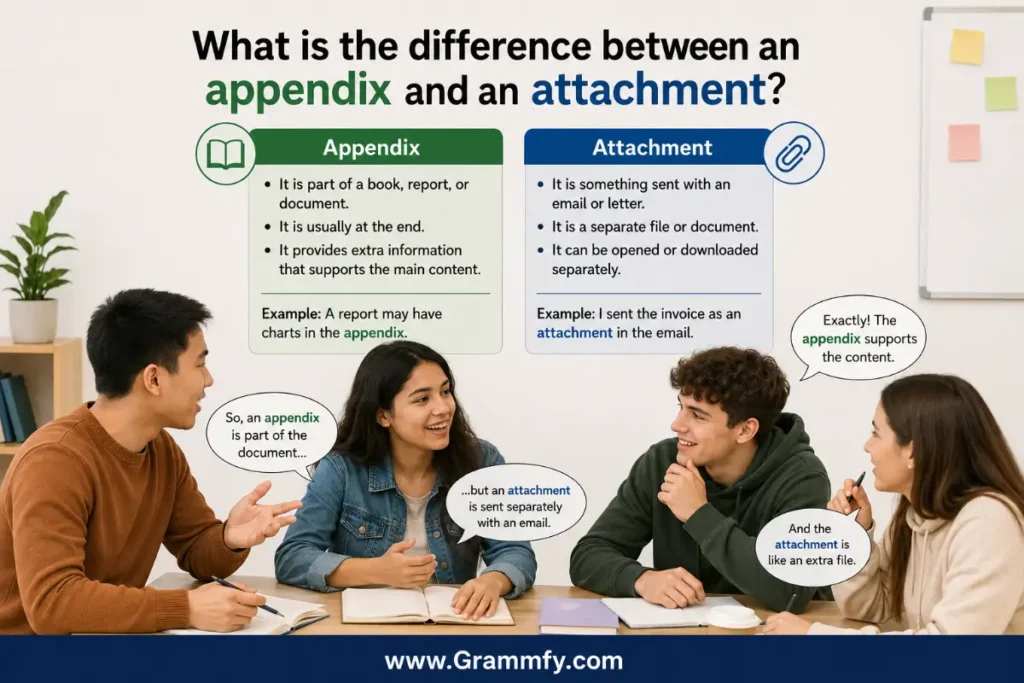
What is the difference between an appendix and an attachment?
An appendix is normally part of a larger document.
An attachment is usually a separate file or item sent along with something else, such as an email.
Compare:
See Appendix A for the survey questions.
The survey is part of the report.
Now:
Please see the attached survey.
The survey is a separate attachment.
| Appendix | Attachment |
|---|---|
| Usually part of a document | Usually separate from the main document |
| Common in reports and academic papers | Common in emails |
| Often labeled Appendix A, B, C | Usually a separate file |
| Supports the main document | Sent with another document or message |
What is the difference between an “Appendix and a Aupplement”?
A supplement is broader.
It can be an additional publication, section, dataset, or material that adds information to a main work.
An appendix is specifically placed at the end of a document.
For example:
Appendix A contains the interview questions.
But:
The journal published a supplement containing additional research.
The words overlap, but they aren’t always interchangeable.
What is the difference between an “Appendix and an Exhibit”?
An exhibit is usually an item presented as evidence or supporting material, especially in legal, business, or formal settings.
Examples include:
- contracts
- photographs
- records
- charts
- physical objects
- documents
A report may contain both appendices and exhibits.
Appendix A contains the survey data.
Exhibit 1 is a copy of the signed contract.
An exhibit has a stronger association with evidence or presentation than an appendix.
What is the difference between an “Appendix and an Addendum”?
An addendum is additional information added to a document, often after the original document was completed.
An appendix is normally planned as part of the document’s structure.
For example:
The research paper contains three appendices.
An addendum might be added later:
An addendum was issued to correct the original report.
The plural of addendum is traditionally addenda, though addendums is also used.
How do Appendices work in a research paper?
In a research paper, an appendix usually contains detailed material that supports the research.
Possible content includes:
- survey forms
- interview questions
- full interview transcripts
- raw data
- detailed calculations
- long tables
- research instruments
- additional charts
- technical procedures
The main text should refer to the appendix when necessary.
For example:
The full questionnaire is included in Appendix A.
If there are several:
The survey instrument is provided in Appendix A, while the complete results appear in Appendix B.
The reader can then find the supporting material easily.
How should multiple Appendices be Labeled?
When a document contains several appendices, they are often labeled with letters.
For example:
Appendix A
Survey Questions
Appendix B
Participant Demographics
Appendix C
Raw Data
Appendix D
Interview Transcript
This system makes references simple.
Instead of writing:
Please see the long section containing the survey questions at the end of the report.
you can write:
See Appendix A.
That is shorter and clearer.
How should you refer to multiple Appendices?
If you’re referring to more than one, you can use either accepted plural form.
Traditional:
See the appendices for additional information.
Alternative:
See the appendixes for additional information.
In formal academic writing, appendices is often the safer choice.
If referring to specific sections, you can simply use:
See Appendices A and B.
You don’t always need the plural noun if the labels make the meaning clear.
Can you use “Appendices” for two or more sections?
Yes.
Appendix is singular.
Appendices is plural.
So:
Appendix A
means one section.
Appendices A and B
means two sections.
The same principle applies to appendixes.
Appendixes A and B
is also grammatically correct.
Which form should you use in a resume Appendices or Appendixes?
A resume rarely needs multiple appendices.
Most resumes should stay concise. If supporting documents are required, the employer may ask for them separately.
When preparing a detailed academic CV or professional portfolio, you might have supporting sections containing:
- publications
- certifications
- project details
- references
- awards
- research materials
If you call those sections appendices, appendices is the more traditional formal choice.
Example:
Additional project documentation is provided in the appendices.
However, a normal resume usually doesn’t need an appendix at all.
Which form works best in an essay Appendices or Appendixes?
For an essay, appendices is usually the safest choice if you need the plural.
Example:
The full survey questions are included in the appendices.
For a student essay, paper, thesis, or dissertation, check your instructor’s or institution’s formatting rules.
If the assignment says to use appendices, follow that instruction even though appendixes is also accepted.
Which form works best in texting Appendices or Appendixes?
Texting usually doesn’t require this distinction because most texts won’t discuss formal document sections.
If you do need the word, either plural form is understandable.
I put the extra charts in the appendices.
However, in casual conversation, you might simply say:
I put the extra charts at the end.
Simple language often sounds more natural in a text.
Which form works best in an email Appendices or Appendixes?
Both forms are grammatically acceptable, but appendices is a safe choice for professional emails.
Example:
Please review Appendices A and B before the meeting.
If the files are separate from the email, attachments may be more accurate:
Please review the attached documents.
Don’t call separate email files appendices unless they’re actually sections of a larger document.
Which form works best in speaking Appendices or Appendixes?
In everyday speech, appendices is widely understood and often sounds natural in formal settings.
For example:
You’ll find the detailed figures in the appendices.
In casual conversation, people may avoid the word entirely:
The detailed figures are at the back of the report.
The choice depends on the setting.
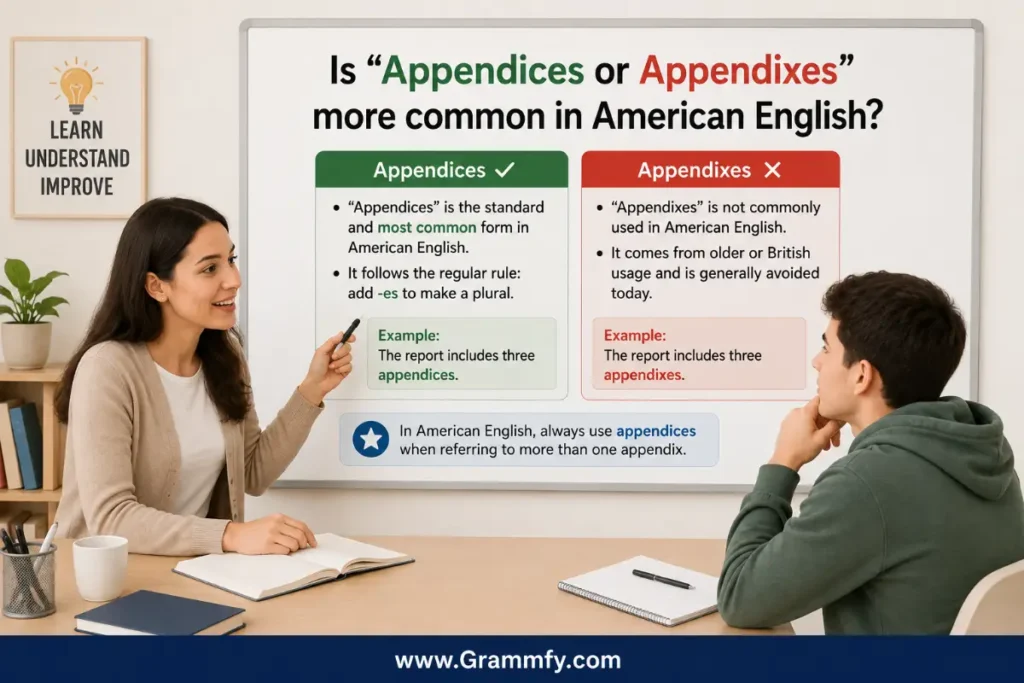
Is “Appendices or Appendixes” more common in American English?
Both forms are used in American English.
Appendices has strong traditional and formal usage, while appendixes follows the regular English plural pattern and is also accepted.
American style can vary by publisher, field, and institution.
For example, a medical publication, university, technical organization, and general-interest publisher may have different preferences.
When consistency matters, follow the style guide for your document.
Is Appendices or Appendixes more common in British English?
Appendices is a familiar traditional form in British English, particularly in formal and academic contexts.
Appendixes can also be understood and is not inherently incorrect.
The key point is that the two forms do not represent two completely different meanings.
Does the meaning change between Appendices or Appendixes?
No. In normal document usage, the meaning stays the same.
The appendices contain the raw data.
and
The appendixes contain the raw data.
Both refer to multiple appendices.
The main difference is stylistic preference.
What are common mistakes with Appendices or Appendixes?
Mistake 1: Thinking appendixes is always wrong
It isn’t.
Appendixes is a recognized plural form.
However, if your school or publisher specifically requires appendices, follow its rules.
Mistake 2: Thinking appendices is the only correct form
It isn’t.
Appendices is traditional and common, but appendixes is also standard.
Mistake 3: Using appendix for multiple sections
Incorrect:
The appendix contain three sections.
Correct:
The appendix contains three sections.
if you’re talking about one appendix.
Or:
The appendices contain three sections.
if you’re referring to multiple appendices.
Mistake 4: Using appendices for unrelated attachments
If you send three separate files with an email, they’re normally attachments, not appendices.
Mistake 5: Capitalizing the word unnecessarily
Usually, use lowercase when referring to appendices generally:
The appendices contain additional data.
Capitalize it when it is part of a specific title or label:
Appendix A
See Appendix B.
Mistake 6: Forgetting consistency
If you choose appendices, use it consistently throughout your document unless a quotation or official title requires another form.
Don’t randomly switch between appendices and appendixes in the same report without a reason.
When should you not use appendices?
Don’t create an appendix just to make a document look more complete.
Supporting material should have a purpose.
You probably don’t need an appendix if:
- the document is very short
- the extra information is unnecessary
- the information belongs in the main text
- the material is unrelated
- the reader doesn’t need it
- the information is better presented as a separate attachment
For example, a one-page email doesn’t need an appendix.
A 100-page research report might.
What are the antonyms of appendix?
There is no exact antonym for appendix.
However, you can contrast an appendix with the main text, main body, or core content.
| Appendix | Contrasting term |
|---|---|
| Supporting material | Main content |
| Additional section | Main section |
| Back matter | Main body |
| Extra information | Core information |
| Supplementary material | Primary material |
These aren’t strict dictionary antonyms. They simply describe the opposite structural role within a document.
How can you decide between Appendices or Appendixes?
Use this simple process.
Step 1: Check your style guide
If your university, employer, publisher, or organization has a required style, follow it.
Step 2: Choose appendices for traditional formal writing
If no style guide gives a preference, appendices is a safe choice for:
- academic papers
- theses
- dissertations
- scientific reports
- formal documents
Step 3: Remember that appendixes is also correct
Don’t mark appendixes as a spelling error simply because you’re more familiar with appendices.
Step 4: Stay consistent
Once you’ve chosen one form, use it consistently throughout the document.
Step 5: Make sure the material really is an appendix
For a separate email file, call it an attachment.
When referring to evidence, exhibit may be more appropriate.
For material added later, addendum may fit better.
What should you remember about “Appendices or Appendixes”?
The easiest points to remember are:
- Appendix is singular.
- Appendices is a traditional plural.
- Appendixes is also an accepted plural.
- Both refer to multiple supporting sections.
- Appendices is especially common in academic and formal writing.
- Appendixes uses a regular English plural ending.
- Follow your institution’s style guide when one exists.
- Use attachments for separate files.
- Use exhibits for evidence or displayed supporting items when appropriate.
- Use supplements for broader additional material.
- Keep your chosen form consistent.
- Don’t create an appendix unless the extra material supports the main document.
A simple memory trick for “Appendices or Appendixes”
Think of the word this way:
One = appendix
More than one = appendices or appendixes
If you’re writing a formal academic document and aren’t sure which version to choose, remember:
Appendices = traditional formal choice.
That doesn’t mean appendixes is wrong. It simply gives you a practical default.
You can also remember that the two forms have the same basic meaning:
one appendix → multiple appendices
or
one appendix → multiple appendixes
The spelling changes, but the document function stays the same.
How should you write Appendix titles?
A clear title helps readers understand what each appendix contains.
For example:
Survey Questionnaire : Appendix A
Raw Research Data : Appendix B
Interview Questions : Appendix C
Additional Statistical Results : Appendix D
Avoid vague titles such as:
Appendix A: Extra Stuff
A useful title tells the reader what information is inside.
How do you cite an appendix in a sentence?
You can refer to an appendix directly.
See Appendix A for the complete questionnaire.
For multiple sections:
See Appendices A and B for additional results.
Or:
Additional data are provided in the appendices.
The reference should help readers locate the supporting material quickly.
Should appendices be included in the table of contents?
In many academic and professional documents, yes.
If the document is long and contains several appendices, listing them in the table of contents helps readers find them.
For example:
Survey Questionnaire — Appendix A
Interview Data — Appendix B
Statistical Tables — Appendix C
Follow your institution’s formatting requirements because different style guides handle appendix placement differently.
Are appendices included in the word count?
This depends on the assignment, institution, publisher, or style rules.
Some academic assignments exclude appendices from the main word count. Others may count certain material.
Don’t assume that all appendices are automatically excluded.
If you’re writing for school or university, check the assignment instructions.
Can an appendix contain images and charts?
Yes.
An appendix can contain:
- images
- charts
- graphs
- tables
- diagrams
- screenshots
- maps
- questionnaires
- transcripts
The material should support the main document.
For example:
Appendix B contains the complete set of survey charts.
The main report might discuss only the most important findings while placing the full collection in an appendix.
Can a document have more than one appendix?
Yes.
A document can have two, three, ten, or more appendices if the material is useful and properly organized.
For example:
- Appendix A — Questionnaire
- Appendix B — Interview Transcript
- Appendix C — Raw Data
- Appendix D — Calculations
When there are several, the plural appendices or appendixes is appropriate.
Why does choosing the right plural matter?
The choice usually won’t change the meaning, but it can affect the tone and consistency of your writing.
In academic writing, using the traditional appendices can make your document fit common conventions.
In general English, appendixes may be perfectly natural.
The bigger issue is not choosing the “right” form at all costs. It’s following the style requirements of the audience and using your chosen form consistently.
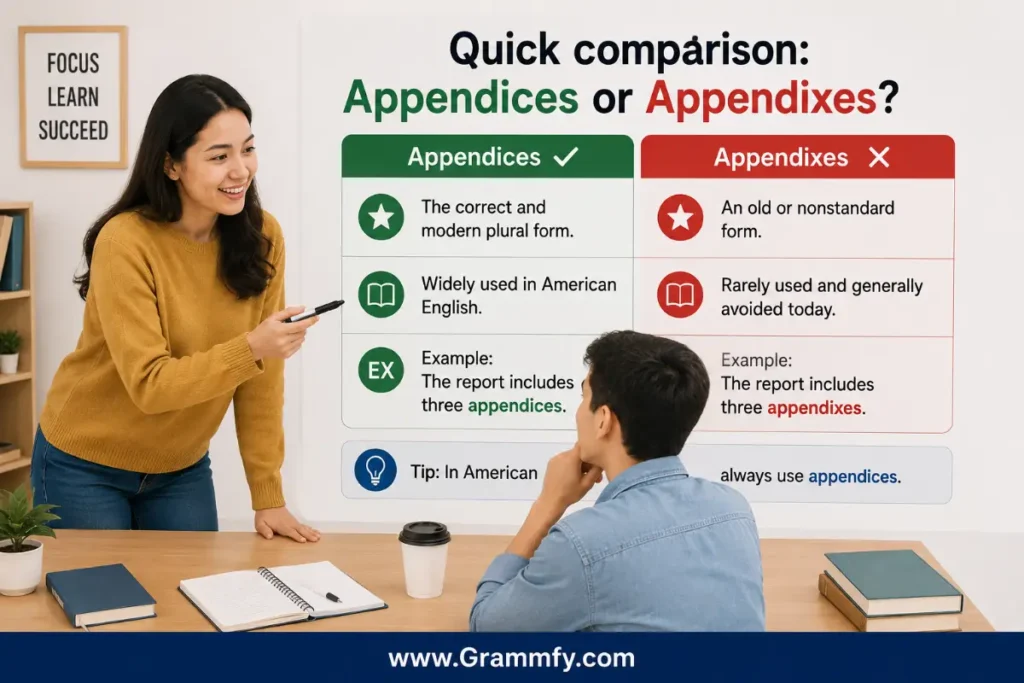
Quick comparison: Appendices or Appendixes
| Feature | Appendices | Appendixes |
|---|---|---|
| Correct? | Yes | Yes |
| Singular | appendix | appendix |
| Plural | Yes | Yes |
| Meaning | Multiple appendices | Multiple appendices |
| Style | Traditional | Regular English plural |
| Academic use | Very common | Acceptable |
| Formal use | Very common | Acceptable |
| American English | Common | Common enough |
| British English | Common | Less traditional |
| Best default for academic writing | Yes | Usually secondary choice |
Conclusion
The choice between these two plural forms is easier than it first appears. Appendices is the traditional plural of appendix and remains a popular choice in academic, scientific, and formal writing. Appendixes is also a correct English plural and follows the regular English -es pattern.
The best option depends on your audience and the style rules you’re following. For a thesis, dissertation, research paper, or formal report, appendices is usually a safe default. In general American English, appendixes is also acceptable. Whatever form you choose, consistency matters more than switching between the two.
Also remember that an appendix should contain useful supporting material, not unrelated information. If you’re referring to separate email files, use attachments instead. If you’re presenting evidence, exhibits may be a better term. Choose the word that accurately describes the document structure, and your writing will stay clear and professional.
Frequently Asked Questions
Is appendices or appendixes correct?
Both appendices and appendixes are correct plural forms of appendix. Appendices is the traditional form, while appendixes is the regular English plural.
Which is better for academic writing, appendices or appendixes?
Appendices is usually the safer choice for academic writing. It is traditional and widely used in research papers, theses, dissertations, and formal reports.
What’s another way to say appendices?
Other terms include supplementary material, supporting documents, additional sections, attachments, exhibits, and supplements. The best alternative depends on what the extra material actually is.
Is appendixes wrong in American English?
No, appendixes is not wrong in American English. It is an accepted plural form, although appendices may be preferred in many formal and academic settings.
Do appendices and appendixes mean the same thing?
Yes, they normally mean the same thing. Both refer to multiple sections added to the end of a document to provide supporting information.
Should I use appendices or appendixes in a thesis?
Use appendices unless your university’s style guide says otherwise. It is the more traditional choice for theses and other academic documents.
Can I use both appendices and appendixes in one document?
You should normally choose one form and stay consistent. Switching between them without a clear reason can make the document look inconsistent.

1 thought on “Appendices or Appendixes: The Ultimate Usage Guide”