
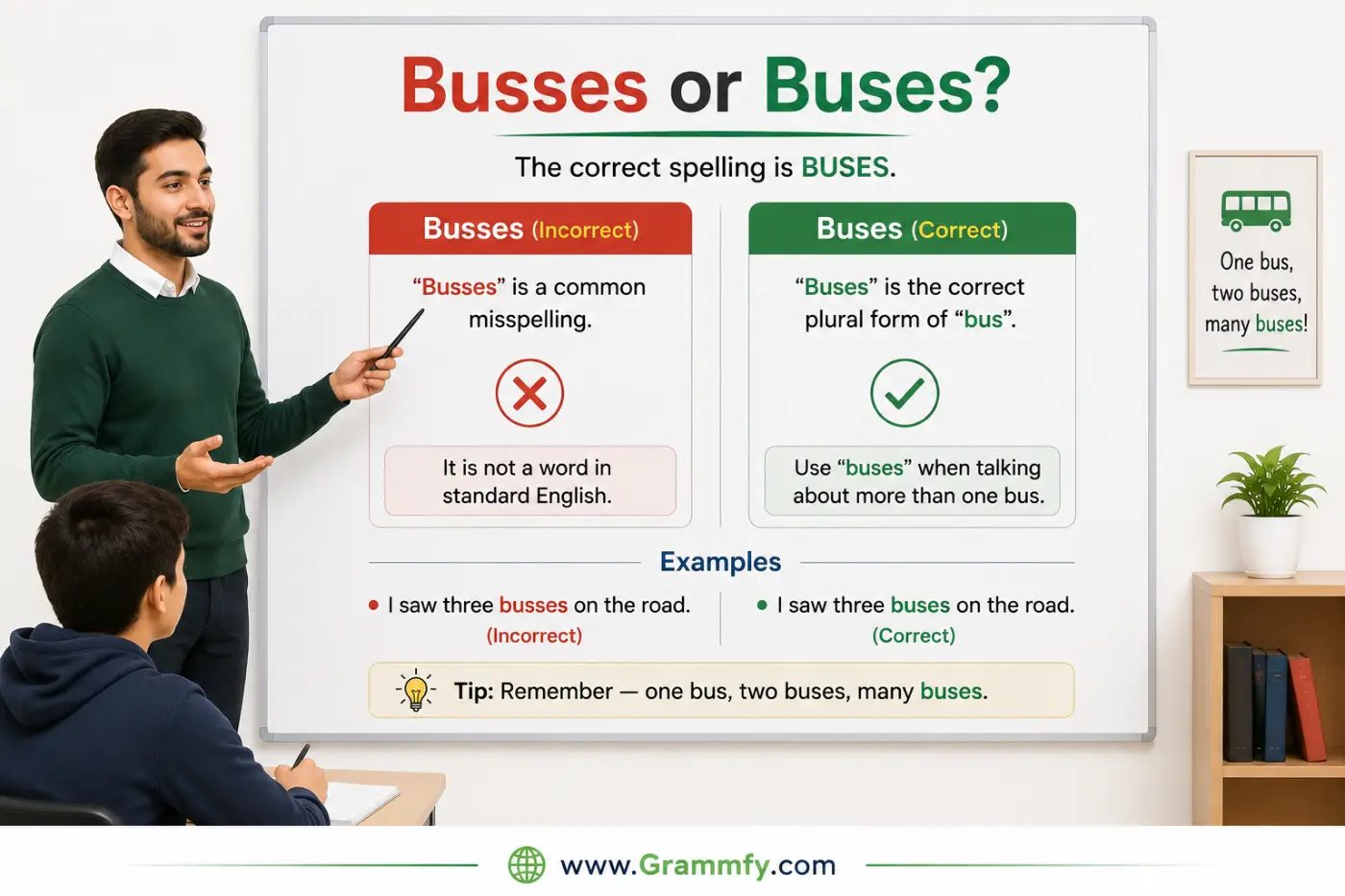
You’re writing an email, school essay, travel guide, or social media post and want to talk about more than one bus. Then you pause: Busses or Buses—which spelling should you choose?
Buses is the standard plural of bus when you’re talking about vehicles that carry passengers. Busses is also a real English word, but it has a different meaning: it is the plural of buss, an old-fashioned word meaning a kiss.
Answer box: Buses is the correct plural when you mean more than one passenger vehicle. Busses usually means more than one kiss and is also found as a verb form of buss.
The difference is easy once you connect each spelling with its meaning. This guide explains the origins, definitions, plural rules, synonyms, regional usage, examples, common mistakes, and the best choice for essays, resumes, emails, texting, and everyday speech. You’ll also learn when busses can actually be correct.
Looking for more guidance on English plurals? Explore [appendices or appendixes].
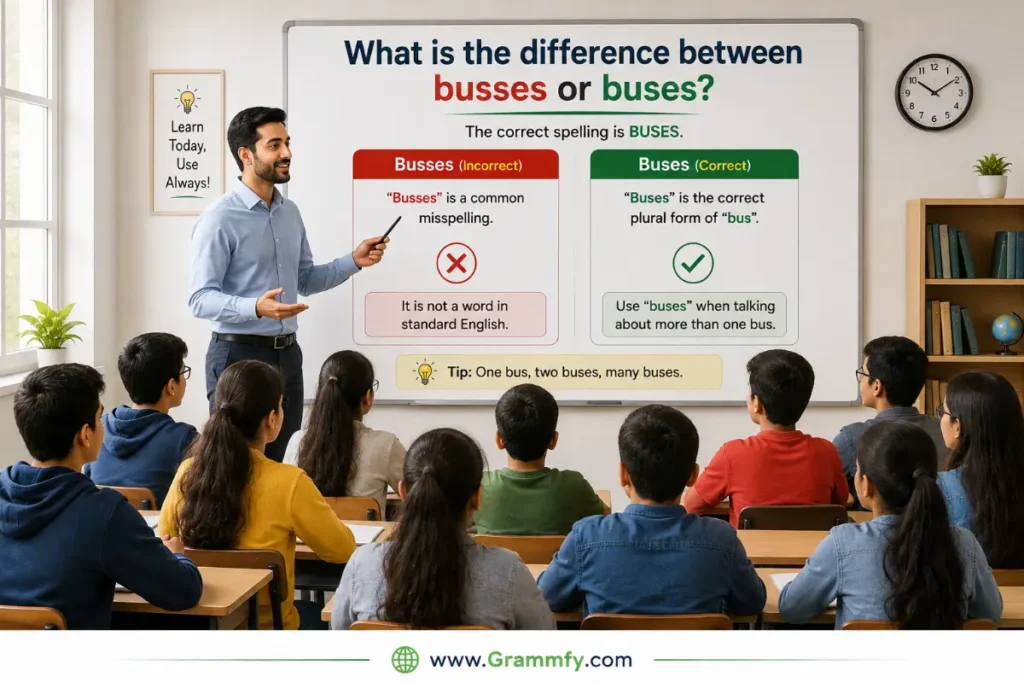
What is the difference between busses or buses?
The key difference is meaning.
Buses is the normal plural of bus. It refers to two or more buses.
Several buses stopped outside the school.
Busses is a much less common word. It can be the plural of buss, which means a kiss, especially in older or literary English.
The old poem describes several busses exchanged between the lovers.
In modern English, buses is overwhelmingly more common when discussing transportation.
| Word | Meaning | Commonness | Example |
|---|---|---|---|
| buses | More than one bus | Very common | The buses arrived late. |
| busses | More than one kiss; also a form of buss | Rare | The poem mentions several busses. |
So, if you’re talking about public transportation, school transportation, city vehicles, or coaches, choose buses.
Is “buses” the correct plural of bus?
Yes. Buses is the standard plural form of bus.
Examples:
The buses are waiting outside.
Three buses arrived at the station.
The city needs more buses.
School buses carry students every morning.
The word bus ends in s, so its plural normally takes -es:
bus → buses
This is similar to other nouns ending in s, x, z, ch, or sh:
- bus → buses
- box → boxes
- dish → dishes
- church → churches
- quiz → quizzes
The added ending makes the plural easier to pronounce.
Is “busses” ever correct?
Yes, but not usually when you’re talking about vehicles.
Busses can be the plural of the noun buss, meaning a kiss. The word buss is uncommon today and often has an old-fashioned, literary, or playful tone.
For example:
The lovers exchanged busses before saying goodbye.
That sentence is grammatically possible, but most modern writers would simply say:
The lovers exchanged kisses before saying goodbye.
Busses can also appear as a verb form of buss:
He busses her cheek.
However, this usage is rare in modern everyday English.
Why do people confuse busses and buses?
The confusion comes from the fact that both spellings are possible English words.
When someone sees busses, they may assume it is simply an alternative spelling of the plural bus. In standard modern English, however, buses is the usual form for multiple vehicles.
The extra s in busses changes the word’s origin and meaning.
Think of it this way:
bus → buses = vehicles
buss → busses = kisses
That simple connection can prevent most spelling mistakes.
What does “bus” mean?
A bus is a large road vehicle designed to carry multiple passengers.
Buses are commonly used for:
- public transportation
- school transportation
- airport transportation
- tours
- long-distance travel
- employee transportation
- city transit
- community transportation
Examples:
I take the bus to work.
The school has several buses.
The bus stopped at the next station.
The word can also appear in compounds:
- school bus
- city bus
- tour bus
- shuttle bus
- transit bus
- double-decker bus
- electric bus
- airport bus
When you make these plural, buses is normally the correct form.
What does “buss” mean?
A buss is an old-fashioned or literary word for a kiss.
It can function as a noun or verb.
As a noun:
He gave her a buss on the cheek.
As a verb:
He bussed her cheek.
Today, most people would use kiss instead.
| Word | Modern frequency | Meaning |
|---|---|---|
| kiss | Very common | Touch someone with the lips |
| buss | Rare | Kiss |
| busses | Rare plural | Kisses |
Because buss is uncommon, busses is also uncommon.
Where does the word “bus” come from?
The modern word bus is a shortened form of omnibus, a Latin word meaning “for all.”
The term became associated with public passenger transportation. Over time, omnibus was shortened to bus.
The shortened form became standard in English and eventually developed the regular plural buses.
This history explains why the word is short even though its original form was much longer.
The word omnibus was used for vehicles that carried many passengers. Modern English speakers usually use bus instead.
Where does “buss” come from?
Buss is an older English word meaning a kiss.
Its history is separate from the modern transportation word bus.
This is important because the two words look almost identical but have different origins and meanings.
So:
bus → passenger vehicle
buss → kiss
That distinction explains why both buses and busses can appear in English.
Why is the plural of bus “buses” instead of “busses”?
The standard plural of the transportation noun bus is buses.
The spelling follows a common English pattern for words ending in s.
For example:
- bus → buses
- gas → gases
- class → classes
- glass → glasses
- dress → dresses
The plural adds -es rather than simply adding another s.
That’s why:
two buses
is standard.
Writing:
two busses
would normally suggest the rare word buss rather than the vehicle bus.
Can “busses” mean buses?
In some historical, informal, or variant usage, busses has appeared as a plural spelling of bus. However, buses is the standard modern form and is the safest choice for general writing.
If you’re writing for a school, business, website, newspaper, or professional audience, use buses when you mean vehicles.
This avoids confusion and follows the most widely accepted modern spelling.
Which spelling is more common?
Buses is far more common in modern English.
You’ll see it in:
- transportation websites
- school documents
- news reports
- travel information
- road signs
- textbooks
- government documents
- business writing
- everyday conversation
Busses is much less common and is usually connected to the older word buss.
For practical writing, the choice is simple:
Buses = vehicles
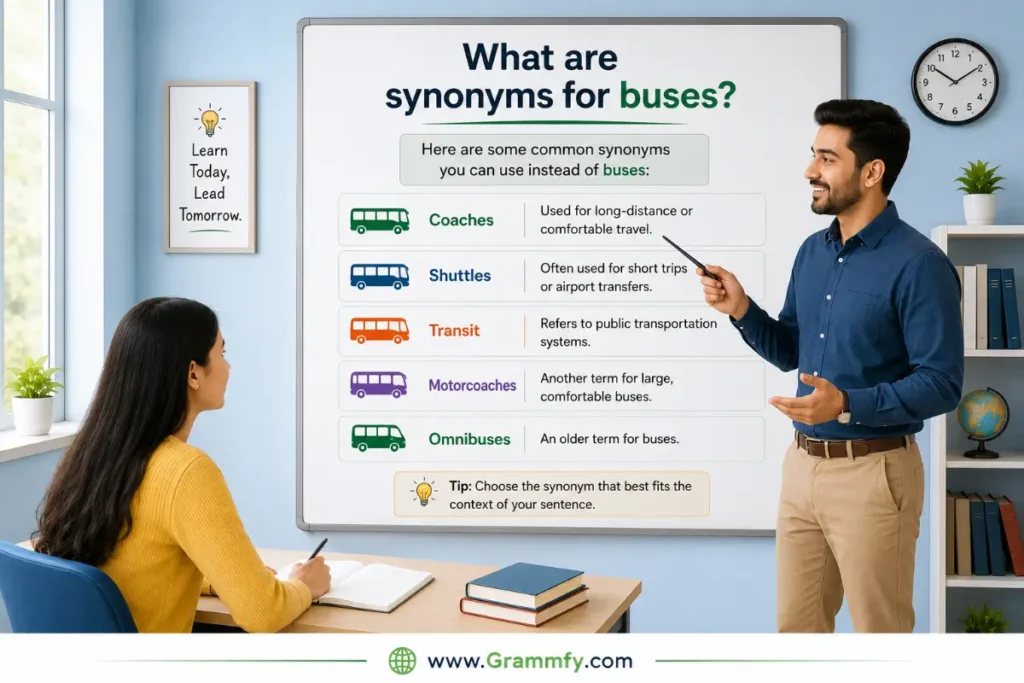
What are synonyms for buses?
There isn’t one perfect synonym for buses because transportation terms can describe different kinds of vehicles.
Still, several related words may fit depending on the situation.
Simple transportation synonyms
| Word | Meaning | Tone | Example |
|---|---|---|---|
| buses | Passenger road vehicles | Neutral | The buses are full. |
| coaches | Larger passenger vehicles, often for long trips | Neutral | The coaches left at noon. |
| shuttles | Vehicles making repeated trips | Neutral | The shuttles run every hour. |
| vehicles | General term for transport | Neutral | The vehicles arrived. |
| minibuses | Smaller buses | Neutral | Two minibuses arrived. |
Everyday alternatives
| Word | Meaning | Tone | Example |
|---|---|---|---|
| coaches | Passenger vehicles, especially for longer trips | Everyday | The coaches are leaving soon. |
| shuttles | Vehicles running between locations | Everyday | The airport shuttles are busy. |
| transit | Public transportation, sometimes referring to buses generally | Everyday | I use public transit. |
| rides | Transportation in a broad sense | Casual | We need rides to the station. |
| public transport | Shared transportation system | Everyday | Public transport is convenient. |
| school transport | Transportation for students | Everyday | School transport starts early. |
Formal alternatives
| Word | Meaning | Tone | Example |
|---|---|---|---|
| transit vehicles | Vehicles used in public transit | Formal | Transit vehicles must meet safety standards. |
| passenger vehicles | Vehicles carrying people | Formal | Passenger vehicles were inspected. |
| fleet vehicles | Vehicles owned or operated as a group | Formal | The company expanded its fleet vehicles. |
| passenger coaches | Larger vehicles for passengers | Formal | Passenger coaches were inspected. |
| transit fleet | Group of vehicles operated by a transit system | Formal | The transit fleet is being upgraded. |
| transport vehicles | Vehicles used to move people or goods | Formal | Transport vehicles require maintenance. |
Informal alternatives
| Word | Meaning | Tone | Example |
|---|---|---|---|
| rides | Transportation | Casual | We need rides to the event. |
| shuttles | Short-route passenger vehicles | Casual | The shuttles are outside. |
| transit | Public transportation | Casual | I usually take transit. |
| wheels | Transportation, in a broad informal sense | Slang | We need some wheels. |
| ride | A vehicle or trip | Informal | I caught a ride downtown. |
These words aren’t exact replacements in every sentence. A coach can differ from a city bus, while a shuttle usually follows a specific route between locations.
Which bus synonym should you use?
The best word depends on the type of transportation.
Bus
Use bus for the general term.
The bus arrives every 15 minutes.
Coach
Use coach when referring to a larger passenger vehicle, especially for longer-distance travel.
We took a coach from London to Manchester.
Shuttle
Use shuttle when a vehicle repeatedly travels between two or more specific locations.
The hotel provides free airport shuttles.
Minibus
Use minibus for a smaller bus.
A minibus took the group to the museum.
Transit vehicle
Use transit vehicle in technical, government, or transportation-industry writing.
The transit authority purchased new vehicles.
What are synonyms by intensity?
Transportation words don’t have “intensity” in the same way emotional words do, but they can differ in specificity.
Broad: vehicle
Vehicle is very general.
Several vehicles arrived.
The sentence doesn’t tell us whether they’re buses, cars, vans, or trucks.
Moderate: passenger vehicle
Passenger vehicle tells us that people are being transported.
Several passenger vehicles arrived.
Specific: bus
Bus identifies the vehicle type.
Several buses arrived.
More specific: shuttle bus
Shuttle bus identifies both the vehicle and its typical service.
Several shuttle buses arrived at the airport.
Highly specific: school bus
School bus tells us the vehicle’s purpose.
Several school buses arrived at the school.
The more specific term you choose, the more information the sentence gives the reader.
What are synonyms by part of speech?
Buses is primarily a plural noun.
The buses arrived.
But bus can also function as a verb.
Bus as a noun
The bus is late.
Plural:
The buses are late.
Bus as a verb
In some contexts, bus means to transport people by bus.
The company buses workers to the factory.
The third-person singular form is:
buses
This is another reason context matters.
Bus as a verb in the past tense
The company bused workers to the site.
Bussed can also be seen, depending on the style and meaning, especially in American English. This creates another spelling issue.
For the transportation noun, however:
bus → buses
is the standard plural.
Buses as a noun vs. buses as a verb
The word buses can have two grammatical roles.
Noun
The buses are crowded.
Here, buses means multiple vehicles.
Verb
The company buses employees to work.
Here, buses means transports employees by bus.
You can usually tell the difference from the sentence structure.
If buses follows the, those, several, or a number, it’s likely a noun:
The buses are full.
If buses follows a subject and acts as an action, it’s a verb:
The company buses its workers.
Buses vs. coaches: What’s the difference?
Bus is the broader everyday term.
Coach often refers to a larger passenger vehicle designed for longer trips and may include more comfortable seating or luggage space.
| Buses | Coaches |
|---|---|
| General term | Often long-distance |
| Common in city transportation | Common for tours and intercity travel |
| Frequent stops are common | Fewer stops may be common |
| Designed for regular routes | Often designed for longer journeys |
The exact distinction can vary by country and transportation system.
In American English, bus is often used more broadly than coach.
Buses vs. shuttles: What’s the difference?
A shuttle usually operates between specific locations.
For example:
The hotel runs a shuttle to the airport.
A city bus may follow a larger public route with many stops:
The city bus stops near the airport.
A shuttle can be a type of bus, but not every bus is a shuttle.
Buses vs public transport: What’s the difference?
Buses refers to the vehicles.
Public transport or public transportation refers to the broader system.
Public transportation can include:
- buses
- trains
- subways
- trams
- ferries
So:
The buses are crowded.
is about vehicles.
Public transportation is crowded.
is about the transportation system more broadly.
Buses vs. busses: What’s the difference?
The difference is primarily the word behind each spelling.
| Buses | Busses |
|---|---|
| Plural of bus | Plural of buss |
| Passenger vehicles | Kisses |
| Very common | Rare |
| Standard transportation spelling | Literary or old-fashioned in most contexts |
Example:
The buses arrived at 8 a.m.
means several passenger vehicles arrived.
The characters exchanged busses.
means they exchanged kisses, although kisses would sound much more natural today.
What is the best word for a resume?
A resume may mention buses when describing transportation, logistics, operations, maintenance, or customer service.
For example:
Managed daily schedules for 25 buses.
You can use more specific terms when needed:
Coordinated a fleet of 40 passenger vehicles.
Managed maintenance schedules for a regional bus fleet.
If you’re applying for a transportation job, terms such as fleet, transit vehicles, and passenger transportation may sound more professional.
Resume example
Simple:
Managed buses for daily routes.
More specific:
Coordinated daily schedules and maintenance for a fleet of 30 buses.
The second version gives more useful information.
What is the best word for an essay?
Buses is the natural choice for most essays about transportation.
Example:
Many cities are investing in electric buses to reduce emissions.
For a more academic essay, you can use terms such as:
- public transportation
- public transit
- transit systems
- passenger vehicles
- transportation networks
Example:
Cities can improve public transportation by expanding electric bus networks.
The word buses itself isn’t informal. It’s a standard word suitable for academic writing.

What is the best word for texting?
Buses is the simplest and most natural choice.
The buses are late again.
Which bus are you taking?
Two buses just passed.
There’s no reason to use busses when talking about transportation.
If you’re talking about kisses as a joke or in a literary context, busses may be intentional, but kisses is usually clearer.
What is the best word for an email?
Use buses when referring to transportation.
The buses will leave at 7:30 a.m.
For a professional email, you may use more specific terms:
The shuttle buses will depart from the main entrance.
The transportation fleet will arrive by 9 a.m.
If you’re talking about separate vehicles, buses is the standard choice.
What is the best word for speaking?
In everyday speech, buses is clearly the best choice for transportation.
I take the bus to work.
The buses are crowded today.
We need more buses.
Most speakers won’t use busses to mean vehicles.
If you’re discussing older literature, busses might appear as the plural of buss, but kisses would be much more common in modern speech.
Is “buses” American or British English?
Buses is standard in both American and British English.
There are some differences in transportation vocabulary between regions, but the plural spelling buses is widely accepted.
For example:
- American English: bus, buses
- British English: bus, buses
- Canadian English: bus, buses
- Australian English: bus, buses
The word coach may be used more frequently in some varieties for certain types of longer-distance transportation, but that doesn’t change the spelling of the plural bus.
Is “busses” ever used in British English?
Yes, busses can occur in English, but its common modern meaning is usually associated with buss, meaning a kiss.
It is not the normal spelling to choose for multiple buses in modern standard writing.
If you’re writing for a British audience about transportation, buses is the safe choice.
Common mistakes with busses or buses
Mistake 1: Writing “busses” for vehicles
Incorrect for standard modern usage:
The busses are waiting outside.
Preferred:
The buses are waiting outside.
Mistake 2: Thinking “busses” is always wrong
It’s not always wrong.
Busses can be a valid plural of buss, meaning kisses.
The problem occurs when writers use it to mean multiple passenger vehicles.
Mistake 3: Adding only “s” to bus
Some learners may write:
buss
as the plural of bus.
That’s incorrect when referring to vehicles.
The standard plural is:
buses
Mistake 4: Confusing bus with buss
The two words have different meanings.
bus = passenger vehicle
buss = kiss
Adding the extra s changes the word.
Mistake 5: Using buses when you mean kisses
If you’re discussing kisses, kisses is the natural modern word.
Writing:
They exchanged buses.
would be confusing.
Writing:
They exchanged busses.
could technically work in an old-fashioned context, but:
They exchanged kisses.
is much clearer.
When should you NOT use “buses”?
Don’t use buses when you mean kisses.
For example:
The actors exchanged buses.
This sounds like they exchanged vehicles.
If the intended meaning is physical affection, write:
The actors exchanged kisses.
Likewise, don’t use buses when a more specific transportation term is needed.
If you’re talking about an airport vehicle running between the terminal and parking area, shuttle may be more precise.
What are the antonyms of buses?
Buses doesn’t have a direct antonym.
It’s a noun describing a type of transportation vehicle.
Depending on context, you might contrast buses with:
- private cars
- bicycles
- motorcycles
- walking
- trains
- airplanes
- private transportation
For example:
The city wants residents to use buses instead of private cars.
Here, private cars are a contrasting transportation option, but not a strict antonym.
How can you remember the correct spelling?
Use this simple memory trick:
One bus → two buses.
Think of the vehicle:
🚌 bus → buses
If you see busses, think:
💋 buss → busses
The extra s belongs to the rare word buss, not the standard plural of the transportation noun.
Another quick reminder:
Buses carry people.
That association can help you choose the spelling quickly.
What should you remember about busses or buses?
Keep these points in mind:
- Bus means a passenger vehicle.
- Buses is the standard plural of bus.
- Buss is an old-fashioned word meaning a kiss.
- Busses can be the plural of buss.
- Buses is far more common in modern English.
- Use buses in school, business, travel, and professional writing when referring to vehicles.
- Use kisses instead of busses in most modern writing when talking about affection.
- Buses is standard in both American and British English.
- A coach is often a larger or long-distance passenger vehicle.
- A shuttle usually travels repeatedly between specific locations.
- A vehicle is a broader term than bus.
- Don’t confuse the noun buses with the verb buses.
- Follow the context rather than choosing a spelling based only on appearance.
How do you use “buses” in a sentence?
Here are more examples across everyday situations.
Public transportation
The buses run every ten minutes during rush hour.
School
Five school buses were waiting outside the building.
Travel
The buses take passengers directly to the airport.
City planning
The city plans to add more electric buses.
Business
The company operates a fleet of buses for its employees.
Weather
Heavy snow delayed several buses.
Event
Extra buses were arranged for the concert.
Airport
Shuttle buses carry passengers between the terminal and parking area.
Tourism
Tour buses stopped near the historic building.
Long-distance travel
The buses left the station early in the morning.
Maintenance
The mechanics inspected all the buses before departure.
School trip
Two buses carried the students to the museum.
Public safety
Drivers checked the buses before starting their routes.
Environmental policy
Electric buses can help reduce emissions in busy cities.
Traffic
Several buses were stuck in traffic.
These examples show how naturally buses fits into different types of writing.
How do you use “busses” in a sentence?
Because busses is uncommon, most modern writers won’t need it.
Still, it can appear when buss means a kiss.
Examples:
The old novel describes several busses exchanged between the characters.
The poem uses the word busses to describe affectionate kisses.
The lovers exchanged busses before parting.
In modern English, these sentences would usually be rewritten with kisses:
The lovers exchanged kisses before parting.
That version is clearer and more natural.
Why is “buses” better for SEO and clear writing?
When you’re writing online, clarity matters.
Readers searching for information about transportation expect buses.
Using busses when you mean vehicles can confuse readers and may make the content look like it contains a spelling error.
For educational content, travel articles, transportation guides, and business writing, buses is the clear standard.
If you’re explaining the difference between the two spellings, however, mentioning busses is useful because it is a legitimate word in another context.
Quick tips for choosing the right word “Busses or Buses”
Tip 1: Think about transportation
If you’re talking about vehicles:
buses
Tip 2: Think about kisses
If you’re intentionally using the old word buss:
busses
But in modern writing, kisses is usually better.
Tip 3: Remember the common plural
bus → buses
This is the spelling you’ll need most often.
Tip 4: Look at the sentence context
The buses arrived.
Clearly transportation.
The lovers exchanged busses.
Here, busses means kisses.
Tip 5: Choose the clearest modern word
If your audience may not know buss, write kiss or kisses instead.
Tip 6: Don’t overcomplicate it
For most everyday writing, there is one easy answer:
Buses = more than one bus.

Conclusion
The spelling choice is simple once you connect each word with its meaning. Buses is the standard plural of bus and should be your choice when you’re talking about public transportation, school vehicles, coaches, shuttles, or other passenger buses. Busses is also a real word, but it belongs to the much less common noun buss, meaning a kiss.
For school essays, resumes, emails, travel content, and professional documents, buses is almost always the form you’ll need. If you encounter busses, check the context before assuming it’s a spelling mistake. It may be referring to the old-fashioned word buss.
The easiest memory trick is straightforward: bus → buses for vehicles. If the topic is affection, use kisses in modern English. Keeping that meaning-based distinction in mind will help you choose the right spelling every time.
Frequently Asked Questions
Is busses or buses correct for multiple vehicles?
Buses is the standard plural when you mean multiple passenger vehicles. Busses is generally associated with the rare word buss, meaning a kiss.
Is busses a real word?
Yes, busses is a real word. It can be the plural of buss, an old-fashioned word for a kiss, but it is rarely used in modern everyday English.
What’s another way to say buses?
Other words can include coaches, shuttles, minibuses, transit vehicles, and passenger vehicles. The best choice depends on the type of bus and its purpose.
Why is the plural of bus buses instead of busses?
The standard plural is buses because the transportation noun is spelled bus. The spelling busses is connected to the separate word buss, meaning a kiss.
Is buses correct in American and British English?
Yes, buses is standard in both American and British English. Regional transportation terms may differ, but the plural spelling remains the same.
Can busses mean kisses?
Yes, busses can be the plural of the rare word buss, meaning kisses. Modern English usually uses kisses instead.
Should I write buses or busses in an essay?
Write buses when you’re talking about transportation. It’s the standard and widely recognized plural form and works well in academic, professional, and everyday writing.

1 thought on “Busses or Buses: The Ultimate Spelling Guide”