
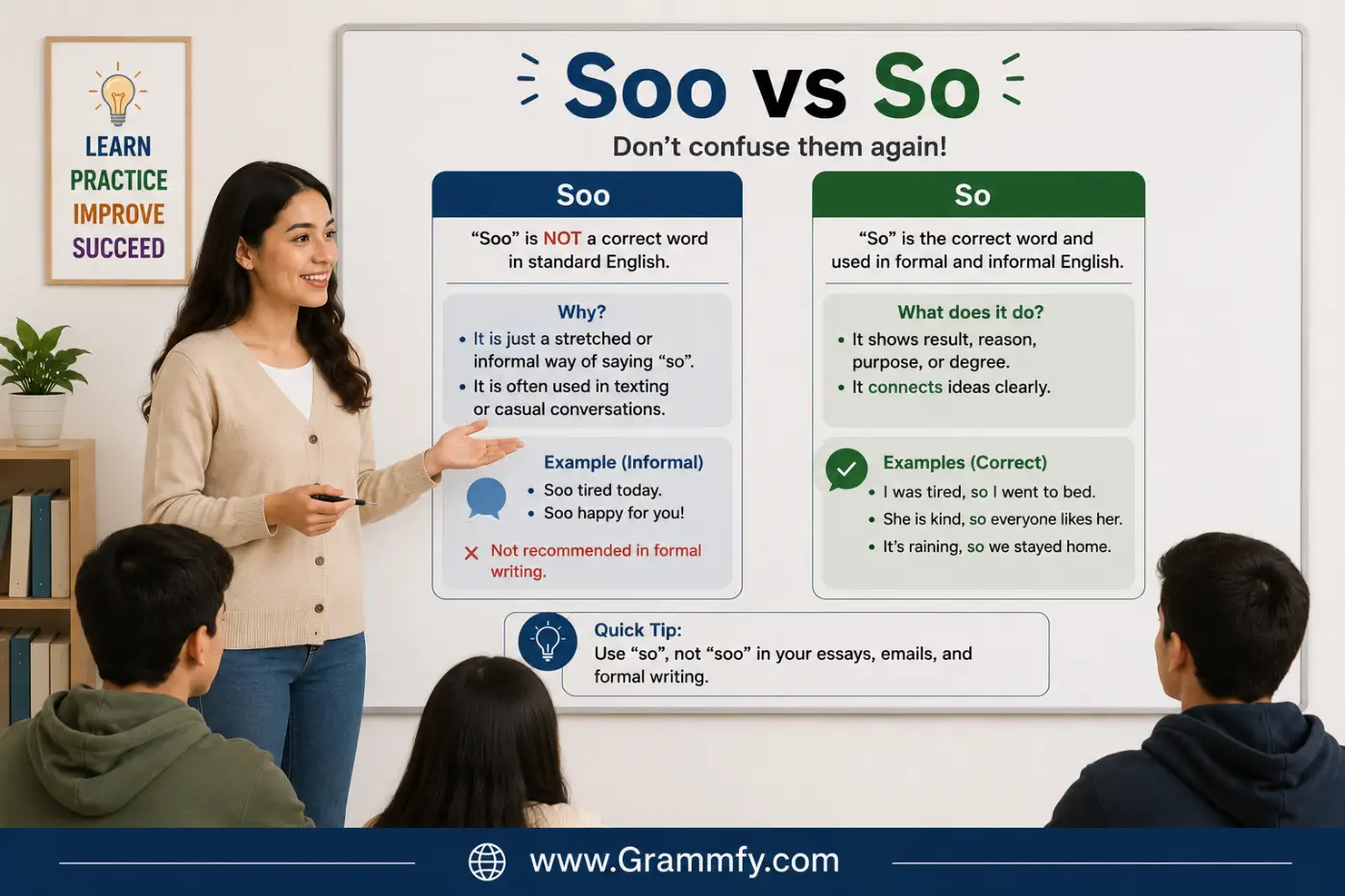
When you’re writing a text, email, essay, or social media post, you may wonder whether soo vs so is the right choice. The answer is simple: so is the standard English word, while soo is usually an informal spelling, a typo, or a stylized form used online.
Answer box: So is the correct standard English spelling. Soo is generally not standard English, although it may appear in casual messages, usernames, names, or playful online writing.
The word so has several important jobs. It can show a high degree, connect ideas, introduce a result, or replace information that is already understood. For example, “She is so happy,” “It was raining, so we stayed home,” and “I think so” all use so correctly.
This guide explains the meaning, history, grammar, spelling, synonyms, common mistakes, and context of soo vs so. You’ll also see examples for texting, email, essays, resumes, speaking, and everyday English.
This is one of several grammar rules that can cause confusion. Learn more in [time has flew by or time has flown by].
What is the correct spelling: Soo vs So?
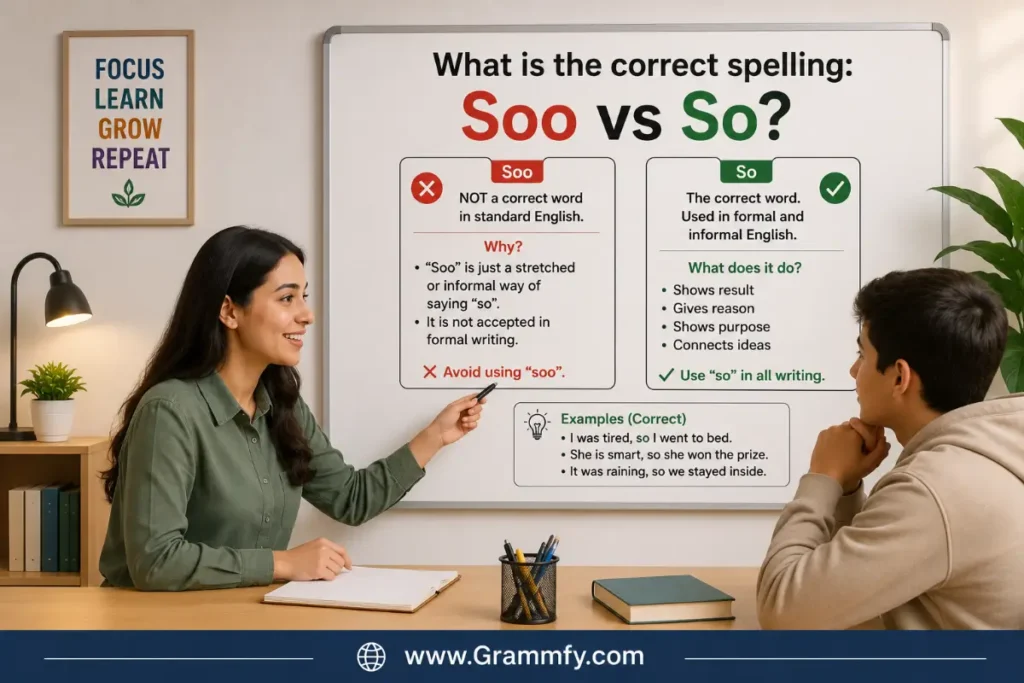
The standard spelling is so.
Soo is not normally accepted as a standard English spelling of the word so.
| Word | Standard English? | Common use |
|---|---|---|
| so | Yes | Standard writing and speech |
| soo | Usually no | Informal, playful, stylized, or mistaken writing |
For example:
I am so tired. ✅
Not:
I am soo tired. ❌
However, you may see soo in texts such as:
I am soo happy!
Here, the writer is usually stretching the spelling to show extra emotion. It works as an informal online style, but it isn’t the standard spelling.
For schoolwork, business emails, resumes, articles, and other formal writing, use so.
Why do people write soo instead of so?
There are several reasons.
Soo can be an intentional informal spelling
People sometimes repeat letters online to make emotions stronger.
For example:
I’m soo excited!
The extra o makes the word look more dramatic. The writer usually isn’t trying to create a new standard word.
Other examples include:
- sooo
- sooooo
- noooo
- yesss
- pleeease
These spellings are common in casual digital communication.
Soo can be a typing mistake
Because so is such a short word, adding another letter can happen accidentally.
Someone might type:
I am soo tired.
when they intended:
I am so tired.
In this situation, soo is simply an error.
Soo can appear as a name or proper noun
You may encounter Soo as part of a person’s name, place name, business name, or other proper noun. In that situation, it isn’t functioning as the ordinary English word so.
For example, a person’s name may contain “Soo.” That doesn’t make soo a standard alternative spelling of the English adverb or conjunction so.
What does so mean in plain English?
So is a small word with several different meanings and grammatical functions.
It can mean:
- To a high degree
- Therefore or as a result
- In this way
- To the same degree
- About something previously mentioned
- Very or extremely in informal emphasis
Examples:
She is so kind.
It was late, so we went home.
Hold the box so.
I think so.
Because so has multiple functions, context determines its exact meaning.
What does soo mean in plain English?
In ordinary standard English, soo does not have a separate standard meaning that replaces so.
Online, however, it may be used as a playful spelling.
For example:
That was soo funny!
The writer means:
That was so funny!
The extra o adds emphasis.
You may also see:
I miss you sooo much!
The writer is intentionally extending the spelling to make the emotion stronger.
This is common in informal communication, but it should not be treated as standard spelling.
Is soo a real English word?
Usually, soo is not a standard English spelling of so.
It can appear in dictionaries or reference sources in other contexts, including names or words from other languages, but that does not make it an accepted replacement for the ordinary English word so.
If you’re writing a normal English sentence, use:
so
For example:
The movie was so good.
Not:
The movie was soo good.
What is the origin of so?
The word so is very old. It comes from Old English swā, which was used in meanings related to “in this way,” “to such a degree,” or “thus.”
Over many centuries, the word developed and remained an important part of English grammar.
Modern English uses so in several ways because it inherited and expanded these older functions.
You can see its history in expressions involving:
- manner
- degree
- result
- agreement
- comparison
For example:
Do it so.
Here, it relates to manner.
It was so cold.
Here, it expresses degree.
It was cold, so we stayed inside.
In this use, it expresses a result.
This variety makes so one of the most useful short words in English.
What part of speech is so?
So can serve different grammatical roles depending on the sentence.
So as an adverb
It can show degree or intensity.
She is so happy.
The test was so difficult.
Here, so modifies an adjective.
It can also modify an adverb:
He ran so quickly.
So as a conjunction
It can connect an action with its result.
It was raining, so we stayed home.
Here, the second part explains the result of the first.
So as a substitute for an idea
It can stand for something already understood.
Do you think he’ll come?
I think so.
Here, so represents the idea that he will come.
So in comparisons
It can be used with as:
She is so tall that she can reach the shelf.
It also appears in structures such as:
I don’t think so.
This gives the word several grammatical functions.
How is so used to show degree?
One of the most common uses of so is to emphasize an adjective or adverb.
Examples:
The movie was so funny.
She was so excited.
He ran so quickly.
The water is so cold.
In these sentences, so means something like “to a very high degree.”
Compare:
The movie was funny.
The movie was so funny.
The second sentence has stronger emphasis.
How is so used to show a result?
So can connect a cause with a result.
Example:
I was tired, so I went to bed.
The first part gives the reason. The second part gives the result.
More examples:
It was raining, so we canceled the picnic.
She studied hard, so she passed the test.
The store was closed, so we came back later.
He missed the bus, so he took a taxi.
This use is especially common in everyday speech and writing.
How is so used to mean “therefore”?
In many sentences, so means therefore, as a result, or for that reason.
Example:
The road was blocked, so we took another route.
You could rewrite it as:
The road was blocked; therefore, we took another route.
The meaning is similar, but so sounds more natural and conversational.
How is so used to express agreement?
So can refer back to a statement.
Example:
I think she is right.
I think so, too.
Here, so means “that she is right.”
Another example:
Will they win?
I hope so.
Again, so replaces a longer idea.
This makes English more concise.
How is so used in “so do I”?
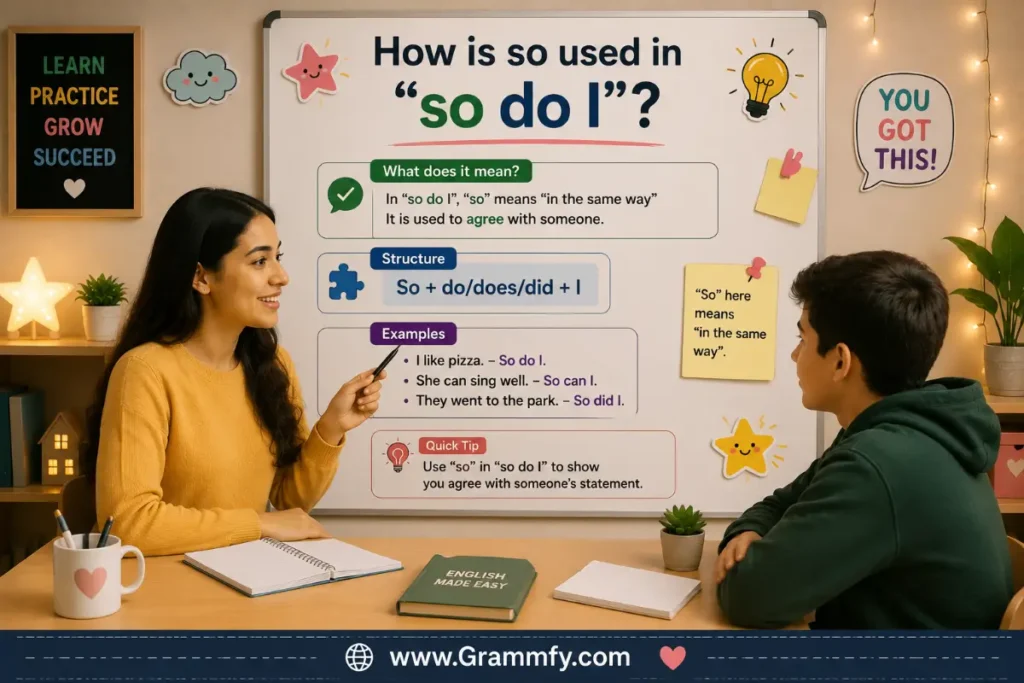
The structure so do I means that the speaker agrees with a positive statement.
Example:
I love this song.
So do I.
This means:
I love this song too.
Other examples include:
She likes coffee. So do I.
He works here. So does his brother.
They enjoyed the show. So did we.
The helping verb changes according to the original sentence.
How is so used in “I think so”?
I think so is a common expression meaning “I think that is true.”
Example:
Is the store open?
I think so.
It avoids repeating the entire idea.
Instead of:
I think the store is open.
you can simply say:
I think so.
This is common in both spoken and written English.
How is so used in “I hope so”?
I hope so expresses a positive expectation or wish.
Example:
Will we get there on time?
I hope so.
The word so represents the expected idea:
I hope we get there on time.
This expression is very common in everyday conversation.
Master synonym list for so
Because so has several meanings, its alternatives depend on how it is being used.
| Word | Meaning | Tone | Example |
|---|---|---|---|
| very | To a high degree | Neutral | She is very happy. |
| extremely | To a very high degree | Strong | It is extremely cold. |
| really | To a high degree | Everyday | That was really good. |
| highly | To a great degree | Formal | It is highly effective. |
| incredibly | To an unusual degree | Strong | She is incredibly talented. |
| especially | More than usual | Neutral | I especially liked this part. |
| greatly | To a large degree | Formal | We greatly appreciate it. |
| therefore | For that reason | Formal | It rained; therefore, we left. |
| consequently | As a result | Formal | He was late; consequently, he missed it. |
| therefore | As a result | Formal | She studied; therefore, she passed. |
| likewise | In the same way | Formal | I agree, and likewise, she does. |
| similarly | In a similar way | Formal | Both teams performed similarly. |
| thusly | In this way | Formal/Uncommon | The process was thusly completed. |
| indeed | Really or certainly | Formal | It was indeed difficult. |
| absolutely | Completely or strongly | Strong | That’s absolutely true. |
| totally | Completely | Casual | I totally agree. |
| really | To emphasize | Casual | I’m really tired. |
| super | Very | Informal | She’s super nice. |
| totally | Completely | Informal | That’s totally fine. |
| incredibly | Very | Everyday/Strong | The view was incredibly beautiful. |
| awfully | Very | Informal | It’s awfully cold today. |
| quite | To some or a fairly high degree | Neutral | It was quite difficult. |
| rather | To a fairly high degree | Neutral/Formal | It was rather expensive. |
| pretty | Fairly or quite | Informal | It’s pretty good. |
Not every synonym can replace so in every sentence. For example, therefore can replace result-based so, but it cannot replace degree-based so.
You can say:
It was so cold.
or:
It was extremely cold.
But you cannot say:
It was therefore cold.
The meaning and grammar are different.
Simple alternatives to so
For everyday writing, these are common alternatives:
- very
- really
- quite
- extremely
- therefore
- as a result
- in this way
The correct option depends on the sentence.
She was so tired.
Possible alternative:
She was very tired.
But:
It was raining, so we stayed home.
would become:
It was raining, so we stayed home.
or:
It was raining; therefore, we stayed home.
The second sentence changes the tone to something more formal.
Everyday alternatives to so
In casual speech, people often use:
- really
- very
- pretty
- super
- totally
- a lot
- because of that
- that’s why
Examples:
I’m really tired.
She’s super friendly.
It was raining. That’s why we stayed home.
These expressions sound natural in conversation.
Formal alternatives to so
Formal writing may use:
- therefore
- consequently
- thus
- hence
- accordingly
- as a result
- to such an extent
For example:
The evidence was incomplete; therefore, the researchers continued the study.
This sounds more formal than:
The evidence was incomplete, so the researchers continued the study.
Both are grammatical. The difference is mainly style and structure.
Synonyms by intensity: mild to strong
When so means “to a high degree,” you can choose an alternative based on intensity.
Mild
- quite
- rather
- fairly
- pretty
Example:
The test was fairly difficult.
Moderate
- very
- really
- highly
Example:
The test was very difficult.
Strong
- extremely
- incredibly
- remarkably
- exceptionally
Example:
The test was extremely difficult.
Very strong or expressive
- absolutely
- unbelievably
- extraordinarily
Example:
The result was absolutely amazing.
Be careful with strong words. If you use extremely or absolutely, you’re making a stronger claim than you would with quite.
Synonyms by part of speech
The alternatives to so change depending on its grammatical role.
When so means “very”
Use adverbs such as:
- very
- extremely
- really
- highly
- incredibly
Example:
She is extremely talented.
When so means “therefore”
Use connectors such as:
- therefore
- thus
- consequently
- hence
- as a result
Example:
The road was closed; therefore, we turned around.
When so means “in this way”
Use:
- thus
- this way
- in this manner
Example:
Hold the paper this way.
When so replaces an idea
Often, no direct replacement is necessary. You can repeat the original idea.
I think so.
could become:
I think that’s true.
soo vs so in texting
Texting is where soo is most likely to appear.
You might see:
I’m soo happy!
That was sooo funny!
I miss you soo much!
In these examples, the writer is usually using an informal spelling for emotional emphasis.
In a casual conversation with friends, this style is understandable.
However, if you’re writing a school assignment, professional message, job application, or formal email, use so.
Compare:
Casual text:
I’m sooo excited!!!
Standard writing:
I’m so excited!
The first is expressive. The second is standard.
Soo vs So in social media
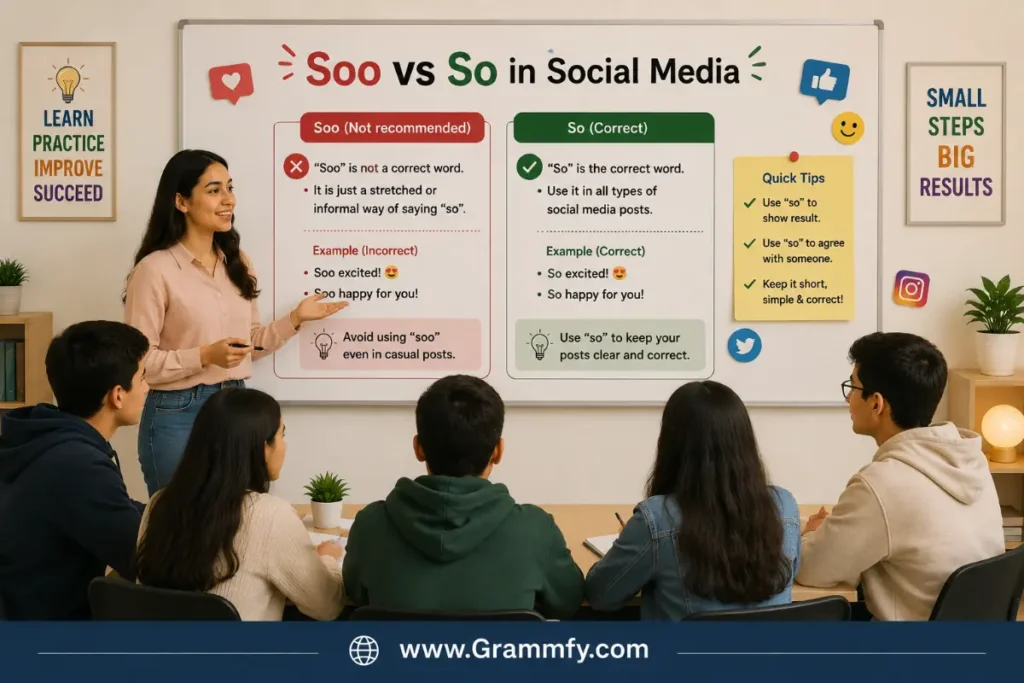
Social media often allows creative spelling.
Users may write:
- sooo
- sooo much
- sooooo cute
- soo good
- soooooo excited
The extra letters are often deliberate.
This style can show:
- excitement
- surprise
- affection
- frustration
- humor
- exaggeration
It isn’t usually meant to follow formal spelling rules.
For example:
This puppy is sooo cute!
The repeated o’s make the statement more emotional.
In a professional social media post, however, standard spelling is usually a better choice.
What is the best word for a resume?
A resume should normally use standard English, so use so, not soo.
However, resumes often benefit from replacing vague emphasis with specific information.
Weak:
I was so successful at managing projects.
Stronger:
Managed 15 projects and completed 95% of them before deadline.
Instead of:
I was so good at customer service.
Try:
Resolved customer concerns and improved satisfaction scores.
A resume is stronger when it shows measurable achievements rather than relying on intensifiers.
What is the best word for an essay?
For an essay, use standard so.
Example:
The character was so frightened that he could not speak.
This is correct.
In formal academic writing, you may sometimes replace result-based so with a more formal connector:
The character was extremely frightened; therefore, he could not speak.
However, don’t replace every so with a formal word. Simple language can often be clearer.
The best academic writing uses the word that expresses the relationship most accurately.
What is the best word for texting?
For texting, so is the standard choice, but soo or sooo may be used intentionally for emphasis.
Standard:
I’m so tired.
Informal:
I’m sooo tired.
Both communicate the basic idea, but they have different styles.
If you want your message to look polished, use so.
If you’re deliberately being playful or dramatic with friends, extended spelling may be acceptable.
What is the best word for an email?
Professional emails should use so.
Example:
The deadline is tomorrow, so please send your documents today.
You can also use therefore or as a result when a more formal tone is appropriate.
For example:
The deadline has changed. Therefore, all documents must be submitted by Friday.
The key is to match the connector to the tone of the email.
What is the best word for speaking?
In everyday speech, so is usually the most natural choice.
Examples:
I’m so tired.
It was so funny.
I was late, so I took a taxi.
I think so.
Formal alternatives can sound unnatural in casual conversation.
For example:
I was late; consequently, I took a taxi.
This is grammatical, but it sounds more formal than normal conversation requires.
15 original example sentences using so
Everyday situations
- I was so tired after work.
- The coffee was so hot that I had to wait.
- She was so happy about the news.
- The movie was so funny that we watched it twice.
- It was raining, so we stayed inside.
School
- The assignment was so difficult that many students asked questions.
- He studied hard, so he passed the exam.
- The teacher explained the topic clearly, so everyone understood it.
Work
- The meeting started late, so we shortened the discussion.
- The instructions were so clear that the team finished quickly.
- She was busy, so I sent her an email.
Travel
- The flight was delayed, so we waited at the airport.
- The hotel was so comfortable that we wanted to stay longer.
Conversation
- I think so.
- I hope so.
These examples show the two most common uses: degree and result.
Close comparison: so vs very
So and very can both increase the strength of an adjective or adverb.
Compare:
She is very happy.
She is so happy.
The meanings are similar, but so often sounds more expressive or emotional.
Another difference appears when so introduces a result:
She was so tired that she went home.
The structure so + adjective + that is especially useful for showing a result.
You cannot always replace this structure directly with very without changing the sentence.
Close comparison: so vs therefore
These words can both connect a cause with a result.
| So | Therefore |
|---|---|
| Common in everyday English | More formal |
| Easy and conversational | Formal and academic |
| Often connects two clauses | Often used with punctuation |
| Natural in speech | Common in formal writing |
Examples:
It was raining, so we stayed home.
It was raining; therefore, we stayed home.
Both are correct.
The choice depends on tone.
Close comparison: so vs really
Both can add emphasis.
That movie was so good.
That movie was really good.
Both are natural.
Really often sounds straightforward and conversational.
So can sound more expressive, especially when followed by that:
The movie was so good that I watched it twice.
Common mistakes with Soo vs So
Mistake 1: Using soo in formal writing
Incorrect:
The results were soo important.
Correct:
The results were so important.
Mistake 2: Assuming soo is the standard spelling
The extra o does not make a new standard form.
Correct:
so
Informal stylistic spelling:
soo / sooo / sooooo
Mistake 3: Using very when a result structure needs so
Consider:
It was so cold that we stayed inside.
The structure is:
so + adjective + that + result
You shouldn’t casually replace it with:
It was very cold that we stayed inside.
Instead:
It was very cold, so we stayed inside.
The sentence structure changes.
Mistake 4: Using therefore in casual speech too often
Therefore is correct, but it can sound stiff in everyday conversation.
Natural:
I was tired, so I went home.
More formal:
I was tired; therefore, I went home.
Choose based on context.
When should you not use so?
Although so is common and useful, sometimes a more precise word is better.
Avoid vague emphasis
Instead of:
The project was so good.
Consider:
The project increased customer engagement by 20%.
Specific details communicate more information.
Avoid repeated so
A paragraph can sound weak if every sentence uses so.
For example:
The room was so large. The windows were so bright. The furniture was so modern.
A stronger version might be:
The room was spacious, with bright windows and modern furniture.
Avoid informal so in highly formal contexts when a precise connector fits better
Instead of:
The evidence was weak, so the researchers continued testing.
A formal report might say:
The evidence was insufficient; therefore, the researchers continued testing.
This isn’t a rule that so is wrong. It’s a style choice.
Antonyms of so
Because so has several meanings, its antonyms depend on the function.
When so means “very,” possible contrasts include:
- slightly
- barely
- hardly
- mildly
- somewhat
Example:
She was so tired.
Contrast:
She was only slightly tired.
When so means “therefore,” there isn’t one direct antonym. You may need a phrase such as:
- despite that
- nevertheless
- however
- even so
Example:
It was raining, so we stayed home.
Contrast:
It was raining; however, we went outside.
The meaning changes because however introduces a contrast rather than a result.
How do you choose the right alternative to so?
Start by asking what so means in your sentence.
Does it mean “very”?
Use:
- very
- really
- extremely
- highly
- incredibly
Does it mean “therefore”?
Use:
- therefore
- thus
- consequently
- as a result
Does it mean “in this way”?
Use:
- this way
- in this manner
- thus
Does it replace an idea?
Keep so, or repeat the idea if greater clarity is needed.
For example:
I think so.
could become:
I think that’s true.
This simple test prevents many awkward substitutions.
Quick tips for remembering Soo vs So
Use these rules:
- So is the standard spelling.
- Soo is usually informal or incorrect.
- Use so in school assignments.
- Use so in resumes.
- Use so in professional emails.
- Use so in formal articles.
- Soo may appear in playful texting.
- Repeated letters can show emotion online.
- Don’t treat soo as a standard synonym.
- Check whether so means degree, result, manner, or agreement.
A simple memory trick is:
One “o” is the standard “so.”
If you’re writing something formal, don’t add an extra o.
How can you proofread so correctly?
When proofreading, look at the surrounding sentence.
If you see:
soo
ask yourself:
Am I using the ordinary English word meaning “so”?
If yes, change it to:
so
If the word is part of a person’s name, business name, place name, or intentionally stylized expression, keep it only when that spelling is actually intended.
This quick check works especially well when editing informal text into professional English.
Is soo acceptable in formal writing?
No, not as a casual replacement for so.
Formal writing should use standard spelling.
Examples:
The results were so significant that the study was repeated.
The meeting was canceled, so the staff returned to their offices.
Avoid:
The results were soo significant.
The extra letter can make the writing look like a typo.
Is soo acceptable in texting?
It can be acceptable as an informal stylistic choice.
For example:
I’m sooo excited!!!
The writer is intentionally stretching the word.
However, if the goal is correct standard English, use:
I’m so excited!
The choice depends on whether you’re prioritizing formal correctness or playful expression.
Is so one of the most common English words?
Yes. So is a very common English word because it serves many grammatical functions.
It can:
- modify adjectives
- modify adverbs
- connect clauses
- introduce results
- replace information
- express agreement
- introduce manner
- appear in fixed expressions
Examples include:
so happy
so quickly
I think so
so we left
so do I
so far
so much
so many
Its short length also makes it easy to use repeatedly, so writers should watch for unnecessary repetition.
Common expressions with so
So far
Means “until now.”
So far, everything is going well.
So much
Used with uncountable nouns or for emphasis.
Thank you so much.
So many
Used with plural countable nouns.
There were so many people.
So long
Can refer to duration or be used as a farewell.
It took so long.
So far as
A more formal expression meaning “as much as.”
So far as I know, the store is closed.
So that
Can introduce a purpose or result.
I left early so that I wouldn’t miss the bus.
So do I
Used to agree with a positive statement.
I like pizza.
So do I.
These expressions show how flexible so is in English.
Why standard spelling matters Soo vs So
Using standard spelling helps readers understand your meaning quickly.
In casual online communication, playful spellings are common and usually harmless.
But in a resume, school essay, professional email, application, report, or website article, standard spelling matters more.
Compare:
We are soo pleased with the results.
and:
We are so pleased with the results.
The second version looks polished and professional.
The first may look like an accidental typing error unless the informal style is clearly intentional.
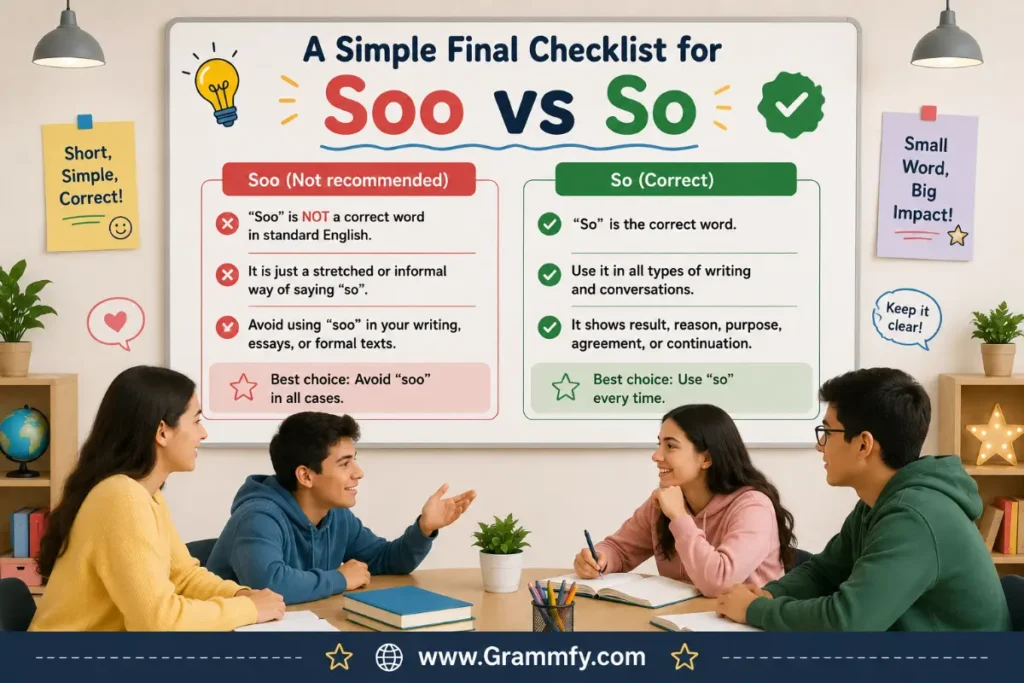
A simple final checklist for Soo vs So
Before publishing or sending your writing, check:
- Did I use so as the standard spelling?
- Did I accidentally type soo?
- If I used soo, was it intentionally informal?
- Is the writing formal or professional?
- Does so mean “very” in my sentence?
- Does so introduce a result?
- Could a more precise word improve the sentence?
- Have I repeated so too many times?
- Would therefore or as a result fit a formal sentence better?
- Does the sentence sound natural when read aloud?
Conclusion
The key difference in soo vs so is simple: so is the standard English spelling, while soo is generally an informal or stylized version used in casual digital communication. The extra o can add emotion in a text, but it shouldn’t replace standard spelling in schoolwork, resumes, professional emails, or formal articles.
The word so is much more versatile than its short length suggests. It can express degree, connect a cause with a result, describe manner, and stand for an idea already mentioned. When choosing an alternative, first identify what so means in your sentence. Then choose a word such as very, extremely, therefore, or as a result when it makes the meaning clearer.
For standard English, the safest rule is easy: use so.
Frequently Asked Questions
Is soo or so the correct spelling?
So is the standard English spelling. Soo is usually an informal, playful spelling or a typo.
Is soo a real word in English?
Soo is not normally used as the standard spelling of the English word so. It can appear in names, proper nouns, or stylized informal writing.
Why do people write sooo instead of so?
People often repeat the letter o online to add emotional emphasis. For example, “I’m sooo excited!” sounds more expressive than “I’m so excited!”
What’s another way to say so?
If so means “very,” alternatives include very, really, extremely, highly, and incredibly. If it means “therefore,” alternatives include therefore, thus, consequently, and as a result.
Can I use soo in a text message?
Yes, it can be used as a playful informal spelling in texting, but so is the standard form. Avoid soo when you need polished or formal English.
Should I use so or soo in a resume?
Use so in a resume. A professional resume should use standard spelling and avoid casual spellings such as soo or sooo.
Is so more common in American or British English?
So is standard in both American and British English. There is no major regional spelling difference between the two forms.

Tylerbrooks is a US-based English grammar writer and contributor at Grammfy. He writes helpful articles about grammar, spelling, commonly confused words, and vocabulary. His goal is to explain English topics in simple language with clear examples and practical tips. Through his articles, he helps readers improve their writing and everyday English skills.