
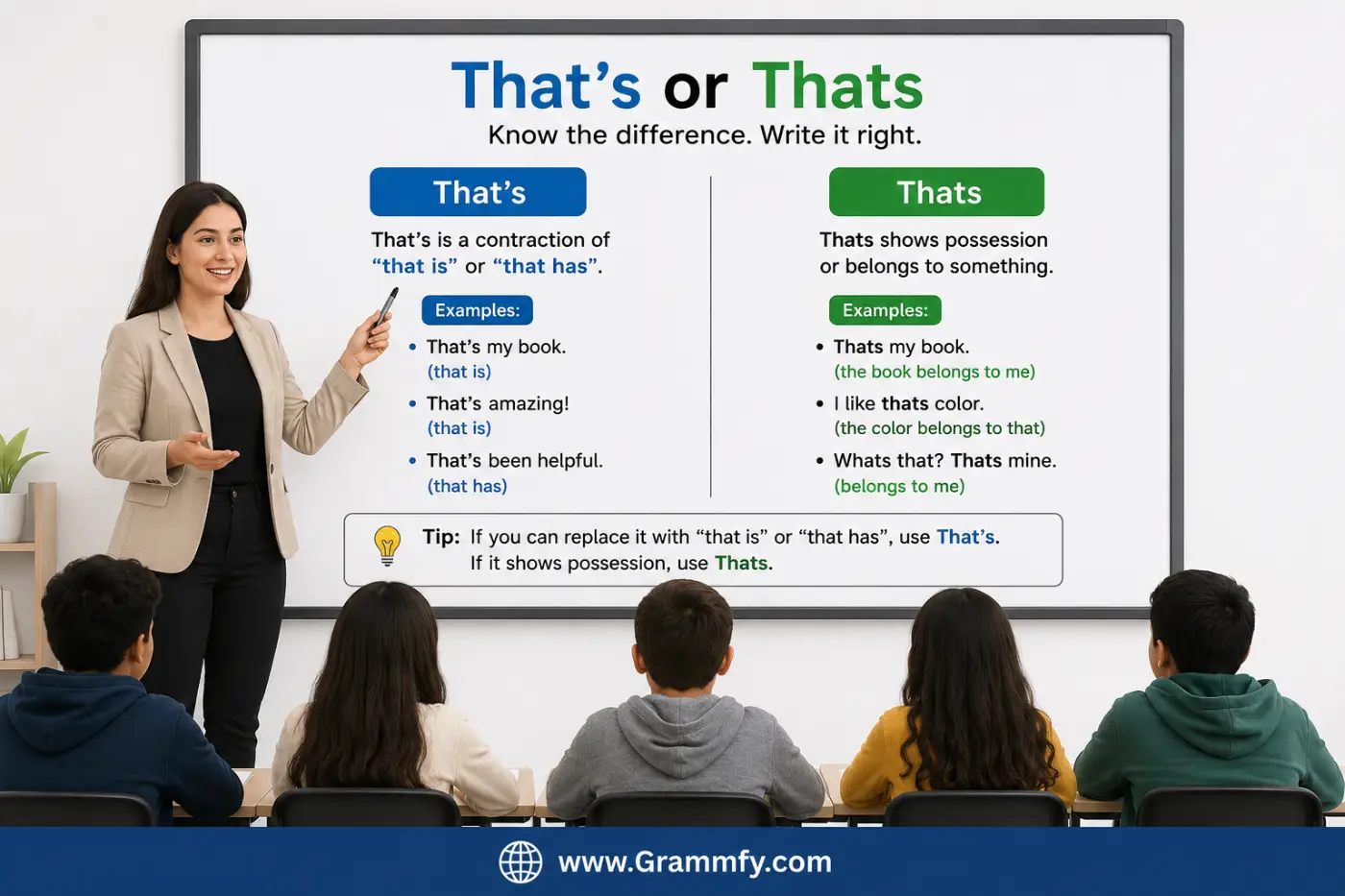
You’re writing a text, email, essay, or social media post, and you type “thats” before stopping to wonder whether it needs an apostrophe. You may also see “that’s” everywhere and wonder what the apostrophe actually does. The two forms look almost identical, but only one is standard English when you’re using the contraction.
Answer box: “That’s” is the correct standard form when you mean “that is” or “that has.” “Thats” is normally incorrect in standard English because it leaves out the apostrophe.
Understanding that’s or thats is simple once you know what the apostrophe represents. The key is not to memorize a complicated spelling rule. Instead, expand the word and check whether “that is” or “that has” makes sense.
This guide explains the meaning, history, grammar, pronunciation, common mistakes, alternatives, and real-world uses. You’ll also see how the choice works in texts, emails, resumes, essays, and everyday speech.
This rule connects closely with the grammar explained in [would vs should].
What does “that’s” mean in plain English?
That’s is a contraction. A contraction combines two words and replaces one or more letters with an apostrophe.
The most common meanings are:
- that’s = that is
- that’s = that has
Examples:
That’s my phone.
This means:
That is my phone.
Another example:
That’s been a difficult week.
This means:
That has been a difficult week.
The apostrophe matters because it shows that letters have been removed.
| Short form | Full form | Example |
|---|---|---|
| that’s | that is | That’s a great idea. |
| that’s | that has | That’s happened before. |
| thats | — | Not normally correct in standard English |
So when you’re deciding that’s or thats, the first question should be: Can I expand it to “that is” or “that has”?
If yes, use that’s.
Why does “that’s” have an apostrophe?
The apostrophe marks missing letters.
In:
that’s
the apostrophe tells the reader that the word is a shortened form of that is or that has.
For example:
That is → that’s
The apostrophe replaces the missing i from is.
Likewise:
That has → that’s
The apostrophe represents the shortened form.
This is the same basic idea behind other contractions:
| Full words | Contraction |
|---|---|
| I am | I’m |
| you are | you’re |
| he is | he’s |
| she is | she’s |
| it is | it’s |
| we are | we’re |
| they are | they’re |
| that is | that’s |
| that has | that’s |
This is why thats is usually considered a spelling error when the writer intends the contraction.
Where did “that’s” come from?
The word that is very old. It comes from Old English forms related to þæt, which was used as a demonstrative pronoun, determiner, or conjunction.
The combination that is has been used for centuries. As English developed, speakers naturally shortened common combinations in everyday speech. These shortened forms eventually became written contractions such as that’s.
The apostrophe became a useful written signal for omitted letters.
This pattern appears throughout English. People tend to shorten frequent expressions because they’re easier and faster to say.
For example:
- do not → don’t
- cannot → can’t
- I will → I’ll
- we are → we’re
- that is → that’s
The contraction isn’t a new word with a completely unrelated meaning. It is a shortened grammatical form of the original words.
Is “thats” ever correct?
In standard modern English, thats is normally not correct when you mean that is or that has.
You might see thats in:
- informal texting
- usernames
- hashtags
- song titles
- branding
- deliberately casual writing
- typing without punctuation
- social media posts
For example, someone might type:
thats crazy lol
That’s common online, but standard edited English would write:
That’s crazy, lol.
The missing apostrophe doesn’t usually prevent people from understanding the sentence. However, it is still a punctuation error in formal or polished writing.
If you’re writing an essay, email, resume, article, application, or professional message, use that’s when the contraction is intended.
How can you tell whether to use “that’s”?
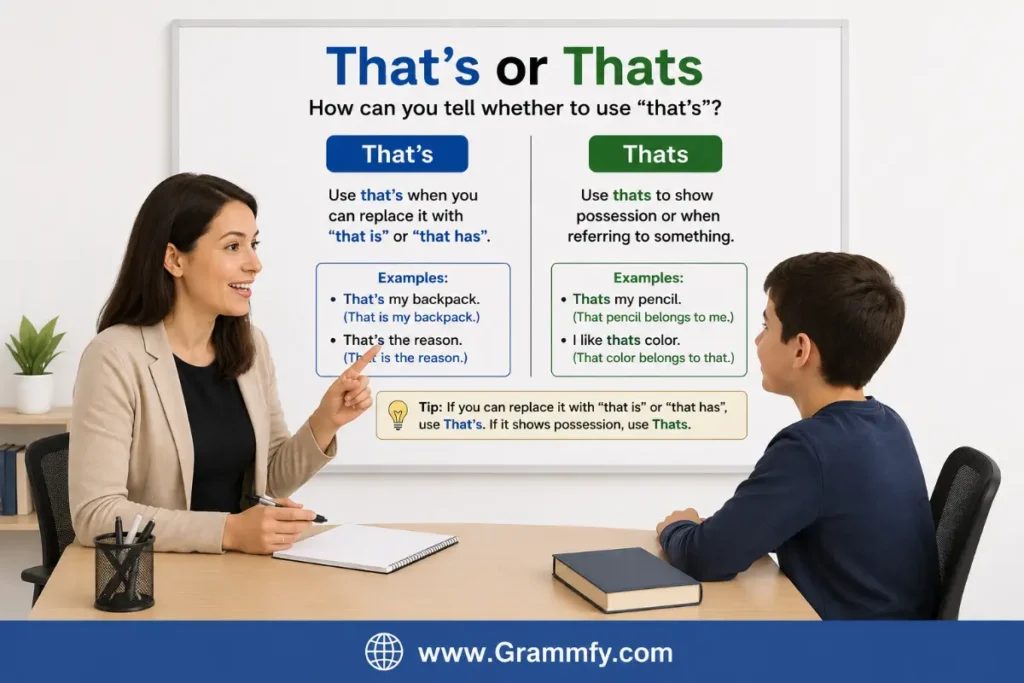
Use this simple replacement test.
Step 1: Replace “that’s” with “that is”
Example:
That’s a beautiful painting.
Expand it:
That is a beautiful painting.
It works. So that’s is correct.
Another example:
That’s why I called you.
Expand it:
That is why I called you.
It works again.
Step 2: Try “that has”
Example:
That’s happened before.
Expand it:
That has happened before.
That works too.
Step 3: If neither works, check the sentence
Sometimes that should be written as a separate word, without an apostrophe.
For example:
I know that you are busy.
You cannot replace that with that’s.
Incorrect:
I know that’s you are busy.
Correct:
I know that you are busy.
The apostrophe isn’t something you add to that whenever it appears. It belongs there only when you’re forming the contraction.
That’s vs. that — what’s the difference?
That’s and that are not interchangeable.
That is a regular word that can work as a:
- determiner
- pronoun
- conjunction
- relative word
Examples:
That book belongs to me.
I think that she is right.
The car that I bought is blue.
That’s is a contraction.
That’s my book.
Here, that’s means that is.
Compare:
That car is expensive.
and:
That’s expensive.
The first uses that to identify a particular car.
The second uses that’s to mean that is.
That’s vs. its — what’s the difference?
This is one of the most common apostrophe problems in English.
That’s = that is or that has
Its = possessive form of it
Examples:
That’s a cute dog.
= That is a cute dog.
The dog wagged its tail.
Here, its means the tail belongs to the dog.
The important trick is:
If you can replace the word with it is or it has, use it’s, not its.
But that’s a separate contraction from that’s.
| Word | Meaning | Example |
|---|---|---|
| that’s | that is / that has | That’s my seat. |
| that | demonstrative or conjunction | I know that answer. |
| its | belonging to it | The cat cleaned its paws. |
| it’s | it is / it has | It’s cold today. |
Master list of alternatives and related expressions
“That’s” doesn’t have 30 exact synonyms because it is a grammatical contraction, not a descriptive adjective or action verb. However, depending on context, you can replace it with related expressions that communicate the same basic idea.
The following list gives useful alternatives grouped by tone.
Simple alternatives
| Word or expression | Meaning | Tone | Example |
|---|---|---|---|
| that is | full form of that’s | Neutral | That is my answer. |
| that has | full form in perfect constructions | Neutral | That has happened before. |
| it is | identifies something as a fact | Neutral | It is a good idea. |
| it has | indicates a completed action/state | Neutral | It has changed. |
| this is | identifies something nearby or current | Neutral | This is my book. |
| that thing | identifies an object or idea | Casual | That thing is broken. |
| the fact is | introduces a fact | Neutral | The fact is, we need more time. |
| the point is | introduces the main idea | Neutral | The point is that we tried. |
Everyday alternatives
| Word or expression | Meaning | Tone | Example |
|---|---|---|---|
| that’s it | finished or exactly correct | Casual | That’s it! |
| that’s right | confirms something | Everyday | That’s right. |
| that’s true | agrees with a statement | Everyday | That’s true. |
| that’s fine | says something is acceptable | Casual | That’s fine with me. |
| that’s okay | accepts something | Casual | That’s okay. |
| that’s great | expresses approval | Friendly | That’s great news. |
| that’s good | expresses approval | Everyday | That’s good to hear. |
| that’s enough | says no more is needed | Direct | That’s enough for today. |
Formal alternatives
| Word or expression | Meaning | Tone | Example |
|---|---|---|---|
| that is | full, formal form | Formal/neutral | That is the main concern. |
| that has | full form | Formal/neutral | That has affected the results. |
| this indicates | shows evidence | Formal | This indicates a change. |
| this demonstrates | clearly shows | Formal | This demonstrates the problem. |
| this means | explains significance | Formal/neutral | This means the plan must change. |
| the evidence shows | states a supported conclusion | Formal | The evidence shows a pattern. |
| the results indicate | describes findings | Formal | The results indicate improvement. |
| the conclusion is | states a final point | Formal | The conclusion is clear. |
Slang and casual expressions
| Word or expression | Meaning | Tone | Example |
|---|---|---|---|
| that’s wild | that’s surprising | Slang/casual | That’s wild! |
| that’s crazy | that’s surprising | Slang/casual | That’s crazy. |
| that’s nuts | that’s very surprising | Slang | That’s nuts! |
| that’s awesome | that’s very good | Casual | That’s awesome. |
| that’s legit | that’s genuine or good | Slang | That’s legit. |
| that’s sick | that’s impressive | Slang | That’s sick! |
| that’s rough | that’s difficult or unfortunate | Casual | That’s rough. |
| that’s a lot | something is excessive or surprising | Casual | That’s a lot of homework. |
These expressions aren’t interchangeable in every sentence. Some are standard replacements, while others are context-specific reactions.
What are the different meanings of “that’s”?
The contraction can serve several purposes.
“That’s” can identify something
That’s my backpack.
Here, that’s means:
That is my backpack.
“That’s” can describe something
That’s expensive.
This means:
That is expensive.
“That’s” can introduce an explanation
That’s why I left early.
This means:
That is why I left early.
“That’s” can refer to an earlier idea
You missed the deadline. That’s the problem.
Here, that’s points back to the situation just mentioned.
“That’s” can mean “that has”
That’s been a difficult experience.
This means:
That has been a difficult experience.
The context usually makes the intended meaning clear.
How does “that’s” change with intensity?
The word itself doesn’t have mild or strong synonyms in the same way an adjective such as “angry” does. However, the expression that follows it can change the strength of your message.
Mild
That’s a little unusual.
That’s slightly difficult.
That’s not ideal.
These sound restrained.
Medium
That’s surprising.
That’s concerning.
That’s a serious problem.
These communicate a clearer reaction.
Strong
That’s absolutely unacceptable.
That’s extremely serious.
That’s completely unbelievable.
These express a much stronger response.
The contraction remains the same. The surrounding words create the intensity.
Which part of speech is “that’s”?
That’s is a contraction rather than a single traditional part of speech.
Depending on what it expands to, it can represent:
- that + is
- that + has
The word that itself has several grammatical functions.
That as a determiner
That car is mine.
Here, that comes before the noun car.
That as a pronoun
That’s mine.
Here, that’s means that is.
That as a conjunction
I know that you are tired.
Here, that connects two parts of the sentence.
You cannot normally turn this into that’s:
I know that’s you are tired. ❌
The contraction would change the grammar and meaning.
That as a relative word
The book that I borrowed was excellent.
Here, that introduces a relative clause.
Again, don’t add an apostrophe simply because the word appears in the sentence.
When is “that’s” best for a resume?
Should you use “that’s” on a resume?
You can use that’s if the sentence genuinely requires the contraction, but resumes often benefit from concise, direct language.
For example:
That’s why I developed a new reporting system.
This may be grammatically correct, but a resume could make the point more directly:
Developed a new reporting system that reduced processing time.
The second version focuses on the achievement.
In professional documents, the issue isn’t that contractions are always wrong. It’s that strong writing often benefits from precise statements.
If you’re writing a professional summary, however, that’s may still appear naturally:
I believe that’s what makes my approach effective.
But a more formal version could be:
I believe that this approach makes my work effective.
Choose based on the style of the document.
When is “that’s” best for an essay?
Should essays use “that’s”?
In a school essay, that’s is grammatically correct, but the full form that is may sometimes sound more formal.
Compare:
That’s the main reason students struggle with the topic.
and:
That is the main reason students struggle with the topic.
Both are grammatical.
The second version has a more formal academic tone.
However, don’t assume every contraction is forbidden in every essay. Style depends on the assignment and teacher. If the assignment calls for formal academic writing, full forms may be a safer choice.
Also, don’t force the full form into places where that is actually a conjunction.
Correct:
Researchers found that the results were different.
Not:
Researchers found that’s the results were different.
When is “that’s” best for texting?
Is “that’s” okay in text messages?
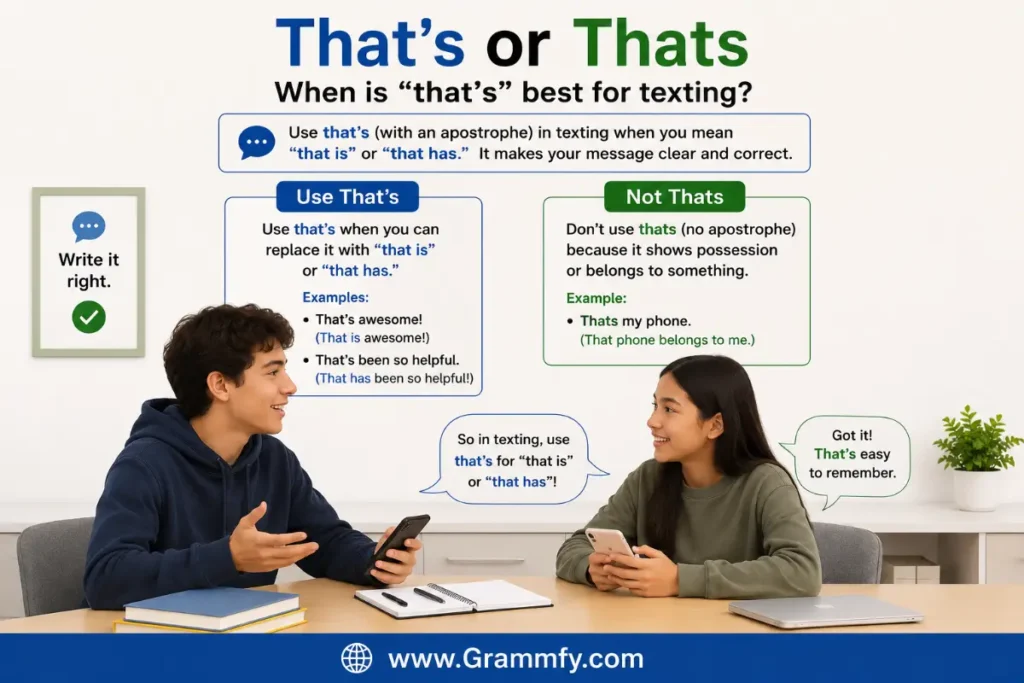
Yes. That’s is completely normal in casual texting.
Examples:
That’s hilarious 😂
That’s what I meant.
That’s fine!
I didn’t know that’s what you wanted.
Texting often uses contractions because they sound natural and save space.
You may see people omit the apostrophe:
thats fine
This is common in fast typing, but that’s fine is the standard spelling.
If you’re texting a friend, the missing apostrophe probably won’t cause confusion. If you’re writing something you want to look polished, include it.
When is “that’s” best in an email?
Is “that’s” professional in an email?
Yes. That’s is perfectly acceptable in many professional emails, especially in friendly or conversational workplaces.
For example:
That’s a helpful suggestion. Thank you.
That’s exactly what I needed.
I understand that’s the current deadline.
If you’re writing a highly formal letter or legal document, you may prefer:
That is a helpful suggestion.
But in most ordinary workplace communication, the contraction sounds natural and professional.
The key is consistency. Don’t use extremely casual slang in one sentence and very formal language in the next unless the context calls for it.
When is “that’s” best in speaking?
How do people pronounce “that’s”?
In everyday American English, that’s is usually pronounced as one short unit, roughly like “thats.”
The apostrophe is not a sound. It marks the missing letters in writing.
This is important because pronunciation can make the two forms seem identical.
When you hear:
That’s my car.
you don’t hear an audible apostrophe.
The spelling tells you the grammatical structure.
This is similar to:
it’s
and:
its
They sound the same in many contexts, but their meanings and grammatical roles differ.
What are common mistakes with “that’s”?
Mistake 1: Writing “thats” in standard English
Incorrect:
Thats a good idea.
Correct:
That’s a good idea.
The apostrophe is needed because the word means that is.
Mistake 2: Using “that’s” when you mean “that”
Incorrect:
The reason that’s I left was simple.
Correct:
The reason that I left was simple.
Here, that introduces a clause. It does not mean that is.
Mistake 3: Confusing “that’s” with “its”
Incorrect:
The company changed that’s policy.
Correct:
The company changed its policy.
The policy belongs to the company, so use possessive its.
Mistake 4: Confusing “that’s” with “it’s”
Incorrect:
That’s raining outside.
Correct:
It’s raining outside.
It’s means it is.
That’s means that is or that has.
Mistake 5: Adding an apostrophe to plural words
Sometimes writers learn that apostrophes are important and start adding them everywhere.
For example:
I bought three book’s.
This is incorrect.
The plural is:
I bought three books.
An apostrophe doesn’t normally make a noun plural.
When should you NOT use “that’s”?
Don’t use that’s just because you see the word that.
Use the contraction only when it means that is or that has.
Compare:
I know that she is tired.
Correct.
I know that’s she is tired.
Incorrect.
Now compare:
That’s why she left.
Correct.
Here, that’s = that is.
Another example:
The fact that he won surprised everyone.
Correct.
You don’t need an apostrophe because that is not a contraction.
What’s the difference between “that’s” and “that is”?
The meaning is usually the same when that’s is being used as the contraction.
That’s my desk.
That is my desk.
Both communicate the same basic idea.
The difference is mainly tone and emphasis.
That’s sounds natural and conversational.
That is can sound more formal or can add emphasis.
Compare:
That’s the problem.
with:
That is the problem.
The second can sound more deliberate, especially when the speaker stresses is.
In writing, the full form may also be preferred when you want a more formal tone.
That’s vs. “that has” — how can you tell?
Look at what follows the contraction.
If that’s is followed by an adjective or noun phrase, it often means that is:
That’s difficult.
That’s my brother.
That’s a good question.
If it is followed by a past participle in a perfect construction, it may mean that has:
That’s changed a lot.
= That has changed a lot.
That’s happened before.
= That has happened before.
Context makes the meaning clear.
What are some original examples of “that’s”?
Here are examples from real-life situations.
- At school:That’s the answer I got on my math test.
- In an email:That’s exactly the information I needed. Thank you.
- At work:That’s why we need to update the schedule.
- In a text:That’s so funny!
- At a restaurant:That’s the table we reserved.
- During a conversation:That’s a good point.
- While shopping:That’s too expensive for my budget.
- Talking about a past event:That’s happened to me before.
- Giving an explanation:That’s why I left early.
- Talking about weather:That’s a lot of snow for one night.
- In a classroom:That’s the example I wanted you to notice.
- During a phone call:That’s what I was trying to explain.
- At home:That’s my jacket on the chair.
- Discussing a mistake:That’s the part we need to fix.
- Talking about a goal:That’s exactly what I want to achieve.
- Talking about change:That’s changed since last year.
- Reacting to news:That’s surprising.
- Agreeing with someone:That’s true.
- Ending a discussion:That’s all I wanted to say.
- Giving reassurance:That’s okay. We can try again.
What’s another way to say “that’s”?
The best alternative depends on what that’s means in your sentence.
If it means that is, use:
- that is
- this is, when the reference changes
- the point is
- the fact is
- this means
- this indicates
If it means that has, use:
- that has
- this has, when the reference changes
For casual reactions, you can also use expressions such as:
- that’s great
- that’s fine
- that’s true
- that’s right
- that’s amazing
- that’s surprising
But these aren’t exact synonyms. They add a specific attitude or meaning.
How does “that’s” compare with “this is”?
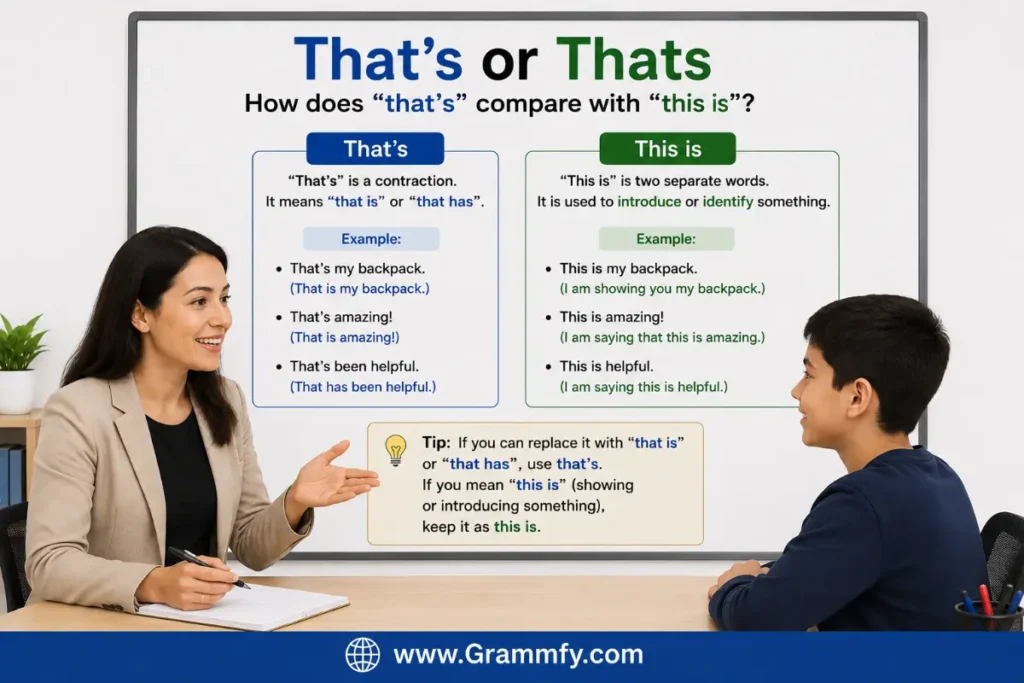
That’s usually points to something understood as farther away, previously mentioned, or already identified.
This is often points to something close, current, or being introduced.
Compare:
This is my new laptop.
You are introducing or presenting it.
Later:
That’s my new laptop.
You might point to it from across the room or refer back to it.
The difference isn’t always physical distance. It can also be about the flow of the conversation.
How does “that’s” compare with “it’s”?
These contractions are often confused because they both contain is.
That’s = that is
That’s my book.
It’s = it is
It’s mine.
Compare:
That’s a beautiful house.
You’re identifying the house.
It’s beautiful.
You’re describing it.
The first uses that to point to something. The second uses it to refer to something already understood.
How does “that’s” compare with “there’s”?
That’s = that is/has
There’s = there is/has
Examples:
That’s my seat.
There’s my seat.
These can both point toward something, but they have different grammatical structures.
There’s is commonly used to say that something exists or is located somewhere:
There’s a problem with the printer.
That’s identifies or describes something:
That’s a problem with the printer.
The meaning isn’t exactly the same.
Why do people leave out the apostrophe online?
Fast digital communication often drops punctuation.
People may write:
thats good
instead of:
that’s good
Other common shortcuts include:
dont
instead of:
don’t
and:
cant
instead of:
can’t
This doesn’t mean the punctuation is unnecessary in standard writing. It simply reflects informal typing habits.
If you’re writing for school, work, clients, customers, or a public audience, standard punctuation is the safer choice.
Quick tips for choosing the right form
Use these fast checks.
Tip 1: Try “that is”
That’s interesting.
→ That is interesting.
It works, so use that’s.
Tip 2: Try “that has”
That’s changed.
→ That has changed.
It works, so use that’s.
Tip 3: If you simply mean “that,” don’t add an apostrophe
I know that you are right.
Not:
I know that’s you are right.
Tip 4: Don’t confuse possession with contraction
The dog hurt its paw.
Not:
The dog hurt that’s paw.
Tip 5: Don’t trust pronunciation alone
That’s and thats can sound the same because the apostrophe isn’t pronounced.
Check the grammar, not just the sound.
Tip 6: Use the full form for emphasis or formality
That is the main issue.
This can sound more deliberate than:
That’s the main issue.
Tip 7: In standard writing, keep the apostrophe
If you mean that is or that has, write:
that’s
not:
thats
A quick decision table
| What you mean | Correct form | Example |
|---|---|---|
| that is | that’s | That’s my car. |
| that has | that’s | That’s changed. |
| the word “that” | that | I know that answer. |
| possession by “it” | its | Its color is bright. |
| it is | it’s | It’s cold. |
| it has | it’s | It’s been difficult. |
| informal missing punctuation | thats | Common online, but nonstandard |
| plural of a noun | usually no apostrophe | three books |
What should you use in formal writing?
When writing something formal, you have two good choices depending on the sentence.
If you want a natural but professional tone:
That’s the main reason for the change.
If you want a more formal or deliberate tone:
That is the main reason for the change.
Neither is automatically grammatically superior. The full form simply gives the sentence a more formal feel.
However, never replace that with that’s just to make writing sound formal.
Correct:
The report shows that sales increased.
The contraction would be wrong here.
Can “that’s” begin a sentence?
Yes.
There is no grammar rule saying a sentence cannot begin with that’s.
Examples:
That’s the problem.
That’s exactly what I mean.
That’s why we changed the plan.
That’s not what I expected.
These are normal English sentences.
The contraction can also appear in the middle or at the end of a sentence:
I think that’s a good idea.
The person you mentioned? That’s him.
Can “that’s” be used in questions?
Yes.
Examples:
That’s your car, right?
That’s the one you wanted?
That’s what you mean?
In natural conversation, speakers often use these questions to confirm information.
It can also appear in structures such as:
Why is it that’s causing the problem?
That structure is more complex and usually not needed for beginners.
For simple questions, focus on ordinary patterns:
That’s your bag, isn’t it?
That’s what you meant, right?
Can “that’s” be used in negative sentences?
Yes.
For example:
That’s not true.
That’s not my problem.
That’s not what I said.
Here, that’s means that is.
The negative word not follows the verb:
that is not → that’s not
This is very common in everyday English.
Can “that’s” mean “that has” in every situation?
No. Context and grammar determine whether that’s means that is or that has.
For example:
That’s a great idea.
Here, that’s = that is.
But:
That’s been a great experience.
Here, that’s = that has.
You can usually identify the meaning by looking at the word that follows it.
If the construction describes a state or identity, that is is likely.
If it introduces a perfect-tense verb phrase, that has may be the intended expansion.
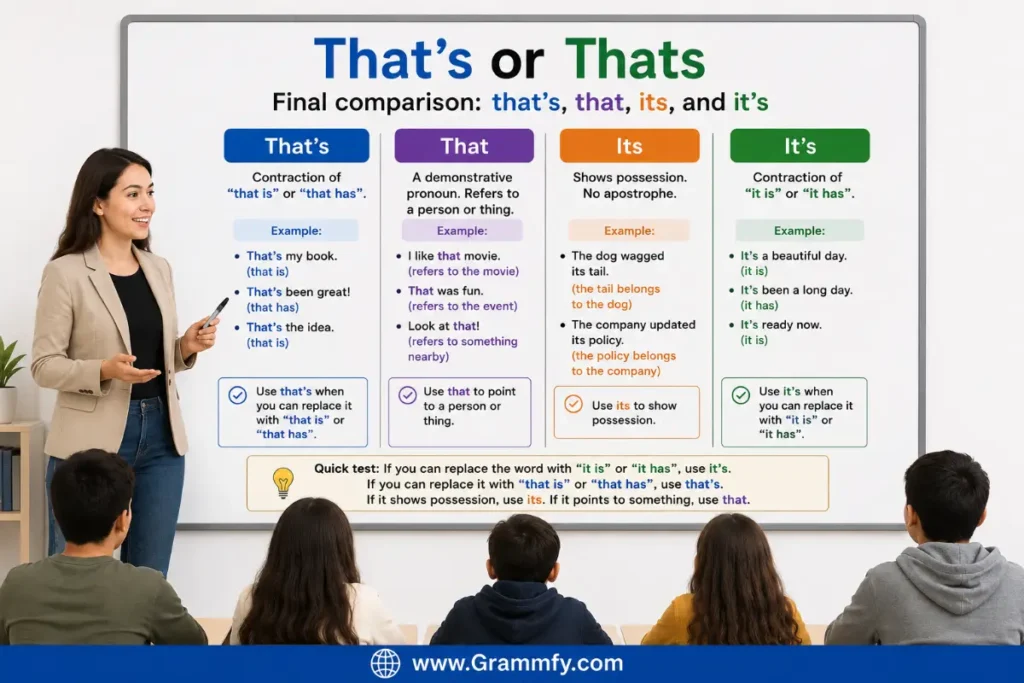
Final comparison: that’s, that, its, and it’s
| Form | Full meaning | Main use | Example |
|---|---|---|---|
| that’s | that is / that has | contraction | That’s great. |
| that | — | pronoun, determiner, conjunction | I know that fact. |
| its | — | possessive | The dog wagged its tail. |
| it’s | it is / it has | contraction | It’s raining. |
This four-word comparison solves many common punctuation mistakes.
Stop that’s and remember :
that is / that has
When you see it’s, think:
it is / it has
For its , just remember :
belongs to it
When you see that, leave it alone unless you actually need the contraction.
Conclusion
The choice between that’s or thats becomes easy when you use the expansion test. If you mean that is or that has, write that’s with an apostrophe. The apostrophe shows that letters have been removed from the original phrase.
If you simply mean that, don’t add an apostrophe. Also watch for similar forms such as it’s and its, since they follow a different grammar rule.
In casual texts, people may type thats without punctuation, but standard English still uses that’s. For schoolwork, professional emails, resumes, articles, and other polished writing, the apostrophe is the safe and correct choice.
Once you start checking the full form in your head, the right spelling becomes almost automatic.
Frequently Asked Questions
Is “thats” grammatically correct?
Thats is normally incorrect in standard English when you mean that is or that has. The standard contraction is that’s.
What’s the difference between that’s or thats?
That’s is the correct contraction of that is or that has, while thats normally leaves out the required apostrophe.
Is “that’s” formal or informal?
That’s is standard English and can be used in both everyday and professional writing. In especially formal writing, you may choose the full form that is or that has.
When should I use “that” instead of “that’s”?
Use that when it is functioning as a normal pronoun, determiner, conjunction, or relative word rather than meaning that is or that has.
What’s another way to say “that’s”?
The most direct alternative is “that is” when that’s means that is, or “that has” when it means that has. Other alternatives depend on the sentence, such as “this indicates,” “the point is,” or “this means.”
Why do people write “thats” in texts?
People often leave out apostrophes when typing quickly or casually. Thats is common online, but that’s remains the standard spelling in edited English.
Is “that’s” the same as “its”?
No. That’s means that is or that has, while its is the possessive form of it. For example, “That’s a dog” is different from “The dog wagged its tail.”
