
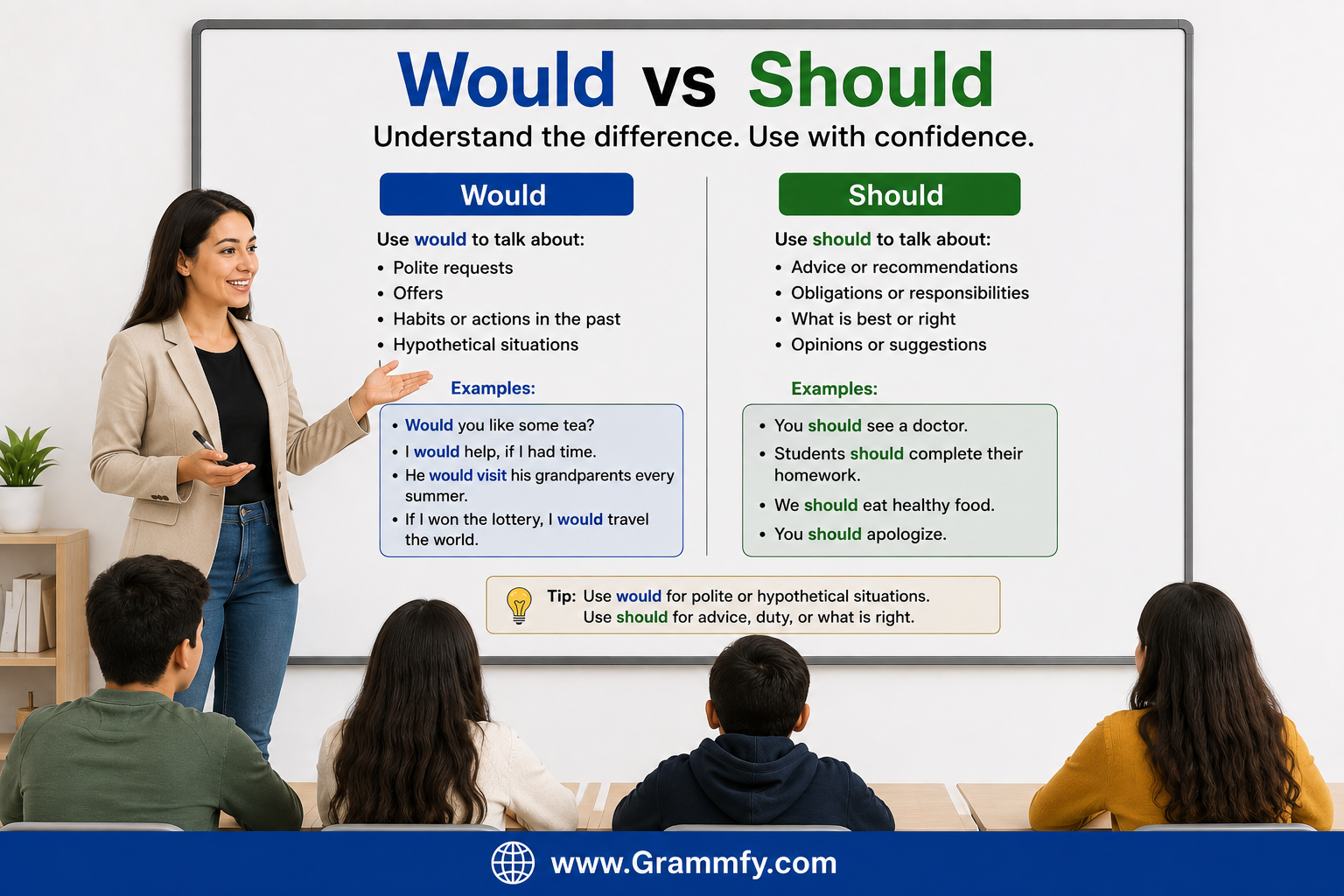
Imagine you’re writing an email to your manager and want to sound polite. You type, “I should like to ask…” Then you wonder if “I would like to ask…” sounds better. Or maybe you’re texting a friend: “Would you help me?” versus “Should you help me?” Both sentences use common modal verbs, but they don’t mean the same thing.The confusion gets bigger because Would vs Should can talk about requests, advice, expectations, possibilities, habits, and imagined situations. Their meanings also change depending on the sentence around them.
Answer box: Would usually expresses a polite request, preference, willingness, or imagined result. Should usually expresses advice, duty, expectation, or something that is likely or appropriate.
This guide explains would vs should in plain English. You’ll learn where the words came from, how their meanings differ, which alternatives work in different situations, and how to choose the right one in emails, essays, resumes, texts, and everyday speech.
Should vs Must is one of several commonly confused grammar topics. Learn more in our guide to Should vs Must.
What do “Would vs Should” mean in plain English?
The easiest way to understand these words is to connect each one with its most common idea.
| Word | Main idea | Simple example |
|---|---|---|
| Would | imagined choice, polite request, preference, willingness | I would help if I could. |
| Should | advice, duty, expectation, likely outcome | You should get some rest. |
Would often answers questions such as:
- What would you prefer?
- What would happen?
- Would you like something?
- Would you help me?
- What would you do in that situation?
Should often answers questions such as:
- What is the right thing to do?
- What advice do you have?
- What is expected?
- What is likely to happen?
- What is the responsible choice?
Compare these two sentences:
I would call him.
This can mean calling him is your choice or something you are willing to do, often in an imagined situation.
I should call him.
This usually means calling him is the sensible, expected, or responsible thing to do.
That small change can completely change the message.
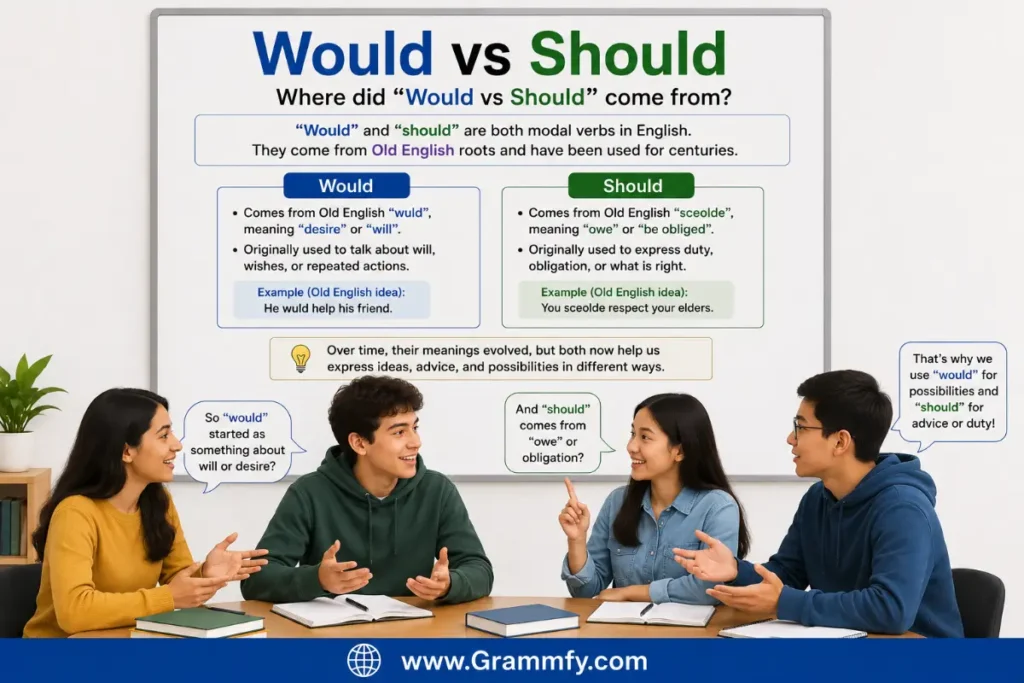
Where did “Would vs Should” come from?
Understanding their history can make their modern meanings easier to remember.
Would developed from the Old English verb willan, meaning “to wish,” “to want,” or “to desire.” Its older form was related to the past form of will. Over time, would developed several modern uses, including polite requests, imagined situations, preferences, and repeated actions in the past.
That’s why would still has a connection with ideas such as willingness and desire.
For example:
I would like some coffee.
The sentence is not simply about the future. It expresses what the speaker wants or prefers in a polite way.
Should developed from the Old English verb sceal, related to the modern shall. Its historical forms were connected with obligation, duty, and what someone was expected to do.
That older connection is still visible today:
You should apologize.
The sentence suggests that apologizing is the proper or responsible action.
Modern English has expanded both words far beyond their original uses. Still, their basic ideas remain useful:
- Would → willingness, preference, imagined situations
- Should → duty, advice, expectation, probability
What is the main difference between “Would vs Should”?
A useful shortcut is:
Would = “What would happen, what do you want, or what are you willing to do?”
Should = “What is advisable, expected, proper, or likely?”
Look at these examples:
| Sentence | Meaning |
|---|---|
| I would buy that car. | I am willing to or inclined to buy it. |
| You should buy a reliable car. | I recommend buying one. |
| Would you open the window? | Polite request. |
| You should open the window. | Advice or recommendation. |
| She would come if she had time. | Imagined condition. |
| She should arrive soon. | Expected arrival. |
The difference becomes especially clear when the same verb follows both modals.
“I would go” vs. “I should go”
I would go often means:
- I am willing to go.
- I would choose to go.
- I would go under a certain condition.
Example:
I would go with you if I didn’t have work.
I should go often means:
- It is probably time for me to go.
- Going is the responsible choice.
- Going is what I am expected to do.
Example:
It’s getting late. I should go home.
The first sentence focuses on a choice or imagined situation. The second focuses on what seems appropriate or necessary.
When should you use “would”?
Use would for several common purposes.
Would for polite requests
Would can make a request sound softer and more respectful.
Would you close the door, please?
Would you send me the report?
Would you mind waiting for a few minutes?
Compare:
Close the door.
This is direct and can sound like an instruction.
Would you close the door?
This sounds more like a polite request.
Would for preferences
Use would like to express what someone wants or prefers.
I would like a glass of water.
She would like to join the meeting.
We would like more information about the course.
In everyday English, I’d like is extremely common.
I’d like to order a sandwich.
Would for imaginary situations
Use would when talking about a result that depends on a condition or imagined situation.
I would travel more if I had more money.
He would buy the house if the price were lower.
What would you do if you lost your phone?
Here, would helps show that the situation is hypothetical.
Would for repeated past actions
Would can describe repeated actions or habits in the past.
Every summer, we would visit our grandparents.
When I was young, my father would read to me before bed.
This use is close to used to, although would normally works best with repeated actions, not permanent states.
Natural:
Every Sunday, we would eat lunch together.
Less natural:
I would be shy as a child.
For past states, used to is usually better:
I used to be shy as a child.
When should you use “should”?
Use should when you want to give advice, express duty, or talk about an expected result.
Should for advice
This is one of the most common uses.
You should drink more water.
You should check your work before submitting it.
She should talk to her teacher.
The speaker is recommending an action, but should is usually softer than must.
Compare:
You must wear a seat belt.
This expresses a strong requirement.
You should wear a seat belt.
This gives advice or says what is sensible.
Should for responsibility or duty
Should can describe what someone is expected to do.
Employees should arrive on time.
Students should follow the exam rules.
We should respect other people’s opinions.
It can express a moral or practical expectation without sounding as forceful as must.
Should for expectation
Use should when you believe something is likely to happen.
The bus should arrive soon.
Your package should arrive tomorrow.
The movie should start at eight.
Here, should does not mean “you ought to make it happen.” It means the speaker expects the event.
For example:
Sarah left at six. She should be here by seven.
This means the speaker expects Sarah to arrive around seven.
Should for recommendations in writing
Should is common in instructions, formal writing, and professional communication.
Applicants should submit their documents before Friday.
The report should include a short summary.
Users should save their changes before closing the program.
It tells readers what is recommended or expected.
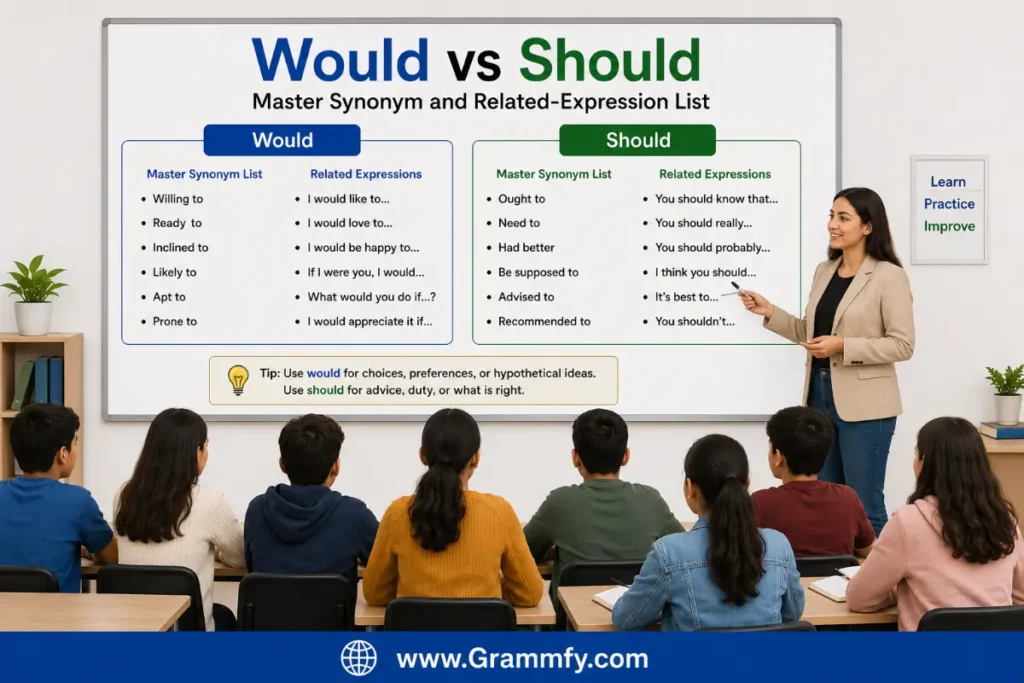
Master synonym and related-expression list
Would and should do not have one perfect synonym each. They are modal verbs, and their meaning changes with context. So the following list gives useful alternatives and related expressions for the ideas they commonly communicate.
| Word or expression | Meaning | Tone | Example |
|---|---|---|---|
| ought to | should; be advisable | Neutral/formal | You ought to apologize. |
| had better | strong advice | Firm | You had better leave now. |
| could | possible option | Neutral | We could leave early. |
| might | possible | Neutral | It might rain. |
| will | future or willingness | Neutral | I will help you. |
| plan to | intend to do something | Neutral | I plan to apply. |
| intend to | have a purpose or plan | Formal | We intend to continue. |
| prefer to | like one choice more | Neutral | I prefer to walk. |
| want to | desire to do something | Everyday | I want to leave. |
| would like to | polite desire | Polite | I’d like to ask a question. |
| be happy to | willingly agree | Polite | I’d be happy to help. |
| be glad to | willingly do something | Friendly | I’d be glad to help. |
| recommend | advise a choice | Neutral/formal | I recommend waiting. |
| suggest | offer an idea | Neutral | I suggest calling first. |
| advise | recommend an action | Formal | I advise caution. |
| encourage | support an action | Positive | I encourage you to apply. |
| expected to | likely or required | Neutral/formal | You are expected to attend. |
| probably | very likely | Everyday | She will probably call. |
| possibly | maybe | Neutral/formal | He could possibly help. |
| in your position | from your situation | Neutral | In your position, I’d ask. |
This table is useful because it shows that the right replacement depends on the exact meaning. For example, must is not a direct replacement for should because it creates a much stronger sense of obligation.
Likewise, want to is not always a replacement for would like to. The latter is often more polite.
Which alternatives are mild, and which are strong?
Not every recommendation has the same force. Choosing the right modal or phrase helps control your tone.
Mild advice
These usually sound gentle:
- might want to
- could
- may want to
- you could consider
- it may help to
- I suggest
- I recommend
Examples:
You might want to check the address.
You could try restarting the computer.
Medium-strength advice
These are clearer and more direct:
- should
- ought to
- recommend
- advise
- are expected to
Examples:
You should back up your files.
You ought to tell the truth.
Strong advice or obligation
These create more pressure:
- had better
- need to
- have to
- must
- are required to
Examples:
You must show identification.
You had better leave before the storm gets worse.
The choice isn’t only about grammar. It also communicates your attitude.
Can “Would vs Should” be replaced by the same words?
Usually, no.
They sometimes overlap with other modal verbs, but they perform different jobs.
Consider:
Would you like some tea?
You cannot normally replace would with should:
Should you like some tea?
That sentence does not mean the same thing in ordinary modern American English.
Now compare:
You should study tonight.
Possible alternatives include:
You ought to study tonight.
You need to study tonight.
You should probably study tonight.
But each alternative changes the strength or tone slightly.
The safest approach is to identify the intended meaning first, then choose the modal.
“Would vs Should” for a resume
What is better on a resume: “would” or “should”?
On a resume, neither word is automatically better. The best choice depends on what you’re trying to communicate.
Use would when describing a hypothetical contribution, though direct action verbs are usually stronger.
Weak:
I would help improve team communication.
Stronger:
Improved team communication by creating weekly project updates.
A resume usually benefits from confident statements about what you actually did.
Use should when discussing expectations, standards, or recommendations in a professional description.
Team members should follow established safety procedures.
However, if you’re describing your own experience, a direct verb is often better than a modal.
Instead of:
I would manage customer accounts.
Write:
Managed customer accounts.
Instead of:
I should complete monthly reports.
Write:
Completed monthly reports on schedule.
This makes your resume more precise and confident.
“Would vs Should” in an essay
Which word works better in an academic essay?
Both can be useful, but they express different ideas.
Use should when making a recommendation or argument:
Schools should provide students with more opportunities to read independently.
Use would for hypothetical consequences:
If schools offered more reading choices, students would have greater control over their learning.
Notice the structure:
If X happened, Y would happen.
But:
Schools should do X.
A strong essay may use both:
Schools should offer more reading choices. If students had more control over their reading, they would be more likely to develop personal interests.
Here, should introduces the recommendation, while would explains the imagined result.
“Would vs Should” in texting
Which word sounds more natural in a text?
In casual texting, would is common for polite or hypothetical questions:
Would you pick me up?
What would you do?
Would you want to go later?
Should is common for asking for advice:
Should I call her?
Should we leave now?
What should I wear?
This gives you an easy texting rule:
- Would you…? → asking about willingness or preference.
- Should I…? → asking for advice.
Compare:
Would I call him?
This sounds like you’re asking about a hypothetical choice.
Should I call him?
This asks whether calling him is a good idea.
“Would vs Should” in an email
Which word sounds more polite in a professional email?
Would is often useful when making a polite request.
Would you be able to send the updated file?
I would appreciate your feedback.
I would like to schedule a meeting.
Should is useful for recommendations, expectations, or instructions.
You should receive the confirmation email shortly.
The meeting should take about thirty minutes.
Applicants should provide two references.
One useful email distinction is:
Would you…? = polite request.
You should… = advice or recommendation.
For a professional email, this difference can prevent an accidental change in tone.
“Would vs Should” in speaking
Which one sounds natural in everyday conversation?
Both are extremely common.
Use would when discussing choices, preferences, polite questions, or imagined situations:
What would you like to eat?
I would probably take the train.
Would you like to come with us?
Use should for advice and expectations:
What should we eat?
You should try the pasta.
The restaurant should be open.
A useful pair is:
What would you like?
This asks about your preference.
What should we order?
This asks for a recommendation or decision.
What are some real-life examples of “Would vs Should”?
Here are examples from different situations.
- At a restaurant:I would like the chicken sandwich, please.
- Giving advice:You should make a reservation before Friday.
- Asking politely:Would you mind moving your bag?
- Talking about an imagined trip:I would visit Japan if I had enough vacation time.
- Talking about expectations:The train should arrive in ten minutes.
- Asking for advice by text:Should I wear a jacket tonight?
- Discussing a preference:I would rather stay home tonight.
- Describing a past habit:During summer, we would swim at the lake every afternoon.
- Making a recommendation:You should read the instructions before using the device.
- Discussing a hypothetical result:If we left now, we would reach the city before dark.
- Professional communication:I would appreciate it if you could review the document.
- School advice:You should proofread your essay before submitting it.
- Talking about expected timing:The doctor should be available after lunch.
- Making a choice:I would choose the smaller apartment because it is closer to work.
- Asking someone about a preference:Would you rather walk or take the bus?
- Expressing responsibility:We should clean the kitchen before our guests arrive.
- Imagining a career choice:If I changed careers, I would probably choose teaching.
- Polite customer service:Would you like a receipt?
These examples show why context matters more than memorizing one simple rule.
Would you rather or should you rather?
Why do we say “Would you rather”?
The expression would rather means “would prefer.”
Would you rather stay home or go out?
It asks someone about a preference.
The answer might be:
I would rather stay home.
Should rather is not the normal modern expression for this meaning.
So remember:
would rather = would prefer
For example:
I’d rather take the train.
means:
I would prefer to take the train.
Would vs. could — what’s the difference?
Would and could can appear in similar polite questions, but they focus on different ideas.
| Sentence | Main focus |
|---|---|
| Would you help me? | willingness |
| Could you help me? | ability/possibility, often a polite request |
| Would you come with us? | willingness/preference |
| Could you come with us? | possibility/ability |
In everyday American English, both can sound polite.
Would you send me the file?
asks whether the person is willing to do it.
Could you send me the file?
literally asks whether it is possible for them to do it, but it commonly functions as a polite request.
Should vs. must — what’s the difference?
These two are closer in meaning, but must is stronger.
| Should | Must |
|---|---|
| Advice or expectation | Strong obligation |
| You should wear a coat. | You must wear a seat belt. |
| You should check the answer. | You must submit the form today. |
| Often leaves room for choice | Often indicates no real choice |
If your meaning is “This is a good idea,” should is often appropriate.
If your meaning is “This is required,” must may be better.
For example:
You should arrive by nine.
This can mean arriving by nine is expected or recommended.
You must arrive by nine.
This sounds like a firm rule.
Should vs. ought to — what’s the difference?
Ought to is very close to should.
You should apologize.
You ought to apologize.
Both can mean that apologizing is the right thing to do.
However, should is much more common in everyday American English. Ought to can sound slightly more formal, old-fashioned, or emphatic depending on the situation.
For most learners, should is the safer everyday choice.
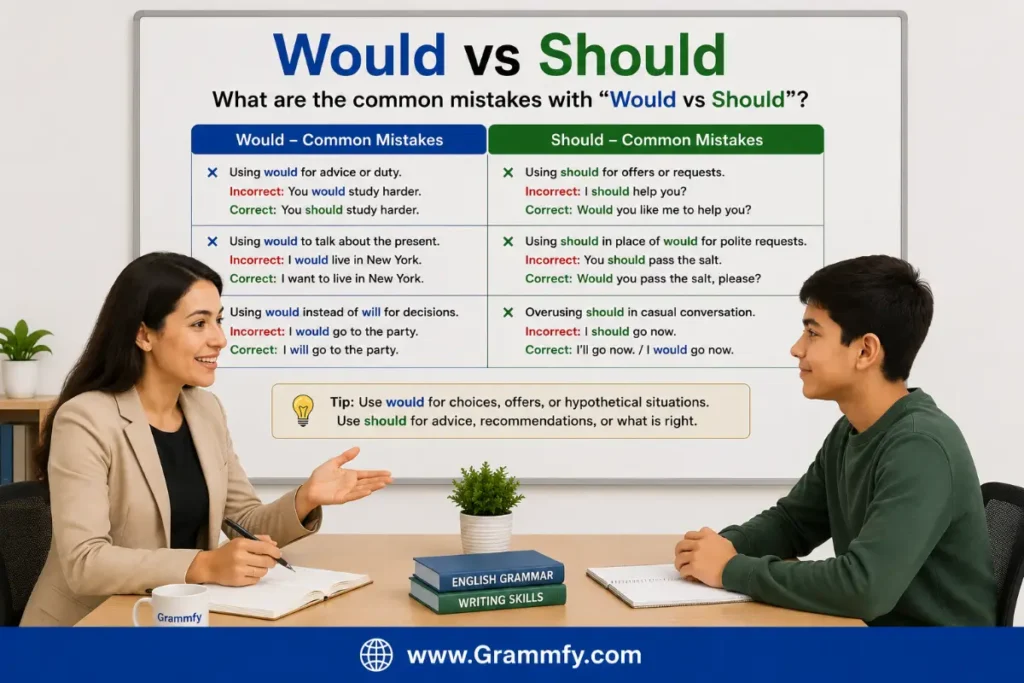
What are the common mistakes with “Would vs Should”?
Mistake 1: Using “should” for a polite request
Incorrect for the intended ordinary request:
Should you pass me the salt?
If you’re asking someone to pass it to you, say:
Would you pass me the salt?
or:
Could you pass me the salt?
Mistake 2: Using “would” when giving simple advice
If you’re telling someone what you think is a good idea, should is usually better.
Less natural for ordinary advice:
You would see a doctor.
Better:
You should see a doctor.
Mistake 3: Confusing “would like” with “should like”
I would like means “I want” or “I would prefer,” usually politely.
I would like a cup of coffee.
I should like is possible in some formal or older styles, but it is uncommon in everyday American English.
For normal conversation, use:
I would like a cup of coffee.
Mistake 4: Using “would” without understanding a condition
A sentence such as:
I would buy it.
can sound incomplete if the listener expects a condition.
Often, the complete idea is:
I would buy it if it were cheaper.
However, would can also be used naturally without an explicit condition when the context already provides one:
Which car would you choose?
The implied situation is clear.
Mistake 5: Thinking “should” always means obligation
It doesn’t.
The package should arrive tomorrow.
Here, should expresses expectation, not a command.
Mistake 6: Thinking “would” always means past tense
It doesn’t.
Would you like some tea?
This is a present-time polite offer.
What would you do?
This usually describes an imagined situation.
So don’t translate would as simply “past will.” Its meaning depends on context.
When should you NOT use “would”?
Avoid would when you simply need a direct statement about something that is true or happening.
For example:
She lives in Chicago.
Don’t use:
She would live in Chicago.
unless you have a special context, such as a hypothetical situation or a repeated past action.
Likewise:
I want some water.
is direct.
I would like some water.
is polite and natural, but it carries a slightly different tone.
Use would when its meaning is actually needed: preference, willingness, politeness, hypothetical results, or repeated past actions.
When should you NOT use “should”?
Don’t use should when you mean a strict requirement if must or have to is more accurate.
For example:
Employees must wear protective equipment.
If this is a legal or safety requirement, must may communicate the rule more clearly than:
Employees should wear protective equipment.
The second sentence can sound like advice rather than a requirement.
Also avoid should when you’re simply asking what someone wants:
What would you like to eat?
not:
What should you like to eat?
The first asks about preference. The second does not express the intended everyday meaning.
What are the antonyms of “Would vs Should”?
Because would and should are modal verbs with several meanings, they don’t have one simple antonym each.
For would, opposite ideas may include:
- refuse
- decline
- reject
- be unwilling to
- won’t
- choose not to
Example:
I would help if I could.
Possible contrast:
I would refuse to help.
For should, opposite ideas may include:
- shouldn’t
- should not
- be discouraged from
- be wrong to
- must not, in stronger contexts
Example:
You should tell the truth.
Contrast:
You shouldn’t lie.
Be careful with must not. It is much stronger than shouldn’t.
How does “should” work with “not”?
Shouldn’t means something is not recommended, expected, or appropriate.
You shouldn’t skip breakfast.
This means skipping breakfast is not a good idea.
It can also express expectation:
The package shouldn’t take long.
This means the speaker expects it not to take long.
Compare:
You should call him.
You are advising the person to call.
You shouldn’t call him.
You are advising the person not to call.
The negative form can therefore change the recommendation completely.
How does “would” work with “not”?
Wouldn’t can express refusal, unwillingness, a negative hypothetical result, or a repeated past behavior.
Refusal or unwillingness
He wouldn’t listen to my advice.
This can mean he refused or was unwilling to listen.
Hypothetical negative result
I wouldn’t buy that phone if I were you.
This means the speaker recommends against buying it.
Repeated past behavior
My old car wouldn’t start on cold mornings.
Here, wouldn’t describes a repeated problem in the past.
So again, context determines the meaning.
Does “should” mean “probably”?
Sometimes, yes.
When should expresses expectation, it can be close to probably.
She should arrive soon.
can mean:
She will probably arrive soon.
But should is not always equal to probably.
Compare:
You should call your mother.
This is advice.
Your mother should call soon.
This is an expectation.
The same modal has two different functions.
Does “would” mean “want”?
Sometimes it can express desire or preference, especially in would like.
I would like some tea.
This means:
I want some tea.
But would by itself does not simply mean “want.”
I would go.
does not automatically mean:
I want to go.
It may describe a hypothetical decision, willingness, or preference depending on context.
US vs. UK English: Is there a difference?
The basic meanings of would and should are shared across American and British English. Most learners can use the same rules in both varieties.
There are, however, some differences in frequency and style.
Should can appear more often in certain formal British constructions, while American English may favor simpler alternatives in everyday speech. Ought to also tends to sound more formal or less common in casual American conversation.
For example:
You should call him.
is natural in both American and British English.
You ought to call him.
is also correct in both, but may sound more formal or old-fashioned to some American speakers.
The important point is that the core distinction remains stable:
- Would → preference, willingness, polite requests, hypothetical situations, repeated past actions.
- Should → advice, responsibility, expectation, probability.
Quick tips for choosing the right word “Would vs Should”
Use this quick decision guide before you send a message or submit an essay.
Ask: Am I giving advice?
Use should.
You should check your spelling.
Ask: Am I asking about someone’s preference?
Use would.
Would you rather stay home?
Ask: Am I making a polite request?
Usually use would or could.
Would you send me the document?
Ask: Am I describing an imagined result?
Use would.
I would move if I found a better job.
Ask: Am I describing what is expected to happen?
Use should.
The results should arrive tomorrow.
Ask: Am I saying what someone wants politely?
Use would like.
I would like more information.
Ask: Is something required by a rule?
Consider must or have to, not automatically should.
Employees must wear identification badges.
A simple decision chart for “Would vs Should”
| If you mean… | Use | Example |
|---|---|---|
| polite request | would | Would you help me? |
| preference | would | I would rather stay. |
| polite desire | would like | I would like some tea. |
| hypothetical result | would | I would go if I could. |
| repeated past action | would | We would visit every summer. |
| advice | should | You should rest. |
| recommendation | should | You should compare prices. |
| expected result | should | She should arrive soon. |
| responsibility | should | We should be honest. |
| strict requirement | must/have to | You must sign here. |
| possibility | could/might/may | It might rain. |
| personal choice | would rather | I’d rather walk. |
How can you remember the difference?
Try these two memory questions:
Would = “What do I want, choose, imagine, or politely ask?”
Should = “What is wise, expected, proper, or recommended?”
Imagine a friend says:
I have an important interview tomorrow.
You might say:
You should prepare tonight.
You’re giving advice.
Now imagine the friend asks:
Would you practice with me?
They’re asking whether you’re willing to help.
Later, you might say:
If I had an interview tomorrow, I would practice too.
That’s a hypothetical situation.
The same conversation can naturally contain both modal verbs because they perform different jobs.
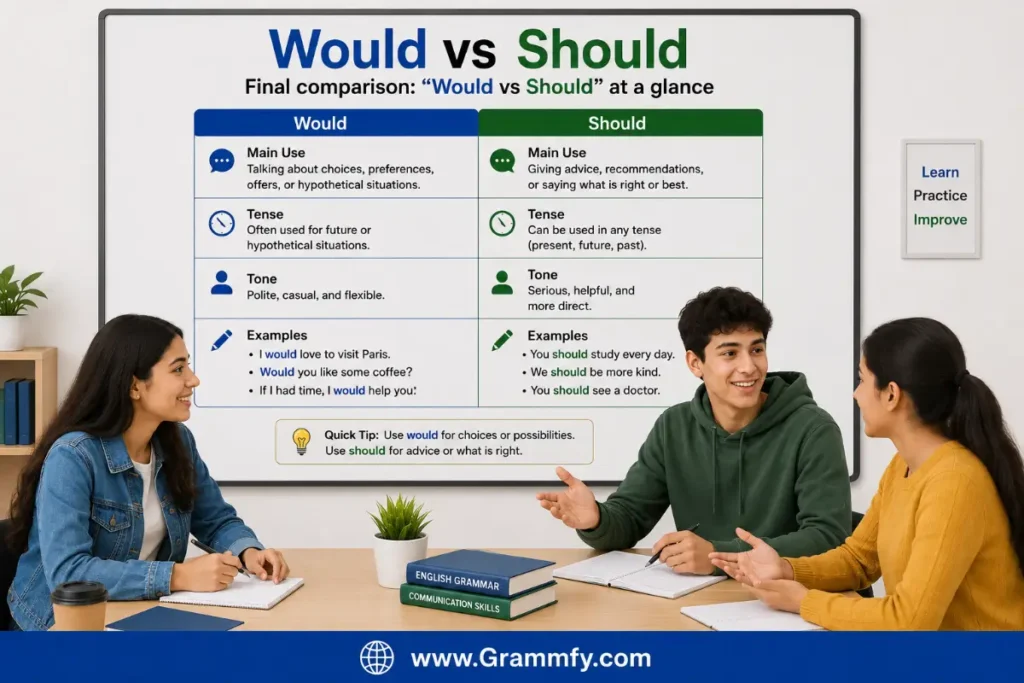
Final comparison: “Would vs Should” at a glance
| Feature | Would | Should |
|---|---|---|
| Polite requests | Very common | Not normally used |
| Advice | Not the normal choice | Very common |
| Preference | Very common | Not normally used |
| Hypothetical situations | Very common | Sometimes, but different meaning |
| Expected result | Not the usual choice | Very common |
| Obligation | Usually no | Moderate |
| Strong requirement | No | Usually use must |
| Repeated past actions | Yes | No |
| “Like” | would like | should like is uncommon |
| “Rather” | would rather | Not normally |
| Common question | Would you…? | Should I…? |
| Core idea | choice, willingness, imagination | advice, duty, expectation |
The key is not to memorize isolated translations. Learn the function of each word in the sentence.
Conclusion
The easiest way to separate would vs should is to focus on the purpose of the sentence. Would commonly points to a preference, willingness, polite request, imagined situation, or repeated past action. Should usually points to advice, responsibility, expectation, or what seems likely to happen.
When you’re unsure, ask yourself one simple question: Am I talking about a choice or imagined situation, or am I talking about what is wise, expected, or recommended? Choice and imagination often call for would. Advice and expectation often call for should.
With practice, the difference becomes much more natural. Read the whole sentence, think about the intended meaning, and choose the modal that matches it.
Frequently Asked Questions
What is the easiest way to remember would vs should?
Remember that would often deals with preference, willingness, politeness, or imagined situations, while should often deals with advice, responsibility, or expectation.
Should I say “Would you help me?” or “Should you help me?”
Say “Would you help me?” when you’re making a polite request; “should” does not normally express that request in modern everyday English.
What’s another way to say “I should”?
Depending on the meaning, you could say “I ought to,” “I need to,” “I’m expected to,” or “I’m supposed to.” The best choice depends on whether you’re expressing advice, necessity, or expectation.
When do I use would instead of will?
Use would for many hypothetical, polite, or preference-based situations, while will commonly expresses a definite future action or willingness.
Is “should” stronger than “would”?
They are not really stronger or weaker versions of the same word. Should usually gives advice or expresses expectation, while would usually expresses preference, willingness, politeness, or a hypothetical result.
Can I use would and should in the same sentence?
Yes. For example, “I would go if I should get the chance” is grammatically possible, but in modern everyday English, a more natural sentence would often be “I would go if I got the chance.” Their combination depends heavily on context.
Should I use Would vs Should in a formal email?
Use would for polite requests and preferences, such as “I would appreciate your reply,” and should for recommendations or expectations, such as “The meeting should take about an hour.”
