
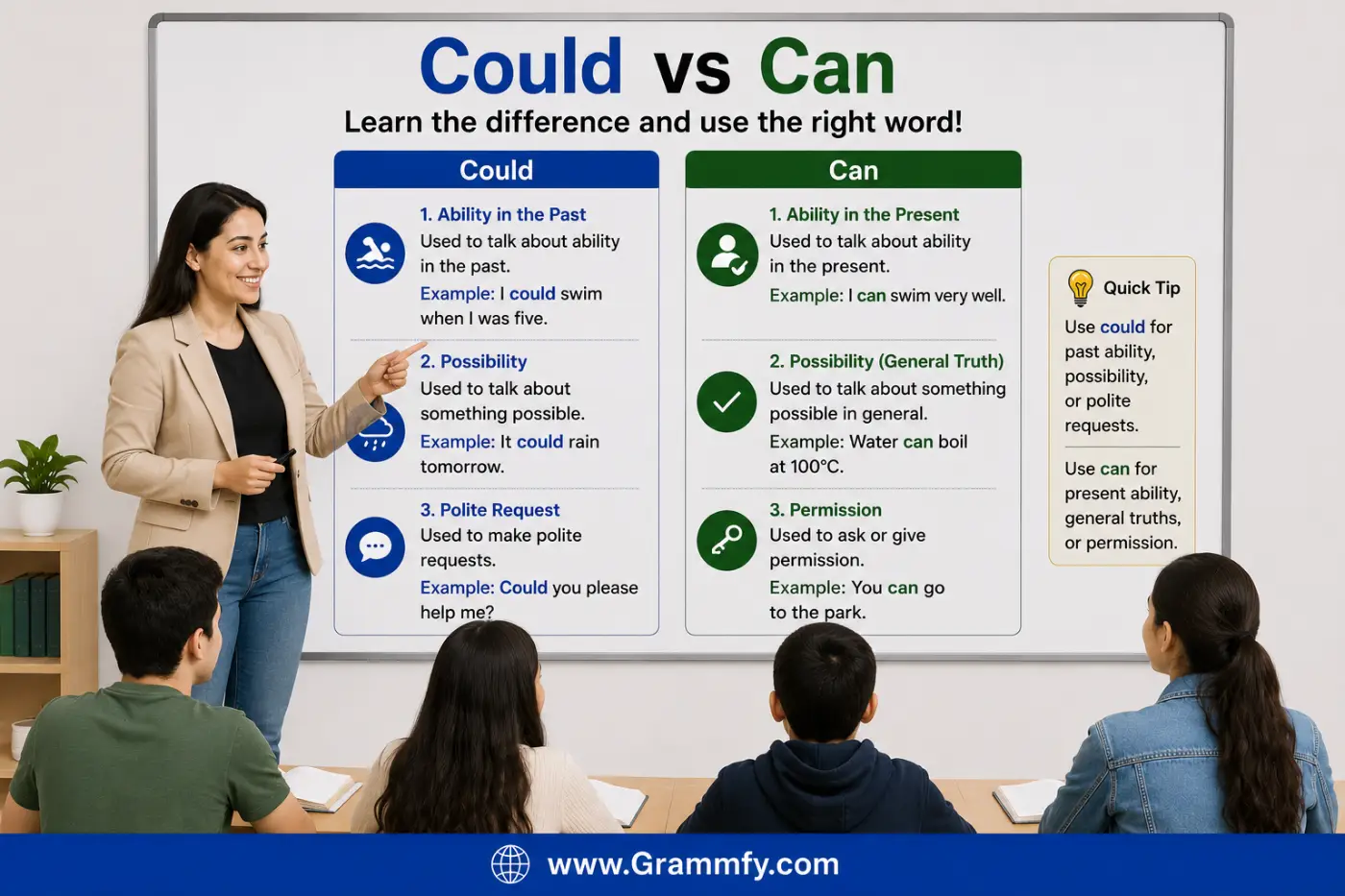
When you’re writing an email, answering a question in an essay, or sending a quick text, could vs can can be confusing. Both words talk about ability and possibility, and both can appear in questions. But they don’t always mean the same thing. The right choice depends on whether you’re talking about present ability, past ability, possibility, permission, or politeness.
Answer box: Can usually expresses present ability, general possibility, or informal permission. Could often expresses past ability, a possible situation, or a more polite request.
For example, “I can swim” describes a present ability. “I could swim when I was five” describes an ability in the past. In a question, “Can you help me?” and “Could you help me?” can both be correct, but could usually sounds more polite or less direct.
This guide explains the meaning and history of both modal verbs, their grammar patterns, synonyms, intensity, regional usage, and differences in real situations. You’ll also learn which form works best in resumes, essays, emails, texts, and everyday speech.
Could vs Would is one of several grammar topics that can cause confusion. Learn more in our guide.
What Does Can Mean in Plain English?
Can is a modal auxiliary verb. It commonly expresses ability, possibility, permission, and sometimes a general fact.
Examples:
- I can swim.
- She can speak Spanish.
- We can meet tomorrow.
- You can use my laptop.
- Anyone can make a mistake.
The exact meaning comes from context.
Can for Present Ability
One of the most common uses of can is present ability.
I can drive.
This means the person has the ability to drive now.
Other examples:
She can play the guitar.
My brother can cook.
They can solve difficult problems.
I can understand this sentence.
The ability may be physical, mental, practical, or learned.
Can for General Possibility
Can can describe something that is generally possible.
Winters can be very cold here.
Too much stress can affect your sleep.
Mistakes can happen.
This doesn’t necessarily mean the event is happening right now. It means the situation is possible under certain conditions.
Can for Permission
In everyday American English, can is commonly used to ask for or give permission.
Can I use your phone?
Can we leave early?
You can sit here.
You can borrow my book.
Some traditional grammar guides prefer may for formal permission, but can is very common in normal conversation.
Can for Requests
Can can also make a direct request.
Can you help me?
Can you send me the file?
Can you close the window?
These requests are normal and friendly. They are often less formal than requests using could.
What Does Could Mean in Plain English?
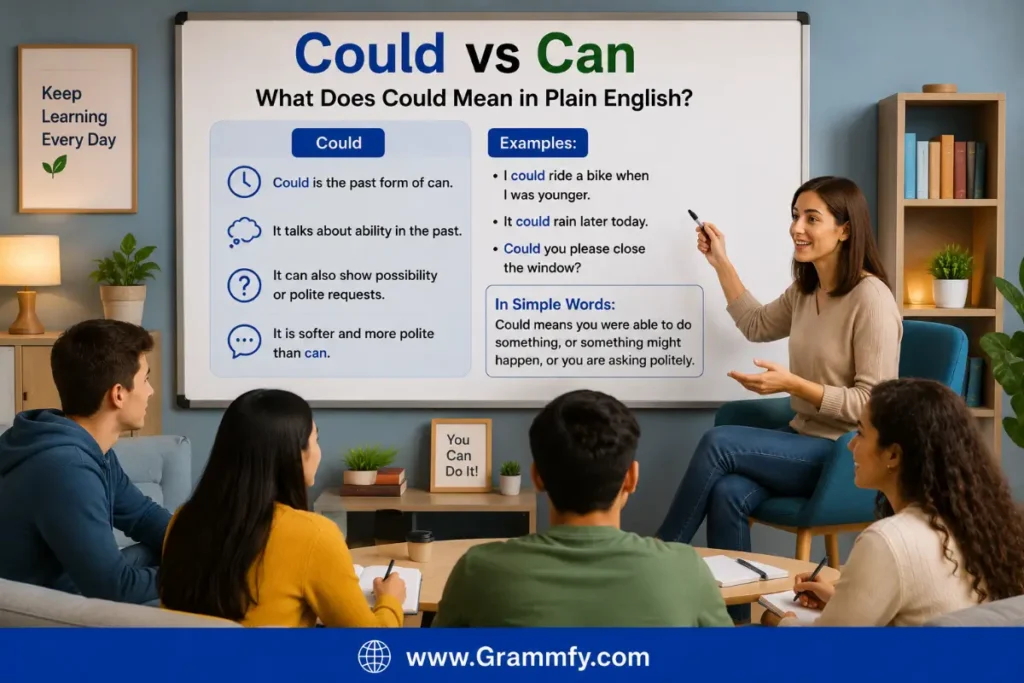
Could is also a modal verb. It is closely related to can, but it has several uses that make it different.
It can express:
- past ability
- possibility
- polite requests
- suggestions
- hypothetical ability
- conditional possibility
Examples:
I could swim when I was six.
It could rain tonight.
Could you help me?
We could take the train.
If I had more time, I could help.
Could for Past Ability
The clearest use of could is past ability.
When I was younger, I could run five miles.
This means the person had the ability in the past.
Compare:
I can run five miles.
This describes current ability.
I could run five miles when I was younger.
This describes past ability.
Could for Possibility
Could can describe something that is possible but uncertain.
It could snow tomorrow.
She could be at home.
That could be the reason.
The speaker doesn’t know that the event will happen. They’re presenting it as one possible outcome.
Could for Polite Requests
Could is frequently used to make requests softer.
Could you help me?
Could you send me the report?
Could you open the door?
The speaker isn’t necessarily asking about someone’s past ability. Here, could works as a polite request form.
Could for Suggestions
Could can introduce an option or possible solution.
You could ask your teacher.
We could leave earlier.
You could try restarting the computer.
This use is usually softer than telling someone what they should do.
Could vs Can: What’s the Main Difference?
The easiest way to understand could vs can is to identify the purpose of the sentence.
| Word | Common use | Example |
|---|---|---|
| Can | Present ability | I can swim. |
| Can | General possibility | Mistakes can happen. |
| Can | Permission | You can leave now. |
| Can | Direct request | Can you help me? |
| Could | Past ability | I could swim at age five. |
| Could | Possibility | It could rain. |
| Could | Polite request | Could you help me? |
| Could | Suggestion | We could take a taxi. |
| Could | Conditional ability | I could help if I had time. |
A useful memory rule is:
Can often points to what is possible or true now.
Could often points to what was possible in the past, what might happen, or what would be possible under certain conditions.
However, could is not simply the past form of can. It has several modern uses that aren’t about past time.
Where Did Can Come From?
The word can comes from an Old English verb connected with knowing or having knowledge. Over time, its meaning developed toward knowing how to do something and then toward being able to do something.
That historical connection helps explain why can is strongly associated with ability.
Modern English uses can as a modal auxiliary verb.
It has a special grammar pattern:
subject + can + base verb
Examples:
- I can go.
- She can help.
- They can work.
- He can drive.
We don’t add to after can.
Incorrect:
I can to swim.
Correct:
I can swim.
We also don’t add -s after can.
Incorrect:
She cans swim.
Correct:
She can swim.
Where Did Could Come From?
Could developed historically as a past form related to can. It has remained connected to ability, but its modern meaning has expanded.
Today, could can describe:
- past ability
- possibility
- polite requests
- suggestions
- conditional ability
- hypothetical situations
This is why saying “could always means past” is incorrect.
For example:
Could you help me?
This is a present request, not a request about the past.
Likewise:
It could rain tonight.
This describes a future possibility.
Why Does Could Sometimes Talk About the Present?
This is one of the most common questions learners have.
If could is related to the past form of can, why can we say:
Could you help me?
The answer is that modal verbs don’t always follow a simple past-versus-present pattern.
English often uses forms such as could to make statements less direct or more hypothetical.
Compare:
Can you help me?
Could you help me?
Both usually refer to the present. The second is generally softer and more polite.
So could can express present politeness even though it is historically connected to can.
Can vs Could for Ability
Ability is one of the most important areas to understand.
Present Ability
Use can for ability now.
I can drive.
She can speak French.
We can solve the problem.
He can run very fast.
Past General Ability
Use could for general ability in the past.
I could swim when I was four.
She could read before she started school.
My father could fix almost anything.
We could see the mountains from our old house.
The important idea is general ability.
Could vs Was Able To for Specific Past Events
There is a useful distinction between could and was able to.
For general past ability:
When I was young, I could run five miles.
For one specific successful event:
Yesterday, I was able to finish the report before lunch.
In positive statements about a particular event, was able to can be clearer because it emphasizes that the action was successfully completed.
Compare:
After several attempts, I was able to open the door.
This clearly tells us that the person eventually succeeded.
For a general ability:
When I was younger, I could open that type of lock easily.
This describes a skill rather than one particular success.
Could for Negative Past Ability
Couldn’t is commonly used for both general and specific past inability.
I couldn’t swim when I was five.
She couldn’t open the door yesterday.
The negative form is often simpler than the positive form.
Can vs Could for Possibility
Both words can describe possibility, but the context is important.
Can for General Possibility
Use can when describing something that is generally possible.
Driving at night can be dangerous.
This means driving at night has the potential to be dangerous in general.
Another example:
Too much rain can cause flooding.
This describes a general relationship between rain and flooding.
Could for Specific Possibility
Use could when describing one possible situation.
It could rain tonight.
This means rain is one possible outcome tonight.
Compare:
Heavy rain can cause flooding.
This is a general fact.
Heavy rain could cause flooding tonight.
This describes a possible event in a particular situation.
That difference is useful in both everyday speech and formal writing.
Can vs Could for Permission
Both words can be used when talking about permission.
Can for Permission
Can is very common in everyday English.
Can I use your computer?
Can we leave now?
You can sit here.
You can borrow my notes.
The tone is direct and natural.
Could for Permission
Could can make the request softer.
Could I use your computer?
Could we leave a little early?
This can sound more polite or cautious.
However, could doesn’t necessarily mean that permission is more likely. It mainly changes the tone of the question.
May for Formal Permission
May is another option, especially in formal situations.
May I come in?
May I ask a question?
In everyday American conversation, Can I…? is much more common.
Can vs Could for Requests
Requests are where many learners notice the difference most clearly.
Can You…?
Can you send me the document?
This is direct, normal, and friendly.
Could You…?
Could you send me the document?
This sounds a little softer and more polite.
Both are useful.
The choice depends on the relationship, situation, and level of formality.
| Request | Typical tone |
|---|---|
| Can you help me? | Direct, friendly |
| Could you help me? | Polite, softer |
| Would you help me? | Focuses more on willingness |
| Would you mind helping me? | Very polite |
| Please help me. | Direct request |
For most professional emails, could is a safe choice when you want to sound polite without sounding overly formal.
Can vs Could for Suggestions
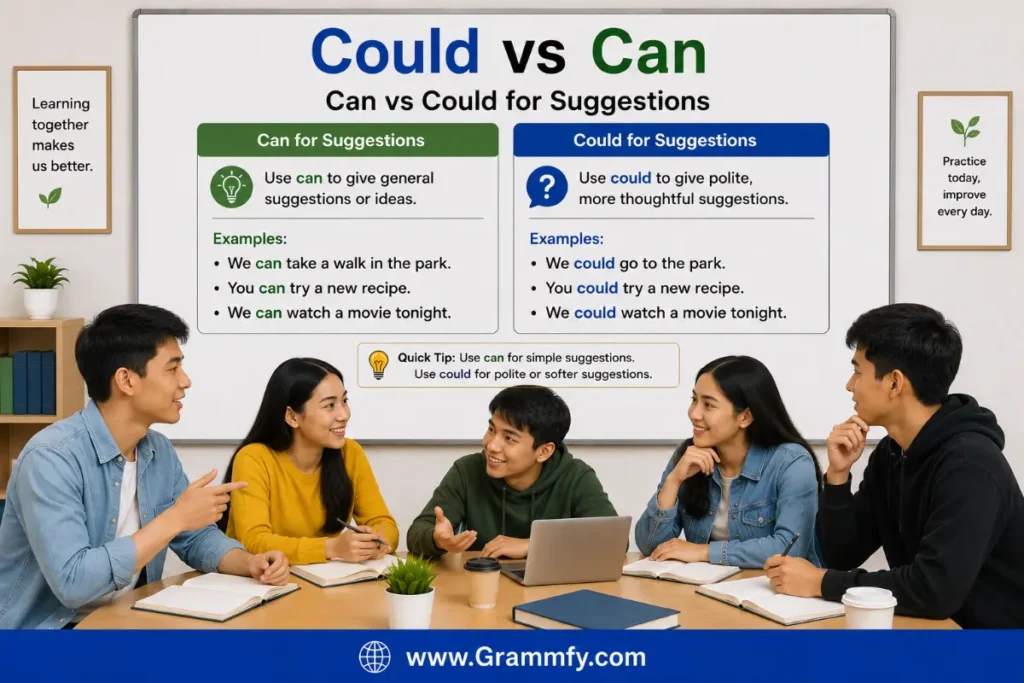
Could is especially useful for giving suggestions.
You could talk to your teacher.
We could try another restaurant.
You could restart your computer.
The speaker is presenting an option.
Can can sometimes describe available options too:
We can take the train.
But the feeling is slightly different.
We can take the train.
This may mean the train is available or that the speaker has decided it is an option.
We could take the train.
This presents it more clearly as one possible choice.
Can vs Could in Conditional Sentences
Conditional sentences show another important difference.
Compare:
If I have time, I can help you.
This describes a real possibility based on a condition.
Now:
If I had more time, I could help you.
This usually describes a hypothetical situation.
The second sentence suggests the speaker doesn’t currently have enough time.
Another example:
If you finish early, you can leave.
This means leaving is permitted or possible if the condition is met.
If I finished early, I could leave.
This presents leaving as a possible result of the imagined situation.
Can vs Could for Future Possibility
Can
We can meet tomorrow.
This can mean tomorrow is available or possible.
Could
We could meet tomorrow.
This sounds more like a suggestion or possible plan.
Compare:
We can meet at 3 p.m.
This often sounds like a clear available arrangement.
We could meet at 3 p.m.
This sounds more tentative.
The difference is small, but it matters when you want to communicate confidence versus uncertainty.
Can vs Could in Questions
Can in Questions
Can you drive?
This can ask whether someone knows how to drive.
Can I borrow your pen?
This asks for permission.
Can we meet tomorrow?
This asks whether meeting is possible.
Could in Questions
Could can ask about possibility, past ability, or politely request something.
Could you help me?
Polite request.
Could she swim when she was six?
Past ability.
Could this be the correct answer?
Possibility.
Could we meet tomorrow?
Polite or tentative suggestion.
The context tells you which meaning is intended.
Can vs Could: Master Synonym List
No single synonym works in every sentence. The right replacement depends on whether you’re talking about ability, possibility, permission, or politeness.
Simple Alternatives
| Word/Phrase | Meaning | Tone | Example |
|---|---|---|---|
| be able to | Have the ability | Neutral | I am able to help. |
| may | Be possible or permitted | Neutral | You may leave. |
| might | Be possible | Neutral | It might rain. |
| be possible | Have a possibility | Neutral | It may be possible. |
| allow | Give permission | Neutral | They allow visitors. |
| permit | Give permission | Formal | They permit visitors to enter. |
| manage to | Succeed in doing something | Neutral | I managed to finish. |
| know how to | Have a learned skill | Neutral | She knows how to swim. |
Everyday Alternatives
| Word/Phrase | Meaning | Tone | Example |
|---|---|---|---|
| be able to | Have ability | Everyday | I was able to finish. |
| might | Possible | Everyday | It might happen. |
| maybe | Perhaps | Casual | Maybe we can go. |
| be allowed to | Have permission | Everyday | We’re allowed to leave. |
| get to | Have the opportunity | Casual | We get to choose. |
| manage to | Succeed | Everyday | I managed to fix it. |
| know how to | Have a skill | Everyday | He knows how to cook. |
| be free to | Have permission or freedom | Everyday | You’re free to leave. |
Formal Alternatives
| Word/Phrase | Meaning | Tone | Example |
|---|---|---|---|
| be capable of | Have ability | Formal | She is capable of leading the team. |
| be able to | Have ability | Neutral/Formal | Applicants must be able to communicate clearly. |
| be permitted to | Have official permission | Formal | Visitors are permitted to enter. |
| be authorized to | Have official approval | Formal | Staff are authorized to access the system. |
| be possible | Be possible | Formal | The change may be possible. |
| be feasible | Be realistically possible | Formal | The proposal is feasible. |
| have the capacity to | Have ability or resources | Formal | The system has the capacity to process data. |
| be in a position to | Have the ability or opportunity | Formal | We are in a position to assist. |
Casual or Slang Alternatives
| Word/Phrase | Meaning | Tone | Example |
|---|---|---|---|
| can | Be able to | Casual | I can do it. |
| can’t | Not be able to | Casual | I can’t go. |
| couldn’t | Wasn’t able to | Casual | I couldn’t find it. |
| maybe | Perhaps | Casual | Maybe we can go. |
| get to | Have an opportunity | Casual | I get to choose. |
| be free to | Be allowed to | Casual | You’re free to use it. |
| manage to | Succeed | Casual | I managed to get tickets. |
| pull it off | Successfully accomplish something | Informal | We pulled it off. |
Can vs Could: Synonyms by Intensity
Different words communicate different levels of certainty, ability, or directness.
Weak Possibility
These suggest uncertainty:
- might
- maybe
- perhaps
- possibly
- could
Example:
It might rain tomorrow.
The speaker isn’t confident that it will happen.
Moderate Possibility
These can present a reasonable option:
- could
- may
- might
- be possible
- be feasible
Example:
We could finish the project next week.
Stronger Possibility or Ability
These can sound more confident:
- can
- be able to
- be capable of
- will likely be able to
Example:
Our team can complete the project by Friday.
This sounds more confident than:
Our team could complete the project by Friday.
Increasing Request Politeness
You can think of these requests as becoming progressively softer:
Can you help me?
Could you help me?
Would you mind helping me?
Would you be able to help me?
The best choice depends on the relationship and situation.
Can vs Could by Part of Speech
Both can and could are modal auxiliary verbs.
They are followed by the base form of a verb.
Correct:
She can drive.
She could drive.
Incorrect:
She can drives.
She could drives.
Incorrect:
She can to drive.
She could to drive.
Correct:
She can drive.
She could drive.
Neither word changes according to the subject.
You say:
- I can
- he can
- she can
- they can
And:
- I could
- he could
- she could
- they could
You don’t say he cans or she coulds.
Can vs Could in Negative Sentences
The negative forms are:
- cannot / can’t
- could not / couldn’t
Can’t
Can’t can mean present inability, lack of permission, or impossibility.
I can’t swim.
Present inability.
You can’t park here.
No permission or prohibition.
That can’t be true.
The speaker believes something is impossible.
Couldn’t
Couldn’t can express past inability, present/future possibility that seems unlikely, or a negative polite response.
I couldn’t swim when I was five.
Past inability.
We couldn’t find the address.
Past inability or failure.
That couldn’t be the answer.
The speaker believes the answer is not possible.
Can vs Could for Impossibility
This distinction is useful when talking about what cannot happen.
Can’t
That can’t be true.
This expresses a strong belief that something is impossible or false.
Couldn’t
That couldn’t be true.
This can sound more cautious, hypothetical, or connected to a particular situation.
For example:
He couldn’t be the person who called me. He was with me all night.
Here, couldn’t means the speaker believes that possibility is ruled out.
Can vs Could in Formal Writing
The choice depends on the claim you’re making.
Can for General Facts
Poor planning can cause delays.
This is a general statement.
Could for Possible Effects
Poor planning could cause delays.
This is more cautious. It presents delays as a possible result.
This distinction is valuable in academic and professional writing because it helps you avoid making claims that are stronger than your evidence.
Compare:
The policy can reduce costs.
This may sound like a general capability.
The policy could reduce costs.
This suggests a possible benefit without guaranteeing the result.
Best Word for Resume Writing
Can on a Resume
Can is grammatically correct, but resumes usually sound stronger when they state abilities directly.
Instead of:
I can manage large teams.
Try:
Manage teams of up to 20 employees.
Or:
Experienced in managing cross-functional teams.
A resume should usually focus on evidence rather than simply saying what you can do.
Could on a Resume
Could is less common when describing current abilities.
Instead of:
I could manage large projects.
Use:
Managed large projects.
Or:
Capable of managing large projects.
Could can still be useful when describing potential capability:
The redesigned system could process twice as many requests.
But for personal qualifications, stronger direct language is often better.
Best Word for Essay Writing
Can in Essays
Use can when making a general statement.
Social media can influence how people communicate.
This says social media has the ability or potential to influence communication generally.
Could in Essays
Use could when making a cautious claim or discussing a possible outcome.
Social media could influence how future generations communicate.
This sounds less certain.
This distinction helps academic writers avoid overstating conclusions.
If your evidence is strong, can may be appropriate. If you’re discussing a possible outcome, could may be better.
Best Word for Email Writing
Can in Professional Emails
Can works well for direct but friendly requests.
Can you send me the revised document?
It’s perfectly acceptable in many workplaces.
Could in Professional Emails
Could is often preferred when you want a slightly softer tone.
Could you send me the revised document?
This sounds polite and professional.
For a formal email, could is often a useful choice when making requests without sounding demanding.
Best Word for Texting
Can in Text Messages
Can is very natural in casual messages.
Can you pick me up?
Can we meet later?
Can I call you tonight?
The tone is direct and friendly.
Could in Text Messages
Could can make a request softer.
Could you pick me up?
Could we meet later?
Could you send me that picture?
Both forms are common. The choice depends on how direct you want to sound.
Best Word for Everyday Speaking
In everyday conversation, can is extremely common for present ability and ordinary requests.
I can help you.
Can you pass the salt?
Can we go now?
Could is common for polite requests, suggestions, possibilities, and past ability.
Could you pass the salt?
We could go tomorrow.
It could be expensive.
I could swim when I was young.
Both belong naturally in everyday American English.
Can vs Could: 15 Real-Life Example Sentences
1. Talking About a Skill
I can speak English and Spanish.
This describes a current ability.
2. Talking About Childhood
When I was six, I could already read simple books.
This describes past ability.
3. Asking for Help
Can you help me carry these boxes?
This is a direct, friendly request.
4. Making a Softer Request
Could you help me carry these boxes?
This request is a little softer.
5. General Possibility
Too much sugar can cause health problems.
This describes a general possibility.
6. Specific Possibility
Too much rain could cause flooding tonight.
This describes a possible event in a particular situation.
7. Asking Permission
Can I borrow your laptop?
This is a common informal request for permission.
8. Polite Permission
Could I leave a little early today?
This sounds more polite or cautious.
9. Offering an Option
We could take the bus instead.
The speaker presents an alternative.
10. Present Availability
We can meet at 4 p.m.
This suggests that 4 p.m. works as an available time.
11. Tentative Plan
We could meet at 4 p.m.
This sounds more like a suggestion.
12. Conditional Ability
If you give me another hour, I could finish the report.
The extra time would make completion possible.
13. Negative Ability
I couldn’t open the file yesterday.
The speaker wasn’t able to open it.
14. Logical Impossibility
That can’t be the right answer.
The speaker believes the answer is impossible or incorrect.
15. Possible Explanation
The problem could be caused by a damaged cable.
The speaker presents one possible explanation.
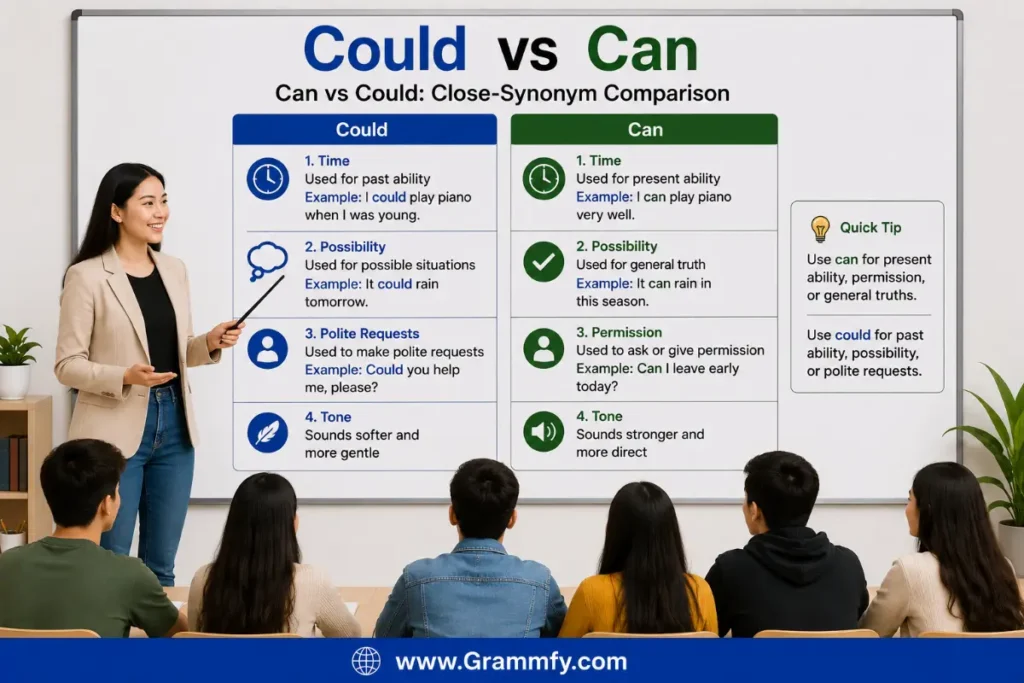
Can vs Could: Close-Synonym Comparison
Can vs May — What’s Different?
Both can express permission or possibility, but they have different tones and common uses.
| Can | May |
|---|---|
| Common in everyday speech | More formal |
| Common for informal permission | Common for formal permission |
| Common for ability | Can express possibility |
| Can you help? | May I ask a question? |
Examples:
Can I leave now?
This is normal everyday English.
May I leave now?
This sounds more formal or polite.
For ability:
I can swim.
You wouldn’t normally replace this with may.
Could vs Might — What’s Different?
Both can express possibility.
It could rain.
It might rain.
The meanings can overlap.
But could has additional uses, such as past ability and polite requests.
I could swim when I was five.
You can’t replace this with might.
Might also doesn’t normally work as a direct substitute in:
Could you help me?
So while the two overlap for possibility, they aren’t interchangeable everywhere.
Can vs Be Able To — What’s Different?
Can is shorter and more natural in many everyday sentences.
I can drive.
Be able to is useful when you need a different tense or a more formal structure.
I will be able to attend the meeting tomorrow.
You normally can’t say:
I will can attend the meeting.
Instead:
I will be able to attend the meeting.
This flexibility makes be able to especially useful in formal writing.
Common Mistakes With Can and Could
Mistake 1: Adding “To” After Can
Incorrect:
I can to swim.
Correct:
I can swim.
Modal verbs are followed directly by the base verb.
Mistake 2: Adding “To” After Could
Incorrect:
She could to help us.
Correct:
She could help us.
Mistake 3: Adding “-S”
Incorrect:
He cans drive.
Correct:
He can drive.
Incorrect:
She coulds speak French.
Correct:
She could speak French.
Mistake 4: Assuming Could Always Means Past
incorrect.
Could you help me?
present request.
It could rain tomorrow.
future possibility.
Could can refer to present and future situations.
Mistake 5: Using Can for Every Request
Can you…? is correct, but sometimes could you…? creates a softer professional tone.
Compare:
Can you send this today?
Could you send this today?
The second is generally less direct.
Mistake 6: Confusing General and Specific Ability
For general past ability:
I could swim when I was young.
For one successful event:
I was able to swim across the river yesterday.
The second emphasizes a particular accomplishment.
When Should You NOT Use Can?
Don’t use can when you’re trying to make a deliberately tentative prediction.
For example:
The new policy can reduce costs.
This may sound like a general capability.
If you’re discussing one possible future result, could may be better:
The new policy could reduce costs.
Also, in very formal permission requests, may can be more appropriate:
May I speak with the director?
That doesn’t mean Can I speak with the director? is wrong in everyday English. It simply has a different level of formality.
When Should You NOT Use Could?
Don’t use could when you need to communicate a clear current ability and confidence.
Instead of:
I could manage this project.
if you mean that you currently have the ability and responsibility, say:
I can manage this project.
Also, don’t use could when a definite future commitment is intended.
I will attend the meeting tomorrow.
is clearer than:
I could attend the meeting tomorrow.
The second sounds like attendance is only a possibility.
Can vs Could in US and UK English
The basic grammar of can and could is similar in American and British English.
Both varieties commonly use:
Can you help me?
Could you help me?
I can swim.
I could swim when I was younger.
There can be small differences in style and preference, but learners don’t need to memorize separate American and British rules for these modal verbs.
One useful point is that can is widely accepted for permission in both varieties:
Can I come in?
Traditional teaching may emphasize may for formal permission, but natural modern English frequently uses can.
Can vs Could in Professional Communication
Tone matters when you’re communicating at work.
Compare:
Can you send me the report?
direct and friendly.
Could you send me the report?
This is softer.
Would you be able to send me the report?
even more indirect and formal.
The best option depends on your relationship with the reader and the urgency of the request.
For a close coworker, can may be perfectly natural.
For a client or someone you don’t know well, could may sound more considerate.
Can vs Could in Academic Writing
Academic writing benefits from accurate levels of certainty.
Use can for general claims:
Lack of sleep can affect concentration.
Use could for possible outcomes:
A longer school day could improve student performance.
The second statement is more cautious.
This doesn’t mean could is always better for academic writing. Don’t weaken a claim if your evidence supports a stronger statement.
Compare:
The study shows that the treatment improves memory.
This is stronger because the evidence is presented as established.
The treatment could improve memory.
This suggests a possibility.
Choose the form that matches the evidence.
Can vs Could for Confidence
Modal verbs can change how confident a statement sounds.
High confidence or established ability
I can finish this today.
The speaker believes finishing today is within their ability.
Possibility
I could finish this today.
This sounds less certain. Finishing today is possible, but not guaranteed.
This distinction is useful in workplace conversations.
Compare:
We can complete the project by Friday.
This sounds like a confident commitment or assessment.
We could complete the project by Friday.
This sounds like a possible outcome, perhaps depending on other factors.
Can vs Could for Politeness
Politeness isn’t only about being “correct.” It is also about how direct the sentence feels.
Compare:
Give me the report.
Very direct.
Can you give me the report?
Normal request.
Could you give me the report?
Softer request.
Would you mind giving me the report?
Very polite and indirect.
This doesn’t mean you should always use the most indirect option. Clear communication matters too.
Can vs Could for Permission in Schools
Teachers and students commonly use both.
Student:
Can I go to the restroom?
This is normal everyday American English.
A slightly more polite version:
Could I go to the restroom?
More formal:
May I leave the classroom?
All three can work. The choice mainly reflects tone and context.
Can vs Could in Customer Service
Customer service language often favors polite forms.
Instead of:
Can you wait?
A representative may say:
Could you please wait a moment?
Instead of:
Can you send your order number?
They might say:
Could you please provide your order number?
The softer form helps maintain a professional tone.
Can vs Could for Offers
Can can make a direct offer:
I can help you with that.
Could can present a possible option:
I could help you with that if you’d like.
The second sounds more tentative and gives the listener more room to decide.
Compare:
I can pick you up at six.
This sounds like the speaker is available.
I could pick you up at six.
This sounds like one possible arrangement.
Can vs Could for Invitations
Can can be used for invitations:
Can you come to my party?
This is direct and friendly.
Could can sound more tentative:
Could you come to my party?
Depending on context, this may sound like the speaker is asking whether attendance is possible.
For a polished invitation, you might also use:
Would you like to come to my party?
This focuses more clearly on the person’s interest or willingness.
Antonyms of Can and Could
Because both words have several meanings, their opposites depend on context.
For ability:
- can’t
- cannot
- couldn’t
- be unable to
Example:
I can swim.
Opposite:
I can’t swim.
For possibility:
- impossible
- cannot happen
- unlikely
- not possible
Example:
It could happen.
Opposite:
It can’t happen.
For permission:
- cannot
- must not
- not be allowed to
- be prohibited from
Example:
You can enter.
Opposite:
You cannot enter.
For opportunity:
- have no opportunity
- be unable to
- be prevented from
Example:
We could attend.
Opposite:
We couldn’t attend.
Quick Tips for Choosing Can or Could
Use can when:
- You’re talking about present ability.
- You’re describing general possibility.
- You’re giving everyday permission.
- You’re making a direct, friendly request.
- You’re expressing confidence in an available option.
Use could when:
- You’re talking about general past ability.
- You’re describing a possible outcome.
- You’re making a polite request.
- You’re giving a suggestion.
- You’re describing hypothetical ability.
- You’re making a tentative proposal.
Remember:
Can = ability or possibility now.
Could = past ability, possibility, politeness, or a hypothetical option.
This is a shortcut, not a rule for every sentence.
Can vs Could: Quick Comparison Chart
| Situation | Better choice | Example |
|---|---|---|
| Present ability | Can | I can drive. |
| General possibility | Can | Exercise can help. |
| Everyday permission | Can | You can leave. |
| Direct request | Can | Can you help me? |
| Past general ability | Could | I could swim at six. |
| Specific possibility | Could | It could rain. |
| Polite request | Could | Could you help me? |
| Suggestion | Could | You could try again. |
| Conditional ability | Could | I could help if I had time. |
| Tentative plan | Could | We could meet tomorrow. |
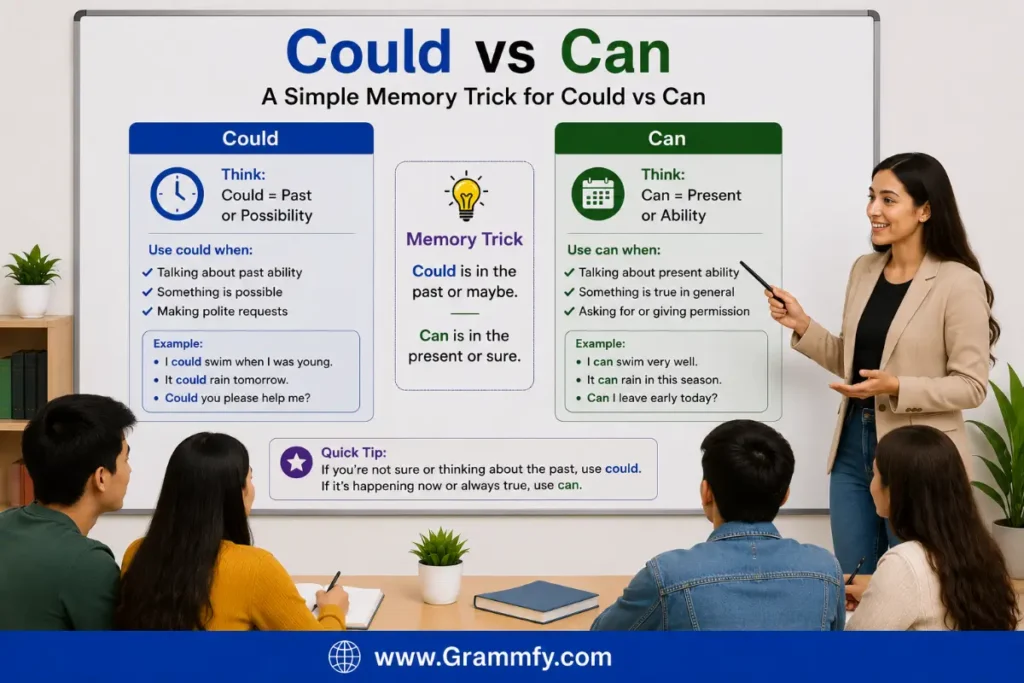
A Simple Memory Trick for Could vs Can
Think of can as the more direct form:
Can = “Is it possible or am I able?”
Think of could as the more flexible form:
Could = “Was it possible, might it be possible, or can I ask more politely?”
Then test your sentence.
talking about a skill you have now:
I can swim.
If you’re talking about a skill you had in the past:
I could swim when I was five.
you’re asking someone to help:
Could you help me?
you’re describing a possible event:
It could happen.
If you’re presenting an option:
We could try again.
These patterns cover most everyday uses.
Conclusion
Understanding could vs can becomes much easier when you identify what the sentence is trying to express. Can is the natural choice for present ability, general possibility, everyday permission, and many direct requests. Could is useful for past ability, specific possibilities, suggestions, conditional situations, and softer requests. The two forms often overlap, especially when asking for something, so tone matters as much as grammar.
One of the best ways to remember the difference is to connect can with what is possible or true now and could with past ability, possible outcomes, or more polite language. Don’t treat that shortcut as an absolute rule, though. Context always matters.
With regular practice, these choices become automatic. Read real English, notice how native speakers use both forms, and compare the meaning of similar sentences. That will help you sound more natural in conversations, emails, essays, and professional writing.
Frequently Asked Questions
What is the main difference between can and could?
Can usually expresses present ability, general possibility, permission, or a direct request, while could often expresses past ability, specific possibility, suggestions, or polite requests. Context determines the exact meaning.
Is could more polite than can?
Yes, could usually sounds softer and more polite than can when making a request. “Can you help me?” is friendly and direct, while “Could you help me?” is slightly more courteous.
Can I use could for present ability?
Usually, use can for present ability, but could can describe a hypothetical ability or possibility. For example, “I can swim” describes current ability, while “I could swim if I had a pool” describes a condition.
What’s another way to say can or could?
Depending on the meaning, alternatives include “be able to,” “may,” “might,” “be permitted to,” and “be capable of.” The best alternative depends on whether you’re expressing ability, possibility, or permission.
Is can or could better for a professional email?
Could is often better for a polite professional request, while can is fine for a direct and friendly request. “Could you please review this?” usually sounds softer than “Can you review this?”
Does could always mean past tense?
No, could does not always refer to the past. It can describe present or future possibility and is also commonly used to make requests more polite.
Can and could—are they interchangeable?
No, they overlap in some situations but have important differences. For example, “I can swim” describes current ability, while “I could swim when I was young” describes past ability.
