
When you’re writing an email, essay, resume, or even a quick text, you may pause over will vs shall. Both words can talk about the future, but they don’t always sound the same or serve the same purpose. The difference becomes especially important when you’re writing formal English or trying to sound natural in American English.
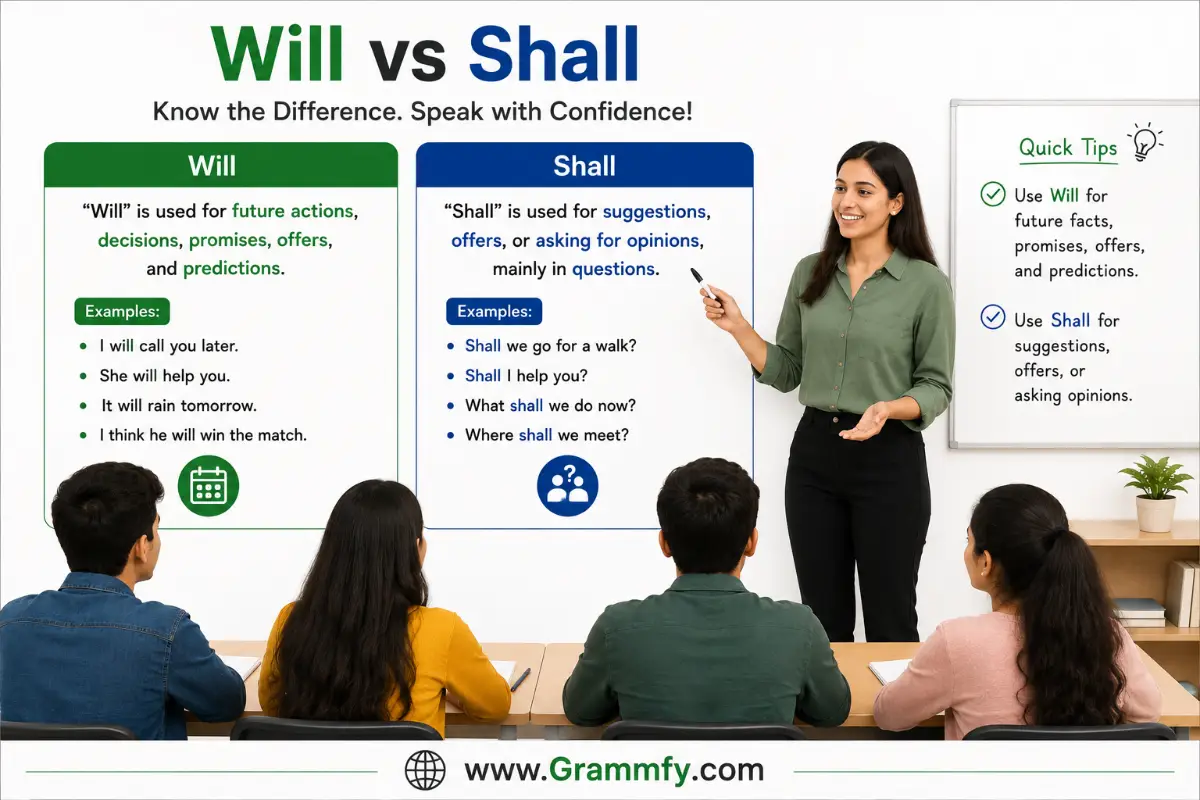
Answer box: Will is the normal choice for talking about future actions in modern English, especially in American English. Shall is less common and is mainly used for suggestions, offers, or formal and legal language.
The two words also carry different tones. For example, “I will call you tomorrow” sounds normal and direct. “Shall I call you tomorrow?” sounds like a polite question asking for a decision. In legal writing, however, “shall” can express a requirement rather than a simple future action.
This guide explains their meanings, origins, synonyms, regional differences, sentence patterns, common mistakes, and the best choice for resumes, essays, emails, texting, and everyday speech.
If you’re working on your grammar, then explore our articles.
What Do “Will vs Shall” Mean in Plain English?
The easiest way to understand these words is to think of them as modal verbs. Modal verbs work with another verb to show ideas such as possibility, ability, permission, necessity, or future action.
What does will mean?
Will commonly shows that something is expected to happen in the future.
Examples:
- I will finish the report tonight.
- She will visit her parents next week.
- They will arrive at noon.
- We will discuss the plan tomorrow.
In everyday American English, will is the standard future auxiliary for most situations.
It can also express:
- willingness
- promises
- decisions
- predictions
- offers
- strong expectations
For example:
I will help you with your project.
Depending on the context, this can mean that you intend to help or that you’re willing to help.
What does shall mean?
Shall can also refer to the future, but its modern uses are narrower.
Examples:
- Shall I open the window?
- Shall we begin?
- We shall overcome this challenge.
- The tenant shall pay the fee by Friday.
In ordinary American conversation, “shall” can sound formal or old-fashioned when it simply means future time.
However, it remains useful in certain questions and formal contexts.
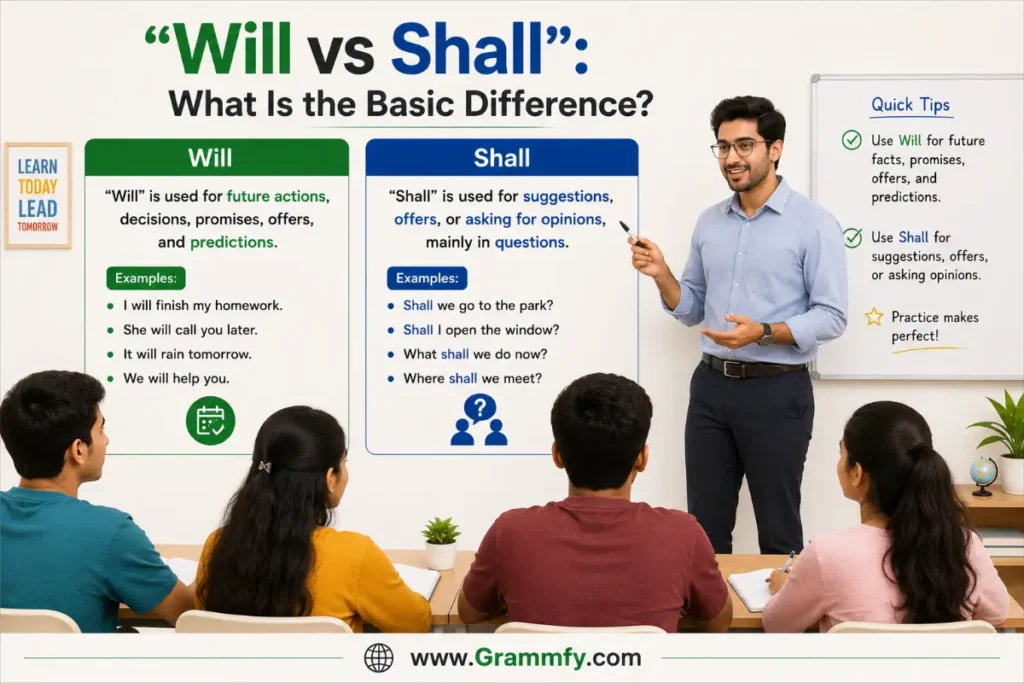
“Will vs Shall”: What Is the Basic Difference?
| Word | Main modern use | Typical tone |
|---|---|---|
| Will | Future actions, predictions, promises, decisions | Neutral and natural |
| Shall | Suggestions, offers, formal rules, legal language | Polite, formal, or official |
A simple rule is:
Use “will” for most future statements. Use “shall” when making a suggestion with “I/we” or when a formal style specifically calls for it.
Where Did Will Come From?
The word will has a long history in English. It is related to an Old English verb connected with ideas such as wishing, wanting, or intending.
That history helps explain one of its modern meanings. When someone says:
I will help.
The sentence can communicate more than future time. It can also suggest intention or willingness.
Over time, “will” became a major way to express future actions in English. Today, it is one of the most common auxiliary verbs in the language.
The word also appears as a noun:
- He changed his will.
- She has a strong will.
- His will was clear.
The noun and auxiliary verb are historically related to the idea of desire, intention, or determination.
Where Did Shall Come From?
Shall also comes from Old English. Its early history is connected with ideas of obligation, duty, or being required to do something.
That older sense still appears in formal language today.
For example:
The applicant shall provide proof of identity.
This doesn’t merely predict what the applicant will do. It states what the applicant is required to do.
Over the centuries, English speakers also used “shall” to describe future actions. Traditional grammar rules even taught different uses for “shall” and “will” depending on the grammatical person.
Modern English is much less strict about those traditional rules.
Why Do People Confuse “Will vs Shall”?
There are several reasons.
First, both words can appear before a base verb to discuss future events.
Compare:
- I will attend the meeting.
- I shall attend the meeting.
Both sentences can refer to the future, but the second one sounds much more formal or unusual in everyday American English.
Second, traditional grammar books sometimes presented complicated rules for choosing between these auxiliaries. Those rules were based partly on older forms of English and formal British usage.
Third, “shall” still has special uses. For example:
Shall we order dinner?
Replacing “shall” with “will” changes the sentence’s function:
Will we order dinner?
The first asks for a suggestion or agreement. The second usually asks whether an event is going to happen.
Master Synonym List for Future Language
There isn’t one perfect synonym for both modal verbs. Their alternatives depend on whether you’re expressing a prediction, intention, plan, promise, requirement, or suggestion.
The following list gives useful related expressions.
Simple Synonyms and Related Expressions
| Word | Meaning | Tone | Example |
|---|---|---|---|
| will | Future action or intention | Neutral | I will call later. |
| shall | Formal future, suggestion, or requirement | Formal | Shall we start? |
| going to | Planned or expected future action | Everyday | I’m going to study tonight. |
| plan to | Have an intention or plan | Neutral | We plan to move soon. |
| intend to | Have a definite purpose | Neutral/Formal | I intend to apply. |
| expect to | Believe something will happen | Neutral | We expect to arrive early. |
| hope to | Want something to happen | Neutral | I hope to visit soon. |
| aim to | Have a goal | Neutral/Formal | We aim to improve service. |
Everyday Alternatives
| Word | Meaning | Tone | Example |
|---|---|---|---|
| might | Possible future action | Neutral | I might join you. |
| may | Possible future action | Neutral/Formal | She may come later. |
| could | Possible future option | Neutral | We could leave early. |
| want to | Desire to do something | Everyday | I want to help. |
| mean to | Intend to do something | Everyday | I mean to call him. |
| be about to | Very near future | Everyday | The show is about to start. |
| be set to | Expected or scheduled | Neutral | The team is set to win. |
Formal Alternatives
| Word | Meaning | Tone | Example |
|---|---|---|---|
| intend | Have a purpose | Formal | We intend to respond. |
| anticipate | Expect something | Formal | We anticipate delays. |
| undertake | Agree to perform an action | Formal | We undertake to provide support. |
| commit to | Promise or dedicate yourself | Formal | We commit to improving quality. |
| be required to | Must do something | Formal | Users are required to register. |
| be obligated to | Have a duty | Formal | Employees are obligated to comply. |
| be expected to | Be considered responsible for doing something | Formal | Staff are expected to arrive on time. |
| must | Strong requirement | Formal/Neutral | You must submit the form. |
Informal or Conversational Expressions
| Word/Phrase | Meaning | Tone | Example |
|---|---|---|---|
| gonna | Going to | Very informal | I’m gonna call you. |
| wanna | Want to | Very informal | I wanna help. |
| I’ll | I will | Everyday | I’ll see you later. |
| we’ll | We will | Everyday | We’ll handle it. |
| I’ll probably | Likely future action | Casual | I’ll probably stay home. |
| I guess I’ll | Reluctant or uncertain decision | Casual | I guess I’ll wait. |
These expressions aren’t interchangeable in every sentence. Their meaning and tone can change significantly depending on context.
Synonyms by Intensity: Mild to Strong
Future expressions can also be arranged by how strongly they communicate certainty or commitment.
Mild or uncertain
These expressions leave room for doubt:
- might
- may
- could
- perhaps
- possibly
- probably
Examples:
I might attend the event.
She may call tonight.
The speaker isn’t making a firm commitment.
Moderate certainty
These expressions suggest a stronger expectation:
- expect to
- plan to
- intend to
- be likely to
- be set to
Examples:
We plan to launch the website next month.
The company is likely to expand.
Strong commitment
These expressions show a firm intention or obligation:
- will
- promise to
- commit to
- must
- be required to
- be obligated to
Examples:
I will finish the assignment tonight.
Employees must wear identification badges.
Notice that will does not always mean absolute certainty. Context determines how strong the statement feels.
Synonyms by Part of Speech
Because “will” and “shall” are modal verbs, their closest alternatives are usually other modal verbs or verb phrases.
Modal verbs
- will
- shall
- may
- might
- can
- could
- must
- should
- would
Verb phrases
- plan to
- intend to
- expect to
- hope to
- aim to
- decide to
- promise to
- agree to
- be going to
- be about to
Nouns related to future intention
- plan
- intention
- decision
- promise
- expectation
- goal
- commitment
- prediction
The best replacement depends on the meaning you want.
For example, replacing “I will attend” with “I might attend” changes the certainty. Replacing it with “I must attend” changes the meaning from future intention to obligation.
US vs UK English: Is There a Difference?
Yes, there can be a difference in frequency and style.
American English
In modern American English, will is overwhelmingly common for ordinary future statements.
Americans naturally say:
I will call you tomorrow.
We will meet at six.
She will finish the work soon.
“Shall” is still understood, but it often appears in special questions or formal writing.
For example:
Shall we go?
This is natural, especially when making a suggestion.
British English
British English also uses “will” frequently, but “shall” has traditionally had a stronger role, particularly with I and we.
You may encounter sentences such as:
I shall return tomorrow.
This is grammatically correct, but it can sound formal, literary, old-fashioned, or deliberately polite depending on the speaker and situation.
British speakers also commonly use:
Shall we begin?
This remains a normal and useful expression.
Legal and official English
“Shall” appears frequently in contracts, regulations, policies, and other formal documents.
For example:
The customer shall provide accurate information.
Here, “shall” often expresses an obligation.
However, legal drafting practices vary. Some modern style guides prefer clearer wording such as must when an obligation is intended.
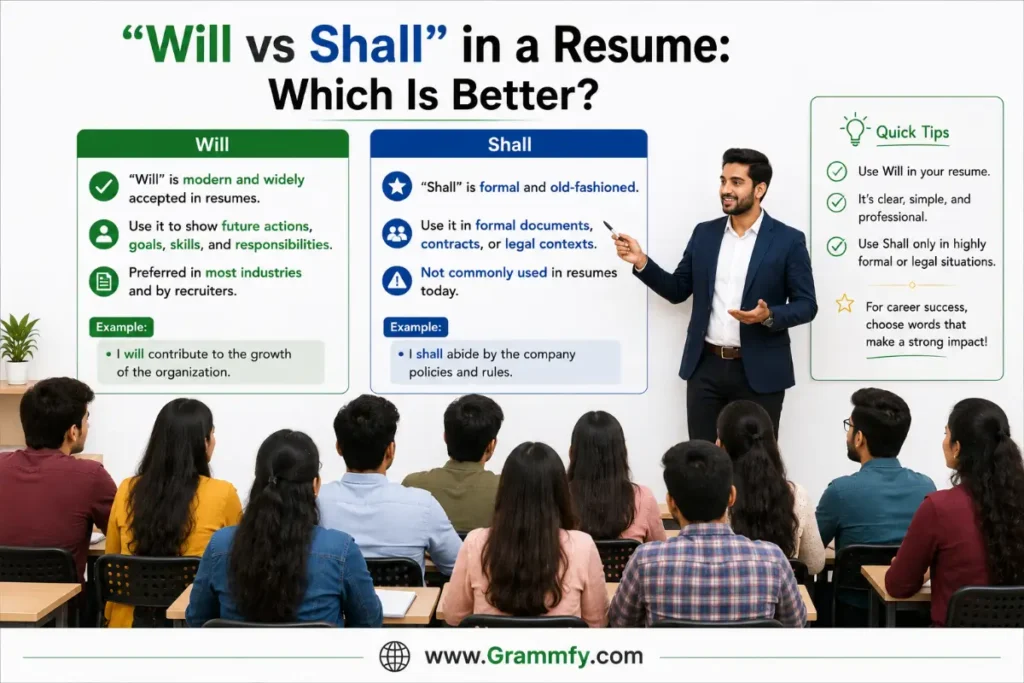
“Will vs Shall” in a Resume: Which Is Better?
For most resumes, will is the safer choice when you need to describe future actions.
However, resumes often work better with direct action verbs rather than future auxiliaries.
Instead of:
I will manage a team of five employees.
You could write:
Manage a team of five employees.
For future career goals:
I will contribute to the company’s marketing strategy.
This is grammatically correct, but a cover letter may be a better place for such a sentence.
A resume should usually focus on:
- achievements
- skills
- responsibilities
- measurable results
- relevant experience
Use strong verbs such as:
- managed
- developed
- created
- improved
- organized
- analyzed
- coordinated
- increased
- reduced
- led
Resume example
Weak:
I will work hard to improve customer satisfaction.
Stronger:
Improved customer satisfaction by developing a faster support process.
The second version is more specific and evidence-based.
“Will vs Shall” in an Essay: Which Is Better?
For most school and college essays, will is the natural choice for future statements.
Example:
This change will affect how students use technology.
“Shall” can make the sentence sound unnecessarily formal:
This change shall affect how students use technology.
The second sentence isn’t necessarily ungrammatical, but it sounds more like official or legal language.
In an academic essay, clarity is usually more important than sounding overly formal.
Use:
Researchers will continue to study this issue.
rather than:
Researchers shall continue to study this issue.
Unless you’re deliberately discussing a formal rule, “will” is generally better.
“Will vs Shall” in Texting: Which Sounds Natural?
For texting, will is much more common.
Examples:
I’ll be there soon.
I’ll call you later.
We’ll see you tomorrow.
“Shall” can sound formal in a casual text.
For example:
Shall I bring pizza?
This isn’t wrong. In fact, it can sound polite or playful. But:
Should I bring pizza?
is often more natural in everyday American texting.
The choice depends on the speaker’s style and the exact meaning.
“Will vs Shall” in Email: Which Should You Use?
For professional emails, will is usually the best choice for ordinary future actions.
Example:
I will send the revised document by Friday.
This sounds clear and professional.
Use “shall” when you’re making a formal suggestion or when the context requires official language.
Example:
Shall we schedule a meeting for Thursday?
That is a polite way to ask for agreement.
For most business emails, don’t use “shall” simply because you think it sounds more professional. Clear English is usually better than overly formal English.
“Will vs Shall” in Speaking: Which Sounds Natural?
In everyday American speech, will is the normal future form.
You may hear:
I’ll get back to you.
We’ll talk tomorrow.
She’ll be here soon.
“Shall” is more limited.
The most common conversational pattern is probably:
Shall we…?
Examples:
- Shall we start?
- Shall we go?
- Shall we order?
- Shall we continue?
- Shall we take a break?
This pattern is useful because it asks for a shared decision.
“Will vs Shall” for Questions
The difference becomes especially clear in questions.
Shall I…?
Shall I usually asks whether the speaker should do something.
Examples:
Shall I close the door?
Shall I send the email?
Shall I help you?
The speaker is offering to act and asking for permission, guidance, or agreement.
Shall we…?
Shall we usually suggests an activity involving both the speaker and listener.
Examples:
Shall we begin?
Shall we take a break?
Shall we meet tomorrow?
This is often similar to:
- Should we…?
- Do you want to…?
- Would you like to…?
Will you…?
“Will you” can ask about future action, willingness, or a request.
Examples:
Will you attend the meeting?
Will you help me?
Will you call her?
The exact meaning depends on context and intonation.
“Will vs Shall”: Close-Synonym Comparison #1 — Will vs Going To
Both can describe the future, but they aren’t always used in the same situations.
| Will | Going to |
|---|---|
| Often used for decisions made at the moment | Often used for existing plans |
| Common for promises | Common for intentions |
| Common for predictions | Common for predictions based on present evidence |
Compare:
The phone is ringing. I’ll answer it.
The decision is made now.
Now compare:
I am going to visit my aunt this weekend.
The visit was already planned.
Another example:
I think it will rain tomorrow.
This is a general prediction.
But:
Look at those dark clouds. It’s going to rain.
Here, the speaker sees present evidence.
These aren’t absolute rules, but they’re useful patterns for natural English.
“Will vs Shall”: Close-Synonym Comparison #2 — Shall vs Should
These words are easy to confuse because both can appear in questions.
Shall I call her?
This is an offer or request for direction.
The speaker is asking:
Do you want me to call her?
Should I call her?
This asks for advice.
The speaker wants to know:
Do you think calling her is a good idea?
Compare:
| Sentence | Main idea |
|---|---|
| Shall I call her? | Do you want me to call her? |
| Should I call her? | Do you think I ought to call her? |
This is an important distinction.
“Will vs Shall”: Close-Synonym Comparison #3 — Shall vs Must
The difference becomes important in formal documents.
The employee shall submit the form.
Depending on the drafting convention, this can communicate an obligation.
The employee must submit the form.
The word must clearly expresses necessity or obligation.
For readers, “must” can often be easier to understand.
Compare:
| Shall | Must |
|---|---|
| Formal or legal style | Direct obligation |
| Meaning can depend on context | Usually clearer |
| Common in contracts and regulations | Common in rules and instructions |
If your goal is plain English, must is often the clearer choice when you mean “required to.”
12+ Original Examples in Real Situations
The best way to understand these words is to see them in context.
1. Making a promise
I will help you finish the presentation tonight.
Here, “will” expresses willingness and commitment.
2. Making a prediction
The new store will probably attract many customers.
The speaker predicts a future result.
3. Making a quick decision
I forgot my lunch, so I’ll buy something nearby.
The decision is made at the moment of speaking.
4. Offering help
I’ll carry that box for you.
The speaker offers to help.
5. Asking for a suggestion
Shall we meet at the library?
The speaker proposes a shared plan.
6. Asking permission or direction
Shall I print another copy?
The speaker asks whether printing another copy would be useful.
7. Talking about a schedule
The train will leave at 8:30.
This describes a future event.
8. Talking about a formal requirement
The applicant shall provide all required documents.
This has an official tone and may express a duty.
9. Talking about future plans
We will visit Chicago next summer.
The sentence simply communicates a future plan.
10. Talking about a future consequence
If you save regularly, you will have more money later.
This describes a likely result.
11. Making a professional commitment
I will send the final report before Friday.
The writer gives a clear commitment.
12. Suggesting an activity
Shall we take a short break?
The speaker invites the group to agree on a break.
13. Expressing determination
I will finish this project even if it takes all weekend.
Here, “will” carries a strong sense of determination.
14. Writing a formal rule
Members shall follow the organization’s safety procedures.
This sounds official and regulatory.
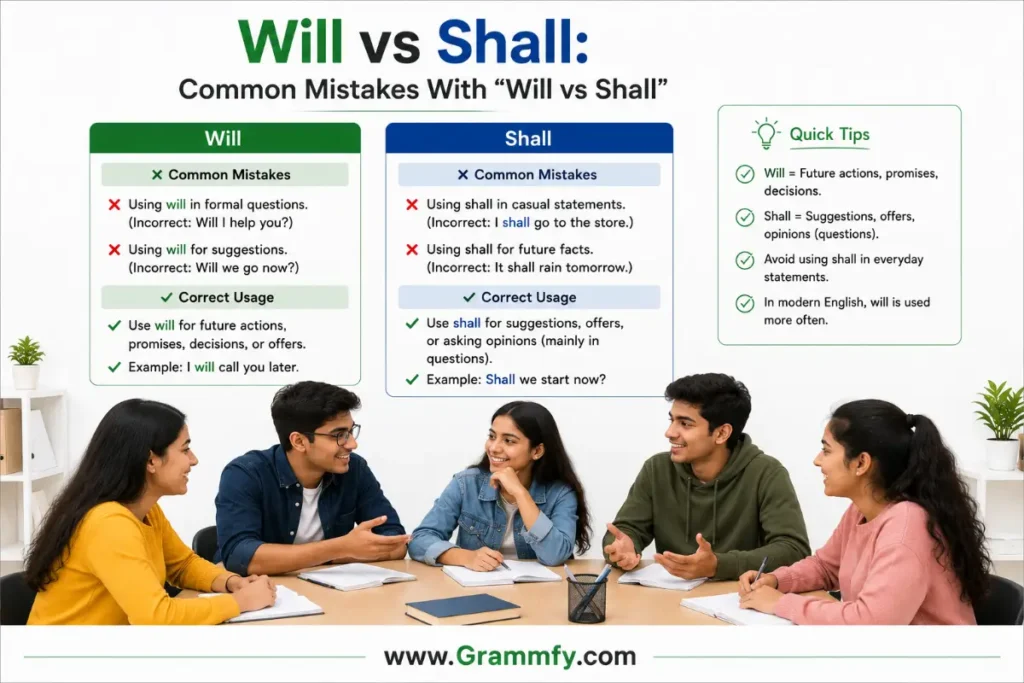
Common Mistakes With “Will vs Shall”
Mistake 1: Using shall everywhere because it sounds formal
Some writers think “shall” makes every sentence more professional.
It doesn’t.
Instead of:
I shall send you the information tomorrow.
A modern business email would normally use:
I will send you the information tomorrow.
The second sentence is clear and professional.
Mistake 2: Thinking shall is always more correct
Traditional grammar rules gave “shall” and “will” specific roles. Modern English doesn’t follow those rules as strictly.
In American English, “will” is perfectly normal with I, you, he, she, we, and they.
Examples:
I will go.
You will go.
She will go.
We will go.
They will go.
There’s no need to force “shall” into these sentences.
Mistake 3: Confusing shall with should
These are different words.
Shall can make a suggestion:
Shall we leave?
Should often asks for or gives advice:
Should we leave?
The meanings overlap in some situations, but the tone and purpose can differ.
Mistake 4: Using shall in casual conversation
A sentence like:
I shall text you later.
may sound unusually formal in American English.
A natural version is:
I’ll text you later.
Mistake 5: Assuming will always means certainty
“Will” can express prediction, intention, willingness, or expectation.
For example:
It will probably rain.
The word “probably” shows uncertainty.
So “will” does not automatically mean something is guaranteed.
Mistake 6: Using shall in legal writing without understanding the rule
Legal uses of “shall” can be complicated. Different contracts and legal systems may use the word differently.
If a document needs to establish a clear obligation, writers should follow the drafting rules appropriate to that legal setting.
Don’t assume that replacing every “must” with “shall” makes a document more legally correct.
When Should You NOT Use Shall?
Avoid “shall” when a simpler word communicates your meaning more clearly.
Don’t write:
I shall update the spreadsheet later.
when you simply mean:
I will update the spreadsheet later.
Don’t write:
The team shall probably arrive at noon.
when you mean:
The team will probably arrive at noon.
Don’t write:
You shall receive an email soon.
unless you’re intentionally using a formal, official style.
For everyday American English, “will” is usually the better choice.
When Is Shall the Better Choice?
“Shall” can be a good choice when you are:
- making a suggestion with I or we
- offering to do something
- asking what action should be taken
- writing in a deliberately formal style
- working with traditional British English
- drafting or reading legal or regulatory language
Examples:
Shall I bring some extra chairs?
Shall we start the meeting?
Shall we discuss the next point?
These uses remain useful and natural.
Antonyms: What Are the Opposites?
Because “will” and “shall” are modal verbs rather than simple action words, they don’t have one direct antonym.
However, several expressions can communicate an opposite idea depending on the sentence.
Opposite of future intention
- won’t
- will not
- refuse to
- decline to
- decide not to
Example:
I will attend.
Opposite:
I won’t attend.
Opposite of willingness
- refuse
- decline
- reject
- resist
Example:
She will help.
Possible opposite:
She refuses to help.
Opposite of obligation
- need not
- don’t have to
- aren’t required to
Example:
You must submit the form.
Opposite:
You don’t have to submit the form.
The correct opposite depends on the meaning of the original sentence.
Quick Tips for Choosing the Right Word “Will vs Shall”
Use these shortcuts when you’re unsure.
Tip 1: Talking about the future?
Choose will in most ordinary sentences.
I will call tomorrow.
Tip 2: Making a suggestion with “we”?
Try shall.
Shall we start?
Tip 3: Offering to do something with “I”?
Shall I…? can work well.
Shall I help you?
Tip 4: Writing an everyday American email?
Use will unless there’s a specific reason to use “shall.”
Tip 5: Writing a school essay?
Use will for ordinary future statements.
Tip 6: Writing a formal rule?
Check whether must would be clearer than “shall.”
Tip 7: Asking for advice?
Consider should.
Should I apply for the job?
Tip 8: Describing an existing plan?
Consider going to.
I’m going to apply next week.
Tip 9: Making a spontaneous decision?
Will is often natural.
I’ll order the pizza.
Tip 10: Want your writing to sound natural?
Don’t choose “shall” simply because you think longer or more formal words are better.
Clear writing usually wins.
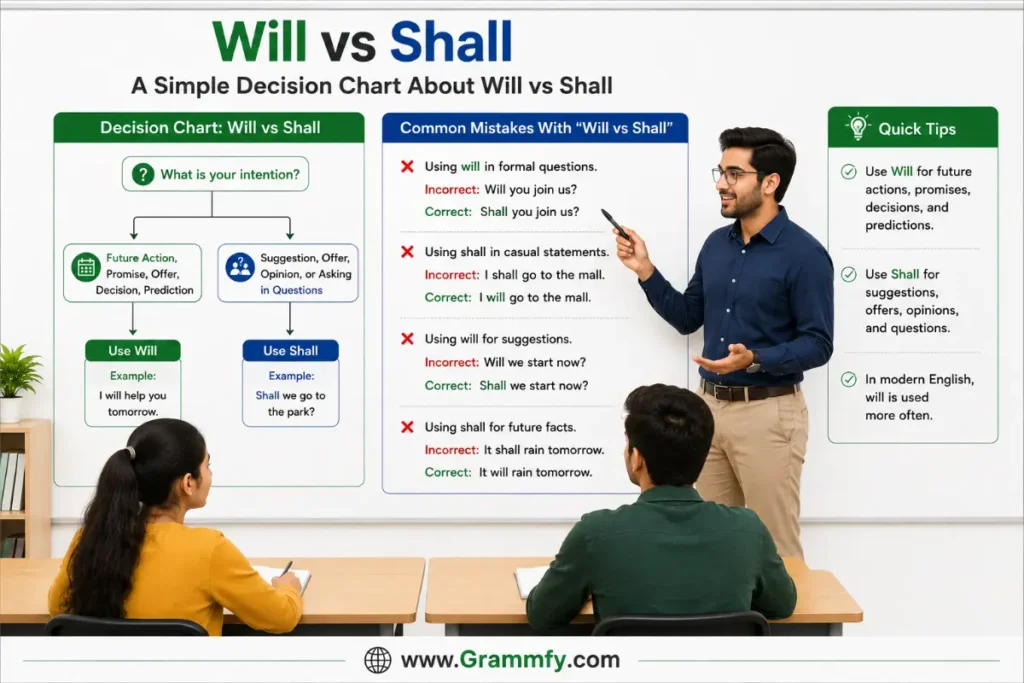
A Simple Decision Chart About Will vs Shall
| What do you mean? | Best choice |
|---|---|
| Ordinary future action | will |
| Future prediction | will |
| Promise | will |
| Quick decision | will |
| Offer | will / shall I…? |
| Suggestion | shall we…? |
| Asking for advice | should |
| Existing plan | going to / plan to |
| Possibility | may / might / could |
| Strong obligation | must |
| Formal contractual requirement | shall or must, depending on drafting style |
Can “Will vs Shall” Ever Mean the Same Thing?
Yes. In some future statements, they can communicate nearly the same basic idea.
For example:
I will return tomorrow.
I shall return tomorrow.
Both can refer to the speaker returning tomorrow.
The difference is mainly in tone, style, and regional usage.
The first sounds normal and neutral in modern American English. The second sounds more formal, literary, traditional, or British depending on context.
So the words can overlap in meaning without being equally natural in every situation.
Is Shall Old-Fashioned?
Sometimes, but not always.
“Shall” isn’t an obsolete word. It remains common in expressions such as:
Shall we?
It also appears in formal, legal, literary, and traditional language.
What has changed is its everyday use.
An American speaker saying:
I shall see you tomorrow.
may sound unusually formal.
But:
Shall we go?
sounds completely understandable and can be perfectly natural.
So it is better to call “shall” less common in everyday American English rather than simply “old-fashioned.”
Can You Use Will for Every Person?
Yes.
Modern English commonly uses “will” with every grammatical person:
- I will
- you will
- he will
- she will
- it will
- we will
- they will
Examples:
I will study.
You will learn.
He will arrive.
She will call.
We will wait.
They will return.
This is one reason “will” is so useful for learners.
What About Contractions?
Contractions are extremely common with “will.”
| Full form | Contraction |
|---|---|
| I will | I’ll |
| you will | you’ll |
| he will | he’ll |
| she will | she’ll |
| it will | it’ll |
| we will | we’ll |
| they will | they’ll |
Examples:
I’ll call you tonight.
We’ll see you tomorrow.
They’ll finish the work soon.
In formal academic writing, you may sometimes prefer full forms depending on the style guide. In everyday writing and speech, contractions are completely normal.
“Shall” can also be contracted in some varieties of English, but those forms are much less common in modern American usage.
How Does Will Work With If?
“Will” commonly appears in the main clause of a first conditional sentence.
Pattern:
If + present simple, will + base verb
Examples:
If it rains, we will stay inside.
If you study, you will improve.
If she calls, I will answer.
A common learner mistake is putting “will” directly after “if” when a normal condition is intended.
Less natural:
If it will rain, we will stay home.
Better:
If it rains, we will stay home.
There are special cases where “will” can appear after “if,” especially when it expresses willingness, but those are different structures.
How Does Will Work in Questions?
The structure is usually:
Will + subject + base verb?
Examples:
Will you join us?
Will she come tomorrow?
Will they finish on time?
Will it be expensive?
The question can ask about:
- future events
- predictions
- willingness
- decisions
- requests
For example:
Will you help me?
can be a request for help.
But:
Will you be at the meeting tomorrow?
usually asks about future attendance.
Context determines the exact meaning.
How Does Shall Work in Questions?
“Shall” is especially useful with I and we.
Common patterns include:
Shall I + verb…?
Shall I open the door?
Shall we + verb…?
Shall we continue?
These structures are often used to offer an action or suggest something.
That’s why “shall” can feel more natural in a question than in a simple future statement.
Final Grammar Check: A Fast Test
Before choosing between the two, ask yourself three questions:
1. Am I simply talking about the future?
Use will in most cases.
2. Am I asking for a suggestion or making a shared proposal?
Try shall I…? or shall we…?
3. Am I writing a formal rule or legal document?
Check the specific style requirements. “Shall” may be appropriate, but must may provide a clearer statement of obligation.
This quick test handles most everyday situations.
Conclusion
The main lesson from will vs shall is simple: will is the normal choice for most future statements, especially in modern American English. It works for predictions, promises, intentions, offers, and decisions. Shall has a narrower but still useful role. It appears naturally in questions such as “Shall I…?” and “Shall we…?”, and it remains important in formal, traditional, and legal language.
You don’t need to force “shall” into your writing to make it sound intelligent or professional. In most everyday situations, clear and natural English is the better goal. When you’re making a suggestion, offering an action, or following a formal style, “shall” may be exactly the right choice. With these patterns in mind, choosing between the two becomes much easier.
Frequently Asked Questions
Is will or shall more common in American English?
Will is much more common for ordinary future statements in American English. “Shall” is mainly used in certain questions, formal expressions, and official language.
When should I use shall instead of will?
Use “shall” mainly for suggestions or offers such as “Shall we begin?” or “Shall I help you?” It can also appear in formal and legal writing.
Is shall more formal than will?
Yes, in many modern contexts, “shall” sounds more formal, traditional, or official than “will.” However, formality doesn’t automatically make it the better choice.
What’s another way to say “shall”?
Depending on the meaning, alternatives include should, will, going to, plan to, must, may, or might. The correct replacement depends on whether you’re expressing a suggestion, future action, possibility, or obligation.
Is “shall we” correct English?
Yes, “shall we” is completely correct and remains common in suggestions. For example, “Shall we start the meeting?” asks the group whether it should begin.
Is shall still used in British English?
Yes. British English continues to use “shall,” especially with “I” and “we,” as well as in expressions such as “Shall we…?” However, “will” is also widely used.
Can I use will instead of shall in formal writing?
Often, yes, but it depends on the intended meaning. For ordinary future actions, “will” is usually clear; for legal or regulatory language, follow the document’s drafting conventions and consider whether “must” expresses an obligation more clearly.
