
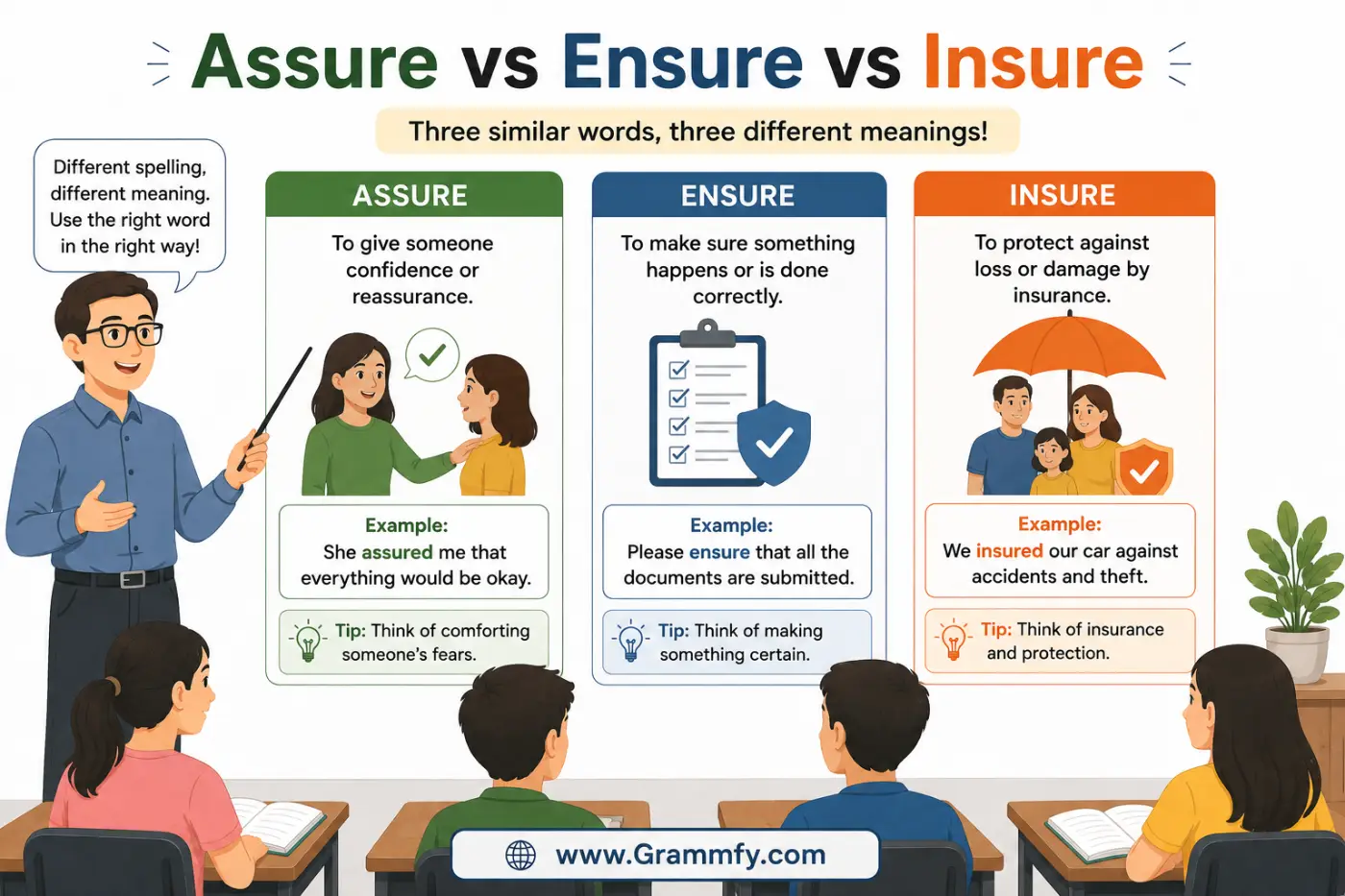
When you’re writing an email, essay, resume, or even a quick text, choosing the right word can be tricky. The words Assure vs Ensure vs Insure sound similar, but they have different jobs. Knowing the difference helps your writing sound clear and professional.
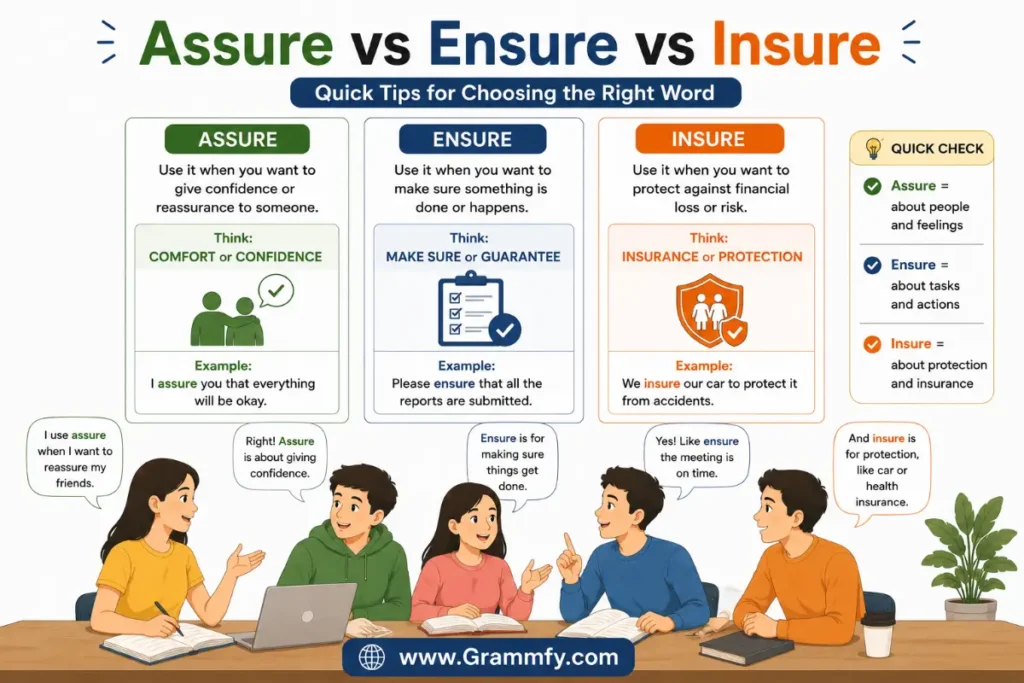
Assure is mainly about giving a person confidence, ensure means making sure something happens, and insure usually relates to financial protection against loss or damage.
The easiest way to remember them is simple: assure a person, ensure an outcome, and insure against a risk.
In this guide, you’ll learn their meanings, origins, common patterns, synonyms, intensity levels, regional differences, real-life examples, common mistakes, and the best choice for emails, resumes, essays, texting, and everyday speech.
Having trouble remembering which word fits? See our guide to [brake or break].
What Is the Difference Between “Assure vs Ensure vs Insure”
The basic distinction is based on what follows the verb and what the writer wants to communicate.
| Word | Main Meaning | Usually Used With | Simple Example |
|---|---|---|---|
| Assure | To tell someone something confidently so they feel certain | A person | I assure you that everything is fine. |
| Ensure | To make certain that something happens | A result, condition, or event | Please ensure that the door is locked. |
| Insure | To protect financially against possible loss or damage | A person, property, or risk | We insure our house against fire. |
A useful memory trick is:
- Assure = someone
- Ensure = something
- Insure = protection
There can be some overlap in real-world usage, especially with insure and ensure, but this three-part distinction works well for standard American English.
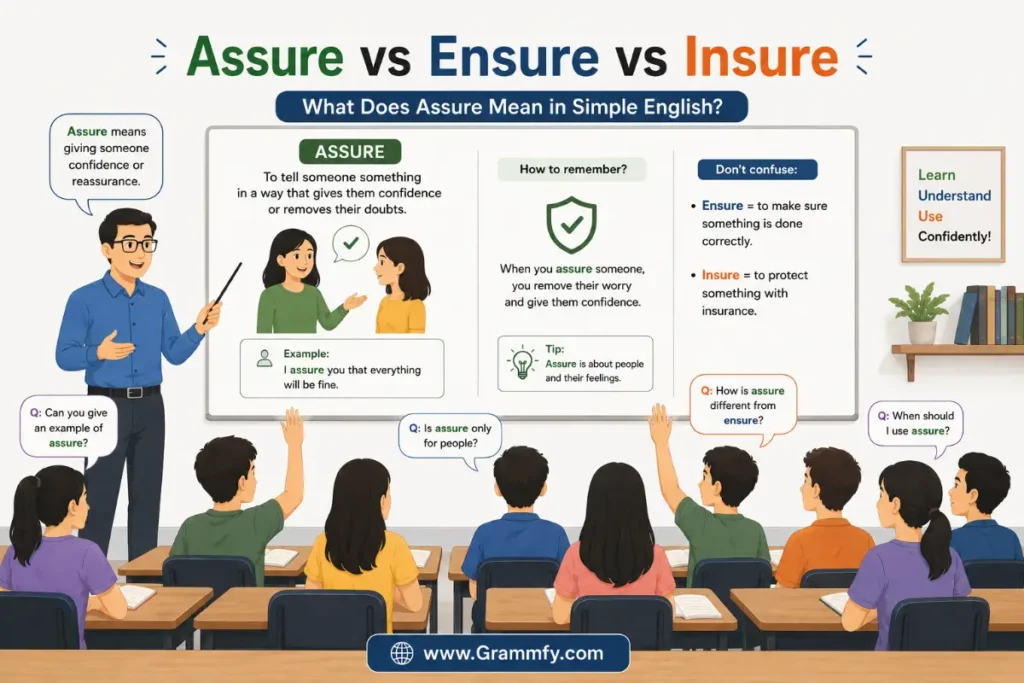
What Does Assure Mean in Simple English?
Assure means to tell someone something confidently to remove doubt, fear, or worry.
It normally has a person as its object.
For example:
I assure you that your application has been received.
The speaker is giving another person confidence.
Other examples include:
- She assured me that she would call.
- The teacher assured the students that the test would be fair.
- He assured his parents that he was safe.
- I assure you, we have checked everything.
- The manager assured the customer that the problem would be fixed.
The key idea is reassurance.
When you use assure, you are usually communicating confidence directly to someone.
Common Grammar Pattern for Assure
The most common pattern is:
assure + person + that-clause
Examples:
- She assured me that she was ready.
- They assured us that the information was correct.
- He assured the client that the team was working on it.
You can also use a pronoun:
- I assure you.
- We assure you.
- I can assure him that the plan is safe.
What Does Ensure Mean in Simple English?
Ensure means to make certain that something happens or remains true.
Unlike assure, it focuses on an outcome rather than simply giving someone confidence.
For example:
Please ensure that all students submit their assignments.
The speaker wants a particular result: all assignments should be submitted.
Other examples include:
- Check the address to ensure correct delivery.
- We added extra staff to ensure fast service.
- Please ensure that your password is secure.
- The checklist helps ensure accuracy.
- She arrived early to ensure that everything was ready.
The key idea is making something certain.
Common Grammar Pattern for Ensure
A common structure is:
ensure + that + result
Examples:
- Ensure that the windows are closed.
- We must ensure that everyone understands the instructions.
- The company created new rules to ensure safety.
Another common pattern is:
ensure + noun
Examples:
- We need to ensure safety.
- The system ensures accuracy.
- Good planning ensures success.
What Does Insure Mean in Simple English?
Insure traditionally means to protect someone or something financially against a possible loss, accident, damage, illness, or other covered risk.
For example:
We insure our car against accidents.
The word is strongly associated with insurance policies and financial protection.
Other examples include:
- She insured her car.
- The company insures commercial buildings.
- They insured the property against fire.
- Many homeowners insure their houses.
- The business insured its equipment against damage.
The key idea is financial protection against risk.
Where Did “Assure vs Ensure vs Insure” Come From?
The three words are closely related historically. They all connect to the idea of making something certain or secure.
They developed from forms related to the Latin word securus, meaning safe or free from worry. Through French and English, related forms developed with meanings involving certainty, confidence, and protection.
That shared history explains why the words look and sound so similar.
Over time, English separated their common uses:
- Assure became strongly connected with giving confidence to people.
- Ensure became connected with making a result certain.
- Insure became strongly connected with financial protection.
The meanings are therefore related, but their modern uses are not identical.
Understanding this history can make the difference easier to remember. Think of all three as dealing with certainty or security, but from different angles.
Master Synonym List for “Assure vs Ensure vs Insure”
There isn’t one perfect synonym that can replace all three words in every sentence. Their meanings differ, so the best alternative depends on the situation.
The following list groups related words by tone and common use.
| Word | Meaning | Tone | Example |
|---|---|---|---|
| Reassure | Make someone feel less worried | Everyday | She reassured me that everything was okay. |
| Promise | Say confidently that something will happen | Everyday | He promised to call later. |
| Confirm | State that something is true | Everyday/Formal | Please confirm your appointment. |
| Comfort | Reduce someone’s worry or sadness | Everyday | His words comforted the child. |
| Calm | Make someone less anxious | Everyday | The nurse calmed the patient. |
| Certify | Confirm officially | Formal | The expert certified the results. |
| Assure | Give someone confidence | Formal/Everyday | I assure you that it is safe. |
| Reaffirm | Confirm something strongly again | Formal | The leader reaffirmed the commitment. |
| Pledge | Make a serious promise | Formal | The company pledged to improve service. |
| Vow | Make a strong promise | Strong | She vowed to finish the project. |
| Swear | Promise very strongly | Informal/Strong | He swore he was telling the truth. |
| Guarantee | Give a firm promise | Strong | We guarantee satisfaction. |
| Validate | Confirm that something is legitimate or correct | Formal | The test validated the results. |
| Substantiate | Support a claim with evidence | Formal | The data substantiated the claim. |
| Back up | Support or confirm something | Informal | The records back up his story. |
| Stand behind | Support or guarantee something | Everyday | We stand behind our product. |
| Make certain | Make something sure | Everyday | Make certain the lights are off. |
Some of these words overlap only partially. For example, reassure is close to assure, while verify is closer to confirming something than ensuring it. Choosing the exact synonym matters when precision is important.
What Are the Synonyms From Mild to Strong?
Different words express different levels of certainty.
Mild Certainty
These words can suggest ordinary confidence:
- suggest
- indicate
- confirm
- reassure
- support
Example:
The manager reassured me that the meeting was still scheduled.
Medium Certainty
These words communicate stronger confidence:
- assure
- verify
- establish
- secure
- affirm
- guarantee
Example:
The technician verified that the system was working.
Strong Certainty
These expressions can sound especially firm:
- guarantee
- pledge
- vow
- swear
- certify
Example:
The company guarantees that every product is inspected.
Be careful with very strong words. Guarantee can create a stronger commitment than assure, so it should not be used casually when you cannot truly promise an outcome.
What Are the Parts of Speech of “Assure vs Ensure vs Insure”?
Assure, ensure, and insure are all verbs.
Their related forms can appear in other parts of speech.
| Verb | Noun | Adjective/Related Form |
|---|---|---|
| Assure | Assurance | Assured |
| Ensure | Assurance/ensuring | Ensured |
| Insure | Insurance | Insured |
Examples:
- Her assurance helped me relax.
- The company provided insurance for the vehicle.
- The manager gave an assured response.
- The system was carefully ensured through testing.
The nouns can be especially useful when writing formal documents.
For example:
We need assurance that the project will remain on schedule.
But:
We need insurance for the company vehicle.
These sentences deal with very different ideas.
Is There a US and UK Difference between “Assure vs Ensure vs Insure”?
The basic distinction between the three words is widely recognized in both American and British English.
However, insure and ensure can overlap more in British usage than many learners expect.
In standard American English, insure is strongly associated with insurance and financial protection, while ensure is preferred for making something certain.
For example:
Please ensure that the report is complete.
And:
We insure the building against fire.
In British English, insure may sometimes be used in broader contexts where American writers would normally choose ensure.
For learners, the safest approach is still simple:
- Use assure when speaking to a person.
- Use ensure when making an outcome certain.
- Use insure for insurance and financial risk.
This rule works well for school, professional, and general American English writing.
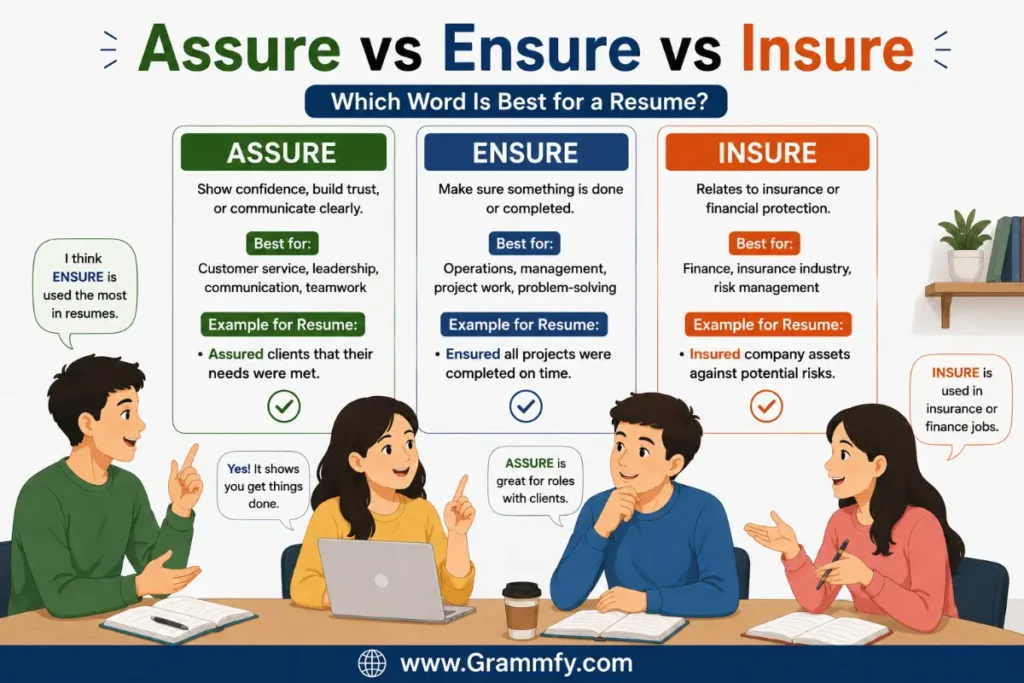
Which Word Is Best for a Resume “Assure vs Ensure vs Insure”?
Should You Use Assure, Ensure, or Insure on a Resume?
For resumes, ensure is often the best choice when describing actions that produced reliable results.
Examples:
Ensured accurate customer records and timely reporting.
Ensured compliance with company safety procedures.
Ensured smooth communication between departments.
These sentences focus on responsibility and results.
Assure can work when your job involved communicating confidence or handling customer concerns:
Assured customers that their concerns were being addressed.
Insure should generally appear only when insurance is actually part of the job or industry.
For example:
Managed insurance documentation for commercial clients.
A resume should show what you did, so choose the verb based on the actual responsibility rather than trying to sound formal.
Which Word Is Best for an Essay “Assure vs Ensure vs Insure”?
Should You Use Assure, Ensure, or Insure in an Essay?
Ensure is common in academic writing because essays often discuss actions that produce a particular result.
Examples:
Schools must ensure that students have access to reliable learning materials.
Careful editing helps ensure that an argument is clear.
Assure is useful when discussing communication, confidence, or promises.
The speaker assured the audience that the information was accurate.
Insure is appropriate when discussing insurance, financial risk, or protection.
Many homeowners insure their properties against natural disasters.
In an essay, don’t choose a word simply because it sounds sophisticated. Choose the one that matches the meaning.
Which Word Is Best for Texting “Assure vs Ensure vs Insure”?
What Should You Use in a Text Message?
In casual texting, assure and ensure can both appear, but simpler alternatives may sound more natural.
Instead of:
I assure you that I’ll be there.
A casual text might say:
I promise I’ll be there.
Instead of:
Please ensure that you bring your ID.
You might say:
Make sure you bring your ID.
Still, assure and ensure are not wrong in texts. The choice depends on your relationship with the reader and how formal you want to sound.
Insure should remain connected to insurance.
For example:
Did you insure your new car?
That sounds natural because the subject is insurance.
Which Word Is Best for an Email “Assure vs Ensure vs Insure”?
What Is the Best Choice for a Professional Email?
All three words can appear in professional emails, but they perform different functions.
I assure you that we are reviewing the issue.
Please ensure that all documents are attached before sending the application.
Please provide proof that the vehicle is insured.
A useful professional-writing rule is to ask:
Am I talking about a person’s confidence, an outcome, or financial protection?
That question usually gives you the answer immediately.
Which Word Is Best When Speaking “Assure vs Ensure vs Insure”?
What Sounds Natural in Everyday Conversation?
In everyday speech, assure is often used when someone wants to calm another person.
I assure you, everything will be fine.
However, people often use simpler phrases such as:
I promise.
Trust me.
Don’t worry.
Ensure is more common in instructions and formal conversation:
Please ensure the door is locked before you leave.
Insure usually comes up when people discuss cars, homes, health coverage, businesses, or other forms of insurance.
What Are Real-Life Examples of “Assure vs Ensure vs Insure”?
Here are examples from different situations.
Workplace
The supervisor assured the staff that their questions would be answered.
The team checked the figures twice to ensure accuracy.
The company insured its warehouse against fire.
School
The teacher assured the students that the quiz would be short.
Students should read the instructions carefully to ensure they understand the task.
The school insured its equipment against damage.
Customer Service
The representative assured the customer that the refund was being processed.
The employee checked the order to ensure that the correct item was shipped.
The retailer may insure expensive inventory against theft.
Travel
The airline assured passengers that another flight was available.
We arrived early to ensure that we had enough time for security.
The traveler insured the rental vehicle according to the rental agreement.
Home
Dad assured us that the house was safe.
We checked every window to ensure they were locked.
The homeowner insured the property against certain risks.
Technology
The developer assured users that their information was protected.
The team tested the software to ensure that it worked correctly.
The company may insure valuable hardware against physical damage.
Personal Conversation
I assure you that I didn’t forget your birthday.
Set a reminder to ensure you don’t miss the appointment.
We insured the car after buying it.
Business Planning
The director assured investors that the company had a clear plan.
The company changed its process to ensure faster delivery.
The business insured its equipment against covered losses.
Assure vs Reassure: What’s the Difference?
Assure means to tell someone confidently that something is true or will happen. Reassure specifically emphasizes reducing someone’s fear, worry, or doubt.
Compare:
I assured Maria that the meeting was tomorrow.
This simply gives Maria information confidently.
Now compare:
I reassured Maria that everything would be okay.
This focuses on reducing her worry.
The two words can overlap:
The doctor assured the patient that the treatment was safe.
The doctor reassured the patient that the treatment was safe.
The second version more strongly suggests that the patient was worried.
Ensure vs Guarantee: What’s the Difference?
Ensure means to take action to make an outcome certain or more likely. Guarantee is stronger and often suggests a firm promise.
Compare:
We checked the equipment to ensure safety.
This means the team took steps to promote or maintain safety.
Now:
We guarantee your safety.
This makes a much stronger promise.
That distinction matters in professional writing. You may be able to ensure that a process follows safety rules, but you should not claim to guarantee an outcome unless you genuinely have the authority and ability to promise it.
Insure vs Protect: What’s the Difference?
Protect is a broad word. Insure is more specific.
You can protect something through security systems, careful planning, physical barriers, backups, or insurance.
A password protects your account.
But:
Insurance protects you financially against covered losses.
So insure is a specific type of protection connected to an insurance arrangement.
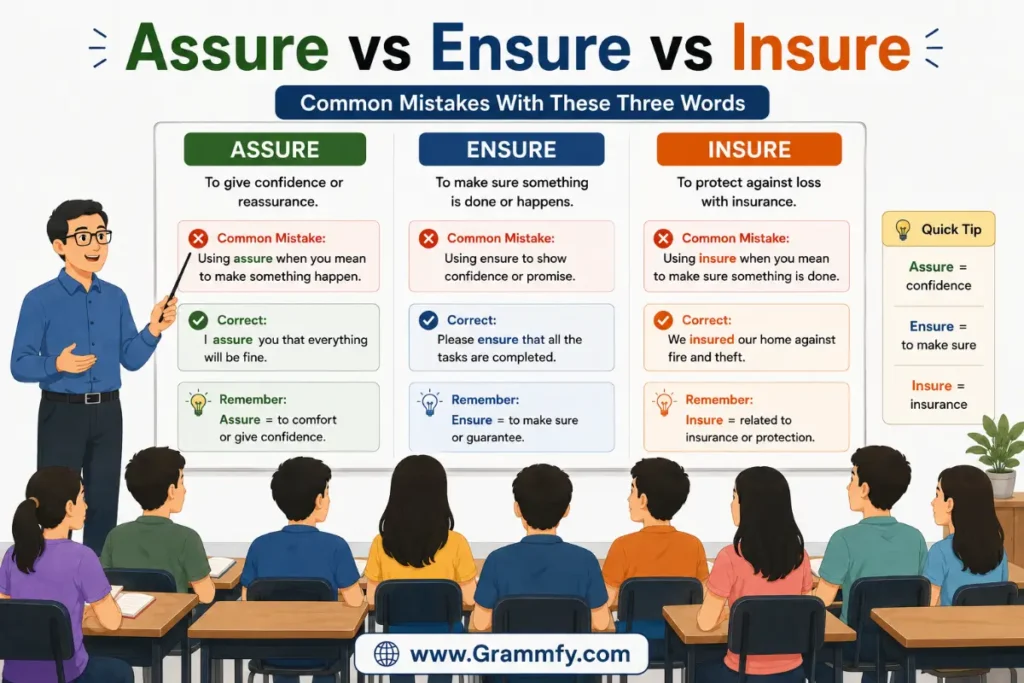
Common Mistakes With These Three Words “Assure vs Ensure vs Insure”
Mistake 1: Using Insure Instead of Ensure
Incorrect for standard American usage:
Please insure that the report is complete.
Better:
Please ensure that the report is complete.
Here, no insurance is involved. The writer simply wants to make sure the report is complete.
Mistake 2: Using Ensure for a Person
Awkward:
I ensure you that everything is fine.
Better:
I assure you that everything is fine.
The person is receiving confidence, so assure fits.
Mistake 3: Using Assure for a Result
Awkward:
We assured that the machine was working properly.
Better:
We ensured that the machine was working properly.
The focus is on making sure a condition existed.
Mistake 4: Thinking They Are Completely Interchangeable
They share a history and some meanings, but they are not interchangeable in every sentence.
Compare:
I assured the customer.
I ensured the customer.
The first can mean I gave the customer confidence. The second does not work with the same meaning.
Mistake 5: Using Guarantee When You Mean Ensure
We guaranteed that all forms were checked.
This can sound like a promise.
If you mean that the team took steps to make sure the forms were checked, use:
We ensured that all forms were checked.
Mistake 6: Using Assure When You Mean Confirm
These words can overlap, but they focus on different things.
I assure you that the appointment is at 3 p.m.
This emphasizes confidence given to the listener.
I confirm that the appointment is at 3 p.m.
This simply confirms the information.
When Should You NOT Use Assure?
Don’t use assure merely because something is certain.
For example:
The system assures accuracy.
This may sound unnatural if you mean the system makes accuracy more likely.
A better choice could be:
The system ensures accuracy.
Use assure when someone is being given confidence or certainty.
When Should You NOT Use Ensure?
Don’t use ensure when the main subject is financial insurance.
For example:
The homeowner ensured the house against fire.
If you mean the homeowner purchased insurance, use:
The homeowner insured the house against fire.
Also avoid using ensure just to sound formal. Sometimes make sure is clearer and more natural.
When Should You NOT Use Insure?
Don’t use insure when you simply mean “make certain” in standard American writing.
Instead of:
Insure that the door is locked.
Write:
Ensure that the door is locked.
Save insure for insurance-related contexts.
What Are the Antonyms?
The exact opposite depends on the word and context.
Antonyms of Assure
Possible opposites include:
- worry
- alarm
- frighten
- discourage
- unsettle
- doubt
Example:
Her words reassured me.
Opposite idea:
His warning worried me.
Antonyms of Ensure
Possible opposites include:
- prevent
- undermine
- jeopardize
- hinder
- obstruct
- endanger
Example:
Careful planning ensured success.
Opposite idea:
Poor planning jeopardized the project.
Antonyms of Insure
There isn’t one perfect direct antonym. Depending on context, you might use:
- expose
- risk
- endanger
- leave unprotected
Example:
The policy insured the property against theft.
Opposite idea:
Without coverage, the property was exposed to financial loss.
How Can You Quickly Choose the Right Word “Assure vs Ensure vs Insure”?
Use this three-question test.
1. Am I Giving a Person Confidence?
Choose assure.
I assure you that we will help.
Think: a person receives reassurance.
2. Am I Making Something Certain?
Choose ensure.
Check the figures to ensure accuracy.
Think: an outcome becomes certain or more secure.
3. Am I Talking About Insurance?
Choose insure.
They insure their home against damage.
Think: financial protection against risk.
This simple test handles most everyday cases.
A Simple Memory Trick
Remember the first letters:
A = Assure a person
E = Ensure an outcome
I = Insure against risk
You can turn it into a short phrase:
Assure people. Ensure results. Insure property.
This isn’t a rule that covers every specialized use, but it’s an excellent starting point for students, writers, and English learners.
Quick Comparison Chart “Assure vs Ensure vs Insure”
| Situation | Best Word | Example |
|---|---|---|
| Giving a customer confidence | Assure | I assure you that we’ll help. |
| Giving a friend confidence | Assure | I assure you, I’m fine. |
| Making a result certain | Ensure | Check the work to ensure accuracy. |
| Following a safety procedure | Ensure | Ensure that the door is locked. |
| Making delivery more certain | Ensure | We called to ensure delivery. |
| Buying insurance | Insure | We insure our car. |
| Protecting property financially | Insure | They insured the building. |
| Discussing an insurance policy | Insure | Is the vehicle insured? |
How Do You Use Them in Professional Writing “Assure vs Ensure vs Insure”?
Professional writing rewards precision.
Instead of choosing the word that sounds most formal, identify the exact relationship between the action and the object.
I assure you that your request has been received.
We reviewed the procedure to ensure that all requirements were met.
The company insured its equipment against covered losses.
This distinction is especially useful in reports, contracts, customer messages, resumes, and business correspondence.
How Do You Use Them in Academic Writing?
Academic writing often needs precise cause-and-effect language.
Examples:
Researchers used multiple tests to ensure the reliability of the results.
The author assures readers that the evidence has been carefully reviewed.
The organization insured its research facilities against certain risks.
Notice how the words do different jobs. Ensure is particularly useful when discussing methods, procedures, accuracy, consistency, and outcomes.
How Do You Use Them in Customer Service?
Customer service often uses assure because employees need to reduce customer concerns.
For example:
I assure you that your complaint has been forwarded to our support team.
But customer service instructions may use ensure:
Please ensure that the information on your account is correct.
And insurance companies naturally use insure:
Customers can insure eligible property against covered risks.
Choosing the correct word can make a customer message sound more professional and trustworthy.
Can “Assure vs Ensure vs Insure” Ever Mean the Same Thing?
They can overlap around the general idea of certainty or security, but they are not exact synonyms.
For example, assure and ensure can both relate to certainty, but one normally focuses on a person while the other focuses on a result.
Ensure and insure have historically been related and may overlap in some regional usage, but modern American English usually separates them clearly.
If you are writing for a school, workplace, website, or professional audience, following the standard distinction is the safest choice.
Why Do People Confuse These Words “Assure vs Ensure vs Insure”?
There are several reasons.
First, all three words sound very similar.
Second, they share a related history.
Third, their meanings all connect to certainty, security, or confidence.
Fourth, ensure and insure have overlapping uses in some varieties of English.
Finally, people often hear the words more frequently than they see them in writing. This can make spelling and usage harder to remember.
The solution isn’t memorizing a long dictionary definition. It’s learning the central idea of each word.
Assure = confidence for a person.
Ensure = certainty about an outcome.
Insure = financial protection against risk.
Quick Tips for Choosing the Right Word “Assure vs Ensure vs Insure”
- If a person is being reassured, use assure.
- If an outcome needs to happen, use ensure.
- If something needs insurance coverage, use insure.
- Replace ensure with “make sure” when a casual tone is better.
- Replace assure with “reassure” when reducing worry is the main idea.
- Use guarantee only when you really mean a strong promise.
- In American English, reserve insure mainly for insurance contexts.
- Read the entire sentence before choosing the word.
- Ask what the verb is doing: calming a person, securing an outcome, or providing financial protection.
- When in doubt, use the memory trick: person, result, risk.
Practice: Choose the Correct Word
Try filling in each blank.
- I ______ you that everything is under control.
- Please ______ that all windows are closed.
- They decided to ______ the vehicle.
- The manager ______ the customer that the issue would be investigated.
- The checklist helps ______ accuracy.
- The homeowner wants to ______ the property against fire.
- We changed the process to ______ faster service.
- She ______ me that she had received my message.
- The company ______ its equipment against theft.
- Please ______ that your name is spelled correctly.
Answers
- assure
- ensure
- insure
- assured
- ensure
- insure
- ensure
- assured
- insured
- ensure
The pattern should now be easier to see. People receive assurance, outcomes are ensured, and risks are insured.
Conclusion
The key to using these three verbs correctly is to focus on the relationship between the verb and the situation. Assure is about giving a person confidence or removing doubt. Ensure is about making a result or condition certain. Insure is about financial protection against possible loss or damage.
Once you connect each word with its main purpose, the spelling becomes much easier to remember. Think assure a person, ensure an outcome, and insure against risk. This simple pattern works in most everyday American English situations, from school assignments and resumes to business emails and conversations.
Learning assure vs ensure vs insure isn’t about memorizing complicated grammar. It’s about noticing what your sentence is trying to say. Choose the word that matches that purpose, and your writing will be clearer and more precise.
Frequently Asked Questions
What is the difference between assure, ensure, and insure?
Assure means to give someone confidence, ensure means to make something certain, and insure means to provide financial protection against risk. The easiest memory trick is person, outcome, insurance.
Is it correct to say “I ensure you”?
No, not in standard usage when you mean “I give you confidence.” The natural expression is “I assure you.”
Should I use ensure or insure?
Use ensure when you mean “make certain,” and use insure when you mean financial protection through insurance.
What’s another way to say assure?
Common alternatives include reassure, confirm, promise, guarantee, comfort, and convince, depending on the exact meaning. “Reassure” is especially useful when someone is worried.
Is insure the same as ensure in American English?
No. In standard American English, ensure usually means “make certain,” while insure is mainly connected with insurance and financial protection.
Can I use assure in a professional email?
Yes. Assure is useful when you want to give a customer, colleague, or client confidence about something. For example, “I assure you that we are reviewing your request.”
Which word should I use in a resume: assure or ensure?
Ensure is usually better when describing responsibilities and results, such as “Ensured accurate records and timely reporting.” Use assure when your work specifically involved reassuring people.
