
When you’re writing an essay, email, book review, or even a social media post, you might pause over climactic vs climatic. The words look and sound similar, but they describe very different ideas. Mixing them up can change the meaning of a sentence in a way that’s easy for readers to notice.
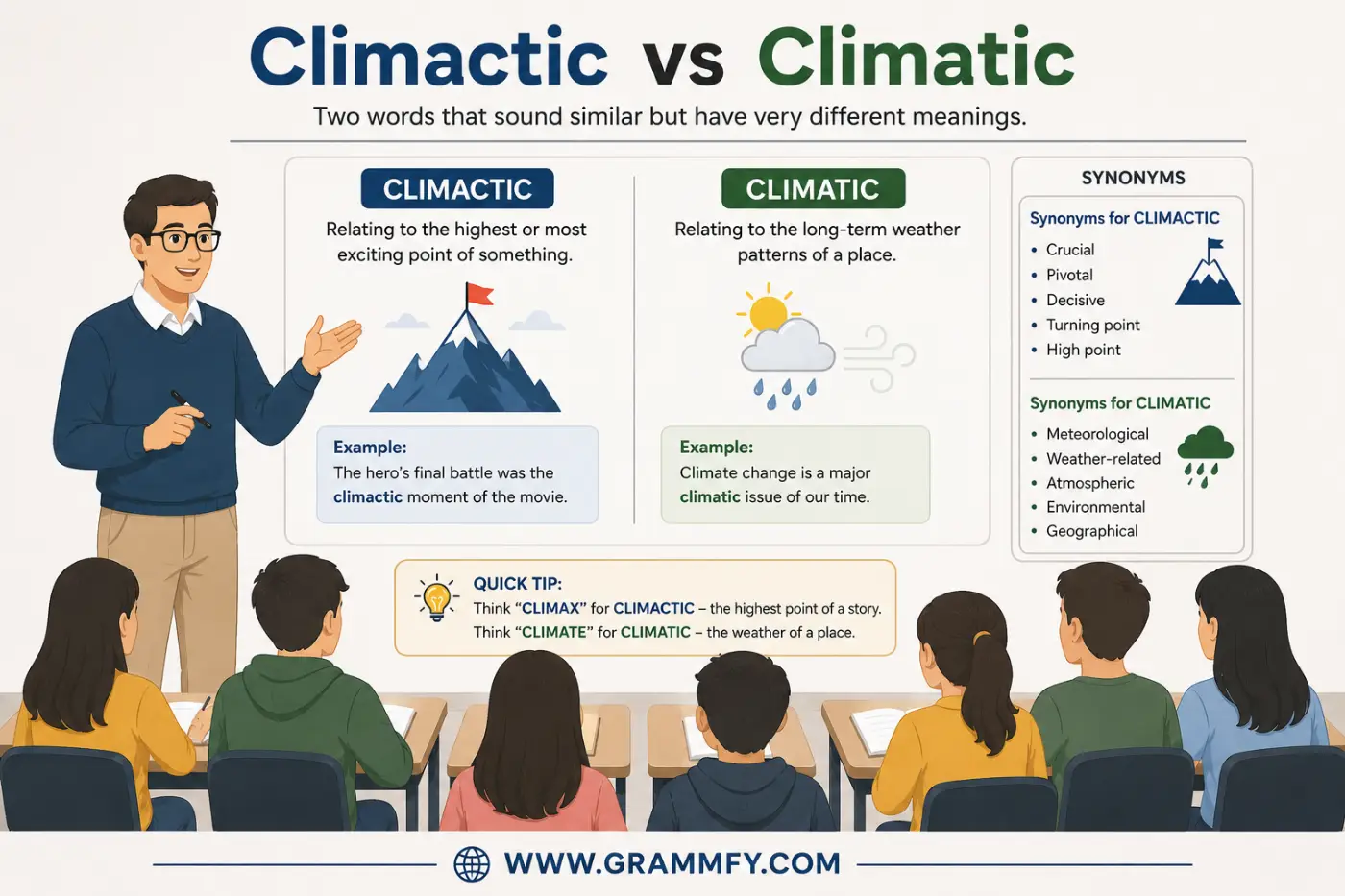
The good news is that the difference is simple once you connect each word to its root idea. Climactic relates to a climax, or the most exciting, important, or intense point. Climatic relates to climate, especially weather and long-term atmospheric conditions.
Answer: Climactic means relating to a climax or the most intense point, while climatic means relating to climate, weather, or atmospheric conditions.
This guide explains the meanings, origins, grammar, synonyms, intensity levels, common mistakes, regional usage, and real-world examples. You’ll also learn which word works best in essays, resumes, emails, texts, and professional writing.
If you’re working on choosing the right word, explore [cite vs sight vs site].
What is the difference between “Climactic vs Climatic”?
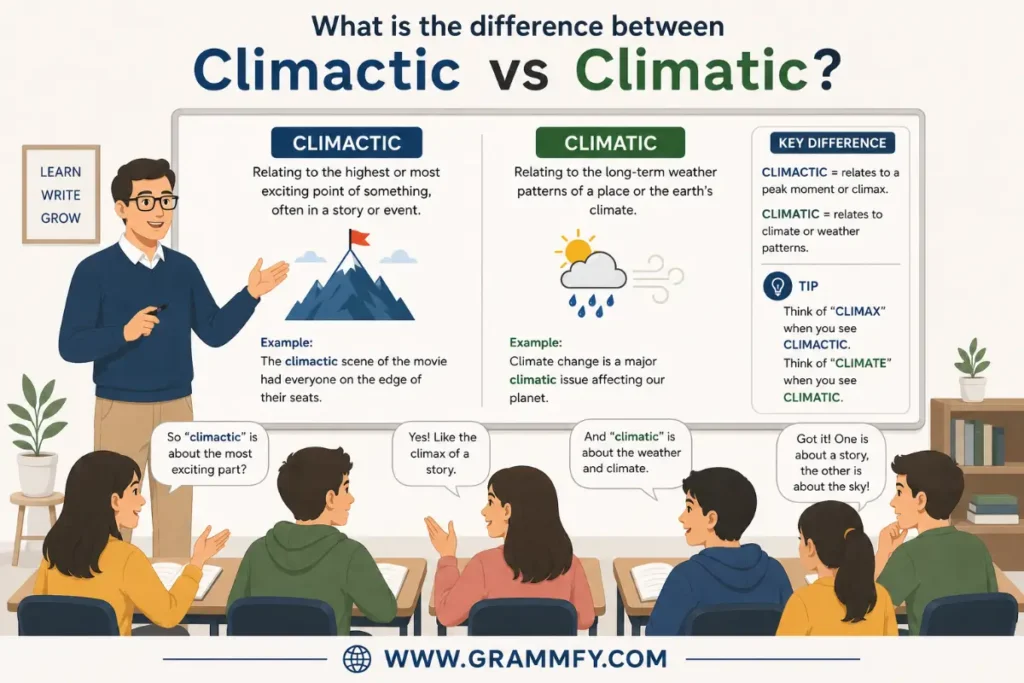
The main difference is the noun each adjective comes from.
Climactic comes from climax. It describes something connected with the highest, most exciting, or most important point of an event, story, process, or situation.
Climatic comes from climate. It describes something connected with weather, climate, or long-term atmospheric conditions.
| Word | Related noun | Meaning | Example |
|---|---|---|---|
| Climactic | Climax | Relating to the highest or most intense point | The movie has a climactic final battle. |
| Climatic | Climate | Relating to climate or weather patterns | Climatic conditions affect farming. |
Compare these sentences:
The novel ends with a climactic confrontation.
The region has harsh climatic conditions.
The first sentence is about a dramatic peak. The second is about climate.
A quick memory trick is:
Climactic → climax → peak
Climatic → climate → weather
That connection solves most usage questions.
What does climactic mean in plain English?
Climactic means connected to the climax or highest point of something.
A climax is the point where tension, action, emotion, or importance reaches its peak.
You might describe these things as climactic:
- A movie’s final battle
- A novel’s biggest confrontation
- A championship match
- A dramatic speech
- A turning point in history
- The final scene of a play
- The most important moment of an argument
- The peak of a long process
For example:
The hero faces the villain in the climactic scene.
This means the scene is the major dramatic peak of the story.
You can also use climactic outside fiction.
The team scored in the climactic final seconds of the game.
Here, the word describes a dramatic moment when the action reaches its highest intensity.
What is a climax?
A climax is the point of greatest intensity, excitement, importance, or tension.
In storytelling, it usually comes after the conflict has developed and before the final resolution.
For example:
- A detective investigates a mystery.
- The clues point toward a suspect.
- The detective confronts the suspect.
- The truth is revealed.
- The story reaches its climax.
- The remaining details are resolved.
The confrontation or revelation may be the climactic moment.
What does climatic mean in plain English?
Climatic means related to climate.
Climate is the typical pattern of weather in a particular place over a long period. It includes factors such as:
- Temperature
- Rainfall
- Humidity
- Wind patterns
- Seasonal conditions
- Long-term changes in weather patterns
For example:
The region has unique climatic conditions.
This means the area’s climate has characteristics that affect the region.
You might see climatic in writing about:
- Agriculture
- Geography
- Environmental science
- Climate research
- Weather patterns
- Ecosystems
- Energy use
- Architecture
- Urban planning
Examples of climatic conditions
Farmers must adapt to changing climatic conditions.
The country’s climatic differences create several growing seasons.
The building was designed for the area’s climatic conditions.
In each case, the word relates to climate rather than drama.
Why are “Climactic vs Climatic” so easy to confuse?
The two words are nearly identical in spelling.
They also sound very similar in many varieties of English.
That creates a problem because English has many pairs and groups of words that differ by only a few letters but have completely different meanings.
The best way to separate these two is to focus on their roots.
Climactic has an extra “c” connection to climax
Think:
climactic → climax
Both begin with climac-.
If you’re talking about the peak of a story, event, argument, competition, or emotional experience, choose climactic.
Climatic connects to climate
Think:
climatic → climate
If you’re talking about weather, long-term atmospheric conditions, or environmental patterns, choose climatic.
This is more reliable than trying to remember the spelling by itself.
Where did climactic come from?
Climactic comes from the noun climax.
The word climax ultimately traces back to Greek klimax, meaning a ladder or staircase. That image makes sense because a climax represents a point that has been reached after a rise or progression.
English later developed the figurative meaning of a climax as the highest point of an event, story, argument, or experience.
From climax, English formed the adjective climactic.
So the relationship is:
climax → climactic
Examples:
- climax of a story → climactic scene
- climax of a battle → climactic moment
- climax of an argument → climactic exchange
This word is closely connected to the idea of a peak.
Where did climatic come from?
Climatic comes from climate.
The word climate entered English through French and Latin and has older Greek roots connected with a region or zone of the Earth.
Over time, climate became closely associated with the characteristic weather conditions of a place.
The adjective climatic developed from climate.
So the relationship is:
climate → climatic
Examples:
- climate of a region → climatic conditions
- climate change → climatic change
- climate patterns → climatic patterns
- climate factors → climatic factors
The root gives you the answer.
“Climactic vs Climatic”: the fastest memory trick
If you only remember one rule, use this:
Climactic = climax = dramatic peak.
Climatic = climate = weather conditions.
You can make the distinction even shorter:
Climactic is about a peak. Climatic is about climate.
Try these two examples:
The film reaches a climactic moment.
Ask: Is this about a dramatic peak? Yes.
The area has unusual climatic conditions.
Ask: Is this about climate? Yes.
Once you ask that question, the correct word is usually obvious.
Master synonym list for “Climactic vs Climatic”
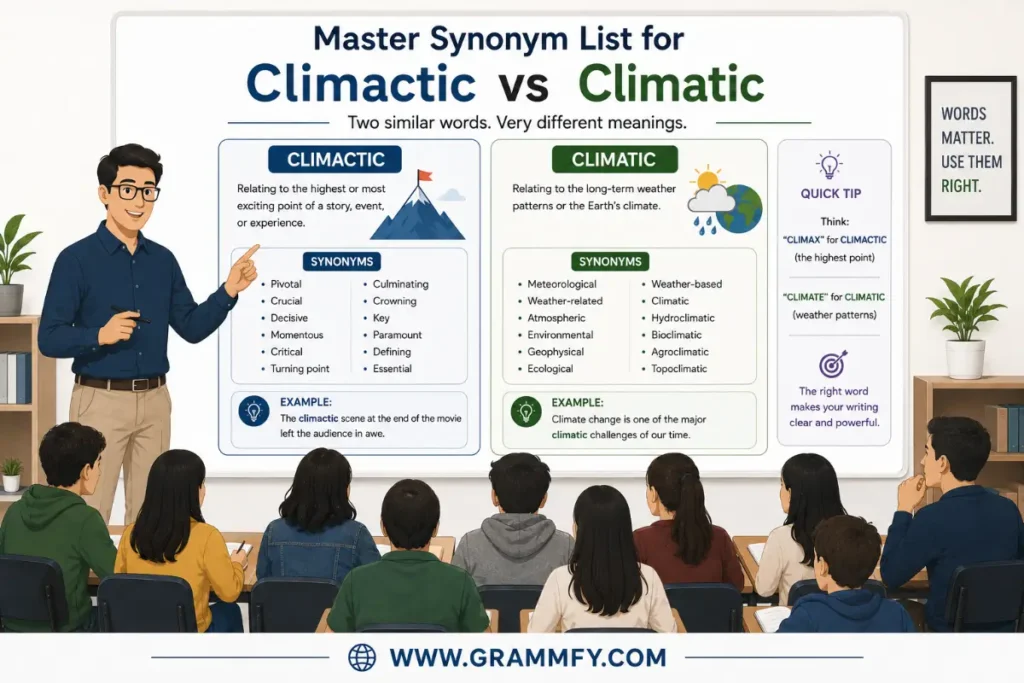
Because these two adjectives have different meanings, their synonyms belong to separate groups. The following table includes more than 20 useful alternatives and related terms.
Simple synonyms and related words
| Word | Meaning | Tone | Example |
|---|---|---|---|
| Peak | Highest point | Simple | The race reached its peak. |
| High point | Most important or exciting moment | Everyday | The final match was the high point. |
| Final | Happening at the end | Simple | The final scene was powerful. |
| Dramatic | Full of excitement or tension | Neutral | The ending was dramatic. |
| Intense | Very strong or extreme | Neutral | The final moments were intense. |
| Exciting | Creating strong interest or emotion | Everyday | The ending was exciting. |
| Critical | Extremely important | Neutral | It was a critical moment. |
| Important | Having great value or effect | Simple | This was an important event. |
| Weather-related | Connected with weather | Simple | The damage was weather-related. |
| Climate-related | Connected with climate | Neutral | The study examines climate-related risks. |
| Atmospheric | Related to the atmosphere | Neutral | Atmospheric conditions changed. |
| Seasonal | Related to a season | Neutral | Seasonal weather affects travel. |
Everyday alternatives
| Word | Meaning | Tone | Example |
|---|---|---|---|
| Dramatic | Exciting or emotionally powerful | Everyday | The game had a dramatic ending. |
| Tense | Full of nervous excitement | Everyday | The final scene was tense. |
| Powerful | Having a strong effect | Everyday | It was a powerful moment. |
| Major | Very important | Everyday | The decision was a major turning point. |
| Peak | Highest level | Everyday | Attendance reached its peak. |
| Turning point | Moment when circumstances change | Everyday | The speech was a turning point. |
| Weather | Conditions of the atmosphere | Everyday | The weather changed quickly. |
| Seasonal | Connected to a season | Everyday | Seasonal rainfall varies. |
| Environmental | Related to the natural world | Everyday/Neutral | Environmental conditions matter. |
| Regional | Related to a particular area | Neutral | Regional climate patterns differ. |
Formal alternatives
| Word | Meaning | Tone | Example |
|---|---|---|---|
| Pivotal | Extremely important to what happens next | Formal | It was a pivotal moment. |
| Culminating | Reaching a final or highest point | Formal | The project ended with a culminating event. |
| Terminal | Relating to an endpoint | Formal | The process reached its terminal stage. |
| Critical | Extremely important or decisive | Formal | The team entered a critical phase. |
| Peak-level | At the highest level | Formal | Demand reached peak levels. |
| Meteorological | Related specifically to atmospheric weather | Scientific | Meteorological data were collected. |
| Atmospheric | Related to the atmosphere | Scientific/Formal | Atmospheric pressure decreased. |
| Climatic | Related to climate | Formal/Scientific | Climatic factors influence ecosystems. |
| Environmental | Relating to environmental conditions | Formal | Environmental changes affect habitats. |
| Geographical | Related to geography or location | Formal | Geographical differences influence climate. |
Casual and slang-adjacent expressions
| Word/Phrase | Meaning | Tone | Example |
|---|---|---|---|
| Big moment | Very important moment | Casual | That was the big moment of the game. |
| High point | Best or most exciting part | Casual | The concert’s high point came at the end. |
| Showdown | Major confrontation | Casual | The final showdown was intense. |
| Finale | Final part or event | Casual/Neutral | The finale was exciting. |
| Blowout | Very decisive win | Casual | The championship ended in a blowout. |
| Turning point | Moment that changes events | Casual/Neutral | That meeting was the turning point. |
| Peak | Highest level | Casual | The excitement hit its peak. |
| Weather conditions | Current atmospheric situation | Casual/Neutral | The weather conditions were rough. |
Not every word in these tables is a perfect replacement. Climactic specifically emphasizes a climax, while words such as dramatic, pivotal, and intense highlight different aspects. Likewise, climatic is more precise than broad terms such as environmental or weather-related in many scientific contexts.
Synonyms by intensity: mild to strong
The word climactic can describe different levels of dramatic importance, depending on the context.
A rough progression is:
Important → significant → dramatic → intense → pivotal → climactic
These words overlap, but each has a different focus.
Important
Something matters.
The decision was important to the team.
Significant
Something has meaningful importance or influence.
The discovery was significant for researchers.
Dramatic
Something creates strong emotion, tension, or excitement.
The final scene was dramatic.
Intense
Something has a very strong emotional or physical quality.
The final minutes were intense.
Pivotal
Something changes the direction of events.
Her decision was pivotal to the investigation.
Climactic
Something represents or belongs to the highest point of a developing sequence.
The climactic confrontation revealed the truth.
This distinction matters because climactic doesn’t simply mean “very exciting.” It suggests that something represents a peak or culmination.
Synonyms by part of speech
The two focus words are adjectives, but related words appear in several grammatical forms.
Nouns related to climactic
- climax
- peak
- culmination
- turning point
- finale
- high point
- conclusion
- culmination
Examples:
The climax of the story surprised readers.
The speech marked the culmination of years of work.
Adjectives related to climactic
- dramatic
- pivotal
- intense
- critical
- decisive
- culminating
- final
- momentous
Example:
The team prepared for the decisive match.
Nouns related to climatic
- climate
- weather
- atmosphere
- temperature
- rainfall
- humidity
- conditions
- environment
Examples:
The region has a dry climate.
Rainfall is an important climatic factor.
Adjectives related to climatic
- climatic
- meteorological
- atmospheric
- environmental
- seasonal
- weather-related
- geographic
- regional
These aren’t exact synonyms in every context. Meteorological, for example, often relates to weather and atmospheric science, while climatic focuses more broadly on climate patterns.
Is “Climactic vs Climatic” correct for a movie?
For a movie’s most exciting or important moment, climactic is correct.
The movie’s climactic scene takes place in the final battle.
You can also say:
The movie reaches its climax during the final confrontation.
Using climatic here would be incorrect unless you’re specifically talking about the movie’s climate or weather.
For example:
The film’s climatic setting reflects the region’s desert climate.
That sentence can be correct because it’s about climate.
Is “Climactic vs Climatic” correct for weather?
For weather and climate, climatic is the correct choice.
The region faces difficult climatic conditions.
Researchers studied climatic changes over several decades.
However, climatic and meteorological aren’t always identical.
Meteorological often relates to weather conditions and atmospheric science, including short-term weather.
Climatic generally relates to climate patterns over longer periods.
For example:
Meteorological data showed heavy rainfall this week.
Climatic trends show that average temperatures have increased over decades.
The time scale and scientific context can help you choose the better word.
Is “Climactic vs Climatic” correct for a story?
For a story’s most important or exciting moment, use climactic.
The climactic chapter reveals the villain’s identity.
The story builds toward a climactic confrontation.
The adjective works for books, movies, television shows, plays, video games, and other narratives.
You can also describe non-fiction events:
The climactic moment of the debate came when both candidates challenged the same claim.
Is “Climactic vs Climatic” correct for a speech?
Use climactic when referring to the point where a speech builds toward its strongest or most important moment.
The speaker’s climactic statement received a standing ovation.
Use climatic only if the speech is actually discussing climate.
The scientist gave a presentation about climatic changes.
The subject tells you which adjective belongs.
Best word for a resume
On a resume, climactic is uncommon but can work when describing a major moment in a project, competition, or performance.
For example:
Led the team through a climactic final round of the national competition.
Still, resume writing often benefits from more direct words such as:
- pivotal
- decisive
- critical
- successful
- final
- high-impact
A stronger resume bullet might be:
Led a five-person team through the decisive final round, earning first place.
That sentence gives the reader a concrete result instead of relying on a dramatic adjective.
Climatic is more likely to appear in resumes for environmental science, agriculture, geography, engineering, energy, or climate-related work.
Examples:
Analyzed climatic data to assess regional agricultural risks.
Evaluated climatic conditions for sustainable building design.
Studied regional climatic trends using historical datasets.
Best word for an essay
Both words can be useful in essays, but they belong to different subjects.
Use climactic when discussing:
- Literature
- Film
- History
- Drama
- Speeches
- Arguments
- Competitions
Example:
The author’s climactic scene resolves the novel’s central conflict.
Use climatic when discussing:
- Geography
- Environmental science
- Agriculture
- Climate research
- Weather patterns
- Ecosystems
Example:
Climatic conditions influence the distribution of plant species.
In academic writing, precision matters. Don’t choose a word because it sounds more advanced. Choose the one that matches your meaning.
Best word for texting
Texting is usually informal, so people may simply say climactic moment, big moment, or the climax when talking about a dramatic event.
Example:
That was the climactic moment of the whole movie!
For weather:
The area’s climatic conditions are really different from ours.
In a casual message, you might say:
The weather here is totally different.
The simpler sentence may sound more natural in everyday conversation.
Best word for email
In professional email, choose the word based on the subject.
For a project milestone:
The final presentation was the climactic point of the six-month project.
For environmental conditions:
We reviewed the climatic conditions before beginning construction.
If the message is formal, a more specific word may sometimes be better.
Instead of:
The project reached a climactic point.
you could write:
The project reached its final and most important stage.
That version is less dramatic and may be more appropriate for business communication.
Best word for speaking
In conversation, climactic is useful when describing the most exciting or important moment.
The climactic scene was incredible.
The game had a climactic finish.
For weather or climate:
The region has unusual climatic conditions.
But in everyday speech, people often choose simpler words:
The ending was amazing.
The weather is very different there.
Good communication doesn’t require the most sophisticated word. It requires the clearest one.
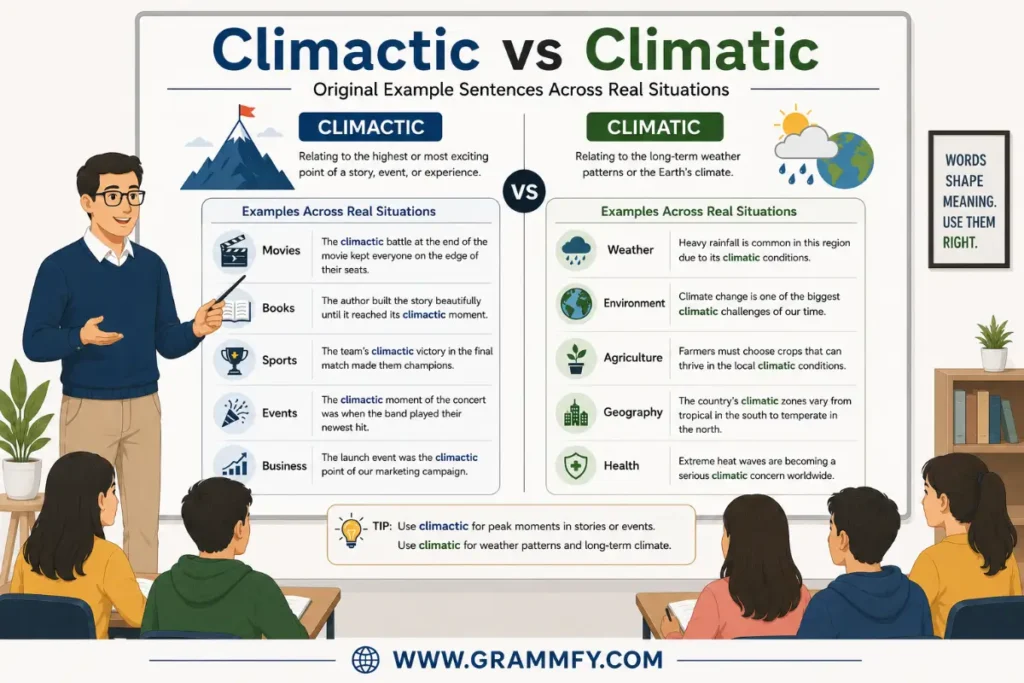
15+ original example sentences across real situations “Climactic vs Climatic”
Movies and books
- The film’s climactic battle takes place on a mountain.
- The novel builds toward a climactic confrontation between the two brothers.
- The director saved the biggest surprise for the climactic final scene.
- The story’s climactic moment changes the main character’s life.
Sports
- The championship game had a climactic final minute.
- Her goal was the climactic moment of the tournament.
- The team won after a climactic overtime period.
School and presentations
- The speaker’s climactic argument convinced several students.
- The final experiment became the climactic part of the science presentation.
- The debate reached a climactic point when both teams presented their strongest evidence.
Science and climate
- Farmers must understand local climatic conditions.
- Researchers examined long-term climatic changes in the region.
- The species can survive only under specific climatic conditions.
- Climatic factors affect rainfall and crop production.
Business and construction
- The project entered its climactic final stage after months of preparation.
- Engineers considered the area’s climatic conditions before choosing construction materials.
- The final product launch was the climactic event of the campaign.
- The company studies climatic risks when planning new facilities.
Everyday situations
- The last song was the climactic moment of the concert.
- The city’s climatic conditions make summers especially dry.
- The argument reached a climactic moment before both people walked away.
- The plants need to be chosen according to local climatic conditions.
Climactic vs dramatic: what’s different?
Climactic and dramatic are close, but they don’t mean exactly the same thing.
| Climactic | Dramatic |
|---|---|
| Relates to a climax or peak | Produces strong emotion, tension, or excitement |
| Suggests a culmination | Doesn’t necessarily involve a culmination |
| Often describes a key final moment | Can describe any intense or exciting moment |
| More specific | Broader |
Compare:
The movie has a dramatic opening.
The opening can be dramatic even though it’s not the climax.
Now:
The movie has a climactic ending.
The ending is connected to the story’s peak.
Something can be both:
The film’s climactic battle is extremely dramatic.
Here, climactic explains its position in the story, while dramatic explains its emotional quality.
Climatic vs meteorological: what’s different?
These terms are related but have different ranges.
| Climatic | Meteorological |
|---|---|
| Relates to climate | Relates to weather and atmospheric science |
| Often concerns long-term patterns | Often concerns weather and atmospheric measurements |
| Used in environmental and geographical contexts | Common in weather forecasting and atmospheric science |
| Climatic trends | Meteorological observations |
For example:
Scientists studied climatic trends over 50 years.
This focuses on long-term patterns.
Meteorologists recorded meteorological conditions during the storm.
This focuses on atmospheric conditions associated with a specific weather event.
The distinction isn’t absolute, but it helps you choose the more precise word.
Climactic vs climax: what’s the grammar difference?
Climax is usually a noun.
The climax of the story was unexpected.
Climactic is an adjective.
The climactic scene was unexpected.
This gives you a useful word family:
| Word | Part of speech | Example |
|---|---|---|
| Climax | Noun | The climax occurs near the end. |
| Climactic | Adjective | The climactic scene is powerful. |
| Culminate | Verb | The story culminates in a confrontation. |
| Culmination | Noun | The event was the culmination of years of work. |
Knowing the word family can help you vary your writing without changing the meaning.
Climatic vs Climate: what’s the grammar difference?
Climate is a noun.
The climate is becoming warmer.
Climatic is an adjective.
The region has unusual climatic conditions.
This gives you another simple word family:
| Word | Part of speech | Example |
|---|---|---|
| Climate | Noun | The region has a dry climate. |
| Climatic | Adjective | Climatic factors affect crops. |
| Climatology | Noun | She studies climatology. |
| Climatological | Adjective | The report includes climatological data. |
These forms appear frequently in scientific and academic writing.
Common mistakes with climactic
Mistake 1: Using climatic for a dramatic ending
Incorrect:
The movie has a climatic ending.
Correct:
The movie has a climactic ending.
The ending is the dramatic peak, so climactic is correct.
Mistake 2: Assuming climactic simply means exciting
Climactic is more specific than “exciting.”
A roller coaster ride may be exciting, but it isn’t necessarily climactic.
Something is climactic when it relates to a climax or culmination.
Mistake 3: Confusing climactic with climax
Incorrect:
The climactic of the story was surprising.
Correct:
The climax of the story was surprising.
Or:
The climactic scene was surprising.
The noun is climax. The adjective is climactic.
Common mistakes with climatic
Mistake 1: Using climatic for a story
Incorrect:
The climatic scene was the best part of the movie.
Correct:
The climactic scene was the best part of the movie.
The scene represents the climax.
Mistake 2: Assuming climatic means “weather”
Climatic relates more specifically to climate, not necessarily one day’s weather.
For short-term weather, terms such as weather-related or meteorological may be more precise.
Mistake 3: Confusing climatic with climactic because of pronunciation
Don’t choose the spelling based on sound.
Instead, identify the root:
climate → climatic
climax → climactic
When should you not use climactic?
Don’t use climactic simply to mean:
- interesting
- good
- exciting
- important
- dramatic
It should have a connection to a peak, culmination, or climax.
For example:
The first chapter was climactic.
This can be possible in a story if the first chapter contains the main climax, but it would be unusual in many narratives. If you simply mean the chapter was exciting, exciting or dramatic may be better.
Likewise:
The meeting was climactic.
This suggests the meeting represented a major culmination. If you only mean it was important, important or significant may be clearer.
When should you not use climatic?
Don’t use climatic when you mean dramatic.
Incorrect:
The climatic final scene shocked everyone.
Correct:
The climactic final scene shocked everyone.
Don’t use climatic as a fancy replacement for “environmental” either. It specifically relates to climate or long-term atmospheric conditions.
Antonyms of climactic
There isn’t one exact opposite of climactic, but several words can express the opposite idea depending on context.
Possible contrasts include:
- preliminary
- opening
- initial
- beginning
- minor
- uneventful
- anticlimactic
The strongest direct contrast is often anticlimactic.
What does anticlimactic mean?
Anticlimactic describes something that happens after a buildup but feels disappointing, weak, or less exciting than expected.
Compare:
The movie’s climactic battle was thrilling.
The movie’s ending was anticlimactic.
The first reaches a powerful peak. The second fails to deliver the expected excitement.
Antonyms of climatic
Climatic does not have a simple direct antonym because it describes a relationship to climate.
Depending on context, you may contrast it with terms such as:
- non-climatic
- unrelated to climate
- indoor
- artificial
- controlled
For example:
The study separates climatic factors from non-climatic factors.
The appropriate opposite depends on what exactly you’re comparing.
What does anticlimactic have to do with climactic?
This is an important word connection.
Anticlimactic comes from the idea of something failing to provide the expected climax.
For example:
The audience expected a huge final battle, but the ending was anticlimactic.
The word contains climactic, so the spelling is related.
This can actually help you remember the correct form:
climax → climactic → anticlimactic
All three connect to the idea of a dramatic peak.
How does climate change relate to climatic?
Climate change is a major area where climatic appears in scientific writing.
Examples include:
- climatic change
- climatic conditions
- climatic variation
- climatic patterns
- climatic factors
- climatic impacts
- climatic trends
For example:
Researchers examined how climatic changes affect coastal ecosystems.
Here, climatic means related to climate.
Be careful not to write climactic simply because climate change is an important topic. The correct root is still climate, so the adjective is climatic.
How does climax relate to climactic?
The relationship is direct:
Climax → climactic
If you can substitute “related to the climax,” climactic is likely the correct word.
For example:
The climactic scene is the scene related to the climax.
This is why the extra “c” in climactic is useful as a visual reminder.
US vs. UK usage
There is no major difference between American and British English in the basic meanings of climactic and climatic.
American English:
The movie’s climactic scene was unforgettable.
British English:
The movie’s climactic scene was unforgettable.
American English:
The region has difficult climatic conditions.
British English:
The region has difficult climatic conditions.
The spellings and meanings remain essentially the same.
Pronunciation can vary slightly by speaker and region, but the words are still distinguished primarily by context and meaning.
For writers using US English, the same root-based memory rule works:
climax → climactic
climate → climatic
Quick tips for choosing the right word “Climactic vs Climatic”
Use these checks before you publish.
Ask: Is this about a climax?
If yes, use climactic.
- climactic scene
- climactic moment
- climactic battle
- climactic ending
- climactic confrontation
Ask: Is this about climate?
If yes, use climatic.
- climatic conditions
- climatic changes
- climatic factors
- climatic patterns
- climatic trends
Look for the noun
If the related noun is climax, choose climactic.
If the related noun is climate, choose climatic.
Don’t rely on pronunciation
Both words sound similar, so listening alone may not help.
Don’t use the longer word just to sound formal
Simple words are often better.
Instead of:
The climactic final moment was very dramatic.
you might simply write:
The final moment was dramatic.
Precision is more important than complexity.
A quick decision table
| Question | Answer | Word |
|---|---|---|
| Is it about a story’s peak? | Yes | Climactic |
| Is it about a dramatic final moment? | Yes | Climactic |
| Is it about a major culmination? | Yes | Climactic |
| Is it about weather patterns? | Yes | Climatic |
| Is it about long-term climate? | Yes | Climatic |
| Is it about climate conditions? | Yes | Climatic |
| Is it about a movie’s final battle? | Yes | Climactic |
| Is it about rainfall patterns? | Yes | Climatic |
| Is it about a turning point? | Usually | Climactic |
| Is it about atmospheric conditions? | Usually | Climatic |
Practice quiz: choose climactic or climatic
Try these sentences before checking the answers.
- The movie’s ______ scene left everyone speechless.
- Farmers must adapt to changing ______ conditions.
- The speech reached a ______ moment near the end.
- Scientists studied long-term ______ trends.
- The championship game had a ______ finish.
- The region has unusual ______ patterns.
- The novel’s ______ chapter reveals the truth.
- Engineers considered local ______ conditions.
- The final scene was the story’s ______ moment.
- Researchers examined ______ changes over several decades.
- The debate reached a ______ point when the evidence was revealed.
- Crops must be selected according to local ______ conditions.
Answers
- climactic
- climatic
- climactic
- climatic
- climactic
- climatic
- climactic
- climatic
- climactic
- climatic
- climactic
- climatic
The pattern is straightforward: dramatic peaks are climactic, while climate-related conditions are climatic.
How to proofread these words in your writing
Spellcheck can miss this kind of error because both words are correctly spelled.
If you write:
The climatic scene was the most exciting part of the film.
A spellchecker may not flag anything.
But the sentence is probably wrong because the scene is connected to the climax, not the climate.
During proofreading, search for climactic and climatic separately.
For each use, ask:
- What noun is this adjective related to?
- Am I talking about a climax?
- Am I talking about climate?
- Would “dramatic peak” make sense?
- Would “climate-related” make sense?
If “climate-related” makes sense, climatic is likely correct.
If “related to the climax” makes sense, climactic is likely correct.
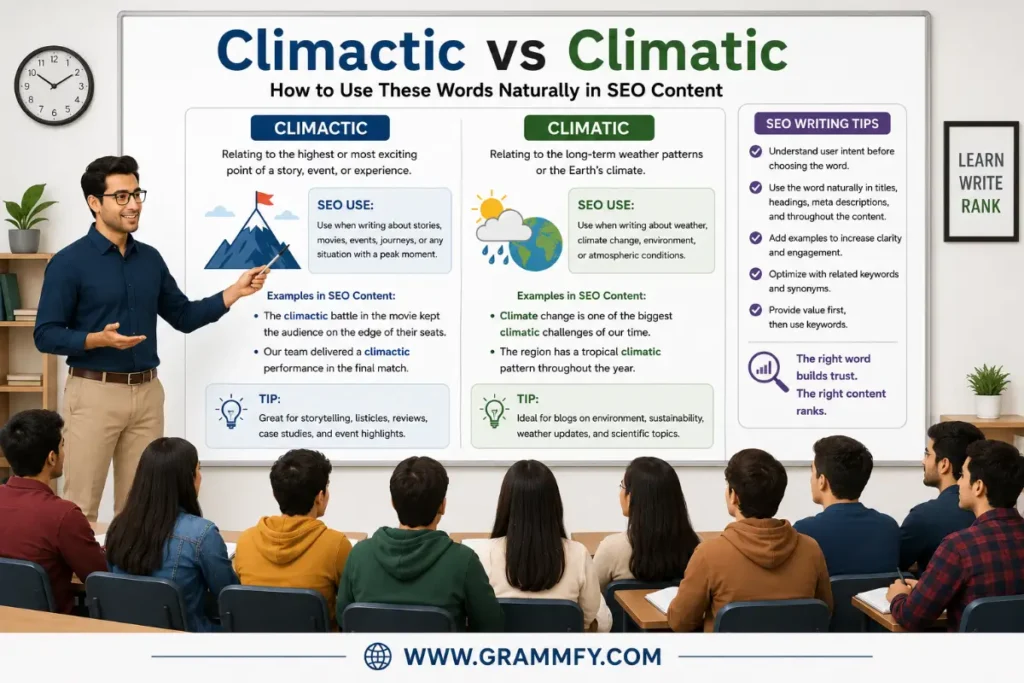
How to use these words “Climactic vs Climatic” naturally in SEO content
Educational and informational content often needs both words because people search for them as a commonly confused pair.
A strong explanation should define the distinction immediately rather than repeating the same sentence.
For example:
A climactic event is a peak or culmination. A climatic event is related to climate or weather patterns.
Then examples can reinforce the difference:
The story has a climactic ending.
The region faces climatic challenges.
This gives readers useful context without forcing the terms into unrelated sentences.
Good SEO writing should answer the searcher’s question first. Supporting examples, tables, word origins, and comparisons can then expand the explanation.
Why the distinction matters in professional writing
A one-letter difference can change the entire meaning of a sentence.
Consider:
The project reached a climatic stage.
A reader may wonder whether you’re talking about climate.
But:
The project reached a climactic stage.
Now the meaning is clear: the project reached a peak or major culmination.
The reverse problem can happen in environmental writing:
The region has climactic challenges.
That could be interpreted as something related to a climax rather than climate.
The correct form is:
The region has climatic challenges.
Correct word choice prevents unnecessary confusion.
A final three-question test
When you’re stuck, ask yourself these questions:
1. Am I talking about a climax?
Use climactic.
2. Am I talking about climate?
Use climatic.
3. Can I connect the word to its root noun?
- climax → climactic
- climate → climatic
That’s it.
Conclusion
Understanding climactic vs climatic comes down to two root words: climax and climate. If you’re describing the peak, culmination, or most intense point of a story, event, competition, argument, or process, climactic is the right choice. If you’re describing weather patterns, long-term atmospheric conditions, or factors related to climate, choose climatic.
The words may sound similar, but their meanings are easy to separate once you connect each one to its source. Before using either adjective, ask whether you’re talking about a peak or climate. That quick check can prevent an otherwise distracting spelling and meaning error in schoolwork, professional writing, and everyday communication. With a little practice, you’ll recognize the difference almost automatically.
Frequently Asked Questions
What is the difference between climactic and climatic?
Climactic relates to a climax or highest point, while climatic relates to climate and weather patterns. A movie can have a climactic ending, while a region can have difficult climatic conditions.
Is the climactic scene or climatic scene correct?
“Climactic scene” is correct when you mean the most important or dramatic scene in a story. The scene is connected to the climax, not the climate.
What does climatic mean in simple English?
Climatic means related to climate or long-term weather conditions. For example, climatic factors can affect farming, ecosystems, and building design.
What’s another way to say climactic?
You can often use “pivotal,” “dramatic,” “decisive,” or “culminating,” depending on the sentence. None is a perfect substitute in every context.
Is climactic the same as dramatic?
No, climactic specifically refers to a peak or culmination, while dramatic simply means exciting, emotional, or striking. A scene can be dramatic without being the climax.
Is climatic the same as meteorological?
They overlap, but climatic usually relates to climate patterns, while meteorological often relates to weather and atmospheric science. The time scale and context help determine which word is more precise.
How can I remember climactic vs climatic?
Connect climactic with climax and climatic with climate. Think “climactic = peak” and “climatic = weather.”
