
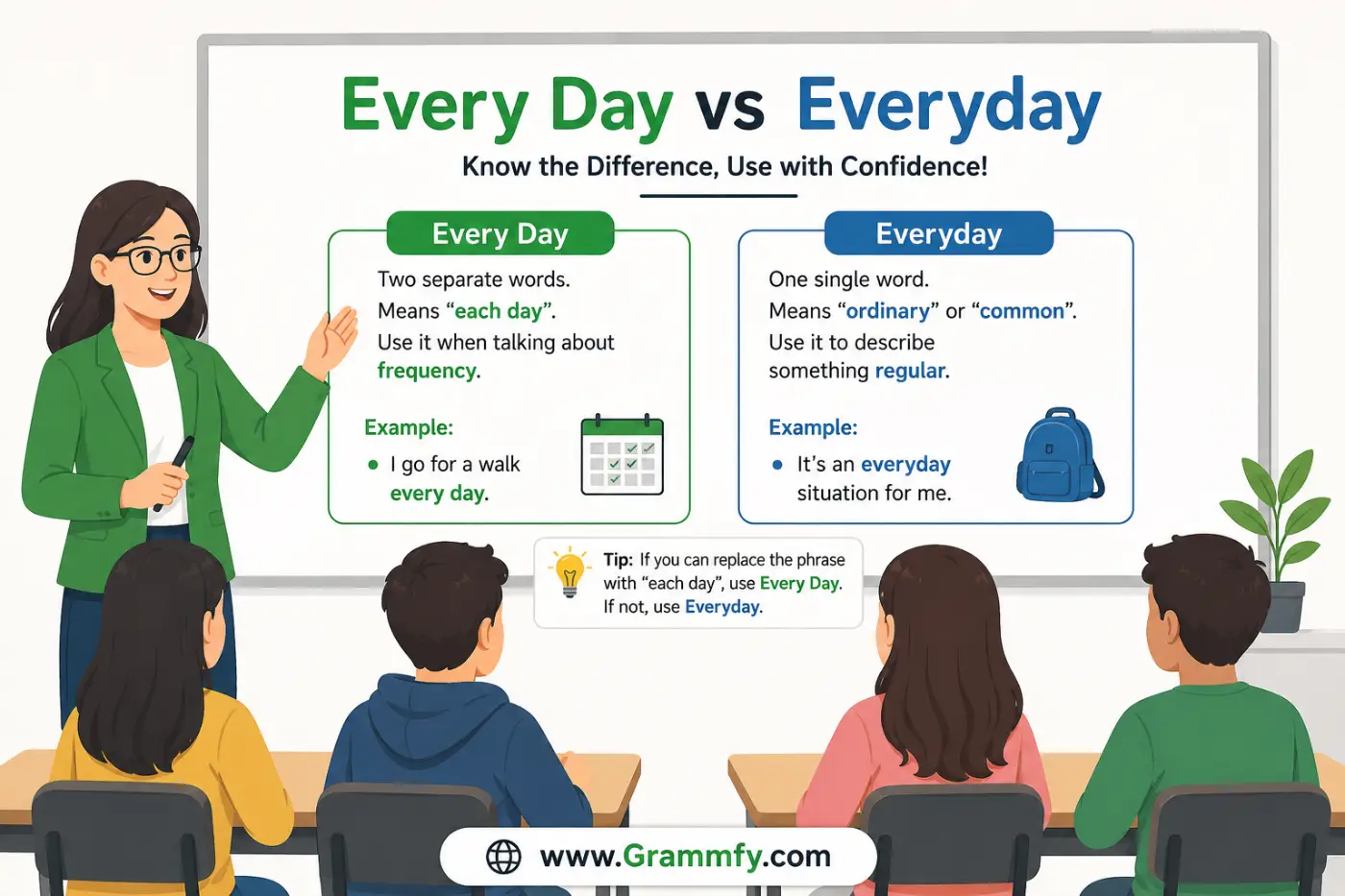
Have you ever stopped while writing an email, essay, resume, or text and wondered whether to write” every day vs everyday“? You’re not alone. These two forms look almost identical, but they have different jobs in a sentence.
The easiest way to remember the difference is this: every day usually talks about when something happens, while everyday describes something ordinary or common.
Answer: “Every day” means each day or daily. “Everyday” is an adjective meaning ordinary, usual, or common.
Once you understand what role each form plays, the choice becomes much easier. This guide explains the meaning, word origins, grammar, synonyms, common mistakes, regional usage, and the best choice for resumes, essays, emails, texts, and everyday speech.
Want to avoid another common word-choice mistake? Read [hear vs here].
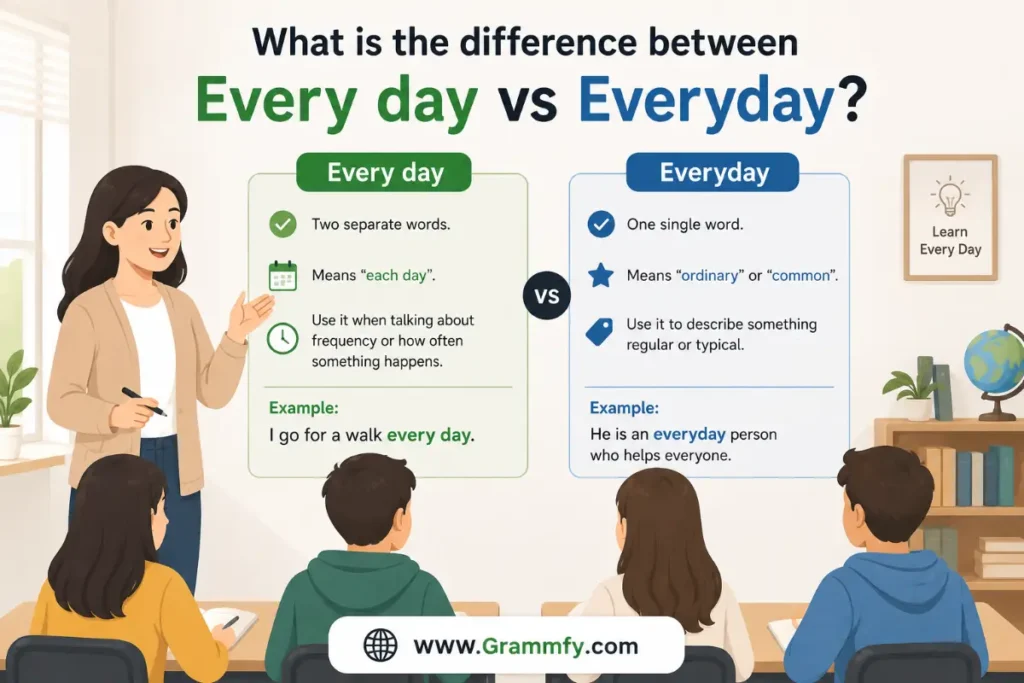
What is the difference between “Every day vs Everyday”?
The main difference is grammatical.
Every day is a time expression. It tells you how often something happens.
- I walk every day.
- She reads every day.
- We practice English every day.
Everyday is an adjective. It describes a noun.
- These are my everyday shoes.
- Cooking is an everyday activity for him.
- This is an everyday problem.
A simple test can help:
If you can replace the phrase with each day, use every day. If it describes a noun and means ordinary or usual, use everyday.
Compare these two sentences:
- I drink coffee every day.
- Coffee is an everyday part of my routine.
In the first sentence, the phrase tells us when the action happens. In the second, the adjective describes the noun “part.”
When should you use every day?
Use every day when you mean “each day” or “on a daily basis.”
It normally works as an adverbial phrase. In simple terms, it gives information about the frequency of an action.
Examples with every day
- I check my email every day.
- My brother exercises every day.
- She calls her grandmother every day.
- We study vocabulary every day.
- The store opens every day.
- He writes in his journal every day.
Notice that every day often comes after the verb or after the object.
I practice English every day.
You can also move it to the beginning of a sentence for emphasis:
Every day, I practice English for thirty minutes.
Both versions are correct.
When should you use everyday?
Use everyday when it means “ordinary,” “usual,” “routine,” or “common.”
Because it is an adjective, it usually comes before a noun.
Examples with everyday
- These are my everyday clothes.
- Stress is an everyday problem for many people.
- She uses an everyday vocabulary in her writing.
- We need an everyday solution, not a complicated one.
- He prefers everyday language.
- This bag is perfect for everyday use.
You can often replace everyday with ordinary or usual.
For example:
These are my everyday shoes.
can become:
These are my ordinary shoes.
The meaning isn’t always exactly the same, but the grammar gives you a useful clue: everyday is describing “shoes.”
Why are “Every day vs Everyday” so easy to confuse?
The confusion comes from the fact that every day and everyday sound almost the same in normal speech.
The space changes the grammatical role.
Think of them as two related expressions:
| Form | Part of speech | Main meaning | Example |
|---|---|---|---|
| every day | Adverbial phrase | each day | I study every day. |
| everyday | Adjective | ordinary or usual | This is my everyday routine. |
The spelling is different because the function is different.
A useful rule is:
Every day = when?
Everyday = what kind?
That one question can solve most usage problems.
Where did the words come from “Every day vs Everyday”?
Understanding the origin can make the spelling easier to remember.
The word every developed from older English forms connected with the idea of “each” or “each one.” It combines the sense of individual items into a group.
The word day comes from Old English dæg, meaning a day or period of daylight.
The phrase every day therefore has a literal sense close to “each day.”
Over time, everyday developed as a compound adjective. English often combines words into adjectives when they regularly work together to describe something.
For example:
- every + day → everyday
- some + time → sometime
- any + thing → anything
- week + end → weekend
However, the fact that words can form compounds doesn’t mean the compound should be used in every situation.
In modern English, everyday has a specialized descriptive meaning: ordinary, common, or routine.
That is why these sentences are not interchangeable:
I work from home every day.
I use my everyday laptop for work.
The first talks about frequency. The second describes the type of laptop.
What does every day mean in plain English?
In plain English, every day means each day.
If an action happens Monday, Tuesday, Wednesday, Thursday, and so on, you can say it happens every day.
Quick examples
- She walks every day. = She walks each day.
- I read every day. = I read each day.
- They meet every day. = They meet each day.
The expression can refer to a regular habit without literally meaning that something happens every single calendar day in every possible situation. Context matters.
For example:
The team practices every day during training camp.
This tells us that daily practice is part of the schedule.
What does everyday mean in plain English?
In plain English, everyday means ordinary, normal, common, or used regularly.
It describes something that isn’t unusual or special.
Quick examples
- everyday clothes = ordinary clothes for regular use
- everyday language = normal, familiar language
- everyday problems = common problems
- everyday life = normal daily life
- everyday expenses = regular expenses
The adjective can describe both physical things and abstract ideas.
She has an everyday job.
Money is an everyday concern for many families.
We use everyday words in this lesson.
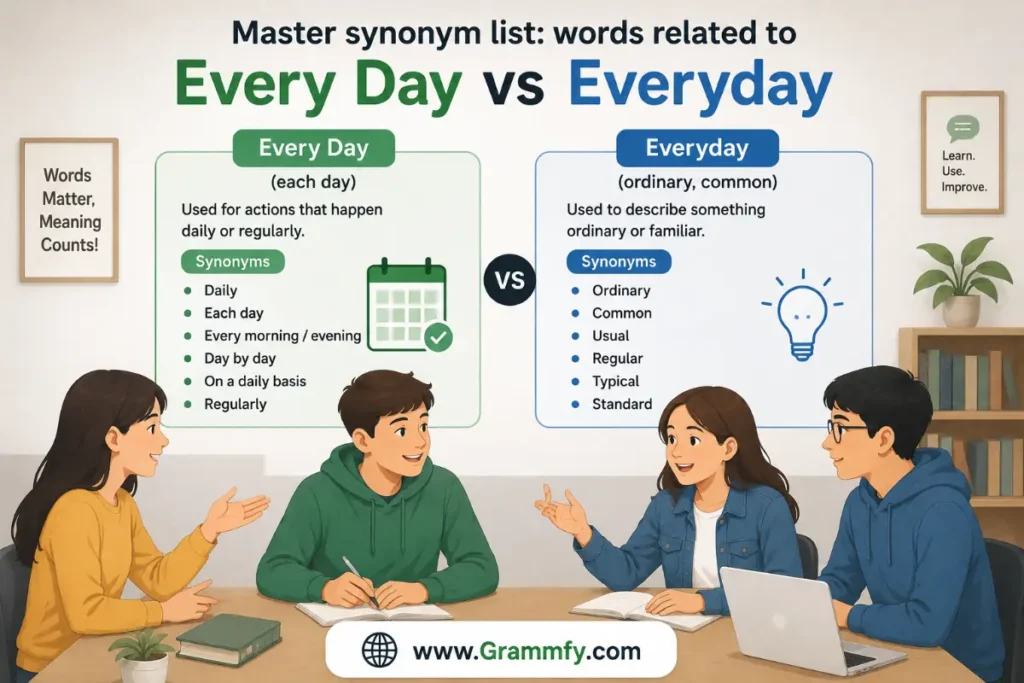
Master synonym list: words related to “Every day vs Everyday”
The best synonym depends on whether you’re talking about frequency or describing something ordinary. The words below give you a wider vocabulary without treating all of them as perfect replacements.
Simple synonyms
| Word | Meaning | Tone | Example |
|---|---|---|---|
| Daily | Happening each day | Neutral | I take my daily walk. |
| Regular | Happening repeatedly or normally | Neutral | She has a regular schedule. |
| Usual | Normal or expected | Neutral | He took his usual route. |
| Normal | Typical or expected | Neutral | That’s a normal part of life. |
| Common | Happening often or found often | Neutral | This is a common mistake. |
| Routine | Part of a repeated pattern | Neutral | Exercise is part of my routine. |
| Ordinary | Not unusual or special | Neutral | It was an ordinary afternoon. |
Everyday-use vocabulary
| Word | Meaning | Tone | Example |
|---|---|---|---|
| Day-to-day | Related to normal daily activities | Casual/Neutral | She handles the day-to-day tasks. |
| Typical | Representative of what usually happens | Neutral | That’s a typical workday. |
| Frequent | Happening often | Neutral/Formal | Frequent practice improves skills. |
| Repeated | Happening more than once | Neutral | Repeated practice builds confidence. |
| Constant | Happening continuously or very often | Strong | The constant noise was distracting. |
| Habitual | Done regularly as a habit | Formal | His habitual routine starts early. |
| Familiar | Well known through experience | Neutral | She uses familiar expressions. |
| Routine | Regular and expected | Neutral | It was a routine task. |
Formal alternatives
| Word | Meaning | Tone | Example |
|---|---|---|---|
| Per diem | For each day | Formal | The policy sets a per diem allowance. |
| Daily | Occurring each day | Formal/Neutral | The report provides daily updates. |
| Recurring | Happening repeatedly | Formal | The company addressed recurring issues. |
| Regularly | At repeated or expected times | Formal/Neutral | The system is regularly reviewed. |
| Routinely | As part of a normal procedure | Formal | Files are routinely checked. |
| Continually | Repeatedly over time | Formal | The process is continually monitored. |
| Consistently | In a steady, repeated way | Formal | She consistently meets deadlines. |
Casual and slang-adjacent expressions
| Word/Phrase | Meaning | Tone | Example |
|---|---|---|---|
| Day in, day out | Every day without much change | Casual | He works day in, day out. |
| All the time | Very frequently or constantly | Casual | She talks about books all the time. |
| On the regular | Frequently or routinely | Slang/Informal | They meet on the regular. |
| Every single day | Each day, with emphasis | Casual | I think about it every single day. |
| Day-to-day | Normal daily life or tasks | Casual/Neutral | We handle the day-to-day work. |
| Day after day | Repeatedly over many days | Neutral | The rain continued day after day. |
Some of these expressions are not exact replacements. Daily is a close replacement for the frequency meaning, while ordinary is closer to the descriptive meaning.
Synonyms by intensity: mild to strong
Not every word carries the same strength.
For frequency, you can think of related terms on a rough scale:
Occasional → regular → frequent → daily → constant
These aren’t exact substitutes.
- Occasional means something happens sometimes, but not regularly.
- Regular means something follows a pattern.
- Frequent means it happens often.
- Daily means it happens each day.
- Constant suggests it continues or happens extremely often.
Consider the difference:
I receive occasional emails.
I receive frequent emails.
I receive emails every day.
I receive constant emails.
The last sentence sounds much stronger than the third.
For the descriptive sense, a different scale may work:
Unusual → normal → typical → ordinary → routine
Again, these words overlap but aren’t identical.
It was an unusual day.
It was a typical day.
It was an ordinary day.
It was a routine day.
The speaker’s attitude changes slightly with each word.
Synonyms by part of speech
Grammar matters when choosing a replacement.
Adverbs and adverbial expressions
These tell us how often an action occurs:
- daily
- regularly
- routinely
- frequently
- consistently
- continually
- repeatedly
- occasionally
Example:
She exercises daily.
Here, “daily” performs a similar job to “every day.”
Adjectives
These describe nouns:
- everyday
- ordinary
- usual
- normal
- typical
- common
- routine
- familiar
- regular
Example:
She wears everyday shoes.
You could say:
She wears regular shoes.
But the exact meaning and naturalness can change depending on context.
Nouns
Some related ideas can be expressed with nouns:
- routine
- habit
- frequency
- schedule
- practice
- custom
For example:
Reading is part of my routine.
That doesn’t directly replace the original phrase, but it lets you express the same general idea in a different grammatical structure.
Is “Every day vs Everyday” correct in a sentence?
Both forms can be correct. The right choice depends on what you mean.
Compare these examples:
| Sentence | Correct? | Why |
|---|---|---|
| I exercise every day. | Yes | “Every day” tells when. |
| I wear everyday shoes. | Yes | “Everyday” describes shoes. |
| I exercise everyday. | No | The intended meaning is “each day.” |
| These are my every day shoes. | Usually no | The adjective is normally written as “everyday.” |
| She studies every day. | Yes | It expresses frequency. |
| She has an everyday study routine. | Yes | “Everyday” describes the routine. |
A common mistake is using everyday as though it were an adverb.
Incorrect:
I go running everyday.
Correct:
I go running every day.
Another common mistake is separating the adjective.
Usually incorrect:
These are my every day clothes.
Correct:
These are my everyday clothes.
Best word for a resume “Every day vs Everyday”
A resume often benefits from daily, regularly, consistently, or a more specific verb.
Instead of:
I checked reports every day.
You could write:
I reviewed reports daily.
Or:
I consistently reviewed weekly reports for accuracy.
The best choice depends on what you actually did. A resume should favor precise language over vague repetition.
Resume examples
- Reviewed customer requests daily.
- Consistently updated inventory records.
- Routinely checked documents for errors.
- Managed day-to-day administrative tasks.
- Maintained regular communication with clients.
Be careful with exaggerated claims. If you didn’t perform a task every day, don’t use “daily” just to make the bullet sound stronger.
Best word for an essay “Every day vs Everyday”
For an essay, choose the form that matches your meaning.
If you’re discussing something that happens each day:
Students should read every day to build stronger reading habits.
If you’re describing something ordinary:
Reading has become an everyday activity for many students.
For formal academic writing, daily, regularly, typically, and routinely can sometimes provide more variety.
However, don’t replace a simple phrase just to sound more sophisticated. Clear writing is usually better than complicated writing.
Best word for texting “Every day vs Everyday”
Text messages are informal, so both forms are common in casual communication. Still, standard grammar remains useful.
Correct:
I think about you every day.
Correct:
That’s my everyday jacket.
Incorrect in standard writing:
I think about you everyday.
The second sentence may appear in casual posts or texts, but that doesn’t make the spelling standard.
If you’re texting a friend, a typo may not matter. If you’re writing a school assignment, work message, or public post, it’s worth using the standard form.
Best word for email “Every day vs Everyday”
In professional email, use every day for frequency and everyday as an adjective.
For example:
I check the support inbox every day.
Or:
This issue affects our everyday workflow.
You can also use daily when it makes the sentence shorter:
I send daily status updates.
A professional email usually benefits from direct wording. You don’t need to avoid every day simply because the message is formal.
Best word for speaking “Every day vs Everyday”
In conversation, the pronunciation is often similar, so listeners usually rely on context.
You might say:
I walk to work every day.
Or:
These are my everyday shoes.
When speaking, the grammatical distinction still exists even though the difference isn’t always easy to hear.
If you’re learning English, don’t worry if this distinction feels strange at first. Native speakers learn many compound adjectives and fixed phrases through repeated exposure.
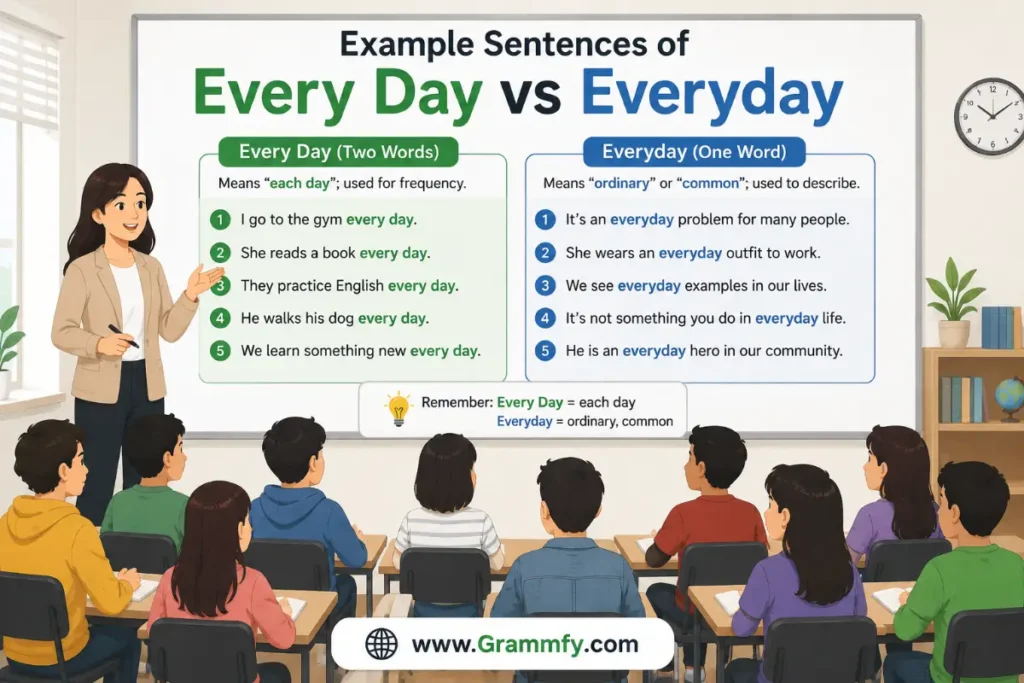
10+ real-world example sentences of “Every day vs Everyday”
Seeing the forms in different situations is one of the fastest ways to understand them.
Work
- I check the project dashboard every day before our morning meeting.
- Good communication is an everyday part of my job.
- The manager reviews customer feedback every day.
- Solving small problems is part of the everyday work of a support team.
School
- Students should practice new vocabulary every day.
- Teachers often use everyday examples to explain difficult ideas.
- I write in my notebook every day after class.
- Grammar mistakes can appear in everyday writing.
Home
- We clean the kitchen every day.
- These plates are for everyday use.
- She takes her dog outside every day.
- Cooking is an everyday responsibility in their home.
Technology
- I use this phone every day.
- The app solves an everyday problem for busy users.
- We back up important files every day.
- Password management is an everyday security concern.
Health and fitness
- He walks for thirty minutes every day.
- Drinking enough water is an everyday health habit.
- She stretches every day before work.
- Small changes can improve your everyday routine.
Personal life
- I call my parents every day.
- Her everyday routine starts with a cup of tea.
- They talk about their plans every day.
- The book focuses on ordinary everyday experiences.
Every day vs Everyday: two close-synonym comparisons
Knowing the difference between related words can prevent subtle mistakes.
Daily vs every day
Daily and every day often have the same basic meaning: each day.
| Daily | Every day |
|---|---|
| Often shorter | More conversational |
| Can be an adjective or adverb | Usually an adverbial phrase |
| Daily report | I read the report every day |
| Daily exercise | I exercise every day |
Compare:
I exercise daily.
I exercise every day.
Both are correct.
But:
I have an every day exercise plan.
is not the standard form when the phrase is being used as an adjective. You would normally write:
I have a daily exercise plan.
or:
I have an everyday exercise routine.
Ordinary vs everyday
Ordinary and everyday are close when both describe something normal or not unusual.
She wore her everyday clothes.
She wore her ordinary clothes.
The first emphasizes clothing for regular use. The second simply says the clothes weren’t special or unusual.
Everyday often feels connected to routine life:
- everyday tasks
- everyday language
- everyday expenses
- everyday clothes
Ordinary can emphasize that something is not special:
- an ordinary person
- an ordinary day
- an ordinary meal
So they’re related, but they don’t always carry the same feeling.
Every day vs Everyday: what about daily life?
This is a useful phrase because everyday life is normally written as one word.
Correct:
Technology has changed everyday life.
Why?
Because everyday is describing “life.” It means ordinary or normal life.
But if you write:
Technology affects people every day.
the two-word form is correct because it tells us how often technology affects people.
Compare:
Social media is part of everyday life.
People use social media every day.
The same topic can use both forms in one short passage because the grammatical roles are different.
Common mistakes and when not to use each form
Mistake 1: Using everyday after a verb
Incorrect:
I study English everyday.
Correct:
I study English every day.
Why? “Every day” tells us when the studying happens.
Mistake 2: Separating everyday when it describes a noun
Usually incorrect:
I wear every day clothes.
Correct:
I wear everyday clothes.
Why? “Everyday” is an adjective describing “clothes.”
Mistake 3: Assuming everyday means each day
This is the biggest mistake.
Everyday does not normally mean “each day.”
If you mean “each day,” use the two-word expression.
Mistake 4: Using daily when you mean ordinary
These aren’t always interchangeable.
This is a daily problem.
This usually means the problem occurs each day.
This is an everyday problem.
This usually means the problem is common or ordinary.
The difference can be important.
Mistake 5: Using everyday in a formal sentence as a substitute for daily
In professional or academic writing, don’t use everyday simply because it sounds similar to daily.
Instead:
The system is checked every day.
or:
The system is checked daily.
Not:
The system is checked everyday.
Antonyms
The opposite depends on the meaning you’re expressing.
For every day or daily frequency, possible contrasts include:
- occasionally
- rarely
- seldom
- never
- infrequently
- sporadically
For everyday meaning ordinary or usual, possible opposites include:
- unusual
- extraordinary
- exceptional
- rare
- special
- remarkable
- uncommon
Examples:
She rarely visits the office.
This contrasts with visiting every day.
It was an extraordinary event.
This contrasts with something ordinary or everyday.
US vs. UK usage
The basic distinction between every day and everyday is the same in American and British English.
American English:
I go there every day.
British English:
I go there every day.
American English:
These are my everyday shoes.
British English:
These are my everyday shoes.
There is no major US-versus-UK spelling difference for this pair.
What can vary by region is the vocabulary surrounding these expressions. British speakers may choose different informal words or phrases in certain contexts, but the core grammar remains the same.
For writers using American English, the safest standard rule is simple:
Use every day for “each day.” Use everyday for “ordinary.”
How to choose the right form quickly
You don’t need to memorize a long grammar rule.
Try these three tests.
Test 1: Can you replace it with “each day”?
If yes, write every day.
I study every day.
Replace it:
I study each day.
The sentence still works.
Test 2: Is it describing a noun?
If yes, you probably need everyday.
These are my everyday shoes.
“Everyday” describes “shoes.”
Test 3: Can you replace it with “ordinary”?
If yes, everyday may be correct.
It was an everyday problem.
Replace it:
It was an ordinary problem.
The basic meaning remains.

Quick tips for choosing the right word “Every day vs Everyday”
Keep these reminders handy:
- Every day = each day.
- Everyday = ordinary or usual.
- Ask “When?” → every day.
- Ask “What kind?” → everyday.
- Before a noun, everyday may be the adjective you need.
- After an action, every day may be the frequency phrase you need.
- Daily can often replace every day.
- Ordinary can often replace everyday.
- Don’t use everyday as a standard substitute for “each day.”
- Don’t separate everyday when it is functioning as a compound adjective.
A simple memory trick about “Every Day vs Everyday”
Imagine a tiny space between the two words.
Every day has a space because you’re counting days individually: one day, another day, another day.
Everyday has no space because the two words work together as one adjective describing something ordinary.
You can also remember:
Every day = time.
Everyday = type.
For many writers, that is enough.
Practice: choose the correct form
Try filling in the blanks before checking the answers.
- I read the news ______.
- These are my ______ shoes.
- She calls her sister ______.
- This is an ______ problem.
- We have a meeting ______.
- He uses ______ language when talking to children.
- I check my calendar ______.
- Cooking is an ______ activity in our home.
- The company sends ______ updates.
- They face the same ______ challenges as other families.
Answers
- every day
- everyday
- every day
- everyday
- every day
- everyday
- every day
- everyday
- daily or, depending on the intended structure, “updates every day”
- everyday
The key isn’t memorizing the answers. It’s recognizing the job each form performs.
How to use both forms in the same paragraph
A useful way to test your understanding is to use both forms naturally.
I practice writing every day because I want to improve my skills. Clear writing is an everyday need in school and at work. I review new words every day, but I try to use simple, familiar language in my everyday conversations.
Notice how the meaning changes each time.
The first and third examples describe frequency. The second and fourth examples describe ordinary or routine situations.
That’s the central distinction.
Why this small spelling difference matters
At first, the difference may seem minor. After all, readers can often understand what you mean from context.
But correct word choice makes writing clearer.
Compare:
I use this notebook everyday.
A reader will probably understand the sentence, but the standard form is:
I use this notebook every day.
Now compare:
This is my every day notebook.
The intended meaning is probably:
This is my everyday notebook.
In schoolwork, professional writing, resumes, websites, and published content, small grammar details add up. Using the correct form helps your writing look polished and trustworthy.
What should you use in SEO and website writing?
For website content, choose the form based on the intended meaning, not just keyword frequency.
If you’re explaining a habit:
People search for grammar answers every day.
If you’re describing common language:
The article uses everyday English.
Search engines can understand related meanings and context, but readers still need clear grammar. Don’t force either spelling into a sentence where it doesn’t belong.
Natural usage is more important than repeating a phrase.
What should English learners remember?
English learners often find this pair confusing because the pronunciation is similar and the spelling differs by only one space.
Start with one rule:
Every day means each day. Everyday means ordinary.
Then learn the sentence patterns.
Pattern for every day
Subject + verb + every day
I study every day.
She works every day.
They practice every day.
Pattern for everyday
Everyday + noun
everyday life
everyday clothes
everyday problems
everyday language
Once these patterns become familiar, you won’t need to stop and think about them as often.
Conclusion
The key to choosing between every day and everyday is understanding their jobs in a sentence. Use the two-word form when you mean “each day” or when you’re describing how often something happens. Use the one-word form when you mean “ordinary,” “usual,” or “common” and it describes a noun.
When you’re unsure, ask two quick questions: Am I talking about when something happens? If so, choose every day. Am I describing what kind of thing it is? If so, choose everyday.
For most writing, this simple test is all you need. With a little practice, the distinction will become automatic. Clear word choices make your emails, essays, resumes, and conversations easier to understand, so it’s worth getting this small detail right.
Frequently Asked Questions
What is the difference between every day and everyday?
Every day means each day, while everyday means ordinary, usual, or common. Use the first for frequency and the second as an adjective.
Is it correct to say I do it everyday?
No, standard English uses I do it every day when you mean that you do something each day. “Everyday” would need to describe a noun, such as “everyday activity.”
What’s another way to say every day?
“Daily” is the closest simple alternative to every day. Depending on context, “regularly,” “each day,” or “routinely” may also work.
Can everyday mean daily?
Not usually. Everyday normally means ordinary or usual, while “daily” means happening each day.
Should I write everyday life or every day life?
Write everyday life when you mean ordinary or normal life. “Everyday” is an adjective describing “life.”
Is every day one word or two words?
When you mean “each day,” write every day as two words. When you mean “ordinary” and use it before a noun, write everyday as one word.
Is everyday formal English?
Yes, everyday is standard English when it is used correctly as an adjective. For example, “everyday language” and “everyday tasks” are both natural in formal and informal writing.
