
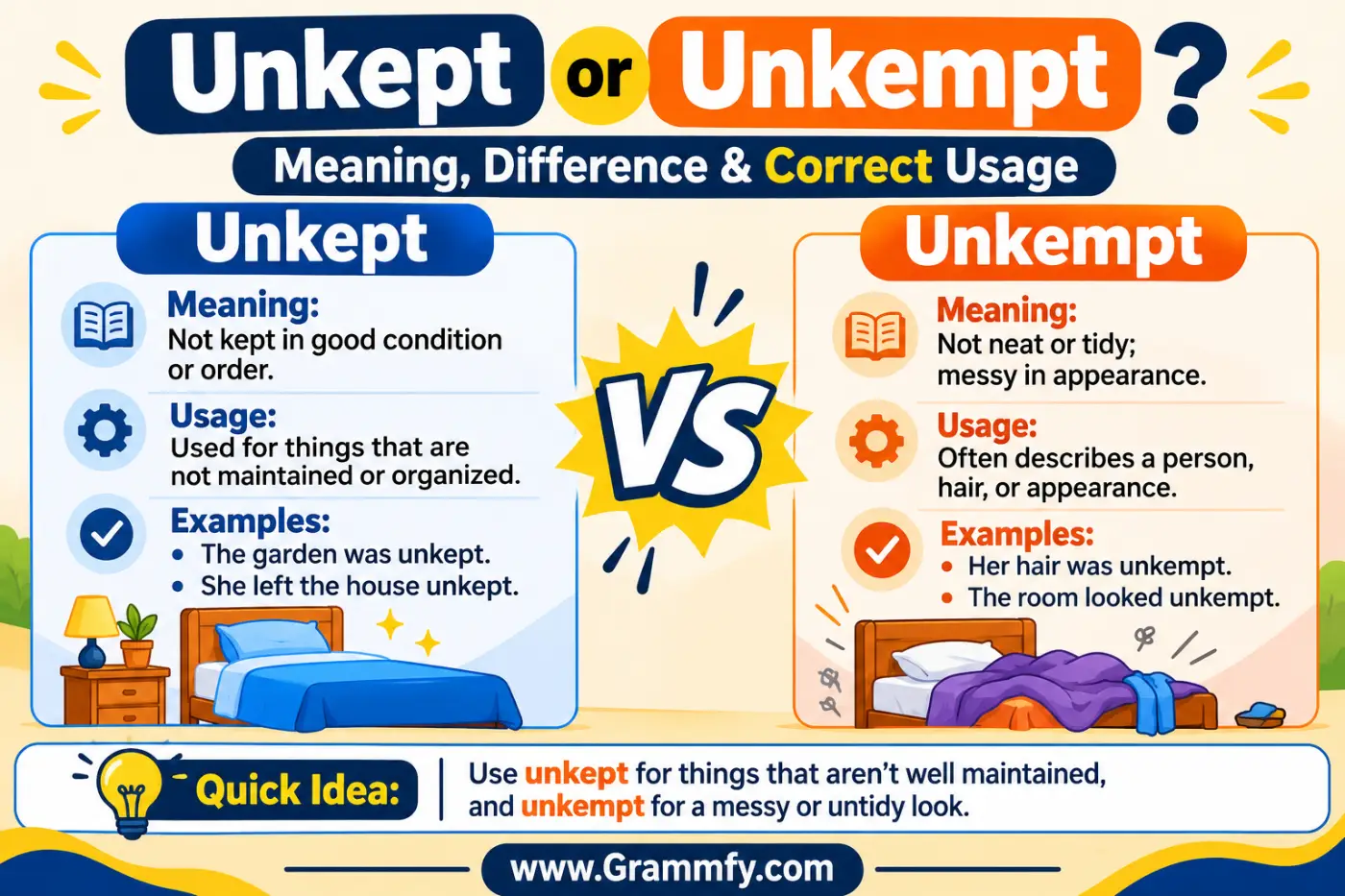
Have you ever written an email, essay, or social media post and wondered whether to use unkept or unkempt? Both spellings look similar, so it’s easy to mix them up. However, they don’t have the same meaning, and choosing the wrong one can make your sentence confusing. Unkempt means messy, untidy, or poorly cared for. Unkept means not kept, maintained, or fulfilled, often referring to a promise, agreement, or responsibility.
The main difference is that unkempt is the correct word when describing someone with messy hair, untidy clothes, or an unclean appearance. Unkept is also a word, but it usually describes something that has not been maintained, cared for, or kept as promised. The difference becomes easier once you connect each word with its meaning. Use unkempt for a person’s messy hair, clothing, or appearance.
For example, you can describe someone’s messy hair as unkempt, while an unkept promise refers to a promise that someone failed to fulfill. Knowing this small difference can help you avoid spelling mistakes in everyday writing.
Use unkept when you have not kept or carried out something, although writers often preferbroken or unfulfilled in many situations.
Explore more commonly confused words to improve your spelling and avoid common mistakes in everyday writing.
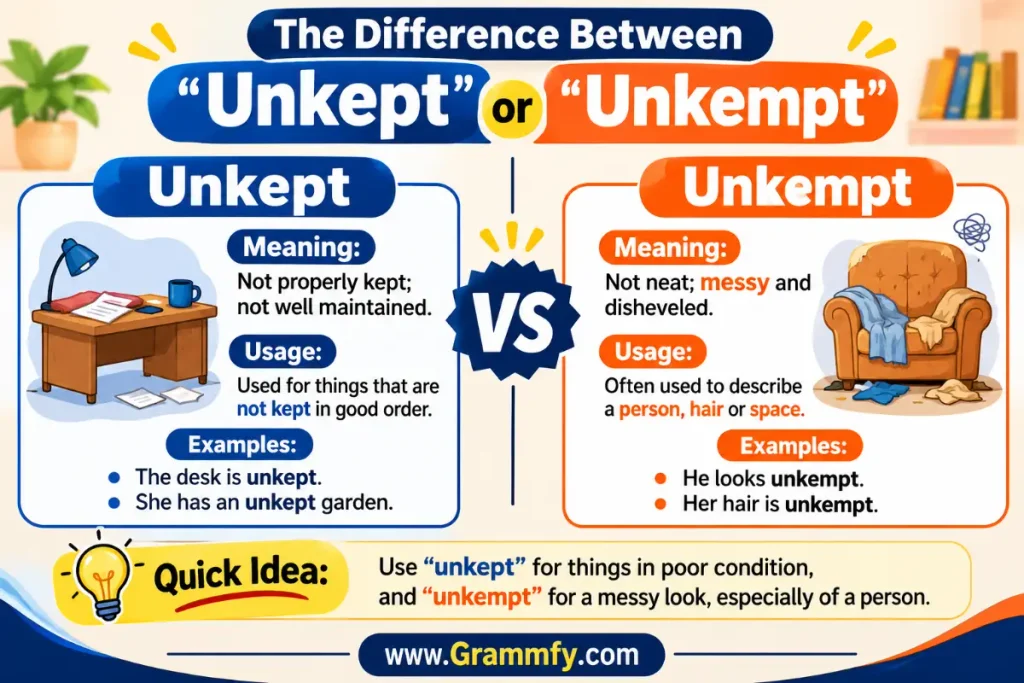
The Difference Between “Unkept” or “Unkempt”
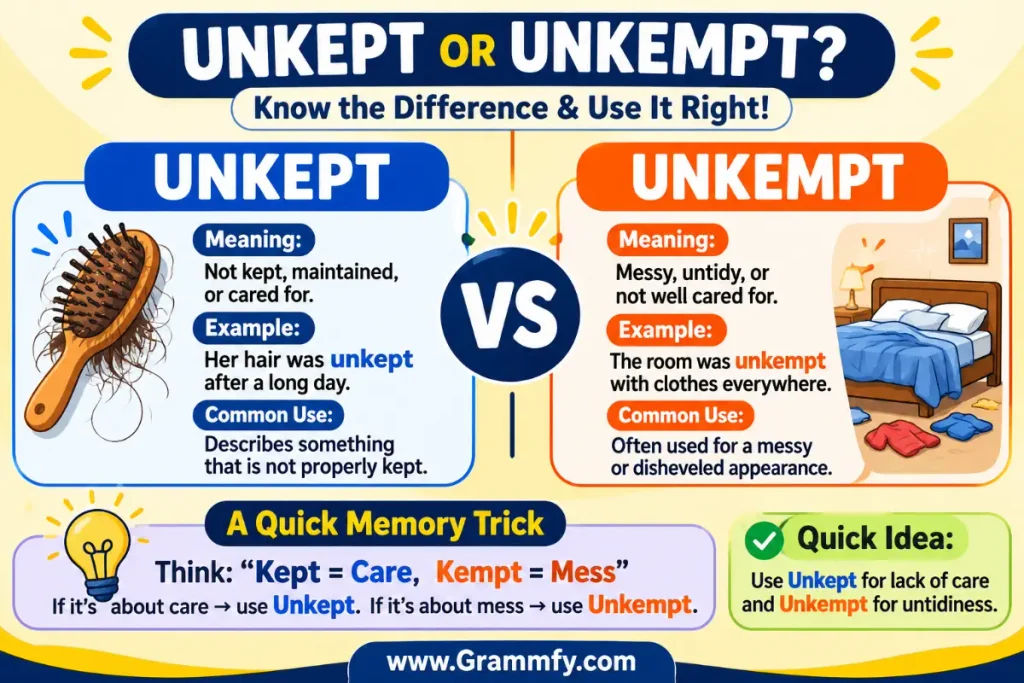
The main difference is that unkempt describes a messy or neglected appearance, while unkept describes something that has not been kept, maintained, or fulfilled.
| Word | Meaning | Common use | Example |
|---|---|---|---|
| Unkempt | Messy, untidy, or not properly cared for | Hair, clothing, gardens, rooms, appearance | His hair looked unkempt. |
| Unkept | Not kept, maintained, or fulfilled | Promises, commitments, duties, places | The promise remained unkept. |
When Should You Use “Unkempt”?
Use unkempt when something looks messy, disorganized, or neglected. It often describes a person’s hair, clothes, or general appearance. It can also describe a place that has not been properly cared for.
Examples:
- He arrived at the meeting with unkempt hair.
- The garden looked unkempt after months without care.
- She wore an old coat and had an unkempt appearance.
- The empty house had an unkempt yard.
The word often suggests that something needs attention or grooming. It does not always mean that the person or place is dirty. A person’s hair can be unkempt simply because it is messy or untidy.
When Should You Use “Unkept”?
Use unkept when you mean that you have not kept, maintained, or fulfilled something, although writers often use words such as promise, commitment, or agreement with it.
Examples:
- He apologized for the unkept promise.
- The agreement included several unkept commitments.
- The property had been unkept for years.
However, unkept is less common than some alternatives. In many sentences, broken promise, unfulfilled commitment, or neglected property sounds more natural.
The Quickest Way to Remember the Difference
Connect unkempt with a messy appearance, while you should associate unkept with something that was not kept.
- Unkempt: Think of messy hair that needs combing.
- Unkept: Think of a promise that someone failed to keep.
If you’re describing someone’s appearance, choose unkempt. If you’re talking about a promise or obligation that was not fulfilled, unkept may fit.
“Unkempt” Mean in Plain English
Unkempt is an adjective that means untidy, messy, or not properly cared for. It is commonly used for hair, clothing, personal appearance, and outdoor spaces.
The word can describe a small problem, such as messy hair after waking up, or a more noticeable lack of care, such as an overgrown garden.
“Unkempt” Mean When Describing a Person
When you describe a person as unkempt, you usually mean that their appearance looks untidy or poorly groomed.
Their hair may be tangled, their clothes may be wrinkled, or their overall appearance may seem careless. The word describes how someone looks, not necessarily their personality, character, or personal habits.
Examples:
- The traveler looked unkempt after a long flight.
- His unkempt hair fell over his forehead.
- She arrived with muddy shoes and an unkempt coat.
- The actor wore an unkempt beard for the role.
Be careful when using this adjective about another person. It can sound critical or judgmental, especially in a professional setting.
“Unkempt” Mean When Describing a Place
The word can also describe a place that has not received enough care or maintenance.
An unkempt place may have tall weeds, overgrown plants, scattered objects, or visible signs of neglect. The condition usually suggests that someone has not cleaned, organized, or maintained the area.
Examples:
- The backyard became unkempt during the winter.
- Weeds covered the unkempt garden.
- The abandoned building had an unkempt entrance.
- His desk looked unkempt after a busy week.
You can use the word for a garden, yard, room, office, or other space when its appearance is messy or neglected.
Unkempt Pronunciation
Say unkempt as un-KEMPT. The word has two syllables, and you stress the second syllable. Pronounce the p and t sounds at the end clearly.
Example: His unkempt hair looked messy after a long day.
“Unkept” Mean in Plain English
Unkept is an adjective meaning not kept, maintained, or fulfilled. It is formed from un- and kept, the past participle of keep.
The word is understandable, but it is less common in modern everyday English than expressions such as not kept, broken, unfulfilled, and neglected. The best alternative depends on what you are describing.
“Unkept” Mean When Talking About a Promise
A promise is unkept when someone does not do what they said they would do. The person has failed to fulfill their word or commitment.
Examples:
- The unkept promise damaged their friendship.
- Years later, he still remembered the unkept promise.
- The company faced criticism over its unkept commitments.
In everyday English, broken promise is usually the more natural expression.
For example:
- She was upset because she felt frustrated about his unkept promise.
- She was upset because he broke his promise.
Both communicate the idea, but the second sounds more familiar to most readers.
“Unkept” Mean When Talking About Duties
The word can describe a responsibility or obligation that someone has failed to carry out.
Examples:
- The report listed several unkept commitments.
- Their unkept obligations caused problems for the team.
- The organization was criticized for its unfulfilled responsibilities.
In formal writing, unfulfilled obligations or unmet responsibilities may be clearer.
Can “Unkept” Describe a Place?
It can be used to mean that a place has not been maintained. However, unkempt is usually the more natural choice when describing a messy or neglected appearance.
Compare:
- The garden was unkempt. (Natural and common)
- The garden was unkept. (Possible, but less natural in this meaning)
When you describe an overgrown lawn, messy yard, or neglected garden, choose unkempt.
Where Do “Unkept” and “Unkempt” Come From?
The two words have different histories, even though their spellings are similar. Understanding their origins can help explain why they have separate meanings.
The Origin of “Unkempt”
Unkempt comes from the prefix un- and the older word kempt. The word kempt is related to the verb kemb, an old form connected with combing or arranging hair.
The prefix un- reverses the meaning. So, something that is unkempt is not combed, arranged, or properly cared for.
Think about the original idea: hair that has not been combed. That image is still one of the easiest ways to remember the word.
The Origin of “Unkept”
Unkept is formed from un- and kept. The word kept is the past participle of keep, a verb that has several meanings.
To keep something can mean to hold onto it, maintain it, follow it, or fulfill it. For example:
- Keep a promise.
- Keep an agreement.
- Keep a record.
- Keep a garden in good condition.
Adding un- gives the idea of something not kept or fulfilled. This explains why the word can describe a promise or commitment that someone failed to honor.
Why Do the Words Look So Similar?
Both words begin with un- and contain letters associated with keep or kept. However, their roots and meanings are different.
| Word | Main word connection | Meaning |
|---|---|---|
| Unkempt | Kempt, connected with combing or grooming | Untidy or poorly groomed |
| Unkept | Kept, the past participle of keep | Not kept, maintained, or fulfilled |
Synonyms for “Unkempt” or “Unkept”
The best synonym depends on what you want to describe. Words such as messy, untidy, and disheveled can replace unkempt in some sentences. Words such as broken, unfulfilled, and neglected may work for the meaning of unkept.
These words are related, but they are not all exact replacements. Check the meaning and tone before choosing one.
Simple Synonyms for “Unkempt”
These words are easy to understand and work well in everyday writing.
| Word | Meaning | Tone | Example |
|---|---|---|---|
| Messy | Not neat or organized | Simple | His hair looked messy. |
| Untidy | Not arranged neatly | Simple | The room was untidy. |
| Scruffy | Untidy in appearance | Informal | He wore a scruffy jacket. |
| Rough | Not smooth or carefully finished | Everyday | His beard looked rough. |
| Unclean | Not clean | Simple | The unclean shoes were covered in mud. |
| Disordered | Not arranged in order | Everyday | The desk was disordered. |
| Neglected | Not given proper care | Everyday | The neglected yard needed attention. |
| Unbrushed | Not brushed or combed | Simple | Her unbrushed hair was tangled. |
Remember that unclean means dirty, while unkempt means untidy or poorly groomed. Use the more exact word when cleanliness matters.
Everyday Synonyms for “Unkempt”
These words are useful when describing someone’s appearance, clothing, hair, or a place.
| Word | Meaning | Tone | Example |
|---|---|---|---|
| Disheveled | Messy, especially hair or clothing | Everyday | He arrived with disheveled hair. |
| Unruly | Difficult to control or keep neat | Everyday | Her unruly curls fell around her face. |
| Tousled | Messy in a loose or natural way | Everyday | He had tousled hair after the walk. |
| Uncombed | Not combed or arranged | Everyday | His uncombed hair stood up. |
| Untended | Not cared for or maintained | Everyday | The untended garden was full of weeds. |
| Unpolished | Not neat or refined | Everyday | His appearance seemed unpolished. |
| Overgrown | Covered with plants that have grown too much | Everyday | The overgrown lawn looked untidy. |
| Unarranged | Not put into an orderly position | Everyday | The papers were unarranged on the desk. |
Disheveled is especially useful for a person’s appearance. Untended and overgrown are better choices for outdoor areas.
Are There Slang Synonyms for “Unkempt”?
There are several informal words for a messy appearance. They are useful in conversation but may sound too casual in formal writing.
| Word | Meaning | Tone | Example |
|---|---|---|---|
| Scruffy | Untidy or worn-looking | Informal | He looked scruffy after camping. |
| Messed-up | In a messy condition | Casual | My hair is messed-up today. |
| Bedhead | Messy hair after sleeping | Casual | I still have bedhead. |
| Ragged | Worn, rough, or untidy | Informal | His clothes looked ragged. |
| Shabby | Old, worn, or in poor condition | Informal | The old coat looked shabby. |
| Rumpled | Wrinkled or creased | Informal | His shirt was rumpled. |
| Disheveled-looking | Having a messy appearance | Informal | He looked disheveled-looking after the trip. |
For a casual conversation, messy, scruffy, or bedhead may sound natural. In a report or essay, untidy, disheveled, or neglected is usually a better choice.
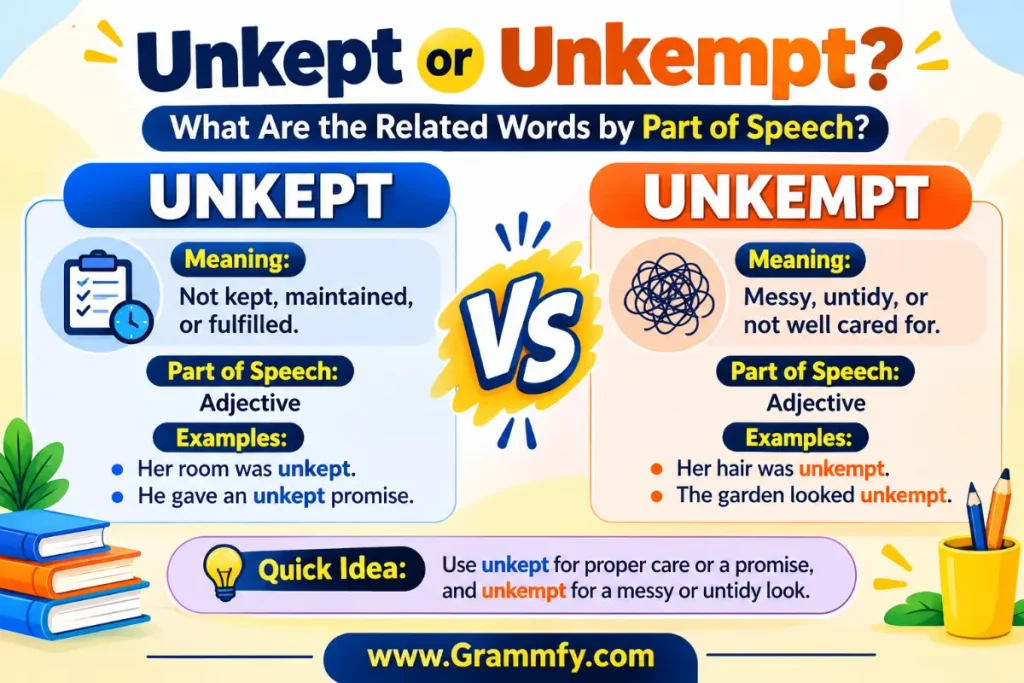
What Are the Related Words by Part of Speech?
The two words have different grammatical forms and uses. Knowing their related forms can help you build accurate sentences.
Is “Unkempt” an Adjective?
Yes. Unkempt is an adjective. It describes a noun, such as hair, clothing, a person, or a place.
Examples:
- The unkempt hair covered his forehead.
- She noticed an unkempt garden behind the house.
- His appearance was unkempt.
- The office looked unkempt after the event.
You can place the adjective before a noun or after a linking verb.
| Position | Example |
|---|---|
| Before a noun | He had unkempt hair. |
| After a linking verb | His hair looked unkempt. |
| After a linking verb | The garden seemed unkempt. |
Is “Unkept” an Adjective?
Yes. Unkept is also an adjective. It describes something that has not been kept, maintained, or fulfilled.
Examples:
- The unkept promise caused disappointment.
- Several commitments remained unkept.
- The property was unkept for many years.
The word is less common in modern writing, so a more familiar alternative may make your meaning clearer.
The Related Forms of “Keep”
Because unkept is formed from un- and kept, knowing the common forms of the verb keep helps.
| Word | Part of speech | Example |
|---|---|---|
| Keep | Verb | Please keep your promise. |
| Keeps | Verb | She keeps her word. |
| Kept | Past tense / past participle | He kept the agreement. |
| Keeping | Present participle / gerund | Keeping promises builds trust. |
| Keeper | Noun | She is the keeper of the records. |
| Unkept | Adjective | The unkept commitment caused trouble. |
There is no need to create an unusual form when a familiar phrase works. Writers often find that saying “a promise that someone did not keep” is clearer than saying “an unkept promise.”
Does “Unkept” or “Unkempt” Change in American and British English?
No. Both words have the same spelling and basic meanings in American and British English.
| Region | Spelling for messy appearance | Spelling for something not kept |
|---|---|---|
| American English | Unkempt | Unkept |
| British English | Unkempt | Unkept |
| Canadian English | Unkempt | Unkept |
| Australian English | Unkempt | Unkept |
There is no standard regional spelling that changes unkempt into unkept or the other way around.
Do American and British Writers Use the Words Differently?
The core meanings remain the same. However, the words chosen to explain a situation may vary with style and context.
For example:
- American English: His hair looked messy.
- British English: His hair looked untidy.
- British English: The garden was neglected.
- British English: The garden was neglected.
These examples show differences in vocabulary preferences, not different spellings of the two target words.
Which Word Should You Use in a Resume, Essay, Text, or Email?
The best choice depends on what you are describing and how formal your writing needs to be. In many professional situations, a more specific alternative will sound more respectful and clear.
What Word Should You Use in a Resume?
A resume should focus on skills and experience. Avoid describing yourself or another person as unkempt unless the word is directly relevant to a specific job task or evaluation.
If you are writing about property care, grooming services, or maintenance work, choose precise terms.
Examples:
- Maintained outdoor areas and prevented overgrown lawns.
- Kept workspaces clean, organized, and presentable.
- Groomed animals and maintained clean equipment.
- Completed regular property maintenance and repair tasks.
If you are describing an unmet goal or responsibility, use unfulfilled, incomplete, or not completed.
Example: “Reviewed outstanding commitments and completed overdue tasks.”
How Should You Use These Words in an Essay?
In an essay, choose the word that accurately describes the subject.
Use unkempt when describing a character’s appearance, a neglected setting, or a messy environment.
Examples:
- The novel introduces an unkempt traveler who has spent months on the road.
- The unkempt garden reflects the family’s difficult circumstances.
- The character’s disheveled appearance suggests exhaustion.
Use unkept when you discuss promises, duties, or commitments that were not fulfilled.
Examples:
- The character’s unkept promise creates conflict.
- The story explores the consequences of broken commitments.
For academic writing, broken promise or unfulfilled commitment may sound more natural than unkept promise.
Which Word Is Better for Texting?
In casual messages, messy is often easier and more natural than unkempt. Still, the latter is correct when you want to describe a noticeably untidy appearance.
Examples:
- My hair looks messy today.
- I woke up with unkempt hair.
- The garden looks neglected.
- He never kept the promise he made.
You probably won’t need unkept in most casual messages. A simple phrase such as “He didn’t keep his promise” is clearer.
How Should You Use These Words in a Professional Email?
Professional emails should be polite and specific. If you need to describe an untidy place, use unkempt only when it fits the situation. If you are discussing a missed obligation, consider unfulfilled or not completed.
Examples:
- The garden outside the office appears unkempt and needs attention.
- Several maintenance tasks remain incomplete.
- The supplier has not fulfilled the agreed delivery terms.
- We would appreciate an update on the outstanding commitments.
When writing about a person, be careful with negative descriptions. Instead of saying that an employee looks unkempt, describe the specific issue if it is relevant to the discussion.
Which Word Should You Use When Speaking?
In conversation, messy, untidy, and not kept often sound more natural than either target word.
Examples:
- Your hair looks a little messy.
- The backyard hasn’t been maintained.
- He didn’t keep his promise.
- The office looks untidy after the meeting.
Use unkempt when you want a more descriptive word. Use unkept when the context clearly involves something that was not kept or fulfilled.
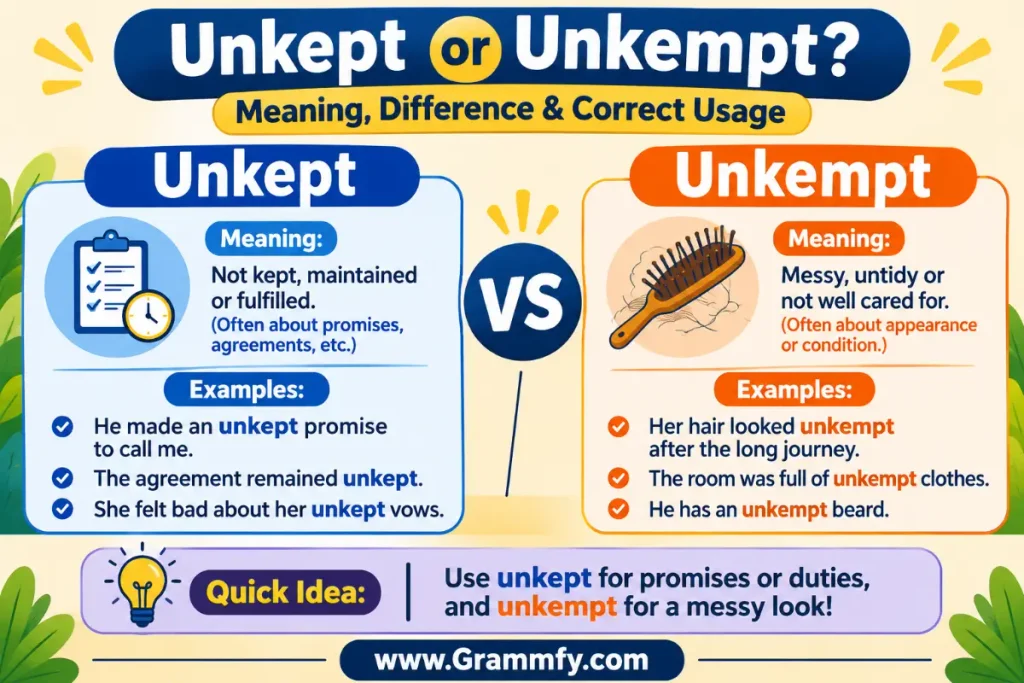
Some Original Example Sentences for “Unkempt” or “Unkept”
Examples from everyday life make the difference easier to understand. These sentences show how the words work in different situations.
“Unkempt” in Everyday Life
- After sleeping on the train, Marcus arrived home with unkempt hair.
- The children returned from the park with muddy shoes and unkempt clothes.
- Her unkempt ponytail kept falling across her face.
- The old man’s beard looked unkempt after several weeks without trimming.
- A strong wind left everyone’s hair looking unkempt.
- His shirt was wrinkled, and his overall appearance looked unkempt.
- The unkempt lawn made the empty house look abandoned.
- Weeds had spread across the unkempt flower bed.
- The office became unkempt after several days of rushed work.
- She tied back her unkempt hair before joining the video call.
“Unkept” in Everyday Life
- The unkept promise made it difficult for her to trust him again.
- The team discussed several unkept commitments during the review.
- His unkept agreement caused confusion among the partners.
- The manager apologized for the unkept obligation.
- Their unkept promises disappointed the local community.
- The report identified several commitments that remained unkept.
- The contract review focused on unfulfilled duties.
- He admitted that he had not kept his word.
Examples That Show the Difference
- His unkempt hair made him look tired, but his clothes were clean.
- She was upset because he broke his promise.
- The unkempt garden needed a gardener, while the unpaid bill needed attention.
- His appearance was unkempt, but he had kept every promise he made.
- The neglected building looked unkempt, and its owner had failed to meet several maintenance commitments.
Notice how the meaning changes with the noun. Hair, clothing, and gardens often work with unkempt. Promises and commitments can work with unkept, although other expressions may sound more natural.
The Differences Between Similar Words
Several words are close in meaning, but they have different uses. These comparisons can help you avoid replacing one word with another when the meaning does not match.
Unkempt vs. Disheveled: Difference
Both words describe a messy appearance. However, disheveled often focuses on hair and clothing that have become untidy, while unkempt can also suggest a lack of regular grooming or care.
| Unkempt | Disheveled |
|---|---|
| Suggests untidy or neglected grooming | Suggests a messy or disturbed appearance |
| Can describe hair, clothing, gardens, and places | Most often describes people, hair, or clothing |
| May suggest a longer period without care | Can describe a temporary messy state |
Examples:
- His unkempt beard needed trimming.
- Her hair became disheveled during the storm.
Use disheveled when something has been thrown out of order. Choose unkempt when you want to emphasize a lack of neatness or grooming.
Unkempt vs. Untidy: Difference
Untidy is a general word for something that is not neat. Unkempt often suggests a more noticeable lack of grooming or maintenance.
| Unkempt | Untidy |
|---|---|
| Often describes hair, appearance, or neglected places | Can describe almost anything that is not neat |
| May suggest poor care or grooming | Usually describes a lack of order |
| More descriptive | More general and everyday |
Examples:
- His unkempt hair needed attention.
- His untidy desk was covered with papers.
People usually describe a desk as untidy, while they often describe hair as unkempt.
Unkept vs. Broken: Difference
Both can describe a promise that was not fulfilled. However, broken is the more common and natural choice in everyday English.
| Unkept | Broken |
|---|---|
| Means not kept or fulfilled | Can mean violated or not honored |
| Less common in everyday writing | Common with promises, rules, and agreements |
| Can sound formal or old-fashioned | Direct and familiar |
Examples:
- The unkept promise hurt their friendship.
- He broke his promise to return the money.
The second sentence is more natural for most everyday situations.
Unkept vs. Unfulfilled: Difference?
Although both words can describe something that someone did not complete, writers often prefer unfulfilled for its greater flexibility in formal writing.
| Unkept | Unfulfilled |
|---|---|
| Often refers to something not kept or honored | Refers to something not completed, achieved, or satisfied |
| Commonly connected with promises or commitments | Can describe goals, needs, duties, expectations, and promises |
| Less common | More widely used in formal writing |
Examples:
- The unkept promise caused disappointment.
- The unfulfilled goal remained important to her.
Use unfulfilled when you mean that someone has not achieved a goal, expectation, or requirement.
The Common Mistakes With These Words
The most common error is using the spelling for one meaning when you intend the other. A few other mistakes involve choosing a synonym that does not quite fit.
Mistake 1: Using “Unkept” to Describe Messy Hair
Incorrect: He arrived with unkept hair.
Correct: He arrived with unkempt hair.
Hair that is messy or poorly groomed is unkempt. The word unkept is not the standard choice for this meaning.
Mistake 2: Using “Unkempt” for a Broken Promise
Incorrect: She was angry about his unkempt promise.
Better: She was angry because he broke his promise.
A promise can be unkept, but broken promise is more natural. Unkempt describes untidiness, not a failure to honor an agreement.
Mistake 3: Assuming “Unkempt” Always Means Dirty
Incorrect: The kitchen was unkempt, so the food must have been unsafe.
Better: The kitchen looked untidy and needed cleaning.
An unkempt space may look neglected, but the word alone does not prove that it is dirty or unsafe. Describe the actual condition when cleanliness matters.
Mistake 4: Using “Unkept” When “Unmaintained” Is Clearer
Less natural: The unkept building needed repairs.
Clearer: The unmaintained building needed repairs.
When you are describing a building, garden, road, or machine that has not received proper care, unmaintained or neglected may be more precise.
Mistake 5: Treating “Unkempt” as a Noun
Incorrect: The unkempt of his hair was obvious.
Correct: The untidiness of his hair was obvious.
Unkempt is an adjective. Use a noun such as untidiness, messiness, or neglect when the sentence needs a noun.
Mistake 6: Using a Strong Word for a Minor Problem
Incorrect: Her slightly rumpled shirt was dilapidated.
Better: Her shirt was slightly rumpled.
Dilapidated usually describes something badly damaged or falling apart, especially a building. Choose a word that matches the actual condition.
The Antonyms of “Unkempt” or “Unkept”
An antonym is a word with an opposite meaning. The best opposite depends on which word you are using.
Opposite of “Unkempt”
Use words that describe a neat, clean, or well-groomed appearance.
| Antonym | Meaning | Example |
|---|---|---|
| Neat | Arranged in an orderly way | He wore a neat outfit. |
| Tidy | Clean and organized | Her desk was tidy. |
| Well-groomed | Carefully cared for | He looked well-groomed. |
| Presentable | Suitable and neat in appearance | She looked presentable for the interview. |
| Orderly | Properly arranged | The garden was orderly. |
| Trim | Neatly cut or arranged | His beard was neatly trimmed. |
Opposite of “Unkept”
Use words and phrases that show someone has fulfilled, maintained, or honored a commitment.
| Antonym or opposite phrase | Meaning | Example |
|---|---|---|
| Kept | Maintained or fulfilled | He kept his promise. |
| Fulfilled | Carried out or completed | She fulfilled her commitment. |
| Honored | Respected or carried out | They honored the agreement. |
| Maintained | Kept in good condition | The property was maintained. |
| Met | Satisfied or achieved | The team met its obligations. |
| Observed | Followed a rule or custom | The requirements were observed. |
There is no single opposite that works in every sentence. Choose the word that matches the meaning you want to express.
Tips for Choosing the Correct Word
A simple meaning check can help you make the right choice. Use these tips when writing an email, essay, report, or casual message.
- Think about appearance: If you are describing messy hair, clothing, or a neglected garden, use unkempt.
- Think about keeping a promise: If someone failed to honor a promise, unkept may fit, but broken is usually more natural.
- Check the noun: Hair and gardens commonly pair with unkempt. Promises and commitments may pair with unkept.
- Choose a familiar alternative: Use messy, untidy, broken, or unfulfilled when those words make the sentence clearer.
- Consider your audience: A formal report may need unfulfilled commitment, while a casual message may simply say “He didn’t keep his promise.”
- Avoid judging people unnecessarily: If appearance is not relevant, do not use a negative description such as unkempt.
- Read the full sentence: Check whether the word describes a physical appearance or a failure to keep something.
- Use a dictionary when unsure: Check the definition and example sentences rather than relying only on how the word looks.
A Quick Memory Trick
Remember these two short ideas:
- Unkempt = untidy appearance.
- Unkept = not kept.
Picture someone with messy hair when you think of unkempt. Picture a promise that was not fulfilled when you think of unkept.
This simple connection will help you choose the right spelling without memorizing a complicated rule.
Conclusion: Choose the Word That Matches Your Meaning
The important difference between unkept or unkempt is the idea each word expresses. Use unkempt for messy hair, untidy clothing, or places that look neglected. Use unkept when something has not been kept, maintained, or fulfilled, especially a promise or commitment. In everyday writing, alternatives such as messy, untidy, broken, and unfulfilled may sound clearer. Always look at the noun in your sentence before choosing a word. A quick meaning check can prevent a spelling mistake and make your writing more precise. Once you connect each spelling with its purpose, choosing the right one becomes much easier.
Frequently Asked Questions
Is “Unkept” or “Unkempt” the Correct Spelling?
Both are valid English words, but they have different meanings. Use unkempt for a messy appearance and unkept for something that has not been kept or fulfilled.
Does “Unkempt” Mean Dirty or Messy?
Unkempt means messy, untidy, or poorly groomed. It does not always mean dirty; clean hair can still look unkempt if someone does not arrange it neatly.
Can You Say “Unkept Promise”?
Yes, unkept promise is understandable and grammatically possible. However, broken promise is more common and usually sounds more natural in everyday English.
What’s Another Word for “Unkempt”?
Common alternatives include messy, untidy, disheveled, scruffy, and unkempt-looking. Choose the word that best describes the condition you mean.
Is “Unkempt” a Negative Word?
It can sound negative because it suggests a lack of grooming, neatness, or care. However, the tone depends on the context and whether you are describing a person, a place, or a temporary situation.
Is “Unkept” a Real Word?
Yes, unkept is a real adjective formed from un- and kept. It means not kept, maintained, or fulfilled, though other expressions are often more natural.
What Is the Opposite of “Unkempt”?
The opposite of unkempt is usually neat, tidy, or well-groomed. For a place, well-maintained may be the best choice.

Tylerbrooks is a US-based English grammar writer and contributor at Grammfy. He writes helpful articles about grammar, spelling, commonly confused words, and vocabulary. His goal is to explain English topics in simple language with clear examples and practical tips. Through his articles, he helps readers improve their writing and everyday English skills.