
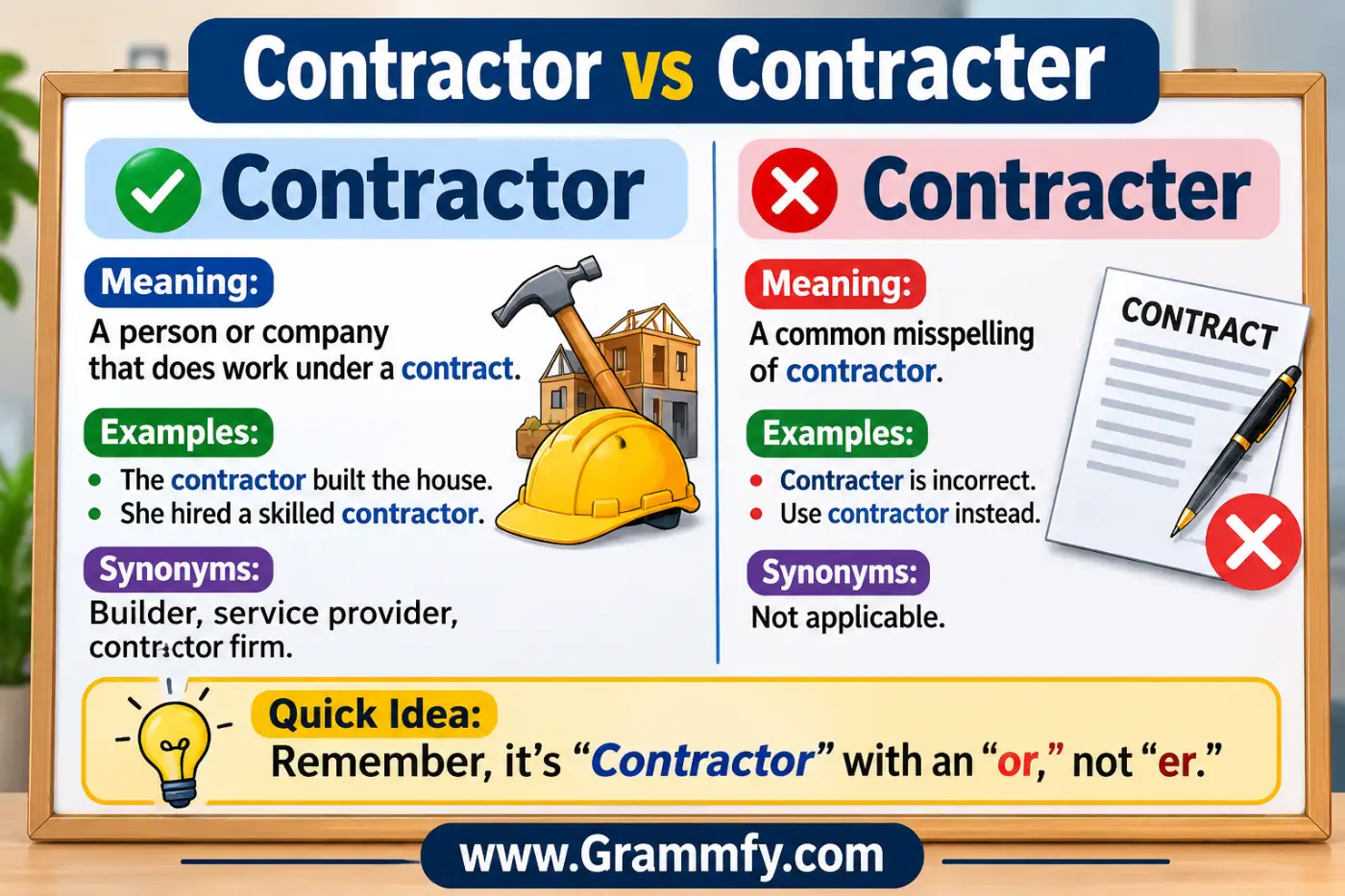
When writing a resume, preparing an invoice, or sending a professional email, choosing the correct spelling matters. You might wonder whether the right word is Contractor vs Contracter. Both spellings look reasonable because English words ending in similar sounds sometimes use different letters. However, only one is the standard spelling in modern English.
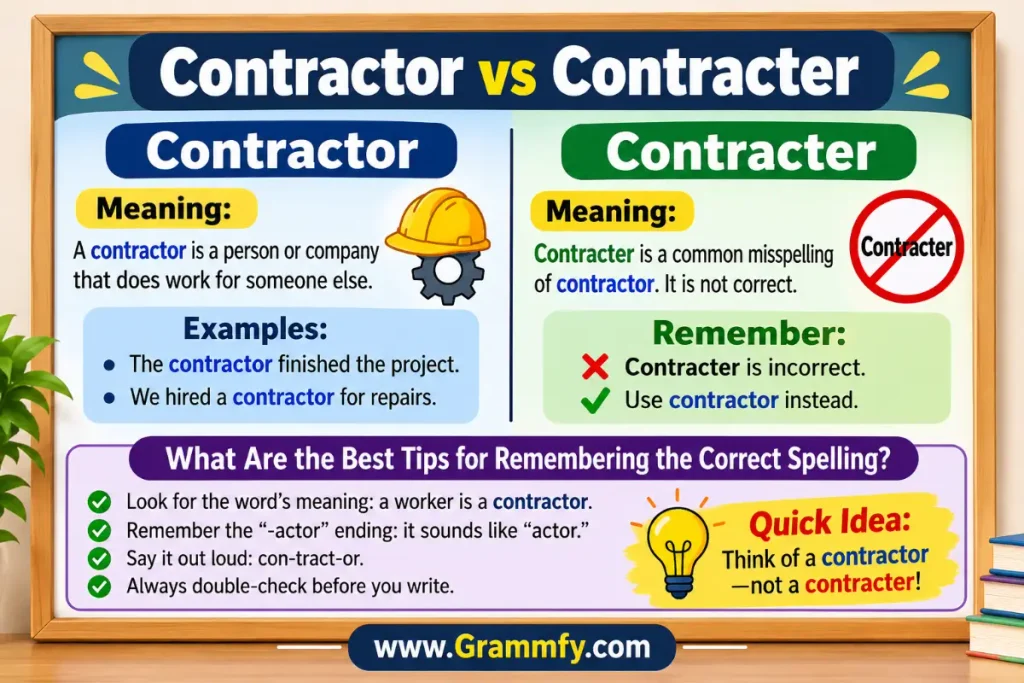
The correct spelling is contractor, with an o before the final r. It refers to a person or company hired to complete specific work, provide services, or supply materials under an agreement. The spelling contracter is not used as the standard modern form.
Quick Answer: Contractor is the correct spelling in modern English. Contracter is generally considered a misspelling, although it appears as an obsolete historical variant in some older records.
This spelling difference is especially important in construction, business, employment, and professional communication. Using the correct form makes your writing clearer and helps you avoid mistakes in important documents.
If you’re curious about different types of residential communities, explore the difference between a village and a subdivision to understand how these two terms are used.
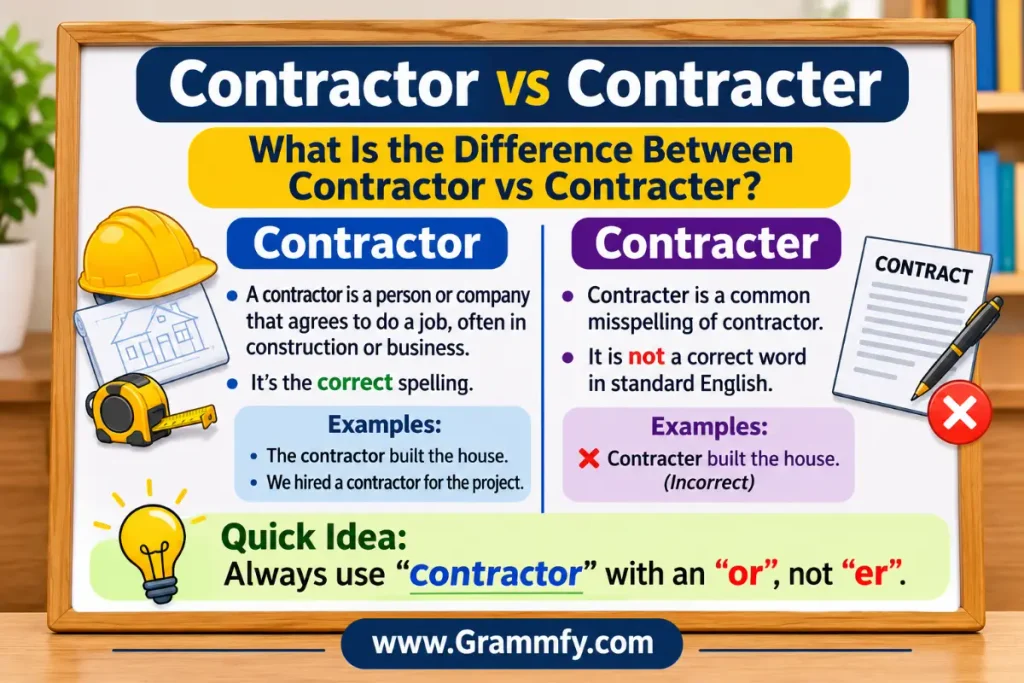
What Is the Difference Between Contractor vs Contracter?
The main difference is spelling. Contractor is the accepted modern English spelling, while contracter is not the standard form used in contemporary writing.
Although the two spellings look similar, you should use contractor in professional and everyday communication.
What does contractor mean?
A contractor is a person or company that agrees to perform specific work, provide services, or supply goods for another person or organization.
Contractors usually work under an agreement that explains the responsibilities, payment, deadlines, and expected results.
The term is especially common in construction, but it also applies to many other industries.
For example, a contractor might:
- Build a new house.
- Repair a damaged roof.
- Install electrical systems.
- Provide plumbing services.
- Manage a renovation project.
- Develop software for a company.
- Supply materials for a construction project.
- Maintain commercial buildings.
- Provide consulting services under an agreement.
Example sentences:
- We hired a contractor to renovate our kitchen.
- The contractor completed the project before the deadline.
- Our company needs an experienced building contractor.
The word can refer to an individual professional or an entire business.
What does contracter mean?
Contracter is not the standard modern spelling of the word you’re looking for.
People sometimes write it because they associate the word with contract and assume that adding -er creates the correct form.
However, English spelling doesn’t always follow that pattern.
The correct noun is contractor, not contracter.
Incorrect: My father works as a building contracter.
Correct: My father works as a building contractor.
Contractor vs Contracter: Quick comparison
| Feature | Contractor | Contracter |
|---|---|---|
| Spelling status | Correct modern spelling | Nonstandard modern spelling |
| Part of speech | Noun | Historical obsolete noun |
| Meaning | Person or company working under contract | Historical variant of contractor |
| Modern usage | Common | Not recommended |
| Professional writing | Accepted | Incorrect in modern usage |
| Business documents | Appropriate | Avoid |
| Resume writing | Appropriate | Avoid |
| Example | We hired a contractor. | We hired a contracter. |
Remember: Choose contractor whenever you mean a person or company hired to perform work under an agreement.
Where Do Contractor and Contracter Come From?
Understanding the history of a word can help you remember its spelling and meaning.
The word contractor has Latin roots and developed from the idea of bringing people together through an agreement.
What is the origin of contractor?
The word contractor entered English during the 16th century.
It comes from Late Latin contractor, meaning someone who makes a contract or agreement. This word is connected to the Latin verb contrahere, meaning to draw together or bring together.
The Latin word contains two important parts:
- Con-: A prefix meaning together or with.
- Trahere: A Latin verb meaning to draw or pull.
The original idea was bringing two or more parties together through an agreement.
By the 16th century, contractor referred to someone who entered into a contract. Its meaning later developed to include people who agreed to perform work or provide supplies for a specific payment.
Today, the word is used in construction, technology, government services, consulting, maintenance, and many other industries.
Where does contracter come from?
The spelling contracter follows a pattern that may seem reasonable to English learners.
Many English words use the suffix -er to identify someone who performs an action.
Examples include:
- Teach → Teacher
- Build → Builder
- Paint → Painter
- Drive → Driver
- Work → Worker
Because contract ends in a similar way to other action words, someone might assume that contracter follows the same pattern.
However, the accepted English word developed through the Latin form contractor.
The final letters are part of its established spelling, so changing the o to an e creates a nonstandard modern form.
Why does contractor end in -tor instead of -ter?
The suffix -or appears in many English nouns describing people or things that perform an action.
Consider these examples:
| Base word | Correct noun |
|---|---|
| Act | Actor |
| Direct | Director |
| Inspect | Inspector |
| Invent | Inventor |
| Conduct | Conductor |
| Contract | Contractor |
| Collect | Collector |
| Translate | Translator |
These examples show that -or is a common word ending.
However, there isn’t one simple spelling rule that explains every English noun. Some words use -er, while others use -or.
That’s why learning the established spelling of contractor is more reliable than trying to create it from a general rule.
What Are the Best Synonyms and Alternatives to Contractor?
The word contractor has several alternatives, but the best choice depends on the person’s actual job and responsibilities.
For example, builder is suitable for someone who constructs buildings, while consultant describes someone who provides professional advice.
These words are related, but they aren’t always interchangeable.
Here are 28 useful alternatives and related expressions, grouped by tone and context.
1. What are simple alternatives to contractor?
Simple alternatives are useful in everyday conversations, basic writing, and explanations.
| Word | Meaning | Tone | Example |
|---|---|---|---|
| Worker | A person who performs a job | Simple | The worker repaired the damaged wall. |
| Builder | Someone who constructs buildings | Simple | We hired a builder for our new house. |
| Helper | Someone who assists with a task | Simple | The contractor brought a helper. |
| Repairman | A person who fixes equipment or property | Simple | The repairman fixed our broken door. |
| Handyman | Someone who performs various small repairs | Simple | A handyman installed the shelves. |
| Tradesperson | A skilled worker in a particular trade | Simple | The tradesperson repaired the electrical system. |
| Installer | Someone who puts equipment or systems in place | Simple | The installer fitted the new windows. |
These alternatives work best when you know what kind of work the person performs.
For example, handyman usually suggests smaller maintenance jobs, while builder generally refers to construction work.
2. What are everyday alternatives to contractor?
Everyday expressions are useful when describing people who provide professional services or complete specific projects.
| Word | Meaning | Tone | Example |
|---|---|---|---|
| Freelancer | A person who works independently for different clients | Everyday | The freelancer designed our website. |
| Consultant | A professional who provides expert advice | Everyday | We hired a consultant to review the project. |
| Service provider | A person or business supplying a service | Everyday | The service provider repaired the equipment. |
| Supplier | A business that provides materials or products | Everyday | The supplier delivered the construction materials. |
| Technician | A skilled person who handles technical work | Everyday | The technician installed the security system. |
| Specialist | Someone with expert knowledge in one area | Everyday | We contacted a roofing specialist. |
| Carpenter | A skilled worker who builds or repairs wooden structures | Everyday | The carpenter made a custom cabinet. |
| Plumber | A professional who installs and repairs water systems | Everyday | The plumber fixed the leaking pipe. |
These words make your sentences more specific.
Instead of saying, “We hired a contractor,” you can say, “We hired a plumber” when the work involves repairing pipes.
3. What are formal alternatives to contractor?
Formal terms are useful in business proposals, legal documents, employment agreements, construction reports, and professional communication.
| Word | Meaning | Tone | Example |
|---|---|---|---|
| General contractor | A professional responsible for overseeing an entire construction project | Formal | The general contractor managed the building project. |
| Subcontractor | A contractor hired by another contractor | Formal | The subcontractor handled the electrical work. |
| Independent contractor | A self-employed person working under a contract | Formal | She works as an independent contractor. |
| Prime contractor | The main contractor responsible for an agreement | Formal | The prime contractor submitted the final report. |
| Principal contractor | The main contractor responsible for specified project duties | Formal | The principal contractor coordinated the site work. |
| Construction contractor | A person or business providing construction services | Formal | The construction contractor submitted a proposal. |
| Project contractor | A contractor engaged for a particular project | Formal | The project contractor completed the installation. |
| Service contractor | A business or person hired to provide specific services | Formal | The service contractor maintains the building. |
These terms are more precise than the general word contractor.
However, their legal meanings and responsibilities can differ depending on the contract and local regulations.
4. What are informal alternatives to contractor?
Informal expressions are common in casual conversations and messages.
| Word or phrase | Meaning | Tone | Example |
|---|---|---|---|
| The builder | Someone handling construction work | Informal | The builder is coming tomorrow. |
| The repair guy | Someone who fixes things | Informal | I called the repair guy this morning. |
| The handyman | A person handling small maintenance jobs | Informal | The handyman fixed the kitchen door. |
| The crew | A group of workers on a project | Informal | The crew finished painting the house. |
| The hired help | People hired to assist with work | Informal | The hired help arrived early. |
| The trades | Skilled workers in a particular industry | Informal | We need to contact the trades before Friday. |
Some expressions, such as the repair guy, are casual and may not suit professional documents.
Choose language that matches your audience and the work being discussed.
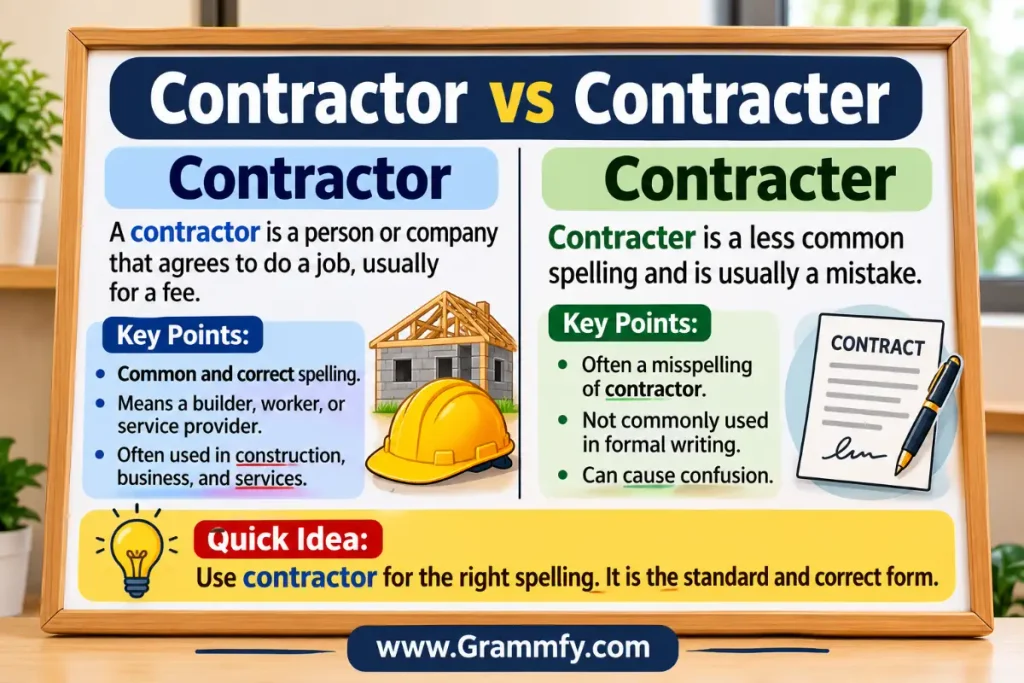
How Do Contractor-Related Words Differ in Meaning and Strength?
Not all alternatives communicate the same level of responsibility or expertise.
Some words describe general work, while others identify a specific professional role.
Instead of treating them as a strict scale of strength, it’s more useful to arrange them by level of job responsibility and specialization.
Which words describe general work?
These terms are broad and can refer to many kinds of paid work.
- Worker: A general term for someone who performs a job.
- Helper: Someone who assists another person.
- Service provider: A person or company offering a service.
- Tradesperson: Someone with practical skills in a particular trade.
- Contractor: A person or business working under an agreement.
For example, a worker may be employed by a construction company, while a contractor may have a separate agreement with the property owner.
Which words describe specialized work?
Specialized terms identify the kind of service being provided.
- Electrician: Handles electrical installations and repairs.
- Plumber: Works with water pipes and plumbing systems.
- Carpenter: Builds and repairs wooden structures.
- Roofer: Installs and repairs roofs.
- Painter: Applies paint and other finishes.
- Technician: Handles technical equipment and systems.
- Landscaper: Designs or maintains outdoor spaces.
These words are more specific than contractor because they describe the professional’s trade.
Which words describe higher project responsibility?
Some contractor titles describe a person’s position within a project.
| Term | Typical responsibility |
|---|---|
| Subcontractor | Completes a specific part of a larger contract |
| General contractor | Coordinates the overall construction project |
| Prime contractor | Holds the main contract with the client |
| Principal contractor | Performs designated lead responsibilities under the applicable project or legal framework |
| Project manager | Coordinates planning, resources, schedules, and progress |
A project manager isn’t automatically a contractor. The person may be an employee, consultant, or independent professional.
Likewise, a general contractor and a prime contractor may have similar responsibilities, but their precise roles depend on the agreement.
What Parts of Speech Are Contractor and Contracter?
Understanding the grammatical role of each form helps you avoid spelling and sentence-structure mistakes.
Is contractor a noun or a verb?
Contractor is a noun.
It identifies a person, company, or other party that undertakes work or provides goods and services under an agreement.
Examples:
- The contractor arrived at the construction site.
- Several contractors submitted their proposals.
- Our company hired a professional contractor.
The word is countable, so you can use it in singular and plural forms.
| Form | Example |
|---|---|
| Singular | One contractor |
| Plural | Three contractors |
| With an article | A contractor |
| With an adjective | An experienced contractor |
| Possessive | The contractor’s equipment |
What is the verb form of contractor?
The related verb is contract.
It can have several meanings depending on the sentence.
Meaning 1: To enter into an agreement
Example: The company plans to contract with a local construction firm.
Meaning 2: To hire someone for a specific service
Example: We contracted a professional to repair the building.
Meaning 3: To become smaller or tighter
Example: Some muscles contract during exercise.
Meaning 4: To acquire an illness
Example: He contracted an infection during his trip.
The meaning changes according to context, but the spelling remains the same.
What are the related grammatical forms?
| Word | Part of speech | Meaning | Example |
|---|---|---|---|
| Contract | Noun | A formal agreement | We signed a contract. |
| Contract | Verb | To enter into an agreement | They contract with local businesses. |
| Contractor | Noun | Someone who works under a contract | The contractor finished the project. |
| Contracted | Verb/adjective | Entered into an agreement or made smaller | The company contracted with a supplier. |
| Contracting | Verb/noun | The process of making agreements or providing work | Contracting requires careful planning. |
| Contractual | Adjective | Related to a contract | We reviewed the contractual terms. |
| Contractually | Adverb | In a way required by a contract | The company is contractually responsible. |
| Subcontractor | Noun | A contractor hired by another contractor | The subcontractor installed the windows. |
| Subcontract | Noun/verb | A secondary contract or the act of making one | They subcontracted the electrical work. |
Is contracter ever grammatically correct?
Contracter is found in historical English records, but it isn’t the standard modern spelling of the occupational noun.
For modern grammar and spelling purposes, use contractor.
Don’t confuse this spelling issue with the French verb contracter, which is a correctly spelled French word with its own meaning.
Is Contractor Spelled Differently in American and British English?
No. The standard spelling is contractor in both American and British English.
Unlike some words that change spelling between the two varieties, this noun keeps the same letters.
How is contractor used in American English?
American English commonly uses contractor for professionals and businesses hired to perform specific jobs.
Common expressions include:
- General contractor
- Independent contractor
- Construction contractor
- Government contractor
- Building contractor
- Roofing contractor
- Electrical contractor
Example: We hired a licensed contractor to build an extension to our house.
In the United States, the term independent contractor is also important in employment and tax discussions.
It describes a working relationship that differs from traditional employee status. The actual classification depends on the applicable legal tests, not simply on the label used in an agreement.
How is contractor used in British English?
British English also uses contractor for someone hired to provide services or complete work.
Common expressions include:
- Building contractor
- Construction contractor
- Electrical contractor
- Independent contractor
- Maintenance contractor
- Security contractor
Example: The building contractor agreed to complete the repairs within three weeks.
The word builder is also common in everyday British conversations about home construction and renovation.
Does the pronunciation change in the US and UK?
Yes. The pronunciation can differ slightly between American and British English.
| Feature | American English | British English |
|---|---|---|
| Spelling | Contractor | Contractor |
| First sound | Often /ˈkɑːn/ | Often /ˈkɒn/ |
| Middle sound | /træk/ | /træk/ |
| Final sound | Usually /tər/ | Often /tə/ |
| General syllables | 3 | 3 |
Regional accents can affect the exact pronunciation.
The important point is that pronunciation differences don’t change the spelling.
What should international English learners remember?
If you’re writing for American, British, Canadian, or Australian readers, use contractor.
The spelling doesn’t change according to the country.
However, the surrounding vocabulary may differ.
For example:
- American English: The contractor is remodeling the kitchen.
- British English: The contractor is renovating the kitchen.
Both sentences use the correct spelling.
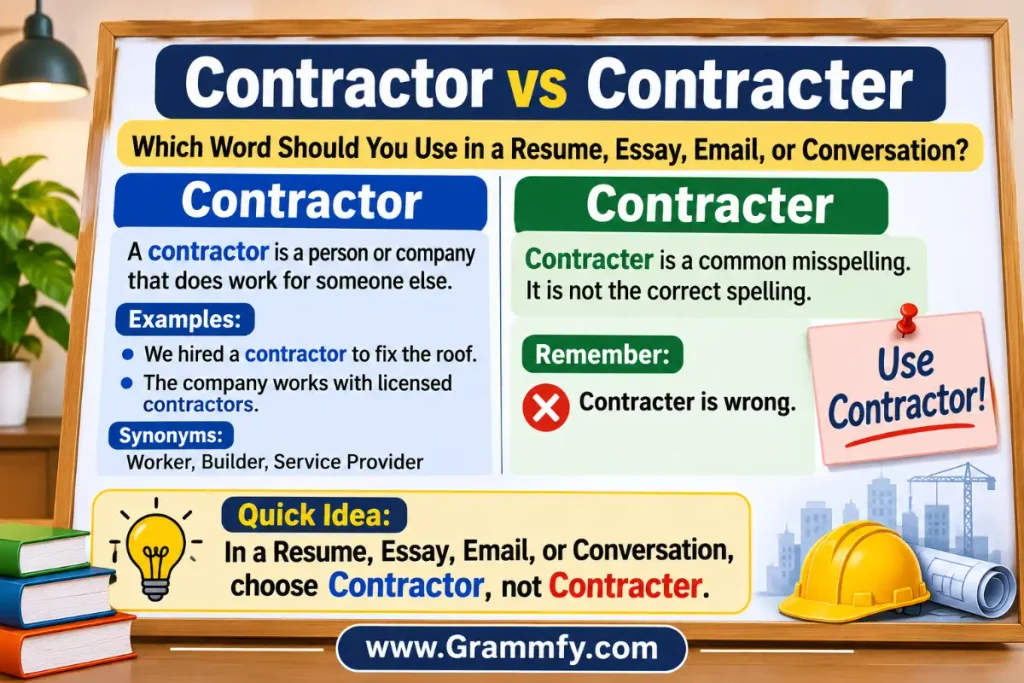
Which Word Should You Use in a Resume, Essay, Email, or Conversation?
The correct spelling is important in every type of writing, but the way you use the word depends on the situation.
Which spelling should you use in a resume?
Always use contractor in a resume.
If you have worked independently or completed projects for different clients, the term can help describe your professional experience.
Examples:
- Worked as an independent contractor for several small businesses.
- Managed residential construction projects as a general contractor.
- Provided electrical installation services as a licensed contractor.
- Coordinated subcontractors and completed projects within agreed deadlines.
Resume tip: Include your actual job title and responsibilities. Don’t use contractor if your position was something more specific, such as electrician, carpenter, or project manager.
Which spelling should you use in an academic essay?
Use contractor when discussing business agreements, construction projects, employment arrangements, or professional services.
Examples:
- The contractor was responsible for completing the building project.
- Independent contractors often work with multiple clients.
- The company hired an external contractor to improve its facilities.
- Construction contractors must follow relevant safety requirements.
Avoid the nonstandard spelling in academic work because it can make your writing look careless.
Which spelling should you use in a text message?
Use contractor even in informal messages.
Correct spelling doesn’t need to be formal or complicated.
Examples:
- The contractor will visit us tomorrow.
- Have you contacted the contractor yet?
- I found a good contractor for the kitchen renovation.
- Our contractor needs another week to finish the work.
A short message can still be clear and correctly written.
Which spelling should you use in a professional email?
Use contractor in business communication, quotations, invoices, agreements, and project updates.
Examples:
- We have selected a contractor for the renovation project.
- Please contact the contractor to confirm the delivery date.
- The contractor has submitted the revised quotation.
- Could you share the contractor’s contact information?
When writing about a specific business, use its registered name if available.
Which spelling should you use when speaking?
The spoken word is contractor.
You don’t need to worry about choosing between the two written forms while speaking because the distinction is mainly a spelling issue.
Examples:
- We need to hire a contractor.
- My uncle is a building contractor.
- The contractor will inspect the property.
For clear pronunciation, divide the word into three syllables and listen to the final vowel sound.
What Are 15 Original Example Sentences Using Contractor?
Examples from everyday situations help you understand how the correct word works in different contexts.
Here are 15 original sentences.
Examples in construction and home improvement
1. We hired a contractor to build a new garage behind our house.
2. The contractor inspected the roof before preparing the repair estimate.
3. Our building contractor recommended stronger materials for the foundation.
4. The homeowner asked the contractor to finish the kitchen renovation by Friday.
5. A local contractor offered a reasonable price for installing new windows.
Examples in business and employment
6. The company hired an independent contractor to develop its new website.
7. Each contractor must submit the required documents before starting work.
8. Our business works with an outside contractor for equipment maintenance.
9. The contractor signed an agreement outlining the project’s responsibilities.
10. She became a successful contractor after gaining several years of experience.
Examples in professional communication
11. Please send the contractor a copy of the updated project schedule.
12. The project manager contacted the contractor about the delayed materials.
13. We received three quotations from different contractors.
Examples in everyday life
14. My neighbor recommended a reliable contractor for our bathroom repairs.
15. The contractor completed the work carefully and cleaned the area afterward.
These sentences show that contractor works in several industries and situations.
It doesn’t refer only to someone who builds houses. The word can describe professionals and businesses that provide services under an agreement.
Contractor vs Builder: What’s the Difference?
Contractor and builder are closely related, especially in construction, but they don’t always mean the same thing.
A contractor is a person or company hired to perform work under an agreement.
A builder is someone who constructs buildings or other structures.
| Feature | Contractor | Builder |
|---|---|---|
| Main meaning | Someone working under a contract | Someone who constructs buildings |
| Industry | Many industries | Mainly construction |
| Responsibilities | Depends on the agreement | Building and construction work |
| Project management | May manage the entire project | May manage or perform construction |
| Scope | Broad | More specific |
| Example | An electrical contractor | A house builder |
When should you use contractor?
Use contractor when the agreement or professional relationship is important.
Example: The contractor agreed to renovate the entire office.
When should you use builder?
Use builder when you specifically mean someone who constructs or repairs buildings.
Example: The builder completed the new house in six months.
Quick tip: Every builder working under a construction contract may be a contractor, but not every contractor is a builder.
Contractor vs Subcontractor: What’s the Difference?
These terms describe two different positions within a project.
A contractor is hired to complete work under an agreement with a client.
A subcontractor is hired by another contractor to complete a specific part of that work.
| Feature | Contractor | Subcontractor |
|---|---|---|
| Hiring party | Often the client or property owner | Usually another contractor |
| Main responsibility | Overall or agreed project work | A specific portion of the project |
| Agreement | Main contract or service agreement | Subcontract |
| Example | General construction company | Electrical installation company |
| Project position | May lead the project | Works under a main contractor |
Example of a contractor
A homeowner hires a general contractor to build a new house.
The contractor coordinates the schedule, materials, workers, and different construction tasks.
Example of a subcontractor
The general contractor hires a plumber to install the water pipes.
The plumber is the subcontractor responsible for that part of the project.
Both professionals may be contractors in a broad sense, but their positions in the project differ.
Contractor vs Employee: What’s the Difference?
A contractor and an employee can both perform work for a business, but their working relationships are different.
An employee usually works within an organization’s employment arrangement.
An independent contractor generally provides services under a separate business or service agreement.
| Feature | Contractor | Employee |
|---|---|---|
| Working relationship | Contract for specific services | Employment relationship |
| Payment | Often project-based or agreed service fees | Often salary or hourly wages |
| Work arrangement | May serve multiple clients | Usually works for an employer |
| Benefits | Not automatically entitled to employee benefits | May receive employment benefits |
| Control | Depends on the actual arrangement | Often subject to employer direction |
| Duration | May be project-based | May be ongoing or fixed-term |
These are general differences, not universal legal rules.
Employment classification depends on the relevant country’s laws and the actual working relationship.
Example: The company hired a contractor to redesign its website, while its employees handled daily customer service.
This comparison is particularly useful when discussing jobs, hiring, and professional agreements.
What Are the Common Spelling Mistakes When Using Contractor?
English spelling can be confusing because many words have similar endings.
Here are some mistakes to avoid when writing about contractors.
1. Replacing the final o with e
This is the main spelling mistake.
Incorrect: The contracter submitted the proposal.
Correct: The contractor submitted the proposal.
Remember that the standard word contains -tor, not -ter.
2. Confusing contractor with contract
These words are related but have different meanings.
- Contract: A formal agreement between parties.
- Contractor: A person or business that undertakes work under an agreement.
Incorrect: We hired a contract to repair the roof.
Correct: We hired a contractor to repair the roof.
3. Confusing contractor with subcontractor
A contractor may be responsible for the main project, while a subcontractor handles a particular part of it.
Incorrect: The subcontractor hired the homeowner to manage the project.
Correct: The general contractor hired a subcontractor to install the electrical system.
4. Using contractor as a verb
Contractor is a noun, not the verb used for entering an agreement.
Incorrect: We will contractor with a local company.
Correct: We will contract with a local company.
5. Forgetting the plural ending
The plural form is contractors.
Incorrect: Three contractor submitted their bids.
Correct: Three contractors submitted their bids.
6. Confusing contractor with consultant
A consultant provides advice or professional guidance. A contractor may perform the actual work.
However, a consultant can also be an independent contractor if hired under that type of agreement.
Incorrect: Every contractor is responsible for giving expert advice.
Better: Some contractors provide consulting services, while others perform practical or technical work.
7. Using an incorrect possessive form
Use an apostrophe to show ownership.
Correct examples:
- The contractor’s tools are in the truck.
- The contractors’ meeting starts at noon.
- The contractor’s agreement includes the payment schedule.
The first example refers to one contractor. The second refers to multiple contractors.
8. Assuming every contractor is self-employed
Not every person described as a contractor has the same legal or business status.
A contractor may operate through a company, work independently, or provide services through another business arrangement.
Check the actual agreement before making assumptions about employment status.
What Are the Antonyms of Contractor?
There is no exact antonym for contractor because the word describes a professional or business relationship rather than a quality with a direct opposite.
However, some words describe contrasting roles.
| Word | Meaning | How it contrasts with contractor |
|---|---|---|
| Client | Person or organization receiving a service | Often hires the contractor |
| Employer | Person or organization hiring workers | May hire a contractor |
| Employee | Person working in an employment relationship | Different working arrangement |
| Customer | Person buying goods or services | Receives the contractor’s services |
| Owner | Person who owns property or a business | May hire a contractor |
| Principal | Main party in a contract or transaction | May engage another party to perform work |
These words aren’t direct antonyms.
For example, a client can hire a contractor, and an employer can also engage contractors for specific projects.
The best contrasting term depends on the sentence.
What Are the Best Tips for Remembering the Correct Spelling?
Remembering the correct spelling becomes easier when you connect the word with its meaning and related vocabulary.
Try these practical techniques.
1. Remember the o in contractor
The simplest trick is to memorize the final spelling:
CONTRACT + OR = CONTRACTOR
The word ends with -or, not -er.
Think of similar words:
- Actor
- Director
- Inspector
- Contractor
This association can help you remember the correct letters.
2. Connect contractor with contract
A contractor works under a contract.
Both words share the same base spelling.
For example:
- Contract
- Contractor
- Contractual
Remembering this word family makes it easier to avoid unnecessary spelling changes.
3. Use a short memory sentence
Try this sentence:
“Our contractor works under a contract.”
The two related words reinforce the correct spelling.
Read it aloud or write it down a few times.
4. Remember the correct professional title
Imagine a person standing at a construction site wearing a safety helmet.
That person may be a builder, electrician, plumber, or contractor.
Whenever you think about the professional title, remember that the standard spelling is contractor.
5. Practice with short sentences
Writing the word in different contexts helps build familiarity.
Try these examples:
- The contractor called me.
- Our contractor finished the job.
- The contractor needs more materials.
- We hired two contractors.
- The contractor signed the agreement.
Regular practice helps you recognize the correct form without stopping to think about it.
6. Use spell-check tools
If you frequently confuse the two spellings, use a reliable spelling checker.
Most modern word processors will identify contracter as a likely spelling error when you intend contractor.
However, don’t depend entirely on automatic corrections. Understanding the word helps you catch mistakes even when spell-check tools aren’t available.
7. Add the correct word to your personal vocabulary list
If you are learning English, keep a small list of commonly confused words.
Include:
| Incorrect or confusing form | Correct form |
|---|---|
| Contracter | Contractor |
| Maneger | Manager |
| Buisness | Business |
| Reciever | Receiver |
| Acheive | Achieve |
| Enviroment | Environment |
Reviewing these words regularly can improve your spelling and writing confidence.
Conclusion: Which Spelling Should You Remember?
The difference between Contractor vs Contracter is simple: contractor is the correct spelling in modern English, while contracter is not accepted as the standard form today. A contractor is a person or company hired to perform work, provide services, or supply materials under an agreement. You can use the word in construction, business, employment, and professional communication. Remember the final -or by connecting it with words such as actor, director, and inspector. If you’re writing a resume, email, invoice, or business agreement, always choose contractor. A small spelling detail can make your writing more accurate and professional. Practice the correct form, and it will soon become natural.
Frequently Asked Questions
1. Is contractor or contracter the correct spelling?
Contractor is the correct modern English spelling. Contracter is a nonstandard spelling and should be avoided in contemporary writing.
2. Why is contractor spelled with an o?
The word comes from Late Latin contractor, which developed from contrahere, meaning to draw together or make an agreement. Its established English spelling ends in -tor.
3. What does a contractor do?
A contractor performs work, provides services, or supplies materials under an agreement. Contractors commonly work in construction, technology, maintenance, consulting, and other industries.
4. Is contracter ever a real word?
Yes, contracter appears in historical English records as an obsolete form of contractor. However, it isn’t the accepted spelling for modern professional or everyday writing.
5. What’s another word for contractor?
Common alternatives include builder, tradesperson, service provider, freelancer, consultant, and construction professional. The best choice depends on the person’s actual responsibilities.
6. Is contractor the same in American and British English?
Yes. Both American and British English use the spelling contractor. Pronunciation may vary slightly between regional accents, but the written form remains the same.
7. What is the plural form of contractor?
The plural form is contractors. For example, “Three contractors submitted their proposals for the construction project.”

Tylerbrooks is a US-based English grammar writer and contributor at Grammfy. He writes helpful articles about grammar, spelling, commonly confused words, and vocabulary. His goal is to explain English topics in simple language with clear examples and practical tips. Through his articles, he helps readers improve their writing and everyday English skills.