
Have you ever written an email, school assignment, or social media post and paused because you weren’t sure whether to write passtime or pastime? These two spellings look similar, and the difference is easy to miss when typing quickly. However, only one is correct in standard English.
The confusion often comes from the way people pronounce the word. When spoken aloud, the middle sounds can make the spelling less obvious. Some writers add an extra letter because they assume the word contains pass, but that isn’t how the correct spelling works.
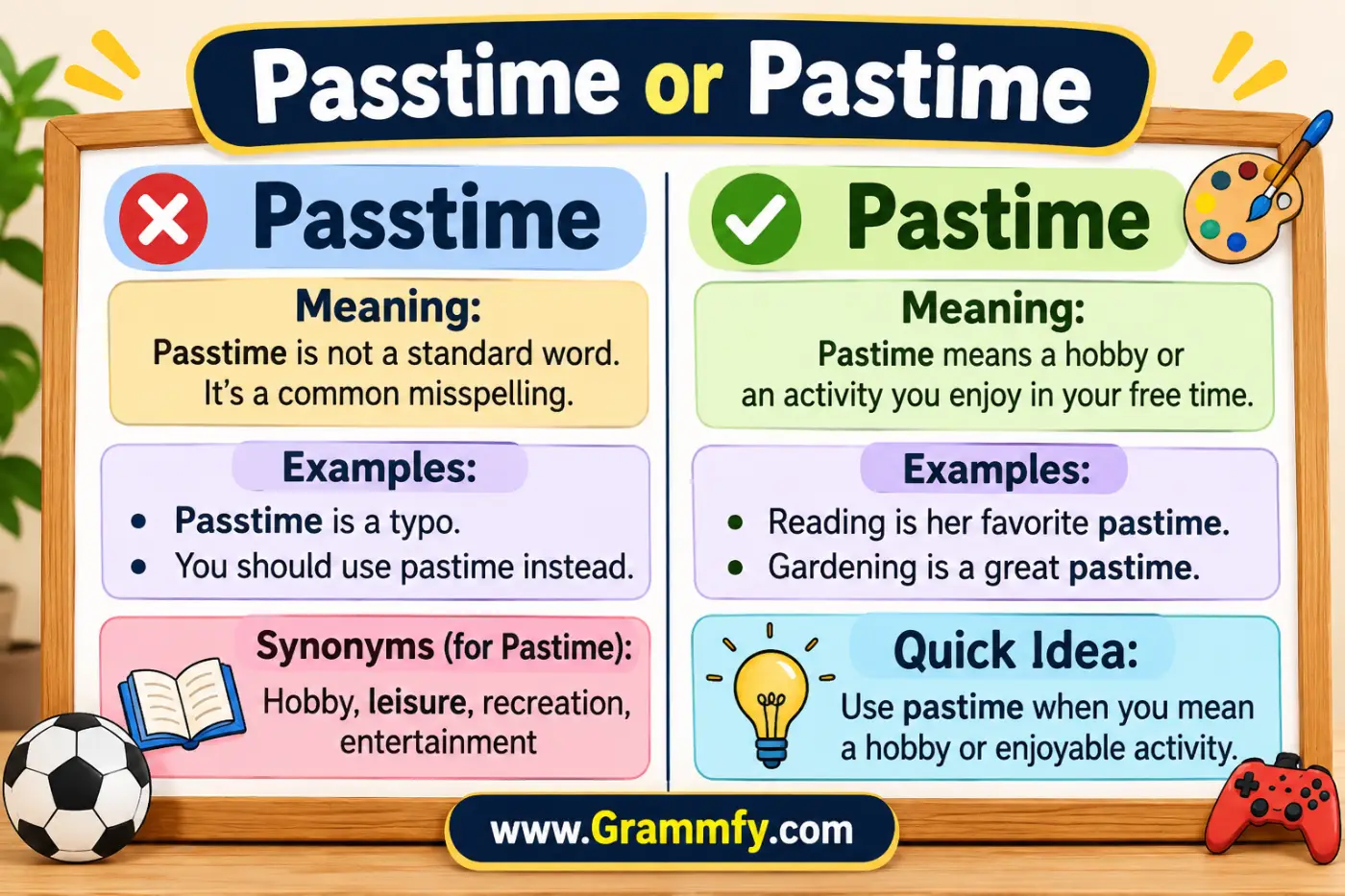
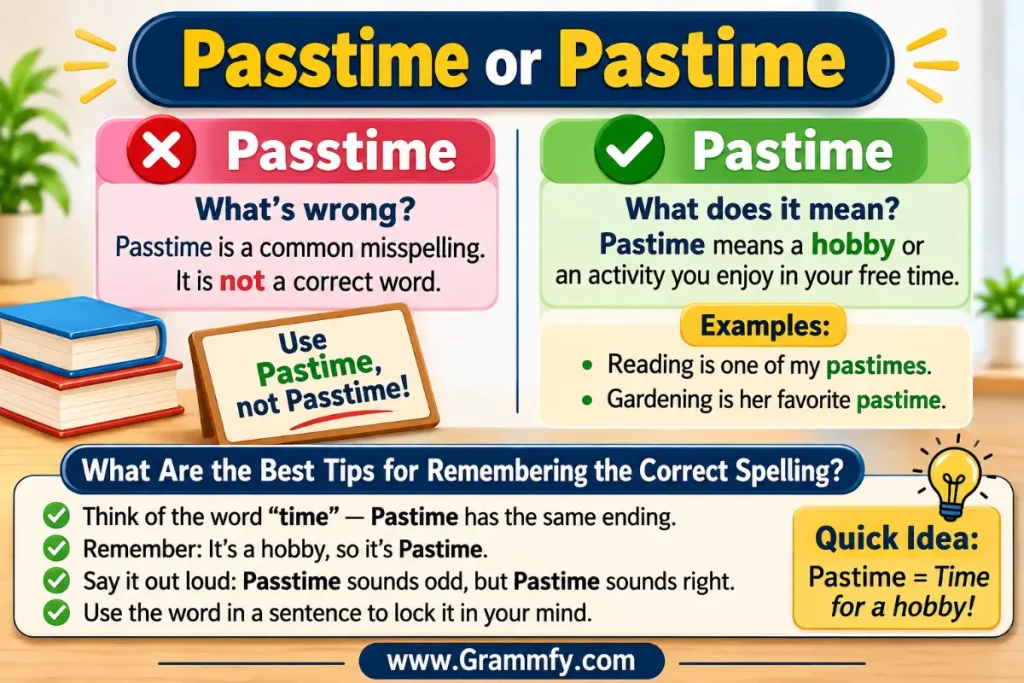
Passtime or Pastime: The correct spelling is pastime. It means an activity someone enjoys doing during their free time, such as reading, gardening, painting, or playing sports. Passtime is a misspelling.
Choosing the correct form helps you write more confidently in professional emails, essays, resumes, and everyday conversations. Understanding the word’s origin also makes it easier to remember.
This guide explains the correct spelling, its meaning and history, useful synonyms, differences between similar words, real-life examples, common mistakes, and simple memory tricks.
If you’re unsure about this spelling, check out why bearable is correct and bareable is not to avoid making the same mistake.
What Is the Difference Between Passtime or Pastime?
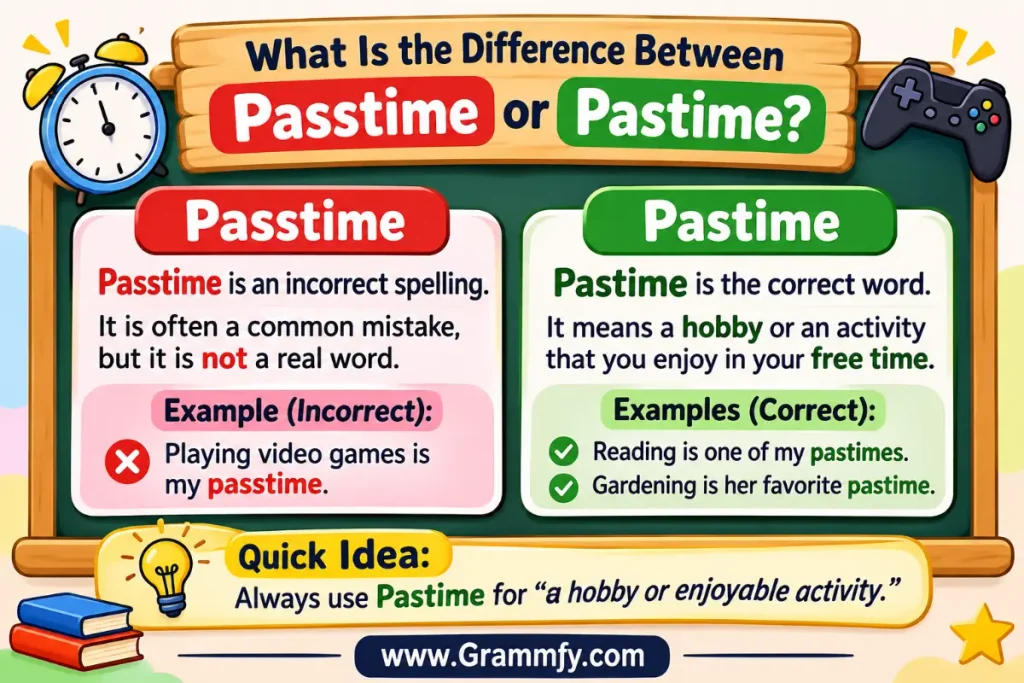
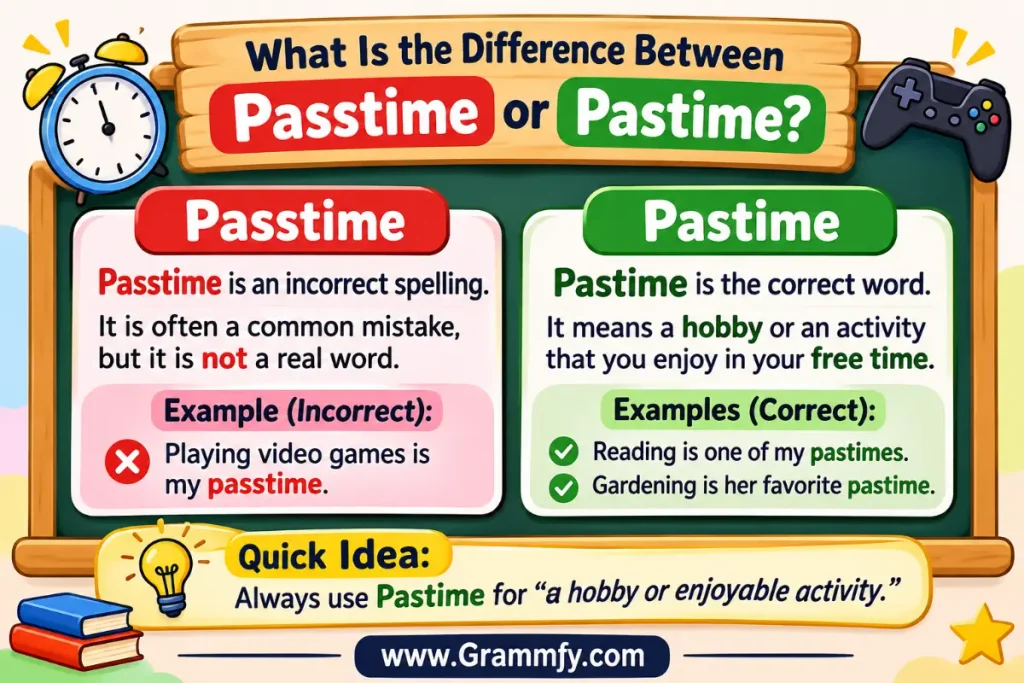
The main difference is spelling accuracy. Pastime is the correct English word, while passtime is an incorrect spelling. Both forms may appear in online searches, informal messages, or typing mistakes, but they do not have equal status in standard English.
1. What Does Pastime Mean?
Pastime is a noun that describes an activity someone enjoys doing during their free time.
It is usually something people do for pleasure, relaxation, entertainment, or personal interest rather than because they have to do it.
For example:
- Reading novels is my favorite pastime.
- Gardening has become a relaxing pastime for my mother.
- Playing chess is a popular pastime among students.
- His favorite weekend pastime is cycling.
In these sentences, the word describes enjoyable activities people choose to do when they have spare time.
Simple definition: A pastime is an enjoyable activity that someone does regularly or occasionally during their free time.
A pastime doesn’t have to be expensive, difficult, or productive. Even simple activities such as listening to music, walking, cooking, or watching birds can qualify.
2. What Does Passtime Mean?
Passtime is a common spelling mistake. It is not the standard spelling of the noun that describes a leisure activity.
People often write it incorrectly because they associate the word with pass the time. Although the expressions are related in meaning, their spellings are different.
Consider these examples:
- Incorrect: Reading is my favorite passtime.
- Correct: Reading is my favorite pastime.
- Incorrect: Fishing is a peaceful passtime.
- Correct: Fishing is a peaceful pastime.
- Incorrect: My weekend passtime is painting.
- Correct: My weekend pastime is painting.
Remember: Use pastime when referring to a hobby or enjoyable free-time activity. Avoid passtime in standard writing.
3. Is Pastime the Same as a Hobby?
A pastime and a hobby are closely related, but they aren’t always exactly the same.
A hobby is an activity someone enjoys and often practices regularly to develop a skill or personal interest. A pastime is a broader term for something that helps someone enjoy or spend their free time.
For example:
- Collecting old coins is my hobby.
- Watching a comedy show is my favorite pastime.
- Playing the guitar is both a hobby and a pastime.
Every hobby can be a pastime, but not every pastime needs to be a serious or regular hobby.
You can enjoy an activity occasionally without treating it as a personal hobby.
Where Does the Word Pastime Come From?
Understanding a word’s history can make its spelling easier to remember. The history of pastime is especially interesting because it connects the word to the everyday expression “pass the time.”
1. What Is the Origin of Pastime?
The word pastime dates back to the late 15th century. It developed from the English words pass and time, following the pattern of the French expression passe-temps.
The French expression referred to an activity that helped someone spend time pleasantly. English adopted the idea and formed the word we use today.
Here is a simple breakdown:
| Word or expression | Meaning | Connection |
|---|---|---|
| Pass | To move through or spend | Describes how time goes by |
| Time | A period or duration | The period being spent |
| Pass the time | To spend time doing something | The basic idea behind the word |
| Pastime | An enjoyable free-time activity | Something that makes time pass pleasantly |
The word originally appeared in forms such as passe tyme and passetyme. Its spelling later developed into the modern form pastime. Etymology, Origin & Meaning+2
2. Why Does Pastime Have Only One S?
The spelling can seem unusual because the word is connected to the expression pass the time. However, modern English uses the established spelling pastime, with one S.
Writers sometimes add another S because they recognize the word pass inside its meaning.
Compare these forms:
- Pass the time: A verb phrase.
- Pastime: A noun.
- Passtime: An obsolete historical spelling, not the standard modern form.
This last point is worth understanding. Although passtime is incorrect in modern standard writing, it has appeared in older English texts as an obsolete spelling. Therefore, you might encounter it in historical documents, but you should use pastime in contemporary writing. Wiktionary, the free dictionary+1
3. How Did the Meaning of Pastime Develop?
The original idea was simple: doing something enjoyable to make time pass pleasantly.
Over the years, the word became associated with hobbies, sports, entertainment, and recreational activities.
For example:
- In earlier times, hunting and fishing were common pastimes.
- Reading became a popular pastime among book lovers.
- Watching television became a familiar household pastime.
- Today, online gaming and photography are popular free-time activities.
The meaning has remained fairly consistent. The activities have changed as people’s interests, technology, and lifestyles have developed.
4. What Is the Difference Between Passing Time and a Pastime?
These expressions are related, but they have different grammatical functions.
| Pass the time | Pastime |
|---|---|
| A verb phrase | A noun |
| Describes an action | Names an activity |
| Focuses on spending time | Focuses on an enjoyable activity |
| We played cards to pass the time. | Playing cards is a popular pastime. |
For example:
- We watched a movie to pass the time while waiting.
- Watching movies is one of my favorite pastimes.
The first sentence describes what someone does. The second names an activity they enjoy.
What Are the Best Synonyms for Pastime?
The English language has many words and expressions that describe hobbies, recreation, entertainment, and free-time activities.
However, not every alternative has exactly the same meaning. Some describe a regular personal interest, while others refer to entertainment or a way to relax.
The following list groups 28 useful alternatives into four categories.
1. What Are Some Simple Synonyms for Pastime?
Simple alternatives work well in everyday conversations, school assignments, and basic writing.
| Word | Meaning | Tone | Example |
|---|---|---|---|
| Hobby | An activity enjoyed regularly | Neutral | Painting is her favorite hobby. |
| Activity | Something a person does | Simple | Swimming is a healthy activity. |
| Game | An activity played for enjoyment | Casual | Chess is an interesting game. |
| Play | An enjoyable activity or recreation | Casual | Children need time for play. |
| Fun | Enjoyment or amusement | Informal | Dancing is fun for everyone. |
| Interest | Something that attracts attention | Neutral | Music is one of his interests. |
| Sport | A physical activity or competitive game | Neutral | Football is a popular sport. |
These alternatives are useful when you want to explain what someone enjoys doing.
For example, instead of saying, “Reading is my favorite pastime,” you could write, “Reading is my favorite hobby.”
Both sentences are natural, although hobby may suggest a more regular personal activity.
2. Which Everyday Words Can Replace Pastime?
Everyday alternatives help describe activities that people enjoy during breaks, weekends, holidays, and other free periods.
| Word | Meaning | Tone | Example |
|---|---|---|---|
| Recreation | An activity done for enjoyment | Neutral | Cycling is a form of recreation. |
| Relaxation | Something that helps someone rest | Neutral | Gardening provides relaxation. |
| Entertainment | Something that amuses people | Neutral | Movies are a popular form of entertainment. |
| Diversion | An activity that takes attention away from routine | Neutral | Reading offers a welcome diversion. |
| Leisure activity | Something done during free time | Neutral | Walking is a simple leisure activity. |
| Pursuit | An activity followed with interest | Slightly formal | Photography is a creative pursuit. |
| Amusement | Something that provides enjoyment | Neutral | Board games provide amusement. |
Each word has a slightly different focus.
For example, relaxation emphasizes rest, while entertainment focuses on enjoyment. A pursuit may involve more dedication or long-term interest.
3. Which Formal Synonyms Work Best in Professional Writing?
Formal vocabulary can make essays, reports, and professional documents more precise.
| Word | Meaning | Tone | Example |
|---|---|---|---|
| Avocation | An activity pursued outside one’s main occupation | Formal | Gardening is her favorite avocation. |
| Recreation | Enjoyable activity outside work | Formal | Outdoor recreation supports well-being. |
| Pursuit | An activity someone follows seriously | Formal | Scientific reading is his personal pursuit. |
| Engagement | Participation in an activity | Professional | Creative engagement improves student learning. |
| Occupation | An activity that takes someone’s time | Formal | Chess became his regular occupation during retirement. |
| Diversion | An activity that provides a break | Formal | Music offers a pleasant diversion. |
| Pastime activity | An activity pursued for pleasure | Descriptive | The program encourages healthy pastime activities. |
A small distinction matters here: occupation can mean a person’s job, so it is not always a suitable replacement for a leisure activity.
Likewise, engagement often describes participation rather than the activity itself.
Choose formal vocabulary based on the exact meaning you want to communicate.
4. What Are Some Casual or Slang Alternatives for Pastime?
Informal expressions are useful in texts, social media posts, and conversations with friends.
| Word or phrase | Meaning | Tone | Example |
|---|---|---|---|
| Time-killer | Something done while waiting | Casual | Mobile games are my favorite time-killer. |
| Time-filler | An activity that fills spare time | Informal | Crossword puzzles are a good time-filler. |
| Fun activity | Something enjoyable | Casual | Baking is a fun activity. |
| Something to do | An activity to avoid boredom | Very casual | I need something to do this weekend. |
| Way to kill time | Something done while waiting | Slang | Scrolling through videos is my way to kill time. |
| Chill activity | A relaxing activity | Slang | Listening to music is my favorite chill activity. |
| Side hobby | An additional personal interest | Informal | Photography is my little side hobby. |
These expressions are not perfect substitutes in every situation.
For instance, a time-killer might simply help someone stay occupied while waiting at an airport. A meaningful hobby may involve years of practice and personal interest.
Use informal alternatives when the audience and situation allow a relaxed tone.
How Do Pastime Synonyms Change From Mild to Strong?
Not all free-time activities require the same level of effort, attention, or commitment.
Some are simple ways to relax for a few minutes. Others involve regular practice, physical activity, creativity, or long-term dedication.
There is no strict dictionary ranking of pastime synonyms by intensity. However, you can group related words by how much involvement they usually suggest.
| Level | Word or phrase | Type of involvement | Example |
|---|---|---|---|
| 1. Very light | Distraction | Briefly takes attention away | Music is a nice distraction. |
| 2. Light | Time-filler | Fills a short period | Puzzles are a useful time-filler. |
| 3. Casual | Amusement | Provides simple enjoyment | Card games offer amusement. |
| 4. Relaxing | Recreation | Helps someone enjoy free time | Walking is a form of recreation. |
| 5. Regular | Hobby | An activity practiced repeatedly | Cooking is his hobby. |
| 6. Personal | Interest | Something someone enjoys or studies | History is her main interest. |
| 7. Creative | Pursuit | An activity followed with interest | Writing is a creative pursuit. |
| 8. Dedicated | Avocation | A serious activity outside work | Painting is his avocation. |
Which Word Should You Choose at Each Level?
For short breaks: Choose distraction, time-filler, or amusement when describing something that occupies a few spare minutes.
Example: A quick crossword puzzle is a good distraction during lunch.
For relaxation: Use recreation or relaxation when an activity helps someone rest or enjoy free time.
Example: Walking in the park is a simple form of recreation.
For regular activities: Choose hobby when someone practices an activity regularly because they enjoy it.
Example: Collecting stamps has been his hobby since childhood.
For serious personal interests: Use pursuit or avocation when the activity involves commitment, learning, or personal development.
Example: Photography became a lifelong pursuit after her first art class.
The best word depends on the activity and the amount of involvement, not just how much free time someone has.
What Part of Speech Is Pastime?
Understanding the grammar of a word helps you use it correctly in different sentences.
Pastime is a noun. It names an activity rather than describing an action or quality.
1. Is Pastime a Noun or a Verb?
Pastime is a noun, not a verb.
It can function as the subject or object of a sentence.
Examples:
- Reading is my favorite pastime. (Subject)
- She enjoys gardening as a pastime. (Object of a preposition)
- Chess is a popular pastime among students. (Subject complement)
If you want to describe the action of spending time, use the verb phrase pass the time.
Examples:
- We play games to pass the time.
- She reads books to pass the time during long journeys.
2. What Is the Plural Form of Pastime?
The plural form is pastimes.
Simply add the letter S to the singular noun.
| Singular | Plural | Example |
|---|---|---|
| Pastime | Pastimes | Reading and gardening are popular pastimes. |
More examples:
- Many people enjoy different pastimes.
- Outdoor pastimes are popular during summer.
- Her favorite pastimes include painting and cycling.
3. Can Pastime Be Used as an Adjective?
No. Pastime is a noun, so it does not normally describe another noun directly as an adjective.
However, related expressions can perform that function.
For example:
- Recreational activity
- Leisure activity
- Hobby-related interests
- Free-time activities
Compare:
- Less natural: Pastime activities help people relax.
- More natural: Recreational activities help people relax.
The phrase pastime activity is understandable, but it can sound repetitive because both words refer to activities. Usually, simply writing pastimes or leisure activities is clearer.
4. What Is the Difference Between Pastime and Pastimes?
The difference is grammatical number.
- Pastime refers to one enjoyable activity.
- Pastimes refers to two or more enjoyable activities.
Examples:
- Reading is my favorite pastime.
- Reading, cycling, and cooking are my favorite pastimes.
Use the singular form for one activity and the plural form when discussing several activities.
Is Pastime Spelled Differently in American and British English?
Some English words have different American and British spellings. For example, Americans write favorite, while British writers usually write favourite. However, pastime keeps the same spelling in both varieties.
1. Is Pastime the Correct Spelling in Both Countries?
Yes. Both American and British English use pastime.
| English variety | Correct spelling | Incorrect modern spelling |
|---|---|---|
| American English | Pastime | Passtime |
| British English | Pastime | Passtime |
| Canadian English | Pastime | Passtime |
| Australian English | Pastime | Passtime |
Examples:
- American English: Reading is a popular pastime among teenagers.
- British English: Gardening is her favorite pastime.
- Canadian English: Hockey is a popular national pastime.
- Australian English: Surfing is a favorite pastime in many coastal communities.
The spelling does not change according to the country or audience. English meaning – Cambridge Dictionary+2
2. Does the Pronunciation Change in American and British English?
Yes. There can be a noticeable difference in the vowel sound.
| English variety | IPA pronunciation | Sound pattern |
|---|---|---|
| American English | /ˈpæsˌtaɪm/ | Short A sound |
| British English | /ˈpɑːs.taɪm/ | Broad AH sound in many accents |
The word has two syllables, and the stress falls on the first syllable.
Although the pronunciation changes slightly, the spelling remains the same. English meaning – Cambridge Dictionary+1
3. What Does National Pastime Mean?
The expression national pastime describes an activity that is especially popular or culturally important in a country.
It does not necessarily mean that everyone participates in the activity. Instead, it refers to something widely enjoyed or associated with a nation’s culture.
Examples:
- Baseball is often called America’s national pastime.
- Hockey is an important part of Canadian sporting culture.
- Football is a popular pastime in many countries.
The expression can also be used humorously.
For example:
“Complaining about the weather seems to be our national pastime.”
This sentence suggests that many people enjoy or regularly engage in the same activity.
Which Word Should You Use in Different Writing Situations?
The best alternative depends on your audience, purpose, and writing style. A casual conversation doesn’t require the same vocabulary as a resume or academic essay.
Here are five common situations and examples of how to use the word naturally.
1. Which Word Is Best for a Resume?
A resume should highlight your interests, skills, and personality without wasting space.
If you include personal interests, use a heading such as Hobbies and Interests rather than writing a long paragraph about your free-time activities.
Suitable examples include:
- Photography
- Creative writing
- Chess
- Volunteering
- Gardening
- Team sports
- Learning new languages
Example:
“Personal interests include photography, creative writing, and outdoor recreation.”
You can also write:
“Enjoys photography as a creative pursuit outside professional responsibilities.”
Avoid using informal expressions such as time-killer or something to do in a professional resume.
Tip: Mention activities that demonstrate useful qualities, such as creativity, patience, teamwork, or dedication. Don’t list interests just to fill space.
2. Which Word Is Best for an Academic Essay?
Academic writing benefits from precise and clear vocabulary.
Depending on your topic, you can use:
- Recreational activity
- Leisure activity
- Hobby
- Personal interest
- Cultural pursuit
- Entertainment
Examples:
- Reading plays an important role in children’s recreational activities.
- Gardening is a common leisure activity among older adults.
- Team sports provide entertainment and encourage social interaction.
- Painting is a creative pursuit that can improve artistic skills.
If your essay discusses how people spend their free time, pastime is also a suitable choice.
Example:
“Outdoor pastimes encourage people to remain physically active and socially connected.”
Avoid repeating the same noun in every paragraph. Use appropriate alternatives to make your writing more natural.
3. Which Word Is Best for Texting Friends?
Text messages usually sound better when they use simple and familiar expressions.
You can choose:
- Hobby
- Fun activity
- Something to do
- Way to spend time
- Time-killer
- Chill activity
Examples:
- What’s your favorite hobby?
- Gaming is my favorite way to spend time.
- I need something fun to do this weekend.
- Watching movies is my favorite way to relax.
A casual message might sound like this:
“Reading is my favorite pastime when I have nothing planned.”
This is perfectly natural, although you could also say, “I love reading in my free time.”
4. Which Word Is Best for a Professional Email?
Professional emails should sound polite, clear, and natural.
If you’re discussing recreational activities at work, consider these expressions:
- Leisure activities
- Recreational interests
- Personal interests
- Hobbies
- Team-building activities
Examples:
- Our company is planning several recreational activities for employees.
- Please share your hobbies and personal interests before the team event.
- The program includes outdoor activities and creative workshops.
When discussing a personal interest, you can still use pastime.
Example:
“Photography is a favorite pastime of mine, and I enjoy sharing my work with colleagues.”
Avoid slang expressions in formal workplace communication.
5. Which Word Is Best for Everyday Speaking?
In everyday conversation, you can use pastime, hobby, or simple expressions such as “what I do in my free time.”
Examples:
- Reading is my favorite pastime.
- My hobby is collecting old coins.
- I enjoy playing cricket in my free time.
- Cooking is something I do for fun.
- Walking helps me relax after work.
You can also ask someone:
“What do you usually do in your spare time?”
This sounds natural and gives the other person a chance to talk about their interests.
Choose a simple expression when speaking casually and a more precise word when discussing a specific activity.
What Are 15 Examples of Pastime in Real-Life Situations?
Examples help you understand how a noun works in different situations. They also show which words naturally appear before and after it.
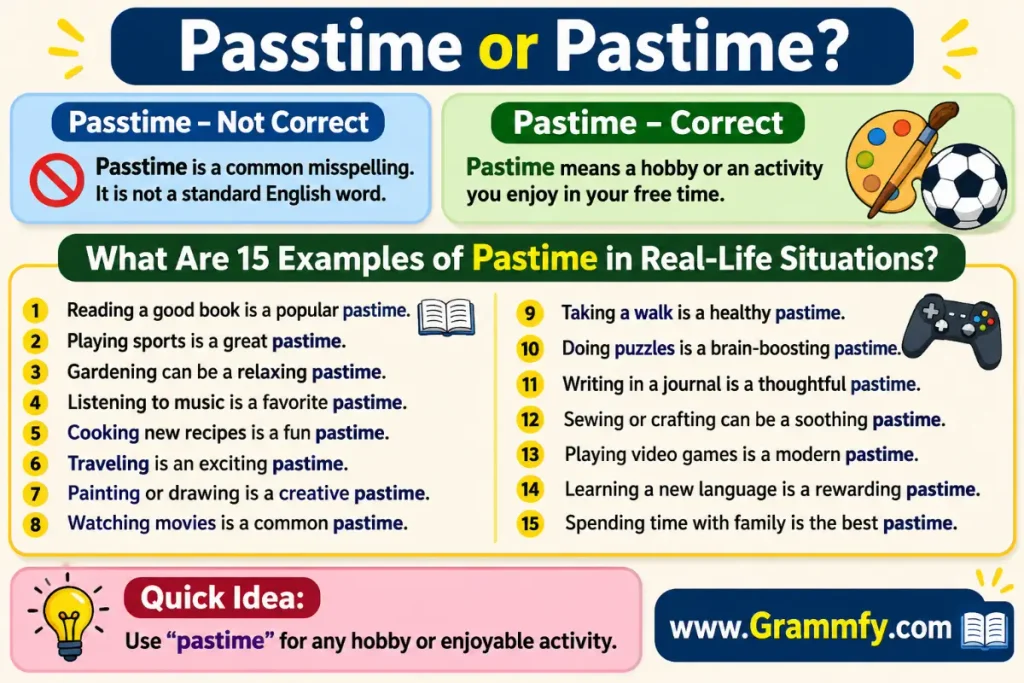
Here are 15 original sentences covering common activities and everyday experiences.
1. Reading and Learning
Reading and learning are popular ways to spend free time.
- Reading mystery novels is her favorite pastime during the winter.
- My grandfather enjoys reading historical books as a relaxing pastime.
- Learning a new language has become an enjoyable pastime for my sister.
2. Sports and Outdoor Activities
Physical activities can provide entertainment, exercise, and social interaction.
- Playing cricket is a popular pastime among young people in our neighborhood.
- Cycling along the river is his favorite weekend pastime.
- Fishing has been a peaceful pastime for our family for many years.
3. Art and Creative Interests
Creative activities allow people to express ideas and develop new skills.
- Painting landscapes became her favorite pastime after retirement.
- Writing short stories is a creative pastime that helps him express his thoughts.
- Photography is more than a pastime for her because she spends hours improving her skills.
4. Technology and Entertainment
Modern technology has introduced many new ways to enjoy free time.
- Playing online games is a common pastime among teenagers.
- Watching documentaries has become a favorite pastime in our household.
- Building digital models is an interesting pastime for technology enthusiasts.
5. Family and Social Activities
Some activities become more enjoyable when shared with other people.
- Playing board games is a traditional family pastime during holidays.
- Gardening is a relaxing pastime that my parents enjoy together.
- Cooking new recipes has become a weekend pastime for our entire family.
What Sentence Patterns Are Commonly Used With Pastime?
Certain words naturally appear with this noun.
| Common expression | Example |
|---|---|
| Favorite pastime | Reading is my favorite pastime. |
| Popular pastime | Walking is a popular pastime. |
| Relaxing pastime | Gardening is a relaxing pastime. |
| National pastime | Baseball is America’s national pastime. |
| Weekend pastime | Cycling is my weekend pastime. |
| Enjoyable pastime | Painting is an enjoyable pastime. |
| Favorite pastimes | Swimming and hiking are my favorite pastimes. |
| Take up a pastime | She decided to take up a new pastime. |
| Pursue a pastime | He pursues several creative pastimes. |
| Share a pastime | They share a love of outdoor pastimes. |
These combinations help your sentences sound more natural.
What Is the Difference Between Pastime and Similar Words?
Several English words describe activities people enjoy during their spare time. However, their meanings are not identical.
Understanding these differences will help you avoid repetition and choose more accurate vocabulary.
1. Pastime vs Hobby — What’s the Difference?
Both words describe enjoyable activities, but hobby often suggests a regular personal interest.
| Pastime | Hobby |
|---|---|
| A broad term for an enjoyable free-time activity | An activity someone enjoys and often practices regularly |
| Can be occasional or regular | Usually involves repeated participation |
| Often used for general activities and cultural trends | Often used for personal interests |
| Watching a movie can be a pastime. | Collecting movie posters can be a hobby. |
Examples:
- Watching television is a common pastime.
- Collecting vintage records is his hobby.
A person can enjoy watching television without treating it as a serious hobby.
Quick tip: Use pastime for enjoyable free-time activities in general. Use hobby when discussing a personal interest that someone regularly practices.
2. Pastime vs Interest — What’s the Difference?
An interest is something that attracts someone’s attention or curiosity. A pastime is an activity someone does for enjoyment.
| Pastime | Interest |
|---|---|
| Usually refers to an activity | Can refer to an activity or subject |
| Involves spending free time | May involve learning, watching, or studying |
| Often describes something people do | Can describe something people simply like |
| Gardening is her pastime. | History is her main interest. |
Examples:
- Playing chess is his favorite pastime.
- He has a strong interest in chess history.
You can be interested in something without actively doing it.
For example, someone may enjoy reading about astronomy but never use a telescope. Astronomy is still an interest, even if it isn’t an active pastime.
3. Pastime vs Recreation — What’s the Difference?
Both words relate to activities people enjoy outside work or other responsibilities.
However, recreation often has a broader meaning that includes rest, exercise, and refreshing activities.
| Pastime | Recreation |
|---|---|
| An enjoyable activity during free time | Activities that provide enjoyment, rest, or refreshment |
| Often refers to a specific interest | Can describe a wider group of activities |
| Gardening is his pastime. | Outdoor recreation includes hiking and cycling. |
Examples:
- Reading is a peaceful pastime.
- Swimming is a form of recreation.
The words can overlap, but recreation is often used in discussions about physical activity, public facilities, and leisure programs.
4. Pastime vs Entertainment — What’s the Difference?
Entertainment describes something that provides amusement or enjoyment. A pastime describes an activity someone does during free time.
| Pastime | Entertainment |
|---|---|
| An activity enjoyed during spare time | Something that provides amusement |
| Can be active or passive | Often involves watching, listening, or participating |
| Gardening is my pastime. | Movies provide entertainment. |
Examples:
- Playing guitar is my favorite pastime.
- Watching comedy shows is my favorite entertainment.
A pastime may provide entertainment, but entertainment does not always become a personal hobby or regular activity.
What Common Mistakes Should You Avoid When Using Pastime?
Even good writers sometimes make spelling and vocabulary mistakes. Most problems happen because people confuse similar-looking expressions or use a noun where a verb phrase is needed.
Here are some common mistakes and how to correct them.
1. Adding an Extra S to Pastime
This is the main spelling mistake.
- Incorrect: My favorite passtime is playing football.
- Correct: My favorite pastime is playing football.
The modern standard spelling contains one S between the A and T.
2. Confusing Pastime With Pass Time
These expressions are related, but they perform different grammatical jobs.
- Pastime: A noun describing an enjoyable activity.
- Pass time: A verb phrase describing how someone spends time.
Examples:
- Reading is my favorite pastime.
- I read books to pass the time.
Both sentences are correct because they communicate different ideas.
3. Writing Past Time Instead of Pastime
The expression past time can be correct in certain sentences, but it has a different meaning.
Compare:
- Pastime: An enjoyable free-time activity.
- Past time: A phrase referring to time that has gone by or, in expressions such as “It’s past time,” something that is overdue.
Examples:
- Gardening is my favorite pastime.
- It’s past time to start preparing for the examination.
Don’t confuse these expressions when writing quickly.
4. Using Pastime as a Verb
Because the word contains pass, some writers incorrectly use it as an action word.
- Incorrect: I pastime by watching television.
- Correct: I pass the time by watching television.
- Correct: Watching television is my favorite pastime.
Remember that pastime is a noun. Use pass the time when describing an action.
5. Confusing Pastime With a Professional Career
A pastime is generally an activity someone does for enjoyment rather than as a main job or obligation.
For example:
- Natural: Photography is my favorite pastime.
- Different meaning: Photography is my full-time profession.
Of course, a hobby can eventually become a career. However, the words describe different roles in the person’s life.
6. Using Pastime for Every Free-Time Activity
Not every activity someone performs outside work is necessarily a pastime.
For example, paying bills, cleaning the house, and completing compulsory assignments may happen during free hours, but they are usually responsibilities rather than enjoyable activities.
Compare:
- Doing household chores takes up my free time.
- Gardening is my favorite pastime.
The second sentence clearly describes something done for pleasure.
7. Repeating the Word Too Often
Using the same noun repeatedly can make writing sound unnatural.
For example:
- Repetitive: Reading is my favorite pastime. This pastime helps me relax. My pastime also improves my vocabulary.
- Better: Reading is my favorite pastime. This hobby helps me relax and improves my vocabulary.
Use alternatives such as hobby, recreational activity, interest, and leisure pursuit when they fit the meaning.
What Are the Antonyms of Pastime?
Unlike adjectives that describe opposite qualities, pastime does not have one exact opposite.
However, some words describe activities that contrast with leisure and entertainment.
| Contrasting word | Meaning | Example |
|---|---|---|
| Work | An activity done as a job or duty | Work keeps him busy during the day. |
| Chore | A routine household task | Washing dishes is a daily chore. |
| Obligation | Something a person must do | Paying bills is a financial obligation. |
| Duty | A responsibility | Completing her duty comes first. |
| Labor | Physical or mental effort | Construction labor can be demanding. |
| Responsibility | Something someone is expected to handle | Caring for children is an important responsibility. |
These words aren’t exact dictionary antonyms. They simply contrast with the idea of an enjoyable leisure activity.
For example:
- Reading novels is my favorite pastime.
- Completing household chores is my daily responsibility.
The first activity provides enjoyment, while the second involves an obligation.
What Are the Best Tips for Remembering the Correct Spelling?
Remembering the spelling becomes easier when you connect the word with its meaning and common expressions.
Try these five simple techniques.
1. Connect Pastime With Pass the Time
This is the easiest memory trick.
Think about the expression:
“Reading helps me pass the time.”
Now change the sentence:
“Reading is my favorite pastime.”
The two expressions share the same basic idea of spending time.
Memory trick: Pass the time pleasantly = Pastime.
2. Remember That Modern English Uses One S
Write the correct spelling several times:
- P-A-S-T-I-M-E
- Pastime
- Pastimes
Notice that there is only one S.
You can also compare it with the incorrect modern form to see the extra letter.
3. Learn the Word as a Noun
Remember that pastime names an activity.
Examples:
- Reading is a pastime.
- Swimming is a pastime.
- Painting is a pastime.
This helps prevent mistakes such as using it as a verb.
4. Practice With Different Activities
Create short sentences using activities you actually enjoy.
For example:
- Playing cricket is my favorite pastime.
- Cooking is a relaxing pastime.
- Reading is an enjoyable pastime.
- Gardening is a peaceful pastime.
- Photography is a creative pastime.
Writing your own examples makes the word easier to remember.
5. Check Your Spelling Before Publishing
Before submitting an assignment, publishing a blog post, or sending an email, check the word carefully.
Ask yourself:
- Am I talking about an enjoyable free-time activity?
- Am I using the word as a noun?
- Have I written it with only one S?
- Would hobby or recreation communicate the idea more clearly?
If you mean an enjoyable activity, pastime is the standard spelling.
Conclusion
The correct spelling is pastime, and it refers to an activity people enjoy during their free time. The alternative passtime is an obsolete historical spelling, not the standard form used in modern English. Remember the connection with the expression “pass the time,” which explains the word’s meaning and makes its spelling easier to recognize. You can use it when discussing hobbies, sports, reading, gardening, entertainment, and other leisure activities. Although words such as hobby, interest, and recreation are useful alternatives, each has a slightly different meaning. Practice with a few original sentences, and you’ll become more confident using this word in everyday and professional writing.
Frequently Asked Questions
1. Is it passtime or pastime?
Pastime is the correct modern English spelling. Passtime is an obsolete historical spelling and should be avoided in contemporary writing.
2. What does pastime mean in simple words?
A pastime is something you enjoy doing during your free time. Reading, swimming, cooking, and gardening are common examples.
3. Why is pastime spelled with one S?
The modern spelling developed from older forms of the word, including passe tyme. Although the word relates to the expression “pass the time,” its established modern spelling uses one S.
4. What’s another word for pastime?
Common alternatives include hobby, recreation, amusement, entertainment, diversion, and leisure activity. Choose one according to the activity and sentence.
5. Is pastime the same as a hobby?
They have similar meanings, but a hobby usually suggests a regular personal interest. A pastime is a broader term for an enjoyable free-time activity.
6. Is pastime spelled the same in American and British English?
Yes. Both American and British English use pastime. The pronunciation can differ slightly, but the spelling stays the same.
7. What is the plural of pastime?
The plural is pastimes. For example, reading, cycling, and painting are her favorite pastimes.

Tylerbrooks is a US-based English grammar writer and contributor at Grammfy. He writes helpful articles about grammar, spelling, commonly confused words, and vocabulary. His goal is to explain English topics in simple language with clear examples and practical tips. Through his articles, he helps readers improve their writing and everyday English skills.