
Have you ever written an email, essay, or text message and stopped because you weren’t sure whether to write bearable vs bareable? These two spellings look almost identical, so it’s easy to mix them up. However, only one is accepted in standard English.
The confusion usually happens because English has several words that sound alike but use different spellings. In this case, the extra-looking letter combination doesn’t create a new meaning. It simply leads to a spelling mistake.
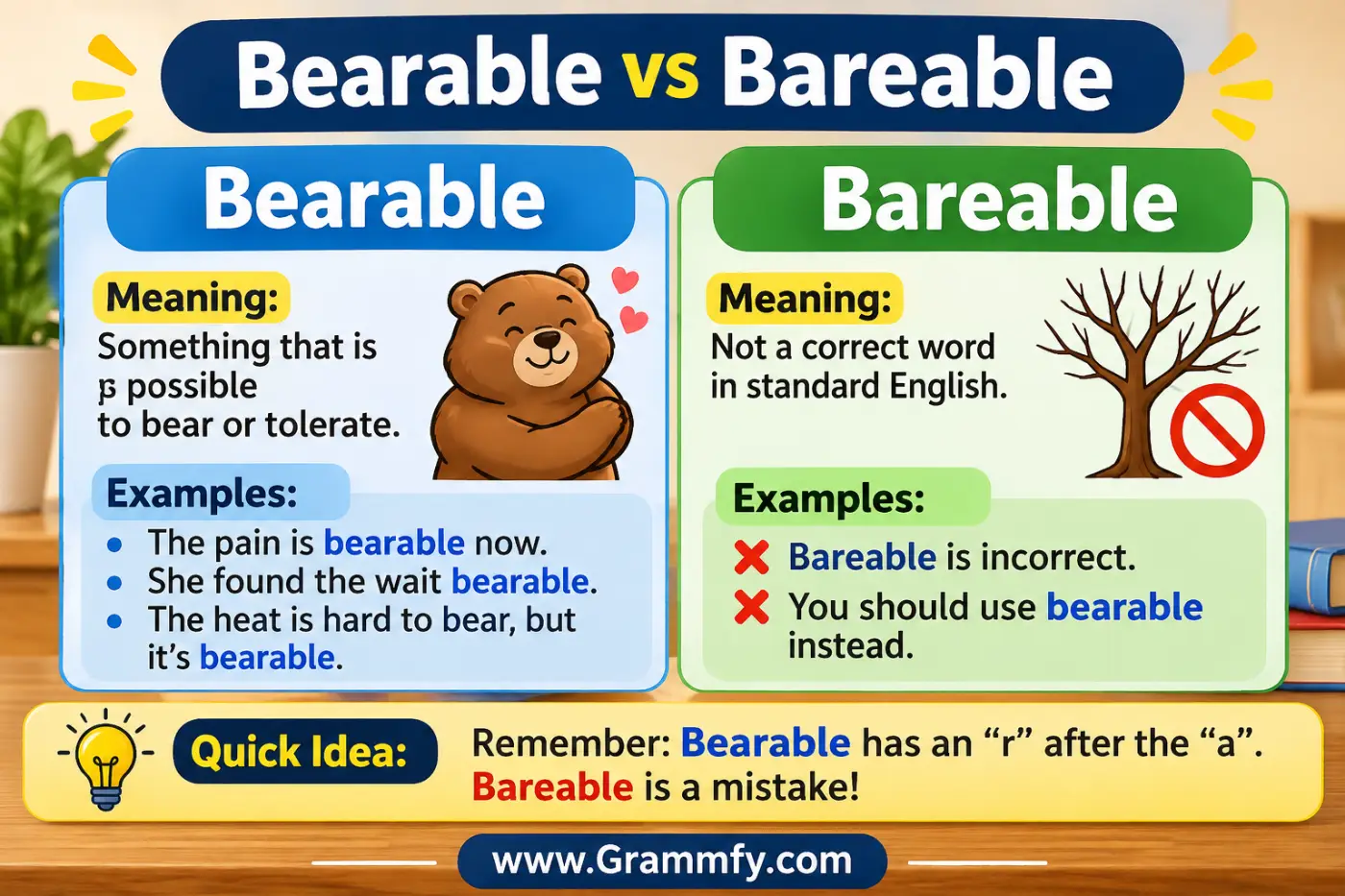
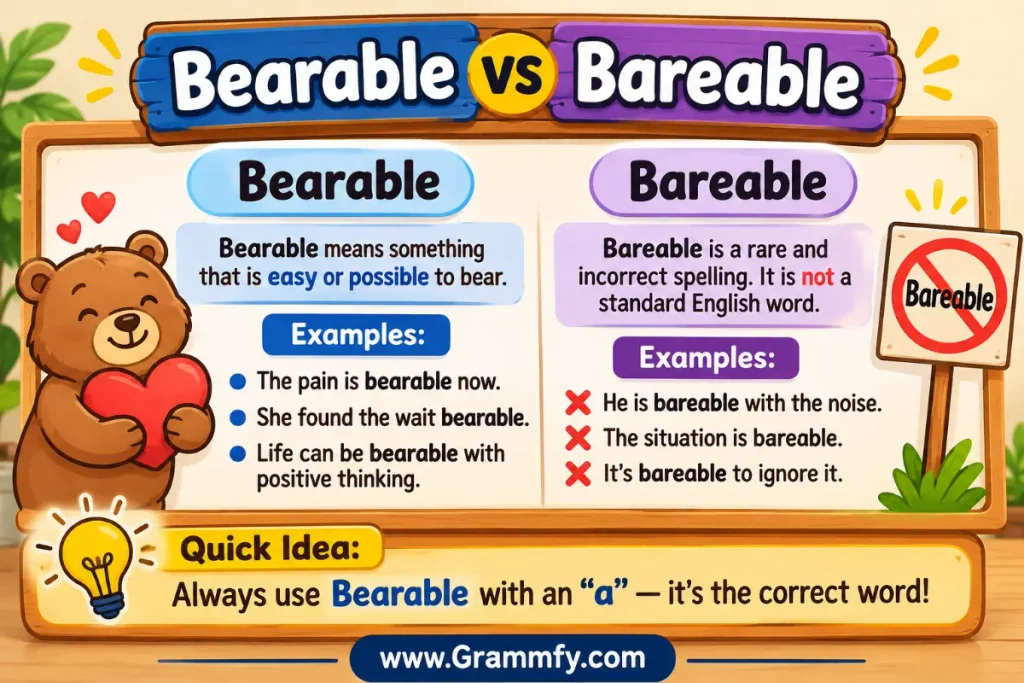
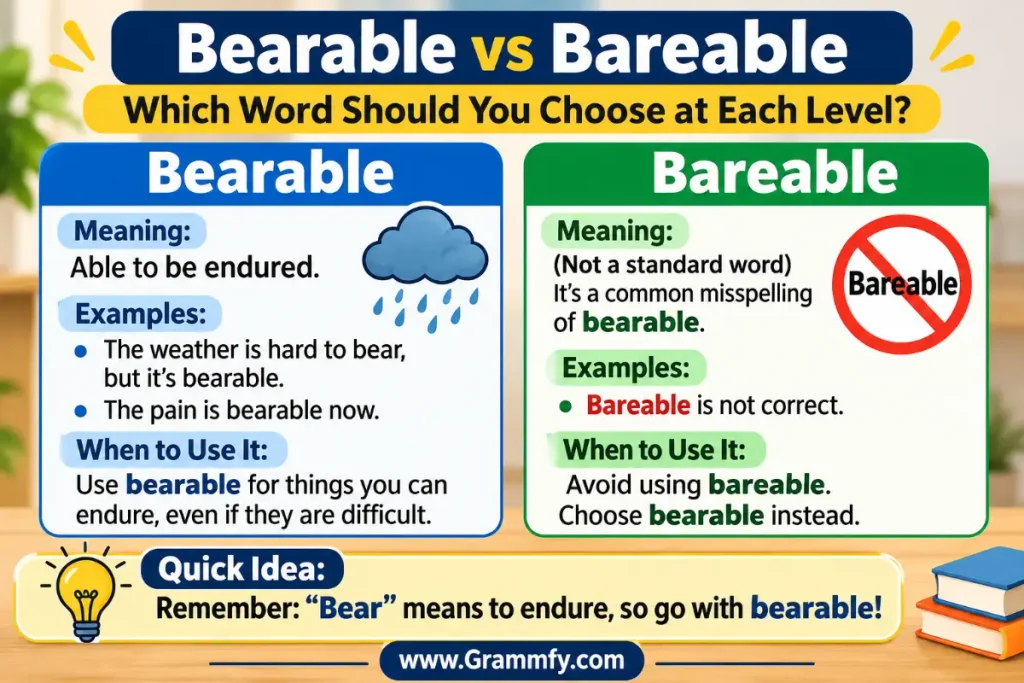
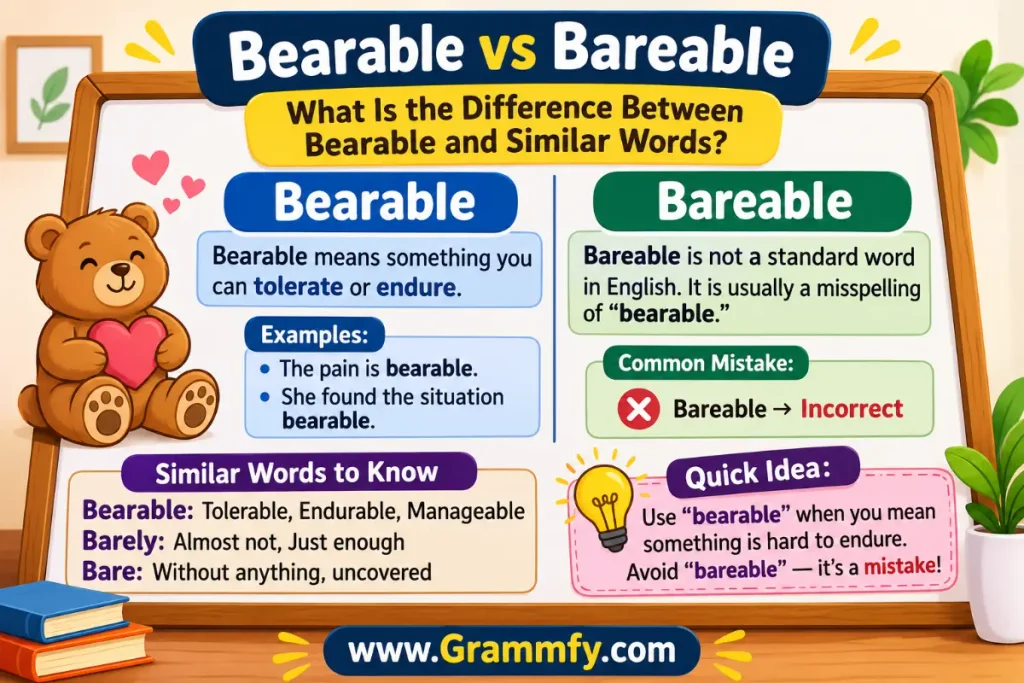
Bearable vs Bareable: The correct spelling is bearable. It means something is tolerable, manageable, or not too difficult to endure. Bareable is a common misspelling and should not be used in standard English.
Understanding this difference will help you write more clearly in school assignments, professional emails, job applications, and everyday conversations. Let’s explore their meanings, word origins, useful synonyms, real-life examples, common mistakes, and easy ways to remember the correct spelling.
If you’re unsure about the correct spelling, check out why focusing is preferred in American English and learn when to use each version.
What Is the Difference Between Bearable vs Bareable?
The main difference is spelling and correctness. Bearable is the standard English word, while bareable is an incorrect spelling. Although both forms may appear in online searches or informal writing, they are not interchangeable.
1. What Does Bearable Mean?
Bearable is an adjective that describes something you can tolerate, handle, or endure without too much difficulty.
It often refers to an uncomfortable, unpleasant, painful, or challenging experience that is still manageable.
For example:
- The heat became bearable after the sun went down.
- Her workload was difficult but still bearable.
- A little music made the long journey more bearable.
In each sentence, the word suggests that something is not entirely pleasant but can be handled.
Simple definition: Bearable means tolerable or manageable enough to deal with.
2. What Does Bareable Mean?
Bareable is not a standard English spelling. It is generally a misspelling of bearable.
The confusion comes from the word bare, which is a real English word meaning uncovered, exposed, or without something extra. However, adding -able to bare does not produce the correct spelling of the word meaning tolerable.
For example:
- Incorrect: The weather was finally bareable.
- Correct: The weather was finally bearable.
- Incorrect: The pain became bareable after treatment.
- Correct: The pain became bearable after treatment.
Remember: Use bearable when you mean something can be tolerated. Avoid bareable in essays, emails, reports, and other standard writing.
Where Does the Word Bearable Come From?
Understanding a word’s history makes its spelling easier to remember. The word bearable has a useful connection to an older meaning of the verb bear.
1. What Is the Origin of Bearable?
The word bearable dates back to the Middle English period. It comes from the verb bear and the suffix -able.
The verb bear developed from the Old English word beran, which carried meanings such as carrying, supporting, bringing, and enduring. Over time, the word also became strongly associated with tolerating something difficult.
The suffix -able means capable of being or suitable for something. When these two parts come together, they create a word that describes something a person can endure.
Here is a simple breakdown:
| Word part | Meaning | Example |
|---|---|---|
| Bear | To carry, support, or endure | I can bear the discomfort. |
| -able | Capable of being done or experienced | Readable means capable of being read. |
| Bearable | Capable of being endured | The discomfort is bearable. |
The word appeared in English around the middle of the 15th century. Its spelling reflects its connection to the verb bear, not the adjective bare. Etymology, Origin & Meaning+1
2. Why Does Bearable Use Bear Instead of Bare?
The two words have different meanings, even though they sound alike in many English accents.
- Bear: To carry, support, tolerate, or endure something.
- Bare: Without covering, clothing, decoration, or something extra.
The word bearable follows the first meaning because it describes something a person can endure.
Consider these examples:
- I can bear the pressure of this job.
- The pressure of this job is bearable.
- The child walked across the grass with bare feet.
- The room had bare walls and very little furniture.
Notice how the meanings change. The first two examples relate to tolerating something, while the last two describe something uncovered or empty.
The easiest way to understand the spelling is to connect bearable with the verb bear. definition in the Cambridge English Dictionary+1
3. How Does the Suffix -able Help You Understand the Meaning?
The suffix -able appears in many English adjectives. It usually describes something that can be done, experienced, or achieved.
For example:
| Base word | Word with -able | Meaning |
|---|---|---|
| Read | Readable | Can be read |
| Wash | Washable | Can be washed |
| Understand | Understandable | Can be understood |
| Enjoy | Enjoyable | Can be enjoyed |
| Manage | Manageable | Can be managed |
| Bear | Bearable | Can be endured |
This pattern gives you a useful spelling clue.
If you understand that bear means to endure and -able means capable of being, the complete word makes sense. The spelling is not connected to bare, which describes something uncovered.
What Are the Best Synonyms for Bearable?
English has many alternatives for describing something that is not pleasant but can still be handled. The best choice depends on how difficult the situation is and how formally you want to communicate.
Some words describe a minor inconvenience, while others suggest that a person is dealing with serious discomfort.
There is no single synonym that works in every sentence. Check the meaning, tone, and situation before replacing one word with another.
1. What Are Some Simple Synonyms for Bearable?
Simple synonyms are useful in everyday conversations, school assignments, and basic writing. They help readers understand your meaning without needing advanced vocabulary.
| Word | Meaning | Tone | Example |
|---|---|---|---|
| Okay | Acceptable or not too bad | Very casual | The weather is okay today. |
| Manageable | Easy enough to handle | Neutral | The assignment is manageable. |
| Tolerable | Not too unpleasant to endure | Neutral | The noise is tolerable. |
| Acceptable | Good enough to be approved | Neutral | The working conditions are acceptable. |
| Doable | Possible to complete | Informal | The extra work is doable. |
| Decent | Fairly good or satisfactory | Casual | The waiting time was decent. |
| Easy enough | Not especially difficult | Casual | The journey was easy enough. |
These words are useful when you want to avoid repeating the same adjective.
For instance, instead of writing, “The workload is bearable,” you could say, “The workload is manageable.”
However, the second sentence focuses more on handling the amount of work than enduring an unpleasant experience.
2. Which Everyday Words Can Replace Bearable?
Everyday alternatives are useful when describing weather, personal experiences, working conditions, relationships, and daily problems.
| Word | Meaning | Tone | Example |
|---|---|---|---|
| Livable | Suitable enough to live with | Neutral | The apartment is small but livable. |
| Survivable | Possible to get through | Informal | The difficult week was survivable. |
| Workable | Practical enough to function | Neutral | We found a workable solution. |
| Passable | Just good enough | Neutral | The hotel room was passable. |
| Reasonable | Fair or acceptable | Neutral | The waiting time was reasonable. |
| Not awful | Not extremely bad | Casual | The traffic was not awful. |
| Could be worse | Not as bad as it might be | Casual | The weather could be worse. |
A few of these words have meanings that go beyond simply enduring discomfort.
For example, workable usually describes a plan or solution that can function. Livable often refers to a place or living condition that is suitable enough to live in.
Choose the alternative that describes your actual situation rather than selecting a word only because it sounds similar.
3. Which Formal Synonyms Work Best in Professional Writing?
Formal alternatives can improve essays, reports, research papers, and professional communication.
| Word | Meaning | Tone | Example |
|---|---|---|---|
| Endurable | Capable of being endured | Formal | The conditions remained endurable. |
| Supportable | Able to be sustained or tolerated | Formal | The additional cost was supportable. |
| Sufferable | Possible to tolerate | Formal | The discomfort was barely sufferable. |
| Sustainable | Able to continue over time | Formal | The working schedule is sustainable. |
| Adequate | Sufficient for a particular purpose | Formal | The facilities were adequate. |
| Acceptable | Suitable or satisfactory | Professional | The proposed arrangement is acceptable. |
| Manageable | Possible to control or handle | Professional | The revised workload is manageable. |
Be careful with these choices.
For example, sustainable is particularly useful when discussing something that can continue over a long period. It does not always mean that something is pleasant or comfortable.
Similarly, adequate means sufficient for a purpose. It does not necessarily suggest that a person is enduring discomfort.
4. What Are Some Casual or Slang Alternatives?
Informal expressions make conversations and text messages sound more natural. They are especially useful when you are talking with friends or family.
| Word or phrase | Meaning | Tone | Example |
|---|---|---|---|
| Okay-ish | Somewhat acceptable | Very casual | The movie was okay-ish. |
| Not half bad | Better than expected | Informal | The food was not half bad. |
| Not the worst | Not extremely unpleasant | Casual | The first day wasn’t the worst. |
| No big deal | Not a serious problem | Casual | The short delay was no big deal. |
| Could live with it | Willing to accept something | Informal | I could live with that schedule. |
| I can deal with it | Able to handle a situation | Conversational | The extra work is fine; I can deal with it. |
| Meh | Neither good nor exciting | Slang | The experience was just meh. |
These expressions are not exact replacements in every situation.
For example, no big deal suggests that something is unimportant or not a serious problem. It does not always communicate that something is uncomfortable but still possible to endure.
Use casual expressions in friendly conversations rather than formal reports or academic assignments.
How Do Bearable Synonyms Change From Mild to Strong?
Not every unpleasant experience causes the same level of discomfort. Sometimes a situation is slightly inconvenient, while other times it requires considerable patience.
Choosing a synonym based on intensity makes your writing more accurate.
The following scale moves from mild discomfort to extreme difficulty.
| Intensity | Useful word | What it suggests | Example |
|---|---|---|---|
| 1. Very mild | Fine | Almost no discomfort | The temperature is fine. |
| 2. Mild | Okay | Acceptable overall | The journey was okay. |
| 3. Slightly unpleasant | Passable | Just good enough | The service was passable. |
| 4. Manageable | Manageable | Can be handled without major trouble | The workload is manageable. |
| 5. Moderately unpleasant | Tolerable | Not pleasant but possible to endure | The headache is tolerable. |
| 6. Difficult | Bearable | Requires patience but can be endured | The long wait is bearable. |
| 7. Very difficult | Endurable | Can still be experienced or tolerated | The pain remained endurable. |
| 8. Nearly impossible | Barely tolerable | Extremely difficult to endure | The heat was barely tolerable. |
| 9. Extreme | Unbearable | Too unpleasant to endure | The pain became unbearable. |
Which Word Should You Choose at Each Level?
For mild discomfort: Use fine, okay, or decent when a situation causes little trouble.
Example: The hotel room was fine for one night.
For moderate difficulty: Choose manageable, workable, or tolerable when something requires effort but does not create a major problem.
Example: The new schedule is manageable with a little planning.
For noticeable discomfort: Use bearable or endurable when something is unpleasant but you can continue dealing with it.
Example: The long training session was bearable because we had regular breaks.
For extreme discomfort: Use unbearable, intolerable, or insufferable when a situation becomes too difficult to tolerate.
Example: The constant construction noise became unbearable.
One important point: these words do not form a strict dictionary ranking. Their intensity can change depending on the context. A person might find a short delay unbearable, while another might describe a much longer delay as manageable.
What Parts of Speech Are Related to Bearable?
The word bearable is an adjective. However, English also has related forms that allow you to express the same general idea in different grammatical structures.
Knowing these forms helps you avoid awkward sentences and choose the right word for your writing.
1. Is Bearable an Adjective?
Yes. Bearable is an adjective because it describes a person, experience, condition, or situation.
Examples:
- The temperature is bearable.
- We had a bearable journey.
- Her living conditions became more bearable.
- The pain was still bearable after the accident.
An adjective usually answers a question such as “What is it like?” In these examples, the word explains how difficult or unpleasant something feels.
2. What Is the Adverb Form of Bearable?
The adverb form is bearably.
It describes the way something happens or the degree to which a condition can be endured.
Examples:
- The room was bearably warm.
- The patient was bearably uncomfortable during the examination.
- Temperatures remained bearably cool throughout the evening.
Although bearably is grammatically correct, it is less common than the adjective bearable.
In everyday writing, you may find it more natural to use expressions such as “not too uncomfortable” or “easy enough to tolerate.”
3. What Is the Noun Form of Bearable?
Two related noun forms are bearability and bearableness.
- Bearability: The quality or condition of being possible to endure.
- Bearableness: The state of being bearable; a less common form.
Examples:
- The bearability of the working conditions improved after the changes.
- The bearableness of the situation depended on everyone’s patience.
Bearability is generally the more useful choice when a noun is needed, but both forms are uncommon compared with the adjective.
4. Can Bear Be Used as a Verb?
Yes. The verb bear is the base word behind bearable.
It can mean to carry something, support something, tolerate a situation, or endure discomfort.
Examples:
- I cannot bear this noise anymore.
- She had to bear the responsibility alone.
- They struggled to bear the financial pressure.
Remember that the verb changes according to tense:
| Tense | Form | Example |
|---|---|---|
| Present | Bear | I can bear the pressure. |
| Past | Bore | She bore the responsibility. |
| Past participle | Borne | The burden was borne by the team. |
The connection between bear, bore, borne, and bearable is a helpful spelling clue. The word is based on the verb associated with enduring something, not the unrelated adjective bare.
Are There Any US and UK Differences in Bearable vs Bareable?
English spelling sometimes changes between American and British English. Words such as color/colour, favorite/favourite, and organize/organise have recognized regional variations.
However, this particular word does not follow that pattern.
1. Is Bearable Spelled Differently in American and British English?
No. Both American and British English use bearable.
| English variety | Correct spelling | Incorrect spelling |
|---|---|---|
| American English | Bearable | Bareable |
| British English | Bearable | Bareable |
| Canadian English | Bearable | Bareable |
| Australian English | Bearable | Bareable |
You should use the same spelling regardless of your intended audience.
For example:
- American English: The summer heat is becoming bearable.
- British English: The long working hours are still bearable.
- Australian English: The weather is finally bearable again.
The spelling remains unchanged in all three examples.
2. Does the Pronunciation Change in Different English Accents?
There can be a small pronunciation difference between American and British English.
- American English: Usually pronounced with a clear American-style r sound.
- British English: Often pronounced without a strong final r sound in non-rhotic accents.
The word generally has three syllables. Its pronunciation can vary slightly by region, but the spelling stays the same. Cambridge lists both British and American pronunciations for the word. English meaning – Cambridge Dictionary+1
3. Why Do People Confuse Bear and Bare?
The main reason is that bear and bare are homophones in many English accents. Homophones are words that sound alike but have different meanings and spellings.
Consider these pairs:
- Bear and bare
- Right and write
- Sea and see
- Flower and flour
- One and won
When people hear a word instead of reading it, they may choose the wrong spelling.
The best solution is to understand the meaning before writing. If you are describing something that can be endured, choose bearable. If you are describing something uncovered, use bare.
Which Word Should You Use in Different Writing Situations?
The right synonym depends on your audience and purpose. A word that works in a casual text message might sound weak or inappropriate in a professional report.
Here is how to choose natural alternatives in five common writing situations.
1. Which Word Is Best for a Resume?
When writing a resume, focus on positive and professional language. The word bearable is usually not the best choice because it can make a job, responsibility, or working environment sound unpleasant.
Consider alternatives such as:
- Manageable
- Sustainable
- Workable
- Efficient
- Well-balanced
Example:
- Less effective: Maintained a bearable workload during busy periods.
- Better: Managed a demanding workload while maintaining consistent performance.
The second sentence sounds more professional because it highlights your ability rather than suggesting that your work was merely tolerable.
Use manageable when discussing responsibilities and sustainable when describing a workload that can be maintained over time.
2. Which Word Is Best for an Academic Essay?
Academic writing benefits from clear, precise vocabulary. Depending on the subject, tolerable, endurable, acceptable, and manageable can work well.
Examples:
- The study found that the noise level was tolerable for most participants.
- Researchers described the environmental conditions as manageable.
- The financial burden remained acceptable for participating families.
Avoid choosing a complicated word simply to make your essay sound advanced.
A clear and accurate word is better than an impressive word that changes your meaning.
3. Which Word Is Best for Texting Friends?
Text messages are usually relaxed and conversational. You can use everyday expressions instead of formal vocabulary.
Good choices include:
- Okay-ish
- Not too bad
- Doable
- Could be worse
- I can deal with it
Examples:
- The traffic is bad, but it’s not too bad.
- The homework is doable.
- The weather could be worse.
- I can deal with the long wait.
These expressions make your message sound natural without making it unnecessarily formal.
4. Which Word Is Best for a Professional Email?
Professional emails should communicate problems without sounding overly negative.
Choose words such as manageable, acceptable, reasonable, or sustainable according to the situation.
Examples:
- The proposed deadline is manageable for our team.
- The revised budget is acceptable.
- We can work with the current schedule.
- The additional responsibilities remain manageable.
If you are discussing an uncomfortable situation, you can still use bearable, but make sure the context supports it.
For example:
“The temporary delay is bearable, although an earlier delivery would be preferable.”
This sentence communicates patience while making your preference clear.
5. Which Word Is Best for Everyday Speaking?
Spoken English often uses shorter and simpler expressions.
You do not need to choose formal vocabulary every time you describe something unpleasant.
Try these examples:
- The heat is not too bad.
- I can handle this situation.
- The journey was okay.
- The pain is manageable.
- The waiting time was tolerable.
When speaking with friends, expressions such as “I can live with that” and “It’s not the worst” can also sound natural.
Choose vocabulary that matches the way you normally speak and the person you are talking to.
What Are 12 Original Examples of Bearable in Real-Life Situations?
Examples make it easier to understand how an adjective works in different contexts. The following sentences show how people use bearable to describe uncomfortable but manageable experiences.
1. Weather and Temperature
The weather can become unpleasant during extremely hot summers or freezing winters. This word helps describe temperatures that are uncomfortable but not impossible to handle.
- The summer heat became bearable after a cool breeze started blowing.
- Although the winter was unusually cold, the warm clothes made it more bearable.
- Evening temperatures were finally bearable enough for an outdoor walk.
2. Work and Education
Workplaces and classrooms sometimes involve pressure, deadlines, and difficult responsibilities.
- Dividing the project into smaller tasks made the workload more bearable.
- The teacher’s clear instructions made the difficult lesson more bearable.
- Regular breaks helped employees manage an otherwise exhausting workday.
3. Health and Physical Discomfort
People can use this adjective when describing physical discomfort, provided it accurately reflects their experience.
- The mild headache was bearable after she rested for an hour.
- A comfortable chair made the long recovery period more bearable.
- His knee pain remained bearable while he followed the doctor’s advice.
Note: Describing pain as bearable does not mean that it is harmless or does not need medical attention.
4. Travel and Daily Life
Long journeys, delays, and crowded places can test a person’s patience.
- Listening to an interesting podcast made the long train ride more bearable.
- The traffic was frustrating, but the short distance made the journey bearable.
- Having a comfortable waiting area made the airport delay more bearable.
What Do These Examples Teach You?
These examples reveal three useful patterns:
- Something is bearable: The experience is manageable.
- Something becomes bearable: A difficult situation improves.
- Something makes life more bearable: A person or action reduces discomfort.
The adjective often appears with words such as more, less, almost, barely, and quite.
Examples:
- The situation is more bearable now.
- The noise is barely bearable.
- The room is quite bearable.
- The waiting time became less bearable.
Learning these patterns will help you use the word naturally rather than inserting it into sentences where another adjective would be more accurate.
What Is the Difference Between Bearable and Similar Words?
Several English words have meanings close to bearable. However, each one emphasizes a slightly different idea.
Understanding these differences will help you choose a more precise word.
1. Bearable vs Tolerable — What’s the Difference?
Both words describe something unpleasant that a person can accept or endure.
However, their everyday meanings are slightly different.
| Bearable | Tolerable |
|---|---|
| Suggests something can be endured. | Suggests something can be accepted despite being unpleasant. |
| Often describes an experience or condition. | Often emphasizes the level of discomfort or acceptability. |
| Common in everyday English. | Common in everyday and formal English. |
Examples:
- The heat became bearable after sunset.
- The noise level was tolerable during the afternoon.
In many situations, you can use either word without changing the main meaning.
However, tolerable may sound more neutral or evaluative, while bearable often emphasizes the experience of enduring something.
2. Bearable vs Manageable — What’s the Difference?
These adjectives are related but do not mean exactly the same thing.
| Bearable | Manageable |
|---|---|
| Focuses on enduring discomfort. | Focuses on controlling or handling something. |
| Often describes an unpleasant experience. | Often describes work, responsibilities, problems, or tasks. |
| Suggests something is not too difficult to endure. | Suggests something is within someone’s ability to handle. |
Examples:
- The pain was bearable.
- The workload was manageable.
The first sentence describes the level of discomfort. The second explains that the amount of work can be handled.
Quick tip: Use bearable for something you can endure and manageable for something you can control or handle.
3. Bearable vs Sustainable — What’s the Difference?
Both words can describe situations that continue over time, but their focus is different.
- Bearable means something is possible to endure.
- Sustainable means something can continue or be maintained over a period of time.
Examples:
- The long working hours were bearable for a few weeks.
- The new working schedule is sustainable for the entire team.
A situation might be bearable for a short period but not sustainable in the long term.
For example, an employee may tolerate extra hours during a busy season. However, maintaining that schedule permanently may lead to exhaustion.
4. Bearable vs Acceptable — What’s the Difference?
These words can overlap, but they emphasize different ideas.
Bearable describes something a person can endure, while acceptable describes something that meets a required standard or is considered satisfactory.
Examples:
- The long wait was bearable.
- The final project result was acceptable.
You can tolerate an unpleasant experience without considering it satisfactory.
Similarly, something may be acceptable without causing any discomfort.
Use acceptable when discussing approval, standards, or requirements. Choose bearable when discussing discomfort or endurance.
What Common Mistakes Should You Avoid When Using Bearable?
Even experienced English writers sometimes make spelling and vocabulary mistakes. Most problems happen when people choose words based on sound instead of meaning.
Here are some mistakes worth avoiding.
1. Writing Bareable Instead of Bearable
This is the most common spelling error.
- Incorrect: The long meeting was bareable.
- Correct: The long meeting was bearable.
The correct spelling comes from the verb bear, which means to endure or tolerate.
2. Confusing Bear With Bare
These words sound alike in many accents, but their meanings are different.
- Bear: To carry or endure something.
- Bare: Uncovered, exposed, or without decoration.
Examples:
- I cannot bear the loud music.
- She walked across the floor with bare feet.
Remember that the spelling depends on what you want to communicate.
3. Using Bearable for Something Completely Pleasant
The adjective generally describes something unpleasant or uncomfortable that a person can endure.
For example:
- Unnatural: The beautiful sunset was bearable.
- Natural: The beautiful sunset was enjoyable.
If something creates happiness or pleasure, choose words such as enjoyable, pleasant, or wonderful.
4. Using Bearable When You Mean Manageable
These words are related, but they do not always fit the same sentence.
- Less precise: The project is bearable.
- More precise: The project is manageable.
The second example communicates that the project can be handled successfully.
Use bearable when you want to emphasize enduring an unpleasant experience.
5. Using Bearable to Describe an Extremely Unpleasant Situation
The word suggests that something can still be endured.
If an experience is too difficult to tolerate, unbearable is usually more appropriate.
For example:
- The noise was bearable during the morning.
- The constant noise became unbearable at night.
Always check the level of discomfort before choosing your adjective.
6. Treating Bareable as an Alternative Spelling
Unlike some English words that have accepted American and British spellings, this is not a regional spelling difference.
Do not assume that bareable is acceptable in British English simply because it looks similar to bearable.
Use the standard spelling in academic assignments, business communication, website content, and everyday writing.
What Are the Antonyms of Bearable?
Antonyms are words with opposite meanings. Since bearable describes something that can be endured, its antonyms describe situations that are extremely difficult or impossible to tolerate.
Here are some useful opposites:
| Antonym | Meaning | Example |
|---|---|---|
| Unbearable | Too unpleasant to endure | The pain became unbearable. |
| Intolerable | Impossible to accept or tolerate | The working conditions were intolerable. |
| Insufferable | Extremely unpleasant or difficult to tolerate | His constant complaints became insufferable. |
| Unendurable | Too difficult to experience or withstand | The emotional stress felt unendurable. |
| Impossible to bear | Too difficult to tolerate | The loss was almost impossible to bear. |
When Should You Use These Opposites?
Choose an antonym according to the strength of the situation.
- Unbearable: A common choice for extreme discomfort, noise, pain, or stress.
- Intolerable: Useful for unacceptable behavior, conditions, or treatment.
- Insufferable: Often describes an extremely annoying person or behavior.
- Unendurable: A more formal alternative for severe emotional or physical difficulty.
For example, you might describe a difficult afternoon as bearable but call continuous, painful noise unbearable.
What Are the Best Tips for Remembering the Correct Spelling?
Remembering the correct spelling becomes easier when you connect the word to its meaning.
Instead of memorizing two spellings separately, use these simple techniques.
1. Connect Bearable With the Verb Bear
The easiest trick is to remember that bear means to carry or endure something.
Think about this sentence:
“I can bear this difficult situation.”
Now add the suffix -able:
“This difficult situation is bearable.”
The relationship between the two words makes the correct spelling easier to remember.
2. Remember the Meaning of Bare
The word bare describes something uncovered or exposed.
For example:
- Bare feet
- Bare walls
- Bare hands
- Bare ground
None of these expressions describe the ability to tolerate something.
If you mean something can be endured, use bearable. If you mean something is uncovered, use bare.
3. Break the Word Into Two Parts
Divide the correct spelling into its base word and suffix:
- Bear = To endure or carry.
- Able = Capable of being.
- Bearable = Capable of being endured.
This simple breakdown connects spelling with meaning.
4. Practice With Short Sentences
Writing your own examples helps you remember the word.
Try these sentences:
- The hot weather is bearable today.
- The extra workload is still bearable.
- A short break made the journey more bearable.
- Her difficult situation became more bearable.
You can also write a few sentences using bare to understand the contrast.
For example, “The room had bare walls” and “The noise was bearable.”
5. Check the Meaning Before Using the Word
Before submitting an essay or sending a professional email, read the complete sentence.
Ask yourself:
- Am I describing something I can endure?
- Does the sentence refer to discomfort or difficulty?
- Does the spelling connect to the verb bear?
If the answer is yes, bearable is the appropriate spelling.
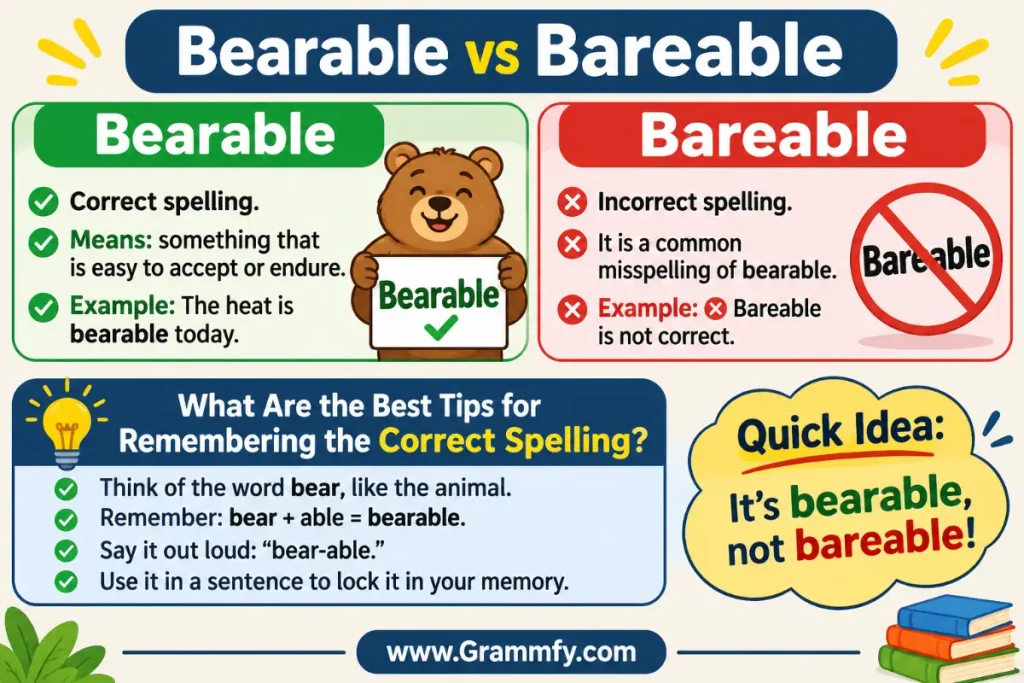
Bearable vs Bareable:
The difference between these spellings is simple once you understand their meanings. Bearable is the only standard spelling for something that can be tolerated or endured. The alternative bareable is a misspelling, not a recognized American or British spelling variation.
Remember the connection between bear and bearable. The verb describes carrying or enduring something, while the adjective describes a situation that can be endured. This small connection can prevent repeated spelling mistakes.
When writing essays, emails, reports, or everyday messages, focus on meaning rather than sound. Practice with a few original sentences, and the correct spelling will become easier to recognize. You don’t need complicated grammar rules to get this one right.
Frequently Asked Questions
1. Is bearable vs bareable the correct spelling?
Bearable is the correct spelling. It means something is tolerable or possible to endure, while bareable is a misspelling.
2. What does bearable mean in simple English?
Bearable means that something is unpleasant or difficult but can still be handled. For example, a long journey becomes bearable when you have comfortable seats.
3. Is bareable ever correct in British or American English?
No. Standard American and British English both use bearable. The spelling bareable is not an accepted regional alternative.
4. What’s another way to say bearable?
You can use tolerable, manageable, endurable, acceptable, or workable, depending on the context. For casual conversations, expressions such as “not too bad” and “I can deal with it” also work.
5. Why do people confuse bearable vs bareable?
People confuse Bearable vs Bareable because bear and bare sound alike in many English accents. However, bear means to carry or endure, while bare means uncovered.
6. What is the opposite of bearable?
The most common opposite is unbearable. Other alternatives include intolerable, insufferable, and unendurable.
7. How can I remember the spelling of bearable?
Connect the word with the verb bear, meaning to endure something. Adding -able creates bearable, meaning capable of being endured.

Tylerbrooks is a US-based English grammar writer and contributor at Grammfy. He writes helpful articles about grammar, spelling, commonly confused words, and vocabulary. His goal is to explain English topics in simple language with clear examples and practical tips. Through his articles, he helps readers improve their writing and everyday English skills.