
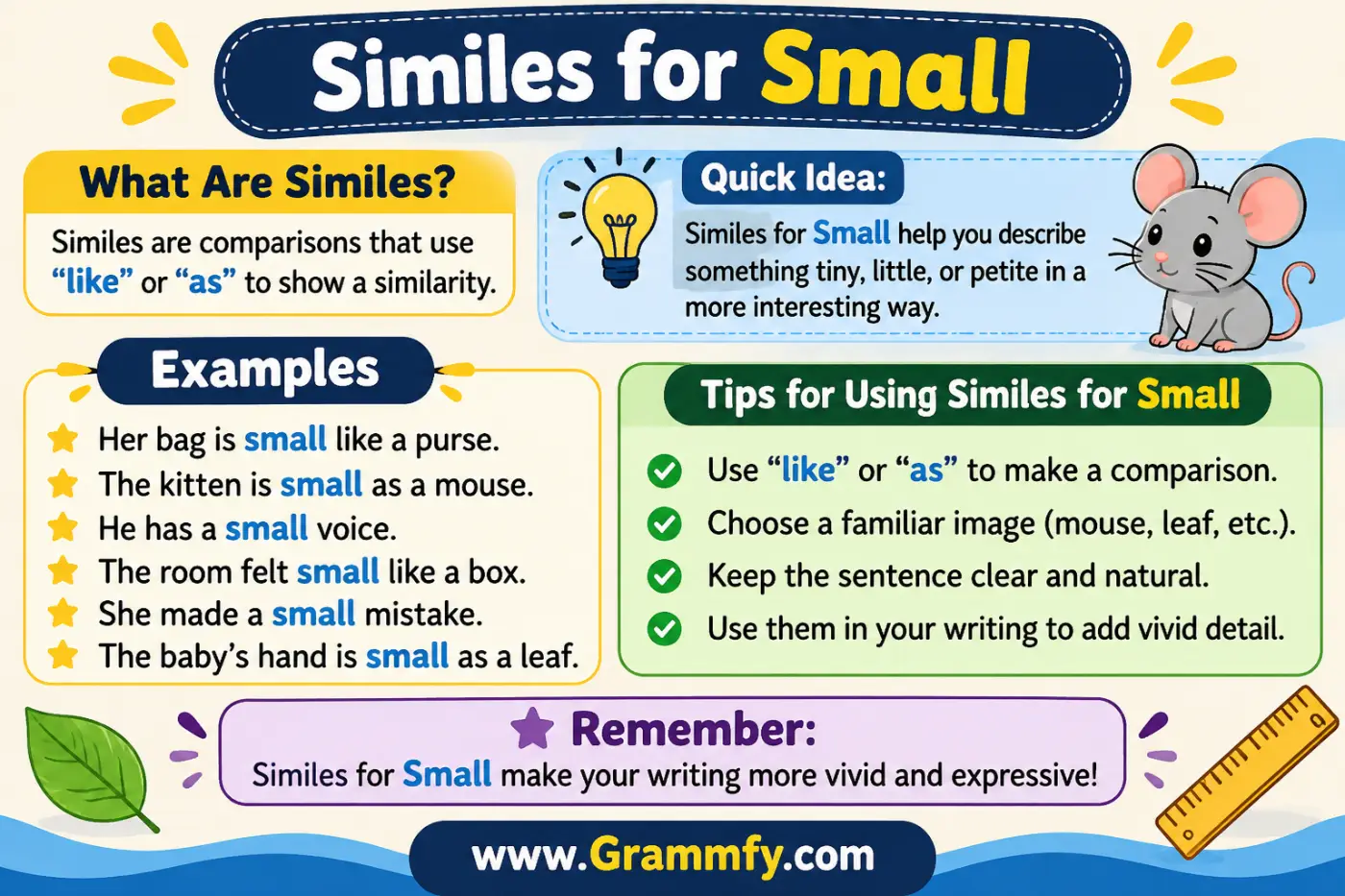
When writing a story, school essay, email, or social media post, you may need a better way to describe something tiny. Simply using the word small can make your writing feel plain. A good comparison helps readers picture the size, shape, or appearance of something more clearly. Similes for Small make descriptions more interesting by comparing tiny objects, people, animals, or things to familiar items. For example, you might describe a tiny house as small as a dollhouse or a little puppy as small as a teacup.
The best comparisons are easy to understand and fit the situation. Some sound cute and playful, while others create a serious or formal tone. Choosing the right one can make a simple sentence more memorable.
Quick Idea: A simile for small compares something with a familiar object or image to show that it has a tiny size. Common examples include small as an ant, tiny as a seed, and little as a button.
In this guide, you’ll find creative comparisons, useful synonyms, examples for different types of writing, and tips for choosing the right expression. You’ll also learn how to avoid awkward comparisons and make your descriptions sound natural.
Need a more vivid way to describe passion? Explore our guide to creative passion similes and examples for fresh ideas and examples.
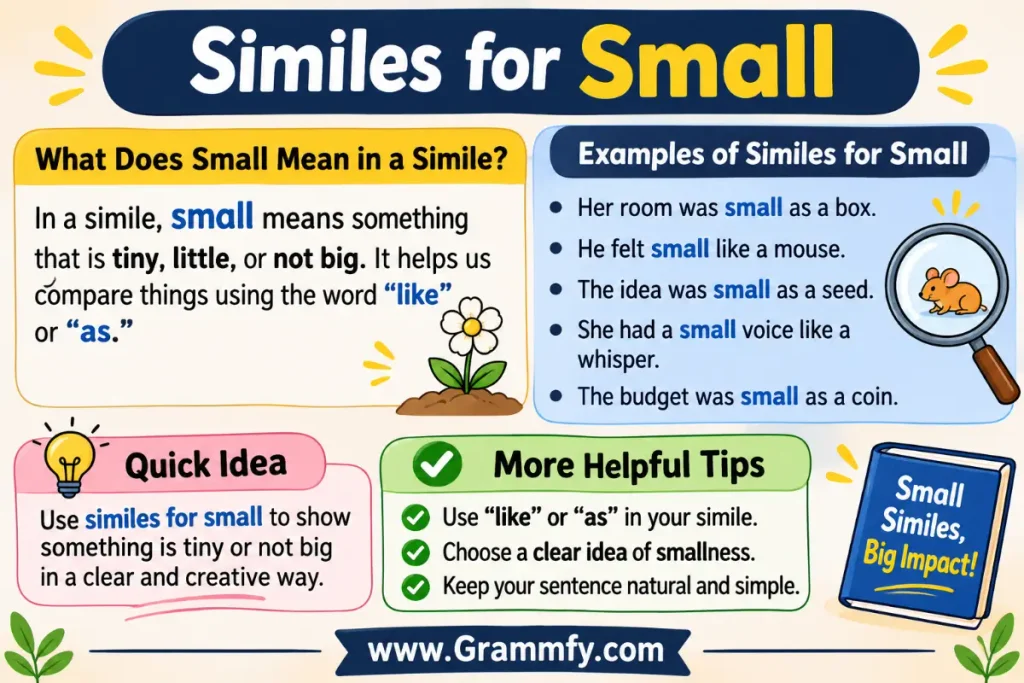
What Does Small Mean in a Simile?
A simile is a figure of speech that compares two different things using words such as like or as. It helps readers understand an idea by connecting it to something familiar.
The word small describes something that has a limited size, height, length, or amount. It can refer to physical objects, living things, spaces, or even abstract ideas.
For example:
- The kitten was as small as a teacup.
- Her room looked like a little box.
- The diamond sparkled like a tiny star.
- His handwriting was as small as ant footprints.
Each comparison gives the reader a clearer picture than simply saying something is small.
Why Do Writers Use Comparisons for Small Things?
Writers use these expressions because they add detail and personality to ordinary descriptions.
Here are some reasons they work well:
- Create clear pictures: Readers can imagine the size of an object more easily.
- Add emotion: A tiny kitten may sound cute, while a small room may feel cramped.
- Improve storytelling: Comparisons make scenes more interesting.
- Avoid repetition: Different expressions prevent writers from using the same adjective again and again.
- Make writing memorable: A creative comparison can stay in the reader’s mind.
For example, compare these two sentences:
- The bird was small.
- The bird was as tiny as a little pebble resting in the grass.
The second sentence gives readers a more detailed picture.
What Are the Best Similes for Small?
The best comparisons depend on what you’re describing. A tiny object, a small animal, and a little space may need different expressions.
Here are some useful examples for everyday writing.
| # | Simile | Meaning |
|---|---|---|
| 1 | As small as an ant | Extremely tiny |
| 2 | As tiny as a seed | Very little in size |
| 3 | As small as a button | Small and compact |
| 4 | As little as a pea | Very small and round |
| 5 | As tiny as a grain of sand | Almost unbelievably small |
| 6 | As small as a mouse | Small in physical size |
| 7 | As little as a pebble | Small and solid |
| 8 | As tiny as a pinhead | Extremely small |
| 9 | As small as a marble | Compact and rounded |
| 10 | As tiny as a raindrop | Very little in size |
| 11 | As small as a ladybug | Tiny and delicate |
| 12 | As little as a bean | Small and rounded |
| 13 | As tiny as a speck of dust | Almost invisible |
| 14 | As small as a coin | Compact and flat |
| 15 | As little as a cherry | Small and round |
| 16 | As tiny as a star in the distance | Very small in appearance |
| 17 | As small as a teacup | Very little |
| 18 | As tiny as a grain of rice | Narrow and small |
| 19 | As small as a shell | Compact and delicate |
| 20 | As little as a leaf bud | Small and developing |
Remember: These are creative comparisons, not exact measurements. Choose one that matches the object and the image you want readers to imagine.
What Are Some Cute and Funny Similes for Small?
Cute and funny comparisons are useful when describing babies, pets, toys, miniature objects, or playful characters.
They make descriptions feel friendly and lighthearted.
Here are some creative options:
- As small as a baby button: Tiny and adorable.
- As little as a pocket mouse: Very small and cute.
- As tiny as a cupcake cherry: Small and sweet-looking.
- As small as a doll’s shoe: Miniature in size.
- As little as a jellybean: Small and colorful.
- As tiny as a kitten’s nose: Delicate and cute.
- As small as a toy house: Much smaller than a real house.
- As little as a candy sprinkle: Extremely tiny.
- As tiny as a fairy’s teacup: Imaginatively small.
- As small as a puppy’s paw: Little and adorable.
When Should You Use Cute Comparisons?
These expressions work especially well in:
- Children’s stories.
- Birthday cards.
- Friendly messages.
- Pet descriptions.
- Creative social media posts.
- Funny conversations.
Example: The little puppy curled up in my hand, as small as a doll’s shoe.
The comparison makes the puppy sound especially tiny and lovable.
What Are Some Creative and Poetic Comparisons for Small?
Sometimes you want a description that feels more imaginative. Poetic comparisons can help create a mood or make a scene more vivid.
Try these expressions:
- As tiny as a star hidden in the sky: Small and distant.
- As small as a whisper in the wind: Delicate and barely noticeable.
- As little as a drop of morning dew: Tiny and beautiful.
- As small as a spark in the darkness: A little point of light.
- As tiny as a grain beneath the ocean: Almost insignificant in size.
- As small as a flower bud: Young and delicate.
- As little as a moonbeam on a windowsill: Soft and delicate.
- As tiny as a silver speck: Very small and noticeable only up close.
- As small as a distant bird in the clouds: Tiny from far away.
- As little as a petal in the breeze: Light and delicate.
How Do Poetic Comparisons Improve Descriptions?
Poetic expressions do more than explain physical size. They can also create atmosphere.
For example:
- Plain: A small light appeared in the distance.
- Poetic: A light flickered like a tiny spark in the darkness.
The second sentence creates a stronger visual image. It also adds a sense of mystery.
These comparisons are particularly useful in poems, descriptive essays, short stories, and fictional writing.
What Are Some Similes for Extremely Small Things?
Sometimes the word small isn’t strong enough. You may need an expression that suggests something is almost invisible.
These comparisons communicate an extremely tiny size.
| Simile | Meaning | Example |
|---|---|---|
| As tiny as a pinhead | Extremely little | The hole was as tiny as a pinhead. |
| As small as a dust particle | Almost invisible | A particle floated in the sunlight. |
| As tiny as a grain of salt | Very little | The crystal was as tiny as a grain of salt. |
| As small as a speck | Barely noticeable | A speck rested on the table. |
| As tiny as a cell | Microscopic in appearance | The diagram showed something tiny as a cell. |
| As small as a needle’s point | Extremely narrow | The opening was as small as a needle’s point. |
| As little as a poppy seed | Very tiny | The seed was as little as a poppy seed. |
| As tiny as a flea | Extremely small | The insect looked as tiny as a flea. |
| As small as a grain of pollen | Almost invisible | The yellow particle was as small as pollen. |
| As tiny as a dot on paper | Very little | The mark looked like a dot on paper. |
Writing tip: Use these comparisons when describing microscopic objects, tiny marks, small openings, or distant details.
What Are Some Similes for Small Objects?
Small objects appear in everyday life. They can be found in homes, classrooms, offices, gardens, and workshops.
The following comparisons can help you describe them naturally.
Similes for Small Toys
- As small as a doll’s handbag.
- As tiny as a toy soldier.
- As little as a miniature car.
- As small as a child’s building block.
- As tiny as a model airplane.
Example: The miniature car was as small as a toy soldier’s boot.
Similes for Small Houses and Rooms
- As small as a dollhouse.
- As little as a garden shed.
- As compact as a tiny cabin.
- As small as a shoebox.
- As little as a birdhouse.
Example: Their first apartment was as small as a dollhouse, but it felt comfortable.
Similes for Small Decorations
- As tiny as a Christmas ornament.
- As small as a glass bead.
- As little as a decorative button.
- As tiny as a pearl.
- As small as a painted pebble.
Example: A tiny pearl, as small as a glass bead, rested inside the jewelry box.
Similes for Small Food Items
- As small as a blueberry.
- As tiny as a chocolate chip.
- As little as a popcorn kernel.
- As small as a grape.
- As tiny as a sugar crystal.
Example: She placed a chocolate chip as tiny as a little seed on top of the cupcake.
What Are Some Similes for Small Animals?
Animals come in many shapes and sizes. Comparisons can make descriptions of little creatures more interesting.
Here are some examples:
| Simile | Best For | Example |
|---|---|---|
| As small as a mouse | Little animals | The field mouse was as small as a walnut. |
| As tiny as an ant | Very small insects | The ant looked tiny beside my shoe. |
| As little as a ladybug | Small insects | The ladybug was as little as a button. |
| As small as a sparrow | Small birds | The bird was as small as a sparrow. |
| As tiny as a baby turtle | Young animals | The turtle was tiny in my palm. |
| As little as a butterfly’s wing | Delicate things | Its body seemed as little as a butterfly’s wing. |
| As small as a kitten’s paw | Young pets | The puppy’s paw was as small as a kitten’s paw. |
| As tiny as a tadpole | Little creatures | The tadpole looked like a tiny comma in the pond. |
How Can You Make Animal Descriptions More Interesting?
Focus on the animal’s appearance, movement, or behavior.
For example:
- The tiny bird hopped like a little pebble bouncing across the ground.
- The baby rabbit was as small as a soft toy.
- The little frog looked as tiny as a green button beside the pond.
These details help readers imagine the animal instead of simply learning its size.
What Are Small Synonyms by Intensity?
Not every small thing is equally tiny. A little garden and a microscopic particle need different descriptions.
Choosing a word according to intensity makes your writing more accurate.
| Intensity | Word | Meaning | Example |
|---|---|---|---|
| Mild | Modest | Not large | They lived in a modest home. |
| Mild | Compact | Small but well arranged | She carried a compact camera. |
| Mild | Limited | Restricted in size or amount | The room had limited space. |
| Mild | Petite | Small and delicate | She wore a petite bracelet. |
| Everyday | Little | Small in size | A little bird sat outside. |
| Everyday | Tiny | Very small | A tiny insect crossed the desk. |
| Everyday | Miniature | A smaller version | He collected miniature cars. |
| Everyday | Narrow | Small in width | The narrow path led home. |
| Strong | Minute | Extremely small | A minute crack appeared in the glass. |
| Strong | Microscopic | Too small to see clearly without magnification | The scientist examined microscopic cells. |
| Strong | Minuscule | Extremely tiny | A minuscule dot appeared on the screen. |
| Strong | Infinitesimal | Almost immeasurably small | The difference was infinitesimal. |
| Strong | Microscopic | Very small in physical size | Microscopic particles filled the sample. |
| Strong | Diminutive | Unusually small | The diminutive figure stood near the door. |
Quick rule: Use modest or compact for something moderately small, tiny or miniature for something much smaller, and minuscule or microscopic when the size is extremely limited.
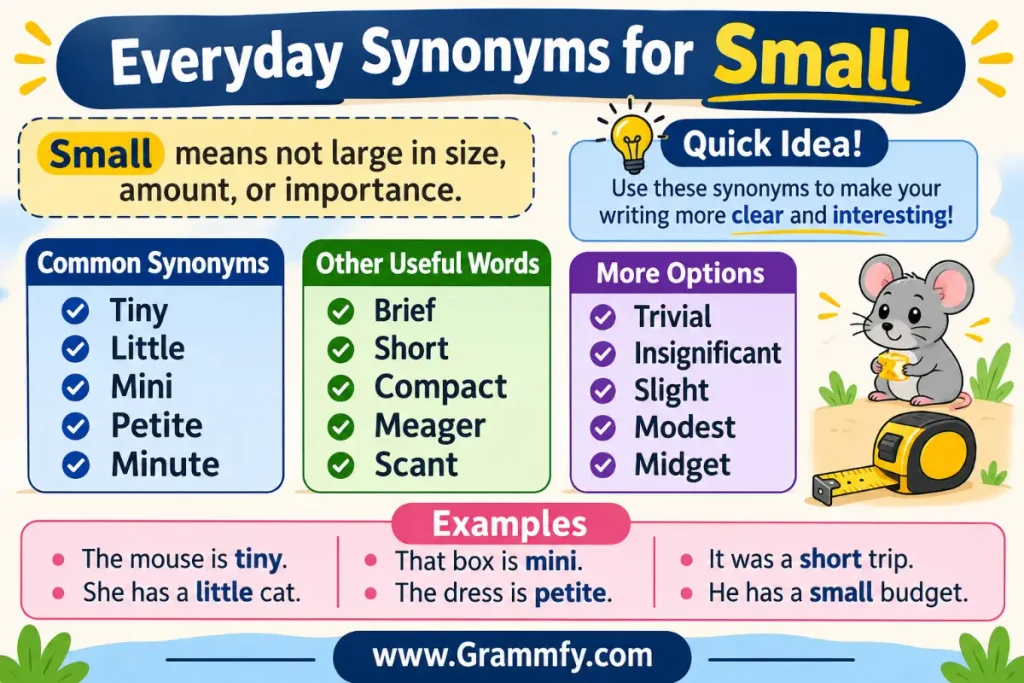
What Are 25+ Synonyms for Small and How Do You Use Them?
The word small has many alternatives. However, each word carries a slightly different meaning and tone.
Some are suitable for professional writing, while others sound casual or playful.
The following master list groups useful alternatives into four categories.
1. Simple Synonyms for Small
These words are easy to understand and work well in everyday writing.
| Word | Meaning | Tone | Example |
|---|---|---|---|
| Little | Small in size | Simple | A little bird landed nearby. |
| Tiny | Very small | Everyday | A tiny box held the ring. |
| Short | Not long or tall | Simple | He wrote a short note. |
| Thin | Small in width | Everyday | A thin line crossed the page. |
| Narrow | Limited in width | Neutral | We walked along a narrow road. |
| Low | Not high | Simple | The table had a low shelf. |
| Minor | Not important or serious | Neutral | It was a minor problem. |
2. Everyday Synonyms for Small
These alternatives are useful in conversations, emails, stories, and general descriptions.
| Word | Meaning | Tone | Example |
|---|---|---|---|
| Petite | Small and delicate | Friendly | She carried a petite purse. |
| Compact | Small and efficiently arranged | Neutral | This compact desk fits anywhere. |
| Miniature | A smaller version of something | Descriptive | He bought a miniature train. |
| Modest | Not large or impressive | Neutral | They own a modest house. |
| Slight | Small in amount or degree | Neutral | There was a slight change. |
| Diminutive | Unusually small | Descriptive | A diminutive puppy followed us. |
| Puny | Very small or weak | Informal | The plant looked puny beside the tree. |
| Scant | Barely enough | Neutral | We had scant supplies. |
3. Formal Synonyms for Small
These words are useful in essays, reports, academic writing, and professional communication.
| Word | Meaning | Tone | Example |
|---|---|---|---|
| Minuscule | Extremely small | Formal | The error was minuscule. |
| Minute | Very small | Formal | The sample contained minute particles. |
| Microscopic | Extremely tiny | Scientific | Microscopic organisms live in water. |
| Insignificant | Too small to matter | Formal | The difference was insignificant. |
| Negligible | So small it can be ignored | Formal | The cost increase was negligible. |
| Inconsequential | Not important | Formal | It was an inconsequential detail. |
| Infinitesimal | Extremely close to zero | Technical | The variation was infinitesimal. |
| Subtle | Small or difficult to notice | Formal | A subtle mark appeared on the surface. |
4. Slang and Informal Synonyms for Small
These expressions work in casual conversations and playful writing. They aren’t always suitable for formal essays.
| Word | Meaning | Tone | Example |
|---|---|---|---|
| Wee | Very small | Informal, British/Scottish | Look at that wee puppy! |
| Tiny-tiny | Extremely little | Playful | She found a tiny-tiny shell. |
| Teeny | Very small | Casual | I bought a teeny bag. |
| Itsy-bitsy | Extremely small | Playful | An itsy-bitsy spider climbed the wall. |
| Mini | A small version | Casual | He bought a mini notebook. |
| Pocket-sized | Small enough to fit in a pocket | Informal | She carried a pocket-sized mirror. |
| Lilliputian | Extremely small | Literary/playful | The garden had a Lilliputian statue. |
Important distinction: Not all synonyms can replace small in every sentence. For example, minor usually describes importance, while narrow describes width. Always consider the meaning before replacing a word.
How Do Small Synonyms Change by Part of Speech?
The word small is mainly an adjective. It describes nouns such as objects, places, animals, and amounts.
However, you can use related words in other grammatical forms to create more natural sentences.
1. Adjectives
Adjectives describe the size of something.
Examples:
- Tiny: A tiny flower grew beside the fence.
- Little: She found a little shell.
- Compact: We bought a compact computer.
- Petite: The petite puppy slept peacefully.
- Minuscule: A minuscule mark appeared on the paper.
2. Nouns
Nouns can name a small amount, object, or miniature version.
Examples:
- Bit: A small bit of paper fell on the floor.
- Speck: A speck of dust floated through the air.
- Fragment: A small fragment of glass remained.
- Particle: A tiny particle moved across the screen.
- Miniature: The museum displayed a miniature of the castle.
3. Adverbs
Adverbs explain how something happens or to what degree something applies.
Examples:
- Slightly: The new bag is slightly smaller.
- Marginally: The second room is marginally smaller.
- Barely: The button was barely visible.
- Minimally: The design was minimally changed.
4. Verbs Related to Becoming Smaller
These verbs describe a reduction in size, amount, or scale.
| Verb | Meaning | Example |
|---|---|---|
| Shrink | Become smaller | The sweater may shrink in hot water. |
| Reduce | Make something smaller | We need to reduce the image size. |
| Minimize | Make as small as possible | Minimize the extra space. |
| Contract | Become smaller or tighter | The material contracts in cold weather. |
| Diminish | Become less or smaller | The sound began to diminish. |
Grammar tip: Don’t confuse small with smaller. Use smaller when comparing two things and smallest when comparing three or more things in a group.
How Do You Choose the Best Word for Small in Different Situations?
The best word depends on your audience, purpose, and writing style. A professional resume needs different language from a funny text message.
Here are some useful choices for common situations.
1. What Words Should You Use for Small in a Resume?
In a resume, choose professional words that explain the size of a project, team, department, or budget.
Good alternatives include:
- Compact
- Modest
- Limited
- Lean
- Specialized
- Focused
Examples:
- Managed a compact team of five employees.
- Worked with a modest annual budget.
- Helped improve processes within a small department.
- Supported a specialized team with limited resources.
Best tip: Avoid words such as puny or teeny in a resume. They sound too casual and may make your work seem less valuable.
2. What Words Should You Use for Small in an Essay?
Essays often need clear and accurate language. Your choice should depend on what you are describing.
Useful alternatives include:
- Minor
- Modest
- Limited
- Minimal
- Negligible
- Compact
Examples:
- A minor change can improve the final result.
- The study included a limited number of participants.
- The difference between the two measurements was negligible.
- A compact design can save valuable space.
Best tip: Use precise words rather than adding dramatic comparisons to every paragraph.
3. What Words Should You Use for Small in Texting?
Text messages can be casual and expressive. You can use playful words and familiar comparisons.
Good choices include:
- Tiny
- Little
- Teeny
- Mini
- Wee
- Pocket-sized
Examples:
- I found a tiny gift for you!
- Look at this little puppy.
- That’s such a teeny bag!
- I bought a mini notebook for my trip.
Best tip: Choose friendly expressions that match the mood of your conversation.
4. What Words Should You Use for Small in an Email?
Emails usually need a polite and professional tone. Choose words that explain size without sounding childish.
Useful alternatives include:
- Brief
- Minor
- Compact
- Limited
- Slight
- Modest
Examples:
- I noticed a minor issue in the document.
- Could you make a slight adjustment to the layout?
- We have a limited amount of time.
- I’ve attached a brief summary of the report.
Best tip: Use minor for problems, brief for messages, and limited for resources or amounts.
5. What Words Should You Use for Small in Speaking?
Everyday conversations allow more flexibility. You can use simple adjectives or familiar comparisons.
Good options include:
- Little
- Tiny
- Petite
- Miniature
- Compact
- Teeny
Examples:
- That’s a tiny little house!
- My new desk is quite compact.
- We saw a little bird in the garden.
- Her dog is as small as a kitten.
Best tip: Natural speech is usually better with simple expressions. Don’t choose a complicated word when an ordinary one works.
What Are 15+ Examples of Similes for Small in Sentences?
Learning individual comparisons is helpful, but seeing them in real situations makes them easier to use.
Here are original examples from everyday life, school, nature, and creative writing.
Everyday Situations
- The new apartment was as small as a shoebox, but it had everything we needed.
- A tiny button, as little as a pea, had fallen under the sofa.
- Her purse was as small as a doll’s handbag, yet she managed to fit her keys inside.
- The old television looked as tiny as a picture frame beside the new screen.
- The little garden was as small as a backyard corner, but it was full of colorful flowers.
School and Learning
- The student drew a circle as small as a coin on the classroom board.
- A dot as tiny as a grain of sand appeared in the science experiment.
- The child wrote letters as small as ant footprints in her notebook.
- The paper boat was as little as a toy car floating in the water.
- The teacher showed us a model as small as a miniature house.
Nature and Animals
- A ladybug, as tiny as a button, rested on the green leaf.
- The baby frog looked as small as a marble beside the pond.
- A seed as tiny as a grain of rice fell into the soil.
- The little bird appeared as small as a distant speck against the bright sky.
- A drop of water, as tiny as a glass bead, hung from the flower.
Creative and Emotional Writing
- Her hope was as small as a spark, but she refused to let it disappear.
- The little cottage stood like a tiny toy house among the enormous trees.
- His voice sounded as small as a whisper in the crowded room.
- The distant light looked as tiny as a star above the dark hills.
- A little flower, as small as a button, brought a smile to her face.
Writing lesson: Notice how each comparison fits its subject. A grain of rice works well for a tiny seed, while a shoebox is more suitable for describing a small room or apartment.
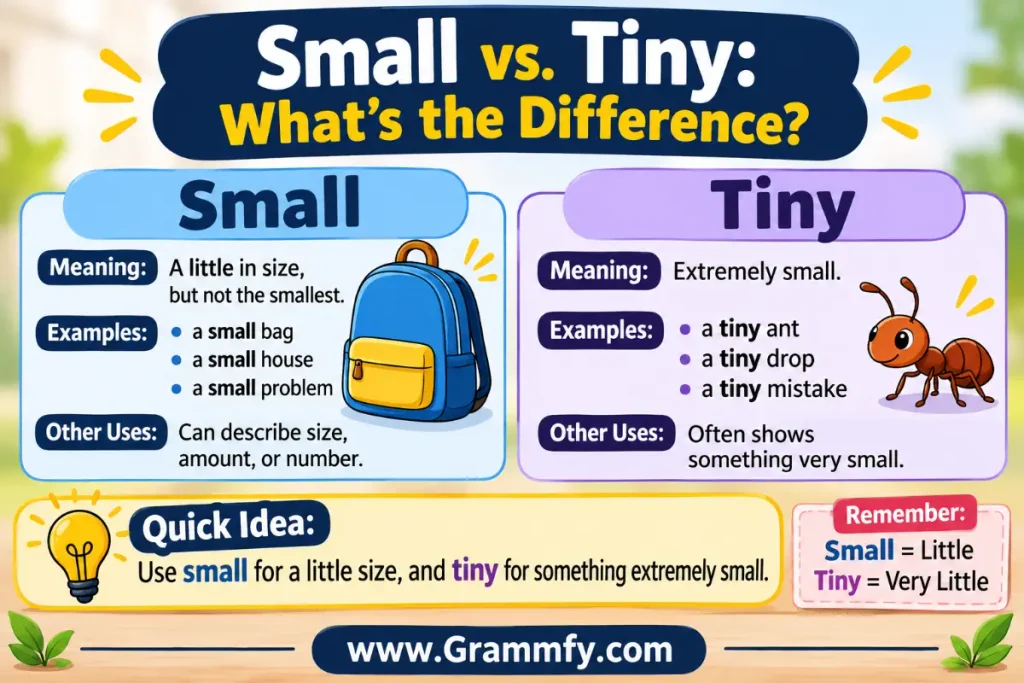
Small vs. Tiny: What’s the Difference?
Both words describe something that isn’t large, but they don’t communicate exactly the same degree of size.
| Small | Tiny |
|---|---|
| Describes a limited size | Describes a very limited size |
| Can be used for rooms, objects, and amounts | Often used for extremely little objects |
| Neutral in tone | More expressive |
| Example: A small house | Example: A tiny toy house |
Examples:
- The house has a small kitchen.
- The doll has a tiny kitchen.
The first kitchen may be smaller than average. The second suggests a much more miniature space.
Which should you choose?
Use small when you want a general description. Use tiny when you want to emphasize that something is especially little.
Little vs. Petite: What’s the Difference?
These two words can both describe small things, but their uses are different.
| Little | Petite |
|---|---|
| Common and flexible | Often describes a small, delicate build |
| Works for objects, animals, and people | Commonly used for people, clothing, and delicate objects |
| Friendly and simple | More refined or descriptive |
| Example: A little puppy | Example: A petite handbag |
Examples:
- She bought a little purse for her trip.
- She bought a petite purse for her trip.
Both sentences are correct, but petite gives a stronger impression of a delicate or compact design.
Which should you choose?
Use little for everyday descriptions. Choose petite when you want to emphasize a small, delicate, or slender appearance.
Small vs. Compact: What’s the Difference?
These words are closely related, especially when describing furniture, technology, and spaces.
However, compact often suggests that something is designed to fit into a limited space.
| Small | Compact |
|---|---|
| General description of size | Small and efficiently arranged |
| Can describe almost anything | Often describes designed objects |
| Doesn’t suggest organization | Can suggest efficient use of space |
| Example: A small room | Example: A compact kitchen |
Examples:
- We rented a small apartment.
- We bought a compact washing machine.
The first sentence describes the apartment’s size. The second suggests that the washing machine is designed to take up less space.
Which should you choose?
Use small for general size. Use compact when an object is designed to fit neatly into a limited area.
Are There US and UK Differences in Words for Small?
Most common words for small have the same meaning in American and British English.
For example, small, tiny, little, miniature, and compact are widely understood in both varieties.
However, some expressions are more common in certain regions.
| Word or Expression | American English | British English |
|---|---|---|
| Small | Common | Common |
| Tiny | Common | Common |
| Little | Common | Common |
| Wee | Less common | More familiar in Scotland and some other UK contexts |
| Petite | Common | Common |
| Mini | Common | Common |
| Compact | Common | Common |
Is Wee a British Word for Small?
Wee means very small or little. It is especially associated with Scottish English and is also used in some other parts of the UK and Ireland.
Examples:
- That’s a wee little puppy.
- We found a wee cottage near the river.
In American English, tiny or little is usually more natural in ordinary conversation.
Do Americans and British Writers Use Different Similes?
The basic comparisons are generally the same.
For example:
- As small as a button.
- As tiny as an ant.
- As little as a pea.
- As small as a grain of rice.
These expressions are easy to understand in both American and British English.
Quick tip: If you’re writing for an international audience, choose familiar comparisons instead of region-specific slang.
What Are the Common Mistakes When Using Small Comparisons?
A simile can make writing stronger, but an unsuitable comparison can confuse readers.
Here are common mistakes to avoid.
1. Using an Unclear Comparison
Not every object creates a clear picture of size.
Unclear: The house was as small as a beautiful cloud.
Better: The house was as small as a dollhouse.
Why? A dollhouse gives readers a familiar idea of miniature size. A cloud does not have a clear or fixed size.
2. Choosing the Wrong Level of Intensity
Avoid using a comparison that exaggerates the situation.
Incorrect: The small office was as tiny as a microscopic cell.
Better: The small office was as compact as a little studio.
Why? A room is not usually comparable to something microscopic. The comparison should match the actual subject.
3. Repeating the Same Word Too Often
Using small in every sentence can make writing boring.
Repetitive:
- The small dog entered the small room.
- The small dog sat beside a small table.
Improved:
- The tiny dog entered the compact room.
- It sat beside a little table.
Why? Different words create variety and improve readability.
4. Using Informal Words in Professional Writing
Words such as teeny, itsy-bitsy, and wee may sound strange in a formal report.
Instead of:
The company has an itsy-bitsy office.
Write:
The company operates from a compact office.
5. Confusing Small Size With Low Importance
The words small and minor are not always interchangeable.
For example:
- A small box describes physical size.
- A minor mistake describes low importance or seriousness.
You wouldn’t normally describe a serious mistake as small simply because it has little physical size.
6. Forgetting the Words Like and As
A simile usually uses like or as to make a comparison.
Simile: The puppy was as small as a button.
Simile: The puppy looked like a little toy.
Metaphor: The puppy was a little toy.
The last sentence directly describes the puppy as something else rather than using an explicit comparison.
7. Using Too Many Comparisons in One Sentence
Too many similes can make a sentence difficult to follow.
Overloaded: The flower was as small as a pea, as tiny as an ant, and as little as a grain of sand.
Better: The flower was as small as a pea.
Remember: One clear comparison is usually stronger than several competing images.
What Are the Opposites of Small?
Antonyms are words with opposite meanings. Learning them can help you create stronger comparisons and describe size more accurately.
Here are useful opposites of small:
| Antonym | Meaning | Example |
|---|---|---|
| Large | Big in size | They own a large house. |
| Big | Considerable in size | A big dog ran across the field. |
| Huge | Extremely large | A huge tree stood outside. |
| Massive | Very large and heavy | A massive rock blocked the road. |
| Enormous | Exceptionally large | An enormous building filled the skyline. |
| Giant | Much bigger than normal | A giant pumpkin won the contest. |
| Immense | Extremely great in size | The desert looked immense. |
| Vast | Very large in area or amount | The ocean stretched across a vast distance. |
| Spacious | Having plenty of room | Their new apartment is spacious. |
| Colossal | Extremely large | A colossal statue stood in the square. |
Quick distinction: Large and big are everyday opposites. Huge, enormous, and colossal communicate a much greater size.
How Can You Choose the Right Simile for Small?
A good comparison should be clear, natural, and suitable for your subject.
Use these practical tips before choosing one.
1. Think About the Object
Start by identifying what you’re describing.
- For a tiny insect, use as small as a speck.
- For a little toy, use as small as a doll’s shoe.
- For a tiny seed, use as little as a grain of rice.
- For a compact room, use as small as a shoebox.
The comparison should make sense for the subject.
2. Consider the Reader
Think about who will read your writing.
Children may enjoy comparisons involving candy, toys, animals, and fairy-tale objects.
Adult readers may prefer straightforward descriptions involving familiar objects.
For example:
- Children’s story: The fairy carried a teacup as tiny as a button.
- Professional report: The device has a compact design.
3. Match the Tone
Your comparison should fit the feeling of the sentence.
| Tone | Suitable Comparison |
|---|---|
| Cute | As tiny as a kitten’s nose |
| Funny | As small as a doll’s shoe |
| Poetic | As little as a drop of dew |
| Professional | As compact as a pocket calculator |
| Scientific | As tiny as a microscopic particle |
| Descriptive | As small as a grain of rice |
4. Avoid Unnecessary Exaggeration
Creative writing allows imagination, but a comparison should still communicate a recognizable idea.
For example, describing a small handbag as as tiny as a grain of sand may sound unrealistic.
A better choice could be as small as a little jewelry box.
5. Read the Sentence Aloud
A comparison may look good on paper but sound awkward when spoken.
Read it aloud and ask yourself:
- Is the meaning clear?
- Does the comparison fit the subject?
- Does it sound natural?
- Does it create the picture I want?
- Is it suitable for my audience?
If the answer is yes, your comparison is probably a good choice.
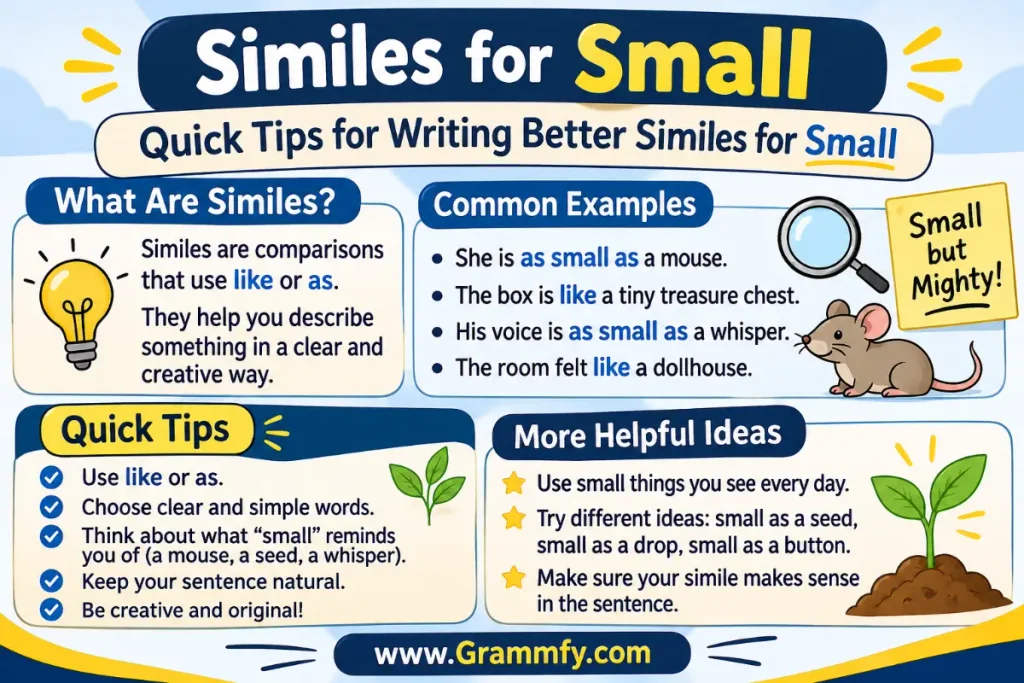
Quick Tips for Writing Better Similes for Small
Use these simple ideas to improve your descriptions:
- Choose familiar objects: Buttons, seeds, peas, and grains of rice create easy mental pictures.
- Use different levels of size: Don’t treat small, tiny, and minuscule as identical.
- Match the mood: Cute comparisons work well in children’s stories, while compact and modest suit professional writing.
- Keep sentences natural: Don’t force a comparison into every paragraph.
- Use specific details: Describe the object’s shape, color, or appearance along with its size.
- Avoid repeated phrases: Try different comparisons to keep your writing fresh.
- Check the meaning: Make sure the object you’re comparing it with is actually small.
- Use one strong image: A clear comparison is often better than three weak ones.
- Consider the context: A small amount of money is different from a tiny physical object.
- Make the comparison useful: Every simile should help readers understand or imagine something.
Quick Idea: How Can You Remember the Best Comparisons?
Think about familiar objects in three groups:
- Nature: Ant, seed, grain of sand, raindrop, and pebble.
- Everyday objects: Button, coin, marble, teacup, and shoebox.
- Cute things: Kitten’s nose, doll’s shoe, jellybean, and puppy’s paw.
These groups make it easier to find a comparison when you’re writing a story, essay, or description.
Conclusion:
Describing something tiny doesn’t have to make your writing feel ordinary. The right comparison can turn a simple sentence into a clear and memorable image. Similes for Small help readers understand size through familiar objects, animals, and details from everyday life. You can use a button, seed, grain of rice, or tiny star to create different pictures depending on your subject.
Remember that the best comparison isn’t always the most creative one. It is the one that fits your meaning, audience, and tone. Use simple expressions for everyday writing and more imaginative ones for stories or poems. With practice, you’ll find it easier to describe little things in fresh and interesting ways. Keep experimenting, and let your words paint a clearer picture.
Frequently Asked Questions
What is a good simile for small?
A good simile is as small as a button. It compares something little to a familiar object, making its size easy to imagine. Other useful choices include as tiny as an ant and as little as a pea.
What are 5 examples of similes for small?
Five examples are:
- As small as a button.
- As tiny as a seed.
- As little as a pea.
- As small as an ant.
- As tiny as a grain of sand.
Each comparison describes something with a limited size.
What’s another way to say something is very small?
You can say something is tiny, minuscule, minute, microscopic, or infinitesimal. For creative writing, expressions such as as small as a pinhead or as tiny as a speck of dust also work well.
How do you describe a very tiny object in writing?
Use specific words such as minuscule, microscopic, or minute. You can also compare the object with something familiar, such as a grain of rice, a seed, or a pinhead.
What is a cute simile for small?
As tiny as a kitten’s nose is a cute comparison. You can also use as little as a jellybean or as small as a doll’s shoe when describing pets, toys, and other adorable things.
What is the difference between small and tiny?
Small describes something that has a limited size, while tiny emphasizes that something is very little. For example, a small house may be modest in size, while a tiny house suggests a much more compact space.
Can I use similes for small in academic writing?
Yes, but use them carefully. Academic writing usually benefits from precise descriptions such as minor, limited, compact, and negligible. Save playful comparisons for situations where they genuinely help explain an idea.

Tylerbrooks is a US-based English grammar writer and contributor at Grammfy. He writes helpful articles about grammar, spelling, commonly confused words, and vocabulary. His goal is to explain English topics in simple language with clear examples and practical tips. Through his articles, he helps readers improve their writing and everyday English skills.