
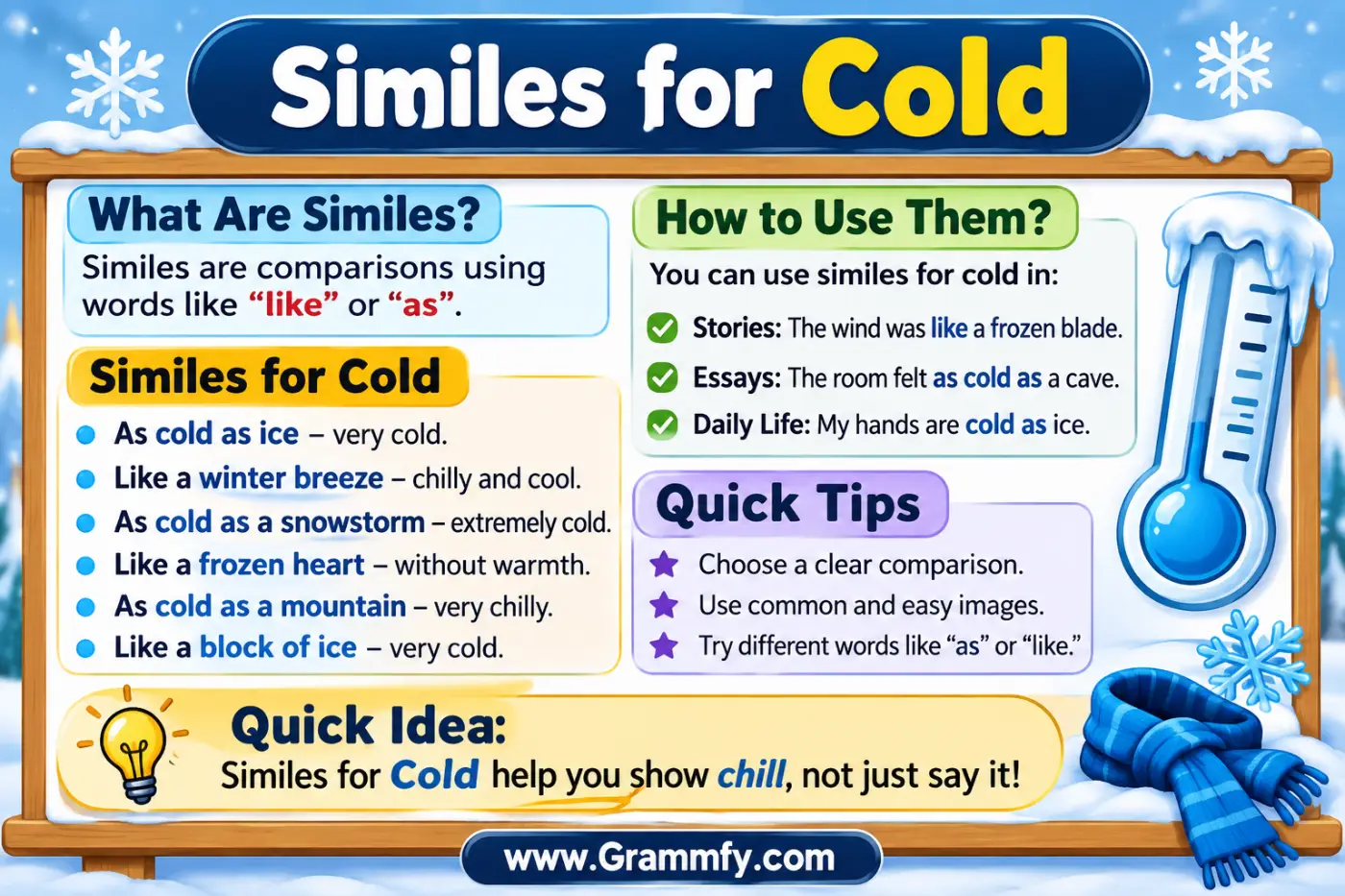
Cold weather can make your hands feel like ice, your breath look like smoke, and your morning walk feel like a trip through a freezer. When you write about these moments in an essay, story, poem, or text message, a good simile can help readers feel the chill. Similes for Cold compare cold temperatures, objects, people, or feelings to something familiar using words such as like or as. They make descriptions more vivid by helping readers imagine icy air, frozen fingers, chilly rooms, or an emotionally distant person.
For example, “The wind was as cold as ice” gives a clear picture of freezing weather. A more creative comparison, such as “The morning air felt like a thousand tiny needles,” helps readers imagine the sharp sting of winter wind.
In this guide, you’ll find original comparisons for freezing weather, icy objects, cold feelings, and winter scenes. You’ll also learn how to choose the right comparison for school assignments, creative writing, everyday conversations, and more.
Need a more vivid way to describe curly hair? Explore our guide to creative curly hair similes and examples for fresh ideas and examples.
What Are Similes for Cold?
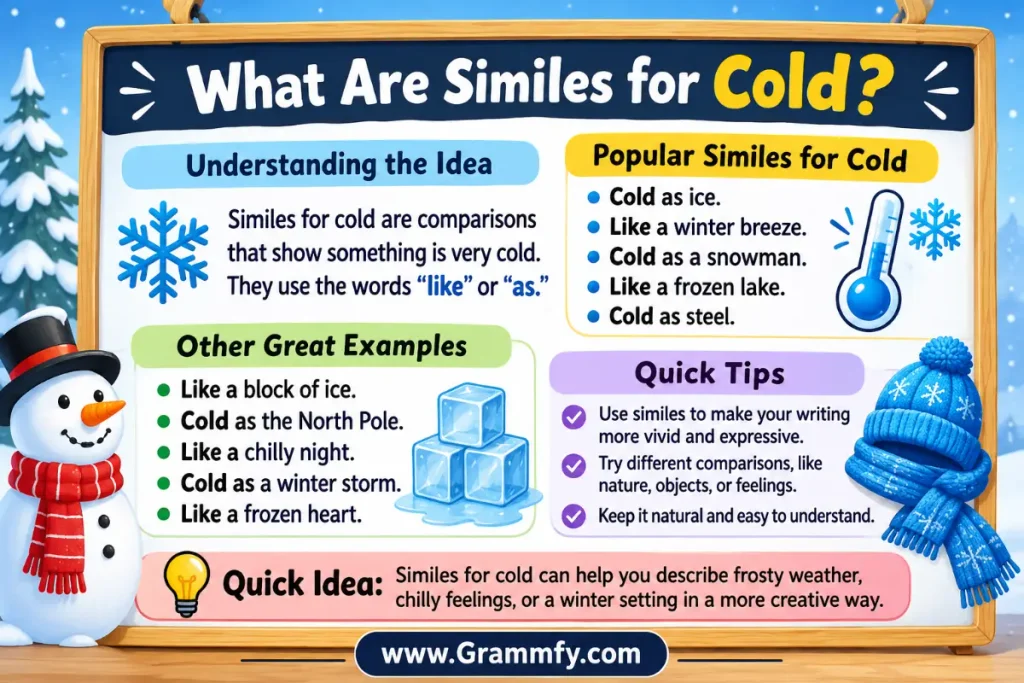
A simile is a figure of speech that compares two different things using like or as. Writers use it to describe a feeling, object, or experience in a way readers can easily imagine.
A cold simile connects low temperatures or an emotionally distant feeling to something familiar, such as ice, snow, a freezer, or a winter storm.
Here are three simple examples:
- The water was as cold as ice.
- The wind felt like a knife against my skin.
- Her hands were like frozen stones.
Each comparison creates a mental picture. The first emphasizes temperature, the second describes the sharp feeling of cold wind, and the third suggests that someone’s hands are extremely cold.
Why Do Writers Use Similes to Describe Cold?
The word cold is useful, but it doesn’t always explain how a person experiences the temperature. Similes add details that make descriptions more memorable.
Writers use them to:
- Show physical discomfort: “My fingers felt like frozen sticks.”
- Describe harsh weather: “The wind howled like a hungry wolf.”
- Create atmosphere: “The empty street looked as lifeless as a frozen lake.”
- Express loneliness: “His welcome was as cold as a winter morning.”
- Make poetry more vivid: “Snowflakes floated like tiny pieces of glass.”
- Add humor: “My toes were as cold as popsicles.”
The best comparison depends on the scene. A school essay may need a simple comparison, while a short story might benefit from a more original image.
12 Best Similes for Cold With Meanings
These examples cover different types of cold, from a mild morning chill to the biting wind of a winter storm. Each one includes a meaning and an example sentence to help you use it naturally.
| o. | Simile | Meaning | Example sentence |
|---|---|---|---|
| 1 | As cold as ice | Extremely cold | The metal handle was as cold as ice. |
| 2 | Like a freezer | Very cold, enclosed air | The garage felt like a freezer. |
| 3 | As cold as snow | Very cold and wintry | Her cheeks were as cold as snow. |
| 4 | Like an icy knife | Sharp, painful cold | The wind cut through my coat like an icy knife. |
| 5 | As cold as a glacier | Extremely cold and unwelcoming | The room felt as cold as a glacier. |
| 6 | Like frozen stone | Hard and very cold | His hands felt like frozen stone. |
| 7 | As chilly as a winter morning | Noticeably cold | The garden was as chilly as a winter morning. |
| 8 | Like an ice cube | Cold to the touch | My nose felt like an ice cube. |
| 9 | As cold as the Arctic | Intensely cold | The wind was as cold as the Arctic. |
| 10 | Like a refrigerator | Cool or uncomfortably cold | The basement felt like a refrigerator. |
| 11 | As cold as a snowman’s nose | Playfully very cold | Your cheeks are as cold as a snowman’s nose. |
| 12 | Like walking through a freezer | Surrounded by freezing air | Going outside felt like walking through a freezer. |
Writing tip: Some comparisons are familiar expressions, while others are creative examples designed for this guide. Choose a comparison that fits your scene instead of using the most dramatic one every time.
Similes for Freezing Cold Weather
Winter weather offers plenty of opportunities for vivid comparisons. The wind, snow, rain, and frozen ground can all make cold feel different.
These examples work well in winter stories, descriptive essays, poems, and journal entries.
1. As Cold as Ice
This is one of the simplest ways to describe something extremely cold. It works especially well for water, metal, hands, and other objects.
- The tap water was as cold as ice.
- I grabbed the railing, but it was as cold as ice.
- Her fingers felt as cold as ice after the long walk.
2. Like a Knife Cutting Through the Air
This comparison describes wind that feels sharp against exposed skin. It suggests discomfort rather than just a low temperature.
- The winter wind felt like a knife cutting through the air.
- A sharp gust struck my face like a blade.
- The wind sliced through my thin jacket like a knife through paper.
Use this simile when the weather feels harsh or painful.
3. As Cold as the Arctic
The Arctic is associated with extreme cold, snow, and icy landscapes. This comparison helps readers imagine severe winter conditions.
- The open field was as cold as the Arctic.
- The air outside felt as cold as the Arctic on a dark morning.
- We hurried indoors because the wind was as cold as the Arctic.
This expression is useful for exaggerated descriptions. It doesn’t mean the weather is literally as cold as the Arctic.
4. Like Walking Through a Freezer
This simile makes cold weather feel immediate and familiar. Most readers understand the sensation of stepping into a freezer.
- Opening the front door felt like walking through a freezer.
- The school courtyard was like walking through a freezer before sunrise.
- Without gloves, the morning walk felt like a trip through a giant freezer.
It works particularly well in everyday storytelling because it uses a common experience.
5. As Cold as a Frozen Lake
A frozen lake suggests a broad, still, icy surface. This comparison can describe a cold landscape, a chilly room, or even an unwelcoming atmosphere.
- The pond looked as cold as a frozen lake beneath the gray sky.
- The empty hall felt as cold as a frozen lake.
- His voice was as cold as a frozen lake when he rejected the idea.
The last example uses the image figuratively to describe an unfriendly tone.
6. Like Winter’s Icy Breath
This poetic comparison treats winter as if it were a living thing that can breathe cold air.
- Winter’s icy breath swept across the empty road.
- The breeze brushed my cheeks like winter’s icy breath.
- As we climbed the hill, winter’s icy breath followed us through the trees.
This simile is especially useful in poems and atmospheric fiction.
Similes for Cold Hands, Feet, and Objects
Cold can feel different depending on what touches your skin. A metal handle can feel sharply cold, while wet socks can make your feet feel painfully chilled.
Use these comparisons when you want readers to picture a specific physical sensation.
7. Like Ice Cubes
This simile is ideal for hands, fingers, toes, and other body parts that feel extremely cold.
- My fingers were like ice cubes after building the snowman.
- Her toes felt like ice cubes inside her wet boots.
- I rubbed my hands together because they felt like ice cubes.
The comparison is simple and easy to understand, which makes it suitable for younger students.
8. Like Frozen Stones
Stones suggest hardness, weight, and a cold surface. This simile creates a stronger image than simply saying that a person’s hands are cold.
- His hands felt like frozen stones after the football game.
- The cold air left my fingers stiff like frozen stones.
- I held the warm mug between my hands, which felt like frozen stones.
Use this comparison when cold makes the body feel stiff or uncomfortable.
9. As Cold as Frozen Steel
Metal can feel especially cold when you touch it during winter. This comparison works well for gates, railings, tools, and door handles.
- The iron gate was as cold as frozen steel.
- I touched the bike handle, and it felt as cold as frozen steel.
- The mechanic picked up a metal wrench that was as cold as frozen steel.
This phrase also suggests toughness and a harsh environment.
10. Like Needles Pricking the Skin
Some types of cold feel sharp rather than dull. Wind, freezing rain, and tiny ice particles can create a stinging sensation.
- The freezing rain felt like needles pricking my cheeks.
- The wind hit my bare ears like tiny needles.
- Sharp snowflakes struck my face like needles in the wind.
This comparison is more intense than a basic ice simile. Use it when the cold causes a stinging sensation.
11. Like a Cold Blanket
A blanket normally provides warmth, but an icy blanket suggests something that covers an area with cold.
- The fog spread over the field like a cold blanket.
- A layer of chill settled over the town like a damp blanket.
- The mist wrapped around the trees like an icy blanket.
This image works well for landscapes, fog, mist, and cold indoor spaces.
Funny Similes for Cold
Humor can make a description more memorable. Funny comparisons work well in texts, casual conversations, children’s stories, and lighthearted social media posts.
Here are a few playful examples.
12. As Cold as a Snowman’s Nose
A snowman’s nose is usually made from a carrot or another object sitting in the cold. The image is easy to picture and has a playful tone.
- Your cheeks are as cold as a snowman’s nose!
- My nose was as cold as a snowman’s nose after five minutes outside.
- His fingers were as cold as a snowman’s nose, even with gloves on.
13. Like a Popsicle Left in the Snow
This comparison exaggerates how cold someone feels. It’s more humorous than scientific.
- My toes felt like popsicles left in the snow.
- After waiting for the bus, my fingers were like forgotten popsicles.
- He jumped into the warm car with feet like frozen popsicles.
14. As Cold as a Penguin’s Lunchbox
This is a playful, imaginative expression rather than a traditional idiom.
- The water in the bottle was as cold as a penguin’s lunchbox.
- That basement is as cold as a penguin’s lunchbox in winter.
- My hands were as cold as a penguin’s lunchbox after the snowball fight.
The humor comes from imagining a penguin carrying a lunchbox through icy weather.
15. Like a Human Ice Lolly
This comparison is exaggerated and informal. An ice lolly is a frozen treat, particularly in British English.
- I stood at the bus stop like a human ice lolly.
- Without my coat, I felt like a human ice lolly.
- We laughed because everyone looked like a frozen ice lolly in the snow.
For a US audience, human popsicle may sound more familiar than human ice lolly.
Similes for Emotional Coldness
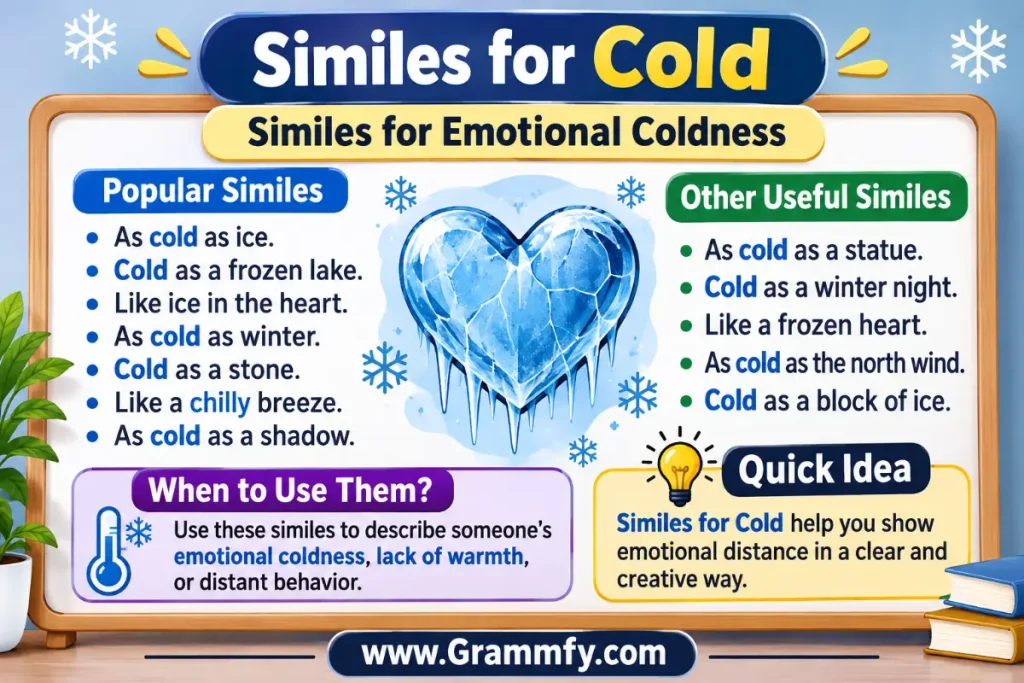
Cold doesn’t always describe temperature. Writers also use it to describe someone who seems distant, unkind, indifferent, or unwilling to show affection.
These comparisons can help create tension in stories, describe difficult relationships, or explain how a conversation feels.
16. As Cold as Ice
This expression can describe both physical temperature and an emotionally distant person.
- Her response was as cold as ice.
- He remained as cold as ice when his friend apologized.
- The manager’s expression was as cold as ice during the meeting.
The meaning comes from the context. A cold glass is physically cold, but a cold response suggests a lack of warmth or sympathy.
17. Like a Heart Made of Ice
This comparison suggests that someone seems unable or unwilling to show kindness.
- The cruel king ruled as if he had a heart made of ice.
- She thought the stranger had a heart made of ice after he ignored the injured dog.
- In the story, the villain spoke with the calmness of someone whose heart was made of ice.
Use this expression in fiction or dramatic writing. It may sound too strong for an ordinary disagreement.
18. As Cold as a Winter Moon
The moon can create an image of distance, pale light, and stillness. This comparison can describe an expression, voice, or atmosphere.
- His smile was as cold as a winter moon.
- She gave him a look as cold as a winter moon.
- The character’s voice sounded as cold as a winter moon in the silent room.
This is more poetic than conversational. It’s best suited to creative writing.
19. Like a Door Slammed Shut
This simile describes an abrupt refusal or a sudden end to emotional closeness.
- Her reply felt like a door slammed shut.
- His refusal ended the conversation like a door slamming in the wind.
- The sudden silence was like a door closing between old friends.
Unlike ice imagery, this comparison focuses on rejection rather than temperature itself.
20. As Unwelcoming as a Snowstorm
A snowstorm can make travel difficult and the surrounding environment seem hostile. This comparison can describe an unfriendly person, place, or greeting.
- The receptionist’s greeting was as unwelcoming as a snowstorm.
- The abandoned house felt as unwelcoming as a winter blizzard.
- His expression was as unwelcoming as a snowstorm at midnight.
Choose this expression when you want to suggest distance, discomfort, or hostility.
Similes for Cold in Poems and Creative Writing
Poetry and fiction often benefit from comparisons that appeal to more than one sense. Instead of focusing only on temperature, a writer can describe the sound, appearance, movement, or emotional effect of cold.
These original examples can help you develop a stronger scene.
| Simile | What it suggests | Best use |
|---|---|---|
| Like silver dust falling from the sky | Delicate, sparkling snow | Poetry and winter scenes |
| As silent as a frozen lake | Stillness and quiet | Atmospheric descriptions |
| Like glass beneath a pale moon | Smooth, icy appearance | Describing frozen surfaces |
| Like a whisper from the north | A gentle, chilly breeze | Reflective writing |
| As pale as a snow-covered field | Cold colors and emptiness | Setting descriptions |
| Like a thousand tiny bells in the wind | Sharp, delicate sounds | Creative winter scenes |
| As still as a world made of ice | Complete quiet and stillness | Fantasy and fiction |
| Like a shadow creeping beneath the door | An unseen cold draft | Suspense and horror |
| As lonely as a cabin in a blizzard | Isolation and sadness | Emotional storytelling |
| Like winter settling into every corner | Gradually spreading cold | Describing a room or house |
How Can You Make a Cold Simile More Original?
A familiar comparison such as “cold as ice” is clear, but it may not stand out in a poem or story. To create a more original simile, think about what the cold does to the character or setting.
For example:
- Basic: The wind was very cold.
- Clear simile: The wind was as cold as ice.
- More vivid: The wind slipped through my sleeves like icy fingers searching for my skin.
The final sentence gives the wind movement and makes the experience feel personal.
You can also combine temperature with sound or appearance:
- Snow fell like white feathers onto the silent road.
- The frozen pond shone like a sheet of glass.
- The icy mist curled around the trees like pale smoke.
Keep the image easy to understand. A creative comparison should make the scene clearer, not force readers to work out an unrelated idea.
How Do You Choose the Right Simile for Cold?
The strongest simile depends on what you want readers to notice. A description of cold water needs a different image from a description of an unfriendly person.
Use the following guide to choose an appropriate comparison.
| Situation | Recommended simile | Why it works |
|---|---|---|
| Freezing weather | As cold as the Arctic | Suggests extreme cold |
| Cold hands | Like ice cubes | Simple and familiar |
| Sharp wind | Like a knife cutting through the air | Emphasizes a stinging sensation |
| Chilly room | Like a freezer | Creates an immediate mental picture |
| Cold metal | As cold as frozen steel | Focuses on touch and material |
| Cold water | As cold as ice | Clear and direct |
| Emotional distance | As cold as ice | Suggests a lack of warmth |
| Lonely setting | As lonely as a cabin in a blizzard | Combines isolation with harsh weather |
| Funny conversation | Like a human popsicle | Adds playful exaggeration |
| Poem about winter | Like a whisper from the north | Creates a softer, more poetic mood |
Which Simile Works Best for School Essays?
For school essays, choose comparisons that are vivid but easy to understand.
Good options include:
- The wind was as cold as ice.
- My fingers felt like frozen sticks.
- The snow covered the road like a white blanket.
- The lake shone like a sheet of glass.
These examples are straightforward and help readers picture the scene without distracting them from the main point.
Which Simile Works Best for Stories?
Stories can use more detailed comparisons because they often need to build mood and character.
For example:
“The wind crept through the broken window like a ghost searching for a place to hide.”
This comparison suggests cold air, movement, and an eerie atmosphere at the same time.
Which Simile Works Best for Text Messages?
Short, familiar expressions usually work best in casual messages.
- “It’s freezing out here!”
- “My hands are like ice cubes.”
- “This room feels like a freezer.”
- “I’m turning into a human popsicle.”
These sound natural and communicate the experience quickly.
What Are the Best Alternatives to the Word Cold?
Sometimes you need a different word rather than a complete simile. The right choice depends on temperature, intensity, context, and tone.
The table below groups useful alternatives into four categories. Some words describe actual temperature, while others describe how cold feels or how a person behaves.
Simple Words for Cold
| Word | Meaning | Tone | Example |
|---|---|---|---|
| Cool | Slightly cold or pleasantly refreshing | Neutral | The evening air was cool. |
| Chilly | Uncomfortably cool | Everyday | The classroom felt chilly. |
| Cold | Low in temperature | Neutral | The water was cold. |
| Icy | Extremely cold or covered with ice | Descriptive | An icy breeze crossed the yard. |
| Frozen | Turned into ice or extremely cold | Neutral | The ground was frozen. |
| Frosty | Very cold or covered with frost | Descriptive | A frosty morning greeted us. |
Everyday Words for Cold
| Word | Meaning | Tone | Example |
|---|---|---|---|
| Freezing | Extremely cold | Everyday | It’s freezing outside. |
| Frigid | Very cold | Strong | Frigid air entered the room. |
| Bitter | Unpleasantly cold, often with wind | Descriptive | A bitter wind blew all afternoon. |
| Nippy | Slightly cold in a noticeable way | Informal | It’s nippy this morning. |
| Crisp | Cool, fresh, and often pleasant | Positive | We enjoyed the crisp autumn air. |
| Raw | Damp, cold, and unpleasant | Descriptive | The raw weather kept us indoors. |
| Brisk | Cool and invigorating | Positive | We took a brisk walk. |
| Wintry | Typical of winter | Descriptive | A wintry breeze crossed the field. |
Formal and Literary Words for Cold
| Word | Meaning | Tone | Example |
|---|---|---|---|
| Frigid | Intensely cold | Formal | Frigid conditions delayed the trip. |
| Gelid | Extremely cold or icy | Literary | Gelid winds swept across the plain. |
| Glacial | Very cold, slow, or emotionally distant | Formal or figurative | A glacial silence filled the room. |
| Arctic | Extremely cold; associated with the Arctic | Descriptive | Arctic air moved south. |
| Inclement | Unpleasant, often severe, weather | Formal | The event was postponed due to inclement weather. |
| Wintry | Cold or characteristic of winter | Literary | Wintry darkness settled over the hills. |
| Numbing | So cold that sensation is reduced | Descriptive | Numbing water soaked his gloves. |
| Frostbitten | Affected by injury from extreme cold | Medical or descriptive | His frostbitten fingers needed urgent care. |
Note: Frostbitten describes an actual cold-related injury, not simply a low temperature. Gelid is uncommon in everyday conversation, so it usually works better in literary writing.
Slang and Informal Expressions for Cold
| Word or expression | Meaning | Tone | Example |
|---|---|---|---|
| Freezing my butt off | Feeling extremely cold | Informal, mildly crude | I’m freezing my butt off waiting for the bus. |
| Ice-cold | Extremely cold or emotionally distant | Informal | This drink is ice-cold. |
| Frozen stiff | So cold that movement feels difficult | Informal | My fingers are frozen stiff. |
| Like a popsicle | Feeling extremely cold | Playful | I’m standing here like a popsicle. |
| Brr! | An expression of feeling cold | Casual | Brr! Let’s go inside. |
| Cold as heck | Very cold | Informal | It’s cold as heck today. |
| Chilled to the bone | Feeling deeply cold | Idiomatic | We were chilled to the bone after the hike. |
Not every alternative is interchangeable. Crisp often describes refreshing weather, while bitter suggests discomfort. Glacial can describe an emotional attitude, but nippy usually describes physical conditions.
How Does Cold Change From Mild to Extreme?
Choosing the right intensity helps readers understand how uncomfortable the temperature feels. Calling a slightly cool room “Arctic” may exaggerate the scene, while describing freezing rain as “a little chilly” may understate it.
Use this scale as a practical guide.
| Intensity | Useful word or phrase | Example |
|---|---|---|
| 1. Slightly cool | Cool | The room was cool after sunset. |
| 2. Noticeably cold | Chilly | The chilly air touched my face. |
| 3. Uncomfortably cold | Nippy, brisk | A nippy breeze crossed the garden. |
| 4. Strong cold | Bitter, raw | Bitter wind blew through the streets. |
| 5. Very cold | Freezing, frigid | The frigid air made my eyes water. |
| 6. Extremely cold | Arctic, gelid | Arctic conditions covered the region. |
| 7. Figuratively distant | Icy, glacial | He gave me a glacial response. |
This scale is descriptive rather than scientific. Actual temperatures vary by location, wind, humidity, clothing, and personal sensitivity.
Mild Cold: Cool as a Spring Morning
Mild cold can feel pleasant or refreshing. Comparisons such as “as cool as a spring morning” or “like a gentle breeze from the hills” work well when the weather is comfortable.
Example: The early morning air was as cool as a spring morning after rain.
Moderate Cold: Like a Chilly Breeze
Moderate cold is noticeable but not necessarily severe.
Example: The wind brushed my arms like a chilly breeze slipping through an open window.
This type of comparison works well for autumn, early winter, and cool evenings.
Severe Cold: Like Standing in a Freezer
Severe cold causes discomfort and makes people seek warmth.
Example: Waiting outside felt like standing in a freezer with the door wide open.
The comparison gives readers a familiar image of an enclosed, freezing space.
Extreme Cold: As Cold as an Arctic Night
Extreme cold requires a stronger image. Comparisons involving polar conditions, frozen steel, or biting wind communicate a harsh environment.
Example: The exposed hillside felt as cold as an Arctic night, and we hurried back toward shelter.
Use extreme descriptions when the setting supports them. If a scene is only mildly chilly, a less dramatic comparison will sound more believable.
What Is the Difference Between Cold, Chilly, Icy, and Frigid?
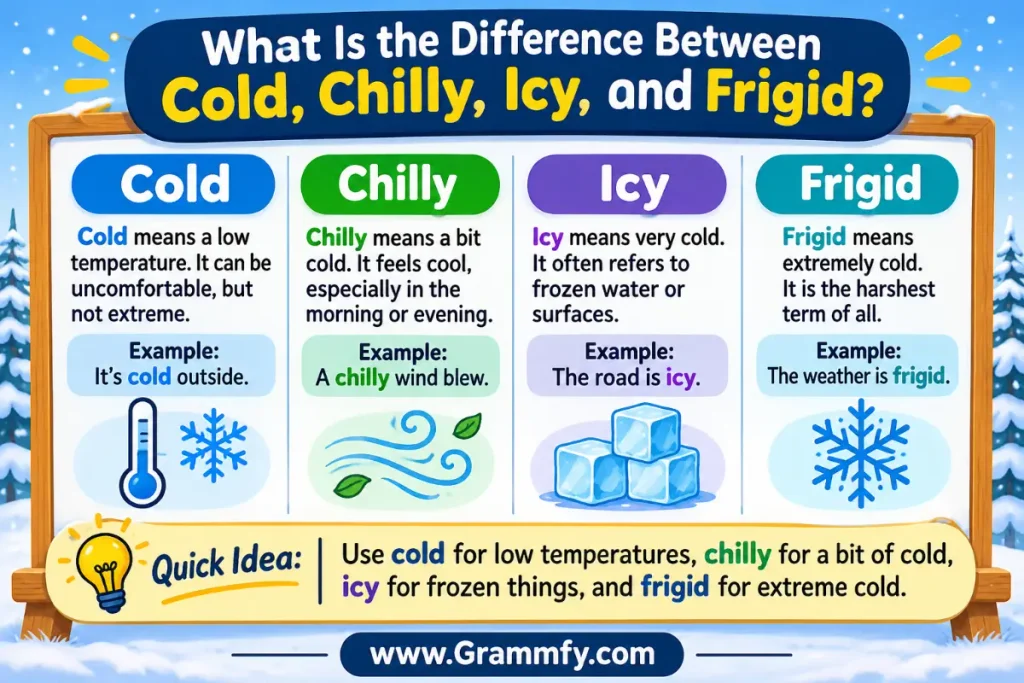
These words overlap, but they don’t communicate exactly the same thing.
| Word | Main meaning | Typical feeling | Example |
|---|---|---|---|
| Cold | Having a low temperature | General | The water is cold. |
| Chilly | Uncomfortably cool | Mild to moderate discomfort | It’s chilly in the shade. |
| Icy | Extremely cold or covered with ice | Sharp, freezing, or slippery | An icy wind blew across the road. |
| Frigid | Intensely cold | Severe cold | Frigid air entered the cabin. |
| Frosty | Very cold or covered with frost | Wintry | Frosty grass sparkled in the morning. |
| Bitter | Cold in an unpleasant, harsh way | Strong discomfort | A bitter wind swept through town. |
Cold vs. Chilly: What’s the Difference?
Cold is a general term for low temperature. Chilly usually suggests that the temperature is uncomfortable enough to notice.
- Cold: The water was cold.
- Chilly: The classroom felt chilly, so I put on my sweater.
A chilly room may not be freezing, but it feels cool enough to make someone want another layer.
Icy vs. Frigid: What’s the Difference?
Icy often connects cold with ice, a sharp sensation, or a slippery surface. Frigid emphasizes very low temperature.
- Icy: The icy railing hurt my bare hand.
- Frigid: Frigid air swept across the open field.
Both words can describe severe cold, but icy often gives readers a more physical image.
Cold vs. Emotionally Cold: What’s the Difference?
Physical cold refers to temperature. Emotional cold describes behavior that seems distant or lacking in kindness.
- Physical: The metal bench was as cold as ice.
- Emotional: His reply was as cold as ice.
The surrounding sentence tells readers which meaning you intend.
How Do You Use Cold Similes in Real-Life Writing?
The best comparison changes with the purpose of the writing. A resume, formal email, school essay, and text message all have different expectations.
Cold Similes in a Resume
A resume usually needs direct, professional language rather than figurative descriptions of temperature.
If you’re describing a work environment, use precise wording unless the comparison adds meaningful detail.
Example:
- Less professional: I worked in a room as cold as a freezer.
- Clearer: I maintained productivity in a poorly heated workspace during winter.
The second version is more useful if the temperature affected working conditions. For most resumes, a simile is unnecessary.
Cold Similes in an Essay
Descriptive and creative essays can use comparisons to help readers imagine a scene.
Example:
“The morning wind was as cold as ice, and the frozen grass crunched beneath my shoes.”
This sentence combines temperature with sound, giving readers two details about the setting.
For an academic essay about climate or weather, however, use factual language when precision matters. A simile cannot replace a measured temperature or scientific explanation.
Cold Similes in Texting
Text messages allow playful, exaggerated comparisons.
Examples:
- “My hands are literally ice cubes right now.”
- “This bus stop feels like a freezer.”
- “I’m freezing like a popsicle.”
- “That wind is as sharp as a knife!”
The word literally is often used casually for emphasis, but technically it should describe something that actually happens. Your hands aren’t real ice cubes; the comparison is figurative.
Cold Similes in Emails
Professional emails usually benefit from clarity and a polite tone.
Example:
“The conference room was unusually chilly this morning, so I’ve asked facilities to check the heating.”
This is clearer than saying the room felt like the Arctic. Use a simile only when you’re writing an informal message or a creative description.
Cold Similes in Speeches
A speech may benefit from a comparison that the audience can understand immediately.
Example:
“The wind was as cold as ice, yet the volunteers stayed outside to help their neighbors.”
The simile establishes the harsh conditions, while the rest of the sentence highlights the volunteers’ determination.
A familiar comparison is often more effective in a speech than an obscure literary word.
12 Original Similes for Cold Across Everyday Situations
Here are additional examples showing how cold descriptions can fit naturally into different scenes.
- At a bus stop: The morning wind felt like an open freezer blowing against my face.
- During a winter walk: The path was as cold as a sheet of ice beneath the cloudy sky.
- After swimming: The pool water felt like melted ice against my skin.
- Inside an old house: The hallway was as chilly as a cellar in December.
- During a snowstorm: Snow whipped across the road like tiny white arrows.
- In a mountain village: The wind rushed through the valley like a river of ice.
- While holding a drink: The glass was as cold as a block of ice in my palm.
- During an early morning run: The air stung my cheeks like a handful of icy pins.
- After touching a railing: The metal bit my fingers like a frozen animal trap.
- In a quiet forest: The winter air hung between the trees like a cold, invisible curtain.
- During a tense conversation: Her voice was as cold as a frozen lake at midnight.
- While entering a basement: The room swallowed my warmth like a giant refrigerator.
These sentences demonstrate different approaches. Some focus on physical sensations, some describe the setting, and others use cold to suggest an emotion.
When writing your own examples, change the image to suit the situation. A bus stop may suggest wind and discomfort, while a quiet forest may call for stillness and atmosphere.
What Are Common Mistakes When Writing Cold Similes?
A simile should clarify an image. If it confuses readers, exaggerates the situation too much, or repeats the same idea, it may weaken the writing.
1. Forgetting “Like” or “As” in a Direct Comparison
A simile usually uses like or as to compare two things.
- Simile: My fingers felt like ice cubes.
- Simile: My fingers were as cold as ice.
- Metaphor: My fingers were ice cubes.
The third sentence is a metaphor because it directly describes the fingers as ice cubes rather than using an explicit comparison.
2. Mixing Too Many Images
Avoid placing several unrelated comparisons in one sentence.
- Overloaded: The wind was like a knife, a freezer, a wolf, and a frozen river.
- Better: The wind cut through my coat like a knife.
One clear image usually has a stronger effect than a collection of competing images.
3. Using Extreme Comparisons for Mild Weather
If the temperature is slightly cool, describing it as “as cold as the Arctic” may seem unrealistic unless you’re intentionally exaggerating for humor.
Match the image to the scene:
- Mild: The air was as cool as a shaded garden.
- Moderate: The wind felt like a chilly draft.
- Severe: The wind stung like tiny needles.
4. Confusing Physical Cold With Emotional Cold
A sentence such as “She was cold as ice” could describe her body temperature or her personality. Add context if the meaning isn’t clear.
- Physical: After playing in the snow, her hands were as cold as ice.
- Emotional: She gave her former friend a look as cold as ice.
5. Repeating the Same Simile Too Often
Using “cold as ice” several times in one paragraph can make the writing repetitive.
Try changing the type of image:
- The wind cut like a blade.
- My fingers felt like frozen sticks.
- Frost covered the window like white lace.
Each sentence offers a different detail.
6. Choosing an Image That Doesn’t Fit
A comparison should have a clear connection to the quality you’re describing.
For example, “as warm as a freezer” creates a confusing image if you mean something is cold. A freezer suggests low temperature, while warmth suggests heat.
Make sure the two things being compared share the intended quality.
7. Treating Every Comparison as a Traditional Expression
Some expressions, such as “cold as ice,” are widely familiar. Others, such as “as cold as a penguin’s lunchbox,” are creative inventions.
Both can work, but they serve different purposes. Use familiar expressions for clear communication and original comparisons when you want a distinctive voice.
What Are the Antonyms of Cold?
Antonyms are words with opposite or contrasting meanings. Choosing the right opposite can help you create contrast in a description.
| Antonym | Meaning | Example |
|---|---|---|
| Warm | Moderately high in temperature | The warm room felt comfortable. |
| Hot | High in temperature | The hot tea warmed my hands. |
| Hotter | Having a higher temperature | The afternoon became hotter. |
| Heated | Made warm or hot | We entered the heated cabin. |
| Toasty | Pleasantly warm | My feet felt toasty in thick socks. |
| Scorching | Extremely hot | Scorching air rose from the pavement. |
| Balmy | Pleasantly warm | A balmy breeze crossed the garden. |
| Tepid | Lukewarm | The water was tepid rather than cold. |
Not all these words have the same intensity. Balmy often describes pleasant weather, while scorching suggests extreme heat. Tepid is useful when something is neither properly hot nor cold.
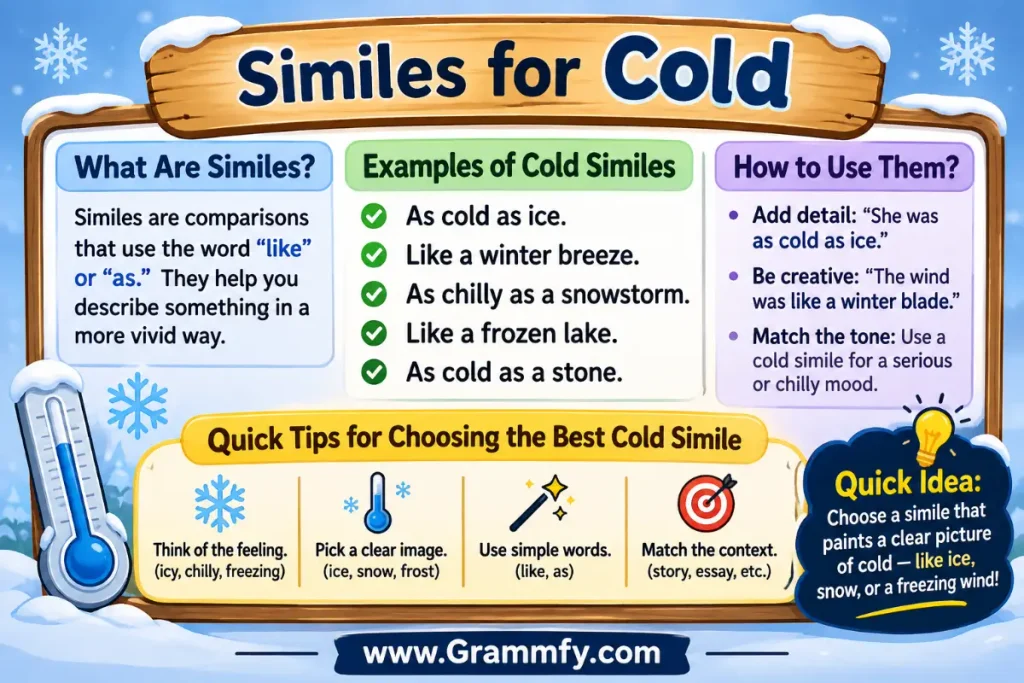
Quick Tips for Choosing the Best Cold Simile
Use these practical tips to make your comparisons clearer and more effective.
- Think about the sensation. Is the cold sharp, damp, mild, freezing, or uncomfortable?
- Choose a familiar image. Ice, snow, freezers, and frozen metal are easy for readers to picture.
- Match the tone. Use playful comparisons in casual writing and more atmospheric ones in fiction.
- Keep your sentence natural. A simile should fit smoothly into the sentence.
- Avoid unnecessary exaggeration. Save extreme images for scenes that deserve them.
- Consider your audience. Younger readers often benefit from simple comparisons, while poetry may allow more unusual images.
- Use different senses. Describe how cold looks, feels, sounds, or affects movement.
- Check the meaning. Make sure the comparison communicates the quality you intend.
- Don’t force a simile into every sentence. Direct descriptions are sometimes more effective.
- Read the sentence aloud. If the comparison sounds awkward, simplify it.
A Simple Formula for Creating Your Own Simile
You can create a new comparison by combining the subject, the sensation, and a familiar image.
Formula: Subject + feels or looks + like/as + familiar image.
For example:
- Identify the subject: the winter wind.
- Choose the sensation: sharp and painful.
- Find a matching image: tiny needles.
- Write the comparison: “The winter wind felt like tiny needles against my cheeks.”
You can apply the same formula to cold objects, weather, or emotions.
- The water felt like melted ice.
- The frozen window looked like a sheet of glass.
- His silence felt like a wall of ice between us.
The goal isn’t to make every comparison unusual. It’s to help readers understand and experience the scene more clearly.
Conclusion: Make Cold Descriptions More Vivid
Strong writing does more than tell readers that something is cold. It helps them imagine the sensation, setting, or emotion behind the words. A simple comparison can describe freezing fingers, while a more detailed image can bring a winter storm or lonely landscape to life.
The best Similes for Cold depend on your purpose. Use familiar expressions such as “as cold as ice” for clear, everyday writing. Choose images involving sharp wind, frozen metal, or icy mist when you want a more vivid description. For poems and stories, original comparisons can create atmosphere and emotional depth.
Remember to match each simile to the scene, avoid repeating the same image, and keep your meaning clear. Start with a familiar comparison, then adjust it to fit your own voice. With practice, you’ll find it easier to describe cold weather and icy feelings in ways that readers can picture and remember.
Frequently Asked Questions
What are some good similes for cold?
Good examples include “as cold as ice,” “like walking through a freezer,” and “as cold as a frozen lake.” Each creates a clear image of low temperature or an icy environment.
What is a simile for extremely cold weather?
“As cold as the Arctic” is a useful simile for extremely cold weather. You can also write, “The wind cut through my coat like an icy knife” to emphasize the discomfort of biting wind.
What’s another way to say something is as cold as ice?
You can say “as cold as a freezer,” “like a block of ice,” or “as cold as frozen steel.” Choose the expression that best matches the object or situation.
What is a funny simile for cold?
“My fingers are like frozen popsicles” is a funny, easy-to-understand comparison. Another playful option is “I feel like a human ice lolly.”
Can similes for cold describe emotions?
Yes, cold similes can describe emotional distance as well as temperature. For example, “His response was as cold as ice” suggests that he sounded unfriendly or uncaring.
What is the difference between a cold simile and a cold metaphor?
A simile makes an explicit comparison using like or as, as in “Her hands were like ice cubes.” A metaphor makes a direct comparison, as in “Her hands were ice cubes.”
How do I write my own simile about cold?
Start with a cold sensation, such as stinging fingers or freezing wind, and compare it to something familiar. For example, “The wind felt like tiny needles against my skin” describes both the temperature and the sensation.

Tylerbrooks is a US-based English grammar writer and contributor at Grammfy. He writes helpful articles about grammar, spelling, commonly confused words, and vocabulary. His goal is to explain English topics in simple language with clear examples and practical tips. Through his articles, he helps readers improve their writing and everyday English skills.