
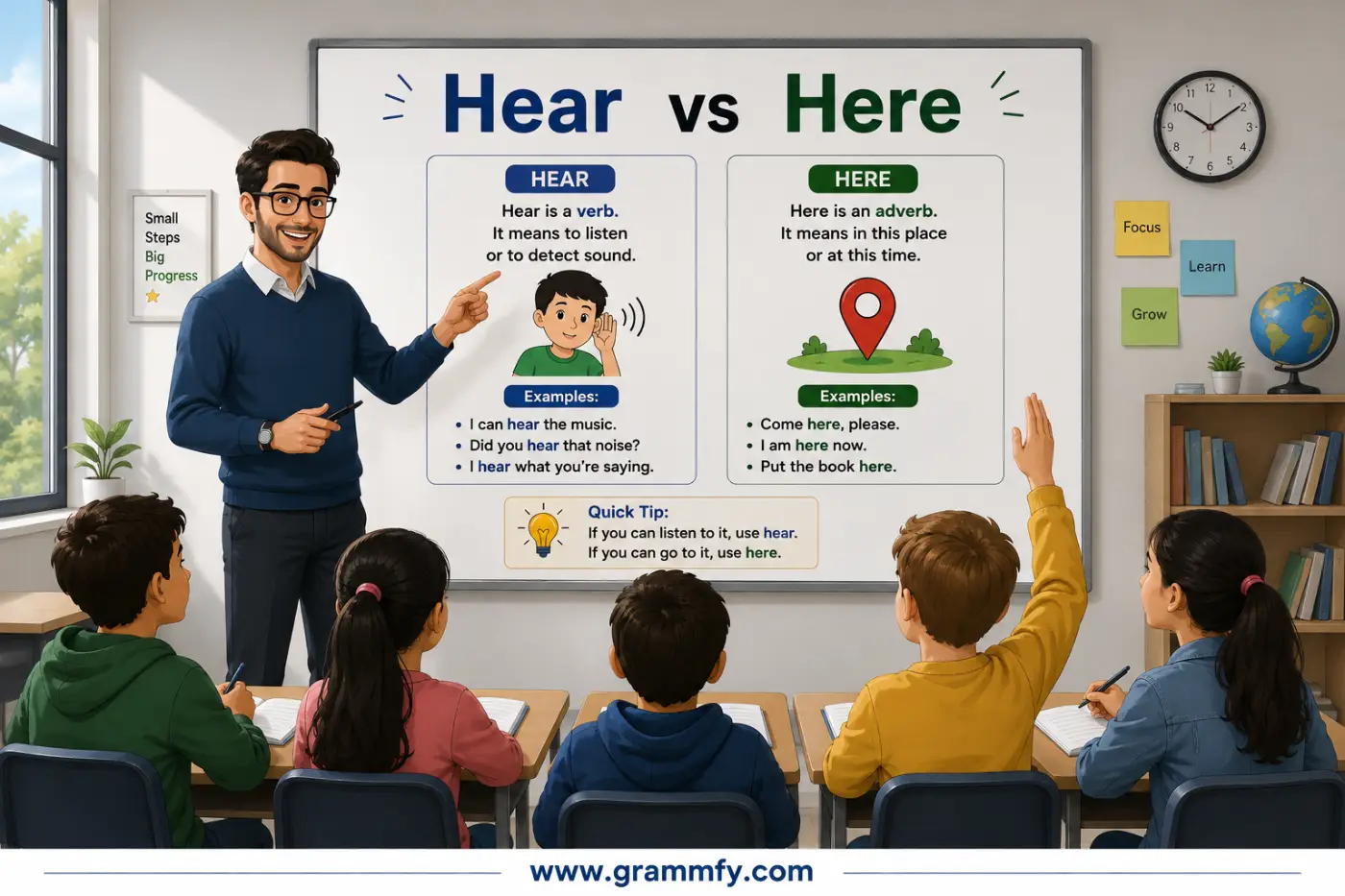
Have you ever typed a quick text, email, school essay, or social media post and paused because you weren’t sure whether to write hear or here? You’re not alone. The confusion between hear vs here is one of the most common spelling mistakes in English because both words sound exactly the same but have completely different meanings.
Many English learners and even native speakers mix up hear vs here when writing quickly. Since they are homophones, your ears can’t tell the difference. Only the spelling and the meaning change. Once you understand what each word means, choosing the correct one becomes much easier.
Quick Answer:
Hear means to receive sound with your ears or listen to something. Here means in this place or at this location. If you’re talking about sound, use hear. If you’re talking about a place, use here.
In this guide, you’ll learn the meanings, origins, pronunciation, common mistakes, memory tricks, synonyms, and real-life examples that make hear vs here easy to understand and remember.
If you’re working on choosing the right word, explore [led vs lead].
What Is the Difference Between “Hear vs Here”?
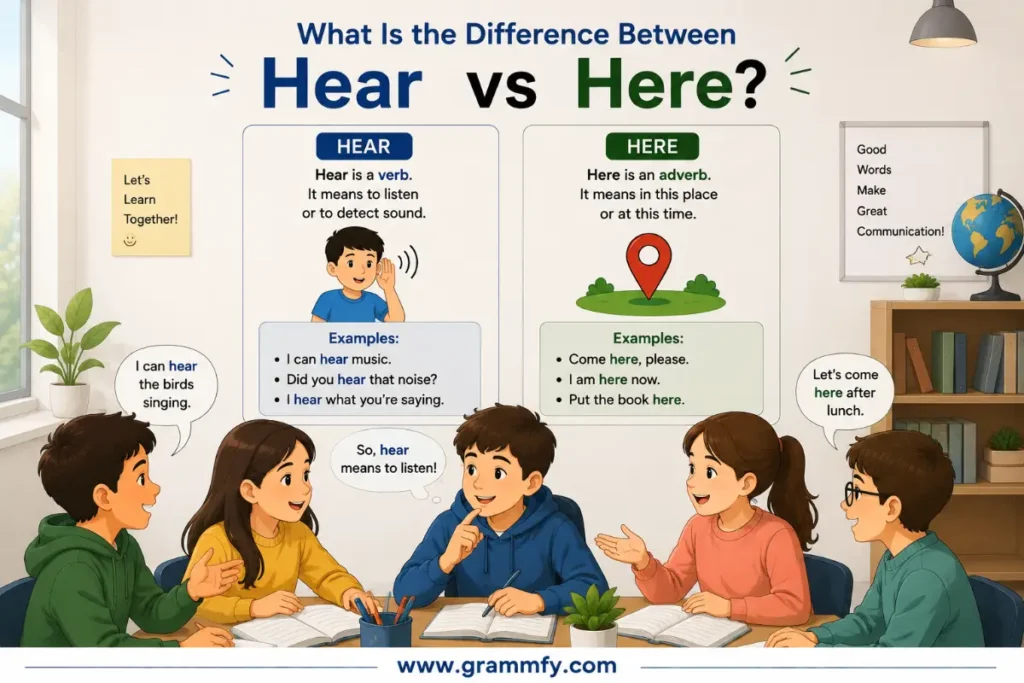
The easiest way to understand hear vs here is to remember that the two words belong to different parts of speech and have different jobs in a sentence.
| Word | Part of Speech | Meaning | Example |
|---|---|---|---|
| Hear | Verb | To listen or receive sound | I can hear the birds singing. |
| Here | Adverb | In this place | Please sit here. |
Although both words sound the same, they never mean the same thing.
Hear Means to Listen
The word hear is a verb. It describes the action of receiving sound through your ears.
You can hear music, people talking, a phone ringing, thunder, birds singing, or someone calling your name.
Examples:
- I can hear the rain outside.
- Did you hear what the teacher said?
- We couldn’t hear the announcement.
- She heard someone knocking on the door.
- Can you hear me clearly?
Whenever the sentence talks about sounds, voices, or listening, hear is the correct word.
Here Means This Place
The word here tells someone about a place or location.
It answers questions like:
- Where?
- At what place?
Examples:
- Please come here.
- Your bag is here.
- We live here now.
- Sit here beside me.
- Everyone is here already.
Whenever you’re talking about location, use here.
Word Origin and Simple Meaning of “Hear vs Here”
Most grammar guides explain only the spelling. Knowing where the words came from helps you remember them better.
Where Does “Hear” Come From?
The word hear comes from the Old English word hieran, which meant to perceive sound or listen.
For hundreds of years, English speakers have used it to describe hearing voices, music, animals, and other sounds.
Today, the meaning is still almost the same.
Hear = receive sound through your ears.
Where Does “Here” Come From?
The word here comes from the Old English word hēr, meaning in this place or at this location.
Its meaning has stayed almost unchanged for over a thousand years.
Here = this place.
Why Do People Confuse “Hear vs Here”?
There are several reasons these words cause mistakes.
They Sound Exactly the Same
Hear and here are pronounced the same way.
Words that sound alike but have different meanings are called homophones.
Other common homophones include:
- Their, there, and they’re
- Two, to, and too
- Your and you’re
- Sea and see
- Right and write
Because hear and here sound identical, spell check doesn’t always catch mistakes.
Only One Letter Changes
Compare them carefully.
- Hear
- Here
The letters are almost the same.
When typing quickly, many people accidentally swap them.
Both Are Common Words
Unlike rare vocabulary, these two words appear in everyday English.
You’ll find them in:
- Emails
- Text messages
- School assignments
- Books
- News articles
- Social media posts
That’s why understanding hear vs here is important for clear writing.
How to Remember “Hear vs Here”
Simple memory tricks work better than memorizing grammar rules.
Trick 1: Hear Has “Ear”
Look at the spelling.
Hear contains the word ear.
You use your ears to hear.
This is one of the easiest memory tricks in English.
Trick 2: Here Has “Here”
Think about pointing at the ground.
“I’m standing here.”
The word itself reminds you of a place.
Trick 3: Ask Yourself One Question
Before choosing the word, ask:
Am I talking about sound or location?
If it’s sound, choose hear.
If it’s a place, choose here.
“Hear vs Here” in Everyday Situations
At School
Correct:
- I can hear the teacher clearly.
- Please come here after class.
Incorrect:
- I can here the teacher.
- Come hear after class.
At Work
Correct:
- Everyone could hear the presentation.
- The manager is here today.
At Home
- Can you hear the television?
- Your keys are here on the table.
While Traveling
Correct:
- I can hear the train arriving.
- We are here at the airport.
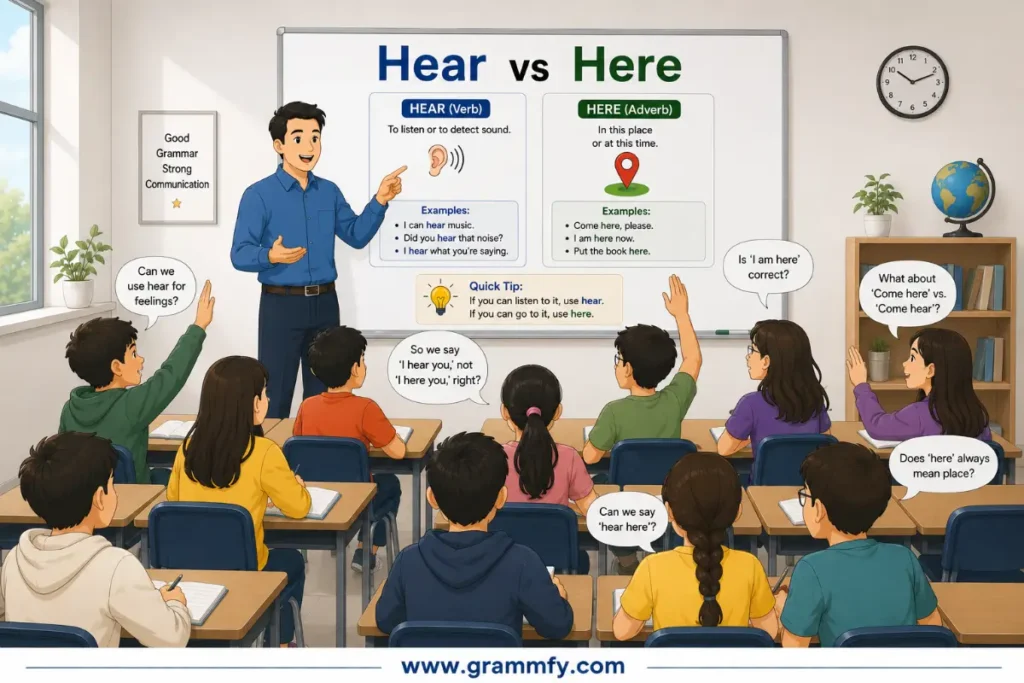
Common Grammar Patterns for “Hear vs Here”
Learning common sentence patterns makes these words much easier to use correctly.
Hear + Someone
- I heard Sarah.
- Can you hear Dad?
- We heard the children laughing.
Hear + Something
- I heard music.
- They heard thunder.
- She heard good news.
Here + Is
- Here is your notebook.
- Here is the answer.
- Here is the schedule.
Here + Are
- Here are your books.
- Here are the results.
- Here are today’s assignments.
Common Mistakes with “Hear vs Here”
Many people make the same mistakes repeatedly.
Mistake 1
❌ I can here the birds.
✅ I can hear the birds.
Mistake 2
❌ Come hear, please.
✅ Come here, please.
Mistake 3
❌ Is your brother hear?
✅ Is your brother here?
Mistake 4
❌ Did you here the news?
✅ Did you hear the news?
Always ask yourself whether you’re talking about sound or location.
Hear vs Here in Questions
Questions often confuse learners because the words come at the beginning or end of the sentence.
Correct examples:
- Can you hear me?
- Did you hear that noise?
- Is everyone here?
- Who is here today?
- Are you here for the meeting?
These simple patterns appear every day in spoken English.
Master Synonym List
The words hear and here have different meanings, so each has its own set of related words.
Simple Synonyms for “Hear”
| Word | Meaning | Tone | Example |
|---|---|---|---|
| Listen | Pay attention to sound | Everyday | Please listen carefully. |
| Notice | Become aware of a sound | Neutral | I noticed someone calling me. |
| Catch | Hear something quickly | Casual | I didn’t catch your name. |
| Detect | Discover a sound | Formal | The device detected a signal. |
| Perceive | Become aware through hearing | Formal | She perceived a quiet noise. |
| Recognize | Identify a familiar sound | Neutral | I recognized his voice immediately. |
| Pick up | Hear something faintly | Casual | We picked up the conversation. |
| Overhear | Hear by accident | Neutral | I overheard their discussion. |
| Understand | Hear and know the meaning | Neutral | I understand what you said. |
| Receive | Receive sound or information | Formal | The microphone received the signal. |
Simple Synonyms for “Here”
| Word | Meaning | Tone | Example |
|---|---|---|---|
| Nearby | Close to this place | Neutral | The store is nearby. |
| Close | Not far away | Everyday | Stay close. |
| Present | In this place | Formal | All members are present. |
| Around | In this area | Casual | She’s around somewhere. |
| Inside | Within a place | Neutral | Come inside. |
| Local | In this area | Neutral | The local library is excellent. |
| On-site | At this location | Formal | The manager is on-site today. |
| At hand | Close by | Formal | Help is at hand. |
| Close by | Very near | Everyday | Parking is close by. |
| Right here | Exactly in this place | Casual | Your phone is right here. |
More Everyday Synonyms for “Hear”
| Word | Meaning | Tone | Example |
|---|---|---|---|
| Attend to | Listen carefully | Neutral | Attend to the instructions before you begin. |
| Be aware of | Notice a sound | Neutral | I wasn’t aware of the alarm. |
| Tune in | Listen closely | Casual | Tune in to the podcast tonight. |
| Make out | Hear with difficulty | Casual | I could barely make out his words. |
| Follow | Understand while listening | Neutral | I couldn’t follow the conversation. |
| Take in | Understand what you hear | Neutral | It took a minute to take in the news. |
More Everyday Synonyms for “Here”
| Word | Meaning | Tone | Example |
|---|---|---|---|
| In this spot | At this exact place | Casual | Wait in this spot. |
| At this point | At this place or stage | Neutral | We are at this point in the project. |
| Within reach | Nearby | Neutral | Keep your phone within reach. |
| Next to | Beside | Everyday | Sit next to me here. |
| In attendance | Present | Formal | All members are in attendance. |
| On the premises | At this location | Formal | Smoking isn’t allowed on the premises. |
Synonyms by Intensity
Some situations need a stronger or softer word than hear.
| Intensity | Hear Synonyms |
|---|---|
| Mild | Notice, Catch, Pick up |
| Medium | Hear, Listen, Recognize |
| Strong | Attend to, Perceive, Detect, Overhear |
For here, intensity is less important because it describes location. Instead, choose words based on how specific you want to be.
| General | Specific |
|---|---|
| Here | Right here |
| Nearby | Close by |
| Around | On-site |
| Present | In attendance |
Synonyms by Part of Speech
Verbs Related to Hear
- Hear
- Listen
- Notice
- Detect
- Recognize
- Perceive
- Catch
- Follow
- Understand
- Overhear
Adverbs Related to Here
- Here
- Nearby
- Close by
- Around
- Inside
- Locally
Nouns Related to Hearing
- Hearing
- Sound
- Voice
- Noise
- Audio
- Listening
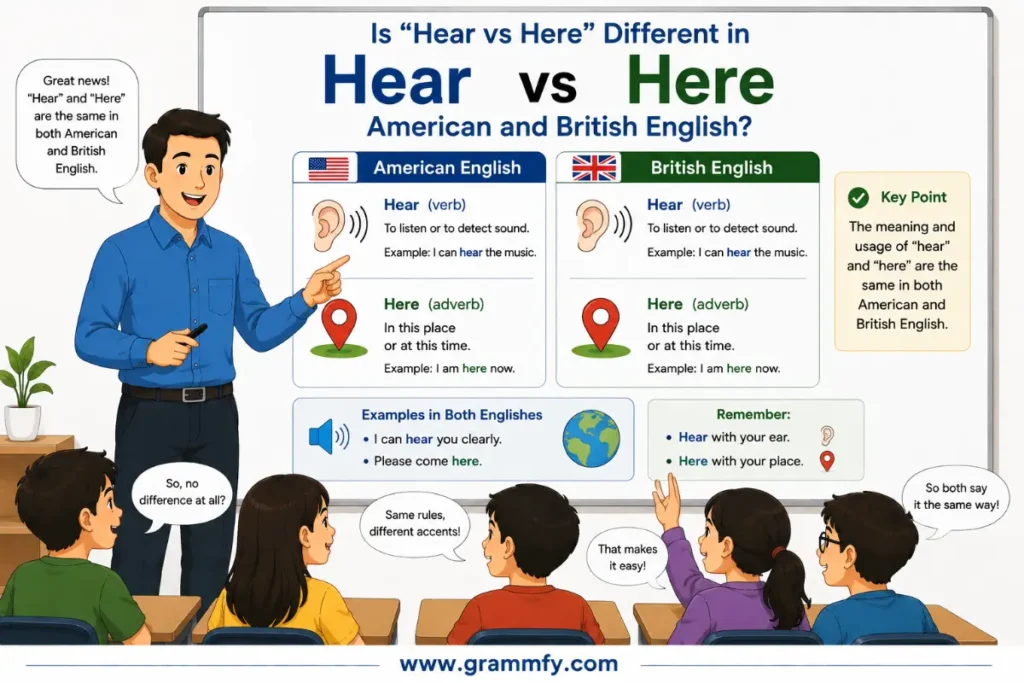
Is “Hear vs Here” Different in American and British English?
No. The grammar rule is exactly the same in both American English and British English.
Whether you’re writing in the US, UK, Canada, Australia, or another English-speaking country:
- Hear always relates to sound.
- Here always relates to location.
Only pronunciation may vary slightly because of different accents, but the spelling and meaning never change.
Which Word Should You Use in Different Situations?
Hear vs Here in a Resume
Professional writing should always use the correct word.
Correct:
- I was pleased to hear positive feedback from clients.
- I’m here to contribute my leadership skills.
Incorrect:
- I was pleased to here positive feedback.
Hear vs Here in an Essay
Academic writing should be clear and accurate.
Example:
- Students can hear different opinions during classroom discussions.
- The experiment was conducted here in our school laboratory.
Hear vs Here in an Email
Emails often include both words.
Example:
- I was happy to hear your update.
- I’ll be here at 9:00 a.m. tomorrow.
Hear vs Here in Text Messages
Texting is casual, but the grammar still matters.
Examples:
- Can you hear me?
- I’m here now.
- Did you hear the news?
- Meet me here.
Hear vs Here in Speaking
Because the two words sound the same, listeners understand them from the sentence.
Examples:
- I can hear your voice.
- Come here for a second.
The context tells people which word you mean.
Real-Life Example Sentences
These original examples show how each word works in everyday English.
- I could hear music from the next room.
- Please come here before the meeting starts.
- We didn’t hear the phone ring.
- My grandparents are here for the weekend.
- Can you hear the birds outside?
- Everyone is here except Liam.
- I was excited to hear the good news.
- The teacher asked us to come here after class.
- Did you hear someone knocking?
- Your backpack is here beside the desk.
- We could hear children laughing in the park.
- She left her notebook here yesterday.
- I can’t hear you because the room is noisy.
- Wait here while I get the tickets.
- They were happy to hear that everyone was safe.
Close Comparisons
Hear vs Listen
These words are related, but they aren’t identical.
| Hear | Listen |
|---|---|
| Happens naturally. | Requires attention. |
| You don’t choose it. | You choose to do it. |
| Uses your ears automatically. | Means paying attention to sound. |
Examples:
- I heard a loud noise.
- I listened carefully to the teacher.
Here vs There
These words describe opposite locations.
| Here | There |
|---|---|
| This place | That place |
| Close to the speaker | Away from the speaker |
Examples:
- Please come here.
- Your bag is over there.
Common Mistakes to Avoid
Using “Here” Instead of “Hear”
❌ I can here you.
✅ I can hear you.
Using “Hear” Instead of “Here”
❌ Put your books hear.
✅ Put your books here.
Forgetting the Meaning
Remember:
- Hear = ears and sound
- Here = place and location
Depending Only on Spell Check
Spell check often misses this mistake because both words are spelled correctly.
Always read your sentence carefully before sending it.
When Should You NOT Use Each Word?
Don’t use hear when talking about a place.
Incorrect:
- My keys are hear.
Correct:
- My keys are here.
Don’t use here when talking about listening.
Incorrect:
- I can’t here you.
Correct:
- I can’t hear you.
Antonyms
Opposites of Hear
- Ignore
- Miss
- Overlook
- Tune out
- Disregard
Opposites of Here
- There
- Away
- Elsewhere
- Outside
- Far away
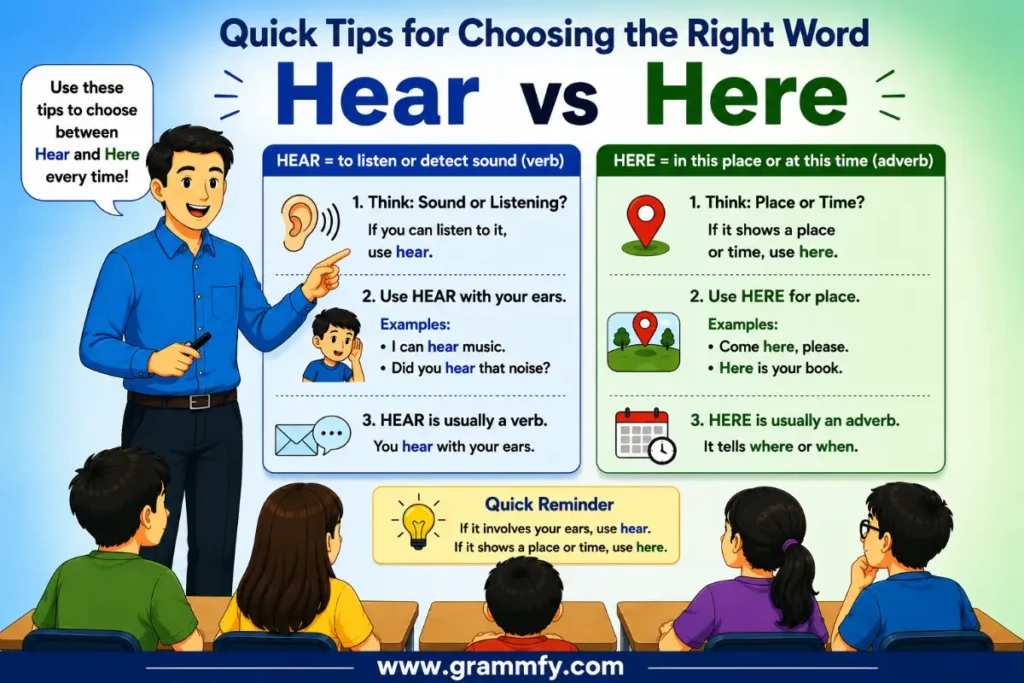
Quick Tips for Choosing the Right Word
- Remember that hear contains the word ear.
- If the sentence is about sound, choose hear.
- If the sentence is about a place, choose here.
- Read the sentence aloud and think about the meaning.
- Don’t rely only on pronunciation because both words sound the same.
- Practice with simple examples until the difference becomes automatic
Conclusion
Understanding hear vs here becomes simple once you focus on the meaning instead of the spelling. Hear always relates to sounds, voices, or listening, while here always refers to a place or location. Even though the two words sound exactly alike, they have completely different jobs in a sentence. A quick memory trick is to notice that hear contains the word ear, reminding you of hearing sounds. Before you write, ask yourself whether you’re talking about sound or a place. With a little practice and the examples in this guide, you’ll use both words correctly and avoid one of the most common English spelling mistakes.
Frequently Asked Questions
Is “hear” or “here” correct?
It depends on the meaning. In hear vs here, hear is about sound, while here is about location.
Why do hear and here sound the same?
They are homophones, which means they have the same pronunciation but different spellings and meanings.
Can I use “here” instead of “hear”?
No. They are never interchangeable because they have different meanings.
What’s another way to say “hear”?
Depending on the sentence, you can use listen, notice, detect, recognize, catch, or perceive.
Is “I’m here” grammatically correct?
Yes. It means you are at this place.
How can I remember hear vs here?
Remember that hear has ear inside it, and you use your ears to hear. That’s one of the easiest ways to remember hear vs here.
