
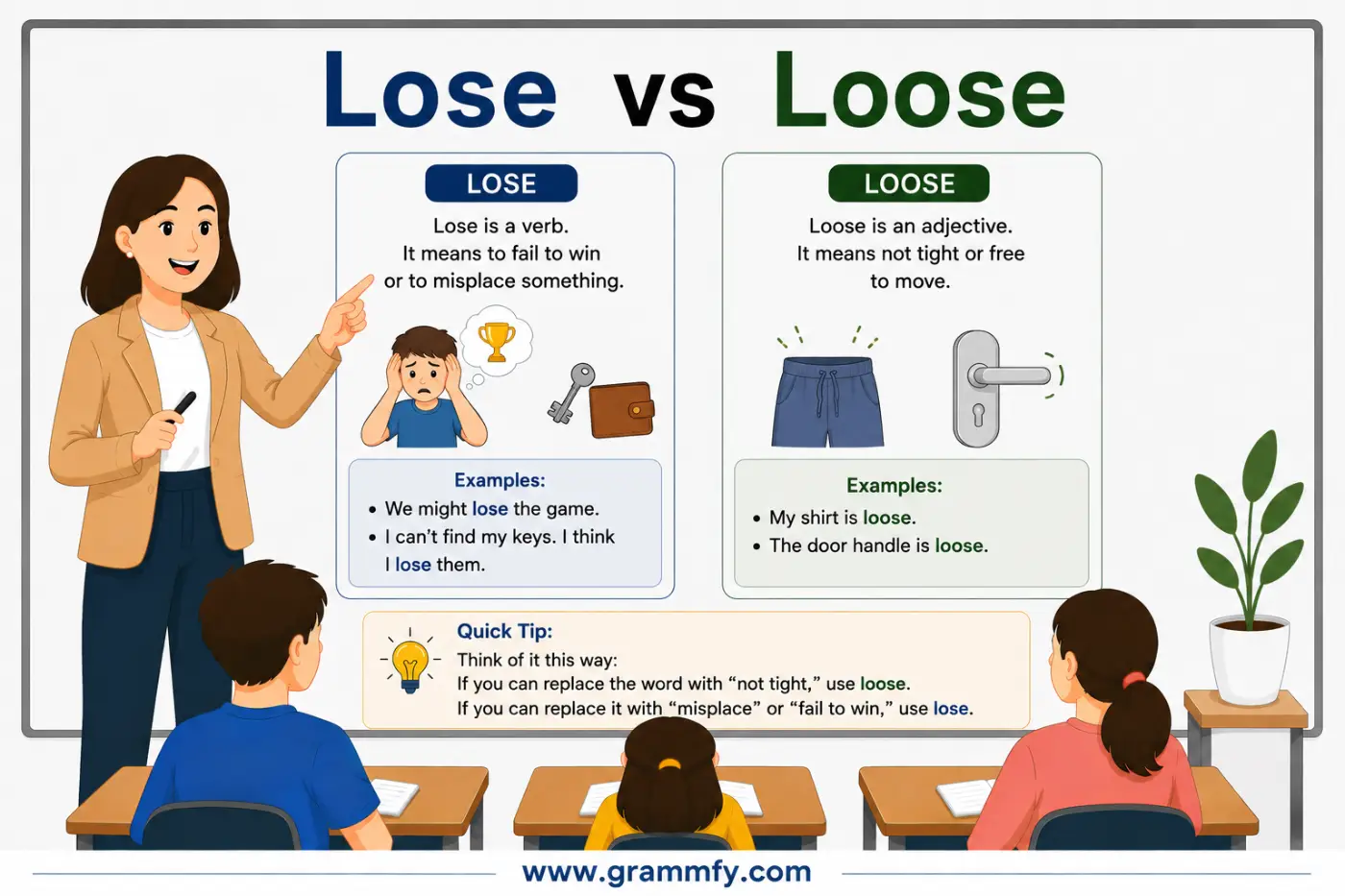
Have you ever typed a quick email or text and paused because you weren’t sure whether to write lose or loose? You’re not alone. The confusion between lose vs loose is one of the most common spelling mistakes in English. Since the words look almost the same but have completely different meanings, it’s easy to mix them up.
Whether you’re writing a school essay, a work email, a social media post, or a text message, understanding lose vs loose will help you write with confidence. Using the wrong word can make your writing look careless, even if your grammar is perfect.
Quick Answer
Lose is a verb that means to no longer have something or to fail to win. Loose is usually an adjective that means not tight or not firmly attached.
In this guide, you’ll learn the difference between lose vs loose, their meanings, origins, pronunciation, memory tricks, synonyms, and plenty of real-life examples.
This is one of many English word pairs that learners confuse; see [passed vs past] for another example.
What Is the Difference Between “Lose vs Loose”?
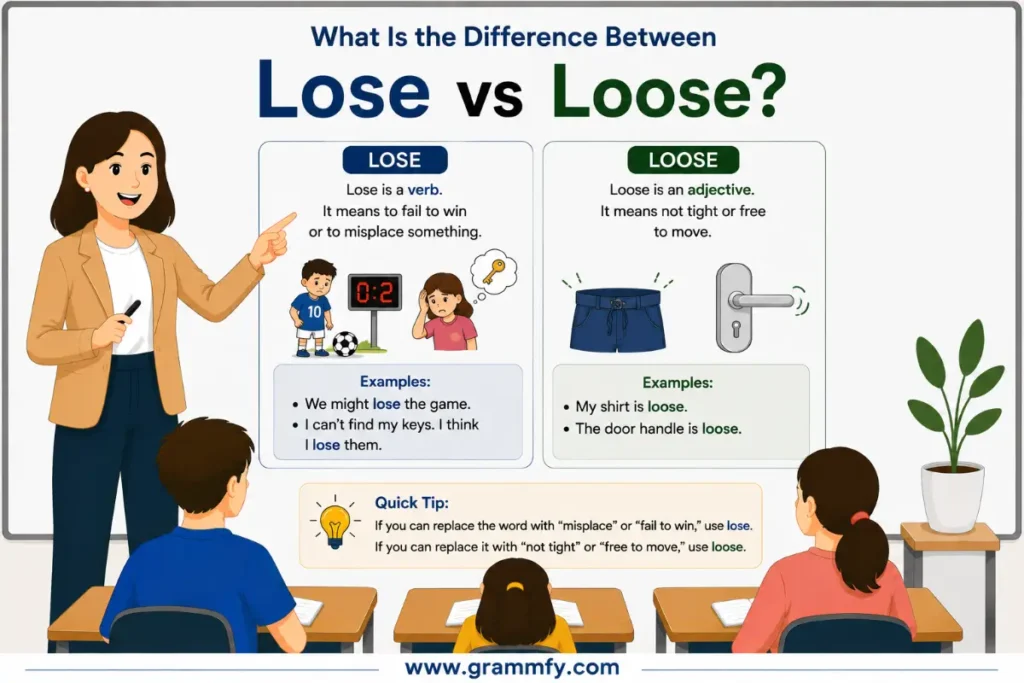
The easiest way to understand lose vs loose is to remember that one is a verb and the other is usually an adjective.
| Word | Part of Speech | Meaning | Example |
|---|---|---|---|
| Lose | Verb | To fail to keep, win, or find something | I don’t want to lose my keys. |
| Loose | Adjective | Not tight or firmly attached | My shirt is loose. |
Here are a few simple examples.
- Don’t lose your wallet.
- My shoelaces are loose.
- We might lose the game.
- That screw is loose.
A simple rule is:
If someone is doing an action, choose lose.
If you’re describing something, choose loose.
Why Do People Confuse “Lose vs Loose”?
The confusion between lose vs loose happens for several reasons.
- The words look very similar.
- They have similar pronunciation.
- Only one extra “o” changes the spelling.
- Both appear often in everyday English.
Many people accidentally write:
- “I don’t want to loose my phone.”
The correct sentence is:
- “I don’t want to lose my phone.”
Remember that spelling matters because these words have different meanings.
“Lose vs Loose” Meaning Explained
Let’s look at each word separately.
What Does Lose Mean?
Lose is a verb.
It means that something is no longer in your possession, you fail to win, or something disappears.
Common meanings include:
- fail to win
- misplace something
- become separated from something
- no longer have something
- waste an opportunity
Examples:
- I don’t want to lose my passport.
- Our team might lose tonight.
- She lost her glasses.
- Don’t lose hope.
- He doesn’t want to lose his job.
Every sentence shows an action.
What Does Loose Mean?
Loose is usually an adjective.
It describes something that isn’t tight, isn’t secure, or can move freely.
Examples include:
- loose clothing
- loose shoes
- loose tooth
- loose screw
- loose rope
- loose button
Example sentences:
- My jacket feels loose.
- That wheel is loose.
- Her bracelet is loose.
- The dog is loose in the yard.
- Your shoelaces are loose.
These examples describe the condition of something.
Where Do “Lose vs Loose” Come From?
Understanding word origins makes lose vs loose easier to remember.
Origin of Lose
The word lose comes from the Old English word losian, which meant “to perish” or “be destroyed.”
Over time, its meaning expanded to include:
- fail
- miss
- misplace
- no longer possess
- suffer defeat
Today, it is one of the most common English verbs.
Origin of Loose
The word loose comes from the Old Norse word lauss, meaning “free” or “not tied.”
That meaning remains almost unchanged today.
Whenever something isn’t tight or firmly attached, loose is usually the correct choice.
How Do You Pronounce “Lose vs Loose”?
Many learners think these words rhyme, but they don’t.
| Word | Pronunciation |
|---|---|
| Lose | looz |
| Loose | looss |
Notice the ending sound.
- Lose ends with a z sound.
- Loose ends with an s sound.
Practice saying them aloud.
- lose
- loose
The pronunciation difference helps native speakers distinguish them quickly.
An Easy Memory Trick for “Lose vs Loose”
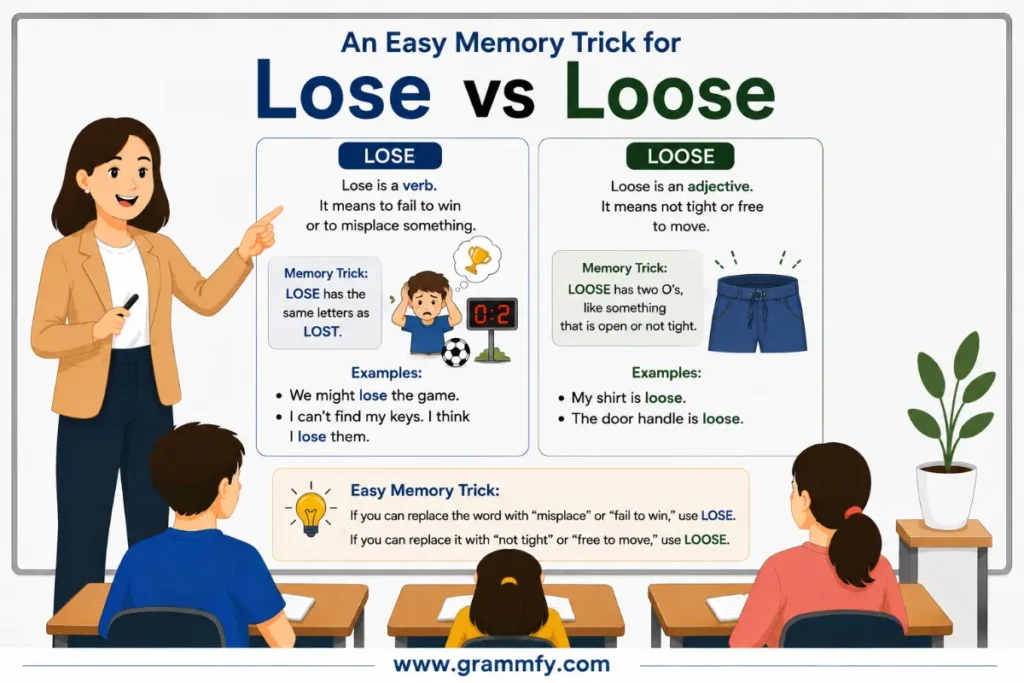
Here’s one of the easiest ways to remember lose vs loose.
Lose Has One “O”
Think of lose as losing one letter.
It has only one O, just as you may lose one thing.
Examples:
- lose money
- lose weight
- lose patience
Loose Has Two “O”s
The two O letters look wide and open.
Imagine something that’s loose because it has extra room.
Examples:
- loose pants
- loose belt
- loose chain
Many students remember this trick for years.
“Lose vs Loose” in Everyday English
You’ll hear these words almost every day.
Common Phrases with Lose
- lose weight
- lose money
- lose a game
- lose interest
- lose hope
- lose confidence
- lose control
- lose your keys
- lose your phone
- lose your balance
Common Phrases with Loose
- loose clothing
- loose change
- loose wire
- loose screw
- loose button
- loose page
- loose hair
- loose knot
- loose bricks
- loose shoes
Learning these common phrases makes choosing the correct word much easier.
Master Synonym List for Lose
Simple Synonyms
| Word | Meaning | Tone | Example |
|---|---|---|---|
| miss | fail to keep | Simple | I miss my bus. |
| drop | let fall | Simple | Don’t drop your phone. |
| fail | not succeed | Simple | We may fail the test. |
| forget | not remember | Simple | Don’t forget your keys. |
| misplace | put somewhere unknown | Simple | I misplaced my wallet. |
| waste | use badly | Simple | Don’t waste time. |
Everyday Synonyms
| Word | Meaning | Tone | Example |
|---|---|---|---|
| surrender | give up | Everyday | They surrendered the lead. |
| give up | stop trying | Everyday | Never give up. |
| miss out | fail to get | Everyday | Don’t miss out. |
| leave behind | forget | Everyday | I left my bag behind. |
| forfeit | lose by rule | Everyday | They forfeited the match. |
| sacrifice | give away | Everyday | She sacrificed her weekend. |
Formal Synonyms
| Word | Meaning | Tone | Example |
|---|---|---|---|
| relinquish | give up willingly | Formal | He relinquished control. |
| abandon | leave behind | Formal | They abandoned the project. |
| surrender | hand over | Formal | The company surrendered its rights. |
| forfeit | lose officially | Formal | The team forfeited the game. |
| yield | give way | Formal | The driver yielded the lane. |
| concede | admit defeat | Formal | They conceded the match. |
Informal Synonyms
| Word | Meaning | Tone | Example |
|---|---|---|---|
| blow | fail | Casual | We blew the game. |
| mess up | make a mistake | Casual | Don’t mess up. |
| slip up | make an error | Casual | I slipped up. |
| choke | fail under pressure | Casual | The team choked late. |
Master Synonym List for Loose
Simple Synonyms
| Word | Meaning | Tone | Example |
|---|---|---|---|
| free | not attached | Simple | The bird is free. |
| open | not closed tightly | Simple | The lid is open. |
| slack | not tight | Simple | The rope is slack. |
| untied | not tied | Simple | My shoes are untied. |
| relaxed | not tense | Simple | Stay relaxed. |
| movable | able to move | Simple | The joint is movable. |
Everyday Synonyms
| Word | Meaning | Tone | Example |
|---|---|---|---|
| baggy | too large | Everyday | Baggy jeans are popular. |
| hanging | dangling | Everyday | A hanging cable. |
| flexible | bends easily | Everyday | Flexible material. |
| unsecured | not fixed | Everyday | An unsecured ladder. |
| detached | separated | Everyday | A detached handle. |
| dangling | hanging freely | Everyday | A dangling chain. |
Formal Synonyms
| Word | Meaning | Tone | Example |
|---|---|---|---|
| unfastened | not secured | Formal | The door was unfastened. |
| disconnected | separated | Formal | A disconnected cable. |
| unrestrained | not controlled | Formal | Unrestrained movement. |
| liberated | set free | Formal | The animals were liberated. |
| independent | not controlled | Formal | An independent structure. |
| unsecured | not protected | Formal | An unsecured connection. |
“Lose vs Loose” by Intensity
Lose Synonyms by Strength
| Level | Synonyms |
|---|---|
| Mild | miss, forget |
| Medium | lose, drop, misplace, fail |
| Strong | surrender, relinquish, abandon, forfeit |
Loose Synonyms by Strength
| Level | Synonyms |
|---|---|
| Mild | free, open |
| Medium | loose, slack, untied |
| Strong | detached, unfastened, unsecured |
What Part of Speech Are “Lose vs Loose”?
Grammar makes lose vs loose much easier to understand.
| Word | Part of Speech | Example |
|---|---|---|
| Lose | Verb | Don’t lose your ticket. |
| Loose | Adjective | My watch is loose. |
Occasionally, loose can also be used as a verb meaning “to release,” but this use is uncommon in everyday American English.
The easiest way to remember is this:
- Lose = action.
- Loose = description.
Is There a Difference Between Lose vs Loose in US and UK English?
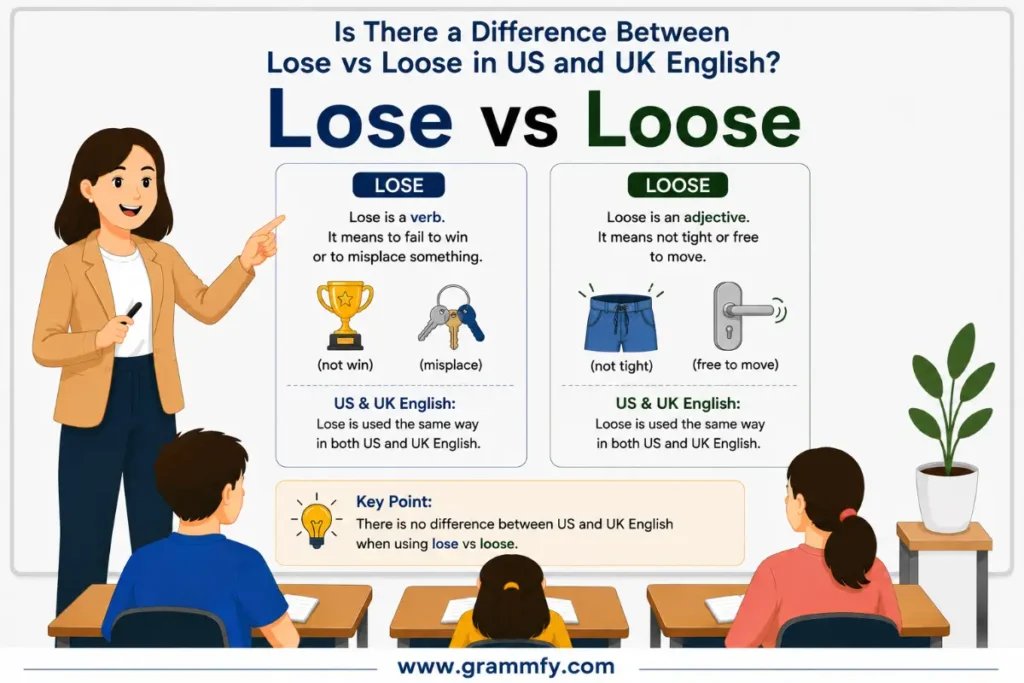
The meaning of lose vs loose is the same in both American English and British English. The spelling, pronunciation, and grammar rules do not change.
You may notice different vocabulary around these words, but lose and loose always keep the same meanings.
Examples:
- US: Don’t lose your driver’s license.
- UK: Don’t lose your driving licence.
Both sentences use lose correctly.
Which Word Should You Use on a Resume “Lose vs Loose” ?
Using the correct word on your resume makes your writing more professional.
Use Lose for Challenges or Results
Although you won’t use lose often on a resume, it may appear when describing lessons learned.
Examples:
- Learned how to recover after losing an important client.
- Developed strategies to avoid losing customer data.
Most resumes focus on achievements rather than failures.
Use Loose When Describing Fit or Condition
The word loose is uncommon on resumes, but it may describe equipment, clothing, or safety issues.
Examples:
- Reported loose electrical wiring.
- Repaired loose machine parts.
- Identified loose bolts during inspections.
Which Word Should You Use in an Essay “Lose vs Loose”?
Both words appear in essays, but they serve different purposes.
Use lose when describing actions.
Examples:
- People lose motivation without clear goals.
- Athletes sometimes lose confidence after a defeat.
- Students may lose focus during long lectures.
Use loose when describing objects or conditions.
Examples:
- The scientist noticed a loose connection.
- The loose soil caused erosion.
- The dog escaped because of a loose gate.
Which Word Should You Use in Text Messages “Lose vs Loose”?
Text messages often include lose.
Examples:
- Don’t lose your phone.
- I hope we don’t lose.
- You’ll lose your chance if you’re late.
You’ll use loose when describing something.
Examples:
- Your shoelaces are loose.
- My jeans feel loose now.
- That screw looks loose.
Which Word Should You Use in Emails “Lose vs Loose”?
Business emails sometimes include both words.
Use Lose
- We don’t want to lose important customers.
- Please don’t lose this document.
- We may lose access if we miss the deadline.
Use Loose
- The cable is loose.
- A loose handle needs repair.
- Several loose wires were found during inspection.
Which Word Sounds Best in Everyday Conversation “Lose vs Loose”?
Ask yourself one simple question.
Is someone doing something?
Choose lose.
Are you describing something?
Choose loose.
That simple habit solves most lose vs loose questions.
More Than 15 Real-Life Example Sentences of “Lose vs Loose”
Examples Using Lose
- Don’t lose your wallet.
- We could lose the championship.
- She doesn’t want to lose her glasses.
- Never lose hope.
- I don’t want to lose my place in line.
- They may lose the contract.
- Try not to lose your patience.
- He doesn’t want to lose his job.
- We almost lose our balance on the ice.
- You’ll lose valuable time if you wait.
Examples Using Loose
- My shirt feels loose today.
- The dog’s collar is loose.
- Your backpack strap is loose.
- That nail is loose.
- These shoes are too loose.
- The door handle became loose.
- Her bracelet is loose after losing weight.
- We found a loose brick.
- A loose wire caused the problem.
- The horse broke free because the rope was loose.
Lose vs Miss: What’s the Difference?
These words are related but not identical.
| Lose | Miss |
|---|---|
| No longer have something | Fail to catch or experience something |
| Can mean fail to win | Can mean fail to arrive on time |
| Often permanent or longer-lasting | Usually temporary |
Examples:
- I don’t want to lose my passport.
- I don’t want to miss my flight.
You can lose your keys, but you miss the bus.
Loose vs Slack: What’s the Difference?
These words have similar meanings but aren’t always interchangeable.
| Loose | Slack |
|---|---|
| Not tight | Hanging without tension |
| Common in everyday English | More technical in some situations |
| Used for clothing, screws, ropes | Often used for ropes and cables |
Examples:
- My jacket is loose.
- The rope became slack.
Common Mistakes with “Lose vs Loose”
Mistake 1: Using Loose Instead of Lose
❌ I don’t want to loose my keys.
✅ I don’t want to lose my keys.
Mistake 2: Using Lose Instead of Loose
❌ My shoes are lose.
✅ My shoes are loose.
Mistake 3: Thinking Loose Is a Verb
Many learners mistakenly believe loose is the action word.
Remember:
- lose = action
- loose = description
Mistake 4: Forgetting the Spelling
Many writers accidentally add an extra “o.”
Remember:
- lose = one o
- loose = two o letters
When Should You NOT Use Lose?
Don’t use lose to describe something that isn’t tight.
Incorrect:
- My belt is lose.
- The screw is lose.
- These jeans are lose.
Correct:
- My belt is loose.
- The screw is loose.
- These jeans are loose.
When Should You NOT Use Loose?
Don’t use loose as the action of misplacing or failing.
Incorrect:
- Don’t loose your wallet.
- We might loose the game.
- I don’t want to loose my job.
Correct:
- Don’t lose your wallet.
- We might lose the game.
- I don’t want to lose my job.
Antonyms
Antonyms of Lose
- win
- gain
- find
- keep
- succeed
- recover
Examples:
- win the game
- keep your phone
- find your wallet
Antonyms of Loose
- tight
- secure
- firm
- attached
- fixed
- fastened
Examples:
- tight shirt
- secure knot
- fixed handle
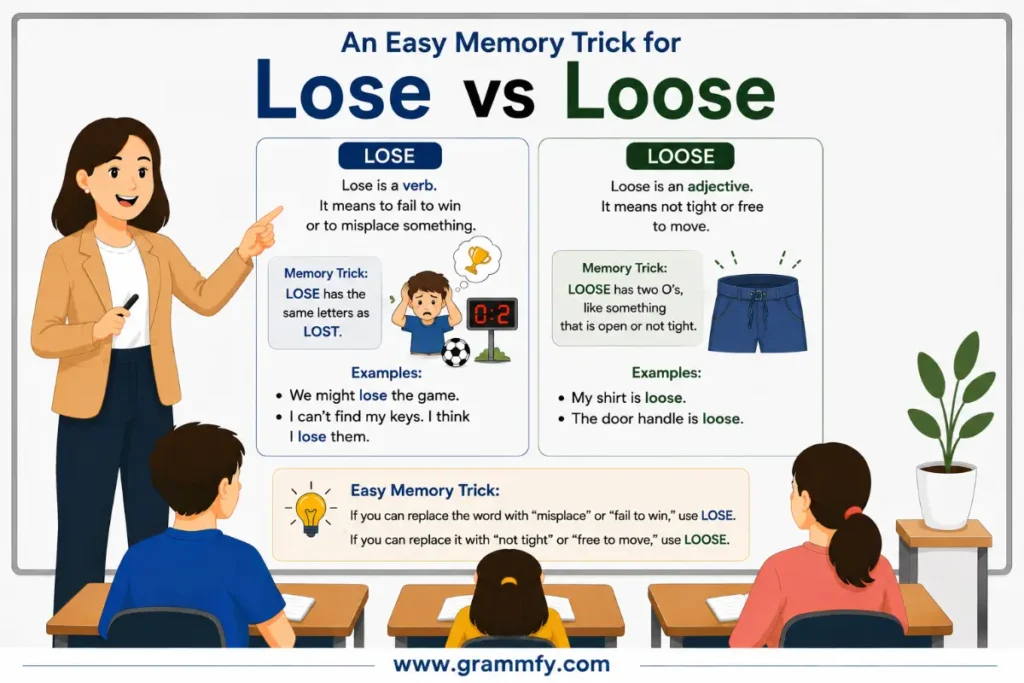
Quick Tips for Choosing the Right Word “Lose vs Loose”
Remember these simple rules.
- If it’s an action, use lose.
- If it means fail to win, use lose.
- If it means misplace something, use lose.
- If you’re describing something, use loose.
- If it means not tight, use loose.
- If you’re talking about clothing, screws, ropes, or wires, it’s usually loose.
Five-Second Memory Trick
Think about the number of “O” letters.
Lose has one O.
You lose one thing.
Loose has two O letters.
The extra space reminds you of something that isn’t tight.
Conclusion
Learning lose vs loose is easier once you remember that the two words have different jobs. Lose is a verb that means to fail to keep something, fail to win, or no longer have something. Loose is usually an adjective that describes something that isn’t tight or securely attached. Although they differ by just one letter, using the correct spelling makes your writing much clearer.
Whenever you’re unsure, ask yourself whether you’re describing an action or a condition. If someone is doing something, choose lose. If you’re describing how something fits or whether it’s secure, choose loose. With the examples, memory tricks, and practice in this guide, you’ll use lose vs loose correctly and confidently in essays, emails, conversations, and everyday writing.
Frequently Asked Questions
Is it lose or loose weight?
Lose weight is correct because lose means to no longer have something.
Is it lose or loose a game?
The correct phrase is lose a game because you’re talking about failing to win.
What’s another way to say lose?
Common alternatives include misplace, fail, forfeit, surrender, give up, and miss, depending on the sentence.
What’s another way to say loose?
Common alternatives include slack, untied, baggy, free, unfastened, and unsecured.
How do I remember lose vs loose?
A simple way to remember lose vs loose is that lose has one O because you lose one thing, while loose has two O letters that look like extra space.
Can loose be a verb?
Yes, but it’s uncommon in modern English. It can mean “to release,” as in “to loose the dogs.” Most everyday writing uses loose as an adjective.
Why do people confuse lose and loose?
People confuse them because they look very similar and are pronounced almost the same. The key difference is that lose is a verb and loose usually describes something.
