
You’re writing an email, finishing an essay, updating your resume, or sending a quick text. Then you stop because you’re unsure about buy vs by vs bye. These three words sound exactly the same, but they have completely different meanings.
If you’ve ever used the wrong one, you’re not alone. They’re homophones, which means they sound alike but have different spellings and definitions. Once you understand what each word means, you’ll be able to use them with confidence.
Quick Answer:
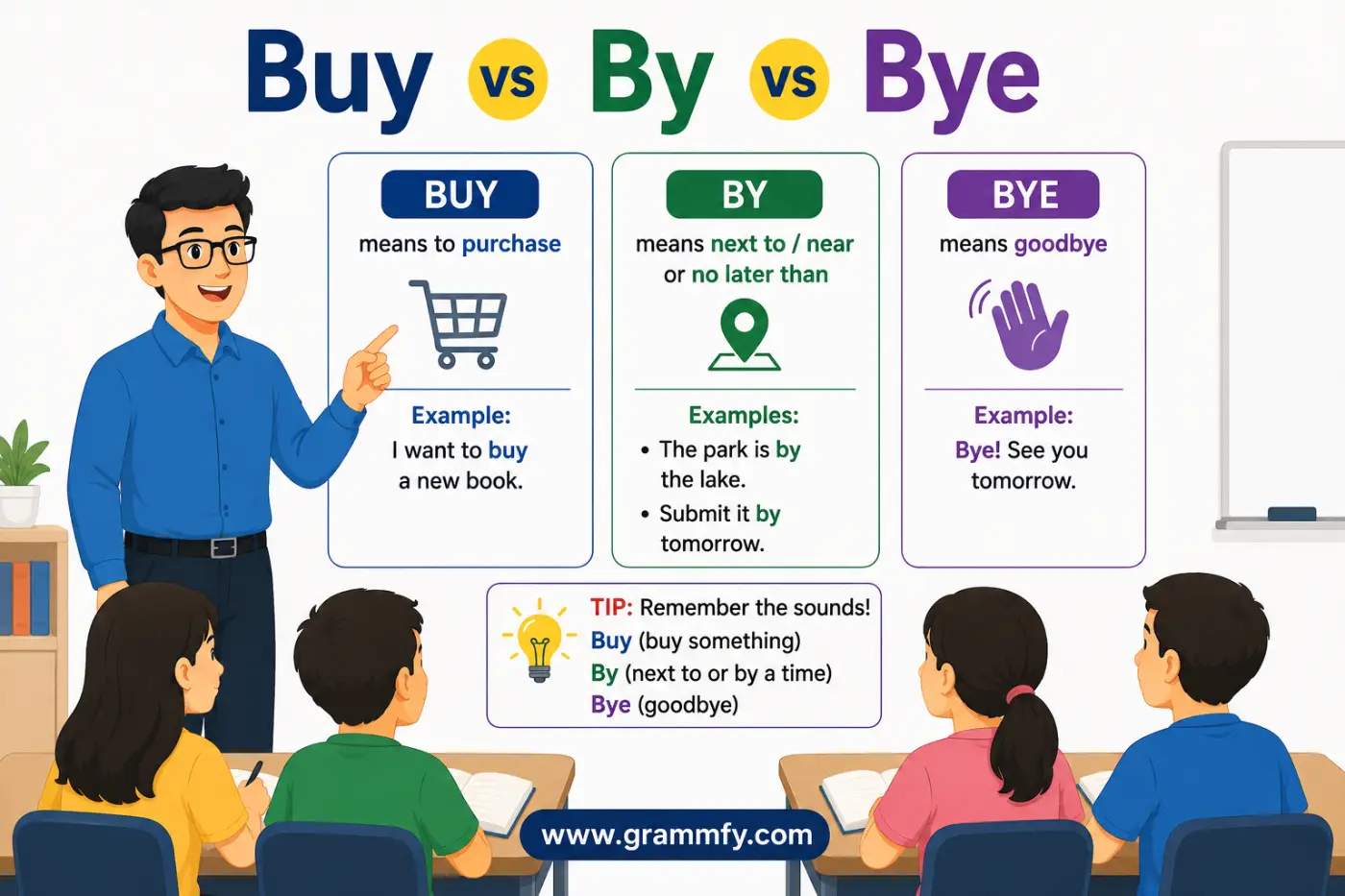
Buy means to purchase something. By usually means near, through, or created by someone. Bye is a way to say goodbye.
In this guide, you’ll learn the difference between buy vs by vs bye, where these words came from, when to use each one, their synonyms, common mistakes, and plenty of real-life examples.
If you often mix up similar words, check out our guide to [canvas vs canvass].
What Does “Buy vs By vs Bye” Mean?
Although these three words sound identical, they serve different purposes in English.
| Word | Simple Meaning | Easy Memory Trick |
|---|---|---|
| Buy | To purchase something | Think of spending money |
| By | Near, through, beside, or written by someone | Think of location or connection |
| Bye | Goodbye | Think of leaving |
Quick Examples
- I want to buy a new laptop.
- The book was written by my favorite author.
- She walked by the park.
- He waved and said, “Bye!“
One word is about shopping.
One is mostly a preposition.
One is a farewell.
Word Origin and Plain-English Meaning Buy vs By vs Bye
Understanding where these words came from helps you remember them.
Where Does “Buy” Come From?
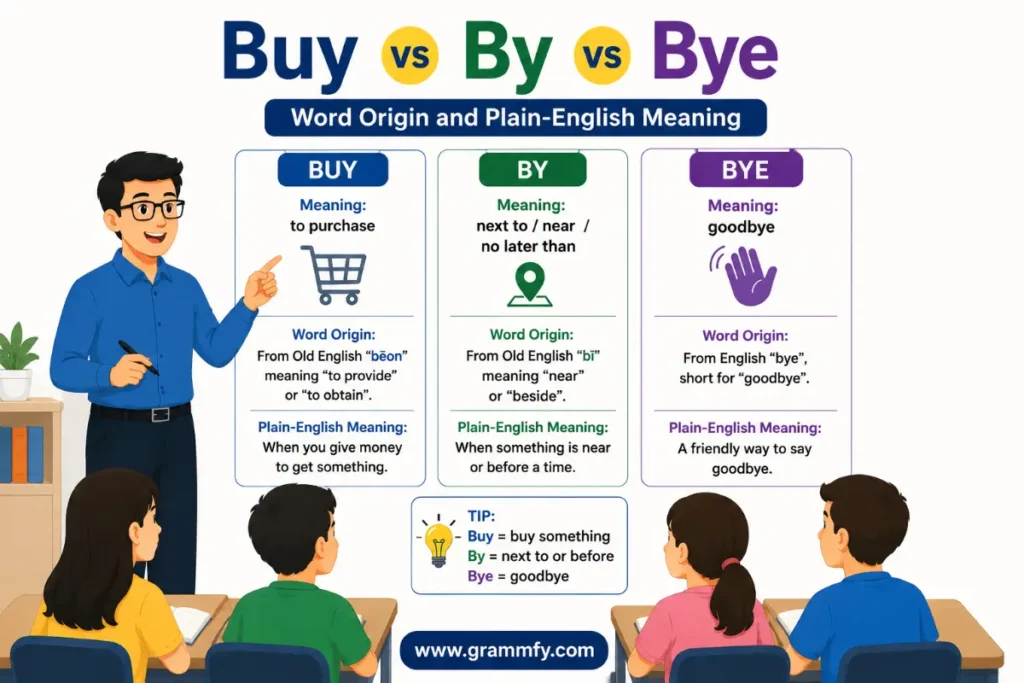
The word buy comes from the Old English word bycgan, meaning “to obtain something by paying for it.”
Today, buy usually means getting something in exchange for money.
You can buy:
- groceries
- clothes
- books
- cars
- tickets
- gifts
- food
- services
Plain-English Definition
Buy = to pay money in exchange for something.
Examples
- I want to buy a new phone.
- We bought fresh vegetables.
- She plans to buy concert tickets online.
- They buy coffee every morning.
Where Does “By” Come From?
The word by comes from Old English and has been used for hundreds of years to describe location, method, time, and authorship.
It’s one of the most common prepositions in English.
You use by to mean:
- next to
- near
- through
- before a time
- created by someone
- using a method
Plain-English Definition
By = near, through, using, before, or created by.
Examples
- Sit by the window.
- The report was written by Sarah.
- We traveled by train.
- Finish the project by Friday.
Where Does “Bye” Come From?
The word bye developed as a shortened form of the phrase goodbye.
Today, it’s one of the most common ways to end a conversation.
People say bye:
- when leaving
- ending a phone call
- finishing a meeting
- saying farewell
- ending a text conversation
Plain-English Definition
Bye = a short way to say goodbye.
Examples
- Bye! See you tomorrow.
- She smiled and said, “Bye!“
- We all waved bye.
- Time to say bye.
The Biggest Difference “Buy vs By vs Bye”
Ask yourself one simple question.
Am I talking about purchasing something?
Use buy.
Am I talking about location, method, time, or authorship?
Use by.
Am I saying goodbye?
Use bye.
Examples:
- I want to buy a bicycle.
- The painting was created by Picasso.
- She said bye before leaving.
Each word has a completely different job.
An Easy Memory Trick
These simple tricks make the words much easier to remember.
Buy
Think:
Buy = Buy with money.
If you’re spending money, choose buy.
By
Think:
By = Beside.
Both words start with B and often describe location.
Bye
Think:
Bye = Goodbye.
If someone is leaving, choose bye.
Can They Ever Mean the Same Thing Buy vs By vs Bye?
No.
Even though they sound the same, these words cannot replace one another.
Compare these sentences.
- ✔ I want to buy a new backpack.
- ✔ The story was written by my teacher.
- ✔ She said bye before getting into the car.
Now switch them.
- ✘ I want to by a new backpack.
- ✘ The story was written buy my teacher.
- ✘ She said buy before leaving.
Every sentence becomes incorrect because the meanings are different.
Master Synonym List Buy vs By vs Bye
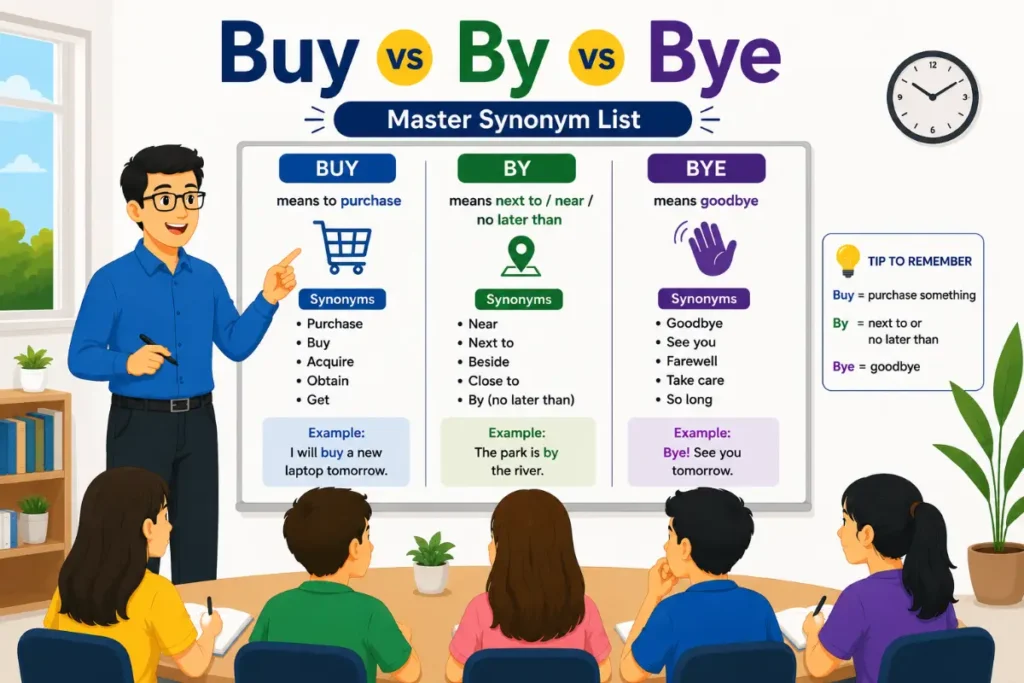
A broader vocabulary helps you write naturally and avoid repeating the same word.
Buy Synonyms
Simple and Everyday Words
| Word | Meaning | Tone | Example |
|---|---|---|---|
| Purchase | Buy something | Everyday | I purchased a new laptop. |
| Get | Obtain | Everyday | I’ll get some milk. |
| Pick up | Buy casually | Everyday | Pick up some bread. |
| Order | Request to purchase | Everyday | We ordered pizza. |
| Pay for | Exchange money | Everyday | I’ll pay for lunch. |
| Shop for | Look to buy | Everyday | They’re shopping for shoes. |
| Acquire | Obtain | Everyday | She acquired new skills. |
| Grab | Buy quickly | Casual | I’ll grab a snack. |
Formal Synonyms
| Word | Meaning | Tone | Example |
|---|---|---|---|
| Procure | Obtain officially | Formal | The company procured equipment. |
| Obtain | Get possession of | Formal | They obtained permission. |
| Secure | Successfully obtain | Formal | She secured the contract. |
| Invest in | Spend money wisely | Formal | They invested in new software. |
| Purchase | Formal buy | Formal | Customers purchased products online. |
| Source | Find and obtain | Formal | We sourced local materials. |
| Commission | Order custom work | Formal | They commissioned a painting. |
| Lease | Rent for payment | Formal | The company leased office space. |
Casual Alternatives
| Word | Meaning | Tone | Example |
|---|---|---|---|
| Snag | Get something good | Casual | I snagged a great deal. |
| Scoop up | Buy quickly | Casual | We scooped up the tickets. |
| Treat yourself | Buy for enjoyment | Casual | Treat yourself to dessert. |
| Shell out | Spend money | Casual | I had to shell out $100. |
| Fork over | Pay reluctantly | Casual | He forked over the cash. |
By Synonyms
Simple and Everyday Words
| Word | Meaning | Tone | Example |
|---|---|---|---|
| Near | Close to | Everyday | Sit near the door. |
| Beside | Next to | Everyday | She stood beside me. |
| Next to | Adjacent | Everyday | Park next to the building. |
| Through | Using | Everyday | We learned through practice. |
| Via | By means of | Everyday | Send it via email. |
| Using | With the help of | Everyday | We traveled using the subway. |
| Alongside | Close beside | Everyday | Walk alongside me. |
Formal Synonyms
| Word | Meaning | Tone | Example |
|---|---|---|---|
| Through | By means of | Formal | Success came through teamwork. |
| Via | Using a route | Formal | The package arrived via courier. |
| Per | According to | Formal | Paid per agreement. |
| According to | Based on | Formal | According to policy, it’s approved. |
| In accordance with | Following | Formal | The work followed company rules. |
| By means of | Using | Formal | Data was transferred by means of software. |
| Under | Following rules | Formal | Operated under supervision. |
| Pursuant to | According to | Formal | Pursuant to the contract, payment is due. |
Bye Synonyms
Simple and Everyday Words
| Word | Meaning | Tone | Example |
|---|---|---|---|
| Goodbye | Standard farewell | Everyday | Goodbye, everyone. |
| See you | Friendly farewell | Everyday | See you tomorrow. |
| Take care | Kind goodbye | Everyday | Take care on your trip. |
| Farewell | Formal goodbye | Everyday | Farewell, my friend. |
| Later | Casual goodbye | Casual | Later! |
| See ya | Informal goodbye | Casual | See ya after class. |
| Catch you later | Friendly farewell | Casual | Catch you later! |
| So long | Older farewell | Casual | So long, everyone. |
Synonyms by Intensity (Mild → Strong)
For Buy
| Intensity | Word | Typical Use |
|---|---|---|
| Very Mild | Get | Everyday speech |
| Mild | Pick up | Casual conversation |
| Mild | Buy | General writing |
| Medium | Purchase | Business writing |
| Medium | Acquire | Professional writing |
| Strong | Procure | Official documents |
| Strong | Secure | Business contracts |
| Very Strong | Commission | Custom orders |
| Very Strong | Invest in | Financial contexts |
For By
| Intensity | Word | Typical Use |
|---|---|---|
| Very Mild | Near | Daily conversation |
| Mild | Beside | General writing |
| Mild | Next to | Everyday speech |
| Medium | Via | Professional communication |
| Medium | Through | General writing |
| Strong | By means of | Technical writing |
| Strong | According to | Formal reports |
| Very Strong | Pursuant to | Legal documents |
And for Bye
| Intensity | Word | Typical Use |
|---|---|---|
| Very Mild | Bye | Everyday speech |
| Mild | See ya | Casual conversation |
| Mild | Later | Friends |
| Medium | Take care | Friendly messages |
| Medium | Goodbye | General writing |
| Strong | Farewell | Speeches and letters |
| Strong | Until we meet again | Formal farewell |
| Very Strong | Godspeed | Rare, ceremonial farewell |
Synonyms by Part of Speech
Buy
Related Verbs
- purchase
- get
- acquire
- obtain
- procure
- secure
- order
- invest in
- commission
- lease
- shop for
- pick up
- grab
- snag
Related Nouns
- purchase
- purchase order
- acquisition
- transaction
- bargain
- deal
- payment
- sale
By
Related Prepositions
- near
- beside
- next to
- via
- through
- alongside
- according to
- per
- under
- by means of
Bye
Related Interjections
- goodbye
- farewell
- see you
- see ya
- later
- take care
- catch you later
- so long
- until next time
- have a good one
US vs. UK Usage: Is There Any Difference?
The words buy, by, and bye have the same spellings and meanings in both American and British English.
| Word | US English | UK English | Notes |
|---|---|---|---|
| Buy | ✅ Common | ✅ Common | Means to purchase something |
| By | ✅ Common | ✅ Common | Used as a preposition and in many expressions |
| Bye | ✅ Common | ✅ Common | A casual way to say goodbye |
The biggest difference is in everyday speech.
- Americans often say See ya! or Take care!
- British speakers may say Cheers! or Bye then! in informal conversations.
- In both countries, buy and by follow the same grammar rules.
No matter where you’re writing, the meanings stay the same.
Buy vs By vs Bye: Which Word Should You Use in Different Situations?
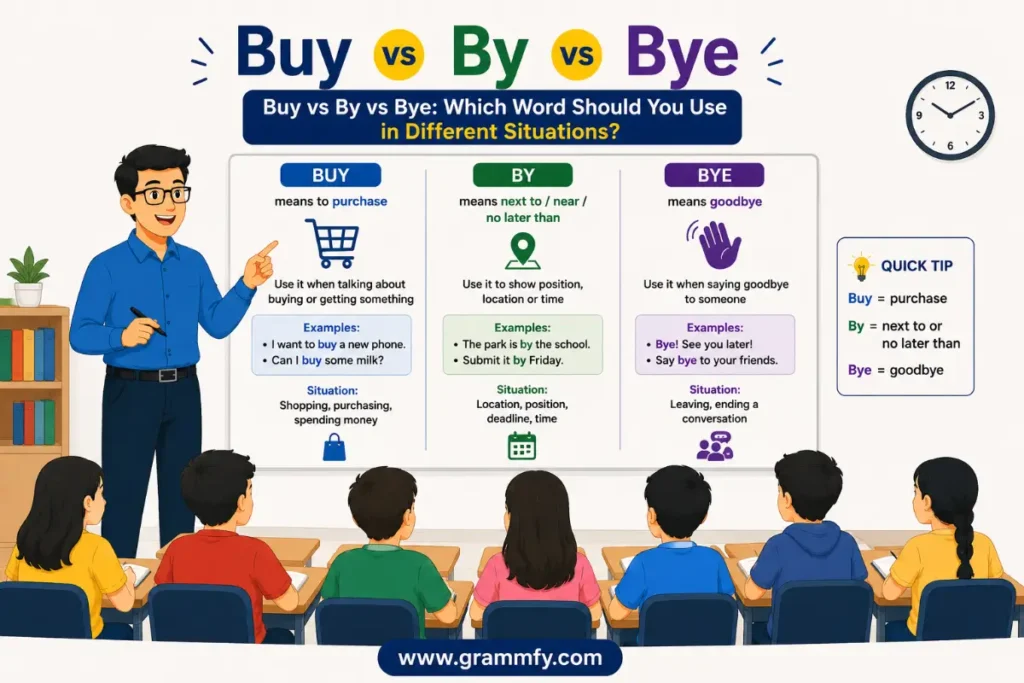
Choosing the correct word depends on what you’re trying to say.
Best Word for a Resume
A resume rarely uses bye, but buy and by appear often.
Examples:
Managed inventory and purchased office supplies.
Report prepared by the project team.
Instead of buy, professional resumes often use:
- purchase
- procure
- acquire
- source
- secure
Best Word for an Essay Buy vs By vs Bye
Essays commonly use all three words, but in different ways.
Use buy when discussing shopping, business, or consumer behavior.
Example:
Many people buy products online because it’s convenient.
Use by for:
- authors
- methods
- locations
- deadlines
Example:
The novel was written by Maya Angelou.
Use bye only in dialogue.
Example:
The character smiled and said, “Bye.”
Best Word for an Email Buy vs By vs Bye
Professional emails usually include buy and by.
Examples:
We’d like to buy additional software licenses.
Please submit your report by Friday.
Avoid using bye in formal emails unless you’re quoting someone. End with phrases like:
- Best regards
- Thank you
- Sincerely
Best Word for Text Messages Buy vs By vs Bye
Texting is where bye appears most often.
Examples:
Bye! Talk later.
I’ll buy snacks on my way.
Meet me by the entrance.
Short, natural wording works best.
Best Word for Speaking Buy vs By vs Bye
In conversation, these words are very common.
Examples:
I’m going to buy lunch.
Stand by the door.
Bye! See you tomorrow.
Most native speakers use these words every day without thinking about them, but spelling matters when writing.
Real-Life Example Sentences of Buy vs By vs Bye
These examples show each word in everyday situations.
- I need to buy groceries after work.
- She decided to buy a birthday gift online.
- We bought tickets for the concert last night.
- He wants to buy a used bicycle.
- My parents buy fresh fruit every weekend.
- They didn’t buy the expensive phone.
- Please sit by the window.
- The painting was created by a local artist.
- We traveled by bus across the city.
- Finish your homework by 8 p.m.
- The café is by the library.
- Everything happened by accident.
- She smiled and said, “Bye!“
- It’s time to say bye and head home.
- Everyone waved bye after the party.
Close-Synonym Comparisons
Buy vs Purchase
These words have the same basic meaning, but their tone is different.
| Buy | Purchase |
|---|---|
| Everyday word | More formal |
| Common in speech | Common in business |
| Simple and natural | Professional sounding |
Example:
I’ll buy a new laptop.
The company will purchase new equipment.
By vs Near
These words are similar when talking about location.
| By | Near |
|---|---|
| Can mean beside or through | Mainly means close to |
| Many different uses | Mostly about distance |
| More flexible | More specific |
Example:
She stood by the door.
The hotel is near the airport.
Bye vs Goodbye
Both are correct, but they fit different situations.
| Bye | Goodbye |
|---|---|
| Casual | Neutral to formal |
| Friends and family | Any situation |
| Common in texts | Common in letters and speech |
Example:
Bye! See you tomorrow.
Goodbye, and thank you for coming.
Common Mistakes to Avoid
Because these words sound exactly alike, many writers confuse them.
Mistake 1
❌ I want to by a new computer.
✅ I want to buy a new computer.
You’re purchasing something.
Mistake 2
❌ Stand buy the window.
✅ Stand by the window.
You’re describing location.
Mistake 3
❌ He waved buy before leaving.
✅ He waved bye before leaving.
You’re saying goodbye.
Mistake 4
❌ The article was written buy John.
✅ The article was written by John.
Use by for authorship.
Mistake 5
Using bye instead of by in written assignments.
Remember:
- Buy = purchase.
- By = location, method, author, or deadline.
- Bye = farewell.
Antonyms
Learning opposites helps reinforce the meanings.
Antonyms of Buy
- sell
- return
- exchange
- give away
- donate
Example:
Instead of buying a new chair, she decided to sell the old one.
Antonyms of By
There is no direct opposite because by is a preposition. Depending on the sentence, possible opposites include:
- far from
- away from
- distant from
Example:
The cabin is far from the highway.
Antonyms of Bye
- hello
- hi
- welcome
- greetings
Example:
Instead of saying bye, everyone said hello to the new students.
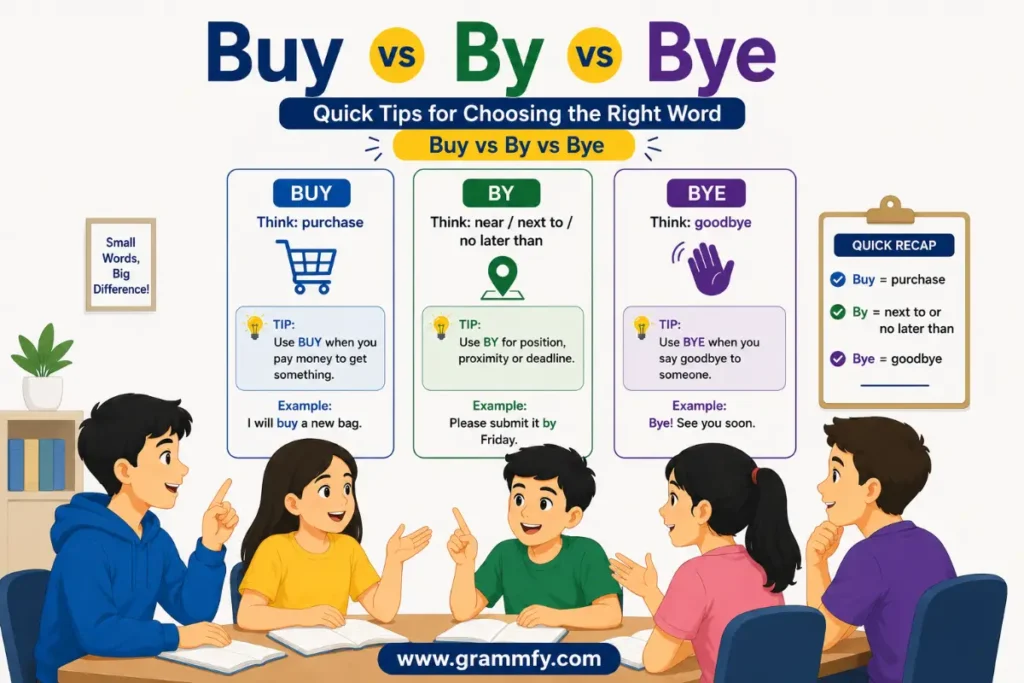
Quick Tips for Choosing the Right Word “Buy vs By vs Bye”
Remember these simple rules whenever you write.
- Buy means to purchase something.
- By usually means near, through, using, before, or created by someone.
- Bye means goodbye.
- Think of money when you see buy.
- Think of location or connection when you see by.
- Think of leaving when you see bye.
- If you can replace the word with purchase, use buy.
- If you can replace it with near or through, use by.
- If you can replace it with goodbye, use bye.
Conclusion
Learning buy vs by vs bye is much easier once you know the role each word plays. Buy is about purchasing something, by connects ideas by showing location, method, time, or authorship, and bye is simply a friendly way to say goodbye. Even though these words sound exactly the same, they aren’t interchangeable. Before you write, pause for a second and ask what you’re really trying to say. That quick habit will help you choose the correct spelling every time, whether you’re writing an email, school paper, business report, or text message.
Frequently Asked Questions
What is the difference between buy vs by vs bye?
Buy means to purchase something. By is a preposition that often means near, through, before, or created by someone. Bye is a casual way to say goodbye.
Which is correct: “buy a book” or “by a book”?
Buy a book is correct because you’re purchasing the book. By a book would only be correct if you mean next to a book.
What’s another way to say buy?
Some common alternatives include purchase, get, acquire, obtain, order, shop for, and pick up. Choose the one that best fits your sentence.
Can bye be used in formal writing?
Not usually. In formal writing, goodbye, farewell, or a professional closing such as Sincerely is often a better choice.
Why do people confuse buy vs by vs bye?
People confuse buy vs by vs bye because they are homophones. They sound exactly the same but have different spellings and meanings.
Is by only used for location?
No. By can also show authorship, transportation, deadlines, methods, and measurements, making it one of the most flexible words in English.
How can I remember the difference quickly?
Think of buy with money, by with place or method, and bye with saying goodbye. These simple associations make it much easier to choose the correct spelling.
