
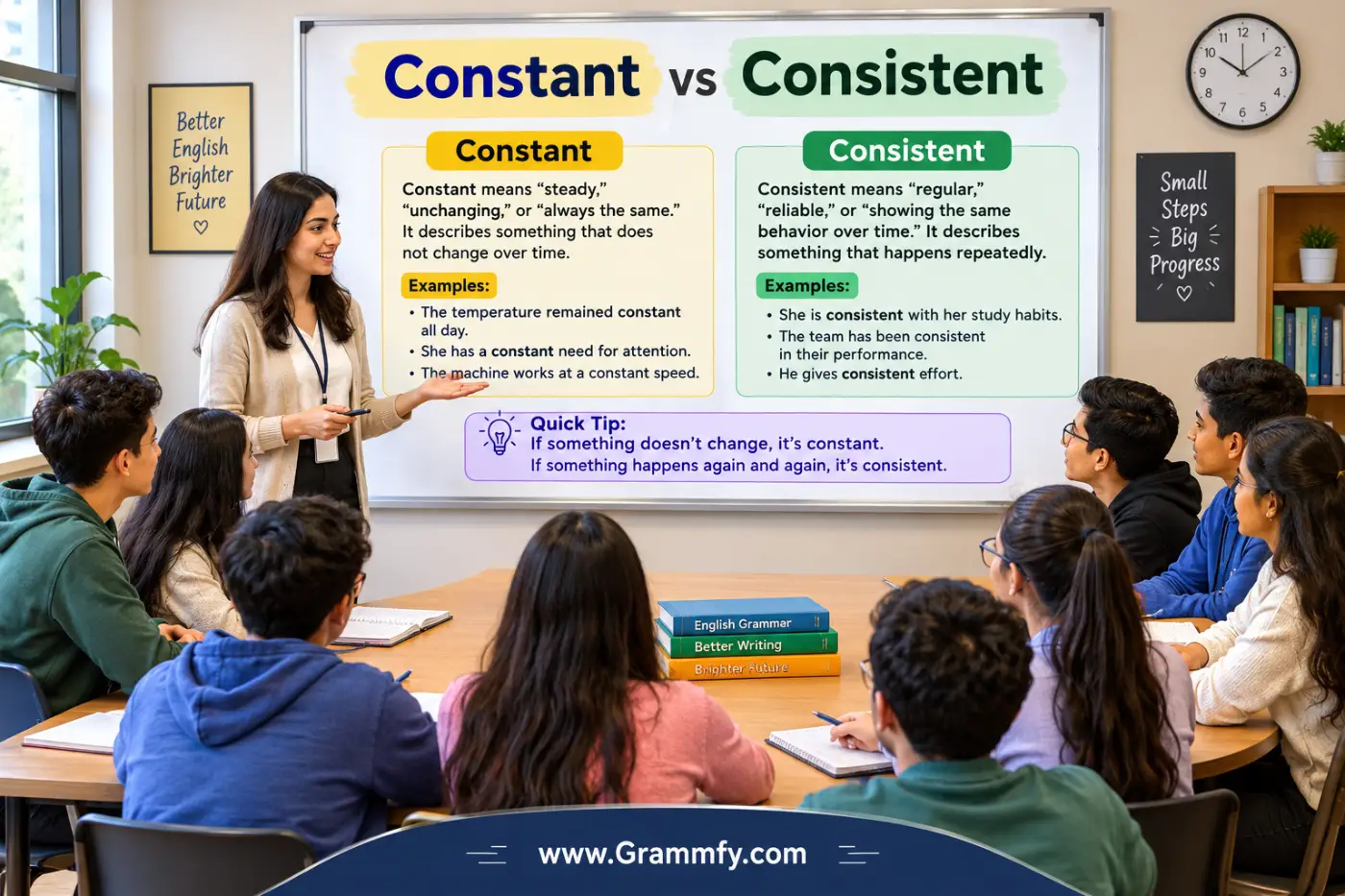
You’re writing an email, essay, resume, or text and want to describe someone who can always be trusted to act the same way. You may stop and wonder: should you use constant vs consistent?
The two words are closely related, but they don’t mean exactly the same thing. Constant usually describes something that stays the same or continues without stopping. Consistent describes something that happens in a reliable, steady, or expected way.
- Answer: Constant means staying the same or continuing without change, while consistent means behaving or happening in a steady and reliable way.
This guide explains the difference with clear meanings, word origins, synonyms, examples, common mistakes, and context-based choices. You’ll also learn which word works best in resumes, essays, emails, texting, and everyday speech.
These words are easy to mix up, so read our guide to the difference between Vicious vs Viscous to see their meanings and examples side by side.
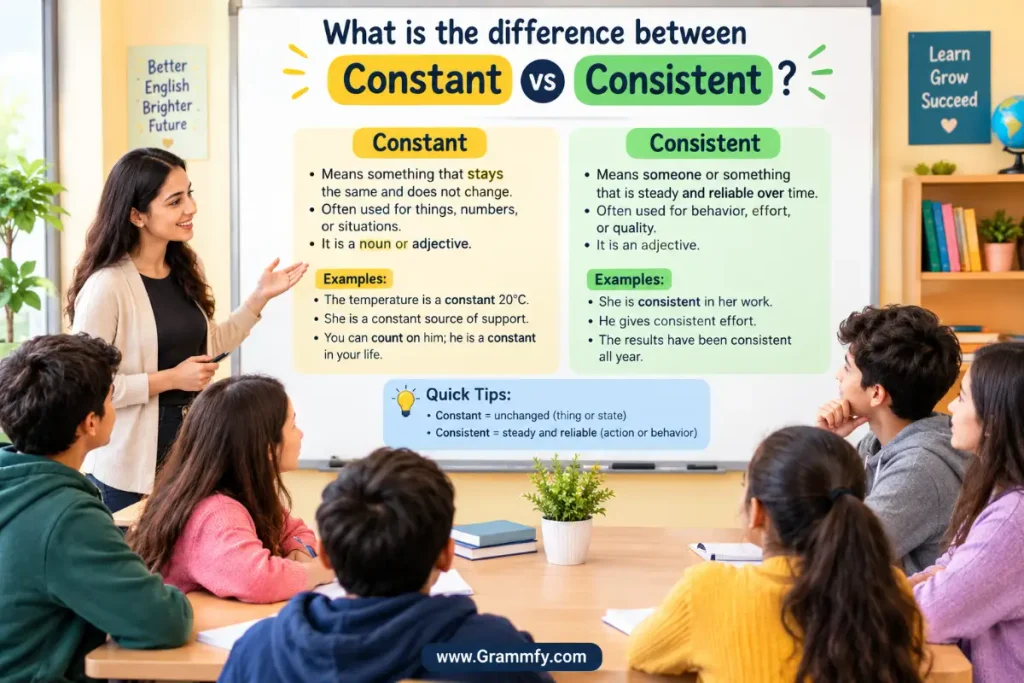
What is the difference between “Constant vs Consistent”?
Constant focuses on something that stays unchanged or continues over time. Consistent focuses on regularity, reliability, or agreement between different things.
For example:
- She receives constant support from her family.
The support is ongoing or continuous. - She receives consistent support from her family.
The support is reliable and steady.
These sentences are similar, but the focus changes.
With constant, you’re thinking about continuation or lack of change.
With consistent, you’re thinking about reliability or a repeated pattern.
| Word | Main idea | Simple meaning |
|---|---|---|
| Constant | No change or interruption | Staying the same or continuing |
| Consistent | Steady and reliable | Happening or behaving in a dependable way |
A person can be consistent without being constant. For example, a student may study every evening from Monday through Friday. That routine is consistent, but the studying isn’t constant because the student takes breaks.
What does constant mean?
Constant is an adjective that describes something that stays the same, happens repeatedly, or continues without stopping.
In simple English, think:
Constant = continuing or unchanged.
Consider these examples:
- The machine makes a constant noise.
- He needs constant attention.
- The temperature remained constant.
- She has been a constant source of support.
- The company faces constant pressure.
Notice that constant can describe both physical and abstract things.
A temperature can remain constant because it doesn’t change. Noise can be constant because it continues. Support can be constant because it remains available.
Constant can also mean continuous
Sometimes constant means something happens almost all the time.
For example:
- The baby was crying constantly.
Here, constantly means again and again or nearly all the time.
Another example:
- We experienced constant rain during the trip.
The emphasis is on the rain continuing for a long period.
Constant can describe an unchanged condition
Constant can also mean that something remains at the same level.
For example:
- The speed of the vehicle stayed constant.
The speed did not change significantly.
In mathematics and science, constant has an even more specific meaning. A constant is a value that does not change within a particular situation or equation.
What does consistent mean?
Consistent is an adjective that describes something reliable, steady, or similar over time.
In simple English, think:
Consistent = steady and dependable.
Examples include:
- She is consistent with her homework.
- His performance is consistent.
- The team has produced consistent results.
- Try to be consistent with your practice.
- Her writing style is consistent throughout the essay.
The key idea is reliability.
If someone behaves consistently, you usually know what to expect from them.
If a student consistently studies, the student follows a regular habit. The student doesn’t need to study every second. They simply study in a dependable pattern.
Where do “Constant vs Consistent” come from?
The origins of these words help explain their modern meanings.
Where does constant come from?
Constant comes from the Latin word constans, meaning “standing firm,” “unchanging,” or “steadfast.” It is connected to the Latin verb constare, meaning “to stand firm” or “to remain.”
That idea still appears in modern English.
When something is constant, it can remain firm, unchanged, or ongoing.
For example:
- The pressure remained constant.
The pressure stayed at the same level.
The word later developed broader meanings involving something that continues or remains dependable.
Where does consistent come from?
Consistent comes from the Latin consistens, related to consistere, meaning “to stand together” or “to stand firm.”
The modern meaning developed around ideas such as agreement, compatibility, and steadiness.
That’s why consistent can describe both behavior and information.
For example:
- Her actions are consistent with her words.
Her actions agree with what she says.
This is an important meaning that constant usually doesn’t have.
Constant vs Consistent: What’s the easiest way to remember?
Use this simple memory trick:
Constant = stays.
Consistent = repeats reliably.
Ask yourself:
“Does it stay the same or continue?”
Use constant.
“Does it happen in a reliable pattern or produce steady results?”
Use consistent.
Compare:
- The noise was constant.
The noise continued.
- Her performance was consistent.
Her performance stayed reliably good or similar.
That small distinction will help you choose the right word in most situations.
What are the main differences between “Constant vs Consistent”?
| Feature | Constant | Consistent |
|---|---|---|
| Main focus | Continuity or sameness | Reliability or regularity |
| Change | Often means little or no change | Can allow some change |
| Repetition | May happen repeatedly | Usually suggests a pattern |
| Reliability | Can imply it | Strongly implies it |
| Agreement | Rarely used this way | Commonly used this way |
| Typical use | Constant noise, constant pressure | Consistent effort, consistent results |
One of the biggest differences is that consistent does not necessarily mean identical.
A person can give consistent performances even if each performance is slightly different. The overall quality or pattern remains reliable.
What are the best synonyms for constant and consistent?
The following words can help you avoid repetition while writing. Some are close matches, while others fit only certain contexts.
| Word | Meaning | Tone | Example |
|---|---|---|---|
| Steady | Firm and regular | Everyday | She made steady progress. |
| Continuous | Without interruption | Formal | The system requires continuous monitoring. |
| Unchanging | Not changing | Neutral | The rule remained unchanging. |
| Ongoing | Still happening | Everyday | We discussed the ongoing problem. |
| Permanent | Intended to last | Neutral | They made a permanent change. |
| Fixed | Set and not changing | Neutral | The price is fixed. |
| Persistent | Continuing despite difficulty | Formal | He showed persistent effort. |
| Regular | Happening repeatedly | Everyday | She is a regular customer. |
| Stable | Not likely to change suddenly | Neutral | The patient’s condition was stable. |
| Reliable | Can be trusted | Everyday | He is a reliable worker. |
| Dependable | Can be trusted to do what is expected | Everyday | She is dependable. |
| Predictable | Easy to expect | Neutral | His response was predictable. |
| Uniform | Remaining the same throughout | Formal | The color is uniform. |
| Repeated | Happening more than once | Neutral | Repeated errors caused delays. |
| Recurring | Happening again | Formal | The issue is recurring. |
| Uninterrupted | Without a break | Formal | The service continued uninterrupted. |
| Sustained | Maintained over time | Formal | The campaign received sustained attention. |
| Invariable | Not changing | Formal | The process follows an invariable rule. |
| Regularly | At repeated or expected times | Everyday | He exercises regularly. |
| Steadily | In a gradual, stable way | Everyday | Sales increased steadily. |
| Repeatedly | Again and again | Neutral | She repeatedly asked the question. |
Not every synonym can replace constant or consistent in every sentence. Context matters.
For example, continuous is a strong synonym for constant when something doesn’t stop, but it doesn’t always mean reliable.
Likewise, reliable is often close to consistent, but it usually focuses more strongly on trustworthiness.
What are synonyms for constant from mild to strong?
The strength of a synonym can change the feeling of a sentence.
Mild
- steady
- regular
- ongoing
- stable
- repeated
Example:
- She made steady progress.
This sounds calm and positive.
Medium
- persistent
- continuous
- sustained
- recurring
- dependable
Example:
- His persistent effort helped him improve.
This suggests stronger or longer-lasting action.
Strong
- constant
- nonstop
- unceasing
- uninterrupted
- incessant
Example:
- The incessant noise made it hard to sleep.
Incessant can sound negative because it suggests something keeps happening without giving you a break.
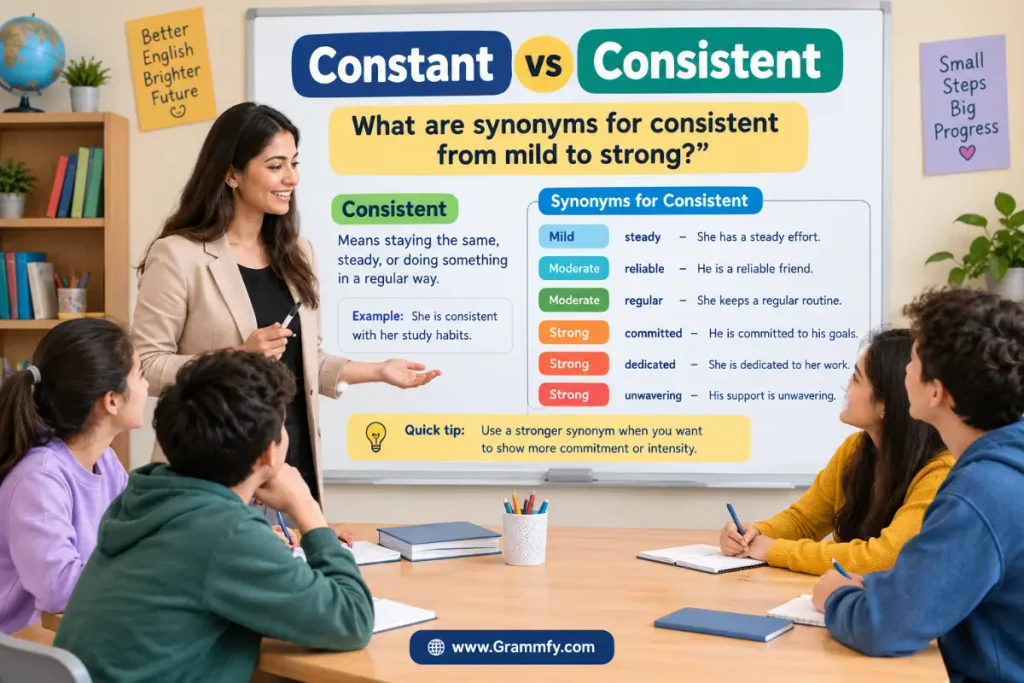
What are synonyms for consistent from mild to strong?
Mild
- regular
- steady
- similar
- stable
Example:
- Her results were steady throughout the semester.
Medium
- reliable
- dependable
- predictable
- uniform
Example:
- The service has been reliable for years.
Strong
- unwavering
- steadfast
- disciplined
- highly reliable
Example:
- His commitment to the project was unwavering.
These stronger words often work better when you want to praise someone’s character, discipline, or dedication.
How do “Constant vs Consistent” work as different parts of speech?
Both words are mainly used as adjectives.
Constant as an adjective
- The constant noise distracted me.
Here, constant describes the noun noise.
Its related forms include:
- constantly
- constancy
Example:
- She constantly checks her phone.
Consistent as an adjective
- His results are consistent.
Here, consistent describes the quality of his results.
Related forms include:
- consistently
- consistency
Example:
- She consistently meets her deadlines.
The noun consistency is especially common in professional and academic writing.
Constant vs Consistent — which word is better for a resume?
For a resume, consistent is usually the better choice when you want to show reliable performance, effort, or results.
For example:
- Delivered consistent results while managing multiple projects.
This sounds professional because it highlights reliability.
You could also write: “Maintained consistent performance across multiple projects”.
By contrast, constant can sometimes sound negative on a resume.
For example:
- Provided constant support to the team.
This isn’t grammatically wrong, but ongoing, reliable, or consistent may sound more precise depending on what you mean.
A stronger resume sentence might be: “Provided consistent support to team members throughout major projects”.
Use constant when you truly mean continuous or uninterrupted.
Maintained constant communication with remote team members.
Here, the intended meaning is frequent or ongoing communication.
Which word is better for an essay?
For essays, the right choice depends on your meaning.
Use constant when describing something that remains unchanged or continues.
The constant pressure of exams can affect students.
Use consistent when discussing patterns, behavior, results, or agreement.
Students who make consistent progress often develop stronger study habits.
In academic writing, consistent is also useful when comparing information.
The findings are consistent with earlier research.
You would not normally replace consistent with constant in that sentence.
Which word is better in an email?
Both can work in emails, but consistent is often better for polite professional communication.
For example:
Thank you for your consistent support.
This sounds natural and appreciative.
You could also say: “We appreciate your consistent effort throughout the project”.
Use constant when you want to emphasize something continuing for a long period.
- We appreciate your constant communication during the transition.
The choice depends on whether you mean reliable pattern or ongoing presence.
Which word is better for texting?
In casual texting, both words are common.
For example:
Your constant messages are distracting me 😂
Here, constant means the messages keep coming.
Another example:
Thanks for always being consistent.
Here, consistent means the person can be counted on to behave in a reliable way.
A useful texting distinction is:
- constant = always happening
- consistent = always reliable
Which word is better in speaking?
In everyday speech, constant is often used for things that happen repeatedly or continuously.
My phone keeps making a constant buzzing sound.
Consistent is common when talking about habits, effort, quality, or results.
You need to be consistent if you want to improve.
When you’re unsure while speaking, think about the main idea you want to communicate. If it’s continuation, choose constant. If it’s reliability, choose consistent.
What are some real examples of constant vs consistent?
Here are original examples from everyday situations.
- The constant rain made it difficult to drive.The rain continued for a long time.
- She made consistent progress in English.Her progress was steady and reliable.
- The employee received constant feedback from her manager.Feedback came frequently or continuously.
- The employee showed consistent improvement.Her improvement followed a steady pattern.
- The room has a constant temperature of 70°F.The temperature remains unchanged.
- He delivers consistent results every month.His results are reliably similar in quality.
- The constant noise from the street kept me awake.The noise continued repeatedly or without much interruption.
- Regular practice is the key to consistent improvement.Practice helps produce steady progress.
- Her constant questions slowed the meeting down.The questions kept coming and may have felt excessive.
- Her consistent questions showed that she was paying attention.
Her questions followed a useful and reliable pattern.
- The company has faced constant changes in leadership.
Leadership changes have happened repeatedly.
- The company needs consistent leadership.
The focus is on dependable leadership.
- He stayed constant in his beliefs.
His beliefs did not change.
- He remained consistent in his behavior.
His behavior stayed reliable and predictable.
- The athlete maintained a consistent training schedule.
The schedule followed a regular pattern.
- The athlete trained under constant pressure.
Pressure continued throughout the situation.
Constant vs Consistent — what’s the difference in these pairs?
Constant support vs consistent support
- Constant support suggests support that is always available or continues.
- Her parents gave her constant support during the difficult year.
Consistent support suggests dependable support that can be counted on.
- Her parents gave her consistent support throughout her studies.
The first focuses on continuation. The second focuses on reliability.
Constant effort vs consistent effort
This distinction is especially useful.
Constant effort can mean continuous effort. “The project required constant effort”.
It may suggest that effort was needed almost all the time.
Consistent effort means steady effort over time. “His consistent effort helped him improve”.
It doesn’t mean he worked every minute. It means he kept putting in reliable effort.
For habits and self-improvement, consistent effort is usually the more natural phrase.
Constant change vs consistent change
These phrases can sound similar but carry different meanings.
Constant change means change happens repeatedly or continuously.
- The constant changes to the schedule confused everyone.
Consistent change is less common and can mean change that follows a regular pattern.
If you mean gradual progress, phrases such as steady change or consistent improvement may be clearer.
Constant quality vs consistent quality
Constant quality can suggest that quality remains unchanged.
The product has constant quality.
This sentence is possible but not always natural.
Consistent quality is much more common when discussing products or services.
The restaurant is known for consistent quality.
This means customers can expect a reliable level of quality.
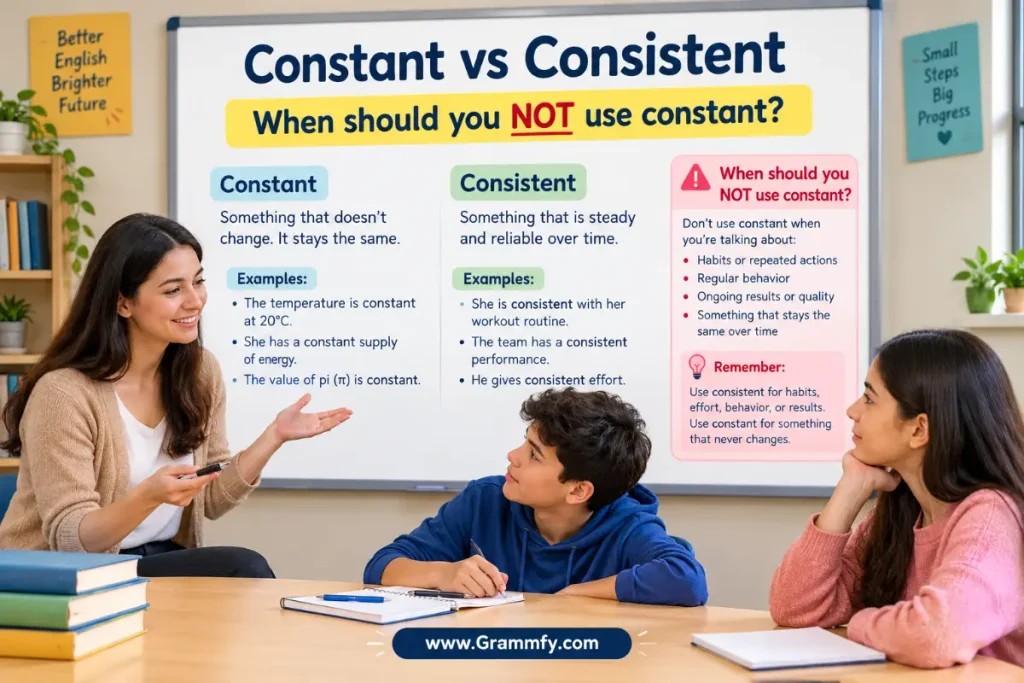
When should you NOT use constant?
Avoid constant when you mean simply “reliable.”
For example:
She is a constant employee.
This sounds unnatural and doesn’t clearly express that she is dependable.
Better:
- She is a consistent employee.
Or:
- She is a reliable employee.
Avoid constant when something happens only at regular intervals.
For example:
- He goes to the gym constantly on Mondays.
If he goes only on Mondays, regularly or consistently is better.
- He consistently goes to the gym on Mondays.
Here, the meaning is clear: he follows the habit reliably.
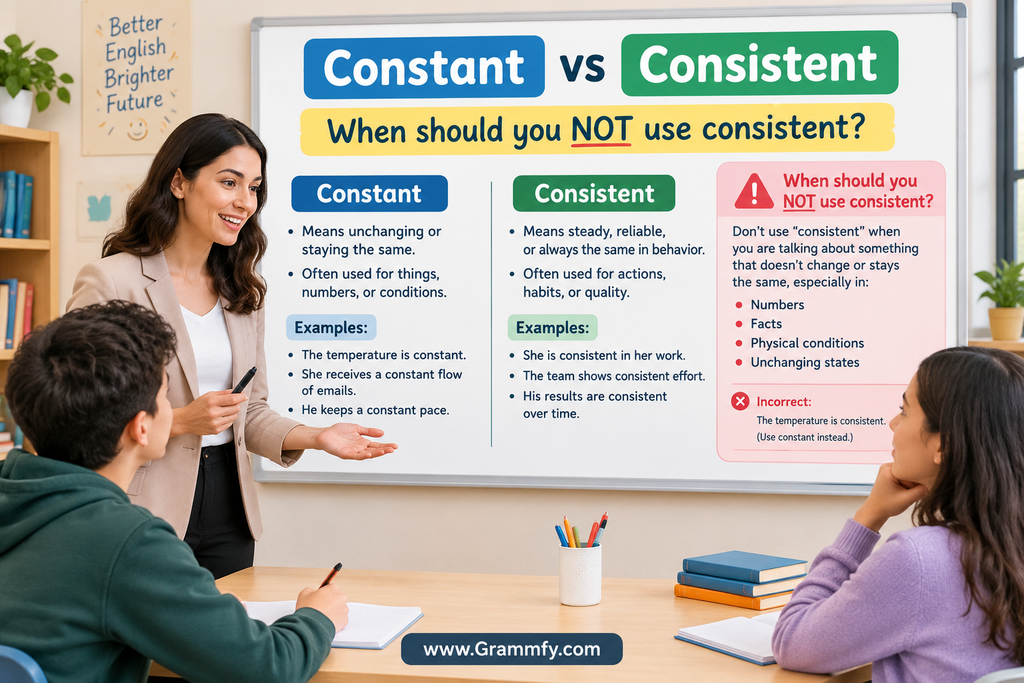
When should you NOT use consistent?
Avoid consistent when you specifically mean “without stopping.”
For example:
The machine made consistent noise all night.
This might mean the noise was predictable, but it doesn’t clearly say the noise continued without interruption.
If you mean it never stopped, say: “The machine made constant noise all night”.
Likewise: “The temperature remained constant”.
is better than: “The temperature remained consistent”.
Both can sometimes work, but constant more directly communicates that the value stayed unchanged.
Is constant always positive?
No. Constant can be positive, neutral, or negative depending on the noun.
Positive:
- She gave me constant encouragement.
Neutral:
- The temperature remained constant.
Negative:
- The constant interruptions made it hard to focus.
The word itself doesn’t automatically express approval or criticism.
Is consistent always positive?
No, although consistent often sounds positive when describing effort or performance.
Positive:
- She is a consistent and hardworking student.
Neutral:
- His answers were consistent with the evidence.
Negative:
- He consistently arrives late.
The last sentence shows that consistency can describe an unwanted habit too.
What are the antonyms of constant?
Common opposites include:
- changing
- variable
- temporary
- intermittent
- occasional
- unstable
- fluctuating
- irregular
- interrupted
Examples:
- The temperature is variable.
- The signal is intermittent.
- The schedule is constantly changing.
The best antonym depends on what constant means in your sentence.
What are the antonyms of consistent?
Common opposites include:
- inconsistent
- unreliable
- irregular
- unpredictable
- unstable
- erratic
- uneven
- variable
Examples:
- His performance is inconsistent.
- The results were unpredictable.
- Her attendance was irregular.
Again, context matters. Inconsistent is the direct opposite, but another word may communicate your exact meaning more clearly.
What are common mistakes with “Constant vs Consistent”?
Mistake 1: Treating them as exact synonyms
They overlap, but they aren’t interchangeable in every sentence.
She made consistent progress.
This means her progress was steady.
She made constant progress.
This can suggest progress continued without stopping, which is a different emphasis.
Mistake 2: Using constant for a regular habit
I constantly exercise every morning.
This can sound like you exercise all the time.
Better:
I consistently exercise every morning.
The second sentence clearly describes a reliable routine.
Mistake 3: Using consistent for something that never stops
- The alarm made consistent noise.
If you mean the alarm continued without stopping, use: “The alarm made constant noise”.
Mistake 4: Thinking consistent means identical
Consistency doesn’t always mean that every result is exactly the same.
A student can have consistent grades even if the grades vary slightly.
For example, grades of 82%, 84%, and 83% show a fairly consistent performance.
Mistake 5: Using constant when reliable is the real meaning
- We need a constant supplier.
If you mean a supplier you can trust to deliver correctly and on time, reliable or consistent may be better.
- We need a reliable supplier.
This clearly communicates trustworthiness.
What is the difference between constant and continuous?
These words are close, but continuous strongly emphasizes an uninterrupted process.
- The constant noise was annoying.
This means the noise kept occurring or continued.
- The continuous noise was annoying.
This more strongly suggests the noise did not stop.
Constant can also mean unchanged, while continuous focuses more on uninterrupted continuation.
What is the difference between consistent and regular?
Regular usually means something happens repeatedly according to a pattern or schedule.
Consistent emphasizes reliability or steadiness.
Compare:
- She takes regular breaks.
The breaks happen at repeated or planned times.
- She gives consistent effort.
Her effort remains steady and dependable.
Something can be regular without being consistent.
For example, a person may regularly attend a gym but perform differently each time. Their attendance is regular, but their performance may not be consistent.
What is the difference between consistent and reliable?
These words are very close, but reliable focuses more on whether someone or something can be trusted.
Consistent focuses on steadiness, similarity, or repeated behavior.
Compare:
- The internet connection is consistent.
The connection performs at a steady level.
- The internet connection is reliable.
You can trust it to work when needed.
For people, reliable often sounds more directly connected to trust.
- Maria is reliable.
You can count on Maria.
- Maria is consistent.
Maria behaves or performs in a steady way.
How do you choose between constant vs consistent?
Use these quick questions.
Choose constant if:
- Something continues for a long time.
- Something does not change.
- Something happens very frequently.
- You mean ongoing or uninterrupted.
- You’re describing an unchanged value.
Examples:
- constant pressure
- constant noise
- constant temperature
- constant attention
- constant change
Choose consistent if:
- Something happens in a dependable pattern.
- Someone regularly behaves a certain way.
- Results remain reliably similar.
- Quality stays dependable.
- Two ideas agree with each other.
Examples:
- consistent effort
- consistent results
- consistent quality
- consistent behavior
- consistent performance
Quick memory trick for “Constant vs Consistent”
Remember:
Constant = no stopping or no changing.
Consistent = no surprising pattern.
Imagine a dripping faucet.
If water keeps dripping nonstop, the sound can be constant.
Now imagine a faucet that drips once every five seconds. The pattern is consistent, even though the dripping stops between drops.
That example captures the difference well.
Constant vs Consistent: Which one should you use?
| If you mean… | Use |
|---|---|
| Never changing | Constant |
| Continuing for a long time | Constant |
| Happening repeatedly | Constant or consistent, depending on context |
| Reliable behavior | Consistent |
| Reliable results | Consistent |
| Regular effort | Consistent |
| Agreement with another idea | Consistent |
| Uninterrupted activity | Constant |
| A stable value | Constant |
| Dependable quality | Consistent |
When both seem possible, ask what you want the reader to notice.
If you want the reader to notice how long something continues, choose constant.
If you want the reader to notice how reliably something happens, choose consistent.
How do “Constant vs Consistent” sound in professional writing?
Professional writing often benefits from choosing the more precise word.
Instead of:
- We need constant improvement.
Consider:
- We need consistent improvement.
If you mean the team should improve steadily over time, consistent is clearer.
But:
- The system requires constant monitoring.
works well when monitoring needs to continue regularly or continuously.
Another example:
- The company maintains consistent quality across its products.
This emphasizes dependable quality.
- The company maintains constant quality across its products.
This can suggest quality never changes, but it sounds less natural in many business contexts.
Precision makes professional writing stronger.
How do “Constant vs Consistent” work with people?
When describing a person’s behavior, consistent is often the better word.
- She is consistent in her work.
This means her performance is steady.
- He is consistent with his promises.
This can mean his actions match what he says.
Constant can describe a person’s presence or support.
- She has been a constant friend throughout my life.
Here, constant has a warm meaning. It suggests the friendship has remained dependable over a long period.
So both words can describe people, but they highlight different qualities.
How do “Constant vs Consistent” work with emotions?
Both can describe emotional experiences, but the meaning changes.
- He felt constant pressure.
The pressure continued or was repeatedly present.
- He showed consistent confidence.
His confidence remained steady across situations.
You might also say: “She gave me constant encouragement”.
This emphasizes ongoing support.
- She gave me consistent encouragement.
This emphasizes reliable support.
Neither sentence is automatically wrong. The intended emphasis determines the better choice.
How do “Constant vs Consistent” work with numbers?
Constant is especially useful when a number or measurement does not change.
- The speed remained constant.
- The temperature stayed constant.
- The rate remained constant.
Consistent is useful when measurements or results stay within a reliable pattern.
- The experiment produced consistent results.
The results don’t necessarily have to be identical. They simply need to be similar and dependable enough to support the conclusion.
This distinction is important in science, math, business, and data analysis.
How do “Constant vs Consistent” work with learning?
For learning, consistent is usually the stronger word.
- Consistent practice improves your English.
This means practicing regularly and steadily.
You usually don’t want to practice constantly. Constant practice could imply practicing without stopping.
A natural learning sentence is: “Consistent study is more useful than studying for ten hours once a month”.
The point is regular effort.
This applies to grammar, vocabulary, reading, writing, and speaking.
How do”Constant vs Consistent” work with work habits?
Consistent is often ideal for positive work habits.
- She consistently meets deadlines.
- He consistently checks his work before submitting it.
- The team consistently delivers high-quality results.
These sentences emphasize dependable performance.
Constant works when the work itself requires ongoing attention.
- The manager needs constant communication with the operations team.
This suggests communication must continue or happen very frequently.

Conclusion
The easiest way to separate these words is to focus on the idea behind them. Constant points to something that continues, stays unchanged, or keeps happening. Consistent points to something steady, reliable, or predictable. A temperature can stay constant, while a worker can produce consistent results. A noise can be constant, while a study habit can be consistent. Once you identify whether your sentence focuses on continuation or reliability, the choice becomes much easier. In Constant vs Consistent, neither word is automatically better. The right word depends on what you want to emphasize. Use the quick memory trick—constant means it stays; consistent means it stays reliable—and your word choice will become more natural.
Frequently Asked Questions
What is the simple difference between constant and consistent?
Constant means something stays the same or continues, while consistent means something happens in a steady and reliable way.
Is it better to say constant effort or consistent effort?
Consistent effort is usually better when you mean steady effort over time, while constant effort suggests ongoing or nearly nonstop effort.
Can constant and consistent be used interchangeably?
Sometimes they can be close in meaning, but they aren’t exact synonyms. Constant focuses more on continuation or lack of change, while consistent focuses more on reliability or regularity.
What’s another way to say consistent?
Depending on the sentence, you can use steady, reliable, dependable, regular, stable, predictable, or uniform.
Should I use constant or consistent on a resume?
Use consistent when describing reliable performance, results, effort, or quality. Use constant when you specifically mean ongoing or continuous activity.
Is constant positive or negative?
Constant can be positive, neutral, or negative. “Constant support” sounds positive, while “constant interruptions” usually sounds negative.
Which word means reliable: constant or consistent?
Consistent is usually closer to reliable because it describes something that can be expected to happen or perform in a steady way.

Tylerbrooks is a US-based English grammar writer and contributor at Grammfy. He writes helpful articles about grammar, spelling, commonly confused words, and vocabulary. His goal is to explain English topics in simple language with clear examples and practical tips. Through his articles, he helps readers improve their writing and everyday English skills.