
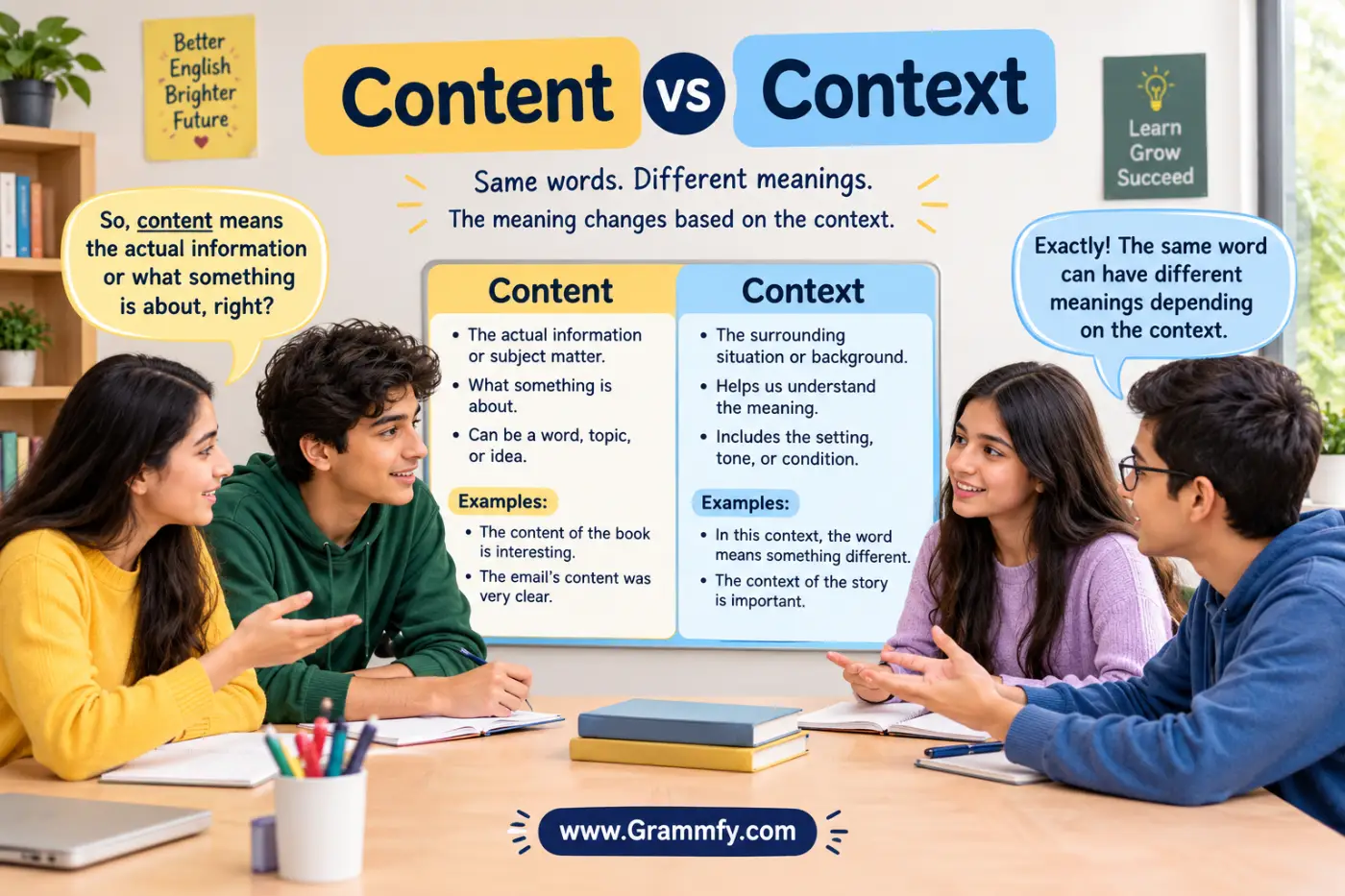
Have you ever written an email, essay, social media post, or text and wondered whether you were focusing on the content vs context? These two words are closely related, but they describe different parts of communication. Knowing the difference can help you understand messages more clearly and choose better words in your own writing.
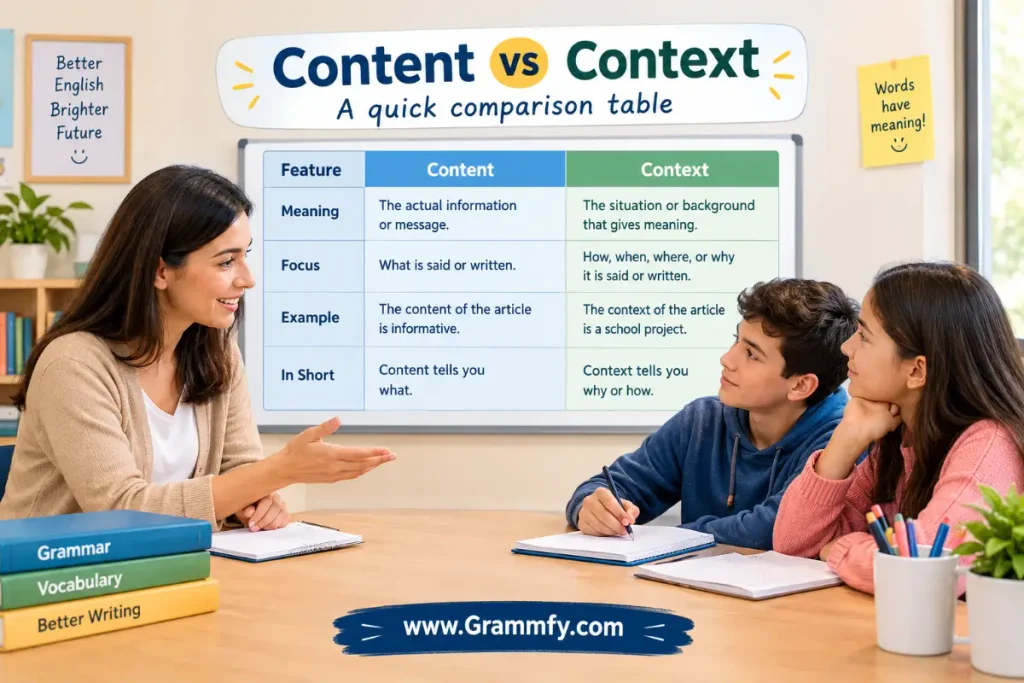
Content is the actual information, ideas, words, images, or material being communicated. Context is the surrounding information or situation that helps you understand that content correctly.
- Answer box: Content is what is said or included, while context is the situation, background, or surrounding information that explains what it means.
The difference matters in school, business, journalism, social media, conversations, and everyday life. A single sentence can have one meaning when you read it alone and a very different meaning when you know what happened before or after it.
This guide explains the meanings and origins of both words, gives a large synonym list, compares related terms, and shows how to use each word in resumes, essays, emails, texting, and conversation. You’ll also learn common mistakes and simple ways to choose the right word.
These words are easy to mix up, so read our guide to the difference between Since vs Sense to see their meanings and examples side by side.
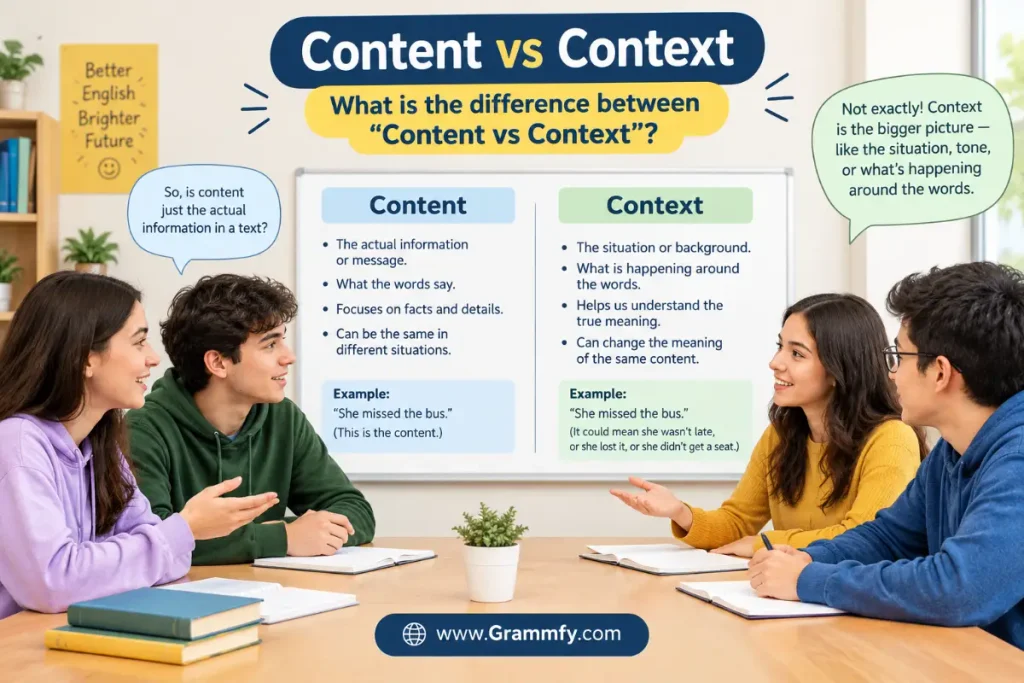
What is the difference between “Content vs Context”?
The easiest way to understand Content vs Context is to remember two questions:
Content answers: “What is being communicated?”
Context answers: “What surrounds it, and why does it mean what it means?”
For example, imagine someone sends you this text:
- “Fine.”
The word fine is the content. But its context could change how you understand it.
Maybe the person means:
- “Everything is okay.”
Or perhaps they are annoyed and mean:
- “Fine. Do whatever you want.”
The words themselves are the content. The previous conversation, tone, relationship, situation, and other clues provide context.
| Term | Simple meaning | Example |
|---|---|---|
| Content | What something contains or communicates | The article contains useful content. |
| Context | Background information surrounding something | The context explains why the article was written. |
Another example is a news report.
The content might include:
- facts
- quotes
- statistics
- photographs
- descriptions
- opinions
The context might include:
- what happened before
- where the event happened
- why it happened
- who was involved
- what happened afterward
- historical background
Without enough context, even accurate content can be misunderstood.
What does content mean in plain English?
Content refers to what something contains.
It can mean the actual material in a book, article, website, video, conversation, speech, or social media post.
Examples:
- The content of the book is easy to understand.
- This website has useful educational content.
- The video content explains basic grammar.
- Please check the content before publishing the article.
- The email contains important content.
Content can include almost anything that communicates information.
Content as information
One common meaning is information or ideas.
For example:
- The presentation contains valuable content.
Here, content means the information presented to the audience.
Content as material
Content can also refer to material published or shared online.
You might hear:
- blog content
- website content
- video content
- social media content
- educational content
- marketing content
- digital content
For example:
She creates educational content about English grammar.
This means she creates articles, videos, posts, or other materials that teach grammar.
Content as what something contains
The word can also refer to the physical or literal things inside something.
For example:
The contents of the box were damaged.
Here, contents means the things inside the box.
This use is slightly different from the way marketers talk about “content,” but the basic idea is still related to what something contains.
What does context mean in plain English?
Context is the information or situation surrounding something that helps you understand it.
Consider this sentence:
“I can’t believe you did that.”
By itself, it doesn’t tell us whether the speaker is angry, surprised, impressed, or joking.
The context might tell us.
If a friend just won a difficult competition, the sentence could express admiration.
If a friend made a serious mistake, it could express anger or disappointment.
The words are the content. The circumstances surrounding the words provide context.
Context in communication
Context can include:
- the speaker
- the listener
- location
- time
- previous events
- tone
- cultural background
- relationship between people
- purpose of communication
All these details can affect meaning.
Context in writing
In an essay, context can explain:
- historical background
- the author’s purpose
- the situation being discussed
- events leading up to a claim
- information needed to understand an argument
For example:
The writer criticizes the government’s decision.
Without context, you may not know which decision or why the writer criticized it.
Additional background makes the statement clearer.
Where did the word content come from?
The word content comes from Latin roots related to the idea of something being contained.
Its history connects naturally with its modern meanings. When we talk about the content of something, we’re talking about what it contains.
This is why the word works in several situations.
A container has contents.
A book has content.
A website has content.
A speech has content.
A video has content.
The word eventually developed broader meanings connected with the information and material contained in a work.
Why does content have different meanings?
Modern English uses content in several fields.
- In publishing, it means the material in a book or article.
- In digital media, it means material such as videos, posts, articles, and images.
- In communication, it can mean the actual information being expressed.
The central idea remains similar: what is contained or communicated.
Where did the word context come from?
Context comes from Latin and is related to the idea of things being woven or joined together.
That origin fits its modern meaning. Context is the surrounding information that connects an individual word, sentence, event, or idea to the larger situation.
Think about a single sentence taken from a long conversation.
The sentence may be clear grammatically, but its full meaning can depend on the words and events around it.
That surrounding material is context.
This is why people often say:
“You need to look at it in context.”
They mean you shouldn’t judge a statement or event based on one isolated piece of information.
What are the best synonyms for “Content vs Context”?
The right synonym depends on what you mean. Content can describe information, material, substance, or what something contains. Context can describe background, circumstances, setting, or surrounding information.
Here is a broad synonym guide.
| Word | Meaning | Tone | Example |
|---|---|---|---|
| Information | Facts or knowledge | Everyday | The article contains useful information. |
| Material | Things used or presented | Neutral | The course includes extra material. |
| Substance | Main ideas or meaning | Formal | The speech lacked substance. |
| Subject matter | Main topic | Formal | The subject matter is complex. |
| Data | Collected facts or figures | Technical | The report contains useful data. |
| Details | Specific pieces of information | Everyday | Check the details carefully. |
| Message | Main idea being communicated | Neutral | What is the message? |
| Meaning | What something communicates | Everyday | I understand the meaning now. |
| Theme | Main recurring idea | Academic | The story has a strong theme. |
| Substance | Important or meaningful material | Formal | The argument has substance. |
| Background | Information that explains something | Everyday | I need more background. |
| Setting | Situation or environment | Neutral | The setting changes the meaning. |
| Situation | Current conditions | Everyday | Consider the situation first. |
| Framework | Structure used to understand something | Formal | The framework provides context. |
| Perspective | A particular way of viewing something | Neutral | Consider her perspective. |
| History | Past events related to something | Neutral | You need to know its history. |
| Setting | Place and conditions | Neutral | The setting helps explain the scene. |
| Situation | Existing conditions | Everyday | The situation changed quickly. |
| Environment | Conditions around something | Neutral | The environment influences behavior. |
| Perspective | Point of view | Neutral | Her perspective is different. |
| Explanation | Information that makes something clear | Everyday | His explanation helped. |
| Framework | Structure surrounding an idea | Formal | The framework supports the argument. |
| Surrounding information | Details around a statement | Neutral | The surrounding information matters. |
Which synonyms are simple and easy to use?
For everyday English, these alternatives are usually the easiest.
Simple alternatives for content
- information
- material
- details
- ideas
- message
- meaning
- topic
Examples:
- The article contains useful information.
- The video provides helpful details.
- What’s the main message of the story?
Simple alternatives for context
- background
- situation
- setting
- circumstances
- surroundings
- background information
Examples:
- I need more background before I can understand this.
- The situation explains his reaction.
- The historical background is important.
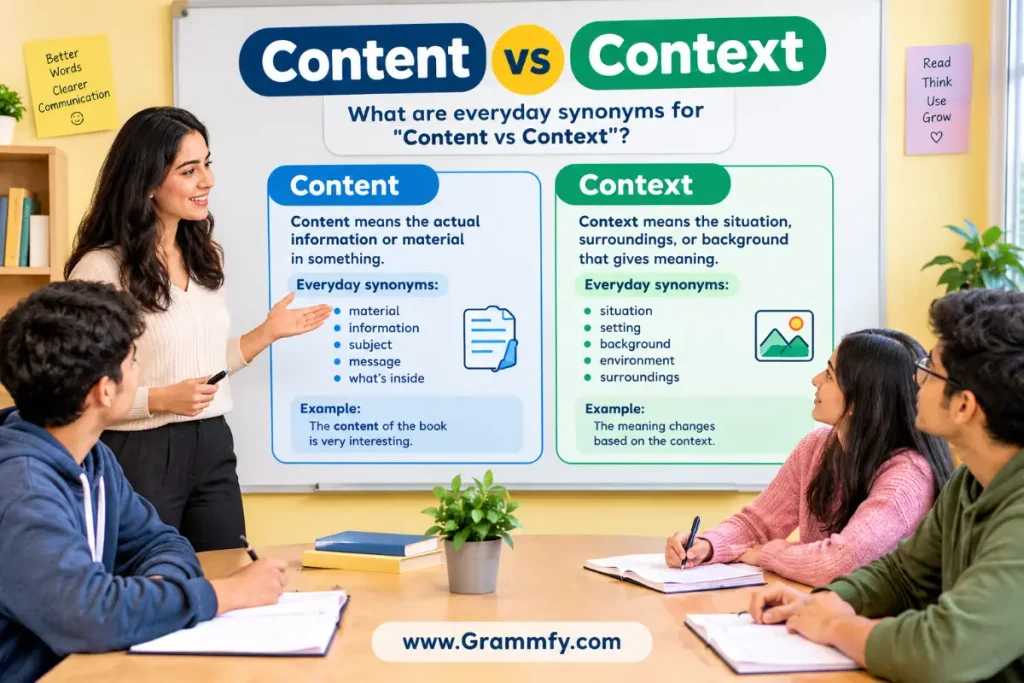
What are everyday synonyms for “Content vs Context”?
In normal conversation, people often use simple words instead of technical vocabulary.
| Concept | Everyday alternatives |
|---|---|
| Content | information, details, material, message, ideas |
| Context | background, situation, circumstances, setting, surroundings |
For example, instead of saying:
“The context of this statement is important.”
You might say:
“The background is important.”
But context is often the more precise word when you’re discussing communication or interpretation.
What are formal synonyms?
Academic and professional writing may use more precise terms.
For content, useful formal alternatives include:
- substance
- subject matter
- data
- material
- information
- argument
For context, useful formal alternatives include:
- circumstances
- framework
- historical background
- perspective
- environment
- surrounding conditions
Example:
- The historical context of the speech is essential to understanding its meaning.
This sounds appropriate in an academic essay.
Are there slang synonyms for content and context?
There aren’t many true slang replacements for context, because context is already a normal and widely used word.
Online conversations may use casual expressions such as:
- backstory
- the full story
- the whole picture
- the bigger picture
- the details
For content, informal terms may include:
- stuff
- material
- posts
- media
- stuff you’re sharing
For example:
Give me the backstory.
This can mean:
Give me the context.
However, backstory is not always a perfect synonym. It usually focuses on previous events rather than every surrounding factor.
How do content synonyms change by intensity?
Synonyms can carry different levels of importance.
Mild or general
These words are broad:
- information
- details
- material
- ideas
Example:
The website contains useful information.
More specific
These words can suggest a particular type of information:
- data
- evidence
- facts
- subject matter
- message
Example:
The report contains evidence supporting the claim.
Stronger or more evaluative
These words may suggest quality or importance:
- substance
- significance
- depth
- meaning
Example:
The article has real substance.
The word substance can suggest that something contains important or valuable ideas rather than empty material.
How do context synonyms change by intensity?
Context words can also vary.
Basic background
- background
- setting
- situation
These are broad and easy to understand.
More specific circumstances
- circumstances
- conditions
- environment
- historical setting
These give more detail about what surrounds an event.
Deeper interpretation
- perspective
- framework
- cultural background
- historical context
These can help explain why people understand an event or statement in different ways.
Is content a noun, adjective, or verb?
Content can have different grammatical roles depending on pronunciation and meaning.
As a noun, content means material, information, or what something contains.
The content is useful.
The plural form contents can refer to the things inside something.
The contents of the box were missing.
There is also an adjective content, meaning satisfied.
She was content with the result.
That adjective has a different pronunciation and meaning from the noun commonly used for information.
The verb content also exists, meaning to satisfy someone, although it is much less common in everyday modern English.
Is context a noun or verb?
Context is primarily a noun.
Examples:
- The context is important.
- We need more context.
- The historical context explains the decision.
English also has related forms such as:
- contextual
- contextually
For example:
- The meaning is contextual.
This means the meaning depends on the surrounding situation.
Content vs Context in communication: why does the difference matter?
Communication is rarely just about words.
Imagine your manager says:
- “We need to talk.”
That sentence is the content.
But context could include:
- You just made a mistake.
- The manager is smiling.
- It’s your annual performance review.
- The company is planning a new project.
- The manager previously praised your work.
Each detail could change how you interpret the message.
This is why communication experts often consider both the message and its surrounding circumstances.
A message without context can be misunderstood.
Context without content may not tell you enough about the actual message.
Good communication usually requires both.
Content vs Context in social media: why can posts be misunderstood?
Social media is one of the clearest examples of the difference.
A short post may contain only a few words. Someone who sees those words without the original conversation may interpret them incorrectly.
For example:
“Great job.”
Depending on context, this could be:
- sincere praise
- sarcasm
- humor
- criticism
The content stays the same.
The context changes the interpretation.
This is especially common when people share:
- screenshots
- short video clips
- headlines
- quotes
- memes
- short comments
A small piece of content may not contain enough context for someone who wasn’t there.
Content vs Context in journalism: what is the difference?
Journalists provide content such as:
- facts
- quotes
- statistics
- descriptions
- photographs
- video
But readers also need context.
Suppose a news story reports:
“The company lost $5 million.”
That’s content.
Context might explain:
- the company’s previous revenue
- whether the loss was expected
- whether the company had been profitable
- what caused the loss
- how the loss compares with the previous year
Without that information, readers may form the wrong impression.
Good journalism therefore doesn’t simply provide facts. It helps readers understand those facts.
Content vs Context in education: why do students need both?
Students often memorize content for tests.
Content might include:
- vocabulary
- formulas
- historical dates
- scientific facts
- grammar rules
- definitions
But context helps students understand how those facts connect.
For example, memorizing the definition of a historical event gives you content.
Understanding:
- what caused it
- who participated
- what happened before it
- what happened afterward
- why it mattered
provides context.
Context often makes information easier to remember because it gives facts a meaningful structure.
Which word is better in a resume “Content vs Context”?
Both words can appear in professional writing, but content is more common when describing work involving information or media.
Examples:
- Created educational content for an English-learning website.
- Developed written content for marketing campaigns.
- Reviewed website content for accuracy.
Context is useful when describing communication, research, analysis, or decision-making.
Examples:
- Analyzed customer feedback in the context of changing market conditions.
- Evaluated survey results within the broader business context.
A resume should use the word that describes the actual skill or activity.
Which word is better in an essay “Content vs Context”?
Both are extremely useful in academic writing.
Use content when discussing what a work contains.
The content of the article focuses on climate policy.
Use context when discussing the surrounding circumstances.
The historical context helps explain the author’s argument.
A strong essay may use both: “The content of the speech becomes clearer when examined in its historical context”.
This sentence works because the speech has actual material or ideas, while the historical background helps explain them.
Which word is better in texting “Content vs Context”?
In casual texting, context is common when someone wants the full story.
Examples:
I need some context here.
Give me the full context.
You might use content when talking about something someone posted or shared.
Examples:
I saw your new content.
That video is great content.
What kind of content do you usually post?
The two words can appear in the same conversation:
I saw the content, but I don’t know the context.
That’s a perfect example of the distinction.
Which word is better in an email “Content vs Context”?
Use content when discussing documents, articles, websites, presentations, or information.
Please review the content before Friday.
Use context when explaining why something needs to be understood in a particular way.
I wanted to provide some context before our meeting.
The phrase provide some context is especially useful in professional emails.
Example:
I’d like to provide some context before we discuss the results.
This tells the reader that additional background information will help them understand the issue.
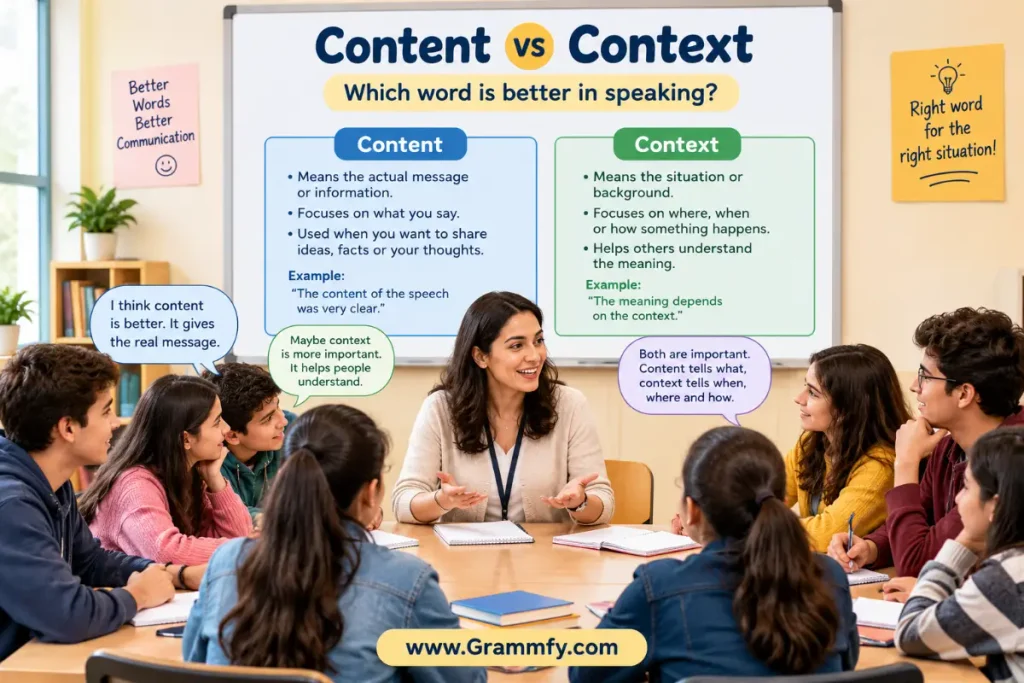
Which word is better in speaking “Content vs Context”?
In conversation, context is especially useful when someone needs more background.
You might say:
I don’t have enough context.
Let me give you some context.
For content, you might say:
What does the article contain?
I liked the content.
The presentation had useful content.
A natural speaker chooses the word based on whether they are talking about the material itself or the circumstances around it.
What are 12 real-life examples of “Content vs Context”?
Example 1: A text message
- “Sure.”
The word itself is the content. Whether it sounds friendly, annoyed, or uncertain depends on context.
Example 2: A news headline
- “Prices Increase Again.”
That’s the content of the headline. The article’s statistics, dates, causes, and economic background provide context.
Example 3: A school essay
- The essay contains strong content but needs more historical context.
The ideas are strong, but the writer needs to explain the background.
Example 4: A meeting
- I sent the presentation content before the meeting.
This refers to the material in the presentation.
Example 5: A disagreement
- You misunderstood my comment because you didn’t know the context.
The surrounding situation would have helped explain the comment.
Example 6: Social media
- The video was shared without its original context.
People saw the material but didn’t know the circumstances surrounding it.
Example 7: A book
- The book’s content is suitable for teenagers.
This refers to what the book contains.
Example 8: History
- You can’t understand the decision without knowing its historical context.
The background helps explain the decision.
Example 9: Marketing
- The company creates short-form video content.
This refers to the material produced for an audience.
Example 10: Research
- The researchers examined the data in the context of previous studies.
The data is the information being studied. Previous research provides the surrounding framework.
Example 11: A conversation
- Let me give you some context before I tell you what happened.
The speaker is preparing the listener with background information.
Example 12: An email
- The content of the email was clear, but the context was missing.
The email had understandable words, but the reader didn’t know the circumstances behind them.
Example 13: A presentation
- The presentation had useful content and enough context to explain the results.
Both terms are correct because the sentence refers to information and background.
Example 14: A quote
- Don’t judge the quote until you’ve read it in context.
The words may have a different meaning when separated from the surrounding text.
What does “out of context” mean?
Out of context means that something has been removed from the surrounding information needed to understand it properly.
For example, imagine someone says:“I hate this movie.”
But the complete conversation was:“I hate this movie at first, but the ending is amazing.”
If someone only shares the first sentence, the quote is out of context.
The words may be real, but the missing information changes the overall meaning.
This phrase is common in:
- journalism
- social media
- politics
- conversations
- academic writing
- online arguments
When someone says:“That quote was taken out of context.”
They mean that the surrounding information was removed or ignored.
What does “in context” mean?
In context means considering something together with the surrounding information.
For example:
- Read the sentence in context.
This means don’t look at the sentence alone. Read the sentences around it.
Another example:
- The statement makes more sense when viewed in context.
Here, the surrounding facts help explain the statement.
Content vs context: what’s the difference between information and background?
This is one of the closest comparisons.
Information is usually something you learn or receive.
Background is information that helps you understand a particular subject or event.
For example:
- The article provides information about the election.
But:
- The article provides background about previous elections.
The first focuses on the main information. The second focuses on supporting history.
Context can include background, but it can also include other things such as tone, location, timing, relationships, and circumstances.
Content vs context: what’s the difference between meaning and situation?
Meaning focuses on what something communicates.
Situation focuses on the circumstances in which something happens.
For example:
- The meaning of the sentence is unclear.
This is about interpretation.
- The situation was unusual.
This is about the circumstances.
Context can connect the two.
The situation can help explain the meaning.
Content vs context: which one describes a website?
Usually, content describes what a website publishes.
Examples:
- articles
- videos
- images
- guides
- product descriptions
- tutorials
- podcasts
You might say:
The website has helpful educational content.
Context is used when discussing the circumstances surrounding information on the website.
For example:
The article provides context for the historical event.
So a website can contain content, while individual pieces of that content can provide context.
Common mistakes with content and context
Mistake 1: Treating them as exact synonyms
They are related, but they’re not interchangeable.
Incorrect:
“The context of the website” when you actually mean the articles and videos it publishes.
Better:
“The content of the website.”
Mistake 2: Using context when you mean information
If you want someone to send you the actual details, say:
Please send me the information.
If you want them to explain the background, say:
Please provide some context.
Mistake 3: Assuming content always means written words
Content can include:
- text
- images
- audio
- video
- graphics
- data
- other media
So content is much broader than writing.
Mistake 4: Thinking context only means history
Historical background is one type of context, but context can also include the immediate situation, tone, location, timing, culture, and relationships.
Mistake 5: Confusing content with context in a quote
A quote can be accurate but still misleading if important context is missing.
Always consider what came before and after the quote.
When should you NOT use content?
Don’t use content when you specifically mean the surrounding circumstances.
For example:
❌ I don’t understand the content of his reaction.
If you mean the situation that explains the reaction, say:
✅ I don’t understand the context of his reaction.
Use content when you mean what is contained or communicated.
When should you NOT use context?
Don’t use context when you simply mean the material itself.
For example:
❌ The context of the website includes 50 articles.
Better:
✅ The content of the website includes 50 articles.
If you’re talking about articles, videos, images, or other material, content is usually the better choice.
What are the antonyms of content vs context?
Neither word has one perfect opposite in every situation.
For content, possible contrasts include:
- emptiness
- lack
- absence
- omission
For example:
The container was empty.
This contrasts with the idea of it having contents.
For context, possible contrasts include:
- isolation
- disconnection
- lack of background
- decontextualization
These words describe information that has been separated from the surrounding situation.
How can you remember the difference between “Content vs Context”?
Try this simple formula:
Content = the thing
Think:
What is actually there?
Words, ideas, facts, images, videos, and information are content.
Context = the surroundings
Think:
What helps me understand it?
Background, circumstances, history, tone, setting, and surrounding information are context.
Another useful memory trick is:
Content is inside. Context is around.
A book’s content is inside the book.
The context helps you understand the book in relation to its time, culture, author, and purpose.
Quick tips for choosing the right word “Content vs Context”
Use content when you’re talking about:
- information
- material
- articles
- videos
- images
- ideas
- facts
- messages
- what something contains
Use context when you’re talking about:
- background
- circumstances
- situation
- history
- setting
- surrounding information
- tone
- perspective
- reasons that help explain meaning
Ask yourself one question
If you’re unsure, ask:
Am I talking about what was said, or what helps explain it?
- If you’re talking about what was said or included, choose content.
- If you’re talking about what helps explain it, choose context.
A quick comparison table about “Content vs Context”
| Question | Content | Context |
|---|---|---|
| What is it? | The actual material | Surrounding information |
| Main question | What is being communicated? | What explains it? |
| Includes facts? | Yes | Can explain their background |
| Includes words? | Yes | Helps interpret the words |
| Includes videos? | Yes | Can explain the situation around them |
| Includes history? | Sometimes | Often |
| Includes circumstances? | No, usually | Yes |
| Used in digital media? | Very common | Common when discussing interpretation |
| Used in essays? | Very common | Very common |
| Used in emails? | Common | Common |
| Used in texting? | Common | Very common when asking for background |
Can content vs context appear in the same sentence?
Absolutely. In fact, using both can make a sentence more precise.
Examples:
- The content of the article is useful, but the historical context is missing.
- We need to understand the context before judging the content.
- The content explains what happened, while the context explains why it happened.
- The video contains important content, but viewers may need more context.
- Good writing includes both useful content and enough context for the reader.
These examples show why the two words shouldn’t be treated as interchangeable.
Why context can change the meaning of content
Words don’t always carry their full meaning by themselves.
Consider the word: “Interesting.”
That word could mean genuine praise.
It could also mean:
- surprising
- strange
- doubtful
- sarcastic
- mildly positive
The content is one word.
The context might include:
- who said it
- how they said it
- what happened before
- their facial expression
- their relationship with the listener
This is why effective communication requires more than simply choosing accurate words.
How does context improve writing?
Good context helps readers understand your point without guessing.
Suppose you write: “The company changed its policy”.
That’s content, but the reader may still have questions.
- What policy?
- Why did it change?
- When did it change?
- Who was affected?
- What happened afterward?
Adding context could produce: “The company changed its remote-work policy after a six-month review of employee productivity”.
Now the reader has more information about the circumstances.
The content is clearer because the context supports it.
How does content improve communication?
Context alone isn’t enough.
Imagine saying: “You know what happened.”
The listener may have context but not the actual information.
Clear content tells the audience what you’re trying to communicate.
Strong communication therefore often requires a balance:
Content gives the message.
Context gives the message meaning.
When both are present, readers and listeners are less likely to misunderstand you.
Content vs context in SEO and online writing
For online publishers, both ideas matter.
Content includes the actual material published on a website:
- blog posts
- guides
- FAQs
- images
- videos
- definitions
- examples
Context comes from the surrounding information that helps readers understand the topic.
For example, a grammar article should not only define a word. It can also explain:
- when to use it
- when not to use it
- related words
- common mistakes
- examples
- differences from similar terms
The definitions and examples are content. The explanations connecting those ideas create useful context for the reader.
This is especially important when explaining confusing words. A short definition may answer one question, but contextual examples can show how the word works in real communication.
Conclusion
Understanding Content vs Context becomes much easier when you separate the message from its surroundings. Content is the material itself: the words, facts, ideas, images, videos, or information being shared. Context is the background that helps you understand that material, including circumstances, timing, history, tone, setting, and purpose.
A useful rule is simple: content tells you what is there, while context helps explain what it means. This distinction is valuable in writing, speaking, journalism, education, social media, and professional communication. When you’re unsure which word to use, ask whether you’re describing the actual material or the information surrounding it. Once you learn that difference, you’ll be able to use both words naturally and accurately.
Frequently Asked Questions
What is the difference between content and context?
Content is the actual information or material being communicated, while context is the surrounding information that helps explain or interpret it. Content tells you what is there; context helps you understand it.
Is context the same as background?
Context can include background, but the two words aren’t always identical. Background usually refers to supporting information, while context can also include timing, tone, circumstances, location, relationships, and other surrounding factors.
What is an example of content and context?
A text message such as “Fine” is the content, while the previous conversation, tone, and situation provide the context. Those surrounding details can change how the message is understood.
What’s another way to say context?
Another way to say context is background, circumstances, situation, setting, surrounding information, perspective, or framework, depending on the sentence.
Is content the same as information?
Content can mean information, but it can also include other material such as images, videos, audio, and graphics. In digital media, the term often refers to anything created or published for an audience.
Why is context important in communication?
Context helps people understand the intended meaning of a message. Without it, a statement, quote, or event may be interpreted incorrectly.
Can you use content and context together?
Yes, and they often work together naturally. The content provides the actual message, while the context provides the background and circumstances needed to interpret that message accurately.
