
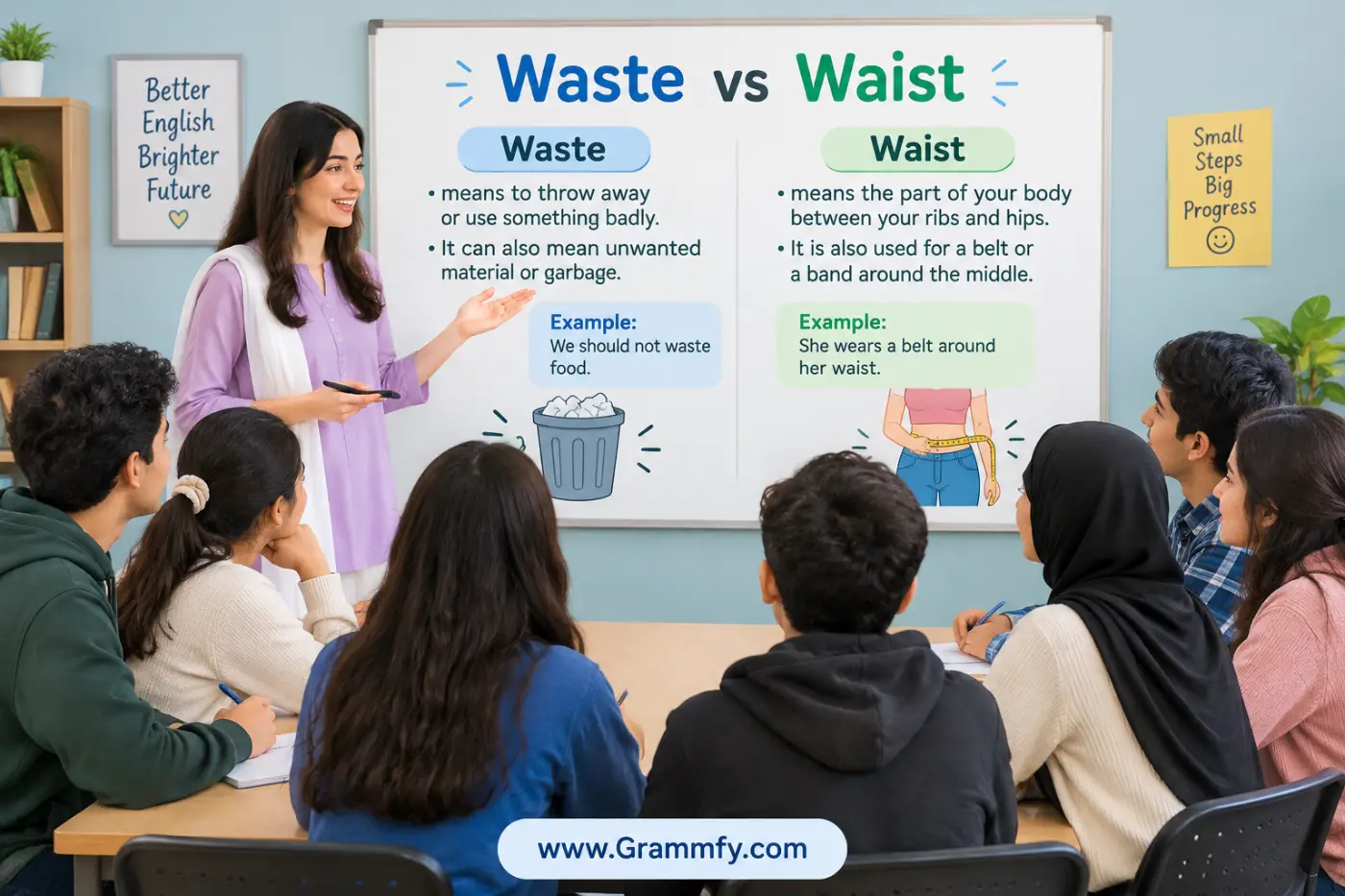
Have you ever been writing an email, essay, resume, or text and suddenly wondered whether you should type waste vs waist? These two words sound exactly the same in most varieties of English, but they have completely different meanings. One is mainly about using something carelessly, unwanted material, or the act of throwing something away. The other refers to the middle part of your body.
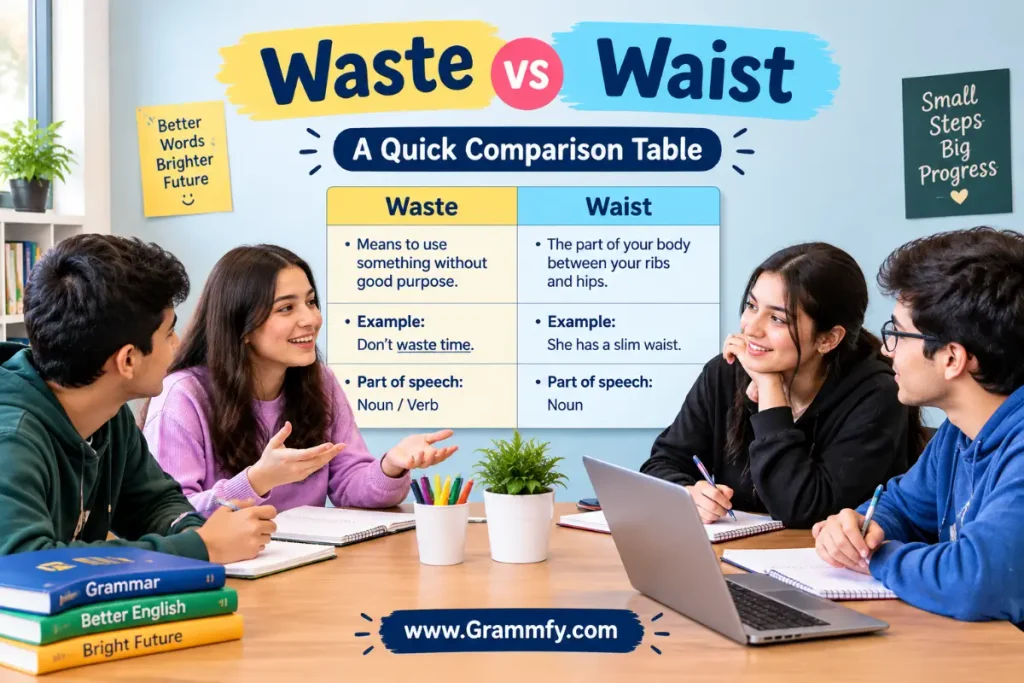
Waste means to use something carelessly, fail to use it well, or refer to unwanted material. Waist means the part of your body between your ribs and hips.
This small spelling difference can change the meaning of an entire sentence. Time, food, money, and opportunities can all be wasted. The word waist, however, refers to the middle part of your body, such as when you measure it or wear a belt around it. Since these words sound alike, their spelling depends entirely on the meaning of the sentence.
This guide explains their meanings, origins, synonyms, common mistakes, regional notes, and the best word to use in emails, resumes, essays, texts, and everyday speech. By the end, choosing the right spelling should feel easy.
For a closer look at another confusing word pair, explore [Save vs Safe].
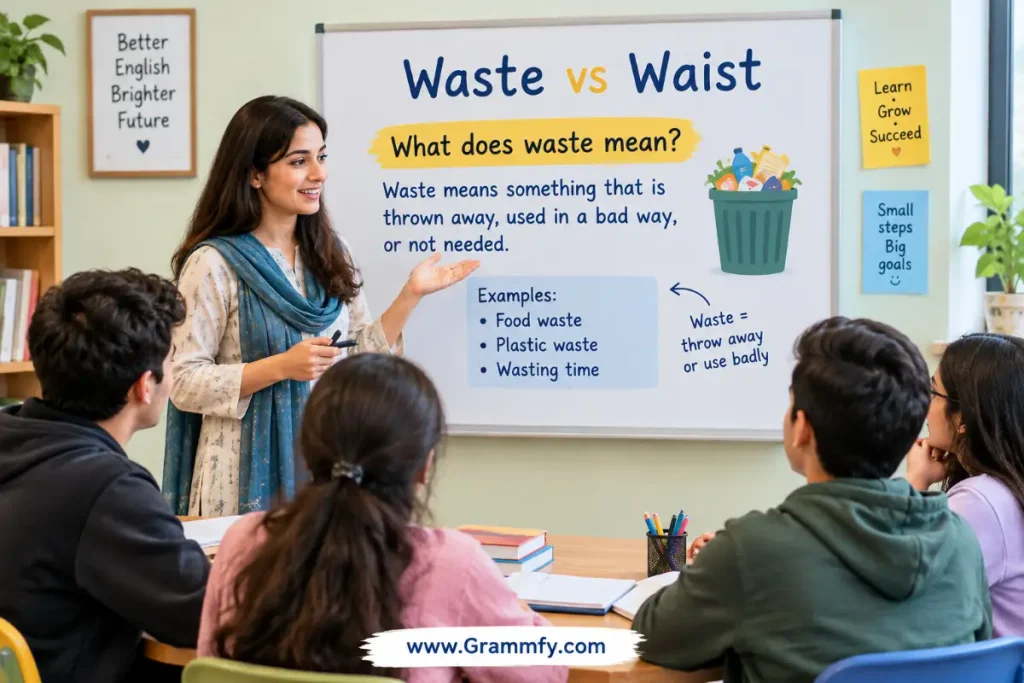
What does waste mean?
Waste has several related meanings, but they all connect to something being used badly, left unused, or thrown away.
As a verb, waste means to use more of something than necessary or to use something without getting a useful result.
- Don’t waste your time.
- We shouldn’t waste food.
- She wasted her money on things she didn’t need.
- He wasted an excellent opportunity.
As a noun, waste can mean unwanted material or the unnecessary use of something.
- Food waste is a serious problem.
- The factory produces a lot of industrial waste.
- We need to reduce water waste.
Waste can also describe a large empty or unused area, although this use is less common in everyday conversation.
- The travelers crossed a vast waste of land.
What does waist mean?
Waist is a body-related noun. It means the part of the human body between the ribs and the hips.
You might talk about your waist when discussing clothing, measurements, exercise, or body shape.
- This skirt is too tight around my waist.
- He wore a belt around his waist.
- The dress has a narrow waist.
- She measured her waist before buying the pants.
Unlike waste, waist is normally used as a noun. It does not mean to use something carelessly or throw something away.
Why are Waste vs Waist confusing?
The main reason is pronunciation.
In standard English, waste and waist are homophones. Homophones are words that sound alike but have different spellings and meanings.
For example:
| Word | Meaning | Sound | Example |
|---|---|---|---|
| Waste | Use carelessly or unwanted material | Same as “waist” | Don’t waste water. |
| Waist | Middle part of the body | Same as “waste” | My waist hurts. |
This is why the mistake often happens when people are writing rather than speaking. When you hear the words, there is usually no clue about the spelling. Context tells you which meaning is intended.
A simple memory trick is:
Waist has “waistline,” and both are related to the body. Waste is everything else related to using, losing, or throwing something away.
Where did waste come from?
The word waste has a long history. It comes through Middle English and Old French from Latin vastus, meaning empty, deserted, or unoccupied.
Over time, its meanings expanded. The idea of something being empty or unused became connected with land that was unproductive. From there, the word developed meanings related to using something unnecessarily, destroying value, or producing unwanted material.
Today, waste is used in many contexts:
- waste time
- waste money
- waste food
- waste energy
- waste resources
- household waste
- industrial waste
- food waste
- waste management
The common idea is something valuable being unused, misused, or discarded.
Where did waist come from?
Waist also has an interesting history. It comes from Old English wæst, which referred to the waist or middle part of the body.
The spelling changed over centuries, eventually becoming the modern English waist.
Unlike waste, its meaning has stayed closely connected to the body. Modern English uses it for the area between the chest and hips.
This is a useful clue: if you’re talking about anatomy, clothing, body measurements, or a belt, waist is almost certainly the word you need.
Waste vs Waist: what’s the basic difference?
The easiest way to remember the difference is to focus on the subject of your sentence.
| Word | Basic meaning | Usually used for | Example |
|---|---|---|---|
| Waste | Use badly, use unnecessarily, or unwanted material | Time, money, food, energy, resources, garbage | Don’t waste your time. |
| Waist | Middle section of the body | Body, clothing, measurements, belts | The belt fits my waist. |
Try this test:
Can you put “body” or “clothing” after the word?
If yes, you probably need waist.
Are you talking about time, money, food, energy, resources, or garbage?
If yes, you probably need waste.
Master synonym list for Waste vs Waist
Not every synonym works in every sentence. Some words are close in meaning but have different tones or uses. The table below separates common alternatives so you can choose naturally.
| Word | Meaning | Tone | Example |
|---|---|---|---|
| Waste | Use badly or unnecessarily | Everyday | Don’t waste your time. |
| Squander | Spend carelessly | Strong/Formal | He squandered his savings. |
| Disposal | Getting rid of something | Formal | Safe disposal is important. |
| Garbage | Unwanted household material | Everyday | Take out the garbage. |
| Trash | Unwanted material | Everyday/US | Put the trash in the bin. |
| Refuse | Waste material | Formal | The city collects household refuse. |
| Debris | Scattered pieces left after damage | Neutral/Formal | Workers cleared the debris. |
| Scrap | Leftover material | Everyday/Technical | The metal was sold as scrap. |
| Discard | Throw something away | Neutral | Discard damaged packaging. |
| Throw away | Get rid of something | Everyday | Don’t throw away that box. |
| Ditch | Abandon or get rid of something | Informal | He ditched the old plan. |
| Fritter away | Waste gradually | Informal | He frittered away his free time. |
| Idle away | Spend time doing little | Informal | They idled away the afternoon. |
| Exhaust | Use up a supply | Neutral/Formal | The project exhausted our resources. |
| Consume | Use something | Neutral/Formal | The machine consumes energy. |
| Overuse | Use too much | Neutral | Overuse can damage the equipment. |
| Waist | Middle of the body | Neutral | The dress fits her waist. |
| Midsection | Middle area of the body | Neutral | The exercise strengthens your midsection. |
| Waistline | Measurement or shape around the waist | Neutral | The pants have a high waistline. |
| Abdomen | Area of the body containing many organs | Medical/Formal | The injury affected his abdomen. |
| Torso | Upper body excluding head and limbs | Neutral/Formal | The shirt covers the torso. |
| Beltline | Area around the waist | Everyday | The jacket ends near the beltline. |
Notice that the last group contains words connected to waist, while most of the earlier words relate to waste.
Which words can replace waste?
The best synonym depends on what you’re describing.
Waste time → squander, misuse, fritter away
These choices are close but not identical.
- Don’t waste your time.
- Don’t misuse your time.
- Don’t squander your time.
- Don’t fritter away your time.
Waste is the most general choice.
Squander suggests that something valuable was used carelessly.
Fritter away suggests wasting something gradually, often in small amounts.
Misuse usually means using something incorrectly rather than simply failing to use it productively.
Waste money → squander, overspend, spend carelessly
For money, several alternatives work:
- waste money
- squander money
- overspend
- spend carelessly
- throw money away
They differ in strength.
Waste money is neutral.
Squander money sounds stronger and suggests poor judgment.
Throw money away is informal and often emphasizes that the spending was obviously pointless.
Waste material → garbage, trash, rubbish, refuse
The right choice depends partly on the type of material and the region.
- Garbage is common in American English for household waste.
- Trash is also very common in American English.
- Rubbish is especially common in British English.
- Refuse is more formal.
- Debris usually refers to scattered remains rather than ordinary household garbage.
- Litter means waste left in inappropriate public places.
Synonyms for waste by intensity
Different words show different levels of criticism.
| Intensity | Word/Phrase | Meaning |
|---|---|---|
| Mild | Use unnecessarily | Use something without a strong reason |
| Mild | Overuse | Use more than needed |
| Mild | Inefficient use | Use something less effectively |
| Moderate | Waste | Fail to use something well |
| Moderate | Misuse | Use something incorrectly |
| Moderate | Throw away | Get rid of something |
| Strong | Squander | Waste something valuable carelessly |
| Strong | Fritter away | Waste gradually and pointlessly |
| Strong | Throw money away | Spend money with little or no benefit |
For example, saying “You used the money inefficiently” sounds much less critical than “You squandered the money.”
What are the parts of speech for waste and waist?
Understanding grammar can make the spelling easier.
Waste as a Noun
The word waste can describe something related to unwanted material.
- Food waste is increasing.
- The project resulted in a waste of resources.
Waste as a verb
When used as a verb, waste means to use something carelessly or unnecessarily.
- Don’t waste water.
- She wasted her opportunity.
Waste as an adjective
The word waste can describe something related to unwanted material.
- The city built a new waste facility.
- Waste management requires careful planning.
Waste as a plural noun
In some contexts, wastes can refer to large, empty, or uncultivated areas.
- The explorers traveled across the frozen wastes.
Waist as a noun
Waist is normally a noun.
- My waist measures 30 inches.
- The shirt fits around my waist.
It can also appear in compound words:
- waistline
- waistband
- waistcoat
- waist-high
How is waist used in clothing?
Waist appears frequently when talking about clothes.
You may see phrases such as:
- waist size
- waist measurement
- waistline
- waistband
- high-waisted
- low-waisted
- waist-high
Examples:
- These jeans have a 30-inch waist.
- The waistband feels tight around my waist.
- She prefers high-waisted pants.
- The skirt sits at the natural waist.
If the sentence is about how clothing fits around the body, waist is the correct spelling.
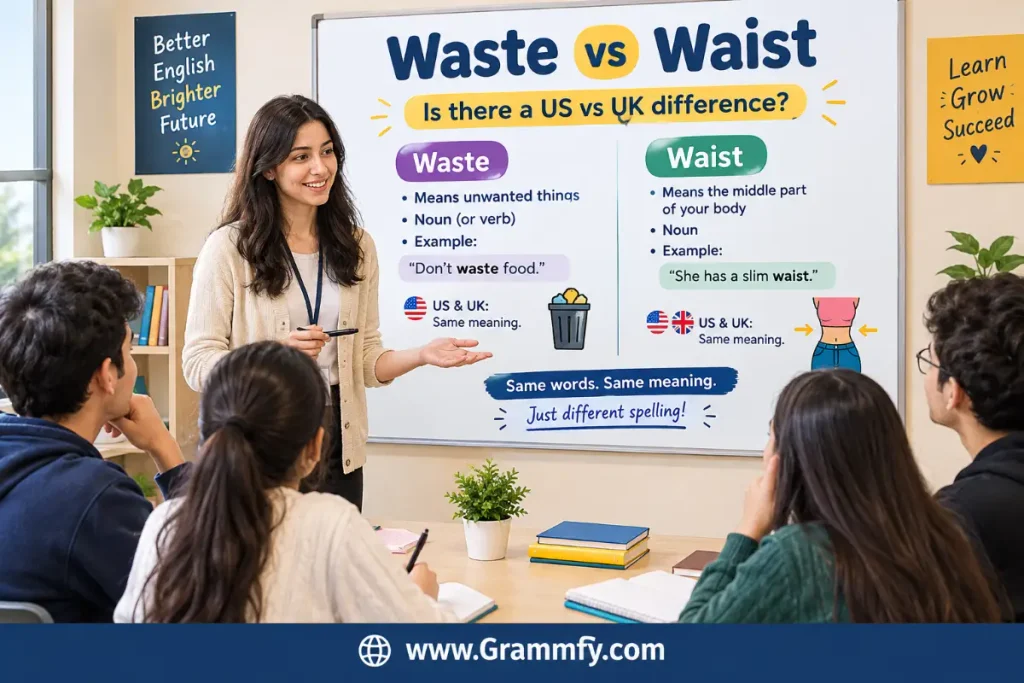
Is there a US vs UK difference?
The spelling waste and waist is the same in both American and British English.
The main regional difference involves some synonyms for waste.
| American English | British English | Meaning |
|---|---|---|
| Trash | Rubbish | Unwanted material |
| Garbage | Rubbish | Household waste |
| Trash can | Bin | Container for waste |
| Garbage can | Bin | Waste container |
| Dumpster | Skip/dumpster | Large waste container |
The word waste itself remains standard in both varieties.
Likewise, waist is spelled the same in American and British English.
So if you’re writing for a US audience, you don’t need a different spelling for either word.
What’s the best word for a resume Waste vs Waist?
For a resume, waste is usually useful when describing efficiency, resources, or improvements.
Avoid casual alternatives such as “throw away” unless you’re directly describing a job task.
Better resume language includes:
- Reduced material waste by 15%.
- Improved production efficiency and reduced waste.
- Helped reduce food waste in the kitchen.
- Developed a system to minimize resource waste.
- Reduced time waste through better scheduling.
A resume should focus on measurable results. Instead of saying:
I stopped wasting materials.
Try:
Reduced material waste by improving inventory control.
The second version sounds more professional and shows the result clearly.
Waist may appear on a resume only when it is directly relevant to the job, such as clothing, fashion, tailoring, fitness, or costume design.
Example:
Measured customers’ waist sizes and adjusted garments for proper fit.
What’s the best word for an essay Waste vs Waist?
For an essay, waste is common and flexible.
It can appear in discussions about:
- environmental issues
- education
- economics
- time management
- food
- energy
- natural resources
- consumer behavior
Examples:
Reducing food waste can help families save money.
Many students worry that excessive screen time wastes valuable study time.
For formal academic writing, more specific terms can sometimes be stronger than simply using waste.
Instead of:
The factory wastes a lot of water.
You could write:
The factory uses excessive amounts of water.
Or:
The factory has inefficient water consumption practices.
For waist, use the word when discussing anatomy, clothing, body measurements, or physical descriptions.
What’s the best word for texting Waste vs Waist?
In casual texting, waste is extremely common.
- Don’t waste your time 😂
- What a waste of money!
- Don’t waste food.
- I wasted my whole afternoon.
Waist is also common when the conversation is about clothes or the body.
- What waist size do you wear?
- These jeans are tight around my waist.
- I need to measure my waist.
The trick is to think about the subject, not the sound.
What’s the best word for an email Waste vs Waist?
In a professional email, waste often appears when discussing efficiency.
For example:
We should avoid wasting time on tasks that don’t support the project.
Or:
The new process should reduce material waste.
If you’re discussing clothing measurements, use waist:
Please provide your waist measurement before we finalize the order.
Using the wrong spelling in an email can make the message look careless, even when the meaning is obvious from context.
What’s the best word when speaking Waste vs Waist?
When speaking, the difference is not something you can hear because the words are normally pronounced alike.
That means your listener relies on context.
For example:
I need to measure my waist.
and
I don’t want to waste my time.
The surrounding words make the meaning clear.
This is also why spelling practice matters. You may use both words correctly in conversation but confuse them when typing.
10+ real-life examples of Waste vs Waist
Here are examples from different situations.
Example 1: Time
Don’t waste your time arguing about something you can’t change.
Here, waste means to use time without a useful result.
Example 2: Food
Please don’t waste food when there are people who could use it.
Here, waste refers to using food carelessly or throwing it away unnecessarily.
Example 3: Money
Buying something you don’t need can waste your money.
Here, waste is a verb describing poor use of money.
Example 4: Clothing
This jacket feels tight around my waist.
Here, waist refers to the middle part of the body.
Example 5: Measurement
The tailor measured my waist before making the trousers.
The sentence concerns a body measurement, so waist is correct.
Example 6: Environment
Recycling can help reduce household waste.
Here, waste means unwanted material.
Example 7: Opportunity
Don’t waste the opportunity to learn a new skill.
The opportunity is valuable, so waste means failing to use it properly.
Example 8: Exercise
This exercise strengthens your waist and core muscles.
The sentence concerns the body, so waist is correct.
Example 9: Energy
Turn off the lights when you leave to avoid wasting electricity.
Here, wasting means using electricity unnecessarily.
Example 10: Public places
Leaving plastic bottles on the sidewalk creates litter and waste.
Here, waste means discarded material.
Example 11: Fashion
The dress has a belt that sits naturally at the waist.
The word refers to the body’s middle section.
Example 12: Work
Better planning can prevent employees from wasting valuable work hours.
The sentence is about inefficient use of time.
Example 13: Household chores
We separate food waste from recyclable materials.
Here, waste is a noun.
Example 14: Clothing design
The designer created a dress with a fitted waist.
The sentence describes the shape of clothing around the body.
Waste vs Garbage: what’s different?
Waste is broader than garbage.
Garbage usually refers to unwanted material, especially household material.
Compare:
We need to reduce food waste.
This means we should prevent edible food from being unnecessarily discarded.
Take the garbage outside.
This refers to physical household trash.
You can waste time, but you cannot normally call time garbage.
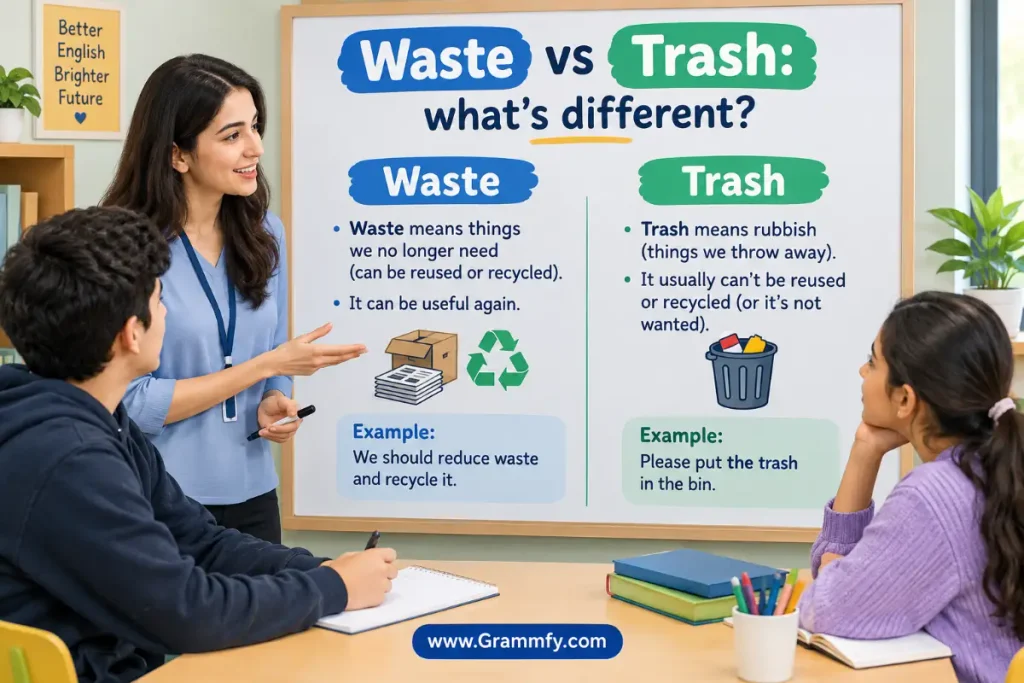
Waste vs Trash: what’s different?
Trash usually means unwanted physical material, especially in American English.
Waste has a much wider meaning.
Compare:
| Word | Main use | Example |
|---|---|---|
| Waste | Physical material or unnecessary use | Don’t waste electricity. |
| Trash | Unwanted physical material | Put the trash in the bin. |
You can say:
Don’t waste your money.
But you cannot normally say:
Don’t trash your money.
The words overlap when discussing discarded material, but they are not interchangeable everywhere.
Waste vs Litter: what’s different?
Litter is waste that has been left in an inappropriate place, especially outdoors or in public areas.
For example:
Someone left litter on the beach.
The word emphasizes the location and careless behavior.
Waste is more general:
The company needs a better waste-management system.
You can have waste inside a home, factory, hospital, restaurant, or office without calling it litter.
Waste vs Misuse: what’s different?
These words are closely related, but misuse focuses on using something incorrectly.
Don’t misuse the equipment.
This suggests the equipment is being used in a way it wasn’t designed for.
Don’t waste the equipment.
This suggests the equipment is being used unnecessarily, left unused, damaged, or otherwise treated as though its value doesn’t matter.
Similarly:
Don’t misuse your authority.
means use authority in an improper way.
Don’t waste your authority.
would suggest failing to use authority effectively or allowing an opportunity to have no useful result.
Common mistakes with Waste vs Waist
Mistake 1: “Don’t waist your time.”
Incorrect:
Don’t waist your time.
Correct:
Don’t waste your time.
Time is something you can use inefficiently, so the correct word is waste.
Mistake 2: “My waste is 32 inches.”
Incorrect:
My waste is 32 inches.
Correct:
My waist is 32 inches.
A body measurement uses waist.
Mistake 3: “This belt fits my waste.”
Incorrect:
This belt fits my waste.
Correct:
This belt fits my waist.
Belts go around the waist.
Mistake 4: “Don’t waste food” when you mean the body
If you’re describing a body part, don’t use waste.
Correct:
The fabric rests around the waist.
Mistake 5: “Waist money”
Incorrect:
I don’t want to waist money.
Correct:
I don’t want to waste money.
Money can be wasted, not “waisted.”
When should you NOT use waste?
Don’t use waste simply because a word sounds like it.
If you’re referring to:
- the middle of the body
- clothing measurements
- a waistband
- a belt
- body shape
- a waistline
use waist.
Also, choose a more specific word when the context demands one.
For example, if you’re talking about physical garbage left on a street, litter may be more precise than waste.
If you’re talking about broken pieces after a building collapses, debris may be better.
If you’re talking about money spent carelessly, squander may communicate stronger criticism.
When should you NOT use waist?
Don’t use waist when you’re discussing:
- time
- money
- food
- energy
- resources
- opportunities
- garbage
- unnecessary spending
- discarded materials
For example:
We shouldn’t waste electricity.
Not:
We shouldn’t waist electricity.
Likewise:
She wasted her chance.
Not:
She waisted her chance.
What are the antonyms of waste?
The opposite of waste depends on the meaning.
When waste means using something badly, possible antonyms include:
- use
- save
- conserve
- preserve
- utilize
- manage
- optimize
- protect
Examples:
Don’t waste water. Conserve it.
Don’t waste your time. Use it wisely.
Don’t waste money. Save it.
When waste refers to unwanted material, the opposite idea may involve:
- resource
- useful material
- reusable material
- product
- asset
There is no single antonym that works in every sentence.
Does waist have an opposite?
Waist is a body-part noun, so it doesn’t have a direct antonym.
However, words such as shoulder, chest, hip, and ankle can identify other body areas.
For example:
- shoulder = upper body near the arm
- chest = front upper part of the torso
- waist = middle section
- hip = area below the waist
- ankle = joint between the foot and lower leg
These are related body terms, not true antonyms.
How can you remember the spelling?
A simple memory trick is:
Think “waistline” for the body
Waist is related to:
- waistline
- waistband
- waist size
- waist-high
- high-waisted
If you’re talking about clothes or the body, remember the I in waist.
Think “waste” for things you don’t want to lose
Waste is connected with:
- waste time
- waste money
- waste food
- waste energy
- waste resources
- waste material
A useful sentence to remember is:
Don’t waste your time; measure your waist.
The two words sound alike, but their meanings are completely different.
Quick decision guide: which spelling should you choose?
Use this checklist before you type.
Choose waste if you’re talking about:
- time
- money
- food
- water
- energy
- resources
- opportunities
- materials
- garbage
- unnecessary use
- poor spending
- discarded items
Examples:
Don’t waste your time.
Food waste is a major issue.
We need to reduce energy waste.
Choose waist if you’re talking about:
- the middle of the body
- clothing
- belts
- body measurements
- waistlines
- body shape
- waistbands
Examples:
My waist hurts.
The pants fit my waist.
She has a 28-inch waist.
A quick comparison table
| Question | Correct word | Example |
|---|---|---|
| Can you waste time? | Waste | Yes, don’t waste time. |
| Can you waste money? | Waste | Don’t waste your money. |
| Can you waste food? | Waste | Try not to waste food. |
| Can you waste energy? | Waste | Turn off unused lights to avoid waste. |
| Is the middle of your body your waist? | Waist | Your waist is between your ribs and hips. |
| Does a belt go around your waist? | Waist | The belt fits around my waist. |
| Can you measure your waist? | Waist | Measure your waist for the correct size. |
| Is household garbage a type of waste? | Waste | Household waste needs proper disposal. |
| Is a waist a type of garbage? | Neither | Waist refers to the body. |
| Are waste and waist pronounced alike? | Yes | They are homophones in standard English. |
7 quick tips for choosing the right word Waste vs Waist
- Think about the meaning, not the sound.
They sound alike, but their meanings are different. - Look for body-related clues.
Clothes, belts, measurements, and body shape usually point to waist. - Look for resource-related clues.
Time, money, food, water, and energy usually point to waste. - Remember “waistline.”
The spelling helps connect waist with the body. - Remember “waste time.”
If you’re talking about using something badly, choose waste. - Check whether the word is a noun or verb.
Waste can be a noun or verb. Waist is normally a noun. - Read the entire sentence.
Since these words sound the same, the surrounding words usually reveal the correct spelling.
Conclusion
Knowing the difference between Waste vs Waist comes down to one simple idea: waste is about poor use, unnecessary loss, or unwanted material, while waist is about the middle of the body. The words sound the same, so spelling can be tricky, especially when you’re writing quickly. When you see words such as time, money, food, energy, or resources, think waste. When you see belt, clothing, measurement, or body, think waist. If you’re still unsure, read the whole sentence and identify what the word describes. With a little practice, this homophone pair becomes easy to separate. Keep the body connection in mind for waist, and you’ll have a simple way to choose the correct spelling every time.
Frequently Asked Questions
What is the difference between waste and waist?
Waste refers to using something carelessly or to unwanted material, while waist refers to the middle part of the body. They sound alike but have different meanings and spellings.
Is it waste time or waist time?
It is waste time. You waste time when you use it without a useful purpose.
Is it waist size or waste size?
It is waist size. A waist size describes the measurement around the middle of your body.
What’s another way to say waste?
Another way to say waste depends on the context: you can use squander, misuse, discard, overuse, garbage, trash, refuse, or litter for different meanings.
Are waste and waist homophones?
Yes, waste and waist are homophones in standard English because they normally have the same pronunciation but different meanings and spellings.
Can I use waist for money or time?
No. Use waste for money or time. For example, “Don’t waste your money” and “Don’t waste your time” are correct.
How can I remember waste vs waist?
Think of waist as a body word connected to your waistline, while waste is connected to things such as time, money, food, energy, and unwanted material.
