
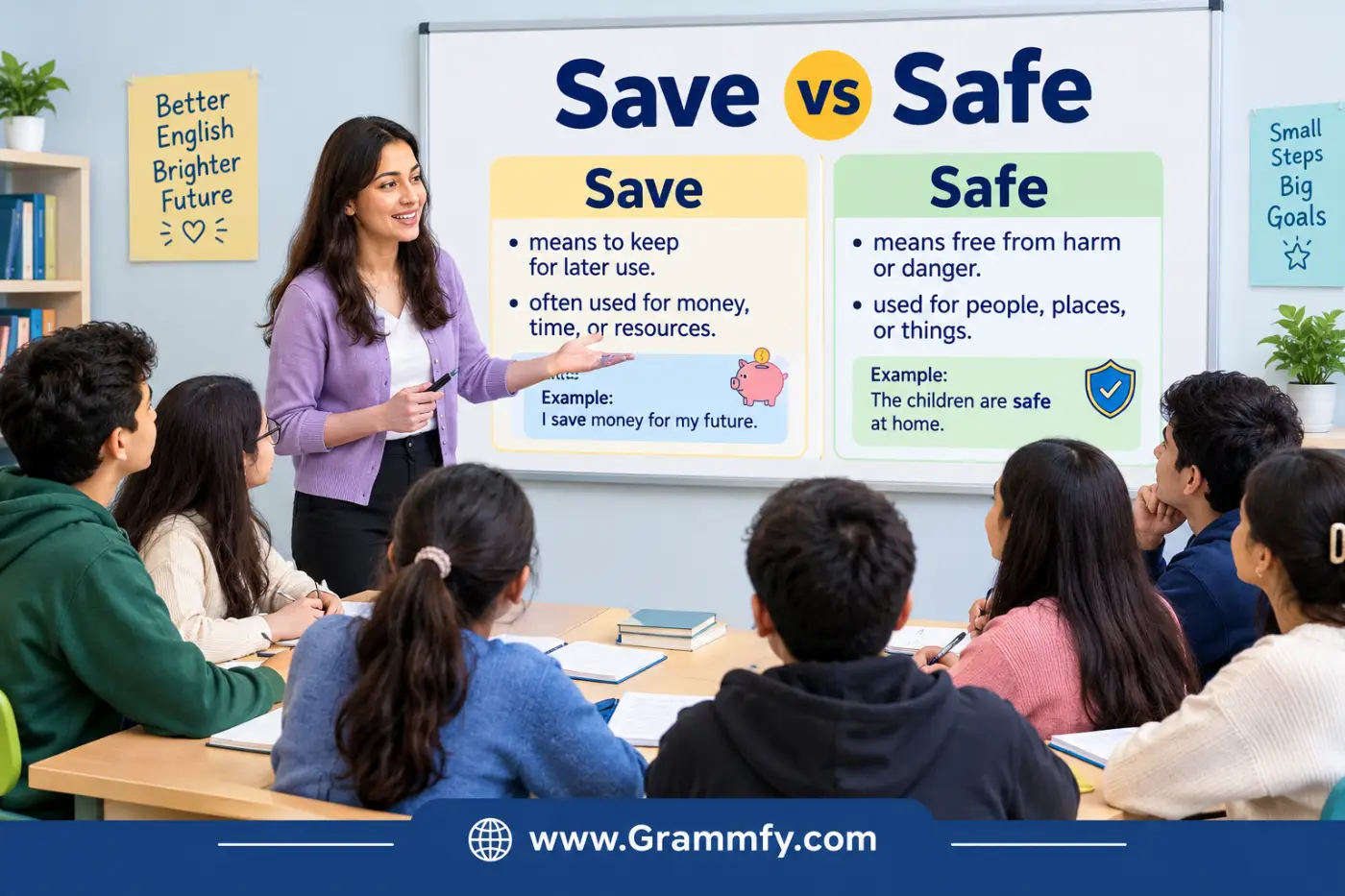
You’re writing an email, essay, resume, or text, and you suddenly wonder: should you write save vs safe? These two words look and sound similar, but they have different jobs in a sentence. One is mainly an action word, while the other describes a condition or state.
Save usually means to keep something, prevent harm, rescue someone, or avoid spending something. Safe means protected from danger, harm, damage, or risk.
Answer box: Use save when you mean “keep,” “rescue,” or “prevent loss.” Use safe when you mean “protected from danger or harm.”
The confusion is understandable because the words are only one letter apart, and their pronunciation can sound similar in fast speech. Still, their meanings are easy to separate once you know what role each word plays.
This guide covers their meanings, origins, grammar, synonyms, examples, common mistakes, regional notes, and the best choice for everyday, academic, professional, and online writing.
For more help with commonly confused words, check out [Violate vs Breach].
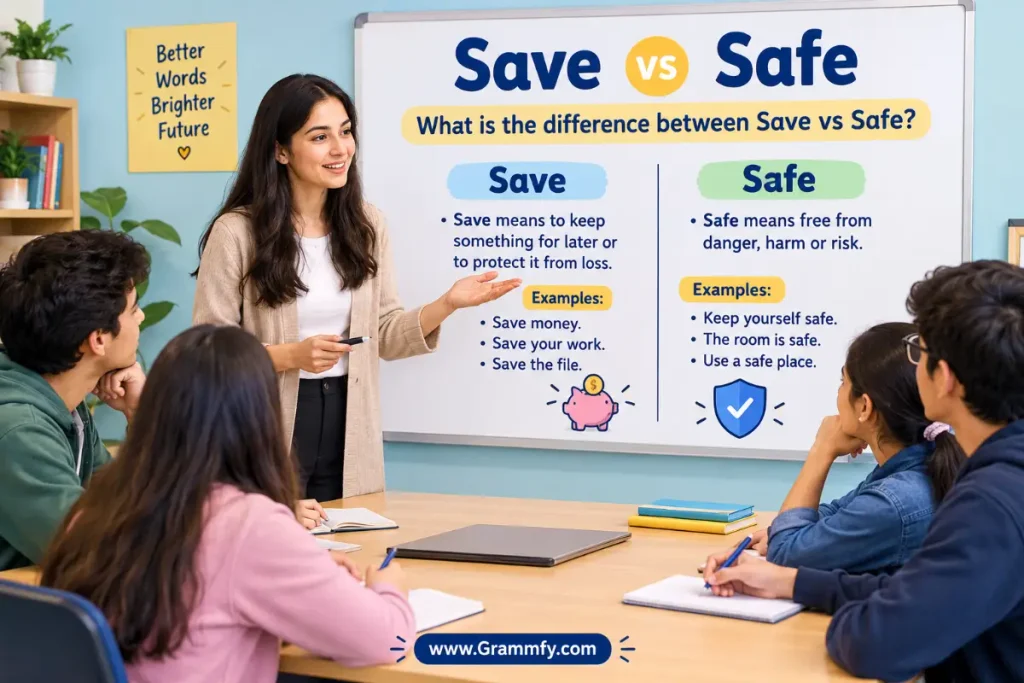
What is the difference between Save vs Safe?
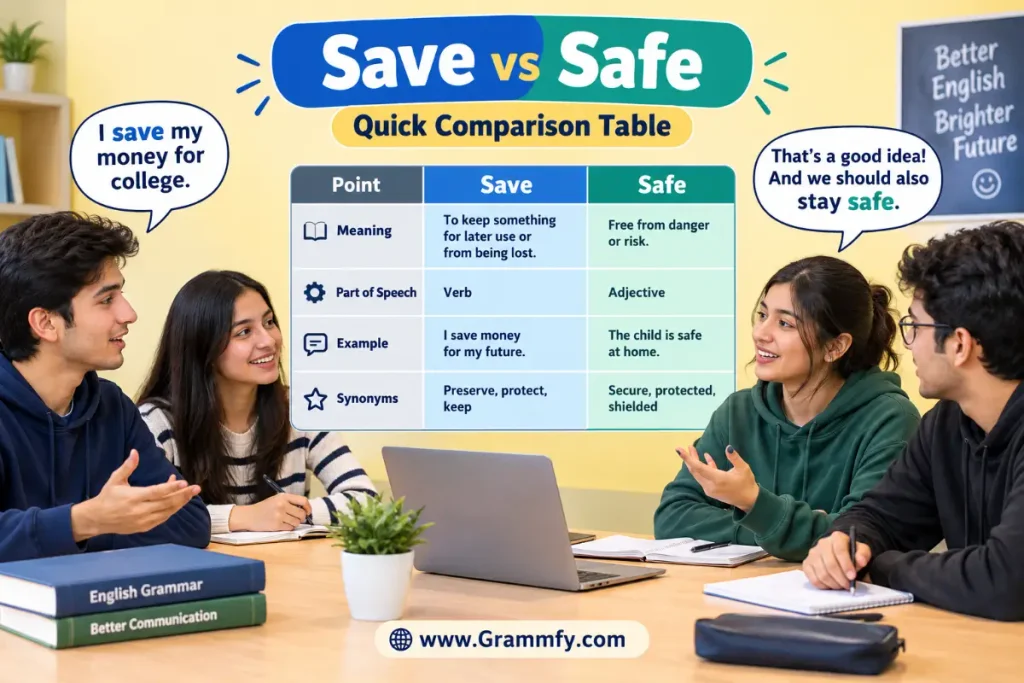
The biggest difference is simple: save is usually a verb, while safe is usually an adjective.
A verb tells us about an action. A person can save money, save a file, save a life, or save time.
An adjective describes a person, place, thing, or situation. Someone can be safe. A building can be safe. Your files can be safe. A road can be safe.
Compare these sentences:
- Please save this document.
- Your document is safe on the backup drive.
- We need to save money.
- The children are safe at home.
- The firefighter saved the child.
- The child is now safe.
The words can appear in the same situation, but they don’t mean the same thing.
A useful shortcut is:
Save = do something to keep or protect.
Safe = be protected or free from danger.
Is save a verb or an adjective?
Save is mainly a verb, although it can have other grammatical uses in English.
As a verb, save can mean several things.
Save means keep something
“Save the file before closing the program.”
Here, save means to keep the information so it isn’t lost.
Save means rescue someone
“The lifeguard saved the swimmer.”
The action prevented the swimmer from drowning.
Save means avoid using something
“I’m saving my money for college.”
The person is keeping the money instead of spending it now.
Save means prevent something bad
“Wearing a seat belt may save your life.”
The action can prevent death or serious injury.
Save can mean reserve something
“Can you save me a seat?”
This means keeping a seat available for someone.
The meaning changes with context, but the central idea is often keeping, protecting, or preventing loss.
Is safe a verb or an adjective?
Safe is primarily an adjective.
It describes something that isn’t exposed to unacceptable danger, damage, or harm.
Examples:
- The children are safe.
- Your money is safe.
- This neighborhood feels safe.
- Is the food safe to eat?
- The files are safe from damage.
- We arrived home safely.
Notice the difference between safe and safely.
“The driver is safe.”
This describes the driver.
“The driver arrived safely.”
This describes how the driver arrived.
The adjective is safe, while the adverb is safely.
Where do Save vs Safe come from?
Their histories are different, even though they look similar today.
Where does save come from?
Save developed from older French and Latin-related forms connected with the idea of making something safe or preserving it. Over time, English developed several related meanings, including rescuing, preserving, and keeping something from being lost.
This explains why modern English uses save in many different ways.
You can:
- save a person
- save money
- save time
- save a file
- save a document
- save energy
- save food
- save a seat
The shared idea is often preventing loss or preserving something.
Where does safe come from?
Safe entered English through Old French from Latin salvus, meaning unharmed, healthy, or secure.
Its modern meaning still centers on protection from danger or harm.
You might describe:
- a safe place
- a safe journey
- a safe choice
- a safe password
- safe food
- safe equipment
- a safe environment
The historical connection to protection helps explain why safe describes a condition rather than an action.
How do Save vs Safe work in plain English?
Think of save as something you do and safe as something you are or something is.
Save describes an action
“I saved the photo.”
You performed an action that kept the photo.
“She saved her money.”
She chose not to spend it.
“The doctor saved his life.”
The doctor prevented his death.
Safe describes a condition
“The photo is safe.”
The photo isn’t in danger of being lost or damaged.
“She is safe.”
She isn’t in danger.
“The money is safe.”
The money is protected.
This isn’t a perfect rule for every grammatical use, but it’s an excellent starting point for learners.
What are the main meanings of save?
The word save has more meanings than many learners realize.
Save means to keep something for later
“Save some cake for me.”
The speaker wants some cake kept instead of eaten now.
Save means to store digital information
“Save your work before shutting down the computer.”
This is one of the most common modern uses of the word.
Save means to rescue
“The rescue team saved the hikers.”
The team protected them from serious danger.
Save means to reduce expense
“Cooking at home can save money.”
The action helps you spend less.
Save means to conserve
“Turn off the lights to save energy.”
Here, save means avoid wasting a resource.
Save means to avoid an unwanted result
“The umbrella saved me from getting soaked.”
The umbrella prevented a bad outcome.
Save means to reserve
“I’ll save a seat for you.”
The seat will remain available.
Save means to preserve
“The museum is trying to save the historic building.”
The goal is to prevent its destruction.
Because save has many meanings, context is important.
What are the main meanings of safe?
Safe also has several common uses.
Safe means free from danger
“The children are safe.”
They aren’t in danger.
Safe means unlikely to cause harm
“Is this medicine safe?”
The question asks whether using it is likely to cause harm.
Safe means protected from loss or damage
“Keep your passport somewhere safe.”
The speaker wants the passport protected.
Safe means unlikely to fail or cause trouble
“That’s a safe choice.”
The choice has relatively low risk.
Safe can describe secure storage
“The documents are safe in the locked cabinet.”
The documents are protected.
Safe can describe a person who has returned from danger
“I’m glad you got home safe.”
This is especially common in informal speech.
The core meaning remains protected, secure, or free from serious danger.
What are the best synonyms for save?
The right synonym depends on which meaning of save you need.
Simple synonyms for save
| Word | Meaning | Tone | Example |
|---|---|---|---|
| Keep | Hold onto something | Simple | Keep this receipt. |
| Store | Put something away for later | Neutral | Store the files online. |
| Help | Give assistance | Simple | She helped the injured man. |
| Rescue | Remove someone from danger | Neutral | They rescued the hikers. |
| Protect | Keep something from harm | Neutral | The cover protects the book. |
| Spare | Prevent someone or something from harm | Neutral | The action spared many lives. |
| Retain | Continue to keep something | Formal | The company retained the records. |
Everyday synonyms for save
| Word | Meaning | Tone | Example |
|---|---|---|---|
| Keep | Not throw away or lose | Everyday | I’ll keep the old photo. |
| Set aside | Keep something for later | Everyday | Set aside some money. |
| Put away | Store something | Casual | Put away the toys. |
| Hold | Keep something available | Everyday | Hold a seat for me. |
| Reserve | Keep something for a person or time | Neutral | Reserve a table for six. |
| Rescue | Save from danger | Everyday | Firefighters rescued the family. |
| Preserve | Keep something in good condition | Neutral | The project preserves local history. |
| Conserve | Avoid wasting a resource | Neutral | We should conserve water. |
Formal synonyms for save
| Word | Meaning | Tone | Example |
|---|---|---|---|
| Preserve | Keep something from damage or destruction | Formal | The law preserves historic sites. |
| Conserve | Use carefully to avoid waste | Formal | The program conserves energy. |
| Safeguard | Protect from harm or loss | Formal | The policy safeguards customer data. |
| Rescue | Save from serious danger | Formal-neutral | The team rescued the passengers. |
| Recover | Get something back | Formal | The system recovered the lost data. |
| Retain | Continue to possess or keep | Formal | The firm retained its records. |
| Prevent | Stop something from happening | Formal-neutral | The measure prevented further damage. |
Informal alternatives for save
| Word | Meaning | Tone | Example |
|---|---|---|---|
| Keep | Hold onto something | Casual | Keep it for later. |
| Hang on to | Continue to keep | Informal | Hang on to that ticket. |
| Hold onto | Keep something | Informal | Hold onto your receipt. |
| Pull through | Survive a difficult situation | Informal | He pulled through after surgery. |
| Get out | Escape a dangerous situation | Informal | They got out before the fire spread. |
| Back up | Make a copy of digital information | Casual/technical | Back up your photos. |
What are the best synonyms for safe?
The closest synonym depends on whether you mean physical safety, low risk, security, or emotional comfort.
Simple synonyms for safe
| Word | Meaning | Tone | Example |
|---|---|---|---|
| Secure | Protected from danger or loss | Neutral | Your account is secure. |
| Protected | Kept away from harm | Neutral | The children are protected. |
| Harmless | Not likely to cause harm | Simple | The insect is harmless. |
| Fine | Not injured or in trouble | Casual | Don’t worry; I’m fine. |
| Sound | In good condition or safe | Neutral | The structure is sound. |
| Okay | Not in danger or trouble | Casual | Everyone is okay. |
Everyday synonyms for safe
| Word | Meaning | Tone | Example |
|---|---|---|---|
| Secure | Free from serious risk | Everyday | The door is secure. |
| Protected | Guarded against harm | Everyday | Your account is protected. |
| Out of danger | No longer at risk | Conversational | The patient is out of danger. |
| All right | Safe or unharmed | Casual | We’re all right now. |
| Risk-free | Having no meaningful risk | Neutral | The process isn’t completely risk-free. |
| Reliable | Unlikely to fail or cause problems | Everyday | It’s a reliable option. |
Formal synonyms for safe
| Word | Meaning | Tone | Example |
|---|---|---|---|
| Secure | Protected against danger or unauthorized access | Formal | The system is secure. |
| Safeguarded | Carefully protected | Formal | Customer data is safeguarded. |
| Protected | Defended from harm | Formal-neutral | The site is protected. |
| Harmless | Not dangerous | Formal-neutral | The substance is considered harmless. |
| Low-risk | Having relatively little danger | Formal | It is a low-risk investment. |
| Stable | Unlikely to become dangerous or fail | Formal | The situation is stable. |
| Sound | Reliable and in good condition | Formal | The structure remains sound. |
Informal alternatives for safe
| Word | Meaning | Tone | Example |
|---|---|---|---|
| Okay | Not hurt or in danger | Casual | I’m okay. |
| Fine | Well and unharmed | Casual | She’s fine now. |
| All right | Safe or well | Casual | We’re all right. |
| Good | In a satisfactory condition | Casual | Everyone’s good. |
| Clear | Free from immediate danger | Informal | The area is clear. |
| Chill | Relaxed and not dangerous | Slang | It’s a chill place. |
Some informal alternatives aren’t exact replacements. For example, chill usually describes an atmosphere rather than physical safety.
How strong are synonyms for Save vs Safe?
Different words can suggest different levels of action or danger.
Mild alternatives to save
These suggest preservation or simple prevention:
- keep
- store
- retain
- set aside
- reserve
“I kept the receipt.”
This doesn’t suggest an emergency.
Stronger alternatives to save
These suggest serious danger:
- rescue
- protect
- safeguard
- preserve
- prevent
- spare
“The firefighters rescued the family.”
The situation involved real danger.
Mild alternatives to safe
These suggest comfort or low risk:
- okay
- fine
- reliable
- suitable
- low-risk
Stronger safety terms
These emphasize strong protection:
- secure
- safeguarded
- protected
- out of danger
“The workers were moved to a secure location.”
The word secure suggests protection from a specific threat.
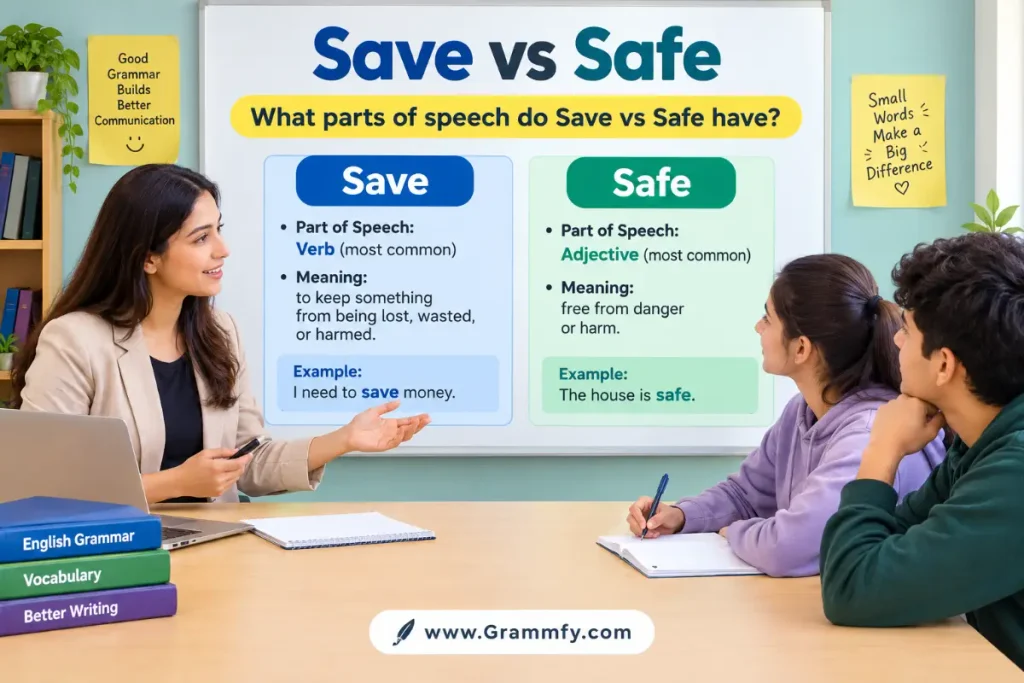
What parts of speech do Save vs Safe have?
Grammar is one of the easiest ways to separate these words.
Save as a verb
“Save the document.”
“Save some food.”
“Save money every month.”
The word describes an action.
Save as a preposition
In formal or literary English, save can also mean except.
“Everyone attended save John.”
This usage is uncommon in everyday American English. Most people would say:
“Everyone attended except John.”
Save as a noun
In sports, save can be a noun.
“The goalkeeper made an incredible save.”
It can also refer to a stored game state in video games:
“I loaded my old save.”
Safe as an adjective
“The road is safe.”
“The children are safe.”
This is the most common grammatical use.
Safe as a noun
Safe can also mean a strong locked container used to store valuables.
“The documents are in the safe.”
This is pronounced differently from the adjective in some varieties and contexts? In standard English, both are generally pronounced /seɪf/. The meaning comes from context.
Safely as an adverb
“She arrived safely.”
This describes the manner of an action.
The word family looks like this:
save → saved → saving → saver
safe → safely → safety
The noun safety is especially useful:
“Safety comes first.”
What should you use in a resume Save vs Safe?
Is save or safe better for a resume?
A resume usually needs action-focused verbs, so save can be useful when describing results.
For example:
“Saved the company $15,000 by reducing supply costs.”
This is strong because it gives a measurable result.
Another example:
“Saved 10 hours per week by automating routine reports.”
The verb clearly shows an achievement.
Safe can work when your role involves safety, security, compliance, or risk management.
For example:
“Maintained a safe working environment for warehouse staff.”
A stronger professional version could be:
“Implemented safety procedures that reduced workplace incidents.”
The best choice depends on whether you’re describing an action or a condition.
What should you use in an essay Save vs Safe?
Is save or safe better for an essay?
Both words can work well in essays, but they serve different purposes.
Use save when discussing conservation, economics, technology, health, or rescue.
“Using public transportation can save energy and reduce emissions.”
Use safe when discussing risk, public health, education, transportation, or security.
“Schools should provide a safe learning environment for students.”
Academic writing often benefits from precise nouns and verbs, too.
Instead of:
“The government should make roads safe.”
You could write:
“The government should improve road safety.”
That version may fit a formal essay better.
What should you use in a text message Save vs Safe?
Is save vs safe better for texting?
Both are common in texts, but their meanings remain different.
You might write:
“Save this number.”
This means keep the phone number.
You might also write:
“Text me when you get home safe.”
Here, safe describes the person’s condition after arriving.
Another common text is:
“Stay safe!”
This means remain protected from danger.
A casual message might also say:
“I saved you some food.”
The speaker kept food for another person.
What should you use in an email Save vs Safe?
Is save vs safe better in an email?
The right word depends on your message.
- For a document:
“Please save a copy of the report before making changes.”
- For personal security:
“Please keep your login information somewhere safe.”
- For financial savings:
“This option could save the company money.”
- For workplace safety:
“Please make sure all equipment is stored in a safe location.”
Professional emails should make the intended meaning obvious. If the sentence can be interpreted in more than one way, rewrite it for clarity.
What should you use when speaking Save vs Safe?
Is save vs safe better in everyday speech?
Both are extremely common in spoken English.
A person might say:
“Save me a seat.”
Or:
“Are you safe?”
The pronunciation difference is small but important.
Save ends with a /v/ sound:
save → /seɪv/
Safe ends with an /f/ sound:
safe → /seɪf/
The final consonant changes the word.
A useful pronunciation trick is to notice your lower lip and upper teeth:
- /v/ in save uses vibration.
- /f/ in safe does not use vocal-cord vibration.
Put your hand on your throat while saying both words slowly. You should feel vibration on the v sound in save.
What are common examples of Save vs Safe?
Here are original examples from real situations.
Money
“I’m trying to save enough money for a new laptop.”
The person is keeping money instead of spending it.
“My savings are safe in a secure account.”
The money is protected.
Technology
“Save the document before you close the app.”
The action preserves the file.
“Your files are safe because the system creates regular backups.”
The files are protected from loss.
Travel
“We saved time by taking the train.”
The choice reduced the amount of time needed.
“Call me when you arrive safe.”
The person wants confirmation that the traveler arrived without harm.
Emergency situations
“The firefighters saved three people from the building.”
They rescued people from danger.
“Everyone was safe after the evacuation.”
Nobody remained in immediate danger.
School
“Save your work before submitting the assignment.”
Keep a copy of your work.
“The teacher created a safe environment for discussion.”
Students can participate without feeling threatened or exposed to harm.
Food
“Save some pizza for your brother.”
Keep some food for him.
“The food is safe to eat.”
It isn’t expected to cause harm when properly handled.
Personal belongings
“Save the receipt in case you need to return the product.”
Keep the receipt.
“Put your passport somewhere safe.”
Protect it from loss or theft.
Work
“The new process saved employees several hours each week.”
The process reduced the time required.
“Safety training helps create a safe workplace.”
The training reduces risks and protects workers.
Money and shopping
“This discount can save you $20.”
The buyer spends less.
“Check that the payment website is safe before entering your card details.”
The website should be secure enough to protect sensitive information.
Relationships
“You saved me from making a huge mistake.”
The person prevented an unwanted outcome.
“I feel safe talking to her.”
The speaker feels protected, comfortable, or free from judgment.
Save vs keep: what’s the difference?
Save and keep overlap, but save often suggests preserving something for a future purpose or preventing loss.
| Save | Keep |
|---|---|
| Often implies future use or prevention of loss | Broadly means continue to have |
| Save money | Keep money |
| Save a file | Keep a file |
| Save a seat | Keep a seat |
| Save food for later | Keep food in the refrigerator |
| Save someone’s life | Keep someone alive |
For example:
“Save some cake for me.”
This clearly suggests future use.
“Keep the cake.”
This can simply mean don’t give it away, although the exact meaning depends on context.
Keep is broader. Save often carries an additional idea of preservation, reservation, or prevention.
Safe vs secure: what’s the difference?
Safe and secure are close, but they aren’t always interchangeable.
Secure often focuses on protection against a specific threat, unauthorized access, loss, or movement.
| Safe | Secure |
|---|---|
| Free from danger | Protected or firmly controlled |
| Safe neighborhood | Secure building |
| Safe to eat | Secure payment system |
| Safe journey | Secure connection |
| Safe environment | Secure account |
Compare:
“The children are safe.”
The focus is their condition.
“The building is secure.”
The focus is the building’s protection.
Something can be secure without being completely safe. For example, a locked building may be secure from thieves but still unsafe because of a fire.
Save vs rescue: what’s the difference?
Rescue is a more specific kind of saving.
Save has many meanings, while rescue normally involves removing someone from danger or a difficult situation.
| Save | Rescue |
|---|---|
| Broad | Specific |
| Save money | Rescue a person |
| Save a file | Rescue an animal |
| Save time | Rescue someone from a fire |
| Save a life | Rescue trapped hikers |
You can say:
“The firefighter saved the child.”
You can also say:
“The firefighter rescued the child.”
The second sentence highlights the act of removing the child from danger.
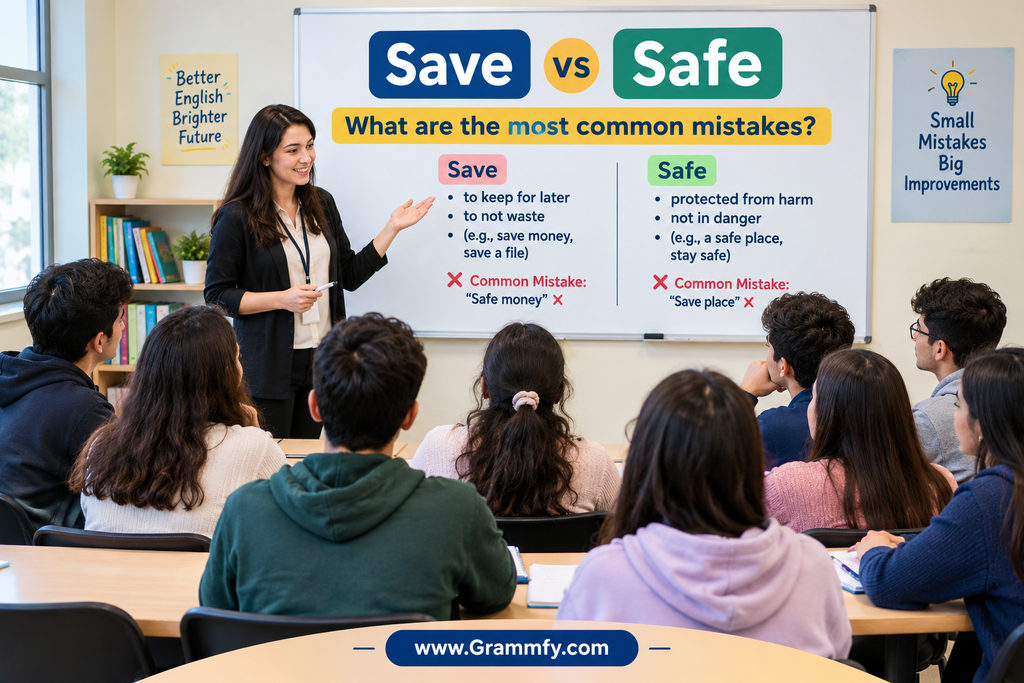
What are the most common mistakes?
Mistake 1: Writing “save” when you mean protected
Incorrect:
“The children are save.”
Correct:
“The children are safe.”
The sentence describes the children’s condition, so you need the adjective safe.
Mistake 2: Writing “safe” when you mean keep
Incorrect:
“Please safe the document.”
Correct:
“Please save the document.”
The action of storing a document uses save.
Mistake 3: Confusing “save” with “safety”
Incorrect:
“Workplace save is important.”
Correct:
“Workplace safety is important.”
Safety is the noun related to safe.
Mistake 4: Confusing “safe” with “safely”
Incorrect:
“She arrived safe at home.”
This can occur in informal speech, but standard formal writing usually prefers:
“She arrived safely at home.”
Here, safely modifies the verb arrived.
However, “arrive safe and sound” is a common fixed expression:
“They arrived home safe and sound.”
Mistake 5: Assuming similar spelling means similar grammar
The words differ by only one letter:
save
safe
That doesn’t make them interchangeable.
Look at the action:
“Save the file.”
Look at the condition:
“The file is safe.”
This quick test solves many mistakes.
When should you NOT use save?
Don’t use save simply because something is good or protected.
For example:
“The room is save.”
This is incorrect.
Use:
“The room is safe.”
Also avoid save when you need an adjective:
“This is a save place.”
Correct:
“This is a safe place.”
If you mean that someone isn’t in danger, use safe, not save.
When should you NOT use safe?
Don’t use safe for actions such as storing, rescuing, or preserving something.
Incorrect:
“Safe your work.”
Correct:
“Save your work.”
Similarly:
“I want to save money.”
not:
“I want to safe money.”
The second sentence doesn’t work in standard English because safe isn’t the normal verb meaning “keep money.”
What are the antonyms of Save vs Safe?
The opposite of save depends on its meaning.
| Save | Possible opposite |
|---|---|
| Save money | Spend money |
| Save a file | Delete a file |
| Save a life | Endanger a life |
| Save time | Waste time |
| Save food | Waste food |
| Save something | Lose or discard it |
The opposite of safe is usually dangerous, unsafe, risky, or threatening.
| Safe | Opposite |
|---|---|
| Safe place | Dangerous place |
| Safe activity | Risky activity |
| Safe food | Unsafe food |
| Safe environment | Unsafe environment |
| Secure system | Vulnerable system |
Context matters here, too.
Are Save vs Safe pronounced differently?
Yes. Their final consonant sounds are different.
Save ends in a voiced v sound:
save
Safe ends in an unvoiced f sound:
safe
The vowel sound at the beginning is similar, which is one reason learners may confuse them.
Try these pairs:
- save / safe
- gave / gave?
- leave / leaf
- live / life
- believe / belief
The final consonant can change the meaning completely.
For save, your vocal cords vibrate during the v sound. For safe, the f sound is unvoiced.
Speaking slowly at first can help you hear and produce the difference.
Are there US and UK differences?
There is no major meaning difference between American and British English for save and safe. Both varieties use the words in essentially the same ways.
For example, both use:
- save money
- save time
- save a file
- save a life
- safe place
- safe journey
- safe food
- stay safe
There can be small differences in preferred expressions.
British English often uses:
“Are you safe?”
and:
“Get home safe.”
American English also uses these forms, especially in casual speech, while “get home safely” is more formal or grammatically explicit.
The basic distinction remains the same across major English varieties.
How can you remember Save vs Safe?
Use the action versus condition trick.
Save = action
Ask:
“What am I doing?”
If the answer is keeping, storing, rescuing, reserving, or preventing loss, save is probably the right word.
“I am saving the file.”
“I am saving money.”
“The doctor saved the patient.”
Safe = condition
Ask:
“What is the condition?”
If something is protected or not in danger, safe is probably correct.
“The file is safe.”
“The money is safe.”
“The patient is safe.”
Another quick memory trick is:
Save has V for verb.
This isn’t a rule of English grammar, but it can be a useful learning reminder.
What should you choose in professional writing Save vs Safe?
Professional writing rewards clarity.
Use save for:
- cost savings
- time savings
- data storage
- resource conservation
- rescue
- preservation
Examples:
“The new software saves employees two hours per week.”
“The company saved $30,000 by changing suppliers.”
Use safe for:
- workplace conditions
- product safety
- data protection
- physical security
- risk levels
Examples:
“The company provides a safe working environment.”
“Customer information must remain safe and protected.”
If you’re writing about technology, secure may sometimes be more precise than safe.
“The database is secure.”
This focuses on protection against unauthorized access.
What should you choose in academic writing?
Academic writing often requires a more precise expression than everyday speech.
Instead of:
“This method is safe.”
You might explain:
“This method is considered safe when used under controlled conditions.”
Instead of:
“This method saves energy.”
You might write:
“This method reduces energy consumption.”
The more specific sentence can communicate the exact idea more clearly.
Still, there’s nothing wrong with save or safe when they are the correct words.
Good academic writing isn’t about avoiding simple vocabulary. It is about using accurate vocabulary.
How can you choose the right word quickly “Save vs Safe”?
Use this five-second test.
Step 1: Identify the action
If someone is doing something to keep, rescue, store, reserve, or prevent loss, use save.
“Save the file.”
Step 2: Identify the condition
If someone or something is protected from danger, use safe.
“The file is safe.”
Step 3: Look at the next word
Common combinations with save:
- save money
- save time
- save energy
- save a file
- save a life
- save a seat
- save food
- save a copy
Common combinations with safe:
- safe place
- safe choice
- safe environment
- safe journey
- safe to eat
- safe to use
- stay safe
- keep safe
Step 4: Try “keep” or “protected”
If keep works, save may be correct.
“Keep this document.”
“Save this document.”
If protected works, safe may be correct.
“The document is protected.”
“The document is safe.”
Step 5: Check the grammar
Does the sentence need an action?
Use save.
Does it need a describing word?
Use safe.
Quick comparison table about Save vs Safe
| Feature | Save | Safe |
|---|---|---|
| Main grammatical role | Verb | Adjective |
| Main idea | Keep, rescue, prevent loss | Protected from danger |
| Save money | ✓ | ✗ |
| Safe money | ✗ | ✗ |
| Save a file | ✓ | ✗ |
| Safe file | Possible in some contexts | ✓ |
| Save a life | ✓ | ✗ |
| Safe person | Possible but context-dependent | ✓ |
| Safe place | ✗ | ✓ |
| Save time | ✓ | ✗ |
| Safe to eat | ✗ | ✓ |
| Save a seat | ✓ | ✗ |
| Stay safe | ✗ | ✓ |
| Save energy | ✓ | ✗ |
| Safe environment | ✗ | ✓ |
| Related noun | Saving / saver | Safety |
What are useful phrases with save?
Learning common word combinations can make your English sound more natural.
- Save money
“I’m saving money for a new computer.”
- Save time
“Online forms can save time.”
- Save energy
“Turn off unused lights to save energy.”
- Save a file
“Don’t forget to save the file.”
- Save a copy
“Save a copy before editing the original.”
- Save a life
“Quick action can save a life.”
- Save a seat
“Can you save a seat for me?”
- Save space
“Cloud storage can save space on your device.”
- Save someone’s number
“Save my number so you can contact me later.”
- Save the date
“Save the date for our annual meeting.”
These expressions show how broad the verb save is.
What are useful phrases with safe?
Common combinations include:
- Safe place
“Let’s find a safe place to wait.”
- Safe journey
“Have a safe journey.”
- Safe environment
“Children need a safe learning environment.”
- Safe choice
“Taking the train is usually the safer choice.”
- Safe to eat
“Check that the food is still safe to eat.”
- Safe to use
“Make sure the equipment is safe to use.”
- Stay safe
“Stay safe during the storm.”
- Safe and sound
“The hikers returned safe and sound.”
- Play it safe
“Let’s play it safe and leave early.”
These expressions are common in everyday English and are worth learning as complete phrases.
Why does “stay safe” use safe instead of save?
Stay safe is correct because safe describes the person’s condition.
The phrase means:
Remain protected from danger.
You wouldn’t say:
“Stay save.”
That doesn’t work because save doesn’t describe the condition of being protected.
Similarly:
“Keep safe.”
is possible, especially in British English and certain contexts, but stay safe is a very common modern expression.
Why do people say “save yourself” but “stay safe”?
The two phrases have different structures.
Save yourself means take action to prevent yourself from harm.
“Run before the building collapses and save yourself.”
Stay safe means remain in a protected condition.
“Take care and stay safe.”
The first uses save as an action. The second uses safe as a description.
Why is “safe” used before a noun?
Because safe is an adjective.
Adjectives can describe nouns:
- safe car
- safe road
- safe food
- safe workplace
- safe choice
- safe environment
For example:
“We need a safe place.”
Here, safe describes place.
You could also place safe after a linking verb:
“The place is safe.”
Both structures are standard.
Why is “save” used before an object?
As a verb, save can take a direct object.
Examples:
“Save the file.”
File is the object.
“Save some money.”
Money is the object.
“Save the patient.”
Patient is the object.
The verb describes an action performed on or for something.
This grammatical difference is one of the fastest ways to distinguish the two words.
Final tips for choosing between them
Before you type save or safe, ask yourself what you mean.
- Do you mean keep something? → save
- Do you mean rescue someone? → save
- Do you mean store a file? → save
- Do you mean avoid spending money? → save
- Do you mean prevent harm? → save
- Do you mean protected from danger? → safe
- Do you mean not dangerous? → safe
- Do you mean secure or protected? → safe
- Do you mean free from immediate risk? → safe
- Do you need an adjective before a noun? → safe
- Do you need a verb showing an action? → save
A few common patterns are especially useful:
Save money.
Save time.
Save a file.
Save a life.
Safe place.
Safe choice.
Safe to use.
Stay safe.
Learning these phrases as chunks can make the difference much easier to remember.
Conclusion
The key to choosing between these words is to focus on the job each one performs. Save usually describes an action: you save money, save time, save a file, save a seat, or save a person from danger. Safe describes a condition: a person can be safe, a place can be safe, and information can be safe from harm or loss.
Remember the simple pattern: save is something you do, while safe describes a protected condition. Common phrases make the distinction even easier to learn. Practice with examples such as “save the document,” “save money,” “stay safe,” and “a safe place.” Once these patterns become familiar, the one-letter difference won’t be confusing anymore.
Frequently Asked Questions
What is the difference between save and safe?
Save usually describes an action such as keeping, storing, rescuing, or preventing loss, while safe describes a condition of being protected from danger or harm. Their similar spelling does not make them interchangeable.
Is it save money or safe money?
The correct phrase is save money when you mean to keep money or spend less. Safe money can have a different meaning in specialized financial contexts, but it isn’t the normal phrase for “keep money.”
Should I say stay safe or stay save?
The correct expression is stay safe because safe describes the condition you want someone to remain in. “Stay save” is incorrect in standard English.
What’s another way to say safe?
Common alternatives include secure, protected, harmless, out of danger, and low-risk. The best option depends on whether you’re talking about physical danger, security, or risk.
Can save mean protect?
Yes, save can mean preventing someone or something from harm or loss. For example, “The helmet saved his life” means the helmet helped prevent a fatal injury.
Is safe an adjective or a verb?
Safe is mainly an adjective, as in “The children are safe.” The related noun is safety, while safely is the adverb.
Can save and safe be used in the same sentence?
Yes, and the meanings remain different. For example, “Save your files somewhere safe” means to store your files in a protected location.
