
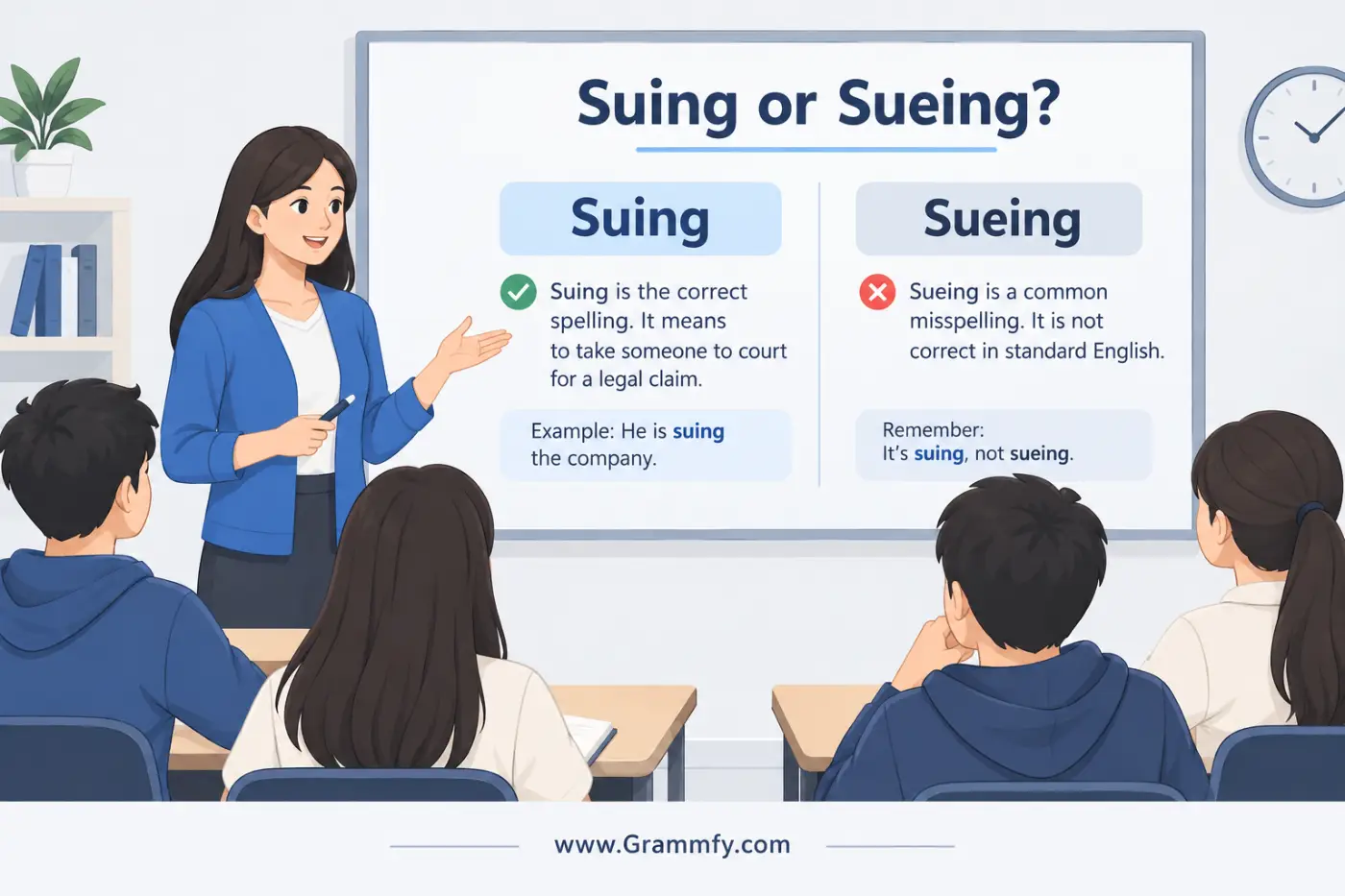
Imagine you’re writing an email about a legal dispute, preparing a school essay, or checking a sentence before posting it online. You want to say that someone is taking legal action, but then you pause: Suing or Sueing—which spelling is correct?
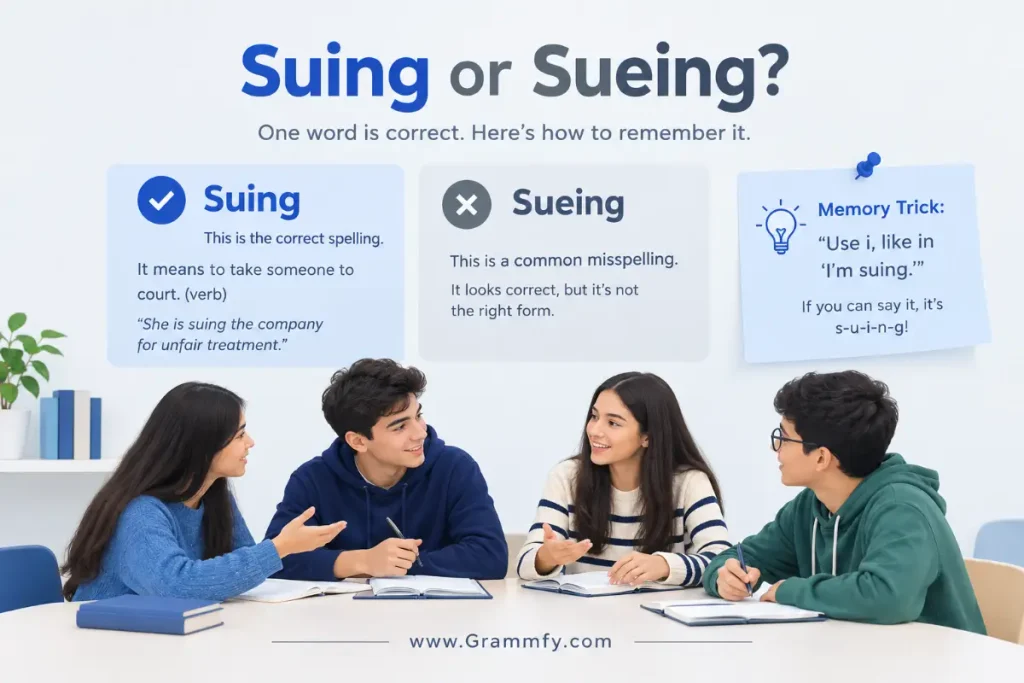
Answer box: Suing is the correct spelling. Sueing is incorrect in standard English. The verb sue becomes suing by dropping the final e before adding -ing.
This spelling follows a common English rule. When a verb ends in a silent e, that e is usually removed before the -ing ending is added. For example, make becomes making, write becomes writing, and use becomes using.
In this guide, you’ll learn why suing is correct, where the word comes from, how to use it in different situations, which alternatives fit different levels of formality, and which common mistakes to avoid. You’ll also see examples, synonym comparisons, regional notes, and quick tips that make the spelling easy to remember.
Want to avoid similar spelling mistakes? See [year old vs years old].
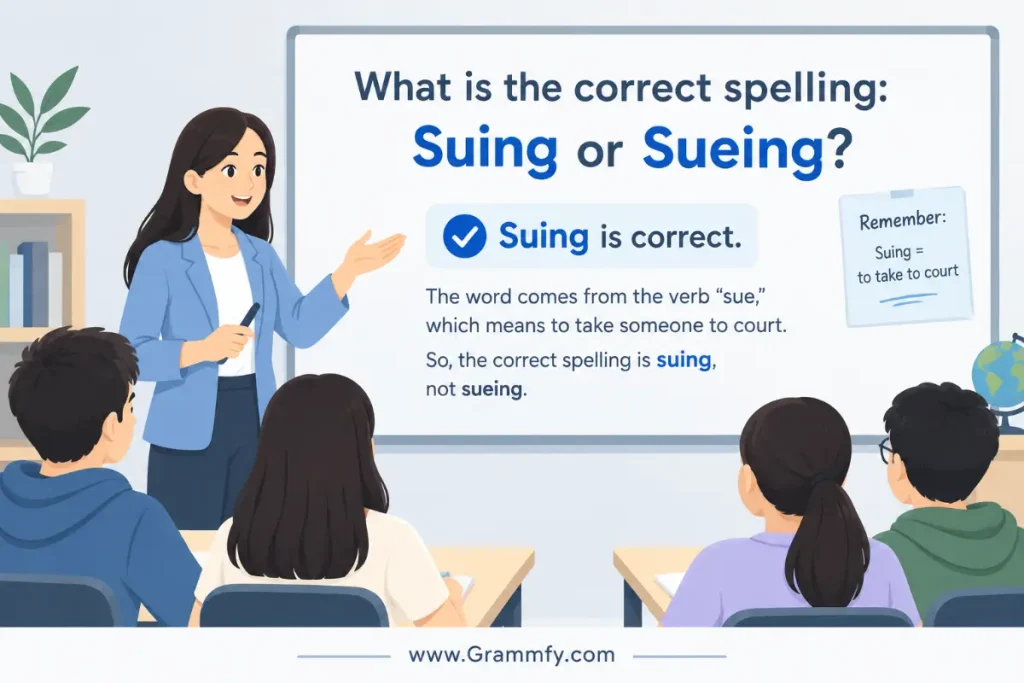
What is the correct spelling: Suing or Sueing?
The correct spelling is suing.
Sueing is a common spelling mistake. It may look logical because the base verb is sue and the ending is -ing. However, English spelling rules normally remove the final silent e when -ing is added.
| Form | Correct? | Example |
|---|---|---|
| sue | Yes | They plan to sue the company. |
| suing | Yes | They are suing the company. |
| sueing | No | They are sueing the company. |
| sued | Yes | They sued the company last year. |
| sues | Yes | She sues companies when necessary. |
So, if you’re deciding between Suing or Sueing, choose suing.
Why is “suing” spelled without the e?
The spelling becomes easier when you look at the base word:
sue + ing → suing
The final e in sue is removed before -ing is added.
The same pattern appears in many other verbs:
- make → making
- bake → baking
- write → writing
- drive → driving
- use → using
- move → moving
- take → taking
- sue → suing
Notice that the pronunciation can change or stay similar, but the spelling follows the same basic pattern.
Is “sueing” ever correct?
No. Sueing is not the standard spelling of the present participle or gerund of sue.
You may see it in informal writing, online comments, or user-generated content, but that doesn’t make it standard English. In schoolwork, professional writing, legal writing, resumes, emails, and published content, use suing.
What does “suing” mean?
Suing means taking someone to court by starting or pursuing a legal case against them.
The verb sue generally means to bring a legal claim against a person, company, organization, or other party.
For example:
The customer is suing the company for damages.
Here, suing shows that the legal action is currently happening or is in progress.
The word can apply to many kinds of legal disputes, including cases involving:
- money
- property
- contracts
- injuries
- business disagreements
- negligence
- employment disputes
- personal rights
- damages
The exact legal meaning can depend on the jurisdiction and type of case, but in everyday English, suing means taking legal action through a court.
Where does the word “sue” come from?
The word sue has a long history in English and developed from legal language.
It comes through Anglo-French and Old French forms related to following or pursuing a legal matter. Over time, the word became established in English as a verb connected with bringing a legal claim.
Today, sue has a much more specific meaning than its older roots might suggest. In modern English, it is strongly associated with court proceedings and legal claims.
The forms are:
- sue — base verb
- sues — third-person singular
- sued — past tense
- suing — present participle and gerund
Understanding the word’s history isn’t necessary to spell it correctly, but it helps explain why sue functions as a normal English verb even though its spelling ends in a vowel combination that can look unusual.
How do you spell the -ing form of “sue”?
The correct process is simple:
sue → remove the final e → add -ing → suing
The result is suing.
Don’t write:
sue + ing = sueing
Instead, remember:
sue → suing
This is part of a broader spelling pattern in English.
What happens to other verbs ending in silent e?
Many verbs ending in a silent e drop that letter before -ing:
| Base verb | -ing form |
|---|---|
| make | making |
| hope | hoping |
| smile | smiling |
| write | writing |
| drive | driving |
| use | using |
| close | closing |
| move | moving |
| save | saving |
| sue | suing |
There are exceptions to English spelling rules, so you shouldn’t apply the pattern blindly to every word. But sue → suing follows the standard rule.
Why do people write “sueing”?
People often write sueing because they are trying to preserve the spelling of the original word sue.
At first glance, this seems reasonable:
sue + ing = sueing
But English spelling doesn’t always work by simply attaching an ending. Sometimes the base word changes slightly when a suffix is added.
For example:
- write → writing, not writeing
- hope → hoping, not hopeing
- use → using, not useing
- sue → suing, not sueing
The mistake usually comes from focusing on the original spelling rather than the spelling rule.
Is “suing” pronounced like “sewing”?
No. Suing and sewing are different words.
Suing relates to taking legal action.
The company is suing its former partner.
Sewing relates to joining fabric with a needle and thread.
She is sewing a button onto her shirt.
In many varieties of English, suing and sewing may sound very similar or even identical. Their meanings and spellings are different, so context matters.
Suing vs. Sewing: What’s the difference?
| Word | Meaning | Example |
|---|---|---|
| suing | taking legal action | They are suing the manufacturer. |
| sewing | joining fabric with thread | She is sewing a dress. |
A useful memory trick is:
Suing = lawsuit
Sewing = needle and thread
If the sentence is about court, lawyers, damages, or legal claims, suing is probably the word you need.
What are the synonyms of “suing”?
There isn’t always a perfect synonym for suing. Legal terms can carry different meanings, so the best alternative depends on the sentence.
Here is a broad synonym list grouped by tone and use.
Simple synonyms for suing
| Word | Meaning | Tone | Example |
|---|---|---|---|
| suing | taking someone to court | Neutral | They are suing the business. |
| challenging | questioning a decision or action | Neutral | She is challenging the ruling. |
| claiming | stating that you have a legal right or complaint | Neutral | He is claiming compensation. |
| complaining | making a formal complaint | Neutral | The customer filed a complaint. |
| pursuing | continuing to seek a legal remedy | Neutral | They are pursuing legal action. |
| accusing | saying someone did something wrong | Neutral | He is accusing the company of fraud. |
These words aren’t interchangeable in every legal sentence. Accusing, for example, doesn’t necessarily mean filing a lawsuit.
Everyday alternatives
| Word | Meaning | Tone | Example |
|---|---|---|---|
| taking someone to court | bringing a case against someone | Everyday | They are taking the landlord to court. |
| taking legal action | using legal procedures | Everyday | She may take legal action. |
| going to court | appearing in court over a dispute | Casual | They’re going to court over the contract. |
| filing a case | officially starting a case | Everyday | He is filing a case against the company. |
| making a claim | asking for a legal remedy | Everyday | She made a claim for damages. |
| seeking damages | asking for financial compensation | Everyday/Formal | They are seeking damages. |
| fighting the case | actively defending or pursuing a case | Casual | The lawyer is fighting the case. |
Formal and legal alternatives
| Word | Meaning | Tone | Example |
|---|---|---|---|
| litigating | taking part in litigation | Formal | The parties are litigating the dispute. |
| commencing proceedings | starting legal proceedings | Formal | The claimant is commencing proceedings. |
| initiating legal action | starting a legal process | Formal | The firm is initiating legal action. |
| bringing an action | starting a legal case | Formal | The claimant is bringing an action. |
| filing a lawsuit | officially starting a lawsuit | Formal | She is filing a lawsuit. |
| pursuing litigation | continuing with a legal case | Formal | The company is pursuing litigation. |
| seeking judicial relief | asking a court for a remedy | Very formal | The plaintiff is seeking judicial relief. |
| asserting a claim | formally stating a legal claim | Formal | The claimant is asserting a claim. |
Informal or slang-like alternatives
These expressions should be used carefully because they can sound emotional or exaggerated.
| Word/Phrase | Meaning | Tone | Example |
|---|---|---|---|
| taking them to court | suing someone | Informal | He’s taking them to court. |
| going after them legally | pursuing legal action | Informal | The customer says she’s going after them legally. |
| taking them on in court | fighting a legal dispute | Informal | The company is taking its former partner on in court. |
| fighting back | responding strongly to an action | Informal | The business is fighting back. |
| making them answer in court | demanding legal accountability | Informal | She wants to make them answer in court. |
These expressions aren’t exact legal equivalents. Use them for general communication rather than precise legal documents.
Which synonym is strongest?
Legal alternatives can differ in intensity.
Mild: raising a concern
Words such as questioning, challenging, and complaining may describe early stages of a dispute.
The employee is challenging the decision.
This doesn’t necessarily mean a lawsuit has been filed.
Moderate: taking legal action
Pursuing legal action and taking legal action suggest a more serious step.
The customer is considering taking legal action.
This phrase can mean someone is preparing for legal proceedings without necessarily saying a lawsuit has already been filed.
Strong: filing a lawsuit
Filing a lawsuit is more specific.
The family is filing a lawsuit against the manufacturer.
It clearly suggests that a lawsuit is being formally initiated.
Strong and formal: litigating
Litigating is a technical legal term.
The two companies are litigating the contract dispute.
It describes participation in litigation rather than simply saying someone is angry or threatening to sue.
What are synonyms for “suing” by part of speech?
Because suing is a verb form, many useful alternatives are verbs or verb phrases.
Verb alternatives
- pursuing
- challenging
- claiming
- accusing
- litigating
- contesting
- appealing
- prosecuting
- filing
- asserting
However, these words have different legal meanings.
Noun alternatives
If you need a noun instead, consider:
- lawsuit
- litigation
- legal action
- legal claim
- court case
- proceeding
- action
- dispute
For example:
They are suing the company.
can become:
They have filed a lawsuit against the company.
The sentence changes structure, but the basic idea remains related.
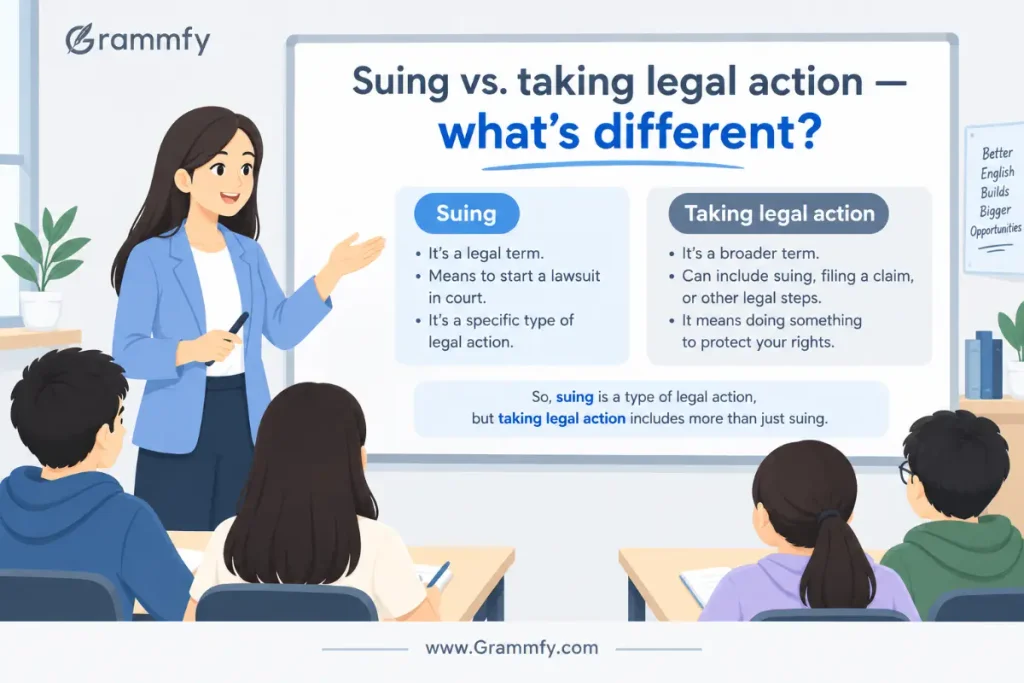
Suing vs. taking legal action — what’s different?
These expressions are close, but they aren’t always identical.
| Suing | Taking legal action |
|---|---|
| Usually means bringing a lawsuit | Broader phrase |
| More specific | Can include several legal steps |
| Clearly connected to a lawsuit | May refer to complaints, proceedings, or other remedies |
| Common in everyday English | Common in formal and everyday English |
Example:
She is suing her former employer.
This directly says a lawsuit is involved.
She is taking legal action against her former employer.
This is broader and doesn’t necessarily identify the exact legal procedure.
Best rule: Use suing when you specifically mean bringing a lawsuit. Use taking legal action when you want a broader expression.
Suing vs. litigating — what’s different?
These words are related but not perfect substitutes.
Suing usually focuses on the act of bringing a legal case against someone.
The customer is suing the manufacturer.
Litigating focuses on participating in litigation.
The two companies are litigating over ownership rights.
A person can be involved in litigation without being the party who originally filed the lawsuit.
So, litigating is more technical and broader in some contexts.
Suing vs. accusing — what’s different?
These words should not be confused.
Accusing means claiming that someone did something wrong.
The employee is accusing the manager of discrimination.
Suing means bringing a legal claim against someone.
The employee is suing the company.
Someone can accuse another person without suing them. Likewise, someone can sue without the central issue being an accusation of intentional wrongdoing.
When should you use “suing” in a sentence?
Use suing when you want to describe an ongoing legal action involving a lawsuit.
Common sentence patterns include:
- Subject + is/are + suing + person/company
The customer is suing the restaurant.
- Subject + was/were + suing + person/company
The company was suing its former supplier.
- Subject + has/have been + suing + person/company
The family has been suing the manufacturer for several years.
- Subject + considered + suing + person/company
She considered suing the contractor.
Notice that suing can appear after several different verbs and verb phrases.
What are real examples of “suing”?
Here are original examples from different situations.
- The customer is suing the company over the disputed contract.
- The family is suing the manufacturer after the accident.
- The business threatened to sue but later settled the dispute.
- She is considering suing her former landlord.
- The two companies are suing each other over the agreement.
- The athlete is suing the organization for alleged financial losses.
- The residents discussed suing the developer over the property dispute.
- The employee is not suing anyone; she is simply filing an internal complaint.
- The lawyer explained that suing might be expensive and time-consuming.
- The newspaper reported that the actor was suing for damages.
- The company denied the allegations and said it would defend itself if sued.
- The customer decided against suing after receiving a satisfactory settlement.
- The couple hired an attorney before considering suing the contractor.
- The organization is suing to challenge the decision.
- The parties reached an agreement before the dispute reached court.
These examples show why context matters. Legal vocabulary can describe different stages of a dispute.
What is the best word for a resume Suing or Sueing?
A resume usually shouldn’t say that someone is suing another person unless the legal action is directly relevant to the job.
For professional writing, use precise and neutral terms such as:
- litigated
- represented
- handled litigation
- managed legal claims
- pursued legal action
- defended clients
- filed lawsuits
For example:
Represented clients in civil litigation matters.
This sounds more professional than:
Sued lots of people.
If you’re describing legal experience, choose terminology that accurately explains your responsibility.
Resume example
Less professional:
I was suing companies for clients.
Better:
Represented clients in civil litigation and managed related legal claims.
The best wording depends on the actual work you performed.
What is the best word for an essay Suing or Sueing?
For a school or academic essay, suing is acceptable when you’re describing a legal dispute.
The company is suing the manufacturer over alleged contract violations.
For a more formal academic tone, you might use:
- filing a lawsuit
- pursuing legal action
- initiating proceedings
- bringing a legal claim
- litigating the dispute
Avoid slang such as going after them in court unless you’re discussing informal speech or quoting a source.
Essay example
After the contract dispute escalated, the company began suing its former business partner.
A more formal version is:
After the contract dispute escalated, the company initiated legal proceedings against its former business partner.
Both can work. The second is more formal.
What is the best word for texting Suing or Sueing?
For texting, suing is usually the simplest choice.
He’s suing the company.
They said they’re suing.
She’s thinking about suing them.
If you’re texting friends, you may also hear:
They’re taking the company to court.
That’s natural and conversational.
Avoid overly formal terms like commencing proceedings in casual texts unless you’re joking or discussing a legal matter seriously.
What is the best word for an email Suing or Sueing?
For a normal email, suing can work, but the best choice depends on your audience.
Casual:
They are suing the company.
Professional:
The customer is pursuing legal action against the company.
Very formal:
The claimant has initiated legal proceedings against the company.
If you’re writing to a lawyer, government office, business, or client, precise legal language is usually better than dramatic wording.
What is the best word for speaking Suing or Sueing?
In everyday speech, suing is clear and natural.
He’s suing his former employer.
Are they really suing the company?
She said she might sue.
In ordinary conversation, there’s usually no need to replace suing with a complicated legal expression.
The simplest word is often the strongest choice when everyone understands the context.
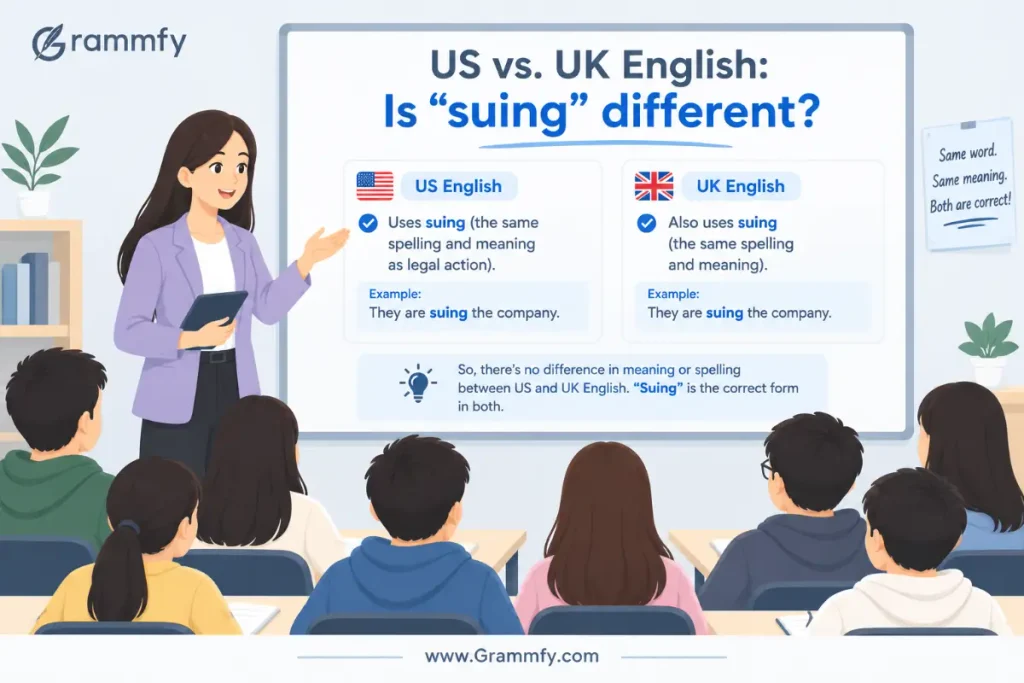
US vs. UK English: Is “suing” different?
Suing is standard in both US and UK English.
The spelling does not normally change between American and British English.
| Variety | Correct spelling |
|---|---|
| US English | suing |
| UK English | suing |
| Canadian English | suing |
| Australian English | suing |
The related legal vocabulary can vary depending on the legal system. For example, legal terminology and court procedures differ between countries. However, the spelling suing remains standard.
So you don’t need a separate American and British spelling for this word.
Common mistakes with “suing”
Mistake 1: Writing “sueing”
Incorrect:
They are sueing the company.
Correct:
They are suing the company.
The final e is removed before -ing.
Mistake 2: Writing “suing” when you mean “sewing”
Incorrect meaning:
My grandmother is suing a shirt.
Correct:
My grandmother is sewing a shirt.
If the topic is fabric, needles, thread, or clothing, use sewing.
Mistake 3: Using “suing” when there is only a complaint
Not every complaint is a lawsuit.
The customer complained to the manager.
This does not mean:
The customer sued the manager.
A lawsuit is a specific type of legal action.
Mistake 4: Using “suing” for a threat
Consider these two sentences:
He threatened to sue.
He is suing.
The first means legal action was threatened. The second indicates that the legal action is happening or has been initiated, depending on context.
Don’t use them as exact substitutes.
Mistake 5: Using “accusing” as an exact replacement
She is accusing the company of negligence.
doesn’t necessarily mean:
She is suing the company.
An accusation and a lawsuit are different things.
When should you NOT use “suing”?
Don’t use suing simply because someone is angry, unhappy, or making a complaint.
For example:
I’m angry with the store.
This doesn’t mean:
I’m suing the store.
Likewise:
The customer complained about the service.
doesn’t automatically mean:
The customer is suing the restaurant.
Use suing only when the context involves a legal claim or lawsuit.
You should also avoid using it casually as a threat unless that’s genuinely what you mean.
What are the antonyms of “suing”?
There is no single perfect antonym for suing, because the opposite depends on the context.
Possible contrasting expressions include:
- settling a dispute
- dropping a lawsuit
- withdrawing a claim
- dismissing a case
- avoiding litigation
- resolving the issue privately
- reaching an agreement
- abandoning legal action
Examples:
The two sides settled the dispute.
She decided to drop the lawsuit.
The company withdrew its claim.
These describe ending, avoiding, or resolving legal action rather than starting or pursuing it.
What spelling rule helps you remember “suing”?
The easiest rule is:
When a verb ends in a silent e, the e often disappears before -ing.
Examples:
- come → coming
- give → giving
- make → making
- take → taking
- write → writing
- sue → suing
So remember:
Sue loses the e before -ing.
That gives you:
sue → suing
not:
sue → sueing
Does “sue” always drop the e?
For the -ing form, yes, the standard spelling is suing.
But don’t assume the final e disappears in every form.
Compare:
- sue
- sues
- sued
- suing
The base form remains sue.
The third-person singular form is sues.
The past tense is sued.
Only the -ing form produces suing.
This is why memorizing the complete set can be useful.
Suing, sued, sues, and sue: A quick grammar guide
| Form | Grammar use | Example |
|---|---|---|
| sue | base form | They may sue the company. |
| sues | present simple, third person | She sues the contractor. |
| sued | past tense | They sued the company last year. |
| suing | present participle/gerund | They are suing the company. |
“Sue” in the present
I may sue.
They plan to sue.
“Sues” in the present
She sues companies over contract disputes.
“Sued” in the past
The customer sued the manufacturer.
“Suing” in continuous structures
The customer is suing the manufacturer.
Seeing all four forms together makes the spelling pattern easier to remember.
What should you remember about Suing or Sueing?
If you’re still unsure, keep these points in mind:
- Suing is correct.
- Sueing is incorrect in standard English.
- The base verb is sue.
- Remove the final e before adding -ing.
- Suing means taking someone to court or pursuing a lawsuit.
- Sewing is a different word related to fabric.
- Suing is used in both American and British English.
- Taking legal action is a broader alternative.
- Litigating is a more formal legal term.
- Don’t use suing when you only mean complaining.
- Don’t confuse suing with sewing.
- Use simple wording in casual communication and precise legal language in formal documents.
Quick tips for choosing the right word “Suing or Sueing”
Tip 1: Think “lawsuit”
If the sentence is about a lawsuit, suing is probably correct.
They are suing the company.
Tip 2: Drop the final e
Remember:
sue → suing
The e doesn’t stay before -ing.
Tip 3: Think about the meaning
If you’re talking about a legal dispute, use suing.
If you’re talking about fabric, use sewing.
Tip 4: Don’t confuse a complaint with a lawsuit
Someone can complain without suing.
A person can threaten to sue without actually suing.
A person can also settle a dispute without going to court.
Tip 5: Match the word to your audience
Suing is common in everyday English.
Taking legal action works well when you want a broader phrase.
Use filing a lawsuit when you want to be specific.
Use litigating when a formal legal term fits the context.
A simple memory trick for the spelling
Here’s an easy way to remember it:
SUE loses E before ING.
Write it like this:
SUE → SU + ING → SUING
The word sue has a final e, but that letter disappears when -ing is added.
You can use the same memory pattern with:
MAKE → MAKING
WRITE → WRITING
USE → USING
SUE → SUING
If you remember just one thing, remember this:
Never carry the final e from “sue” into “-ing.”
Conclusion
Choosing the correct spelling is simple once you recognize the pattern. The verb sue changes to suing when the -ing ending is added because the final silent e is dropped. The incorrect form sueing should be avoided in standard English.
The word itself refers to pursuing a legal claim or bringing a lawsuit, so it should not be confused with sewing, which relates to fabric. For everyday communication, suing is clear and natural. In formal contexts, phrases such as filing a lawsuit, taking legal action, or pursuing litigation may provide more detail.
When you’re stuck, remember one quick rule: sue loses the e before -ing. Once that pattern becomes familiar, this spelling becomes much easier to get right.
Frequently Asked Questions
Is suing or sueing correct?
Suing is correct, while sueing is incorrect in standard English. The final e in sue is dropped before -ing is added.
Why is suing spelled without an e?
The final silent e is removed before the -ing ending is added. Therefore, sue + ing becomes suing, not sueing.
What’s another way to say suing?
Another way to say suing is taking legal action, filing a lawsuit, or pursuing litigation, depending on the context. Taking legal action is broader, while filing a lawsuit is more specific.
Is suing the same as taking legal action?
Not always. Suing usually refers specifically to bringing a lawsuit, while taking legal action is a broader phrase that can cover different legal steps.
Is suing the same as sewing?
No. Suing means taking legal action, while sewing means joining fabric with a needle and thread. They can sound similar but have completely different meanings.
Can I use suing in formal writing?
Yes. Suing is grammatically correct and can be used in formal writing. In highly formal legal documents, more precise terms such as initiating proceedings, bringing an action, or pursuing litigation may be more appropriate.
How can I remember the spelling of suing?
Remember the simple pattern sue → suing. The final e is dropped before -ing, just as in make → making and write → writing.

1 thought on “Suing or Sueing: The Ultimate Spelling Guide”