
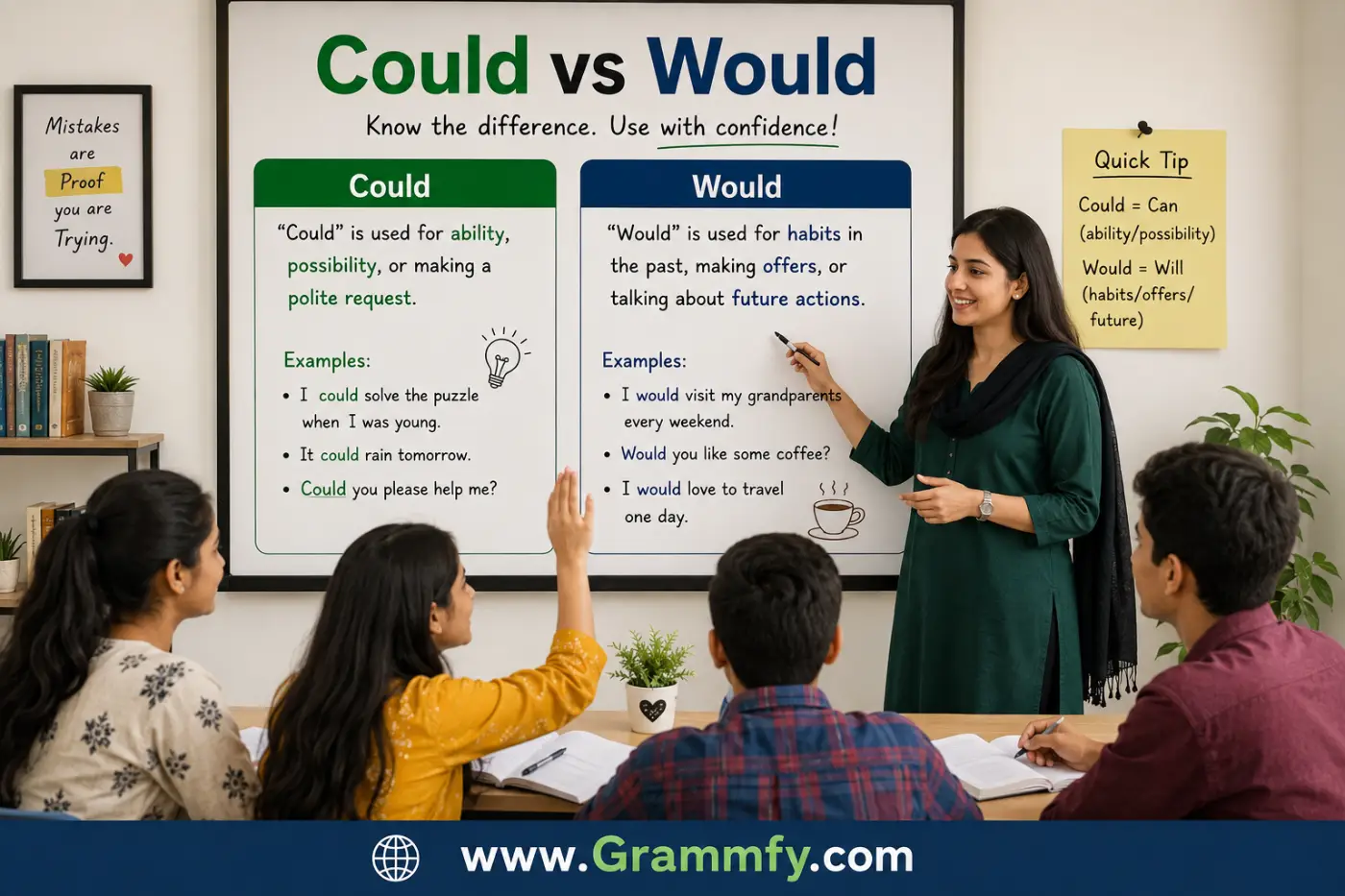
When you’re writing an email, answering a question in an essay, or sending a quick text, could vs would can be confusing. Both words are modal verbs, and both can make sentences sound more polite. But they don’t always express the same idea. The key is to understand whether you’re talking about ability, possibility, permission, willingness, or a hypothetical situation.
Answer box: Could usually expresses past ability, possibility, or a polite request. Would usually expresses willingness, a hypothetical result, a repeated past action, or a polite preference.
For example, “Could you help me?” is a polite request. “Would you help me?” is also possible, but it can sound more like you’re asking whether someone would be willing to help. The small difference can change the feeling of a sentence.
This guide explains the meanings, origins, grammar patterns, synonyms, tone differences, real-life examples, regional usage, and common mistakes. You’ll also learn which word works best in professional emails, essays, resumes, texts, and everyday conversations.
could vs would rule connects closely with the grammar explained in our Article
What Does Could Mean in Plain English?
Could is a modal verb with several important uses. It can describe ability in the past, possibility, permission, or a polite request.
Consider these examples:
- When I was younger, I could run five miles.
- We could go to the beach tomorrow.
- Could you open the window?
- You could try restarting the computer.
- She could be at home.
The meaning changes depending on context.
Could for Past Ability
One of the most common uses of could is talking about something a person was able to do in the past.
When I was ten, I could swim very well.
My grandfather could speak three languages.
She could play the piano when she was young.
Here, could means approximately was able to.
Could for Possibility
Could can also show that something is possible but not certain.
It could rain tonight.
That could be the answer.
We could miss the train if we don’t leave soon.
The speaker doesn’t know that the event will happen. The word simply presents it as one possible outcome.
Could for Polite Requests
Could is often used to make a request sound more polite.
Could you help me with this report?
Could you send me the file?
Could you please close the door?
The person asking isn’t necessarily talking about past ability. Here, could is a polite way to ask someone to do something.
Could for Suggestions
Could can also introduce an option.
We could eat at the new restaurant.
You could ask your teacher for help.
We could take the train instead.
In these sentences, could means something like one possible choice is.
What Does Would Mean in Plain English?
Would is also a modal verb. It has several uses, including hypothetical situations, willingness, polite requests, preferences, and repeated actions in the past.
Examples include:
- I would help if I had more time.
- She would always bring snacks to class.
- Would you like some coffee?
- I would choose the blue one.
- He would be surprised to hear that.
Would for Hypothetical Situations
One of the most important uses of would is talking about an imagined or conditional result.
I would travel more if I had more money.
The speaker isn’t saying that they currently travel more. They’re imagining what they would do under a different condition.
Another example:
If I lived closer, I would visit you every weekend.
The condition is living closer. The imagined result is visiting every weekend.
Would for Willingness
Would can describe someone’s willingness to do something.
She would help you if you asked.
He wouldn’t listen to my advice.
In these examples, would focuses on what someone is willing or unwilling to do.
Would for Polite Offers and Invitations
Would is common in polite questions.
Would you like some tea?
Would you like to join us?
Would you like another piece of cake?
This is one of the most common uses of would in everyday English.
Would for Preferences
Would rather means that someone prefers one option over another.
I would rather stay home.
She would rather walk than drive.
We would rather wait until tomorrow.
Here, would is part of the fixed expression would rather.
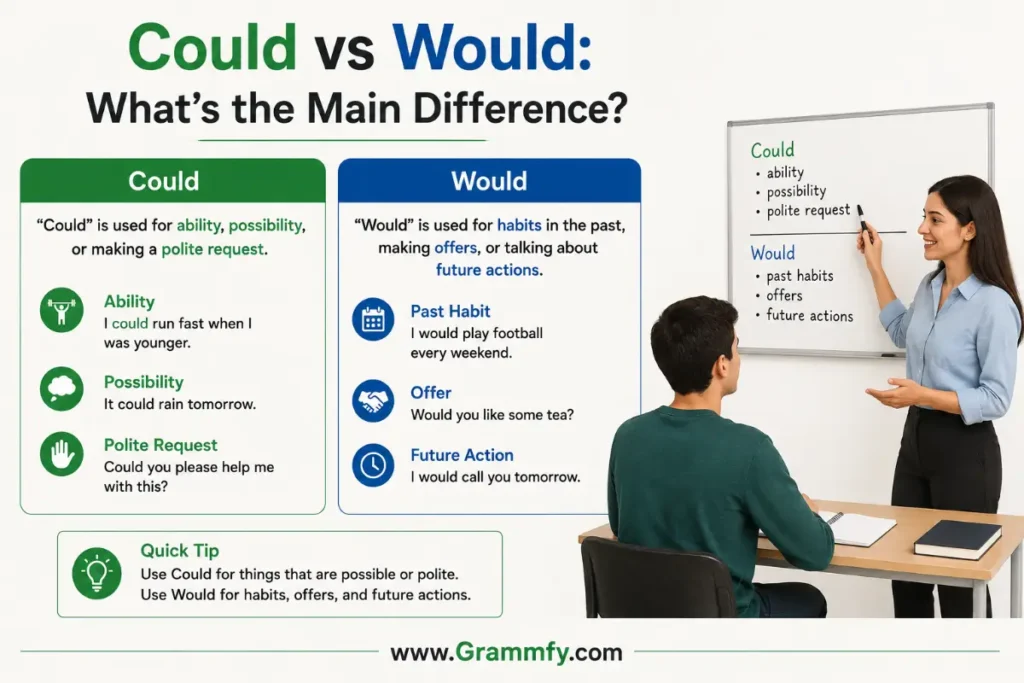
Could vs Would: What’s the Main Difference?
The easiest way to understand could vs would is to ask what the sentence is doing.
| Word | Common function | Example |
|---|---|---|
| Could | Past ability | I could swim at age six. |
| Could | Possibility | It could rain later. |
| Could | Polite request | Could you help me? |
| Could | Suggestion | We could leave early. |
| Would | Hypothetical result | I would travel if I had time. |
| Would | Willingness | She would help us. |
| Would | Polite invitation | Would you like coffee? |
| Would | Preference | I would rather stay home. |
| Would | Repeated past action | He would visit every summer. |
A useful shortcut is:
Could = ability, possibility, or an option.
Would = willingness, imagined result, preference, or polite choice.
This isn’t a rule that covers every sentence, but it gives learners a strong starting point.
Could vs Would for Requests
Both words can appear in polite requests, which is why learners often confuse them.
Compare:
Could you help me?
Would you help me?
Both can be grammatically correct, but they can have different shades of meaning.
Could You Help Me?
This focuses more on whether the person is able or willing to perform the action.
It is a very common polite request.
Could you send me the report?
Could you open the door?
Could you check this sentence?
Would You Help Me?
This focuses more on willingness.
Would you help me if I asked?
This can sound more conditional or personal.
In everyday American English, Could you…? is extremely natural for a straightforward request.
Could vs Would for Possibility
Could is often used to say that something is possible.
We could get there by noon.
This means reaching the destination by noon is one possible outcome.
Would generally needs a context that makes the situation hypothetical or conditional.
We would get there by noon if we left now.
Now the speaker is describing a possible result based on a condition.
Compare:
| Sentence | Meaning |
|---|---|
| We could leave now. | Leaving now is an option. |
| We would leave now if we weren’t waiting for Sam. | Leaving now is a hypothetical choice. |
| It could rain. | Rain is possible. |
| It would rain if the storm moved east. | Rain is a hypothetical result. |
Where Did Could Come From?
Could developed from the past form of can in the history of English.
Today, can and could are closely related.
Compare:
I can swim.
I could swim when I was five.
The connection is clear: can often describes present ability, while could can describe past ability.
Over time, could developed additional uses. Modern English uses it not only for past ability but also for possibility, suggestions, and polite requests.
This is why treating could as simply “the past of can” isn’t enough. Its modern uses are broader.
Where Did Would Come From?
Would developed from an older form related to will.
Modern English still shows the relationship:
I will go.
I would go if I had time.
Historically, would became associated with ideas such as willingness, intention, and hypothetical situations.
Today, would is especially useful for conditional sentences, polite language, preferences, and imagined situations.
For example:
I will help you.
This can describe a future intention.
But:
I would help you if I could.
describes a hypothetical situation.
Could vs Would: Master Synonym List
There isn’t one perfect synonym for either modal verb. The best alternative depends on the exact meaning.
Simple Alternatives
| Word/Phrase | Meaning | Tone | Example |
|---|---|---|---|
| can | Ability or possibility | Neutral | I can help. |
| may | Possibility or permission | Neutral/Formal | It may rain. |
| might | Lower possibility | Neutral | It might rain. |
| be able to | Have ability | Neutral | She is able to swim. |
| be possible | Have a possibility | Neutral | It may be possible. |
| should | Expected or advisable | Neutral | It should work. |
| will | Future or certainty | Neutral | I will help. |
| want to | Desire | Neutral | I want to help. |
| prefer to | Choose one option | Neutral | I prefer to stay. |
| be willing to | Agree to do something | Neutral | I’m willing to help. |
Everyday Alternatives
| Word/Phrase | Meaning | Tone | Example |
|---|---|---|---|
| might | Possible | Everyday | It might work. |
| maybe | Possible | Casual | Maybe we can go. |
| can | Able to | Everyday | I can help. |
| be able to | Have the ability | Everyday | I was able to finish. |
| want to | Desire | Everyday | I want to go. |
| feel like | Want to | Casual | I feel like staying home. |
| would like to | Want politely | Polite | I’d like to ask something. |
| be willing to | Be ready to agree | Neutral | Would you be willing to help? |
Formal Alternatives
| Word/Phrase | Meaning | Tone | Example |
|---|---|---|---|
| may | Possible | Formal | The plan may succeed. |
| might | Less certain possibility | Formal | The result might change. |
| be able to | Have the ability | Formal | Applicants must be able to communicate clearly. |
| be permitted to | Have permission | Formal | Visitors are permitted to enter. |
| be willing to | Agree to do something | Formal | The company is willing to negotiate. |
| would prefer | Prefer an option | Formal | We would prefer a written response. |
| be inclined to | Tend toward a choice | Formal | I would be inclined to agree. |
| be likely to | Have a strong possibility | Formal | Prices are likely to rise. |
Casual or Slang Alternatives
| Word/Phrase | Meaning | Tone | Example |
|---|---|---|---|
| can | Able to | Casual | I can do it. |
| maybe | Perhaps | Casual | Maybe I’ll go. |
| might | Possible | Casual | It might happen. |
| wanna | Want to | Very casual | I wanna go. |
| I’d rather | I would prefer | Casual | I’d rather stay home. |
| I’d love to | Strong desire | Casual/Polite | I’d love to come. |
| could’ve | Could have | Casual | I could’ve helped. |
| would’ve | Would have | Casual | I would’ve gone. |
Forms such as wanna, could’ve, and would’ve are common in informal speech, but they should be used carefully in formal writing.
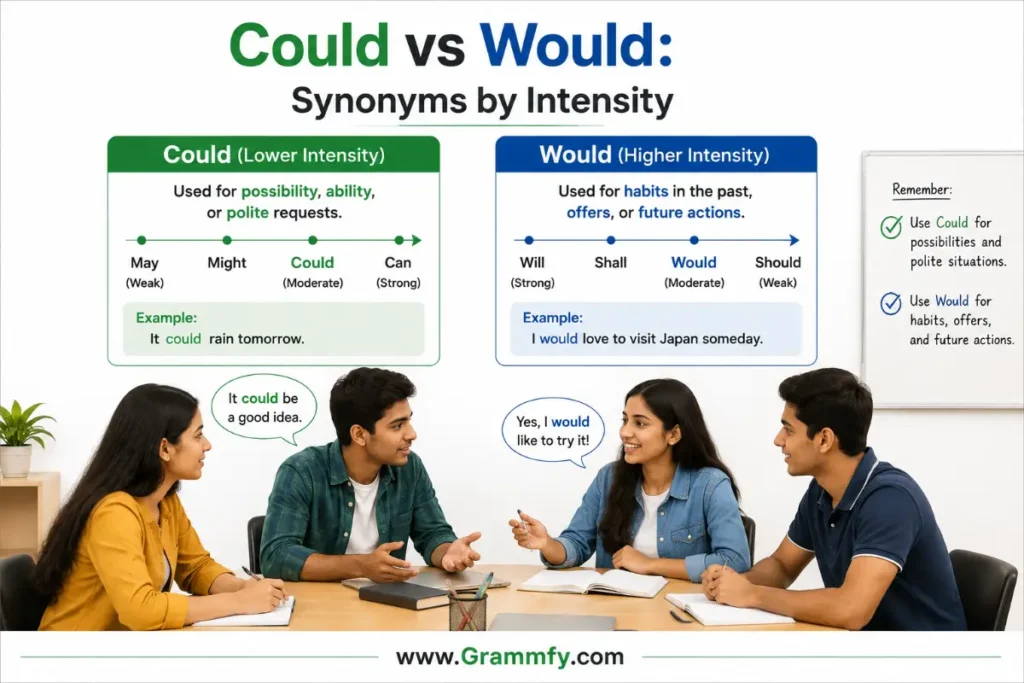
Could vs Would: Synonyms by Intensity
The strength of a modal expression depends heavily on context.
Low-Certainty Possibility
These suggest that something is possible but uncertain:
- might
- could
- may
- perhaps
- possibly
Example:
It might snow tonight.
This presents a possibility without strong confidence.
Moderate Possibility
These can communicate a more reasonable possibility:
- could
- may
- might
- be possible
- be likely
Example:
We could finish the project tomorrow.
This means tomorrow is a possible completion date.
Strong Expectation
These can sound more confident:
- should
- will probably
- be likely to
- be expected to
Example:
The package should arrive tomorrow.
Hypothetical Choice
For imagined situations, common expressions include:
- would
- would probably
- would likely
- would rather
- would prefer
Example:
I would probably choose the cheaper option.
Strong Preference
Expressions such as these make preference clearer:
- would rather
- would prefer
- would like
- want to
- prefer to
Example:
I would rather take the train.
Could vs Would by Part of Speech
Could and would are both modal auxiliary verbs.
They are followed by the base form of another verb.
Correct:
She could go.
He would help.
Incorrect:
She could goes.
He would helps.
Neither modal takes -s after it.
Could + Base Verb
Examples:
- could go
- could help
- could work
- could happen
- could change
Would + Base Verb
Examples:
- would go
- would help
- would work
- would happen
- would change
This structure is simple but important.
Could vs Would in Conditional Sentences
Conditional sentences are one of the best places to see the difference.
Consider:
If I had more money, I could travel more.
This means having more money would make more travel possible.
Now compare:
If I had more money, I would travel more.
This describes what the speaker would choose or do under that condition.
The difference is subtle but useful.
| Sentence | Main idea |
|---|---|
| If I had time, I could help. | Time would make helping possible. |
| If I had time, I would help. | Helping is what I would choose to do. |
This distinction is one of the clearest ways to understand these modal verbs.
Could vs Would in Questions
Could for Questions
Use could for polite requests and questions about possibility.
Could you help me?
Could we meet tomorrow?
Could this be the right address?
These questions can sound polite without being overly formal.
Would for Questions
Use would for willingness, preferences, invitations, and hypothetical situations.
Would you help me?
Would you like some coffee?
Would you choose this option?
What would you do?
The question What would you do? asks someone to imagine a situation and give a response.
Could vs Would in the Past
Could commonly expresses general past ability.
I could read when I was four.
But when describing one specific successful event, was able to can sometimes be clearer.
After several attempts, I was able to open the door.
This is different from:
When I was younger, I could open the door easily.
The first focuses on one successful event. The second describes general ability.
Would for Repeated Past Actions
Would can describe actions that happened repeatedly in the past.
Every summer, we would visit our grandparents.
My father would read to us before bed.
This use is similar to used to, but it generally works best with repeated actions, not permanent states.
Correct:
When we were children, we would play outside every evening.
Less natural:
When I was young, I would know the answer.
For past states, used to is usually better:
I used to know the answer.
Could vs Would for Politeness
Both words can make English sound softer.
Compare:
Can you send me the report?
Could you send me the report?
The second is generally more polite.
Now compare:
Do you want some coffee?
Would you like some coffee?
The second is more polite and conventional in offers.
This gives you a useful pattern:
Could + request
Could you help me?
Would + offer/invitation
Would you like some help?
Could vs Would for Suggestions
Could is very useful when offering an option without forcing it.
You could talk to your teacher.
We could meet on Saturday.
You could try a different approach.
This sounds less direct than:
You should talk to your teacher.
The difference is that could presents an option, while should presents advice.
Could vs Should
Compare:
| Could | Should |
|---|---|
| Presents an option | Gives advice |
| Less direct | More direct |
| “This is possible” | “This is a good idea” |
| You could call him. | You should call him. |
Best Word for Resume Writing
Is Could Good for a Resume?
Could usually isn’t the strongest choice for describing your current skills on a resume.
Instead of:
I could manage large teams.
Use:
Managed large teams.
Or:
Able to manage large teams.
The direct wording sounds more confident.
However, could can appear when discussing possibilities or achievements in a specific context.
Developed a system that could process 10,000 records per hour.
Here, could describes capability.
Is Would Good for a Resume?
Would can appear in descriptions of preferences or hypothetical situations, but it isn’t usually needed for achievement statements.
Instead of:
I would improve customer satisfaction.
Use:
Improved customer satisfaction by 20%.
A resume should normally describe what you actually did, not what you would do.
Best Word for Essay Writing
Could in an Essay
Could is useful when discussing possibilities, potential effects, and cautious claims.
This policy could reduce traffic congestion.
This is often better than:
This policy will reduce traffic congestion.
if the evidence doesn’t prove the result.
Could can make an academic claim more careful.
Would in an Essay
Would is useful for hypothetical results and conditional arguments.
If cities invested in public transportation, traffic would decrease.
Here, the writer is describing a predicted result under a condition.
It can also help compare possible outcomes:
A larger investment would likely improve access to education.
Best Word for Email Writing
Could in a Professional Email
Could is excellent for polite requests.
Could you please review the attached document?
Could you send me the updated figures?
Could we schedule a meeting next week?
These sound professional without being overly formal.
Would in a Professional Email
Would works well for polite offers, invitations, and preferences.
Would you be available for a meeting on Tuesday?
Would you like me to send the revised version?
I would appreciate your feedback.
The phrase I would appreciate… is especially common in professional writing.
Best Word for Texting
Could in Text Messages
Could works naturally when asking for help.
Could you pick me up?
Could we meet later?
Could you send me that photo?
Friends may also use can for the same purpose:
Can you send me that photo?
Would in Text Messages
Would is useful for invitations and hypothetical questions.
Would you want to go tonight?
What would you do?
Would you rather eat out?
In very casual texting, contractions are common:
What would you do? → What’d you do?
Be careful, though. What’d you do? is often understood as What did you do?, so it can create confusion. In writing, keeping the full form is usually clearer.
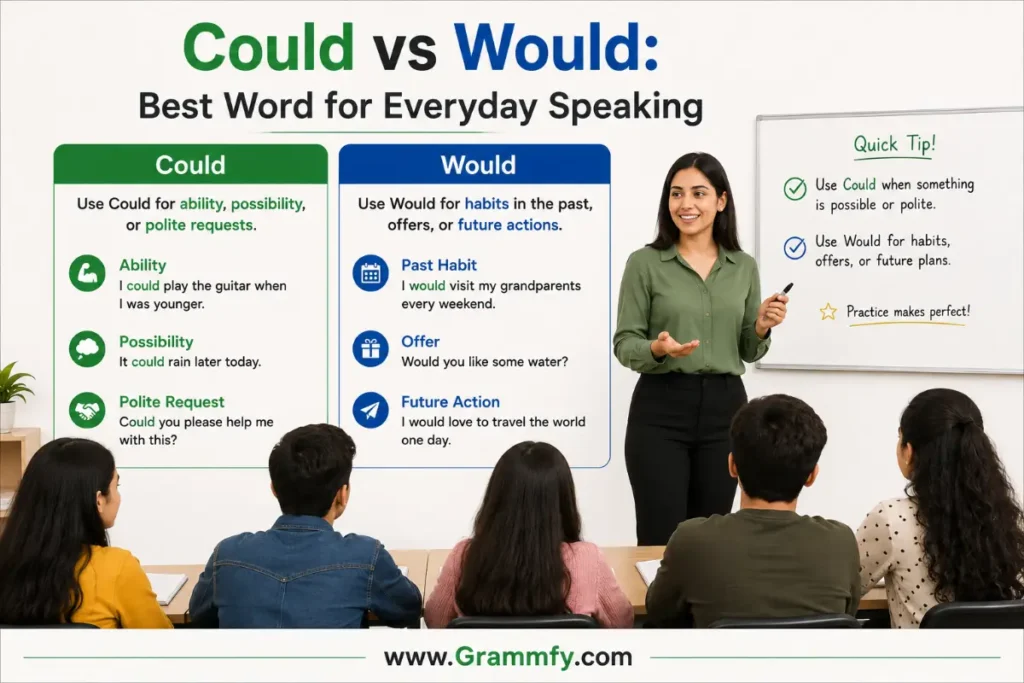
Best Word for Everyday Speaking
In casual speech, could is especially common for polite requests and suggestions.
Could you pass the salt?
We could go tomorrow.
Would is especially common in offers, preferences, and hypothetical questions.
Would you like some coffee?
I’d rather stay home.
What would you do?
Native speakers often choose these forms automatically based on context.
Could vs Would: Real-Life Example Sentences
Here are more examples across everyday situations.
Example 1: Asking for Help
Could you help me carry these boxes?
This is a polite request.
Example 2: Imagining a Choice
I would buy that car if I had enough money.
The speaker is imagining a situation.
Example 3: Possibility
We could finish the project by Friday.
Friday is one possible completion date.
Example 4: Invitation
Would you like to join us for dinner?
This is a polite invitation.
Example 5: Past Ability
When I was younger, I could run much faster.
This describes past ability.
Example 6: Hypothetical Result
If she studied more, she would probably get a higher grade.
The result depends on an imagined condition.
Example 7: Suggestion
You could ask the librarian for help.
The speaker offers one possible solution.
Example 8: Preference
I would rather stay home tonight.
The speaker expresses a preference.
Example 9: Uncertain Explanation
That noise could be coming from the air conditioner.
The speaker presents a possibility.
Example 10: Repeated Past Action
Every winter, my family would visit the mountains.
The action happened repeatedly in the past.
Example 11: Professional Request
Could you please confirm the meeting time?
This is polite and professional.
Example 12: Conditional Help
I would help you if I weren’t so busy.
The speaker says what they would do under a different condition.
Example 13: Past Possibility
He could have taken the wrong train.
This presents one possible explanation for a past event.
Example 14: Regret or Imagined Past
I would have called you if I had known.
The speaker describes an unreal past situation.
Example 15: Polite Offer
Would you like me to carry that for you?
The speaker is offering help.
Could Have vs Would Have: What’s the Difference?
Adding have creates another important distinction.
Could Have
Could have + past participle can express a past possibility or an unrealized ability.
She could have missed the bus.
This means missing the bus was possible.
It can also describe something that was possible but didn’t happen:
We could have won the game.
This means winning was possible, but the team didn’t win.
Would Have
Would have + past participle usually describes a hypothetical past result.
I would have helped you if I had known.
The speaker is imagining a different past outcome.
Compare:
I could have helped you.
This focuses on ability or possibility.
I would have helped you.
This focuses on willingness or the action the speaker intended under a condition.
Could vs Might — What’s the Difference?
Could and might can both express possibility.
It could rain tonight.
It might rain tonight.
Both mean rain is possible.
In many everyday contexts, the difference is small. Might can sometimes emphasize uncertainty more strongly, but context matters.
Another use of could is possibility through available options:
We could take the train.
This means taking the train is an option.
You wouldn’t normally use might in exactly the same way:
We might take the train.
This suggests uncertainty about whether the choice will actually happen.
Would vs Should — What’s the Difference?
Would and should are also easy to confuse.
Should often expresses advice or expectation.
You should study tonight.
Would often describes a hypothetical action.
I would study tonight if I had enough time.
Compare:
| Sentence | Meaning |
|---|---|
| You should call her. | My advice is to call her. |
| You would call her if you cared. | I’m imagining what you would do under a condition. |
The first recommends. The second creates a hypothetical situation.
Common Mistakes With Could and Would
Mistake 1: Using Would for Every Polite Request
Some learners think would is always the most polite option.
But:
Could you send me the file?
is a very natural request.
Would is often better for offers or willingness:
Would you like me to send the file?
These are not interchangeable in every situation.
Mistake 2: Confusing Possibility With Hypothetical Results
Compare:
We could go tomorrow.
This presents tomorrow as an option.
We would go tomorrow if the weather improved.
This presents going tomorrow as a conditional result.
The first is an available possibility. The second depends on a condition.
Mistake 3: Forgetting the Base Verb
Incorrect:
She could goes home.
Correct:
She could go home.
Incorrect:
He would likes it.
Correct:
He would like it.
Modal verbs are followed by the base form.
Mistake 4: Using Could When You Mean Would
Consider:
If I had more money, I could buy the house.
This means buying the house would be possible.
But:
If I had more money, I would buy the house.
This means buying the house is what the speaker says they would choose to do.
Both can be correct, but they communicate different ideas.
Mistake 5: Using Would for Simple Past Ability
Incorrect:
When I was five, I would swim very well.
If you’re describing general ability, use:
When I was five, I could swim very well.
Would can describe repeated actions, but could is the natural choice for general past ability.
When Should You NOT Use Could?
Don’t use could when you need to express certainty.
Too uncertain:
The sun could rise tomorrow.
While technically possible in unusual contexts, it doesn’t express the normal certainty of a daily event.
Use will when the event is expected:
The sun will rise tomorrow.
Also, don’t use could when you’re trying to state a definite fact.
Instead of:
This method could produce better results.
if your evidence proves it does, you might write:
This method produces better results.
Academic and professional writing should match the strength of the language to the evidence.
When Should You NOT Use Would?
Don’t use would for every future statement.
If you’re talking about a real future plan:
I will call you tomorrow.
If you’re imagining a condition:
I would call you if I had your number.
The first describes a planned future action. The second is conditional.
Also avoid would when a direct present-tense statement is clearer.
Instead of:
I would like to inform you that the meeting is canceled.
in a very direct message, you could write:
The meeting is canceled.
However, the longer version can be useful when a polite professional tone is appropriate.
What Are the Antonyms of Could and Would?
Because these words have several meanings, their opposites depend on context.
For could meaning ability:
- couldn’t
- was unable to
- wasn’t able to
Example:
I could swim.
Opposite:
I couldn’t swim.
For could meaning possibility:
- impossible
- cannot
- can’t
- unlikely
Example:
It could happen.
Opposite:
It can’t happen.
For would meaning willingness:
- wouldn’t
- refuse to
- decline to
Example:
She would help.
Opposite:
She wouldn’t help.
For would rather:
I would rather stay.
Opposite preference:
I wouldn’t choose to stay.
Quick Tips for Choosing the Right Word
Ask yourself these questions before choosing a modal verb.
Am I talking about past ability?
Use could.
I could read at age four.
Am I presenting an option?
Use could.
We could take the bus.
Am I making a polite request?
Use could.
Could you help me?
Am I imagining what I would do?
Use would.
I would move abroad if I got the opportunity.
Am I asking about someone’s preference?
Use would.
Would you rather stay home?
Am I making a polite invitation?
Use would.
Would you like some coffee?
Am I talking about repeated past behavior?
Use would.
Every Sunday, we would visit our grandparents.
Am I describing a hypothetical result?
Use would.
If I had more time, I would learn Spanish.
Am I describing possibility?
Use could.
This could be the right answer.
Could vs Would: Quick Comparison Chart
| Situation | Use | Example |
|---|---|---|
| Past ability | Could | I could swim at six. |
| Present possibility | Could | It could happen. |
| Future possibility | Could | We could go tomorrow. |
| Polite request | Could | Could you help? |
| Suggestion | Could | You could try again. |
| Hypothetical action | Would | I would help. |
| Conditional result | Would | I would go if I could. |
| Willingness | Would | She would help. |
| Polite invitation | Would | Would you like tea? |
| Preference | Would | I’d rather stay. |
| Repeated past action | Would | We would visit every summer. |
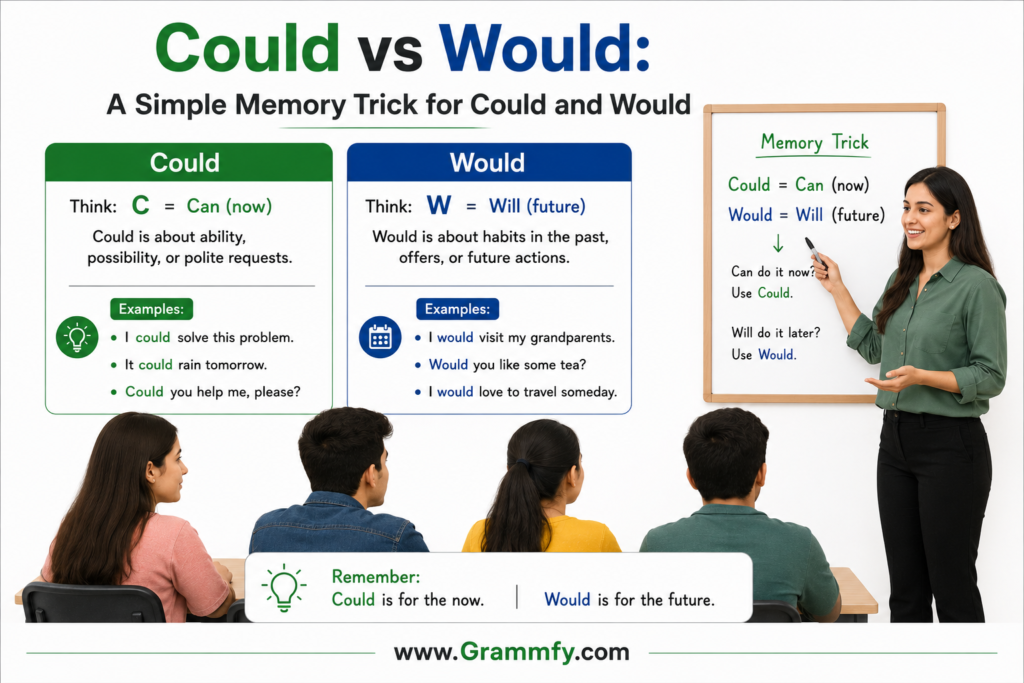
A Simple Memory Trick for Could and Would
Think about the first letters:
Could = Can + possibility
Would = Will + imagined choice
This isn’t a complete grammar rule, but it’s a useful memory aid.
When you see could, ask:
“Is this about ability, possibility, a suggestion, or a polite request?”
When you see would, ask:
“Is this about an imagined situation, willingness, preference, or a polite offer?”
If the answer fits, you’ve probably chosen the right word.
Conclusion
The key to could vs would is to focus on the idea behind the sentence rather than simply memorizing a tense rule. Could often points to ability, possibility, an available option, or a polite request. Would often points to an imagined result, willingness, preference, or a polite offer. The difference becomes especially clear in conditional sentences: “If I had time, I could help” means time would make helping possible, while “If I had time, I would help” describes what the speaker would choose to do.
Once you understand these patterns, choosing between the two becomes much easier. Pay attention to real conversations, emails, books, and everyday examples. With practice, the difference will start to feel natural instead of something you have to calculate each time.
Frequently Asked Questions
What is the difference between could and would?
Could commonly expresses ability, possibility, suggestions, or polite requests, while would commonly expresses hypothetical actions, willingness, preferences, and polite offers. Context determines the exact meaning.
Should I say could you or would you?
Use “Could you…?” for a straightforward polite request and “Would you…?” when the question focuses more on willingness. For example, “Could you send the file?” is a natural request, while “Would you help me?” emphasizes willingness.
Is could more polite than can?
Could often sounds more polite or less direct than can. “Can you help me?” is normal and friendly, while “Could you help me?” sounds slightly softer.
What’s another way to say could?
Depending on the meaning, alternatives include “was able to,” “might,” “may,” “be possible,” and “can.” The correct replacement depends on whether you’re expressing ability, possibility, or a request.
When should I use would instead of will?
Use would for many hypothetical, conditional, polite, or imagined situations. Use will for a real future intention, prediction, or decision.
Can could and would be used together?
Yes, especially in conditional sentences. For example, “If I had more time, I could help” focuses on possibility, while “If I had more time, I would help” focuses on the action the speaker would choose.
Is could the past tense of can?
Could is historically related to can and often expresses past ability, but it has several modern uses beyond the past tense. It can also express possibility, suggestions, and polite requests.
