
When you’re writing an email, finishing an essay, or sending a quick text, choosing between must vs have to can feel confusing. Both expressions show that something is necessary or required, but they don’t always communicate the same idea. The difference often depends on where the obligation comes from, how strong it sounds, and the situation you’re describing.
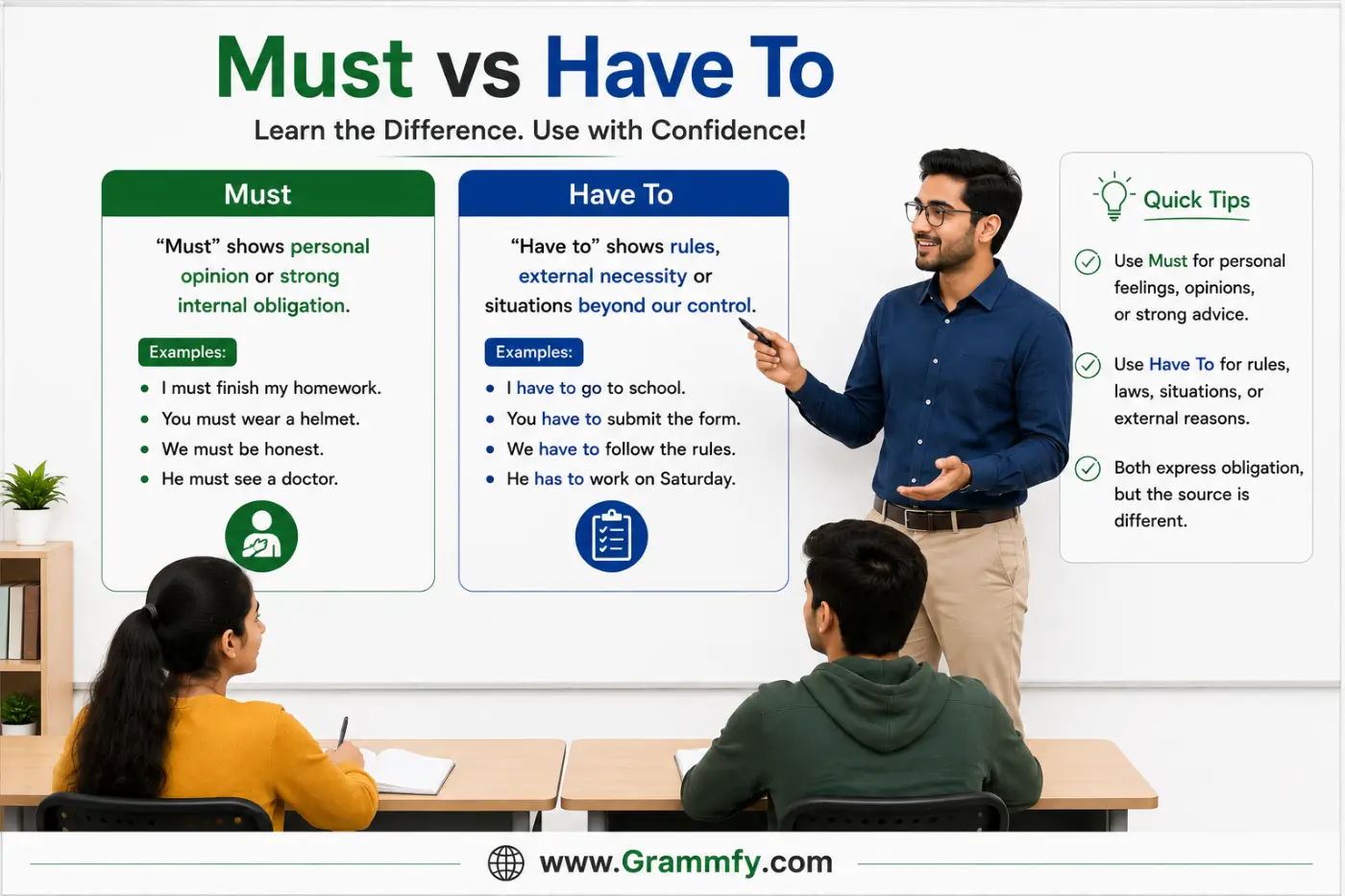
Answer box: Must usually shows a strong obligation felt or stated by the speaker, while have to often describes a rule, requirement, or situation that comes from outside the speaker.
For example, “I must finish this report tonight” can sound like the speaker personally feels it is necessary. “I have to finish this report tonight” can suggest that a boss, deadline, or other outside situation requires it. In everyday American English, have to is often more common in ordinary conversation.
This guide explains the meaning and origin of both expressions, how their strength changes with context, which alternatives work best in formal and informal writing, and how to avoid common mistakes. You’ll also see real examples for texting, emails, resumes, essays, and everyday speech.
Must vs Have To is one of several grammar rules that can cause confusion. Learn more in our guide.
What Does Must Mean in Plain English?
Must is a modal verb used to show strong necessity, obligation, or certainty.
When must expresses obligation, it tells someone that an action is necessary.
- You must wear a seat belt.
- I must remember to call Mom.
- Students must submit the form by Friday.
- You must follow the safety rules.
The source of the obligation can be the speaker, a rule, an instruction, or the situation itself.
Must can also express a strong conclusion:
- She must be tired after working all day.
- They must know the answer.
- He must be at home by now.
Here, must doesn’t mean “required to.” It means the speaker believes something is very likely true.
What Does Have To Mean in Plain English?
Have to means that something is necessary because of a rule, situation, responsibility, deadline, or outside requirement.
Examples include:
- I have to work tomorrow.
- We have to leave before 8 a.m.
- You have to show your ID.
- She has to finish the project today.
In everyday US English, have to is extremely common. People often use it when talking about practical responsibilities.
For example:
I have to pick up my brother from school.
The speaker may not personally want to do it. A responsibility or situation makes it necessary.
Must vs Have To: What’s the Main Difference?
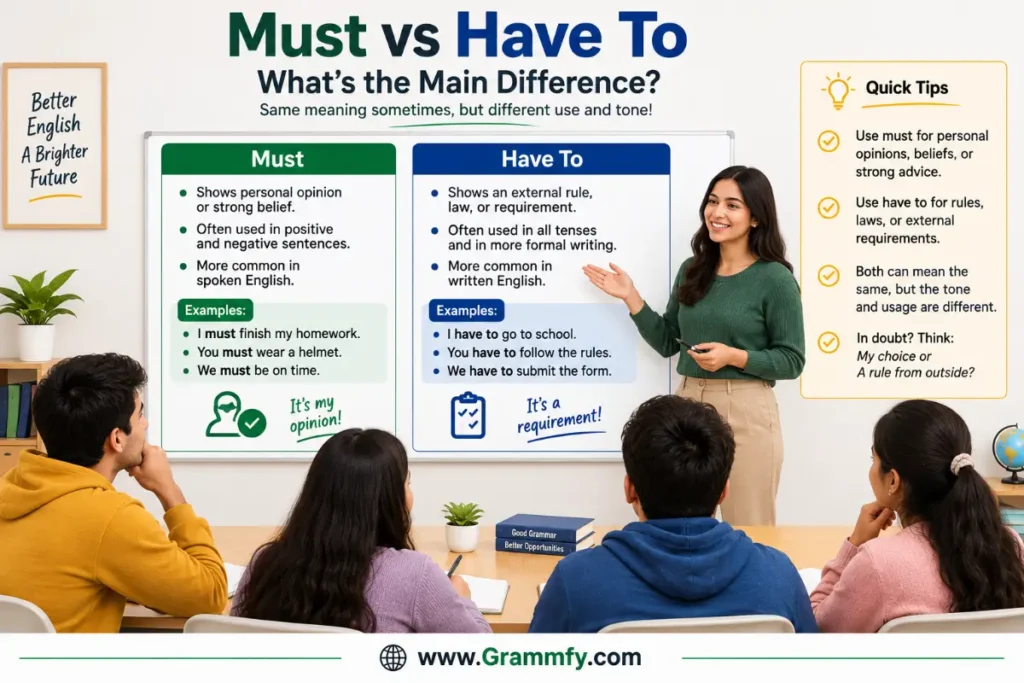
The easiest way to understand must vs have to is to ask:
Where does the obligation come from?
| Expression | Common source of obligation | Example |
|---|---|---|
| Must | Speaker, strong instruction, rule | You must listen carefully. |
| Have to | Outside rule, situation, responsibility | I have to attend the meeting. |
| Must | Formal requirement | Visitors must sign in. |
| Have to | Practical necessity | I have to catch the 7:00 train. |
This isn’t an absolute rule. Native speakers can use must for outside rules and have to for personal decisions.
Compare:
- “I must call my doctor.” → sounds like a strong personal decision or urgent feeling.
- “I have to call my doctor.” → sounds like something that circumstances require.
Both sentences can be correct.
Where Did Must Come From?
The word must has a long history in English. It developed from an Old English form related to the verb meaning “to be able” or “to have to.”
Over time, its meaning became closely connected with necessity and obligation.
Modern English treats must as a modal verb. Like other modal verbs, it has special grammar patterns.
For example:
- I must go.
- She must leave.
- They must wait.
We don’t normally add to after must.
Incorrect:
- I must to go.
Correct:
- I must go.
The historical development of must also helps explain why it behaves differently from ordinary verbs.
Where Did Have To Come From?
Have to comes from the ordinary verb have followed by to and another verb.
The basic structure is:
have + to + base verb
Examples:
- I have to study.
- She has to work.
- We have to leave.
- They had to wait.
Unlike must, have to behaves more like a regular verb phrase. It changes for tense and subject.
Compare:
| Time/subject | Have to |
|---|---|
| Present | I have to go. |
| Third person | She has to go. |
| Past | I had to go. |
| Future | I will have to go. |
| Perfect | I have had to go. |
This flexibility is one reason have to is so useful in everyday English.
Why Is Must vs Have To Important?
Understanding must vs have to helps you express the source and strength of an obligation clearly.
Consider these two sentences:
I must finish my homework.
I have to finish my homework.
Both mean that finishing the homework is necessary. But the first can sound more like a personal commitment. The second can sound like a requirement created by a teacher, deadline, parent, or school rule.
The difference is often subtle rather than absolute.
Must vs Have To in American English
In American English, have to is generally more common in casual conversation when people describe everyday obligations.
People naturally say:
- I have to go.
- I have to work.
- I have to study.
- I have to wake up early.
- I have to buy groceries.
Must is still common, but it often sounds stronger, more formal, more serious, or more deliberate.
For example:
You must wear protective equipment.
This sounds like a serious instruction.
In casual conversation:
I have to wear protective equipment at work.
This sounds like a normal statement about a workplace requirement.
Is Must More Formal Than Have To?
Often, yes.
Must can sound more formal or authoritative, especially in rules, instructions, official notices, and written policies.
Examples:
- Employees must wear identification badges.
- Applicants must provide proof of identity.
- Visitors must remain in the waiting area.
Have to is usually more natural in casual speech:
- I have to wear my badge at work.
- I have to show my ID.
- We have to wait here.
Neither form is automatically better. The best choice depends on the audience and situation.
Must vs Have To: Master Synonym List
There isn’t one perfect synonym for must or have to in every sentence. The best alternative depends on the level of force, formality, and meaning.
The following list covers common alternatives and related expressions.
Simple Obligation Words
| Word/Phrase | Meaning | Tone | Example |
|---|---|---|---|
| need to | Something is necessary | Neutral | You need to rest. |
| have to | Something is required | Everyday | I have to leave. |
| must | Strong necessity | Strong | You must listen. |
| should | Good or advisable idea | Mild | You should call her. |
| ought to | What is advisable or expected | Neutral/Formal | You ought to apologize. |
| need | Require something | Neutral | We need more time. |
| require | Officially demand | Formal | The job requires training. |
| necessitate | Make something necessary | Formal | The delay necessitated a change. |
Everyday Alternatives
| Word/Phrase | Meaning | Tone | Example |
|---|---|---|---|
| need to | Need to do something | Everyday | I need to study. |
| got to | Informal form of “have got to” | Casual | I’ve got to go. |
| have got to | Strong necessity | Casual | We’ve got to hurry. |
| be supposed to | Expected to do something | Everyday | You’re supposed to wait here. |
| be expected to | Expected to do something | Neutral | You’re expected to arrive early. |
| be required to | Officially obligated | Formal | Staff are required to attend. |
| can’t avoid | Cannot reasonably escape an action | Everyday | I can’t avoid talking to him. |
Formal Alternatives
| Word/Phrase | Meaning | Tone | Example |
|---|---|---|---|
| be required to | Be officially obligated | Formal | Applicants are required to apply online. |
| be obligated to | Have a duty | Formal | Tenants are obligated to follow the agreement. |
| be obliged to | Be required to do something | Formal | We are obliged to report the issue. |
| be compelled to | Be forced by circumstances | Strong/Formal | She was compelled to respond. |
| be mandated to | Be officially ordered | Very formal | Agencies are mandated to follow the law. |
| be expected to | Be expected to act in a certain way | Formal | Employees are expected to arrive on time. |
| be responsible for | Have a duty or role | Formal | She is responsible for managing the team. |
| be necessary to | Be needed | Formal | It is necessary to submit the form. |
Informal or Casual Alternatives
| Word/Phrase | Meaning | Tone | Example |
|---|---|---|---|
| gotta | Informal “got to” | Very casual | I gotta go. |
| got to | Need to | Casual | I’ve got to leave. |
| need to | Need to do something | Everyday | I need to call him. |
| have got to | Strong need | Casual | We’ve got to hurry. |
| can’t skip | Must not leave something out | Casual | You can’t skip this step. |
| can’t miss | Must attend or notice | Casual | You can’t miss the meeting. |
For formal writing, avoid gotta. It works in casual speech, dialogue, texts, and informal messages.
How Strong Are These Words?
Obligation words don’t all have the same force.
A useful scale is:
might want to → could → should → ought to → need to → have to → must → be required to → be mandated to
This isn’t a fixed ranking for every situation, but it gives you a useful general idea.
Mild
You might want to check your email.
This is a suggestion, not a strict requirement.
Moderate
You should check your email.
The speaker thinks checking is a good idea.
Stronger
You need to check your email.
The action is presented as necessary.
Strong
You have to check your email.
The action is presented as required.
Very strong
You must check your email.
This can sound like a firm instruction or serious necessity.
Official
You are required to check your email.
This sounds like a formal rule or policy.
Must vs Have To vs Need To
These three expressions are closely related, but their tone can differ.
| Expression | Typical meaning | Example |
|---|---|---|
| must | Strong obligation | You must wear a helmet. |
| have to | Requirement or practical necessity | I have to wear a helmet at work. |
| need to | Necessary action | You need to wear a helmet. |
In ordinary conversation, need to often sounds less forceful than must.
Compare:
You must finish this today.
You need to finish this today.
The first sounds more commanding. The second can sound like practical advice or a necessary task.
Must vs Have To vs Should
This is one of the most important distinctions.
Should usually means something is recommended or advisable.
Must means it is necessary.
Compare:
- You should bring an umbrella. → It may rain.
- You must bring your passport. → You cannot complete the trip without it.
- You have to bring your passport. → A rule or situation requires it.
If something is truly optional, must is too strong.
Must vs Have To vs Ought To
Ought to is close to should. It often expresses advice, expectation, or what is morally right.
- You ought to apologize.
- You should apologize.
- You must apologize.
The first two generally sound like advice. The third sounds like a strong requirement.
In modern American English, should is much more common than ought to in everyday conversation.
Must vs Have To: Synonyms by Intensity
Choosing the right word often depends on how strong you want the sentence to sound.
Mild Obligation
Use these when you want to avoid sounding demanding:
- should
- could
- might want to
- ought to
- may want to
Example:
You might want to check the address.
This doesn’t order the reader to check it.
Medium Obligation
Use these when something is genuinely necessary but you don’t need an especially forceful tone:
- need to
- have to
- be expected to
- be supposed to
Example:
You need to submit the form before Friday.
Strong Obligation
Use these when something is important or required:
- must
- have got to
- be required to
- be obligated to
Example:
All visitors must sign in.
Very Strong or Official Obligation
These expressions often appear in laws, policies, contracts, and official documents:
- be mandated to
- be compelled to
- be obligated to
- be required to
- be legally required to
Example:
Businesses are legally required to keep accurate records.
Must vs Have To by Part of Speech
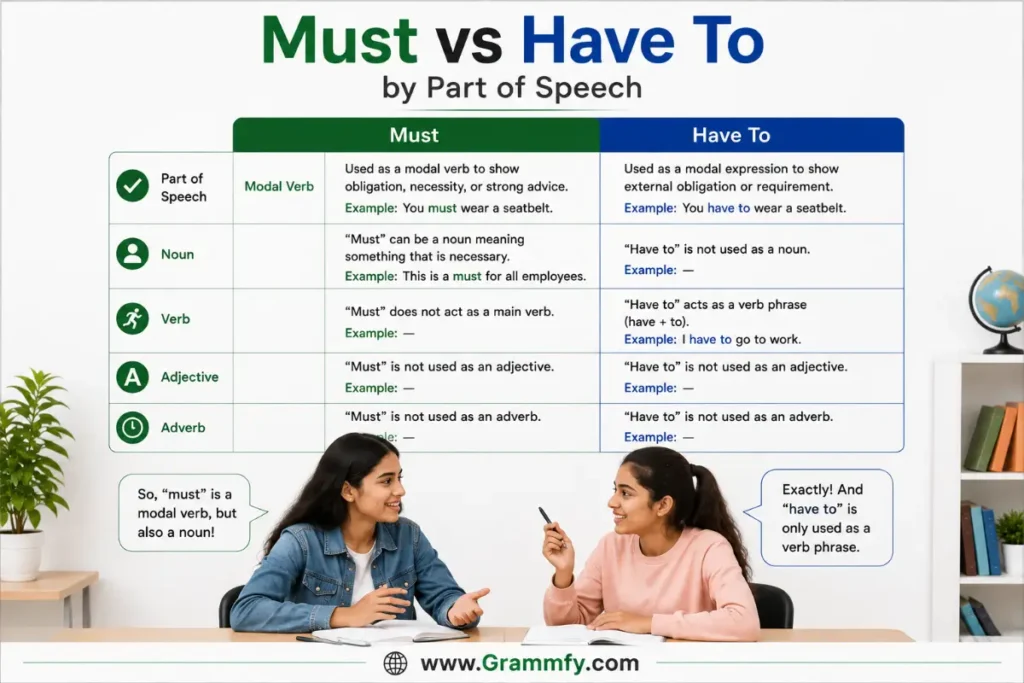
Must as a Modal Verb
Use the base form of the main verb after it:
- must go
- must study
- must work
- must leave
Don’t use to after must.
Incorrect:
She must to study.
Correct:
She must study.
Also, must doesn’t take -s with he, she, or it.
Incorrect:
He musts leave.
Correct:
He must leave.
Have To as a Verb Phrase
Have to changes depending on the subject and tense.
- I have to work.
- You have to work.
- She has to work.
- They have to work.
- We had to work.
- She will have to work.
This makes have to easier to use when you need different tenses.
How Do You Use Must in Different Contexts?
Must in a Resume
Resumes usually don’t need many sentences with must because resume writing focuses on skills, achievements, and responsibilities.
Instead of:
I must complete projects on time.
A stronger resume style is:
Consistently completes projects ahead of deadline.
Or:
Must meet strict project deadlines.
The second version can work in a job description rather than as a personal resume statement.
Have To in a Resume
Have to is usually too conversational for polished resume writing.
Instead of:
I have to manage customer accounts.
Use:
Manage customer accounts and resolve client issues.
Or:
Responsible for managing customer accounts.
The shorter version sounds more professional.
Must in an Essay
Must can work well in academic or argumentative writing when you want to make a strong claim.
Example:
Governments must protect access to clean water.
This sounds firm and persuasive.
However, don’t use must for every claim. If you’re presenting a recommendation, should may be more accurate.
Schools should provide more reading resources.
This sounds less absolute.
Have To in an Essay
Have to is grammatically correct in essays, but it can sound more conversational.
Instead of:
Students have to develop strong reading skills.
You might write:
Students need to develop strong reading skills.
Or:
Students are required to develop strong reading skills.
The choice depends on your intended tone.
Must in an Email
Must works well when communicating a firm requirement.
All employees must complete the training by Friday.
For a softer professional tone:
Please complete the training by Friday.
This is an important writing lesson: sometimes replacing must with a polite request produces a better email.
Have To in an Email
Have to is natural when explaining a practical requirement.
I have to leave the office at 4 p.m. for an appointment.
But if you’re giving a formal instruction, must may be better:
All forms must be submitted by 4 p.m.
Must in Texting
Must is less common in casual texting, but it’s perfectly understandable.
I must remember to call you later.
This can sound slightly dramatic or playful.
A more natural text might be:
I have to remember to call you later.
Or:
I need to call you later.
Have To in Texting
Have to is extremely natural in everyday texting.
- I have to go.
- I have to study.
- I have to wake up early.
- I have to finish this first.
In very casual texting, people may write:
Gotta go.
That’s informal and should not be used in formal documents.
Must in Speaking
Must is common in speech when giving strong advice, instructions, or making a confident guess.
You must try this restaurant.
Here, must can mean something like “I strongly recommend this.”
It can also express logical certainty:
You must be exhausted.
That means the speaker strongly believes the person is exhausted.
Have To in Speaking
Have to is one of the most common ways to describe everyday responsibilities.
I have to get up at six.
We have to catch the bus.
She has to work tonight.
This is why learners often hear have to more frequently than must in casual American English.
What Is the Difference Between Must and Have To in Rules?
Both can describe rules.
Must
Visitors must wear badges.
This sounds like a direct rule.
Have to
Visitors have to wear badges.
This sounds more conversational.
The underlying rule can be exactly the same.
A company handbook might say:
Employees must wear identification badges.
An employee might tell a friend:
We have to wear badges at work.
The meaning is nearly identical, but the style is different.
Must vs Have To: Personal Choice or Outside Rule?
This is one of the most useful distinctions.
Personal obligation
I must remember to buy flowers.
The speaker is emphasizing a personal decision or strong feeling.
Outside obligation
I have to buy flowers because my wife asked me to.
The necessity comes from another person or situation.
But remember: this is a tendency, not a strict grammar law.
You can say:
I have to remember to buy flowers.
And you can say:
I must follow the company rules.
Both are correct.
Must vs Have To in the Negative
This is where the difference becomes especially important.
Must Not
Must not means something is prohibited.
You must not touch the machine.
This means:
Do not touch the machine.
It is not simply the absence of an obligation.
Don’t Have To
Don’t have to means something is not necessary.
You don’t have to wear a tie.
This means:
Wearing a tie is optional.
You may wear one, but you don’t need to.
These meanings are very different.
| Sentence | Meaning |
|---|---|
| You must not leave. | You are prohibited from leaving. |
| You don’t have to leave. | Leaving isn’t necessary. |
| You must not smoke here. | Smoking is prohibited. |
| You don’t have to smoke. | Smoking isn’t required. |
This distinction is one of the most important grammar points related to must vs have to.
Must vs Have To in the Past
Must doesn’t normally have a regular past form for obligation.
Instead, English commonly uses had to.
Present:
I must leave now.
Past:
I had to leave early.
Present:
She must finish the report.
Past:
She had to finish the report.
This is one reason have to is useful: it can easily express past obligations.
Future Obligation
For future necessity, will have to is common.
I will have to leave early tomorrow.
She will have to study harder next semester.
Must can also refer to future requirements:
You must submit the application by Monday.
The choice depends on the situation and tone.
Must vs Have To for Logical Conclusions
Remember that must has another important meaning.
It can show that the speaker thinks something is almost certainly true.
The lights are on. They must be home.
This doesn’t mean they are required to be home.
It means:
I strongly believe they are home.
You generally cannot replace this meaning with ordinary have to.
The lights are on. They have to be home.
This can sometimes be used informally to express a strong conclusion, but it may sound different and is less straightforward for learners.
This is a key reason context matters.
Must vs Have To: Close-Synonym Comparison
Must vs Need To — What’s Different?
| Must | Need to |
|---|---|
| Stronger | Often softer |
| Can sound authoritative | Often sounds practical |
| Common in rules | Common in everyday situations |
| Can show logical certainty | Usually shows necessity |
Examples:
You must wear a helmet.
You need to wear a helmet.
Both can describe a requirement, but the first sounds stronger.
Another example:
I must remember her birthday.
I need to remember her birthday.
The second sounds more like a practical reminder.
Have To vs Be Supposed To — What’s Different?
Have to means something is necessary or required.
Be supposed to usually means something is expected, scheduled, or part of an agreed plan.
Compare:
I have to attend the meeting.
This says attendance is necessary.
I’m supposed to attend the meeting.
This says attendance is expected or planned.
The second sentence doesn’t always mean the person will actually attend.
Must vs Have To: 12 Real-Life Examples
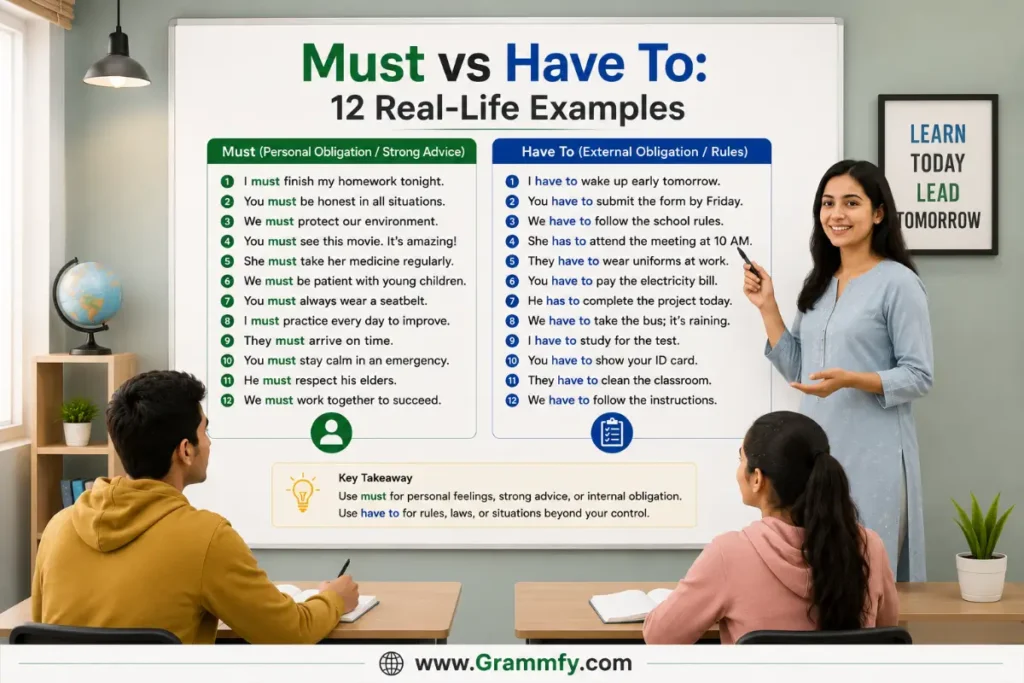
Here are examples from different situations.
1. School
Students must submit their assignments before Friday.
This sounds like an official school requirement.
2. Daily Routine
I have to wake up early tomorrow.
This sounds natural in everyday conversation.
3. Workplace
Employees must wear their ID badges inside the building.
This sounds like a formal workplace rule.
4. Personal Responsibility
I must remember to call my grandmother tonight.
The speaker is emphasizing a personal obligation.
5. Travel
We have to leave now if we want to catch the train.
The situation creates the necessity.
6. Safety
You must wear a helmet while riding this bike.
This is a strong safety instruction.
7. Appointment
I have to leave work early for a doctor’s appointment.
The situation requires it.
8. Formal Notice
All applications must be received by June 30.
This is formal and official.
9. Text Message
Sorry, I have to go. I’ll call you later.
This is natural casual English.
10. Strong Recommendation
You must try this chocolate cake.
Here, must means the speaker strongly recommends it.
11. Logical Conclusion
She must be tired after that long flight.
Here, must expresses a strong conclusion rather than an obligation.
12. Optional Action
You don’t have to bring anything.
This means bringing something is not necessary.
Common Mistakes With Must vs Have To
Mistake 1: Adding “To” After Must
Incorrect:
You must to finish this today.
Correct:
You must finish this today.
After must, use the base form of the verb.
Mistake 2: Adding “-s” to Must
Incorrect:
She musts leave early.
Correct:
She must leave early.
Modal verbs don’t take -s.
Mistake 3: Confusing Mustn’t and Don’t Have To
Incorrect interpretation:
You mustn’t come.
This does not mean “You don’t need to come.”
It means:
You are not allowed to come.
If you mean attendance isn’t necessary:
You don’t have to come.
Mistake 4: Using Have To With the Wrong Subject
Incorrect:
She have to work.
Correct:
She has to work.
Remember:
- I have to
- You have to
- He has to
- She has to
- We have to
- They have to
Mistake 5: Using Gotta in Formal Writing
Casual:
I gotta go.
Formal:
I have to leave.
Or:
I must leave.
Gotta is common in informal speech and texting, but it doesn’t belong in most formal writing.
Mistake 6: Treating Must and Have To as Completely Identical
They often overlap, but they can differ in tone, source of obligation, and formality.
Don’t assume you can replace one with the other in every sentence without changing the feeling.
When Should You NOT Use Must?
Avoid must when the action is only a suggestion.
Too strong:
You must watch this movie if you have time.
If you simply want to recommend it, this may sound better:
You should watch this movie if you have time.
Also avoid must when you’re trying to sound especially gentle in a sensitive conversation.
Instead of:
You must talk to your manager.
Try:
You may want to talk to your manager.
The second version gives the listener more freedom.
When Should You NOT Use Have To?
Don’t use have to when you need a very formal or official tone unless the context allows conversational language.
Instead of:
You have to submit the form by Friday.
A policy might say:
You must submit the form by Friday.
Or:
The form is required by Friday.
Also, don’t use have to when you actually mean that something is prohibited.
Incorrect:
You don’t have to park here.
If you mean parking is forbidden:
You must not park here.
What Are the Antonyms of Must and Have To?
There isn’t one perfect opposite for every use, but useful contrasts include:
- may
- can
- don’t have to
- don’t need to
- may choose to
- be free to
- be allowed to
For example:
You must attend.
Opposite idea:
You don’t have to attend.
Another:
You must not enter.
The opposite permission would be:
You may enter.
Notice that must not and don’t have to are not opposites in a simple grammatical sense. They express different kinds of negative meaning.
How Do You Choose the Right Word?
Use these quick questions.
Is it a strict rule?
Use must or be required to.
Employees must wear safety shoes.
Is it an everyday responsibility?
Use have to.
I have to pick up my kids.
Is it personal motivation?
Use must or need to.
I must remember to send that email.
Is it advice?
Use should.
You should get some rest.
Is it optional?
Use don’t have to or don’t need to.
You don’t have to stay late.
Is it forbidden?
Use must not.
You must not enter this room.
Is the writing formal?
Consider must, be required to, or be obligated to.
Is the conversation casual?
Have to, need to, and got to may sound more natural.
Quick Tips for Choosing Must vs Have To
- Use must for strong obligation.
- Use have to for everyday requirements.
- Use must for many formal rules and notices.
- Use have to when talking about practical responsibilities.
- Use need to when you want a natural middle ground.
- Use should when you’re giving advice instead of a command.
- Use must not for prohibition.
- Use don’t have to when something isn’t necessary.
- Use had to for many past obligations.
- Use will have to for many future obligations.
- Don’t put to after must.
- Don’t add -s to must.
- Use has to with he, she, and it.
- Avoid gotta in formal writing.
- Always consider the tone, not just the grammar.
Which One Sounds More Natural in Everyday American English?
For ordinary daily obligations, have to is often the more natural choice.
You might hear:
I have to go.
I have to work tomorrow.
I have to finish this.
We have to hurry.
Must can sound stronger or more formal:
I must go.
You must finish this.
We must hurry.
The last examples are correct, but depending on context they may sound more deliberate or formal.
That doesn’t make must wrong. It simply means that natural language depends on the situation.
What About British English?
Both must and have to are widely used in British English too.
The basic meanings are similar across major English varieties. Differences are more likely to involve frequency, tone, and context than completely different grammar rules.
In both American and British English:
You must not smoke.
means smoking is prohibited.
And:
You don’t have to come.
means coming isn’t necessary.
So learners shouldn’t worry about a major US-versus-UK meaning difference here. Focus first on the source of obligation, strength, and tone.
Must vs Have To in Professional Communication
Professional communication requires careful control of tone.
you’re writing a company rule, must can be clear:
Employees must complete security training.
you’re explaining your own schedule to a coworker, have to is natural:
I have to leave at three today.
If you’re making a polite request, neither may be the best option:
Could you send me the report by three?
This sounds more cooperative than:
You must send me the report by three.
The right expression depends not only on grammar but also on your relationship with the reader.
Must vs Have To in Academic Writing
Academic writing often needs precise claims.
must, Use when the argument requires a strong statement:
Effective policies must address the needs of low-income families.
should Use when you are recommending an action:
Effective policies should address the needs of low-income families.
Use need to when the tone should remain direct but less forceful:
Researchers need to consider several factors.
Use have to when you’re describing an actual external requirement:
Participants have to complete three surveys.
The key is to match the verb to the strength of your evidence and your intended claim.
Must vs Have To: A Simple Decision Table
| What you mean | Best choice |
|---|---|
| Strong rule | must |
| Everyday requirement | have to |
| Personal strong obligation | must |
| Practical necessity | have to / need to |
| Advice | should |
| Formal requirement | must / be required to |
| Prohibition | must not |
| No obligation | don’t have to |
| Past obligation | had to |
| Future obligation | will have to |
| Strong conclusion | must |
A Final Memory Trick about Must vs Have To
Think of must as a strong voice saying:
“This is necessary.”
Think of have to as a situation saying:
“This is required.”
Then remember the negative forms:
must not = prohibited
don’t have to = not necessary
That small distinction can prevent a major misunderstanding.

Conclusion
Understanding must vs have to becomes much easier when you focus on the source and strength of the obligation. Must often sounds stronger, more deliberate, or more formal, while have to is very natural for everyday requirements and outside circumstances. Still, the two expressions overlap, so context matters more than a rigid rule.
The biggest point to remember is the negative difference: must not means something is prohibited, while don’t have to means something isn’t required. Also remember that must is followed by the base verb, while have to changes to forms such as has to, had to, and will have to.
Choose the expression that matches your meaning, audience, and tone. Once you notice these patterns in real conversations and writing, the choice becomes much more natural.
Frequently Asked Questions
What is the main difference between must and have to?
Must often emphasizes a strong obligation, while have to often describes a requirement created by a situation, rule, or outside source. In everyday American English, have to is especially common for ordinary responsibilities.
Is must stronger than have to?
Must often sounds stronger or more formal than have to, but the actual strength depends on context. Both can describe a strict requirement.
Can I use have to instead of must?
Usually, yes, when both express obligation, but the tone may change. For example, “You must wear a helmet” sounds more like a firm instruction, while “You have to wear a helmet” sounds more conversational.
What’s another way to say “must”?
Common alternatives include “have to,” “need to,” “be required to,” “be obligated to,” and “be expected to.” The best choice depends on how strong and formal you want the statement to sound.
What is the difference between must not and don’t have to?
Must not means something is prohibited, while don’t have to means something isn’t necessary. “You must not enter” means you aren’t allowed to enter; “You don’t have to enter” means entering is optional.
Is have to more common than must in American English?
Have to is very common in everyday American conversation. Must is also common, especially in formal rules, strong instructions, personal commitments, and expressions of logical certainty.
Can must be used for the past?
For ordinary past obligation, English usually uses “had to” rather than a past form of must. For example, “I had to leave early yesterday” describes a past requirement.
