
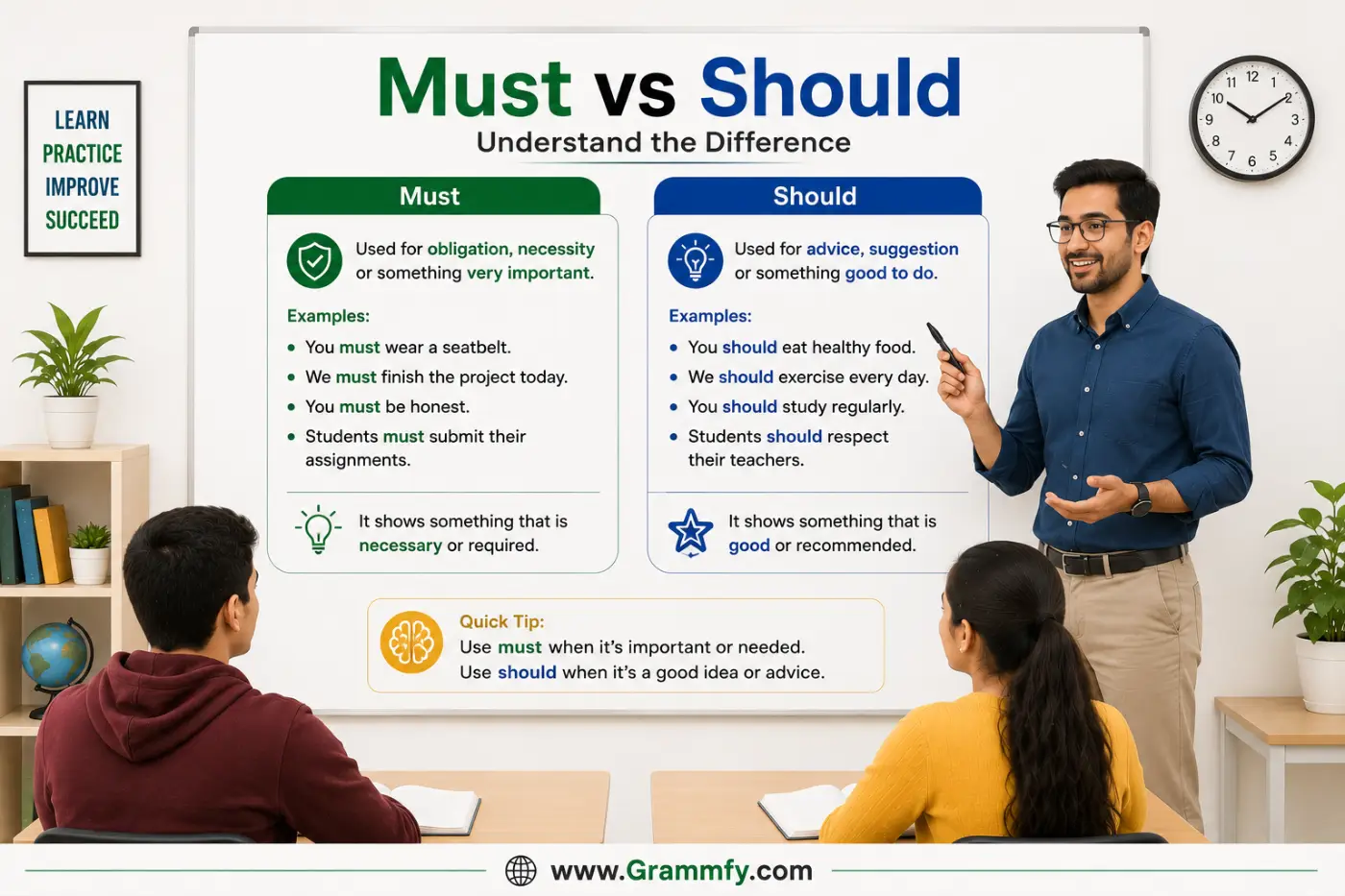
When you’re writing an email, essay, resume, or text, you may stop and wonder whether to use Must vs Should. Both words talk about what is necessary, expected, or recommended, but they don’t carry the same level of force. Choosing the right one can change the meaning of a sentence.
Answer box: Must shows strong necessity, obligation, or certainty. Should usually shows advice, expectation, or what is considered the right thing to do.
For example, “You must wear a seat belt” sounds like a firm requirement. “You should wear a seat belt” sounds like advice. Both sentences encourage safe behavior, but the strength is different.
This guide explains the plain-English meanings, word origins, synonyms, intensity levels, US and UK usage, common mistakes, real-life examples, and the best choice for different types of writing.
If you want to improve your sentence structure, take a look at our article on grammar rule.
What Do “Must vs Should” Mean in Plain English?
The simplest way to understand these words is to think about strength.
Must is strong. It tells someone that something is necessary or required.
Should is softer. It usually gives advice, a recommendation, or an expectation.
Compare these sentences:
You must submit the form today.
You should submit the form today.
The first sentence sounds like a requirement. The second sounds like a recommendation.
This difference matters because using the stronger word can make your message sound demanding, while using the softer word may make a rule sound optional.
What does Must mean?
Must is a modal verb used to express strong necessity, obligation, or certainty.
Examples:
- You must wear a helmet.
- Students must complete the assignment.
- We must leave now.
- She must be tired after that long trip.
Notice that “must” has more than one use.
It can show:
- obligation
- necessity
- strong advice
- logical conclusion
- strong belief
For example:
You must finish the application before Friday.
This expresses an obligation.
But:
She must be at home by now.
This expresses a logical conclusion. The speaker believes that being at home is very likely.
What does Should mean?
Should is also a modal verb. It commonly expresses advice, recommendation, expectation, or a likely result.
Examples:
- You should drink more water.
- You should check your email.
- We should arrive before noon.
- He should be home soon.
It can also describe responsibility or what is considered proper:
People should treat others with respect.
Unlike “must,” “should” normally leaves room for choice.
“Must vs Should”: What Is the Main Difference?
The central difference is strength.
| Word | Main meaning | Strength | Example |
|---|---|---|---|
| Must | Required or necessary | Very strong | You must wear a badge. |
| Should | Recommended or expected | Moderate | You should wear a badge. |
Think of the words as points on a scale:
might → could → should → must
This isn’t a perfect scale for every situation, but it helps learners understand the basic difference.
Must means “this is necessary”
If something is required, “must” is often appropriate.
Employees must follow safety rules.
The sentence presents the rule as something employees are required to follow.
Should means “this is a good idea”
If you’re giving advice, “should” is often better.
Employees should take regular breaks.
This recommends an action without necessarily making it a strict requirement.

Where Did the Word Must Come From?
Must has roots in Old English. It developed from an older verb associated with being obliged or required to do something.
Its history helps explain its strong modern meaning.
Today, “must” doesn’t change according to the subject:
- I must
- you must
- he must
- she must
- we must
- they must
Unlike ordinary verbs, it doesn’t take an -s after “he” or “she.”
Correct:
She must leave.
Incorrect:
She musts leave.
The word has remained useful because English speakers need a direct way to express necessity and strong obligation.
Where Did Should Come From?
Should developed from the Old English verb sculan, which was connected with ideas of obligation, duty, or what someone was expected to do.
It is historically related to shall.
Over time, “should” developed several modern meanings. Today, it can express:
- advice
- expectation
- responsibility
- probability
- moral duty
- conditional recommendations
For example:
You should call your parents.
This can mean that calling them would be a good or responsible thing to do.
Another example:
The package should arrive tomorrow.
Here, “should” expresses an expectation rather than advice.
Why Do People Confuse “Must vs Should”?
People often confuse these words because both can be used when telling someone what to do.
Consider:
You must study for the test.
You should study for the test.
Both sentences encourage studying. The difference is the speaker’s level of force.
The first makes studying sound necessary.
The second recommends studying.
The problem becomes more important in professional communication. A manager who writes “You must attend” is giving a much stronger instruction than one who writes “You should attend.”
Understanding this difference helps you avoid sounding either too weak or too demanding.
Master Synonym List for “Must vs Should”
There isn’t one perfect synonym for either word because their meanings change by context. A word that replaces “must” in one sentence may not work in another.
Here is a broad list of useful alternatives and related expressions.
Simple Alternatives
| Word | Meaning | Tone | Example |
|---|---|---|---|
| must | Something is required | Strong | You must register. |
| should | Something is recommended | Moderate | You should register. |
| need to | Something is necessary | Neutral | You need to register. |
| have to | Something is required | Neutral | You have to register. |
| ought to | Something is advisable | Moderate/Formal | You ought to register. |
| can | Something is possible or allowed | Neutral | You can register online. |
| may | Something is allowed or possible | Formal/Neutral | You may register online. |
| might | Something is possible | Soft | You might register early. |
Everyday Alternatives
| Word/Phrase | Meaning | Tone | Example |
|---|---|---|---|
| need to | Necessary action | Everyday | You need to call her. |
| have to | Required action | Everyday | We have to leave. |
| better | Strong recommendation | Casual | You’d better hurry. |
| be supposed to | Expected action | Everyday | You are supposed to wait. |
| be expected to | Expected responsibility | Neutral | Staff are expected to help. |
| be meant to | Intended action | Everyday | You’re meant to be here. |
| probably ought to | Stronger recommendation | Conversational | You probably ought to go. |
| needn’t | Not necessary | British/Neutral | You needn’t worry. |
Formal Alternatives
| Word/Phrase | Meaning | Tone | Example |
|---|---|---|---|
| be required to | Official obligation | Formal | Applicants are required to apply online. |
| be obligated to | Have a formal duty | Formal | Members are obligated to comply. |
| be expected to | Be required or anticipated | Formal | Employees are expected to attend. |
| be necessary to | Be needed | Formal | It is necessary to respond. |
| be essential to | Be extremely important | Formal | It is essential to verify the data. |
| be advisable to | Be recommended | Formal | It is advisable to check the terms. |
| be recommended to | Be advised to do something | Formal | Users are recommended to update their passwords. |
| be compelled to | Be forced or strongly required | Strong/Formal | They were compelled to leave. |
Informal and Conversational Expressions
| Word/Phrase | Meaning | Tone | Example |
|---|---|---|---|
| gotta | Have to | Very informal | I gotta go. |
| better | Strong advice | Casual | You’d better call him. |
| need to | Necessary | Everyday | You need to hurry. |
| have to | Required | Everyday | I have to work. |
| supposed to | Expected | Everyday | You’re supposed to wait. |
| oughta | Informal form of ought to | Very informal | You oughta see it. |
Some informal forms, such as gotta and oughta, are common in speech but are usually inappropriate for formal essays, resumes, or professional documents.
Synonyms by Intensity: From Mild to Strong
Not every recommendation has the same force. Choosing the right expression helps readers understand exactly how serious the message is.
Very mild
These expressions allow plenty of choice:
- might
- could
- may want to
- perhaps
- consider
- it may be helpful to
Example:
You may want to check the address.
This sounds friendly and non-demanding.
Moderate
These expressions give clear advice:
- should
- ought to
- are advised to
- are encouraged to
- are recommended to
Example:
You should check the address before sending the letter.
The advice is clear, but the reader still has some choice.
Strong
These expressions communicate necessity:
- must
- need to
- have to
- are required to
- are obligated to
Example:
You must check the address before submitting the form.
This sounds like a firm requirement.
Extremely strong or forceful
Depending on context, these can sound more demanding:
- be required to
- be compelled to
- have no choice but to
- cannot avoid
- are legally obligated to
Example:
Applicants are legally obligated to provide accurate information.
Use these carefully because they can make the statement sound highly official or forceful.
Must vs Should by Part of Speech
Both must and should are modal auxiliary verbs.
They are normally followed by the base form of another verb.
Correct:
You must leave.
You should leave.
Not:
You must to leave.
Not:
You should to leave.
Modal verbs don’t use “to” before the main verb in these structures.
Must + base verb
Pattern:
Subject + must + base verb
Examples:
- I must go.
- You must listen.
- She must study.
- They must wait.
Should + base verb
Pattern:
Subject + should + base verb
Examples:
- I should go.
- You should listen.
- She should study.
- They should wait.
This shared grammar pattern is one reason the words are easy to compare.
US vs UK English: Is There a Difference?
The basic meanings of “must” and “should” are broadly similar in American and British English.
However, some related expressions differ in frequency.
American English
Americans commonly use:
- must
- should
- have to
- need to
- ought to
In casual American speech, have to and need to are often more common than “must” for everyday obligations.
For example:
- I have to leave now.
sounds very natural.
- I must leave now.
is correct but can sound more formal or more forceful depending on the situation.
British English
British English also uses “must” and “should” normally.
“Must” is common in rules and strong requirements:
You must wear a seat belt.
“Should” is common for recommendations:
You should take an umbrella.
British English also uses ought to more comfortably in some situations, although it is understood in American English too.
Have to vs Must
There can be a subtle difference in emphasis.
I must leave.
can sound like the speaker personally feels a strong need to leave.
I have to leave.
often suggests that an outside situation or rule requires the action.
For example:
- I must finish this tonight.
could reflect the speaker’s own determination.
- I have to finish this tonight because my boss needs it tomorrow.
The second sentence gives an external reason.
These distinctions are useful but aren’t absolute.

“Must vs Should” in a Resume: Which Is Better?
Resumes usually don’t need either word very often.
A resume should focus on accomplishments rather than giving advice or stating requirements.
Instead of:
I must improve customer service.
write:
Improved customer service response times by 20%.
Instead of:
I should manage projects more efficiently.
write:
Managed five projects simultaneously while meeting deadlines.
However, “must” or “should” may appear in a professional profile or career objective.
Example:
- A successful project manager must communicate clearly with clients and teams.
Here, “must” describes an important requirement of the role.
A resume writer can also use “should” when describing expectations:
Team leaders should understand basic project management principles.
Still, action verbs are generally stronger for achievement-focused resume writing.
“Must vs Should” in an Essay: Which Is Better?
Both can be useful in academic writing.
Use must when you are presenting something as necessary. Governments must address the effects of climate change. This is a strong claim.
Use should when you’re making a recommendation.
Governments should invest more in renewable energy.
This is still a clear position, but it sounds less absolute.
Academic writing often benefits from careful wording. If you don’t have enough evidence to make an absolute claim, “should” may be safer.
For example:
- Schools must eliminate all homework.
This is a very strong statement.
- Schools should reconsider how much homework students receive.
This presents a recommendation rather than an absolute requirement.
“Must vs Should” in Texting: Which Sounds Natural?
Text messages are usually casual, so have to, need to, and should can sound more natural than “must” in many situations.
Compare:
You must come over tonight.
This can sound demanding.
You should come over tonight.
This sounds like an invitation or recommendation.
Or:
You have to come over tonight!
This can sound excited rather than formal, depending on context.
The tone of a text depends heavily on punctuation, relationship, and context.
Texting examples
You should watch this movie.
Friendly recommendation.
You must watch this movie!
Strong enthusiasm.
I have to go now.
Normal statement of necessity.
I gotta go now.
Very casual speech-style texting.
“Must vs Should” in Email: Which One Should You Choose?
Professional emails require careful control of tone.
Use must when you’re communicating a genuine requirement.
All employees must complete the training by Friday.
Use should when you’re offering advice.
You should review the attached document before the meeting.
If you’re writing to a customer, “must” can sometimes sound harsh.
Instead of:
You must send the document immediately.
you might write:
Please send the document as soon as possible.
This can communicate urgency without sounding unnecessarily aggressive.
The best choice depends on whether the action is truly required or simply preferred.
“Must vs Should” in Speaking: Which Sounds Natural?
Both are common in conversation, but their tone differs.
Must in conversation
You must see this movie.
This can mean strong enthusiasm rather than a literal requirement.
You must try this cake!
Here, the speaker isn’t creating a rule. They’re strongly recommending something.
Should in conversation
You should try this cake.
This is softer.
It means:
I recommend it.
The difference is especially clear when you’re giving personal advice.
You must talk to your doctor.
sounds extremely serious.
You should talk to your doctor.
sounds like a recommendation.
In some situations, “must” can be appropriate because the speaker believes the action is truly necessary.
“Must vs Should”: Close Comparison #1 — Must vs Have To
“Must” and “have to” often express necessity, but their tone and source of obligation can differ.
| Must | Have to |
|---|---|
| Often sounds direct or formal | Often sounds conversational |
| Can express personal necessity | Often points to an external requirement |
| Same form for every subject | Changes form with the subject |
| No “to” after must | Uses “to” |
Examples:
- I must finish this report.
- I have to finish this report.
Both can mean the report needs to be completed.
But:
I have to finish this report because my manager requested it.
clearly identifies an external reason.
For everyday American English, have to is often more conversational.
“Must vs Should”: Close Comparison #2 — Should vs Ought To
“Should” and “ought to” are very close in meaning.
Compare:
You should apologize.
You ought to apologize.
Both recommend an apology.
However, “ought to” can sound slightly more formal or traditional. It is also less common in some casual American conversations.
“Should” is usually the safer choice for modern everyday English.
Side-by-side
| Should | Ought to |
|---|---|
| Very common | Less common |
| Natural in speech and writing | Slightly formal/traditional |
| Gives advice | Gives advice |
| Broadly used in US and UK English | Used in both, with regional differences in frequency |
“Must vs Should”: Close Comparison #3 — Should vs Need To
These two expressions can look similar but have different force.
You should call the bank.
This means calling the bank is recommended.
You need to call the bank.
This means calling the bank is necessary.
The second is stronger.
Compare:
| Should | Need to |
|---|---|
| Recommendation | Necessity |
| Softer | Stronger |
| Leaves more choice | Suggests action is needed |
This distinction is useful in workplace communication.
If you write:
You should update your account.
you’re giving advice.
If you write:
You need to update your account.
the reader may understand that something will go wrong if they don’t.
14+ Original Example Sentences in Real Situations
1. Workplace rule
Employees must wear their identification badges inside the building.
- This communicates a requirement.
2. Friendly advice
- You should bring a jacket because it may get cold.
This gives a recommendation.
3. School assignment
- Students must submit their projects before Friday.
The deadline is presented as mandatory.
4. Study advice
- You should review your notes before the exam.
This is useful advice rather than a strict rule.
5. Health-related recommendation
- You should get enough sleep before a big exam.
This sounds like sensible advice.
6. Strong necessity
- We must leave now if we want to catch the train.
The timing makes leaving necessary.
7. Expected arrival
- The delivery should arrive this afternoon.
Here, “should” expresses expectation rather than advice.
8. Logical conclusion
- The lights are on, so someone must be home.
“Must” expresses a strong conclusion based on evidence.
9. Professional email
- You must complete the attached form before submitting your application.
The form is required.
10. Professional recommendation
- You should read the instructions before completing the form.
Reading the instructions is recommended.
11. Family conversation
- You should call Grandma this weekend.
The speaker is giving advice.
12. Strong personal decision
I must finish this book before Monday.
The speaker feels a strong need to finish.
13. Travel planning
You should book your hotel early during the busy season.
This is a recommendation.
14. Safety instruction
Visitors must remain behind the marked line.
This is a firm safety rule.
15. Prediction
The team should arrive within an hour.
The speaker expects the team to arrive soon.
16. Strong conclusion
She has been studying all night. She must be exhausted.
The speaker is making a logical conclusion.
Common Mistakes With “Must vs Should”
Mistake 1: Treating should as a strict rule
You should wear a helmet.
This may be understood as advice.
If wearing the helmet is a firm requirement, write:
You must wear a helmet.
Mistake 2: Using must when you mean friendly advice
You must try this restaurant.
This can sound strong.
However, in casual conversation it can also mean “I strongly recommend it.”
If you want a clearly softer tone:
You should try this restaurant.
Mistake 3: Adding “to” after must
Incorrect:
You must to finish the work.
Correct:
You must finish the work.
Mistake 4: Adding “to” after should
Incorrect:
You should to call him.
Correct:
You should call him.
Mistake 5: Using “musts”
Incorrect:
She musts leave.
Correct:
She must leave.
Modal verbs don’t take -s in the third-person singular.
Mistake 6: Thinking must always means a rule
“Must” can express a logical conclusion too.
He must be tired.
This doesn’t mean someone ordered him to be tired. It means the speaker strongly concludes that he is tired.
Mistake 7: Confusing must not with don’t have to
This is one of the most important differences.
Must not means something is prohibited.
You must not enter this room.
It means:
Do not enter.
Don’t have to means something is not necessary.
You don’t have to enter this room.
It means:
Entering isn’t required.
These meanings are very different.
When Should You NOT Use Must?
Don’t use “must” simply because you want to sound professional or serious.
If you’re offering a personal recommendation, “should” may be more appropriate.
Instead of:
You must read this book.
use:
You should read this book.
if you’re simply recommending it.
Also avoid unnecessary force in customer service, workplace messages, and personal conversations.
Instead of:
You must reply today.
consider:
Please reply today.
if the situation doesn’t involve a strict requirement.
When Should You NOT Use Should?
Don’t use “should” when something is genuinely mandatory.
For example, if a safety rule requires employees to wear protective equipment, saying:
Employees should wear protective equipment.
may make the rule sound optional.
A stronger version is:
Employees must wear protective equipment.
Use the word that matches the actual level of necessity.

Must Not vs Should Not
The negative forms deserve special attention.
Must not
Must not means prohibition.
You must not touch the equipment.
Should not
Should not usually means advice against an action.
You should not touch the equipment.
This sounds like a warning or recommendation.
The first is stronger.
Compare:
| Sentence | Meaning |
|---|---|
| You must not park here. | Parking is prohibited. |
| You should not park here. | Parking is discouraged or unwise. |
In some contexts, “should not” can still sound quite strong, but it generally doesn’t create the same direct prohibition as “must not.”
What About the Past: Had To and Should Have?
The past forms are also useful.
Had to
I had to leave early yesterday.
This means leaving early was necessary.
“Must” doesn’t normally have a simple past form for ordinary obligation.
Should have
Should have + past participle expresses a past recommendation, regret, or criticism.
You should have called me earlier.
This means calling earlier would have been the better choice.
Another example:
I should have studied more.
The speaker regrets not studying enough.
Must have
Must have + past participle can express a strong conclusion about the past.
She must have forgotten the meeting.
The speaker strongly believes that she forgot it.
Notice the difference:
She should have attended the meeting.
Recommendation or criticism.
She must have attended the meeting.
Strong conclusion about what probably happened.
How Does Must Work in Questions?
In everyday English, native speakers often use have to rather than “must” when asking about obligations.
For example:
Do I have to submit this form?
is very natural.
You may also hear:
Must I submit this form?
This is grammatical but can sound formal, old-fashioned, or impatient depending on the context.
For everyday American English, “Do I have to…?” is usually more natural.
How Does Should Work in Questions?
“Should” is very common in questions asking for advice.
Examples:
- Should I call her?
- Should we leave now?
- Should he apply for the job?
- Should I send another email?
These questions ask what the speaker thinks is the best action.
The speaker is looking for guidance rather than stating a strict requirement.
“Must vs Should” in Conditional Sentences
Both can appear in conditional structures.
Must
If you want to enter the building, you must show your ID.
The condition creates a requirement.
Should
If you want to improve your writing, you should read more.
The condition introduces advice.
Compare:
If you want to pass, you must study.
This presents studying as necessary.
If you want to pass, you should study.
This presents studying as a recommendation.
The second sentence is softer.
Antonyms: What Are the Opposites?
Neither “must” nor “should” has one simple opposite in every situation.
The opposite depends on the meaning.
Opposites of must as obligation
- don’t have to
- needn’t
Example:
You must attend.
Opposite:
You don’t have to attend.
Opposites of must not
Because “must not” means prohibition, its opposite can be:
- may
- can
- may freely
Example:
- You must not enter.
Opposite:
- You may enter.
Opposites of should as advice
Depending on context:
- don’t need to
- don’t have to
- shouldn’t
- may choose not to
There isn’t always a direct opposite because advice isn’t necessarily a rule.
Quick Tips for Choosing the Right Word “Must vs Should”
Tip 1: Is it required?
Use must.
- You must submit the application.
Tip 2: Is it advice?
Use should.
- You should check your spelling.
Tip 3: Is it expected?
Use should.
- The train should arrive soon.
Tip 4: Is it a strong logical conclusion?
Use must.
- He must be busy.
Tip 5: Is something prohibited?
Use must not.
- You must not enter.
Tip 6: Is something simply unnecessary?
Use don’t have to or needn’t.
- You don’t have to stay.
Tip 7: Are you writing a casual conversation?
“Have to,” “need to,” and “should” may sound more natural than “must” in many situations.
Tip 8: Are you writing a formal rule?
“Must” is often clear and direct.
Tip 9: Are you worried about sounding too demanding?
Choose “should,” “may want to,” or “please” when the action is not actually mandatory.
Tip 10: Don’t add “to” after a modal
Say:
- You must go.
- You should go.
Not:
- You must to go.
Not:
- You should to go.
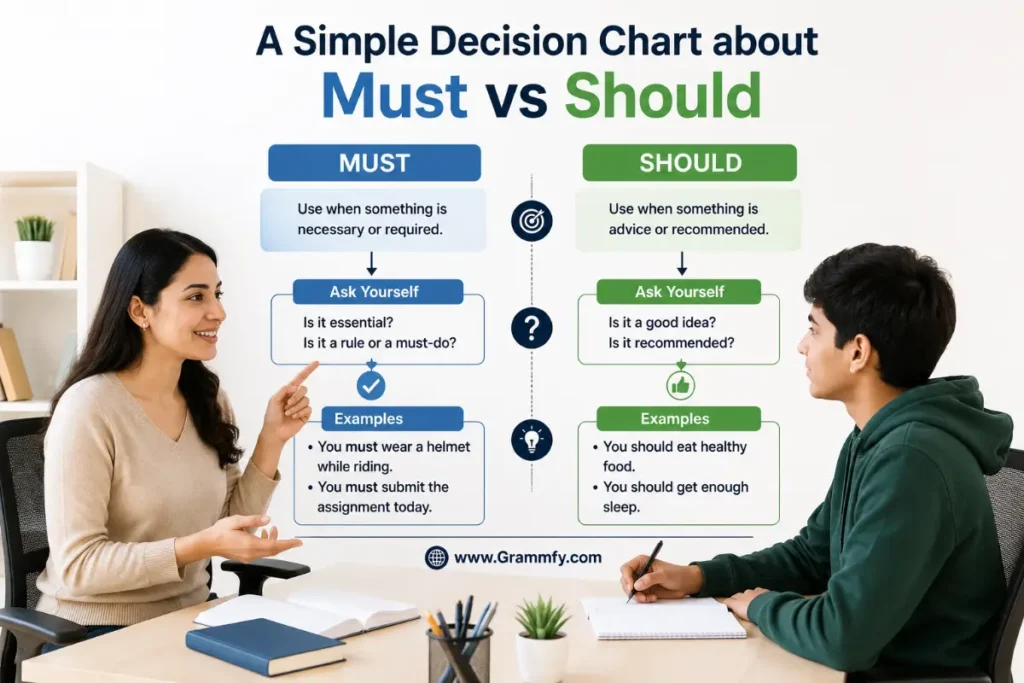
A Simple Decision Chart about Must vs Should
| What do you mean? | Best choice |
|---|---|
| Strict requirement | must |
| Strong necessity | must |
| Strong logical conclusion | must |
| Advice | should |
| Recommendation | should |
| Expected result | should |
| Personal obligation | must / have to |
| External requirement | have to / must |
| Prohibition | must not |
| No requirement | don’t have to / needn’t |
| Past obligation | had to |
| Past advice or regret | should have |
| Strong conclusion about the past | must have |
How Can You Make Your Writing Sound More Natural?
The best word isn’t always the strongest word.
Good writing matches the word to the situation.
you’re giving friendly advice, use a softer expression:
- You should double-check the address.
describing a legal requirement, use a stronger expression:
- Applicants must provide valid identification.
If you’re making a prediction:
- The package should arrive tomorrow.
If you’re making a logical conclusion:
- They must be stuck in traffic.
This precision makes your writing easier to understand.
In professional writing
Don’t automatically use “must” to sound authoritative.
Instead, ask:
Is this actually required?
If yes, “must” may be appropriate.
If not, “should” or another recommendation may be better.
In friendly writing
Think about how the reader will feel.
- You must call me tonight.
can sound demanding.
- You should call me tonight.
sounds softer.
- Give me a call tonight if you can.
sounds even more conversational.
The right choice depends on your relationship with the reader.
“Must vs Should” With Passive Voice
Both modal verbs can be used with the passive voice.
Must + be + past participle
The form must be completed.
All equipment must be inspected.
Should + be + past participle
- The form should be completed before Friday.
This recommends or expects completion.
- The equipment should be inspected regularly.
This expresses a recommendation or expectation.
The difference in strength remains even when the sentence is passive.
“Must vs Should” in Instructions
Instructions need clear language.
For mandatory instructions:
- Users must create an account before purchasing.
For recommendations:
- Users should save their confirmation number.
The second is helpful but not necessarily required.
This distinction is especially important for:
- websites
- manuals
- workplace policies
- school instructions
- safety notices
- software documentation
- customer support pages
Clear instructions tell readers exactly which actions are mandatory and which are optional.
A Practical Editing Test
When editing your sentence, replace the modal with a simple phrase.
If must can be replaced by:
It is required.
then “must” is probably appropriate.
Example:
Employees must wear badges.
It is recommended.
then “should” is probably appropriate.
Example:
- Employees should take breaks.
This test won’t work in every sentence, but it is a useful shortcut.
Final Takeaway for English Learners
The easiest way to remember the difference is to focus on requirement versus recommendation.
Must is strong. It says an action is necessary, required, or strongly concluded.
Should is softer. It usually gives advice, expresses an expectation, or says what would be a good choice.
When you write, don’t ask only, “Which word is grammatically correct?” Ask, “How strong do I want this message to be?”
That question will help you choose the right modal in emails, essays, texts, instructions, and everyday conversations.
Conclusion
Understanding Must vs Should comes down to one key idea: must expresses necessity, while should usually expresses advice or expectation. If an action is required, “must” gives the reader a clear and firm message. If you’re recommending an action or explaining what would be a good choice, “should” is usually the better fit.
The difference also affects tone. “You must respond today” sounds firm, while “You should respond today” sounds more like advice. In professional and academic writing, matching the modal to the real level of obligation makes your message more accurate and respectful. Once you learn to separate rules from recommendations, these two common modal verbs become much easier to use. Pay attention to context, think about the strength of your message, and choose the word that says exactly what you mean.
Frequently Asked Questions
What is the difference between must and should?
Must expresses strong necessity or obligation, while should usually expresses advice, recommendation, or expectation. The main difference is the strength of the message.
Is must stronger than should?
Yes, must is generally stronger than should. “You must leave” presents leaving as necessary, while “You should leave” presents it as recommended.
Can I use must and should in the same sentence?
Yes, but they usually communicate different levels of force. For example, “You must follow the safety rules, and you should report any problems” makes the first action mandatory and the second a recommendation.
What’s another way to say must or should?
Depending on the context, alternatives include have to, need to, ought to, be required to, be expected to, may want to, and be advised to. Choose the alternative based on how strong or formal you want the statement to be.
Is “must not” the same as “don’t have to”?
No, they mean opposite things. “Must not” means something is prohibited, while “don’t have to” means something is not necessary.
Should I use must in formal writing?
You can use “must” in formal writing when something is genuinely necessary or required. It is often clearer than softer language when you’re stating a rule or obligation.
Which sounds more natural in everyday American English, must or should?
Both are common, but should is often used for advice, while have to or need to may sound more conversational than “must” when talking about everyday obligations.
