
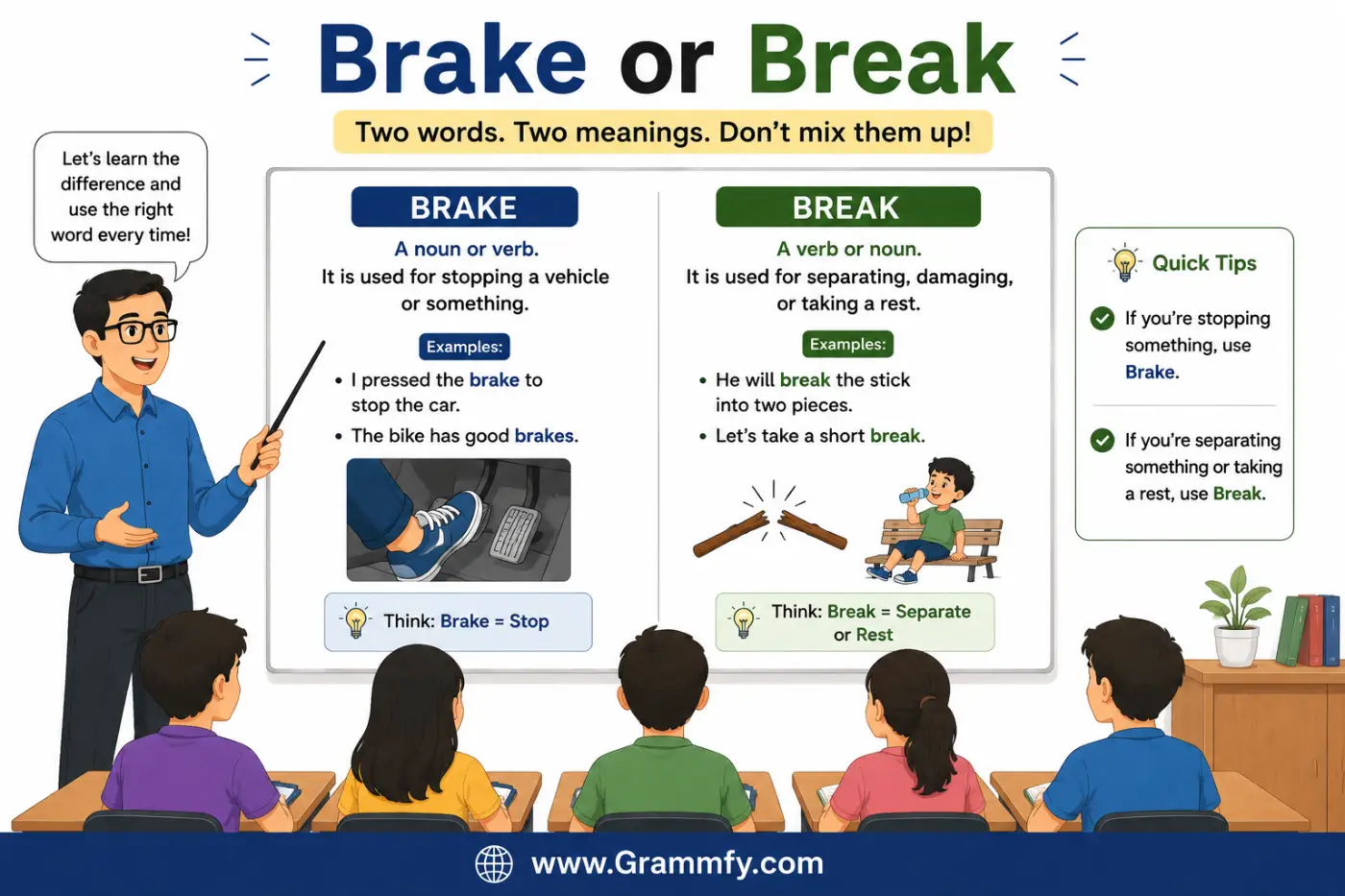
Writing a text, email, school essay, or work message can make you stop and wonder: should you write Brake or Break? One is connected to stopping a vehicle or slowing motion.
Answer: Brake refers to a device or action used to slow or stop a vehicle or machine. Break means to damage, separate, interrupt, or stop something temporarily, depending on the context.
In this guide, you’ll learn the difference, word origins, related vocabulary, useful examples, common mistakes, and simple memory tricks.
You may also want to learn the difference between [capital vs capitol].
What is the difference between “Brake or Break”?
The easiest way to understand Brake or Break is to look at what each word describes.
| Word | Main Meaning | Example |
|---|---|---|
| Brake | A device or action used to slow or stop movement | Press the brake to stop the car. |
| Break | To damage, separate, interrupt, or stop temporarily | Be careful not to break the glass. |
| Brake | To slow or stop a vehicle | The driver braked suddenly. |
| Break | A short rest | Let’s take a break. |
| Break | A pause or interruption | We had a break during class. |
| Break | To violate a rule or promise | Don’t break the rules. |
A brake helps you stop. A break can happen to almost anything.
That difference covers most everyday uses.
What does brake mean in plain English?
Brake is mainly connected with slowing or stopping movement.
The word is most often used for vehicles and machines.
Examples include:
- car brake
- bicycle brake
- motorcycle brake
- train brake
- air brake
- parking brake
- emergency brake
- brake pedal
- brake light
- brake system
As a noun, brake is the device that slows or stops something.
The car’s brake needs repair.
As a verb, brake means to use a braking system to slow or stop.
She braked when the dog crossed the road.
The meaning stays connected to controlling movement.
Brake as a noun
A brake is a mechanical or electronic system that slows or stops a moving object.
For example:
The mechanic inspected the brakes.
Here, brakes refers to the components that help a vehicle stop.
Another example:
The bicycle has hand brakes.
Again, the word refers to a stopping system.
Brake as a verb
As a verb, brake means to slow down or stop by using a brake.
The driver braked quickly.
I had to brake when the traffic stopped.
She braked before the sharp turn.
The verb can be used in different tenses:
- brake
- brakes
- braked
- braking
Examples:
He brakes carefully on wet roads.
She braked suddenly.
The driver is braking now.
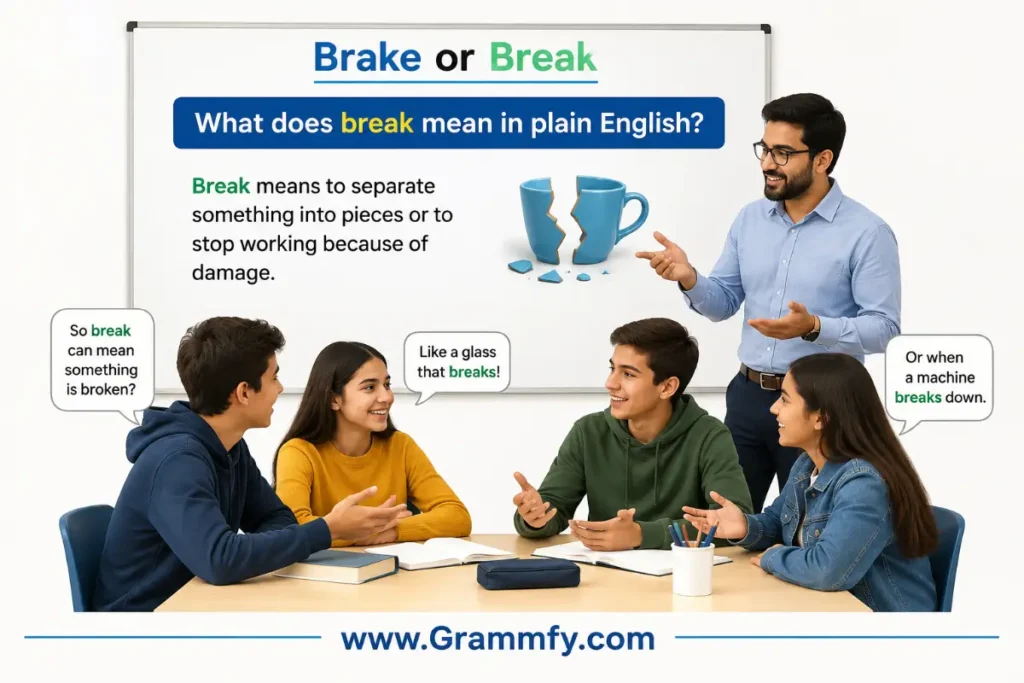
What does break mean in plain English?
Break has many more meanings than brake.
It can mean:
- Damage something.
- Separate something into pieces.
- Stop working.
- Interrupt something.
- Take a rest.
- Violate a rule.
- End a relationship or agreement.
- Escape from something.
- Cause a pause.
- Reveal or solve something.
Examples:
Don’t break the glass.
Let’s take a break.
My phone broke.
She broke the rule.
They broke up last year.
The news broke this morning.
Because break has so many meanings, context is very important.
Why are “Brake or Break” confusing?
The main reason is pronunciation.
In standard American English, brake and break are pronounced the same:
/breɪk/
That means you can’t always tell which spelling someone means when you’re only listening.
For example, if someone says:
“I had to brake.”
and
“I had to break.”
the words sound alike, but the meanings are completely different.
This is why brake and break are called homophones.
Other common homophones include:
- pair / pear
- right / write
- sea / see
- flower / flour
- hear / here
- to / too / two
- there / their / they’re
The best way to master homophones is to learn each word with its meaning and a memorable example.
Where did the word brake come from?
The word brake has Germanic roots and developed from older words connected with controlling or stopping movement.
Over time, it became associated with mechanisms that slow or stop vehicles and machines.
Today, we use brake for many types of vehicles and mechanical systems.
Examples include:
- automobile brakes
- bicycle brakes
- aircraft brakes
- train brakes
- industrial machine brakes
The central idea remains the same: controlling movement by slowing or stopping it.
Where did the word break come from?
Over centuries, its meaning expanded.
She broke the plate.
Abstract:
He broke his promise.
Temporary interruption:
Let’s take a break.
Mechanical failure:
The computer broke.
Ending something:
They broke the agreement.
The word became highly flexible in English.
How is brake used as a noun?
As a noun, brake normally refers to a stopping device.
Examples:
The brake is making a strange noise.
The front brake needs replacement.
Check the brakes before driving.
The emergency brake wasn’t working properly.
Common compound terms include:
- brake pedal
- brake pad
- brake fluid
- brake light
- brake system
- brake lever
- brake disc
- brake rotor
- parking brake
- emergency brake
What is a brake pedal?
A brake pedal is the pedal a driver presses to slow or stop a vehicle.
Example:
Press the brake pedal gently.
What is a parking brake?
A parking brake helps keep a parked vehicle from moving.
- handbrake
- emergency brake
- parking brake
The exact term varies by vehicle and region.
How is brake used as a verb?
As a verb, brake means to slow or stop a moving vehicle.
Examples:
The driver braked hard.
She braked before the corner.
He braked to avoid the cyclist.
The car braked automatically.
Brake or brakes?
Use brake for one brake or the general action.
Press the brake.
The brakes need checking.
Both forms are correct.
How is break used as a noun?
As a noun, break can mean a short period of rest or a pause.
Examples:
We need a break.
The teacher gave the students a ten-minute break.
Let’s take a lunch break.
There was a break in the meeting.
Or a separation:
There was a break in the wall.
The exact meaning comes from the context.
How is break used as a verb?
As a verb, break has many meanings.
Break something physically
She broke the cup.
Stop working
My laptop broke.
Separate into pieces
Break the chocolate into small pieces.
Violate a rule
He broke the law.
Violate a promise
She broke her promise.
Interrupt something
Someone broke the silence.
End a relationship
They decided to break up.
Escape
The prisoner broke free.
Make a sudden discovery
The journalist broke the story.
What are five useful synonyms for brake?
| Synonym | Meaning | Tone | Example |
|---|---|---|---|
| Stop | Bring movement to an end | Everyday | The driver stopped the car. |
| Slow down | Reduce speed | Everyday | Slow down before the turn. |
| Decelerate | Reduce speed | Formal | The vehicle decelerated quickly. |
| Halt | Stop movement completely | Formal | The train halted at the station. |
| Retard | Reduce speed or progress | Technical | The system retards the vehicle’s speed. |
These aren’t perfect substitutes in every sentence.
What are five useful synonyms for break?
The right alternative depends on the meaning.
| Synonym | Meaning | Tone | Example |
|---|---|---|---|
| Damage | Harm something physically | Neutral | Don’t damage the equipment. |
| Crack | Cause a split or fracture | Neutral | He cracked the screen. |
| Shatter | Break into many pieces | Strong | The glass shattered. |
| Interrupt | Stop something temporarily | Formal | The call interrupted the meeting. |
| Rest | Take time away from activity | Everyday | Let’s rest for a few minutes. |
Again, these aren’t interchangeable in every situation.
What are synonyms by intensity?
Different words can describe different degrees of damage or stopping.
Mild physical damage
- scratch
- dent
- chip
- crack
- damage
Example:
The phone screen has a small crack.
Moderate damage
- damage
- fracture
- split
- tear
- break
Example:
The branch split during the storm.
Severe damage
- smash
- shatter
- destroy
- crush
- demolish
Example:
The falling tree smashed the fence.
Mild slowing
- slow
- reduce speed
- ease off
Strong slowing
- brake
- decelerate
- stop
Complete stopping
- halt
- stop
- come to a standstill
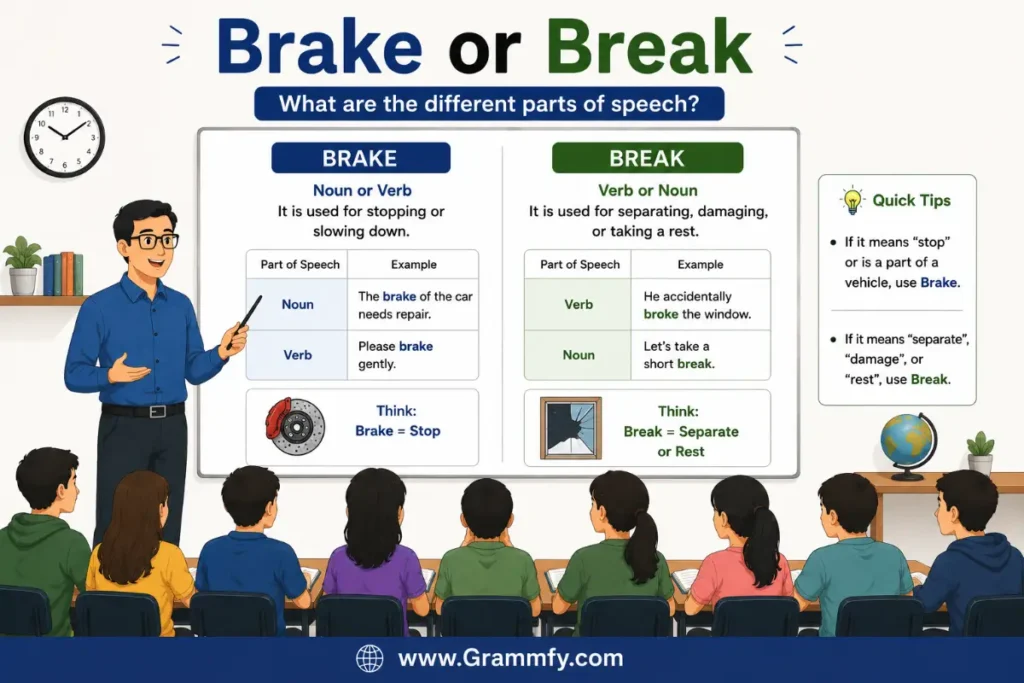
What are the different parts of speech “Brake or Break”?
| Word | Noun | Verb | Example |
|---|---|---|---|
| Brake | Yes | Yes | The brake failed. / He braked suddenly. |
| Break | Yes | Yes | Take a break. / Don’t break it. |
- brake pad
- brake pedal
- brake light
- brake fluid
Break appears in many phrasal verbs:
- break down
- break up
- break in
- break out
- break off
- break through
- break away
- break into
- break down
- break apart
What is the difference between “Brake or Break” in American English?
In American English, the two words are pronounced the same.
The main difference is spelling and meaning.
Brake is connected mainly with stopping or slowing a vehicle.
Break has a wide range of meanings.
Examples:
Brake the car.
Break the glass.
Take a break.
Don’t break the rules.
What is the difference in British English?
British English may use some different terms for braking equipment.
For example:
- handbrake is common in British English.
- parking brake is common in American English.
Brake = stopping system or action.
Break = damage, interruption, rest, separation, and many other meanings.
How should you use brake in a resume?
Examples:
Inspected brake systems on commercial vehicles.
Replaced worn brake pads and rotors.
Diagnosed brake system problems.
Don’t write:
Repaired break systems.
Write:
Repaired brake systems.
How should you use break in a resume?
Examples:
Identified and repaired broken equipment.
Helped break down complex tasks into smaller steps.
Reduced production delays caused by equipment breakdowns.
Here, break can appear in several useful expressions.
How should you use brake in an essay?
- transportation
- road safety
- engineering
- vehicles
- mechanics
- physics
- machines
Example:
A vehicle’s braking system helps the driver control speed and avoid collisions.
Drivers should apply the brake carefully on wet roads.
How should you use break in an essay?
Examples:
The glass can break under extreme pressure.
The machine may break if it is overloaded.
A short break can help students return to class with better focus.
The character breaks a long-standing family tradition.
The surrounding words tell readers which meaning you intend.
How should you use brake in texting?
Text messages often use simple language.
Examples:
Don’t forget to check your brakes.
I had to brake really fast.
My brake light is on.
A message like:
“I had to break really fast”
How should you use break in texting?
Break is extremely common in casual messages.
Examples:
I need a break.
My phone broke.
Don’t break it!
Let’s take a break.
We should break for lunch.
How should you use brake in an email?
In a professional email about transportation or repairs:
The vehicle’s brakes need to be inspected before tomorrow’s trip.
Or:
The brake system appears to need maintenance.
These sentences are clear and professional.
How should you use break in an email?
Examples include:
Could we take a short break before the next meeting?
The equipment appears to have broken down.
Please let me know if the machine breaks again.
These are normal workplace uses.
What are 15 original examples of “Brake or Break”?
- The mechanic replaced the worn brake pads.
- The driver used the brake to slow down.
- Don’t break the glass.
- I need a short break after this meeting.
- My headphones broke yesterday.
- Please don’t break your promise.
- The teacher gave us a ten-minute break.
- The storm caused a tree branch to break.
- He accidentally broke the chair.
- The machine may break down without maintenance.
- The news broke early in the morning.
These examples cover the most common everyday meanings.
What are 10 more examples in real situations “Brake or Break”?
Driving
The car ahead stopped, so I had to brake quickly.
Bicycle riding
He squeezed the bicycle brake before the hill.
Auto repair
The mechanic said the rear brakes need replacement.
School
We have a short break between classes.
Work
Let’s take a five-minute break before the next task.
Home
Be careful not to break the vase.
Technology
My old computer broke last week.
Relationships
They decided to break up after years together.
Rules
You shouldn’t break the rules.
News
The reporter broke the story before other networks.
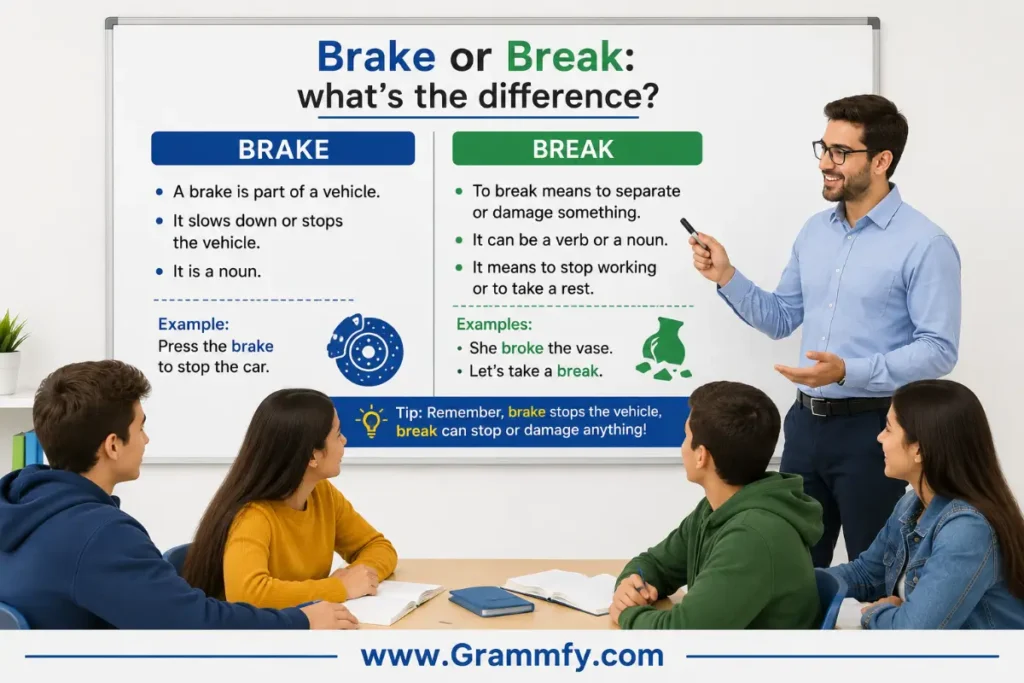
“Brake or Break”: what’s the difference?
| Feature | Brake | Break |
|---|---|---|
| Pronunciation | /breɪk/ | /breɪk/ |
| Main idea | Slow or stop | Damage, separate, pause, interrupt, etc. |
| Noun | Yes | Yes |
| Verb | Yes | Yes |
| Vehicle connection | Strong | Sometimes, but usually not |
| Rest meaning | No | Yes |
| Damage meaning | No | Yes |
| Rule violation | No | Yes |
| Stopping-device meaning | Yes | No |
The biggest difference is meaning, not pronunciation.
“Brake or Break”: what’s different in driving?
When you’re driving, brake is the correct word for the system or action used to slow the vehicle.
Press the brake.
He braked suddenly.
But break can still appear in a driving sentence if it has one of its other meanings.
Don’t break the traffic rules.
Here, break means violate.
So even within the same topic, both words can be correct when they express different ideas.
What are the common mistakes with brake and break?
Mistake 1: “Hit the break”
Incorrect when talking about a car:
Hit the break.
Correct:
Hit the brake.
Mistake 2: “The car breaked”
The past tense of brake is braked, not “breaked.”
Correct:
The driver braked suddenly.
Mistake 3: “Take a brake”
Incorrect when you mean rest:
Let’s take a brake.
Correct:
Let’s take a break.
Mistake 4: “My car’s breaks are bad”
If you mean the stopping system:
My car’s brakes are bad.
Mistake 5: “I need a brake”
If you mean rest:
I need a break.
Mistake 6: “Don’t break the car” when you mean stop
If you mean slow the car:
Don’t forget to brake.
If you mean damage the car:
Don’t break the car.
The intended meaning determines the spelling.
When should you not use brake?
Don’t use brake when you mean:
- rest
- damage
- fracture
- interruption
- rule violation
- promise violation
- relationship ending
- equipment failure
Examples:
I need a break.
Don’t break the glass.
He broke the rule.
Use brake mainly for slowing or stopping movement.
When should you not use break?
Don’t use break when you mean the stopping mechanism of a vehicle.
Incorrect:
The car needs new breaks.
Correct:
The car needs new brakes.
Also:
Press the brake pedal.
Not:
Press the break pedal.
What are the antonyms of “Brake or Break”?
The opposite of brake depends on the context.
For slowing down, possible opposites include:
- accelerate
- speed up
- increase speed
Example:
Brake when necessary; accelerate when the road is clear.
The opposite of break also depends on its meaning.
- repair
- fix
- mend
- restore
- continue
- maintain
- resume
- work
- continue
- resume activity
What are quick tips for choosing the right word “Brake or Break”?
Use these quick checks.
Think about a car
If you’re talking about slowing or stopping it:
Brake
Press the brake.
Think about rest
If you’re talking about stopping work for a while:
Break
Take a break.
Think about damage
If something is damaged:
Break
I broke the cup.
Think about rules
If someone violates a rule:
Break
Don’t break the rules.
Think about a stopping device
Brake
The brakes need repair.
Think about a pause
Break
We had a lunch break.
Can “break” mean stop?
Yes, but its meaning is different from brake.
For example:
Let’s break for lunch.
This means let’s stop working temporarily.
Another example:
The meeting broke for lunch.
Here, break means pause.
By contrast:
The driver braked for the pedestrian.
Here, brake means slow or stop a vehicle.
The words may both involve stopping, but they describe different kinds of stopping.
Can “brake” be used outside cars?
Yes.
Brakes can be used in many machines and transportation systems.
Examples include:
- bicycles
- motorcycles
- trains
- aircraft
- industrial equipment
- elevators
- mechanical systems
The common idea is control of movement.
You might say:
The bicycle’s brake needs adjustment.
Or:
The train’s braking system was inspected.
What are common phrases with brake?
Useful expressions include:
- brake pedal
- brake light
- brake pad
- brake fluid
- brake system
- brake failure
- brake failure warning
- parking brake
- emergency brake
- hand brake
- air brake
- disc brake
- brake lever
- brake pressure
- brake distance
Examples:
The brake light came on.
The mechanic checked the brake fluid.
The driver pulled the parking brake.
What are common phrases with break?
Break appears in many common expressions.
Take a break
Let’s take a break.
My car broke down.
They broke up last month.
Someone tried to break in.
A fire broke out.
The team finally broke through the barrier.
The runner broke away from the group.
The old chair broke apart.
They broke off the negotiations.
Someone broke into the store.
Learning these expressions helps you understand why break appears so often in English.
How can you remember “Brake or Break”?
Try these memory tricks.
Trick 1: Brake has a “car” connection
Think:
Brake → car → stop
When you see brake, picture a brake pedal.
Trick 2: Break has many meanings
Think:
Break → damage, rest, pause, rule, relationship
If the sentence doesn’t involve vehicle stopping, break may be the word you need.
Trick 3: Remember “break time”
You probably already know:
It’s break time.
So if you’re talking about rest, use break.
Trick 4: Remember “brake pedal”
The fixed phrase brake pedal is a strong spelling reminder.
A final comparison chart “Brake or Break”
| Situation | Correct Word | Example |
|---|---|---|
| Stop a car | Brake | Brake before the light. |
| Vehicle stopping device | Brake | The brake needs repair. |
| Slow a bicycle | Brake | Use the brake on the hill. |
| Take a rest | Break | Let’s take a break. |
| Damage glass | Break | Don’t break the glass. |
| Violate a rule | Break | Don’t break the rules. |
| Stop working temporarily | Break | We broke for lunch. |
| Stop functioning | Break | The machine broke. |
| End a relationship | Break | They decided to break up. |
| Separate something | Break | Break the chocolate into pieces. |
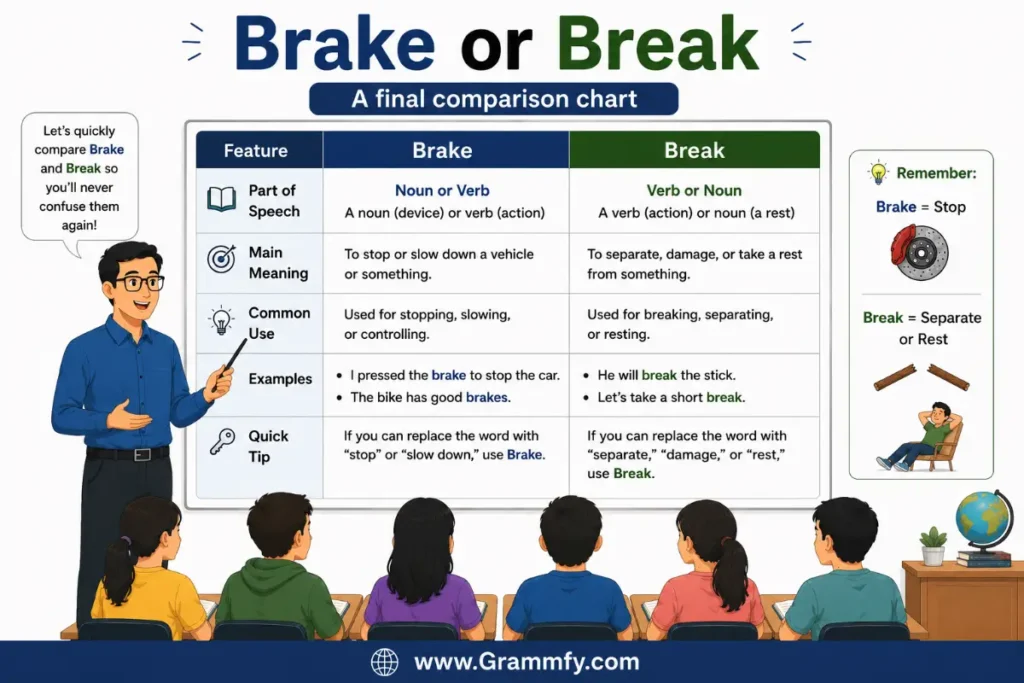
Conclusion
Understanding Brake or Break becomes much easier once you connect each spelling with its main meaning. Brake is linked to slowing or stopping movement, especially in cars, bicycles, motorcycles, trains, and other machines. Break is much broader and can mean damage, separation, rest, interruption, failure, or violation of a rule. The two words sound alike, so pronunciation won’t help you choose the spelling. Instead, look at the meaning of the sentence. If you’re pressing a pedal, checking a vehicle’s stopping system, or slowing down, choose brake. If you’re resting, damaging something, pausing an activity, or violating a rule, choose break. With a few simple examples and memory tricks, you’ll be able to choose the correct word quickly and confidently.
Frequently Asked Questions
Is it “Brake or Break” when talking about a car?
Use brake when you mean the device or action used to slow or stop a car. For example, “Press the brake before the turn.”
Is it take a brake or take a break?
The correct phrase is “take a break.” It means to rest or pause an activity for a short time.
What’s another way to say brake?
You can say slow down, stop, halt, or decelerate, depending on the context. These words aren’t always exact replacements, but they can express a similar idea.
Is brake the past tense of break?
No, brake and break are different verbs. The past tense of brake is braked, while the past tense of break is broke.
How do you remember “Brake or Break”?
Remember that a brake helps a vehicle stop, while a break can mean rest, damage, or interruption. The phrase “brake pedal” is a useful spelling clue.
Is it brake pads or break pads?
The correct term is “brake pads.” Brake pads are parts of a vehicle’s braking system.
Can break mean stop?
Yes, break can mean pause or temporarily stop an activity. For example, “The workers broke for lunch” means they stopped working for lunch.
