
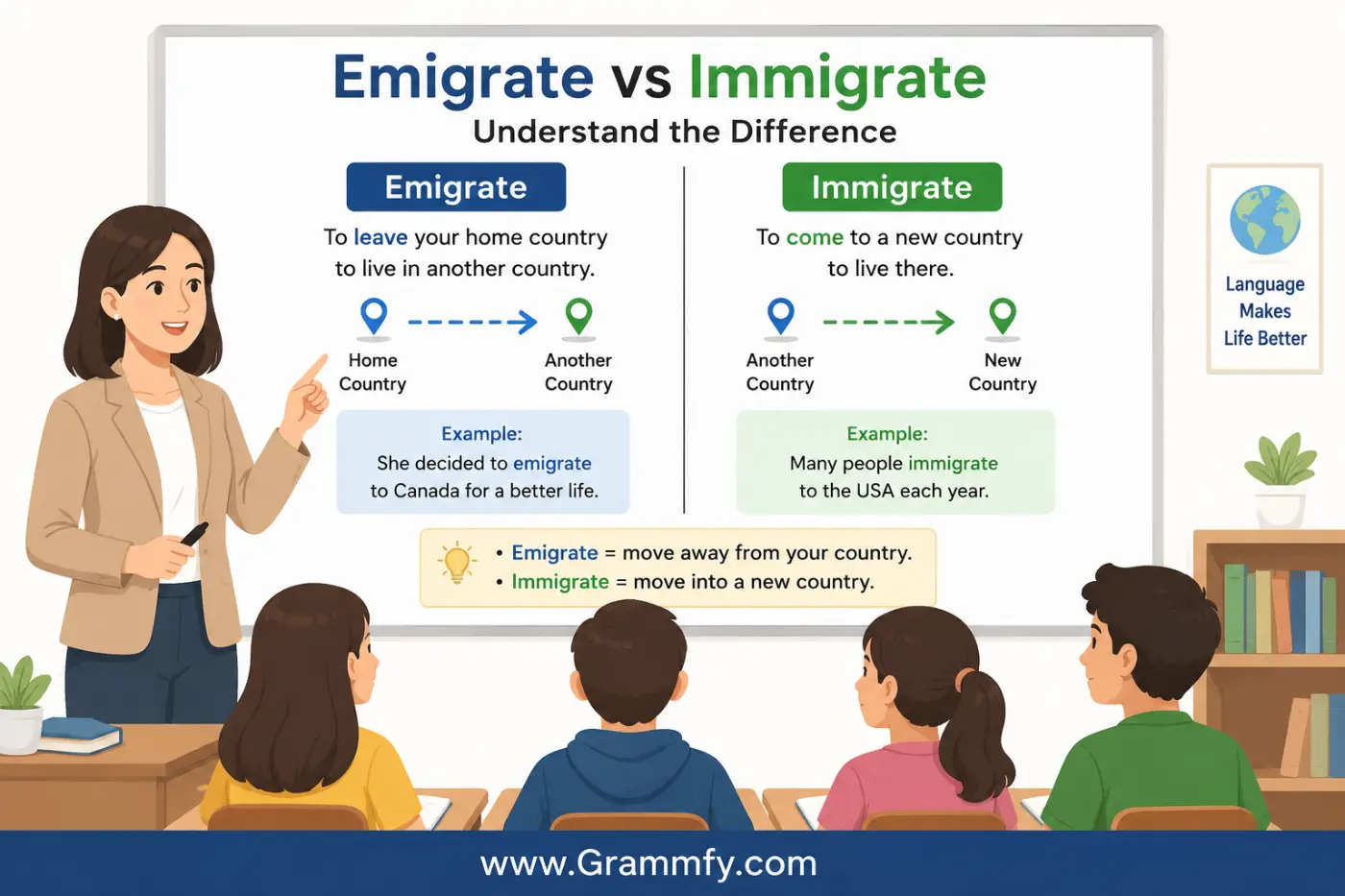
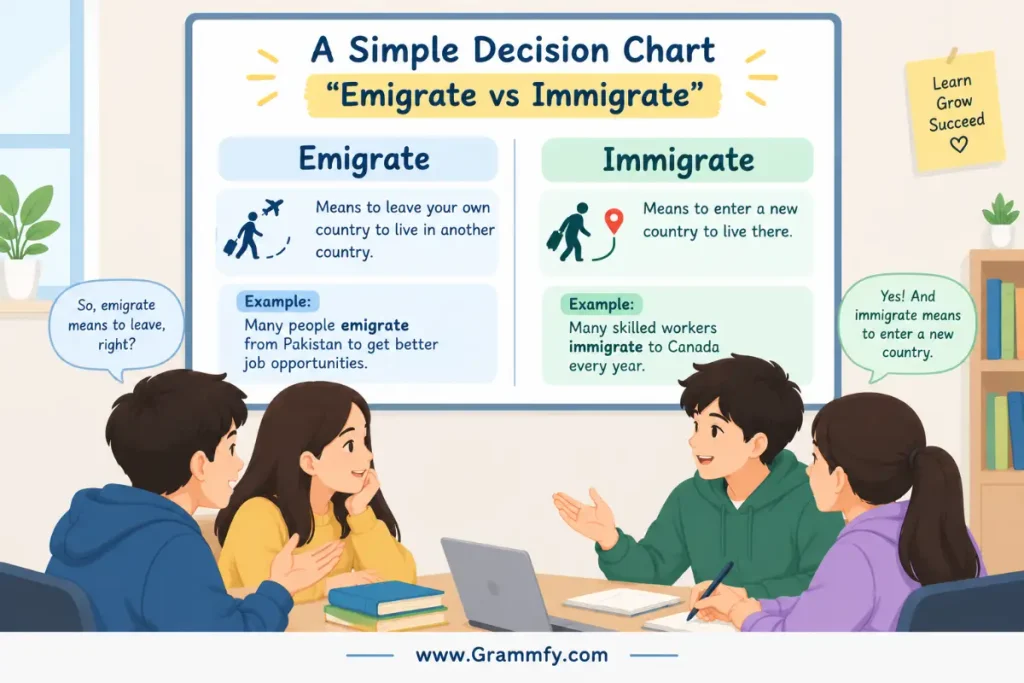
The simple difference is based on direction. Emigrate means to leave your own country to live somewhere else. Immigrate means to enter and settle in a new country. The same person can emigrate from one country and immigrate to another. “Understanding the difference between emigrate vs immigrate can help you use these commonly confused words correctly.”
Answer box: Emigrate means “leave a country to live elsewhere,” while immigrate means “enter another country to live there.”
This guide explains the meanings, origins, synonyms, grammar patterns, regional usage, common mistakes, and real-life examples.
Having trouble remembering which word fits? See our guide to [desert vs dessert].
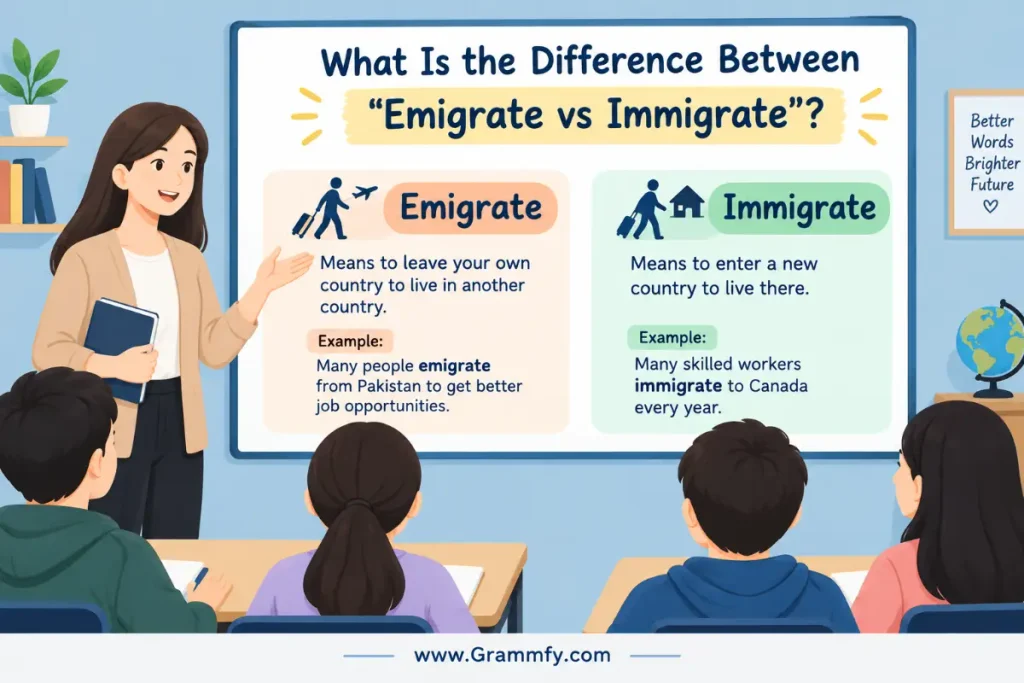
What Is the Difference Between “Emigrate vs Immigrate”?
The easiest way to understand the difference is to think about where the person is going and where the person is coming from.
- Emigrate = move out
- Immigrate = move in
From the American point of view, the same person immigrates to the United States.
- Maria emigrated from Mexico.
- Maria immigrated to the United States.
The verbs focus on different sides of the move.
| Word | Basic meaning | Direction |
|---|---|---|
| Emigrate | Leave your country to live elsewhere | Out of a country |
| Immigrate | Enter another country to live there | Into a country |
| Migrate | Move from one place to another | General movement |
A useful memory trick is:
E = Exit → Emigrate
I = Into → Immigrate
Where Do “Emigrate vs Immigrate” Come From?
Understanding the word origins can make the distinction easier to remember.
Both words have Latin roots connected with movement.
Emigrate comes from the Latin emigrare, meaning to move away or depart from a place. The prefix e- can carry the idea of “out” or “away.”
Immigrate comes from the Latin immigrare, meaning to move into or enter. The prefix im- is related to the idea of “into.”
That gives us a simple historical memory aid:
- Emigrate → move out
- Immigrate → move in
The related word migrate comes from the same broad Latin family of movement.
Why Does the Difference Matter?
Compare:
Ahmed emigrated from Pakistan.
The sentence focuses on Ahmed leaving Pakistan.
Now compare:
Ahmed immigrated to Canada.
The sentence focuses on Ahmed entering Canada to settle there.
Both sentences may be true about the same person.
The real question is:
Are you focusing on leaving or arriving?
“Emigrate vs Immigrate”: A Quick Comparison
| Feature | Emigrate | Immigrate |
|---|---|---|
| Main idea | Leave a country | Enter a new country |
| Focus | Departure | Arrival |
| Common preposition | From | To |
| Example | She emigrated from Italy. | She immigrated to Australia. |
| Memory clue | Exit | Into |
| Typical noun | Emigration | Immigration |
| Person noun | Emigrant | Immigrant |
Emigrate: Focus on Leaving
Example:
His grandparents emigrated from Ireland in the 1950s.
The sentence tells us where they left.
Immigrate: Focus on Entering
Example:
His grandparents immigrated to the United States in the 1950s.
The sentence tells us where they settled.
What Does Emigrate Mean in Plain English?
It is usually used for a long-term or permanent move, not a short vacation.
Examples of Emigrate
- She decided to emigrate from Brazil.
- His family emigrated from Poland many years ago.
The key idea is departure.
Common Grammar Pattern
A very common structure is:
emigrate + from + country/place
They emigrated from France.
She emigrated to Canada.
What Does Immigrate Mean in Plain English?
Immigrate means to move into a foreign country to live there, usually for a long period or permanently.
It focuses on the destination.
Examples of Immigrate
- Her parents immigrated to the United States.
- Many families immigrated to Canada for work.
- She hopes to immigrate to New Zealand someday.
The key idea is arrival and settlement.
Common Grammar Pattern
A very common structure is:
immigrate + to + country
They immigrated to Canada.
immigrate + from + country + to + country
They immigrated from India to the United Kingdom.
In that sentence, the destination receives the main emphasis.
What Is the Difference Between Migrate, “Emigrate vs Immigrate”?
The movement can happen within one country or between countries.For example:
Birds migrate south in winter.
Many workers migrate to cities for better job opportunities.
| Word | Focus | Example |
|---|---|---|
| Migrate | Movement in general | Workers migrated to the city. |
| Emigrate | Leaving a country | They emigrated from Spain. |
| Immigrate | Entering a new country | They immigrated to Canada. |
Emigrate vs Migrate — What’s Different?
Emigrate is more specific.
Someone can migrate without emigrating.
Example:
The family migrated from a rural area to the capital.
Master Synonym List for “Emigrate vs Immigrate”
| Word/Phrase | Meaning | Tone | Example |
|---|---|---|---|
| Migrate | Move from one place to another | Neutral | Many families migrate for work. |
| Relocate | Move to a new place | Formal | She relocated to Canada. |
| Resettle | Establish a new home elsewhere | Formal | They resettled abroad. |
| Move abroad | Move to another country | Everyday | He plans to move abroad. |
| Settle abroad | Make another country your home | Neutral | They decided to settle abroad. |
The table below groups useful related expressions by tone and everyday use.
Which Synonyms Are Closest?
The closest everyday alternatives are usually:
- move abroad
- move overseas
- relocate
- resettle
- settle abroad
- leave the country
The company relocated her from Chicago to Dallas.
Synonyms by Intensity: Mild to Strong
Not every expression has the same emotional or practical force.
| Intensity | Expression | Typical meaning |
|---|---|---|
| Mild | Go abroad | Travel or spend time abroad |
| Mild | Live overseas | Reside in another country |
| Mild | Move abroad | Move to another country |
| Mild | Relocate | Move residence |
| Medium | Resettle | Establish a new home |
| Medium | Leave the country | Depart one’s country |
| Medium | Start a new life abroad | Build a new life elsewhere |
| Strong | Flee the country | Leave because of danger or pressure |
| Strong | Escape the country | Leave to avoid danger or control |
| Strong | Seek refuge abroad | Move for safety or protection |
Be careful with the stronger terms. Flee, escape, and seek refuge suggest danger, fear, or serious pressure. They should not be used as neutral replacements for ordinary relocation.
Synonyms by Part of Speech
Verbs
- emigrate
- immigrate
- migrate
- relocate
- resettle
- move
- leave
- arrive
- settle
Nouns
- emigration
- immigration
- migration
- relocation
- resettlement
- settlement
- movement
- arrival
- departure
People
- emigrant
- immigrant
- migrant
- newcomer
- resident
- expatriate
These people-related words are not interchangeable.
An immigrant is someone who moves into a country to live there. An emigrant is viewed from the country they left.
It doesn’t always have the same legal or immigration meaning as immigrant.
Emigrant vs Immigrant: What’s the Difference?
The nouns follow the same directional pattern as the verbs.
Emigrant focuses on the country a person leaves.
Immigrant focuses on the country a person enters and settles in.
From Ireland’s perspective, he was an emigrant.
From Canada’s perspective, he was an immigrant.
The viewpoint changes.
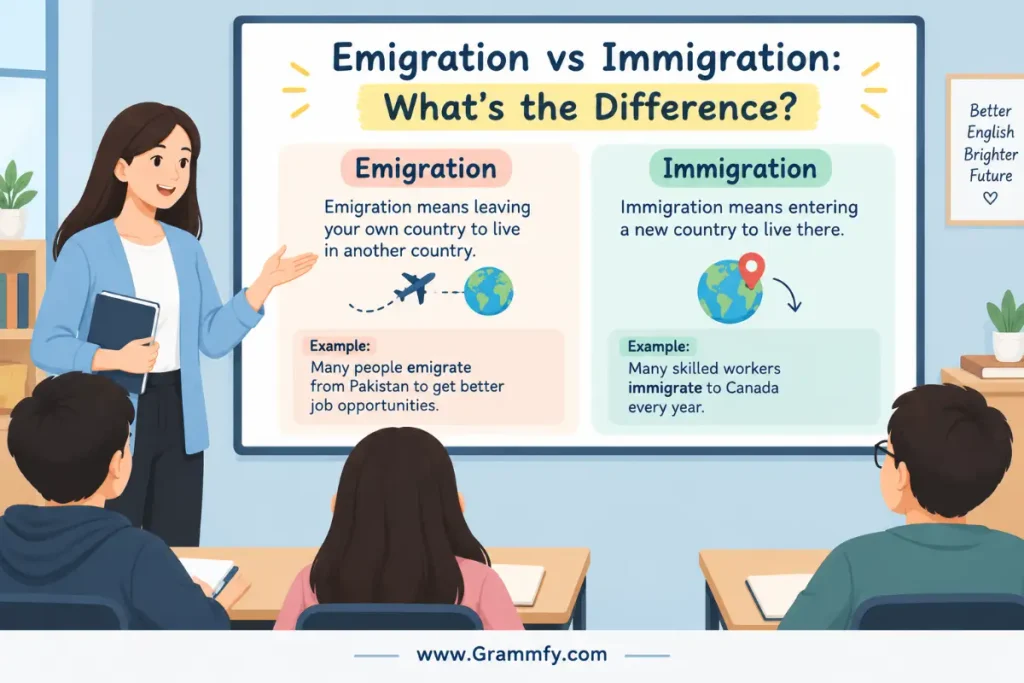
Emigration vs Immigration: What’s the Difference?
The noun forms are:
- emigration = the act or process of leaving a country to live elsewhere
Compare:
The country experienced a wave of emigration.
This focuses on people leaving.
The country experienced a wave of immigration.
This focuses on people arriving.
Both terms can describe the same international movement from opposite sides.
Is Emigrate the Same as Move Abroad?
Not exactly.
Move abroad is a broad everyday phrase. Emigrate is more precise and often sounds more formal.
Compare:
My family moved abroad in 2015.
My family emigrated from Pakistan in 2015.
The first sentence is casual and general.
For everyday conversation, move abroad may sound more natural. For formal writing, historical discussion, or immigration-related contexts, emigrate may be more precise.
Is Immigrate the Same as Move to Another Country?
It doesn’t necessarily say anything about legal status or the duration of the move.
I moved to Spain for six months.
This sounds temporary.
I immigrated to Spain.
This suggests a long-term or permanent move.
Context matters.
How Should You Use “Emigrate vs Immigrate” in a Resume?
Best Word for a Resume
For a resume, use relocated, moved abroad, or immigrated depending on what you want to communicate.
Example:
Relocated to the United States to pursue a career in software development.
Immigrated to Canada in 2022 and began working in the technology sector.
Emigrated from Germany after accepting an international position.
Which Word Is Best for an Essay?
Best Word for an Essay
Many families emigrated from rural areas during the economic crisis.
Or:
Thousands of workers immigrated to the country in search of better employment opportunities.
Use the word that matches your viewpoint.
Which Word Is Best for Texting?
Best Word for Texting
In a text message, most people would simply say:
- moved abroad
- moved overseas
- moved to Canada
- moved back home
- left the country
My cousin moved to Australia last year.
You probably don’t need:
My cousin emigrated from our country last year.
The second sentence isn’t wrong. It just sounds more formal.
For casual communication, use the simplest phrase that clearly communicates the idea.
Which Word Is Best for an Email?
Best Word for an Email “Emigrate vs Immigrate”
The best choice depends on the purpose.
My family moved abroad last year.
I relocated to the United States in 2024.
I immigrated to Canada in 2024.
My grandparents emigrated from Italy in the early 1900s.
The important thing is accuracy first and formality second.
Which Word Is Best in Speaking “Emigrate vs Immigrate”?
Best Word for Everyday Speaking “Emigrate vs Immigrate”
In conversation, move abroad is often easier and more natural.
You might say:
We’re thinking about moving abroad next year.
We’re thinking about emigrating next year.
The second version sounds more formal.
12 Real-Life Examples of “Emigrate vs Immigrate”
1. Family relocation
My grandparents emigrated from Italy after World War II.
The focus is on leaving Italy.
2. New country
My grandparents immigrated to the United States after World War II.
The focus is on entering the United States.
3. Career opportunity
Daniel emigrated from Brazil to pursue better career opportunities.
4. New resident
Daniel immigrated to Portugal after accepting a new job.
5. Historical writing
Large numbers of people emigrated from Ireland during periods of economic hardship.
6. Immigration discussion
Many families immigrated to the country during the twentieth century.
7. Personal story
My parents moved abroad when I was five.
This casual sentence avoids choosing either technical verb.
8. Formal biography
Her family emigrated from Greece in 1978.
9. Destination-focused sentence
Her family immigrated to Australia in 1978.
10. Academic discussion
Migration patterns changed significantly over several decades.
11. Professional profile
After relocating to Canada, he continued his career in engineering.
12. Everyday conversation
We’re planning to move overseas next summer.
These examples show that context determines the best word.
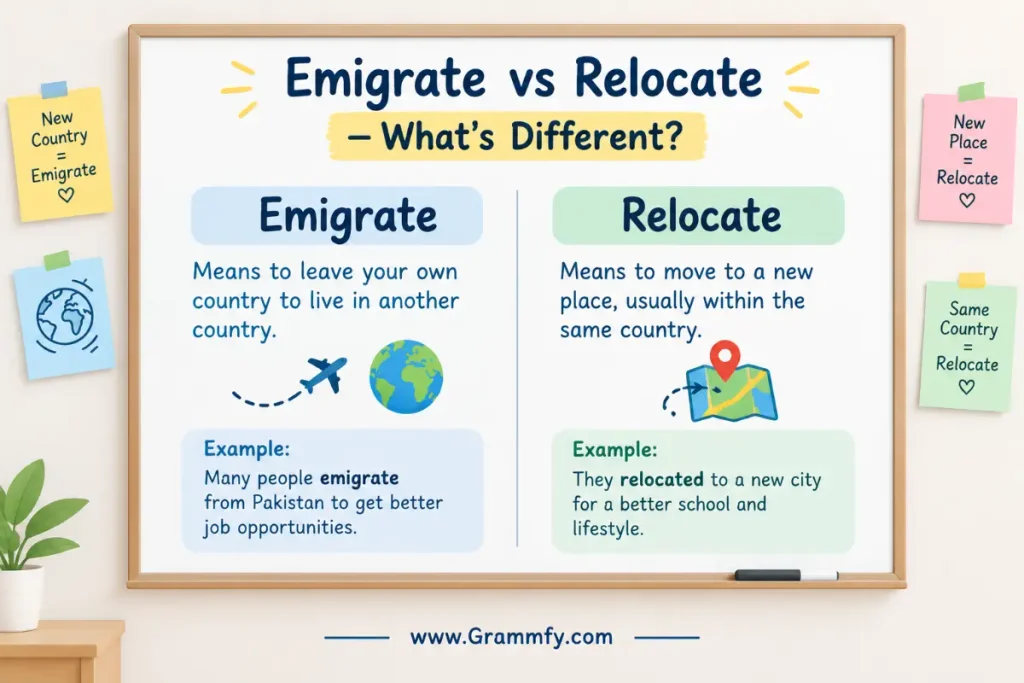
Emigrate vs Relocate — What’s Different?
Relocate means to move to a new place, often for work, family, or practical reasons. It does not require crossing an international border.
The company relocated him from Boston to Chicago.
This is not emigration.
By contrast:
He emigrated from the United States.
This clearly involves leaving a country to establish life elsewhere.
Immigrate vs Resettle — What’s Different?
Resettle emphasizes establishing a new home after moving.
The family immigrated to Canada.
This focuses on entering Canada.
The family resettled in Canada.
This emphasizes establishing a new life there.
Immigrate vs Migrate — What’s Different?
Migrate is the broader term.
A person can migrate:
- from a rural area to a city
- seasonally
- temporarily
- permanently
Workers migrated to the city.
Workers immigrated to the country.
The second sentence clearly presents an international immigration context.
US vs UK English: Is There a Difference?
The basic distinction between emigrate and immigrate is the same in American and British English.
In both varieties:
- emigrate from focuses on leaving
- immigrate to focuses on entering
She emigrated from Britain.
She immigrated to the United States.
Government agencies may use specific terms for visas, residency, citizenship, and migration categories.
Common Mistakes With “Emigrate vs Immigrate”
Mistake 1: Treating Them as Perfect Synonyms
Incorrect thinking:
They both mean moving countries, so either one works.
Better:
She emigrated from France.
She immigrated to Canada.
Mistake 2: Forgetting the Preposition
A useful pattern is:
emigrate from
immigrate to
Examples:
He emigrated from Mexico.
He immigrated to Canada.
Mistake 3: Using Emigrate for Temporary Travel
Don’t normally use emigrate for a vacation or short trip.
She traveled to France for two weeks.
Not:
She emigrated to France for two weeks.
Emigration suggests a long-term move.
Mistake 4: Using Immigrate for Every International Trip
We visited Japan for two weeks.
Not:
We immigrated to Japan for two weeks.
Immigration involves settling or establishing residence, not ordinary tourism.
Mistake 5: Using Immigrate for Internal Movement
She moved from Dallas to Houston.
Not:
She immigrated from Dallas to Houston.
This is domestic relocation or migration, not international immigration.
Mistake 6: Confusing Immigrant With Expat
An expat is a more informal term for someone living outside their home country. The terms can overlap, but they are not always used in exactly the same way.
Mistake 7: Assuming Every Move Is Permanent
If the length or purpose of the stay matters, explain it directly.
For example:
She moved to France for a one-year work assignment.
That is clearer than forcing a more permanent-sounding word into the sentence.
When Should You NOT Use Emigrate?
Avoid emigrate when:
- someone is only traveling
- someone is taking a short vacation
- someone is moving between cities in the same country
- the sentence is simply about general travel
- you mean “leave a room” or “leave a building”
When Should You NOT Use Immigrate?
Avoid immigrate when:
- someone is going on vacation
- you’re only describing a short business trip
- there is no idea of settling or living in the destination
Antonyms of “Emigrate vs Immigrate”
Useful opposites and related concepts include:
| Word | Related opposite or contrasting idea |
|---|---|
| Emigrate | Return, remain, stay |
| Immigrate | Leave, depart, emigrate |
| Arrive | Depart |
| Enter | Exit |
| Move away | Move back |
| Leave | Return |
| Resettle | Remain |
He emigrated from France.
A contrasting action might be:
He returned to France.
She immigrated to Canada.
return to her home country.
Quick Tips for Choosing the Right Word “Emigrate vs Immigrate”
Ask: Is the person leaving?
Emigrate.
They emigrated from Spain.
Ask: Is the person entering a new country to live?
If yes, think:
Immigrate.
They immigrated to Canada.
Ask: Is the move general?
If yes, consider:
They moved to another city.
Remember the letters
E = Exit
I = Into
This is the fastest memory trick.
Consider the level of formality
We moved abroad.
We emigrated from our home country.
We immigrated to Canada.
A One-Line Memory Trick “Emigrate vs Immigrate”
Emigrate = exit a country; immigrate = enter a country.
Think of the first letter:
- Emigrate → Exit
- Immigrate → Into
Once you connect the first letter with the direction, the two words become much easier to separate.
A Simple Decision Chart “Emigrate vs Immigrate”
| Question | Best choice |
|---|---|
| Did the person leave their country? | Emigrate |
| Did the person enter another country to live? | Immigrate |
| Did the person simply move somewhere? | Move |
| Was the movement broad or general? | Migrate |
| Did the person move for work? | Relocate |
| Did the person establish a new home? | Resettle |
| Was it a short trip? | Travel |
| Was it a vacation? | Visit |
“Emigrate vs Immigrate” in One Example
Consider a person named Sara.
Sara lives in India and decides to build a permanent life in Canada.
From India’s point of view:
Sara emigrated from India.
From Canada’s point of view:
Sara immigrated to Canada.
Sara migrated from India to Canada.
Sara moved from India to Canada.
Sara relocated to Canada for work.
All four sentences can be useful. The best choice depends on the exact point you’re making.
Why These “Emigrate vs Immigrate” Words Are Easy to Confuse
The confusion is understandable.
First, the words look almost identical.
Second, both are connected with international movement.
The important thing isn’t memorizing two complicated dictionary definitions. It’s understanding the direction.
Leaving = emigrate.
Entering = immigrate.
That single contrast handles most everyday uses.
Conclusion
Knowing the difference between emigrate vs immigrate becomes much easier when you stop thinking about the spelling and start thinking about direction. Emigrate focuses on leaving a country, while immigrate focuses on entering another country to live there. The simple memory trick is E for Exit and I for Into.
Use migrate when you need a broader word for movement, and use move abroad when you’re speaking casually. In formal writing, choose the more precise term when the direction matters. Always check the context, the preposition, and whether the move is long-term.
With these simple rules, you’ll be able to choose the right word confidently in essays, emails, resumes, conversations, and everyday writing.
Frequently Asked Questions
What is the easiest way to remember “Emigrate vs Immigrate”?
Remember E = Exit and I = Into. Emigrate focuses on leaving a country, while immigrate focuses on entering another country to live there.
Is it emigrate from or immigrate from?
The usual patterns are emigrate from and immigrate to. For example, “She emigrated from Italy” and “She immigrated to Canada.”
Can the same person “Emigrate vs Immigrate”?
Yes. A person can emigrate from one country and immigrate to another. The two verbs simply describe the same international move from different viewpoints.
What’s another way to say “emigrate”?
Common alternatives include move abroad, move overseas, relocate abroad, resettle, and leave the country.
Is migrate the same as immigrate?
No. Migrate is a broader word for movement from one place to another, while immigrate specifically focuses on entering another country to live there.
Does emigrate mean permanently moving?
It generally suggests leaving a country to establish a long-term or permanent life elsewhere. If the move is temporary, phrases such as travel, stay abroad, or move abroad for a short period may be more accurate.
Should I say “I emigrated to” or “I immigrated to”?
Both can appear with a destination, but immigrated to is the clearer choice when you want to emphasize entering and settling in that country. Emigrated from is the clearest pattern when emphasizing the country you left.
