
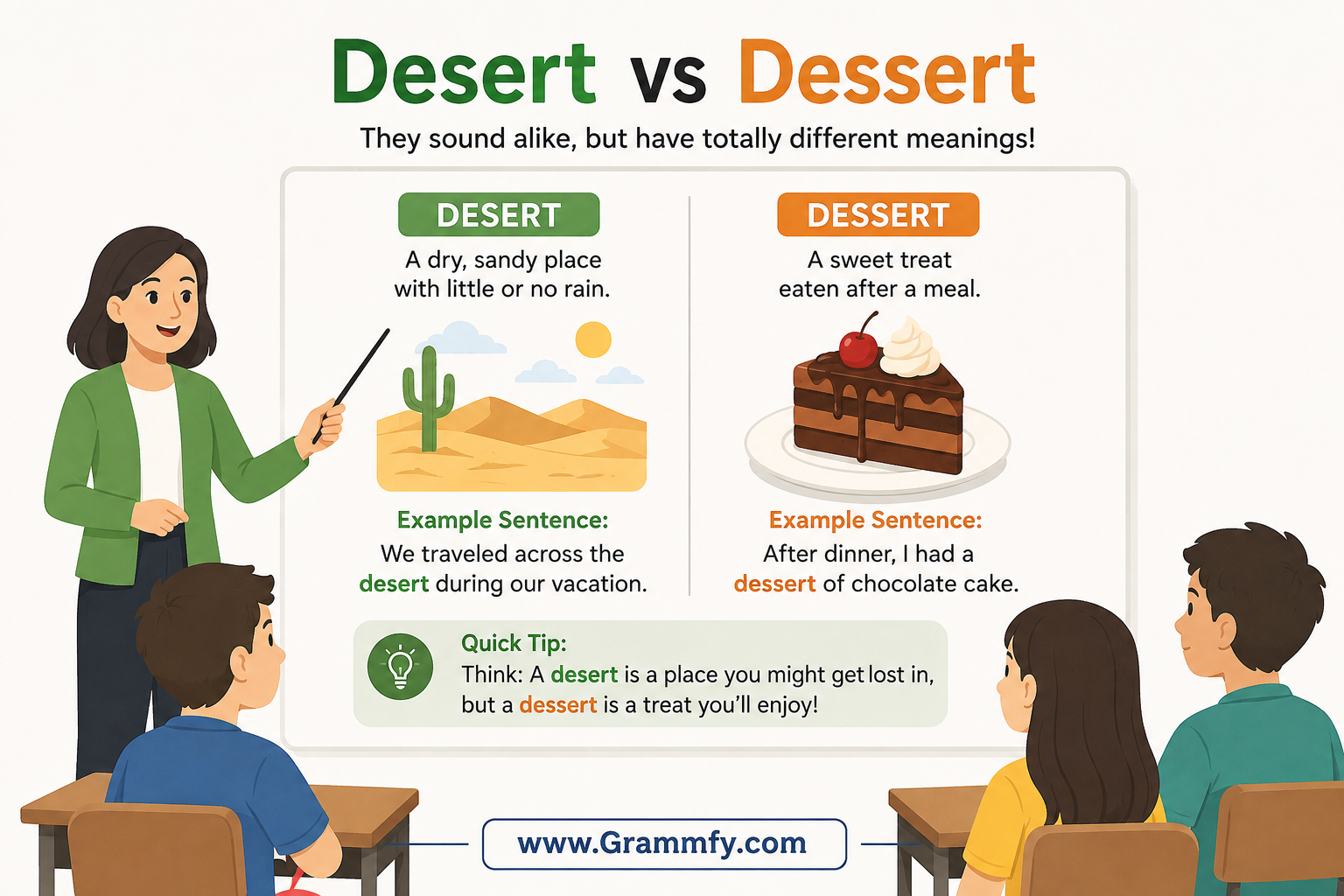
When you’re writing an email, essay, resume, recipe, or text, you may pause over desert vs dessert. Both words are spelled correctly, but they mean completely different things. One can describe a huge, dry landscape. The other is the sweet food you eat after a meal. The only spelling difference is one extra s, but that small letter changes the meaning.
Answer: Desert usually means a dry region with very little rainfall, while dessert means a sweet food served at the end of a meal.
The words can be confusing because they look and sound similar. There’s also an important pronunciation difference: the noun desert meaning a dry region is usually pronounced with the stress on the first syllable, while dessert has stress on the second syllable. The verb desert, meaning to abandon someone or something, has a different pronunciation again.
A simple memory trick can help: dessert has two s’s because you want seconds of something sweet. In this guide, you’ll learn the meanings, word origins, pronunciations, related words, examples, common mistakes, regional notes, and the best choice for different kinds of writing.
Another commonly confused pair worth knowing is [council vs counsel].
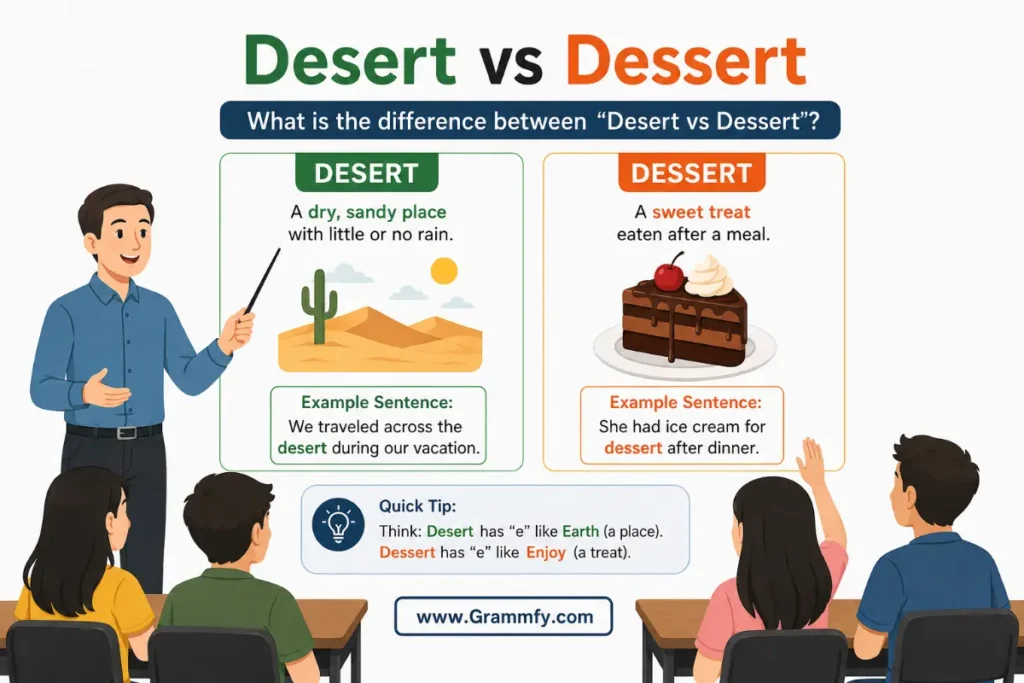
What is the difference between “Desert vs Dessert”?
The easiest distinction is based on meaning.
Desert can be a noun meaning a dry area of land, or a verb meaning to leave or abandon someone or something.
Dessert is a noun meaning a sweet food usually eaten after a meal.
| Word | Main meaning | Part of speech | Example |
|---|---|---|---|
| Desert | Dry area with little rainfall | Noun | The camel crossed the desert. |
| Desert | To abandon | Verb | The soldiers refused to desert their post. |
| Dessert | Sweet food eaten after a meal | Noun | We had cake for dessert. |
Compare these two sentences:
We traveled across the desert.
We ordered ice cream for dessert.
The first sentence is about a landscape. The second is about food.
That distinction is the key to remembering the spelling.
What does desert mean in plain English?
The noun desert refers to a region that receives very little precipitation. Deserts can be hot, cold, sandy, rocky, or covered with gravel and stones.
Many people picture a hot place filled with sand dunes when they hear the word desert, but that picture isn’t complete. A desert is defined mainly by its dryness, not by its temperature or the amount of sand.
For example:
- The Sahara is a hot desert.
- Antarctica is a cold desert.
- Some deserts are rocky.
- Some deserts contain large areas of gravel.
- Some deserts have mountains and valleys.
- Some deserts receive snow.
So the central idea is very low precipitation.
What is a desert?
A desert is an ecosystem or geographic region where water is scarce and precipitation is generally low.
Deserts can have:
- Very dry soil
- Sparse vegetation
- Extreme temperature changes
- Specialized plants
- Animals adapted to limited water
- Sand, rock, gravel, or other terrain
The word doesn’t require sand.
A rocky landscape can be a desert. A frozen landscape can be a desert. What matters most is the lack of available moisture.
What does desert mean as a verb?
Desert can also be a verb meaning to abandon or leave someone or something, especially when support or loyalty is expected.
For example:
The soldiers were ordered not to desert their posts.
Here, desert does not mean a dry landscape.
It means to leave a duty, position, person, or responsibility.
Another example:
He deserted his family during a difficult time.
This means he abandoned them.
The verb has a different pronunciation from the noun for the dry landscape, which makes pronunciation an important part of understanding this word.
What does dessert mean in plain English?
Dessert is a sweet food or course usually served at the end of a meal.
Common desserts include:
- Cake
- Pie
- Ice cream
- Cookies
- Brownies
- Pudding
- Cheesecake
- Donuts
- Fruit tarts
- Pastries
- Custard
- Chocolate mousse
- Gelato
- Sorbet
For example:
We had chocolate cake for dessert.
The word generally refers to a final sweet course, although eating habits vary. Some people have dessert after lunch, dinner, or a special meal.
Does dessert always have to be sweet?
Traditionally, dessert refers to a sweet course. However, what counts as dessert can vary across cultures and meals.
Some desserts may be lightly sweetened rather than extremely sugary. Fruit, cheese-based sweets, rice dishes, pastries, and other foods can serve as dessert depending on the cuisine.
The key idea is that dessert is the sweet or final course rather than a geographical landscape.
Why are “Desert vs Dessert” so easy to confuse?
The words look almost identical.
The main spelling difference is simple:
- desert = one s
- dessert = two s’s
That tiny difference creates a completely different word.
There is another source of confusion: desert has two different meanings as a noun and verb, and the verb is pronounced differently.
Desert as a dry place
The desert was extremely hot.
The noun is pronounced approximately DEH-zert, with the stress on the first syllable.
Desert as a verb
Don’t desert your friends.
The verb is pronounced approximately dih-ZURT, with the stress on the second syllable.
Dessert as sweet food
We ate dessert after dinner.
This is pronounced approximately dih-ZURT, with the stress on the second syllable.
So:
- DEH-zert = dry region
- dih-ZURT = abandon
- dih-ZURT = sweet food
The spelling and context tell you which meaning is intended.
Where did the word desert come from?
The noun desert, meaning a dry or barren region, comes through Old French and Latin roots connected with the idea of something abandoned or left empty.
This historical connection makes sense because early uses could describe a deserted or uninhabited place. Over time, the word became strongly associated with dry, sparsely populated land.
The word has developed into a common geographic term.
Today, it can refer to major ecosystems and regions such as:
- Sahara Desert
- Mojave Desert
- Sonoran Desert
- Gobi Desert
- Atacama Desert
- Antarctic Desert
The word doesn’t simply mean “sand.” Its broader meaning is a region with very low precipitation.
Where did the word dessert come from?
The word dessert comes from French desservir, related to the idea of clearing the table after a meal.
The historical connection is useful because dessert was associated with the final part of dining, after earlier courses had been served.
English adopted the French word and eventually developed the spelling and pronunciation used today.
That history also helps explain why dessert has two s’s. The word’s spelling is different from the geographic noun desert because they have different histories.
How can you remember the spelling “Desert vs Dessert”?
The most useful memory trick is:
Dessert has two S’s because you want seconds.
Think:
Dessert → two S’s → seconds.
You want another serving of cake, pie, or ice cream.
For desert, picture a dry landscape:
Desert → one S → sand.
This isn’t a rule based on the actual history of the words. It’s simply a memory device, and it works well for spelling practice.
Another trick is to associate:
- desert = dry
- dessert = delicious
The extra s gives you the extra sweet course.
What are the main synonyms for desert?
The best synonym depends on which meaning of desert you intend.
If you mean a dry geographic region, useful related words include:
- wasteland
- arid region
- dryland
- barren land
- wilderness
- badlands
- scrubland
- dry zone
- arid zone
- barren region
These aren’t perfect substitutes. A wilderness, for example, does not have to be dry.
If you mean desert as a verb, possible alternatives include:
- abandon
- leave
- forsake
- quit
- flee
- walk away from
- give up
- leave behind
- withdraw from
- betray
Again, context determines the best choice.
What are the main synonyms for dessert?
The word dessert has fewer exact synonyms because it names a specific type of food course.
Related terms include:
- sweet
- sweet course
- pudding
- pastry
- confection
- treat
- after-dinner treat
- sweet dish
- final course
- baked treat
- cake
- pie
- ice cream
Some of these are broader than dessert.
For example, a treat can be eaten at any time, while dessert usually refers to a sweet food served as part of a meal or after it.
Master synonym list for “Desert vs Dessert”
Because the two words have different meanings, the table below separates related vocabulary by meaning and tone.
Simple and everyday words
| Word | Meaning | Tone | Example |
|---|---|---|---|
| Dryland | Land with little moisture | Simple | The region is mostly dryland. |
| Wasteland | Barren or unproductive land | Everyday | The area looked like a wasteland. |
| Wilderness | Wild, undeveloped land | Everyday | They explored the wilderness. |
| Barren land | Land with little plant life | Everyday | Few plants grow on the barren land. |
| Dry region | Area with little rainfall | Simple | It is a very dry region. |
| Sweet | Sweet food, especially in British usage | Everyday | Would you like something sweet? |
| Treat | Food enjoyed for pleasure | Casual | We bought a treat after dinner. |
| Cake | Baked sweet food | Everyday | We had cake after dinner. |
| Pie | Baked dish with pastry | Everyday | Apple pie was served for dessert. |
| Ice cream | Frozen sweet food | Everyday | She ordered ice cream. |
Formal and academic words
| Word | Meaning | Tone | Example |
|---|---|---|---|
| Arid region | Area with very little rainfall | Formal | The species lives in an arid region. |
| Arid zone | Geographical area with low rainfall | Academic | The study focused on an arid zone. |
| Barren region | Area with little vegetation | Formal | The expedition crossed a barren region. |
| Dry ecosystem | Ecosystem with limited moisture | Academic | Several species survive in this dry ecosystem. |
| Confection | Sweet food, often carefully prepared | Formal | The shop specializes in handmade confections. |
| Sweet course | Sweet part of a meal | Formal | Fruit was served as the sweet course. |
| Abandon | Leave behind or give up | Formal | The troops were forced to abandon the position. |
| Forsake | Leave or give up, often permanently | Literary/Formal | He refused to forsake his responsibilities. |
| Withdraw | Move away or leave | Formal | The group decided to withdraw from the area. |
| Barren land | Land unable to support much plant growth | Formal | The survey examined barren land. |
Casual and slang-related expressions
| Word/Phrase | Meaning | Tone | Example |
|---|---|---|---|
| Sweet | A sweet food or candy | Casual | I grabbed something sweet. |
| Treat | Something enjoyable to eat | Casual | Ice cream is a nice treat. |
| Goodie | A small sweet or enjoyable item | Casual | The kids picked a goodie. |
| Sweet stuff | Informal term for sweet foods | Casual | I try not to eat too much sweet stuff. |
| Walk away | Leave a situation | Casual | He decided to walk away from the deal. |
| Bail | Leave quickly or abandon a situation | Slang | They bailed before the meeting ended. |
| Quit | Stop or leave | Casual | He quit the project. |
| Leave behind | Go away and not take someone or something | Everyday | They left the supplies behind. |
These terms provide semantic variety, but they shouldn’t replace the target words blindly. A pie is one kind of dessert, not a complete synonym for every dessert. Likewise, an arid region is close to a desert but may not be technically classified as one.
Synonyms by intensity: mild to strong
The verb desert has several alternatives that differ in emotional strength.
Mild: leave
Leave is neutral.
She left the meeting early.
There is no strong suggestion of betrayal or wrongdoing.
Moderate: abandon
Abandon is stronger.
He abandoned the project.
It suggests leaving something behind, often before it is complete.
Strong: desert
Desert can suggest leaving someone or something that depends on you.
He deserted his family.
The word can carry a stronger emotional sense than simple “left.”
Strong or literary: forsake
Forsake is formal or literary.
She refused to forsake her principles.
It often suggests giving up something important.
Very strong in some contexts: betray
Betray focuses on breaking trust.
He betrayed his closest friend.
This is not an exact synonym for desert, because someone can leave without betraying anyone. But in certain contexts, the meanings overlap.
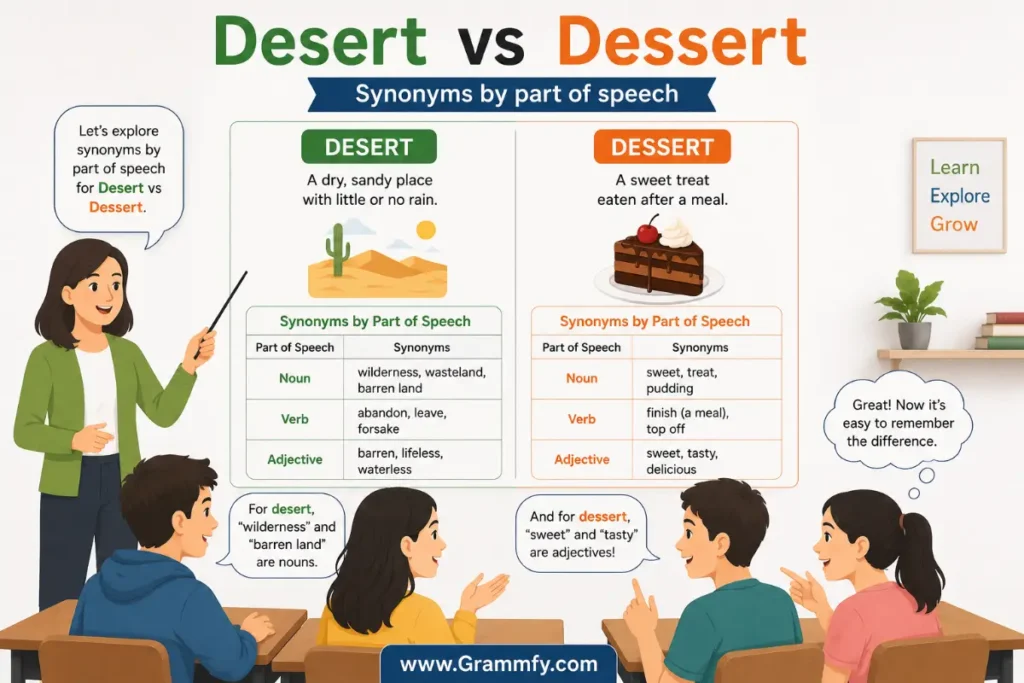
Synonyms by part of speech “Desert vs Dessert”
Nouns related to a dry desert
- arid region
- dryland
- wasteland
- barren region
- wilderness
- badlands
- dry zone
- arid zone
Verbs related to desert
- leave
- abandon
- forsake
- quit
- flee
- withdraw
- walk away
- leave behind
- give up
- betray
Nouns related to dessert
- sweet
- treat
- confection
- pudding
- pastry
- cake
- pie
- ice cream
- sweet course
Unlike desert, dessert is normally used as a noun. You don’t normally use dessert as a standard English verb.
Which word is best for a resume?
A resume may use desert in a geographic, environmental, military, or scientific context.
For example:
Conducted field research in an arid desert ecosystem.
If you’re discussing military service, the verb desert can also appear, but it has a serious meaning:
Studied historical cases involving soldiers who deserted their posts.
For food-related work, dessert is useful:
Created seasonal dessert menus for a high-volume restaurant.
Prepared cakes, pies, and other desserts for private events.
If you mean leaving a job, however, don’t use desert casually.
You wouldn’t normally write:
I deserted my previous position.
That sounds like you abandoned a duty.
Better:
I left my previous position.
or:
I transitioned to a new role.
The best resume word depends heavily on the intended meaning.
Which word is best for an essay “Desert vs Dessert”?
For an academic essay about geography, climate, ecology, or history, desert is the correct term for a dry region.
The Sahara Desert covers a large area of North Africa.
For an essay about food or culture:
Dessert traditions vary across different cultures.
If you’re discussing a person leaving a responsibility:
The soldier deserted his post.
In formal writing, make sure you aren’t choosing a word just because it sounds more sophisticated. Leave may be better than desert when the stronger meaning isn’t intended.
Which word is best for texting “Desert vs Dessert”?
In casual texting, dessert often appears in messages about food:
Want dessert after dinner?
I’m saving room for dessert.
For a landscape:
The desert looks amazing at sunset.
For the verb:
He deserted his team.
The meaning should guide the spelling.
A useful texting trick is to remember that dessert has the extra s when you’re talking about something sweet.
Which word is best for email “Desert vs Dessert”?
Professional emails may use either word depending on the subject.
For example:
The research team will travel to the desert region next month.
Or:
We will serve dessert after the main course.
For the verb desert, be careful because it has a strong meaning.
Instead of:
I deserted the project.
you may actually mean:
I left the project.
or:
I stepped away from the project.
Use desert when abandonment is truly the intended meaning.
Which word is best for speaking “Desert vs Dessert”?
In conversation, dessert is extremely common.
What’s for dessert?
The noun desert is also common:
We drove through the desert.
The verb desert is less common in everyday conversation because it carries a serious meaning.
If someone says:
Don’t desert me.
they mean:
Don’t abandon me.
This can sound emotional or dramatic depending on the situation.
15+ original example sentences of “Desert vs Dessert”
Here are examples from different real-life situations.
Travel
- We watched the sunset over the desert.
- The road crossed a remote desert region.
- Travelers carried extra water because the desert was extremely dry.
Food
- We ordered cheesecake for dessert.
- She made a chocolate dessert for the family.
- The restaurant offers three homemade desserts.
- I usually skip dessert, but the pie looked too good to pass up.
School
- The students learned how plants survive in the desert.
- Our geography class studied desert ecosystems.
- The class prepared a presentation about desert animals.
Work
- The environmental team conducted research in the desert.
- The bakery hired a chef who specializes in desserts.
- The restaurant added a new seasonal dessert to its menu.
Serious situations
- The soldiers were warned not to desert their posts.
- He felt that his friend had deserted him when he needed help.
- The commander punished the soldier for attempting to desert.
Everyday life
- Do you want dessert after dinner?
- We passed through the desert on our road trip.
- She brought a homemade dessert to the party.
- The hikers prepared carefully before entering the desert.
“Desert vs Dessert”: which one means a dry place?
For a dry geographic region, use desert.
The Sahara is a vast desert.
This is the noun with one s.
Remember that deserts aren’t necessarily hot or sandy. Their defining feature is low precipitation.
A cold region can also be classified as a desert if it receives very little precipitation.
“Desert vs Dessert”: which one means a sweet food?
For a sweet course or sweet food, use dessert.
We had ice cream for dessert.
The spelling has two s’s.
This is the word you need for cakes, pies, pudding, ice cream, pastries, and similar foods.
The memory trick is:
Dessert has two S’s because you want seconds.
“Desert vs Dessert”: which one means abandon?
For the verb meaning abandon or leave, use desert.
He chose to desert his post.
This meaning has the same spelling as the dry-land noun, but its pronunciation is different.
Compare:
The soldiers crossed the desert.
Here, desert means a dry region.
The soldiers refused to desert their posts.
Here, desert means abandon.
The spelling is identical, but the pronunciation and grammatical function change.
How is desert pronounced?
The noun meaning a dry region is generally pronounced:
DEH-zert
The stress is on the first syllable.
Example:
We crossed the DEH-zert.
The verb meaning abandon is generally pronounced:
dih-ZURT
The stress moves to the second syllable.
Example:
Don’t dih-ZURT your responsibilities.
This is an important distinction for English learners.
How is dessert pronounced?
Dessert is generally pronounced:
dih-ZURT
The second syllable receives the stress.
Example:
We had cake for dih-ZURT.
So the noun for the dry region and the word for sweet food are not pronounced exactly the same.
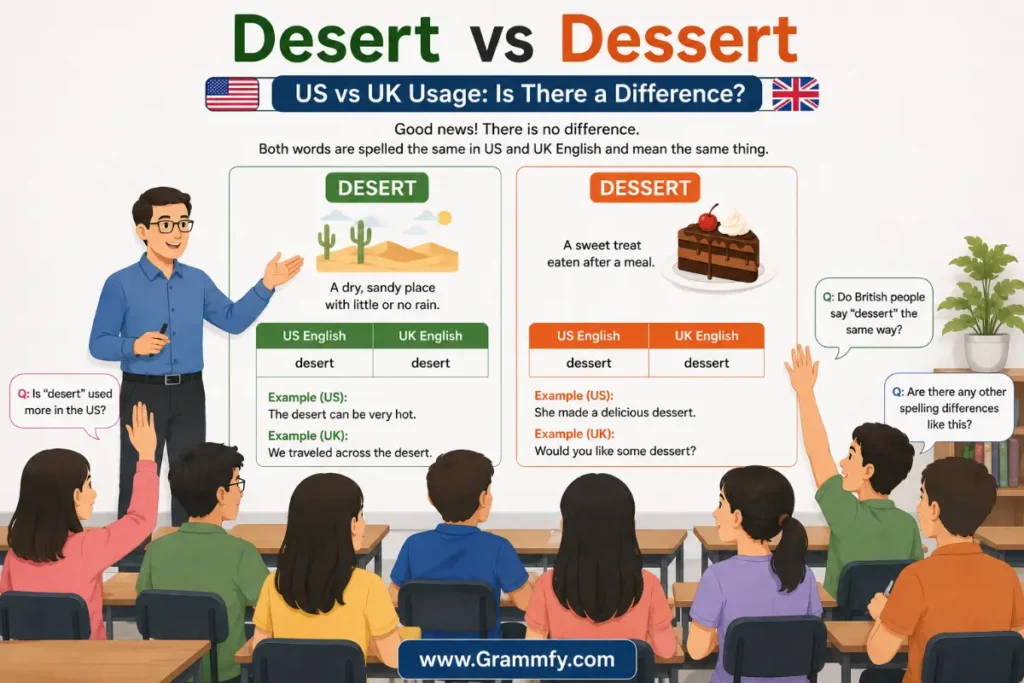
US vs UK usage: is there a difference Between “Desert vs Dessert”?
The core spelling distinction is the same in American and British English.
Both varieties use:
- desert for a dry region
- desert for the verb meaning abandon
- dessert for a sweet course
There can be differences in food vocabulary.
For example, British English sometimes uses sweet to mean what American English commonly calls dessert.
A British speaker may say:
What’s for pudding?
or:
What’s for afters?
depending on region, age, and context.
American English more commonly uses:
What’s for dessert?
These regional terms don’t change the spelling distinction between desert and dessert.
Why does dessert have two S’s?
The extra s is part of the word’s historical spelling, but for everyday spelling practice, the easiest memory aid is:
Dessert has two S’s because you want seconds.
Imagine finishing a slice of cake and asking:
Can I have seconds?
The word seconds has an s idea that helps you remember the extra s in dessert.
For desert, imagine a single stretch of dry land.
Again:
One S = desert
Two S’s = dessert
This is a spelling trick, not a linguistic rule, but it’s easy to remember.
What mistakes should you avoid?
Mistake 1: Writing desert after a meal
Incorrect:
We had ice cream for desert.
Correct:
We had ice cream for dessert.
The sweet course needs two s’s.
Mistake 2: Writing dessert for a dry landscape
Incorrect:
We crossed the Sahara Dessert.
Correct:
We crossed the Sahara Desert.
A geographical desert has one s in the word.
Mistake 3: Using dessert for abandonment
Incorrect:
He desserted his responsibilities.
Correct:
He deserted his responsibilities.
The verb is spelled desert, not dessert.
Mistake 4: Assuming every desert is sandy
A desert doesn’t have to be covered in sand.
Deserts can be:
- Rocky
- Icy
- Gravelly
- Mountainous
- Shrubby
- Sandy
Dryness is the important feature.
Mistake 5: Treating “Desert vs Dessert” as interchangeable
They aren’t interchangeable.
We walked through the desert.
and
We ate dessert.
describe completely different things.
When should you not use the word desert?
Don’t use desert simply to mean “empty,” “boring,” or “unpleasant.”
For example:
The office was a desert.
This can be used metaphorically, but it isn’t the basic geographical meaning.
If you’re writing a clear school essay, use more precise language when possible.
Instead of:
The room was a desert.
you might write:
The room was empty.
or:
The room had almost no activity.
The metaphor can be effective in creative writing, but it may be less clear in technical or academic writing.
When should you not use dessert?
Don’t use dessert for every sweet snack.
A cookie eaten at 3 p.m. might be a snack or treat rather than dessert, depending on the situation.
For example:
I had a cookie as a snack.
This is different from:
We had cookies for dessert after dinner.
The food can be identical, but its role in the meal changes.
Likewise, candy isn’t automatically dessert simply because it’s sweet.
Context matters.
What are the antonyms of desert?
The geographic noun desert doesn’t have one perfect opposite.
Depending on what you’re contrasting, possible terms include:
- rainforest
- wetland
- fertile land
- lush region
- humid environment
- well-watered area
A rainforest is not technically the universal opposite of every desert, but it can represent a very wet ecosystem.
For example:
The desert has very little rainfall, while a rainforest receives abundant precipitation.
Antonyms of desert as a verb
For the verb meaning abandon, possible opposites include:
- stay
- remain
- support
- protect
- accompany
- assist
- stand by
- remain loyal to
For example:
He stayed with his family during the crisis.
This contrasts with:
He deserted his family during the crisis.
What are the antonyms of dessert?
Dessert doesn’t have a direct antonym because it names a course of food.
You can contrast it with other parts of a meal:
- appetizer
- starter
- main course
- entree
- savory course
But these aren’t true antonyms.
For example:
The appetizer came before the main course, while dessert came afterward.
The relationship is about meal order rather than opposite meanings.
Quick comparison chart
| Feature | Desert | Dessert |
|---|---|---|
| Spelling | One S | Two S’s |
| Main meaning | Dry region | Sweet food |
| Part of speech | Noun | Noun |
| Other use | Verb meaning abandon | Usually noun |
| Dry landscape? | Yes | No |
| Sweet food? | No | Yes |
| Common phrase | Sahara Desert | Chocolate dessert |
| Memory clue | One S | Two S’s for seconds |
| Pronunciation | DEH-zert for dry region | dih-ZURT |
| Example | We crossed the desert. | We ordered dessert. |
A simple decision test
When you’re unsure, ask what you can physically imagine.
If you can picture:
- Sand
- Rocks
- Dry mountains
- Sparse vegetation
- Very little rainfall
you probably need desert.
If you can picture:
- Cake
- Pie
- Ice cream
- Cookies
- Pudding
- Chocolate
you probably need dessert.
If you’re talking about leaving someone or something behind, you also need desert as a verb.
This mental-image method works especially well for students and English learners.
Common phrases with desert
Here are useful expressions containing desert:
- desert climate
- desert landscape
- desert ecosystem
- desert wildlife
- desert plants
- desert animals
- desert region
- desert road
- desert island
- desert heat
- desert storm
- desert expedition
- desert crossing
- desert habitat
Note that desert island is a common phrase meaning an island with few or no permanent inhabitants. It does not necessarily mean the island is covered in sand or has a hot climate.
Common phrases with dessert
Useful expressions include:
- dessert menu
- dessert table
- dessert course
- dessert plate
- dessert recipe
- dessert shop
- dessert restaurant
- chocolate dessert
- fruit dessert
- frozen dessert
- homemade dessert
- healthy dessert
- holiday dessert
- after-dinner dessert
These phrases all use the spelling with two s’s.
Why “desert island” can be confusing
The phrase desert island sometimes confuses English learners because the island may not be a desert.
In this expression, desert comes from an older sense connected with being deserted or uninhabited.
So:
desert island
means an island that is uninhabited or nearly uninhabited.
It does not necessarily mean:
an island with a dry desert climate.
This is a good reminder that words can have historical meanings that differ from the first definition you learn.
A short practice exercise
Choose the correct word.
- We ate cake for ______.
- The camel traveled across the ______.
- The soldier refused to ______ his post.
- The restaurant has a large ______ menu.
- They studied animals that live in the ______.
- She made a fruit ______ for the party.
- He was accused of trying to ______ his responsibilities.
- The researchers entered the ______ at sunrise.
- What do you want for ______?
- The region has a very dry ______ climate.
Answers
- dessert
- desert
- desert
- dessert
- desert
- dessert
- desert
- desert
- dessert
- desert
The extra s is your most useful spelling clue.
A memory sentence you can reuse “Desert vs Dessert”
If you’re studying the difference, memorize this sentence:
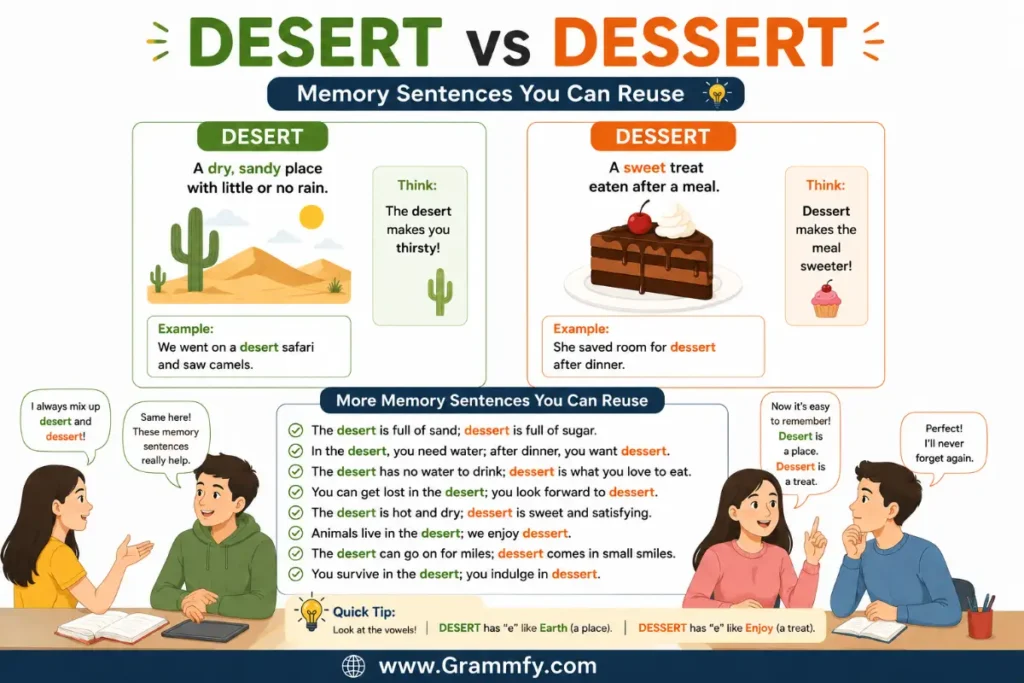
After crossing the desert, we ate dessert.
It contains both words and makes the contrast easy to remember.
You can also use:
The desert is dry, but dessert is delicious.
The first word has one s. The second has two.
These short sentences are useful because they connect spelling with meaning.
Conclusion
The difference between desert vs dessert becomes simple once you connect each spelling to its meaning. Desert with one s can mean a dry region or the act of abandoning someone or something. Dessert with two s’s means a sweet food or course served after a meal. When you’re unsure about the spelling of the food word, remember the classic trick: you want seconds of dessert. Context can also guide you. If you’re discussing climate, geography, or abandonment, choose desert. If you’re discussing cake, pie, ice cream, or another sweet course, choose dessert. With that small spelling clue and a little practice, you’ll be able to choose the right word quickly in schoolwork, professional writing, messages, and everyday conversation.
Frequently Asked Questions
What is the difference between “Desert vs Dessert” ?
Desert usually means a dry region or, as a verb, to abandon, while dessert means a sweet food served after a meal. The easiest spelling clue is that dessert has two s’s.
Is it “Desert vs Dessert” after dinner?
The correct word is dessert after dinner. Cake, pie, ice cream, and similar sweet foods can be served as dessert.
Why does dessert have two s’s?
A common memory trick is that dessert has two s’s because you want seconds. This helps distinguish it from desert, which has only one s.
What’s another way to say dessert?
You can say sweet, treat, sweet course, confection, or a specific food such as cake or pie. The best alternative depends on what you’re describing.
Is a desert always hot and sandy?
No, a desert is defined mainly by very low precipitation, not by heat or sand. Some deserts are cold, rocky, or covered with ice.
How do you pronounce “Desert vs Dessert”?
The dry-land noun desert is usually pronounced DEH-zert, while dessert is pronounced dih-ZURT. The verb desert, meaning abandon, is also pronounced dih-ZURT.
Is it “Desert vs Dessert” in “Sahara”?
The correct phrase is “Sahara Desert.” Here, desert refers to the dry geographic region, so it has one s.
