
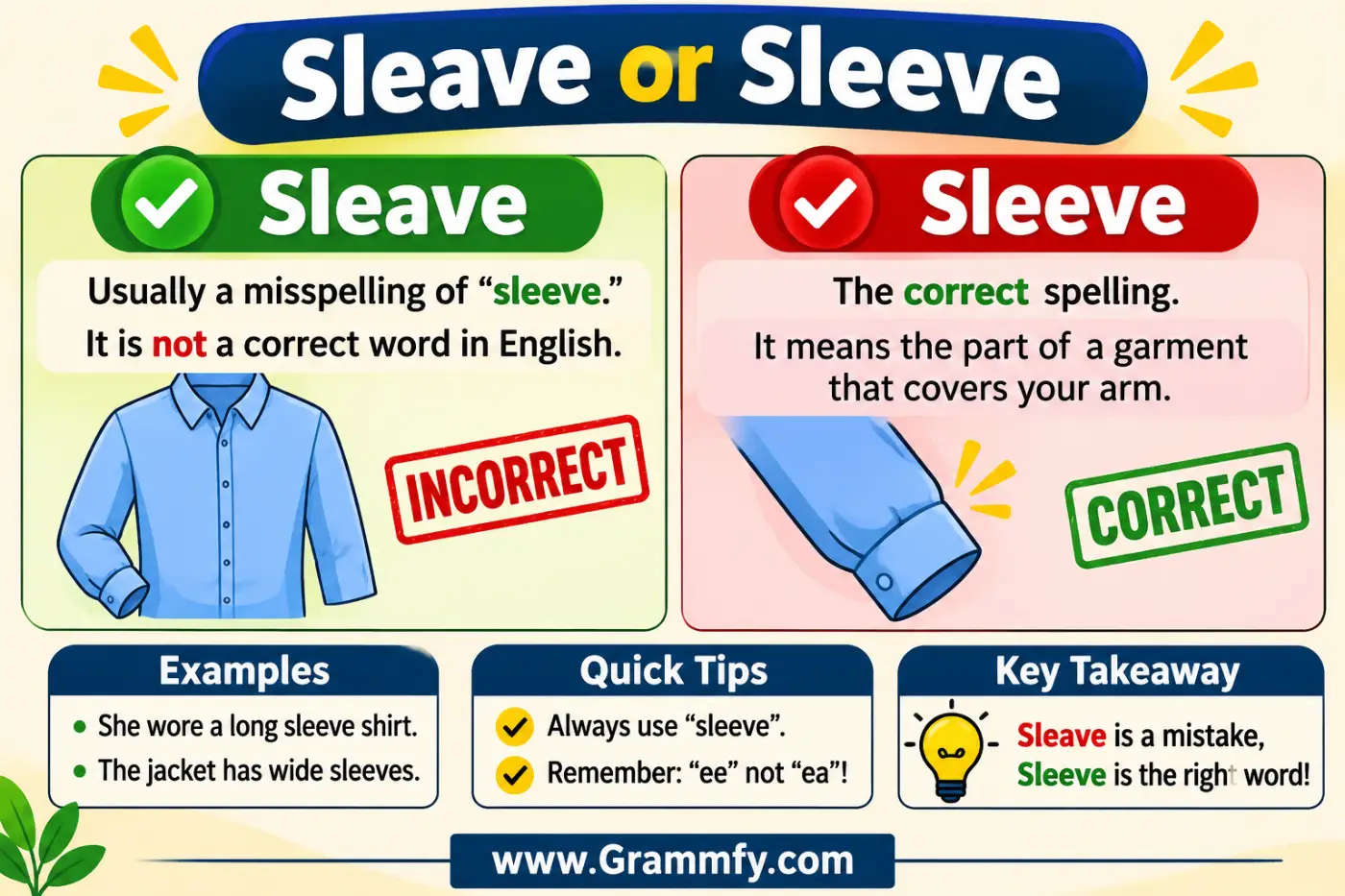
Have you ever written a clothing description, an online shopping message, or a school assignment and paused over the spelling of this word? You might wonder whether sleave or sleeve is correct. The two forms look similar, but only one is the standard spelling for the part of a shirt, jacket, or dress that covers your arm.
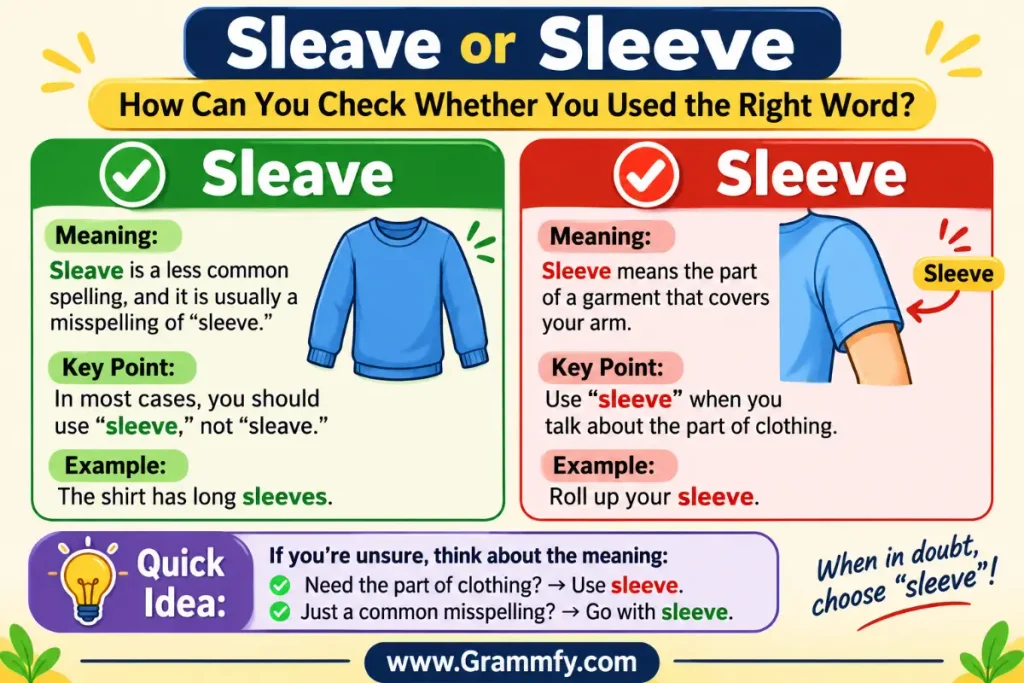
Sleeve is the correct spelling when you mean the part of a garment that covers the arm. Sleave is not the standard spelling for this meaning and is usually a spelling mistake.
When choosing between these two spellings, remember that sleeve is the word you need for clothing. Using the wrong spelling can make your writing look less polished, especially in formal communication.
If you often struggle with English spelling, learn how to spell career correctly and avoid this common mistake in your writing.
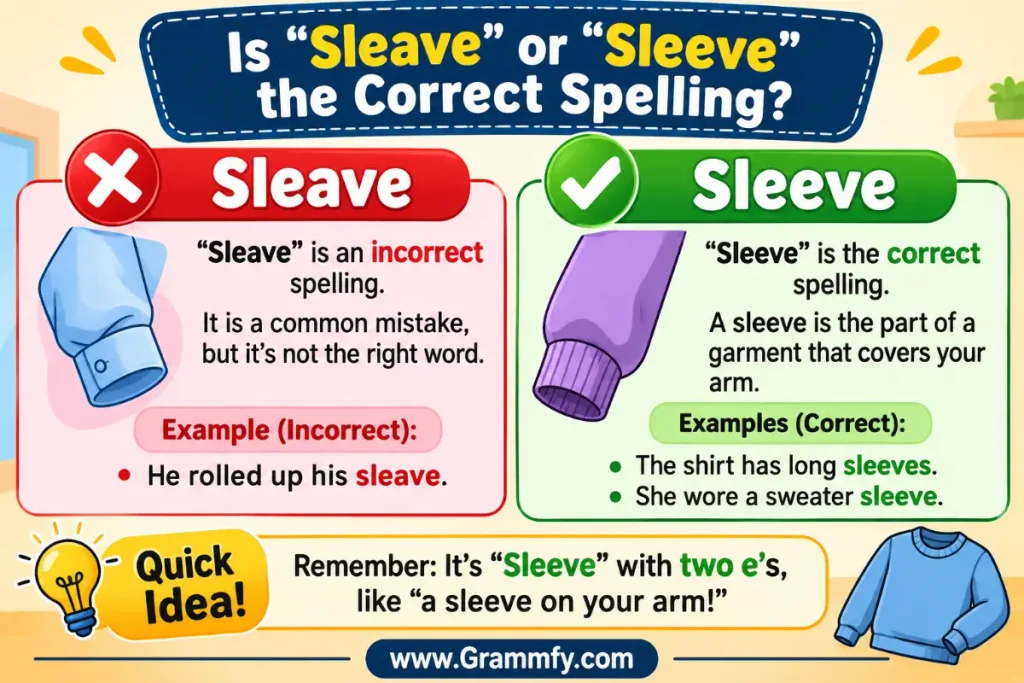
Is “Sleave” or “Sleeve” the Correct Spelling?
Sleeve is the correct spelling for the part of clothing that covers your arm. You use it when talking about shirts, coats, jackets, dresses, sweaters, and other garments.
The word sleave does exist in older English, but it has a different and very uncommon meaning. It has been used for tangled or untwisted silk fibers. It is not the spelling you should use when describing clothing.
| Spelling | Meaning | Modern use |
|---|---|---|
| Sleeve | The part of clothing that covers the arm | Common and correct for clothing |
| Sleave | A rare, old term for tangled or separated silk fibers | Archaic and uncommon |
Why Do People Confuse These Two Spellings?
There are a few reasons this spelling mix-up happens:
- Similar sounds: Both forms can look as though they should sound alike.
- One-letter difference: The only difference is the vowel in the middle. That small change is easy to overlook.
- Unfamiliar spelling: Some writers do not often use the word in everyday writing, so they may guess its spelling.
- Old word history: The form sleave has appeared in historical English, which can make it seem like another accepted spelling of the clothing term.
For modern writing, remember that the garment has a sleeve. A shirt has sleeves, and a jacket has sleeves. You should not use sleave for either one.
Quick Answer: Which Spelling Should You Use?
Choose sleeve when you mean a part of a garment, a protective cover, or a tube-shaped fitting. Choose sleave only when discussing its rare historical meaning in a suitable context. In everyday writing, sleeve is almost always the word you need.
What Does “Sleeve” Mean in Plain English?
A sleeve is the part of a piece of clothing that covers all or part of your arm. It usually begins at the shoulder area and ends near the wrist, elbow, or upper arm. Its length and shape depend on the type of garment.
For example, a winter coat usually has long sleeves to keep your arms warm. A summer shirt may have short sleeves to help you stay cool. A sleeveless top has no sleeves at all.
The word also has meanings beyond clothing. It can describe a protective cover or a tube-shaped part that fits around another object. The exact meaning depends on the situation.
Common Meanings of “Sleeve”
| Meaning | Simple explanation | Example |
|---|---|---|
| Clothing part | Fabric that covers the arm | The sleeve of my shirt is wet. |
| Protective cover | A cover that holds or protects an item | Put the document in a plastic sleeve. |
| Record cover | A paper or cardboard cover for a vinyl record | The album sleeve has a colorful design. |
| Mechanical fitting | A tube-shaped part placed around another part | The metal sleeve protects the connection. |
| Tattoo design | A large tattoo covering much of an arm | He has a full sleeve tattoo. |
These meanings share a general idea: something that covers, surrounds, or fits around another thing. That connection makes the different uses easier to understand.
What Is a Sleeve in Clothing?
In clothing, a sleeve is the section of fabric attached to the body of a shirt, dress, jacket, or similar item. It covers some or all of the arm.
Sleeves can have different shapes and lengths. A fitted sleeve sits close to the arm, while a loose sleeve gives the arm more room. Some sleeves are designed for warmth, while others are mainly decorative.
Common sleeve styles include:
- Long sleeve: Covers most or all of the arm.
- Short sleeve: Usually ends around the upper arm.
- Three-quarter sleeve: Ends between the elbow and wrist.
- Cap sleeve: A short sleeve that covers only the top of the shoulder.
- Puff sleeve: A sleeve gathered to create a rounded shape.
- Bell sleeve: A sleeve that widens toward the wrist.
- Raglan sleeve: A sleeve that extends toward the neckline with a diagonal seam.
- Sleeveless design: A garment made without sleeves.
Can “Sleeve” Be Used as a Verb?
Yes. Sleeve can also be used as a verb, although this use is less common in everyday conversation.
As a verb, it means to provide something with a sleeve or fit it with a protective covering. The past tense is sleeved, and the present participle is sleeving.
Examples:
- The tailor will sleeve the jacket before finishing it.
- The technician sleeved the exposed cable.
- The company is sleeving each product to protect it during shipping.
In ordinary writing, you will probably use sleeve as a noun more often than as a verb.
What Are the Synonyms and Related Words for “Sleeve”?
There is no single list of words that can replace sleeve in every sentence. The word names a specific part of clothing, so many alternatives describe a type of sleeve, a nearby clothing part, or a protective covering instead.
For example, cuff refers to the finished edge at the end of a sleeve. It does not mean the entire sleeve. Similarly, cover may work for a protective sleeve but not for the arm section of a shirt.
The following table groups useful alternatives and related terms by tone and context. Check the meaning before replacing the original word.
Simple Words Related to “Sleeve”
| Word | Meaning | Tone | Example |
|---|---|---|---|
| Arm covering | Fabric that covers the arm | Simple | The arm covering feels soft. |
| Shirt sleeve | The sleeve of a shirt | Everyday | His shirt sleeve is rolled up. |
| Coat sleeve | The sleeve of a coat | Everyday | A button is missing from my coat sleeve. |
| Long sleeve | A sleeve that covers most of the arm | Everyday | I prefer a long-sleeve shirt in winter. |
| Short sleeve | A sleeve that ends above the elbow | Everyday | She wore a short-sleeve top. |
| Cuff | The finished edge around a sleeve opening | Everyday | The cuff is too tight. |
| Hem | A finished edge of fabric | Everyday | The sleeve hem needs repair. |
| Fabric cover | A covering made from cloth | Simple | The fabric cover protects the item. |
Everyday Words and Clothing Terms
| Word | Meaning | Tone | Example |
|---|---|---|---|
| Armhole | Opening where the arm enters a garment | Everyday | The armhole feels too small. |
| Bodice | Upper part of a dress or woman’s garment | Fashion | The bodice has decorative sleeves. |
| Raglan | A sleeve style with a diagonal seam toward the neckline | Fashion | The jacket has raglan sleeves. |
| Cap sleeve | A very short sleeve covering the shoulder area | Fashion | The dress has cap sleeves. |
| Puff sleeve | A gathered, rounded sleeve | Fashion | The blouse has puff sleeves. |
| Bell sleeve | A sleeve that widens toward its lower edge | Fashion | Bell sleeves give the dress a flowing look. |
| Bishop sleeve | A full sleeve gathered at the wrist | Fashion | The shirt has bishop sleeves. |
| Dolman sleeve | A wide sleeve with a deep armhole | Fashion | The sweater has dolman sleeves. |
| Batwing sleeve | A wide sleeve that narrows toward the wrist | Fashion | The top has batwing sleeves. |
| Set-in sleeve | A sleeve attached to a separate armhole seam | Sewing | The tailor fitted a set-in sleeve. |
Informal and Slang-Related Expressions
There are few genuine slang synonyms for sleeve itself. These expressions are related to sleeves, clothing, or how people use the word in conversation. They are not direct replacements in every sentence.
| Word or expression | Meaning | Tone | Example |
|---|---|---|---|
| Rolled-up sleeves | Sleeves folded toward the elbows | Informal | He got to work with his sleeves rolled up. |
| Sleeveless | Having no sleeves | Everyday | She wore a sleeveless dress. |
| Sleeve tattoo | A large tattoo covering much of the arm | Informal | His sleeve tattoo took several sessions. |
| Up one’s sleeve | Hidden and ready to use | Idiomatic | She has another idea up her sleeve. |
| Roll up your sleeves | Get ready to work hard | Informal idiom | We need to roll up our sleeves and finish this. |
| Wear your heart on your sleeve | Show your feelings openly | Idiomatic | He wears his heart on his sleeve. |
Are These Words True Synonyms?
Not all of them are. A true synonym should be close enough in meaning to replace the original word without changing the sentence too much.
For instance:
- The sleeve of my shirt is torn.
- The arm covering of my shirt is torn.
The second sentence is understandable, but it sounds less natural. In most cases, sleeve is the clearest word.
By contrast, cuff and armhole name different parts of a garment. They are useful clothing terms, but they should not replace sleeve when you mean the full fabric section covering the arm.
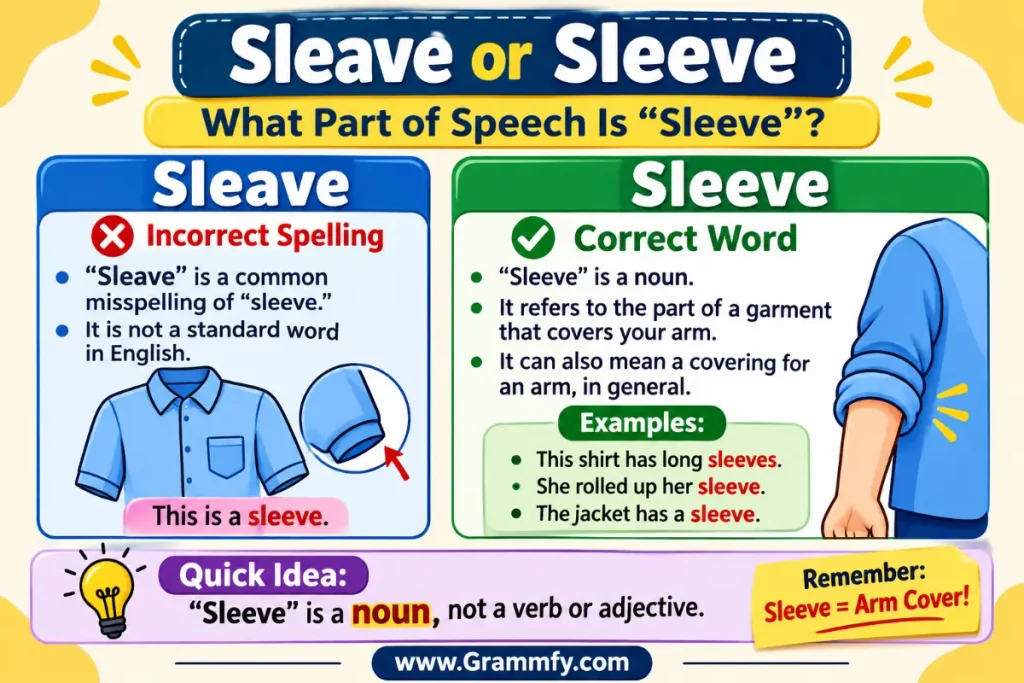
What Part of Speech Is “Sleeve”?
Sleeve is mainly a noun, but it can also function as a verb.
“Sleeve” as a Noun
A noun names a person, place, thing, or idea. In this use, sleeve names a clothing part or another type of covering.
Examples:
- The sleeve of my jacket is too short.
- A small hole appeared in his left sleeve.
- The record sleeve has a picture of the band.
- The protective sleeve keeps the phone safe.
- She brushed the dust off her sleeve.
The plural form is sleeves.
- One sleeve is missing.
- Both sleeves need to be shortened.
“Sleeve” as a Verb
As a verb, sleeve means to fit or provide something with a sleeve or covering.
| Verb form | Example |
|---|---|
| Base form: sleeve | The worker will sleeve the cable. |
| Third-person singular: sleeves | The company sleeves each product. |
| Past tense: sleeved | The technician sleeved the wire. |
| Present participle: sleeving | They are sleeving the new cables. |
This verb is more common in specialist or technical contexts than in everyday conversation.
What Are the Related Forms of “Sleeve”?
| Word | Part of speech | Meaning |
|---|---|---|
| Sleeve | Noun / verb | An arm covering; to provide a covering |
| Sleeves | Plural noun / verb | More than one sleeve; covers something |
| Sleeved | Adjective / verb form | Having sleeves; fitted with a sleeve |
| Sleeving | Noun / verb form | The process of adding a sleeve or cover |
| Sleeveless | Adjective | Having no sleeves |
| Sleevelike | Adjective | Resembling a sleeve |
These forms are useful when describing clothing, sewing, and protective coverings.
Is “Sleeve” Spelled Differently in the US and UK?
No. The standard spelling is sleeve in both American and British English. The spelling does not change when you write for readers in the United States, the United Kingdom, Canada, or Australia.
Some clothing terms may vary by region, but this word stays the same. You can use it in a US shopping description, a UK fashion article, or an Australian clothing advertisement.
| Region | Standard spelling | Example |
|---|---|---|
| United States | Sleeve | The shirt has short sleeves. |
| United Kingdom | Sleeve | The shirt has short sleeves. |
| Canada | Sleeve | The jacket has long sleeves. |
| Australia | Sleeve | The dress has puff sleeves. |
Do American and British Writers Use Different Sleeve Terms?
The spelling is shared, but fashion descriptions can differ based on local preferences and the type of clothing being discussed.
For example, a clothing store in one country may describe a garment as a top, while another store may call it a blouse or shirt. These choices depend on the garment and local usage, not on a different spelling of sleeve.
Here are some examples:
- American English: The sweater has long sleeves.
- British English: The jumper has long sleeves.
- Canadian English: The jacket has adjustable sleeves.
- Australian English: The shirt has rolled-up sleeves.
The clothing name may change, but the spelling of the arm-covering part does not.
Is “Sleave” an Accepted Regional Spelling?
No. Sleave is not a standard regional spelling of the clothing word. You should not use it just because you are writing for a particular English-speaking country.
If you are describing a jacket, shirt, sweater, or dress, write sleeve. The historical word sleave belongs to a different and now uncommon meaning.
Which Word Should You Use in Different Writing Situations?
The best word depends on your audience and purpose. A casual text does not need the same level of detail as a product description or a sewing instruction. Still, the spelling of the clothing term remains sleeve in each situation.
1. What Should You Write on a Resume?
A resume usually focuses on skills, experience, and achievements. You may need this word if you have worked in clothing design, tailoring, fashion retail, or garment production.
Use clear and specific wording rather than an unusual expression.
Examples:
- Designed short-sleeve and long-sleeve garments for a seasonal collection.
- Altered jacket sleeves to meet customer measurements.
- Checked sleeve length and stitching during garment inspections.
- Assisted customers in choosing shirts with suitable sleeve styles.
If you are describing a tailoring skill, you can also use terms such as sleeve alteration, sleeve fitting, and garment construction.
2. How Should You Use It in an Essay?
In an essay, use sleeve when describing clothing, a character’s appearance, or a particular object. Make sure the word supports the point you are making.
Examples:
- The character pulled his sleeve over his hand to stay warm.
- The uniform had a badge on the left sleeve.
- The writer used the image of a rolled-up sleeve to suggest hard work.
- The museum displayed a traditional coat with embroidered sleeves.
For formal writing, avoid using sleave as a creative alternative. Readers may think it is a spelling error unless you are discussing the historical word itself.
3. What Is the Correct Spelling in a Text Message?
Use sleeve in casual messages, too. Short messages still benefit from correct spelling, especially when you are asking about clothing or shopping.
Examples:
- Does this shirt have long sleeves?
- I think the sleeve is too tight.
- Can you check whether the jacket has short sleeves?
- I got a stain on my right sleeve.
4. How Do You Use It in a Professional Email?
When writing to a tailor, clothing store, supplier, or customer, use clear details. Mention the sleeve length, color, fit, or problem so the reader knows what you mean.
Example email sentence:
- Could you please shorten the sleeves by two inches?
- I noticed a small tear near the left sleeve seam.
- Please confirm whether the blue jacket is available with full-length sleeves.
- The sample garment looks good, but the sleeve opening needs adjustment.
Professional messages should avoid unclear descriptions. If you mean the cuff, say cuff. If you mean the entire arm-covering section, say sleeve.
5. How Do You Use It When Speaking?
In conversation, sleeve is useful when describing what someone is wearing, asking about fit, or explaining a clothing problem.
Try sentences such as:
- Your sleeve is caught on the chair.
- I need a shirt with longer sleeves.
- The sleeves on this coat are too wide.
- Can you roll up your sleeves before washing your hands?
The word is common enough for everyday speech. You do not need a more complicated term unless you are talking about a specific design or sewing detail.
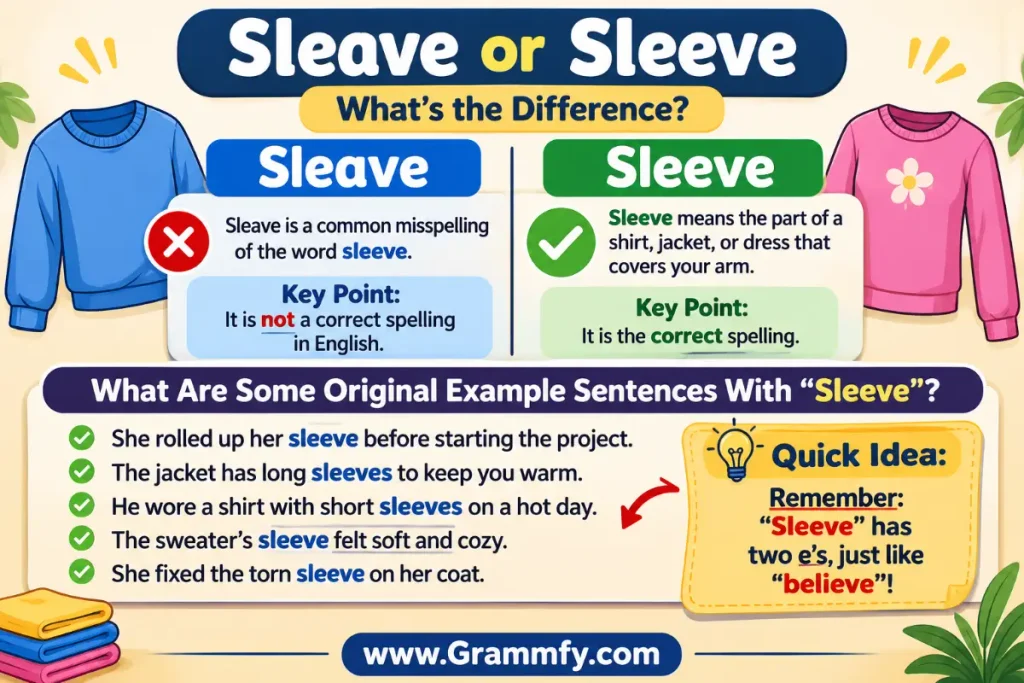
What Are Some Original Example Sentences With “Sleeve”?
Seeing a word in different situations can make its meaning easier to remember. The following examples show how sleeve works in clothing descriptions, shopping, schoolwork, work instructions, and everyday conversation.
Everyday Clothing Examples
- My new shirt has a small pocket on the left sleeve.
- The sleeve of her sweater became wet in the rain.
- He pushed both sleeves above his elbows before washing the dishes.
- The tailor shortened the sleeves of my formal jacket.
- A loose thread was hanging from the right sleeve.
- I prefer long sleeves when the weather turns cold.
- The little boy wiped his hands on his shirt sleeve.
- Her dress has soft, flowing sleeves that move when she walks.
Shopping and Fashion Examples
- The online store lists this top as a short-sleeve design.
- Please check whether the black jacket comes with adjustable sleeves.
- The model wore a white blouse with wide sleeves.
- I returned the shirt because one sleeve was longer than the other.
- This cotton sweater has ribbed cuffs and fitted sleeves.
- The designer added puff sleeves to give the dress a vintage look.
School and Workplace Examples
- The student spilled ink on the sleeve of his uniform.
- Our sewing teacher showed us how to attach a sleeve to a bodice.
- The factory checks every sleeve seam before packing the shirts.
- The costume designer made a separate sleeve pattern for the stage outfit.
- The technician placed a protective sleeve around the exposed cable.
- The document was kept in a clear plastic sleeve.
Creative and Figurative Examples
- She had a small notebook tucked inside her coat sleeve.
- The magician seemed to have one more trick up his sleeve.
- He wore his heart on his sleeve and never hid his feelings.
- After the long walk, dust covered the sleeve of his jacket.
- The old record had a colorful sleeve with faded lettering.
- The actor rolled up his sleeves to show that he was ready for the challenge.
Examples Showing the Spelling Difference
These sentences show why the choice matters:
| Incorrect or correct? | Sentence | Explanation |
|---|---|---|
| Incorrect | The sleave of my coat is torn. | Wrong spelling for clothing |
| Correct | The sleeve of my coat is torn. | Correct clothing term |
| Incorrect | She rolled up her sleaves. | Incorrect plural spelling |
| Correct | She rolled up her sleeves. | Correct plural form |
| Incorrect | The dress has long sleaves. | Incorrect spelling |
| Correct | The dress has long sleeves. | Correct spelling |
A useful habit is to check the middle vowel whenever you write this word. The standard clothing spelling contains ee.
What Is the Difference Between “Sleeve” and Similar Clothing Words?
Some clothing words are closely connected, but they describe different parts or features. Knowing the difference helps you choose the right term instead of using a general word where a specific one would be clearer.
Sleeve vs. Cuff: What’s the Difference?
A sleeve is the part of clothing that covers the arm. A cuff is the finished band or edge at the opening of a sleeve, usually near the wrist.
| Sleeve | Cuff |
|---|---|
| Covers all or part of the arm | Finishes or tightens the sleeve opening |
| Can be long, short, wide, or fitted | Can be buttoned, elastic, folded, or ribbed |
| Forms a larger part of a garment | Usually forms a smaller section at the end |
Examples:
- The sleeve is too long for my arm.
- The cuff is too tight around my wrist.
You would ask a tailor to shorten a sleeve if the whole arm section is too long. You would ask for a cuff adjustment if the wrist opening is the problem.
Sleeve vs. Armhole: What’s the Difference?
A sleeve covers the arm, while an armhole is the opening in a garment where the sleeve attaches or where the arm passes through.
| Sleeve | Armhole |
|---|---|
| Covers the arm | Forms the opening for the arm |
| Made as part of the garment design | Created in the body section of the garment |
| Can have different lengths and shapes | Has a size and shape that affect fit |
Examples:
- The sleeve needs more room around the upper arm.
- The armhole is too tight near the shoulder.
A sleeve can be perfectly sized but still feel uncomfortable if the armhole is too small.
Sleeve vs. Cover: What’s the Difference?
A sleeve can be a specific type of cover, but the word cover has a much wider meaning.
| Sleeve | Cover |
|---|---|
| Often refers to an arm section or fitted protective tube | Can refer to almost any object that protects or hides something |
| Has a more specific meaning | Has a general meaning |
| Used in clothing and technical contexts | Used in many everyday situations |
Examples:
- The sleeve of the shirt is blue.
- Put a cover over the chair.
You can use cover for many things, but it does not usually replace sleeve when talking about clothing.
Sleeve vs. Sheath: What’s the Difference?
A sleeve is a covering that may fit around an object or form part of clothing. A sheath is usually a close-fitting protective cover for an object such as a blade or tool.
Examples:
- The cable has a protective sleeve.
- The knife was stored in a leather sheath.
These words can overlap in the broad idea of protection, but they are not interchangeable in every context.
Sleeve vs. Slim Sleeve: Key Differences
A sleeve is the part of a shirt, jacket, or dress that covers the arm. It can come in different lengths and styles, depending on the clothing design.
A slim sleeve is a specific sleeve style with a narrow, close-fitting shape. It follows the natural shape of the arm instead of hanging loosely. You’ll often find slim sleeves in fitted shirts, formal jackets, and modern dresses.
Examples:
- Sleeve: This shirt has long sleeves that cover my arms.
- Slim sleeve: He prefers a slim-sleeve shirt for a neat, fitted look.
Remember: Sleeve is the general clothing term, while slim sleeve describes a particular fitted sleeve style.
What Are the Common Mistakes When Writing “Sleeve”?
Many spelling errors happen because writers rely on how a word looks or sounds instead of checking its standard form. A few simple checks can prevent these problems.
Mistake 1: Using “Sleave” for Clothing
This is the main error. The historical form may appear in old texts, but it is not the standard spelling for a garment part.
- Incorrect: The sleave of my jacket is dirty.
- Correct: The sleeve of my jacket is dirty.
Remember that a shirt, coat, or dress has a sleeve.
Mistake 2: Writing “Sleaves” Instead of “Sleeves”
The plural form is sleeves, not sleaves. Do not change the second e to an a when adding the plural ending.
- Incorrect: Both sleaves are too short.
- Correct: Both sleeves are too short.
Mistake 3: Confusing the Sleeve With the Cuff
A cuff is only the finished edge near the wrist. It is not the whole sleeve.
- Incorrect: The cuff of my jacket covers my entire arm.
- Better: The sleeve of my jacket covers my arm.
Use cuff when you mean the wrist opening or band.
Mistake 4: Using “Sleeveless” When You Mean “Short-Sleeved”
These words have different meanings.
- Sleeveless: The garment has no sleeves.
- Short-sleeved: The garment has short sleeves.
For example, a tank top is usually sleeveless, while a basic T-shirt is usually short-sleeved.
Mistake 5: Forgetting the Plural Form
Use sleeve for one and sleeves for two or more.
- One sleeve has a tear.
- Both sleeves have matching buttons.
This simple singular-and-plural check can make your sentences more accurate.
Mistake 6: Using “Sleeve” When You Mean the Whole Arm
A sleeve is part of clothing, not the body part itself.
- Incorrect: My sleeve hurts after exercising.
- Correct: My arm hurts after exercising.
You can say that your sleeve feels tight, but the body part underneath it is your arm.
When Should You Avoid Using “Sleave”?
Although sleave has a historical meaning, it is not suitable as a replacement for sleeve in modern clothing descriptions. Using it in ordinary writing can confuse readers and make a sentence look misspelled.
Avoid using sleave in these situations:
- Shopping descriptions: Write “long-sleeve shirt,” not “long-sleave shirt.”
- School assignments: Use the standard spelling when describing clothing.
- Work emails: Write “the left sleeve is damaged,” not “the left sleave is damaged.”
- Fashion articles: Use terms such as puff sleeve, bell sleeve, or short sleeve.
- Sewing instructions: Use sleeve seam, sleeve opening, and sleeve length.
- Product labels: Use the spelling that customers recognize.
There is one exception: you may use sleave when discussing its historical meaning or quoting an older text. In that case, explain the context so readers do not mistake it for the modern clothing term.
What Are the Antonyms of “Sleeve”?
The word sleeve does not have one exact antonym. It names a specific object or part of clothing, rather than a quality with a direct opposite.
However, some related words express the opposite idea of having an arm covering.
| Word or phrase | Meaning | Example |
|---|---|---|
| Sleeveless | Having no sleeves | She wore a sleeveless top. |
| Bare arm | An arm without clothing covering it | His bare arm was exposed to the sun. |
| Uncovered | Not protected or covered | The uncovered arm felt cold. |
| Exposed | Left open or without a covering | The exposed skin needed protection. |
| Without sleeves | Made without arm coverings | The dress is designed without sleeves. |
Sleeveless is the most useful opposite-related word when you are describing clothing. It does not mean the same thing as short-sleeved. A short-sleeved shirt still has sleeves, while a sleeveless garment has none.
What Are the Best Tips for Remembering the Correct Spelling?
A small spelling trick can help you remember the right form. You do not need to memorize a long grammar rule. Focus on the spelling and the meaning.
1. Remember the Double “E”
The correct clothing word contains two e’s together:
- S-L-E-E-V-E
- Not S-L-E-A-V-E
When you write about a shirt, jacket, or dress, check that the middle letters are ee.
2. Connect the Word With “Sleeves on a Shirt”
Think about a shirt you wear every day. It has two sleeves, one for each arm.
You can use this short reminder:
- One sleeve.
- Two sleeves.
- A shirt with sleeves.
Repeating the correct form in a familiar phrase makes it easier to remember.
3. Learn “Sleeveless” Along With “Sleeve”
The word sleeveless is formed by adding -less to sleeve. It means that a garment has no sleeves.
Learning the related form reinforces the correct spelling:
- Sleeve = an arm covering.
- Sleeved = having a sleeve or being fitted with one.
- Sleeveless = having no sleeves.
4. Use a Picture in Your Mind
Imagine a jacket with two long sleeves. Picture the letters EE printed on each sleeve. This visual connection can help you remember the spelling when you are writing.
5. Check the Meaning Before Choosing the Word
Ask yourself what you are trying to describe:
- Are you talking about the arm-covering part of clothing? Write sleeve.
- Are you talking about a garment with no arm coverings? Write sleeveless.
- Are you discussing an old term for tangled silk fibers? The historical word sleave may be relevant.
6. Read Your Sentence Once Before Sending It
A quick review can catch small spelling errors. Pay extra attention to words that differ by only one letter.
For example, read this sentence:
“The tailor shortened the sleeve of my jacket.”
If you are writing about clothing, the double-e spelling should look familiar. This simple habit is useful in emails, assignments, product descriptions, and social media posts.
How Can You Check Whether You Used the Right Word?
A spelling checker can help identify a possible mistake, but it is useful to understand the meaning yourself. Some tools may not recognize rare or historical words correctly, especially when a word has more than one meaning.
Use this quick review process:
- Read the full sentence: Do not check the word without its context.
- Identify the meaning: Decide whether you mean clothing, a protective cover, or something else.
- Check the spelling: Use sleeve for the clothing meaning.
- Check the number: Use sleeve for one and sleeves for more than one.
- Check related terms: Make sure you have not confused the sleeve with the cuff or armhole.
- Read it aloud: A clear sentence is easier to understand and review.
For example, consider this sentence:
“The sleeves of the blue shirt are too long.”
The word is plural because the shirt has two sleeves. The sentence is clear and uses the standard spelling.
Conclusion: Remember the Correct Spelling
The main point is simple: use sleeve when you mean the part of a shirt, jacket, dress, or other garment that covers the arm. Its plural form is sleeves, and related words include sleeveless, sleeved, and sleeving. Although sleave has a historical meaning connected with silk fibers, it is not a modern clothing term. Keep the double e in mind, check the meaning of your sentence, and choose the spelling that matches your message. With this small habit, you can write clothing descriptions, emails, school assignments, and everyday messages with greater confidence.
Frequently Asked Questions
Is “Sleave” or “Sleeve” the Correct Spelling?
Sleeve is the correct spelling when you mean the part of clothing that covers the arm. Sleave is a rare historical word with a different meaning, so it should not be used for a shirt or jacket.
Is “Sleave” a Real English Word?
Yes, sleave has appeared in historical English. It referred to tangled or separated silk fibers, but it is now uncommon and is not a standard alternative to the clothing word.
How Do You Spell the Plural of Sleeve?
The plural is sleeves. For example, “The sleeves of my jacket are too long.” Do not write sleaves or sleave’s when you mean more than one sleeve.
What’s Another Word for a Sleeve?
There is no perfect replacement in every sentence. Arm covering is a simple description, while cuff refers only to the finished edge near the wrist. In most clothing-related sentences, sleeve is the clearest choice.
Is a Cuff the Same as a Sleeve?
No. A sleeve covers all or part of the arm, while a cuff is the band or finished edge at the end of a sleeve. A garment can have a sleeve with a buttoned, elastic, or ribbed cuff.
Is “Sleeve” a Noun or a Verb?
It can be both. As a noun, it names a clothing part or protective cover. As a verb, it means to fit or provide something with a sleeve or covering.
Does “Sleeve” Have the Same Spelling in American and British English?
Yes. American and British English both use sleeve. The spelling does not change between these varieties of English.

Tylerbrooks is a US-based English grammar writer and contributor at Grammfy. He writes helpful articles about grammar, spelling, commonly confused words, and vocabulary. His goal is to explain English topics in simple language with clear examples and practical tips. Through his articles, he helps readers improve their writing and everyday English skills.