
Have you ever written a job application, updated your resume, or discussed your future plans and wondered whether to write carrer or career? These two spellings look almost identical, but only one is accepted in standard English. A small spelling mistake can make an otherwise professional sentence look careless.
The confusion usually happens because both words sound similar when spoken. However, their spelling and usage aren’t interchangeable. If you’re writing about your profession, work experience, career goals, or professional development, choosing the correct form matters.
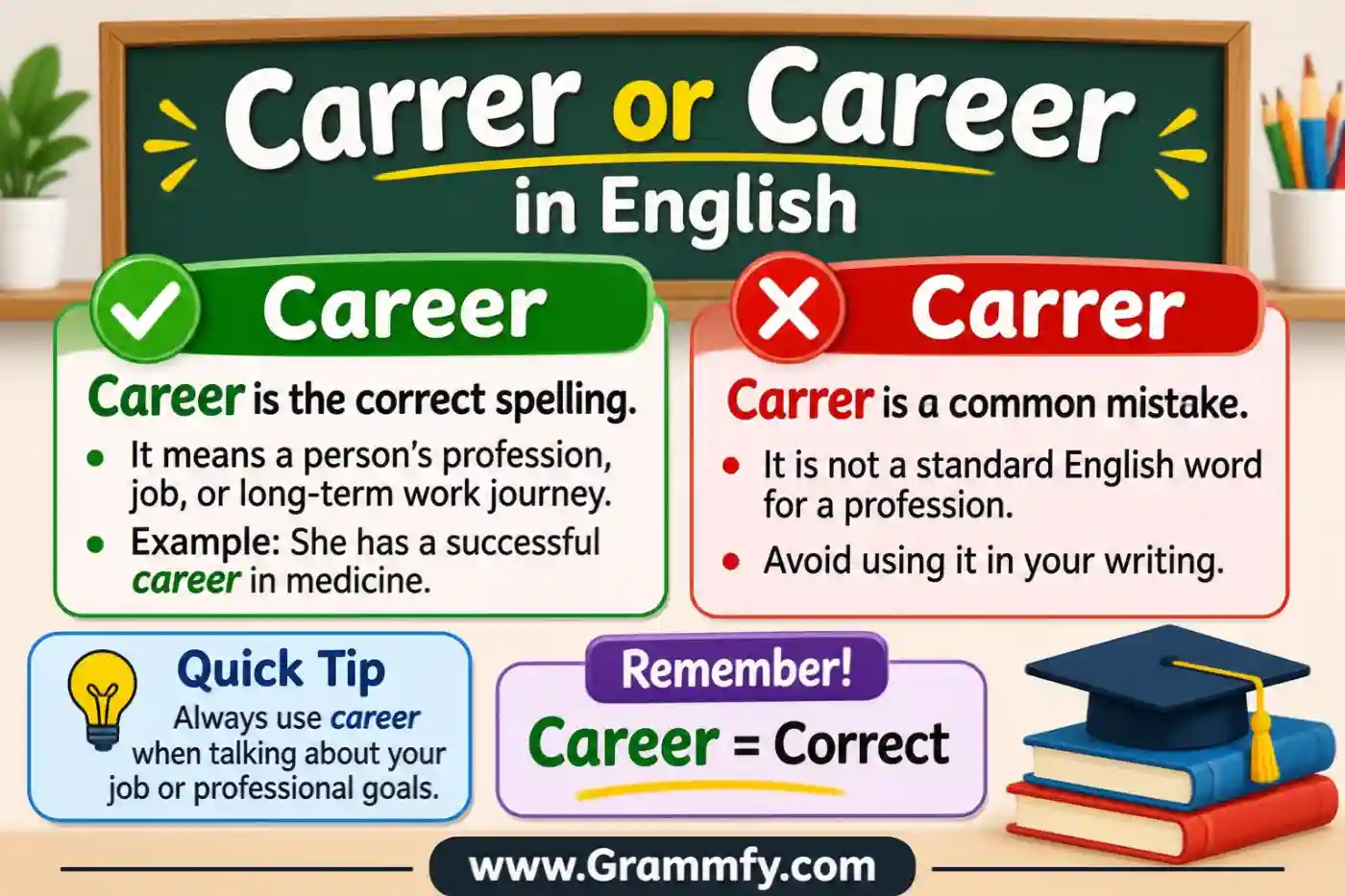
Carrer is a misspelling of career in standard English. Career is the correct word for a person’s profession, occupation, or long-term working life.
The good news is that remembering the correct spelling is simple once you understand its meaning, origin, and common uses. This guide explains the difference between Carrer or Career, explores useful synonyms, provides real-life examples, and shares practical tips to help you avoid this spelling mistake.
If you’re unsure about this commonly confused spelling, check out why contractor is correct and contracter is not to avoid making the same mistake.
Career or Carrer in English
Career is the correct English spelling, while carrer is a common misspelling. The word career refers to a person’s profession, occupation, or long-term work journey. It describes the job or field someone chooses to build their future. For example, teaching, medicine, and engineering can all be career paths. Always use career when discussing professional goals or work experience.
Carrer vs. Career: Correct Spelling
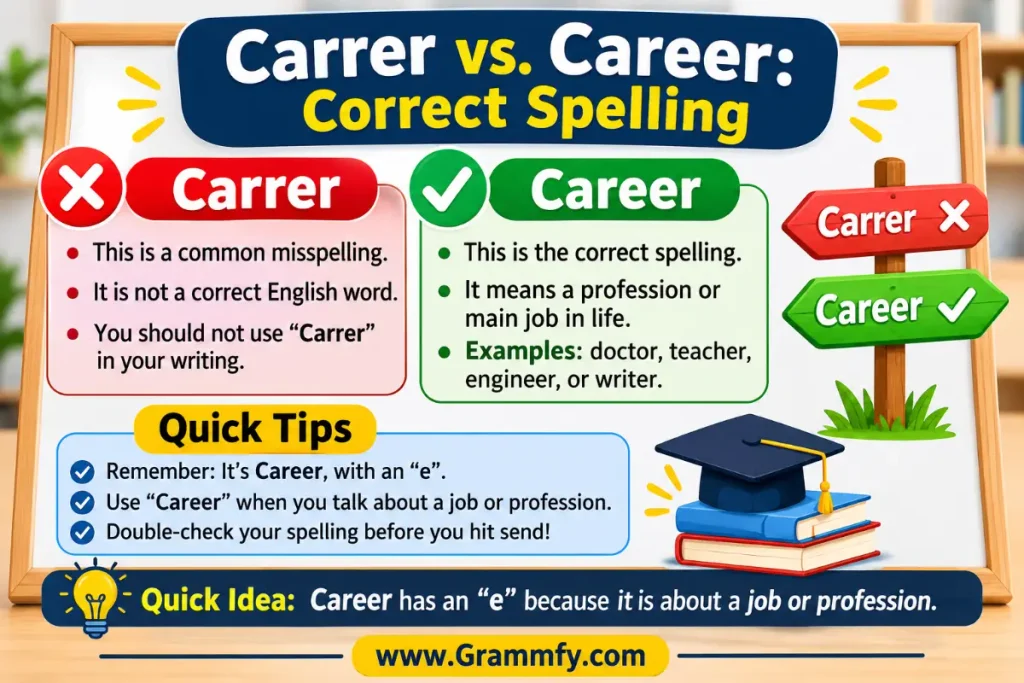
The correct spelling is career, with one R after the A and two Es near the end. The spelling carrer is not accepted as the standard spelling of the word when discussing someone’s job or professional life.
| Spelling | Correct or Incorrect? | Meaning |
|---|---|---|
| Carrer | Incorrect | A common spelling mistake |
| Career | Correct | A person’s profession or working life |
Is Carrer Ever a Correct English Word?
In ordinary modern English, carrer is not a standard alternative spelling of career. You shouldn’t use it in a resume, school assignment, professional email, or business document.
You might occasionally see the spelling in a username, brand name, foreign-language text, or a person’s name. Those special cases don’t make it an accepted English spelling of the profession-related word.
If you’re writing about employment, professional goals, or someone’s working life, choose career.
What Is the Difference Between a Job and a Career?
A job and a career are related, but they don’t have exactly the same meaning.
A job is a particular position that someone performs to earn money. A career is the broader working journey that may include several jobs, promotions, training programs, and professional achievements.
| Feature | Job | Career |
|---|---|---|
| Meaning | A specific paid position | A person’s broader professional journey |
| Duration | May be short or long | Often develops over many years |
| Main focus | Daily work and responsibilities | Long-term professional growth |
| Example | Working as a receptionist | Building a career in business |
| Changes | You may change jobs frequently | Your career may continue across several jobs |
Example: Daniel works as a customer service representative. That’s his current job. However, he hopes to become a manager and eventually lead a customer support department. Those long-term plans are part of his career.
Understanding this difference helps you choose the right word when writing about employment.
The Origin and History of Career
The word career has an interesting history. Its original meaning was connected to roads, tracks, and movement rather than employment.
It entered English during the 16th century through French carrière, which referred to a road or racecourse. The French term can be traced through Old Provençal or Italian forms to Late Latin carraria, meaning a road for wheeled vehicles.
How Did Its Meaning Change?
The meaning developed over several centuries:
| Period | Historical Meaning | Explanation |
|---|---|---|
| Latin roots | Road for vehicles | A route used by carts and wagons |
| French influence | Road or racecourse | A track used for movement or racing |
| 16th-century English | A course or swift movement | Described a run or journey |
| 17th–18th centuries | A general course of action | Extended beyond physical movement |
| 19th century | Professional or working life | Developed its familiar employment-related meaning |
The transition from a physical road to a person’s working journey is especially interesting. Just as a road has a direction and a destination, a professional life can follow a particular path.
Different Forms of Career
Career can appear in different grammatical forms. Knowing these forms helps you write accurate sentences and avoid using the word incorrectly.
| Form | Part of Speech | Meaning | Example |
|---|---|---|---|
| Career | Noun | Profession or working life | Her career is growing. |
| Careers | Plural noun | More than one professional path | They have different careers. |
| Career | Adjective | Related to professional work | He is a career diplomat. |
| Careered | Verb form | Moved rapidly or wildly | The vehicle careered downhill. |
| Careering | Present participle | Moving rapidly or wildly | The car was careering across the road. |
Can Career Be Used as a Noun?
Yes. This is its most common use.
As a noun, it describes someone’s occupation, professional development, or working life.
Examples:
- She started her career in journalism.
- His career lasted more than thirty years.
- They are planning their future careers.
- My brother is considering a career in engineering.
Can Career Be Used as an Adjective?
Yes. Career can also describe something connected with a person’s profession or long-term occupation.
Examples:
- She is a career counselor.
- He became a career politician.
- They attended a career development workshop.
- The organization offers career guidance to students.
In these examples, career describes the type or purpose of another noun.
Can Career Be Used as a Verb?
Yes, although this use is less common in everyday professional writing.
As a verb, to career means to move quickly, often in an uncontrolled or wild way.
Examples:
- The truck careered down the hill.
- A bicycle careered into the fence.
- The vehicle careered across the wet road.
Notice that this meaning has nothing to do with employment.
Synonyms for Career
The best synonym depends on what you want to communicate. Some alternatives describe a person’s profession, while others focus on employment, professional experience, or long-term progress.
For example, occupation is useful when identifying someone’s type of work. Vocation often suggests a strong personal calling, while profession can suggest specialized training.
The following list gives you more than 30 related words and expressions, grouped by tone and everyday use.
What Are the Simple Synonyms for Career?
Simple synonyms are easy to understand and work well in everyday conversations.
| Word | Meaning | Tone | Example |
|---|---|---|---|
| Job | A paid position | Simple | I enjoy my job. |
| Work | Activity done for payment | Everyday | She found work nearby. |
| Profession | A specialized occupation | Neutral | Medicine is his profession. |
| Occupation | A person’s usual work | Neutral | Please state your occupation. |
| Employment | The condition of having a job | Formal | Employment increased this year. |
| Trade | Skilled practical work | Everyday | Plumbing is his trade. |
| Business | Commercial activity or enterprise | Everyday | He started a small business. |
| Calling | Work that feels meaningful | Personal | Teaching is her calling. |
What Are the Everyday Synonyms for Career?
These words are useful when discussing professional choices, working experience, and future plans.
| Word | Meaning | Tone | Example |
|---|---|---|---|
| Working life | The period spent working | Everyday | Her working life was rewarding. |
| Work life | A person’s experience at work | Casual | He wants a better work life. |
| Career path | Direction of professional development | Neutral | Nursing is her chosen career path. |
| Work history | Previous jobs and experience | Neutral | Add your work history to the form. |
| Job history | A record of previous positions | Everyday | His job history is impressive. |
| Professional life | A person’s working activities | Formal | She values her professional life. |
| Work experience | Skills gained through employment | Everyday | I have five years of work experience. |
| Career journey | Progress through working life | Friendly | His career journey began in college. |
What Are the Formal Synonyms for Career?
Formal alternatives are useful in academic writing, business reports, resumes, and professional communication.
| Word | Meaning | Tone | Example |
|---|---|---|---|
| Vocation | Work viewed as a personal calling | Formal | Her vocation is helping children. |
| Livelihood | Work that provides income | Formal | Farming provides their livelihood. |
| Profession | An occupation requiring knowledge or training | Formal | Law is a demanding profession. |
| Pursuit | An activity someone works toward | Formal | Research became his main pursuit. |
| occupational trajectory | Direction of professional development | Academic | Her occupational trajectory is impressive. |
| Occupational path | A person’s employment direction | Formal | His occupational path changed. |
| Practice | Professional work in a specialized field | Formal | She opened a medical practice. |
| Specialization | A focused area of professional expertise | Formal | His specialization is finance. |
| Calling | Work connected with purpose | Formal | She considers education her calling. |
What Are the Informal or Slang Alternatives for Career?
These expressions can make casual conversations sound more natural. However, they’re not all direct synonyms.
| Word or Phrase | Meaning | Tone | Example |
|---|---|---|---|
| Gig | A temporary or freelance job | Slang | I found a writing gig. |
| Hustle | Work done to earn money | Casual | Her side hustle is growing. |
| Grind | Regular hard work | Slang | He’s focused on the daily grind. |
| Day job | Main regular employment | Casual | I write articles outside my day job. |
| Side gig | Additional paid work | Informal | Photography is his side gig. |
| Line of work | A particular type of employment | Everyday | What line of work are you in? |
| Nine-to-five | Regular office employment | Casual | She left her nine-to-five job. |
| Freelance work | Independent paid assignments | Everyday | He prefers freelance work. |
Important: These alternatives don’t always mean exactly the same thing as career. A gig may last only one day, while a career can cover someone’s entire professional life. Choose an expression that matches your intended meaning.
Career or Carrer: 5 Related Word Pairs
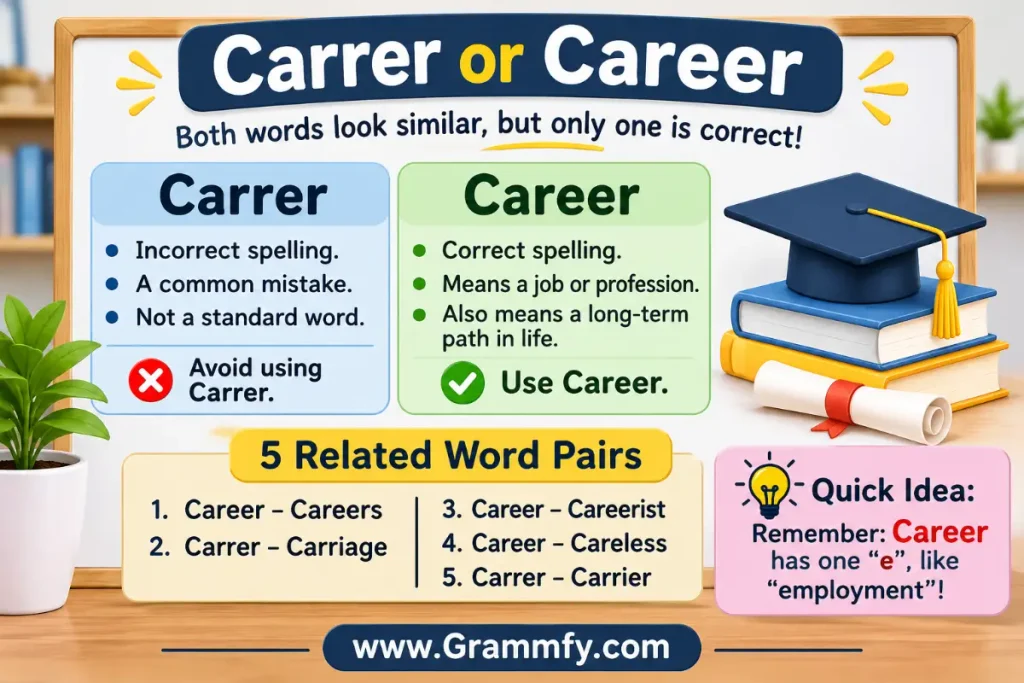
- Career – Profession
- Career – Occupation
- Career – Job
- Career – Vocation
- Career – Employment
Which Word Should You Use in Texting?
Text messages usually sound more natural when you use familiar language. You don’t need complicated vocabulary to discuss someone’s working life.
Useful alternatives include:
- Job
- Work
- Gig
- Day job
- Line of work
- Side hustle
Examples:
- How’s your new job going?
- Are you still looking for work?
- I heard you started a photography gig.
- What line of work are you in now?
Best choice: Job is usually the simplest and most natural alternative.
Which Word Should You Use in a Professional Email?
Professional emails should be polite, direct, and easy to understand. Choose a word that clearly communicates the purpose of your message.
Useful expressions include:
- Professional background
- Career development
- Employment opportunity
- Professional experience
- Career goals
- Job position
Examples:
- I am writing to discuss my professional background.
- I’m interested in learning about future employment opportunities.
- Could you please share information about the available position?
- I would appreciate your guidance regarding my professional development.
Best choice: Professional background works well when introducing your experience, while employment opportunity is useful when discussing a vacancy.
Which Word Should You Use in Everyday Speaking?
Everyday conversations don’t require formal vocabulary. Use familiar expressions that your listener can understand immediately.
Examples:
- What do you do for work?
- She’s starting a new job next month.
- My brother works in healthcare.
- I’m thinking about changing professions.
- He has worked in construction for years.
Best choice: Work or job is usually enough for ordinary conversations.
12+ Original Example Sentences Using Career
Reading examples is one of the easiest ways to understand how a word works in different situations. The following sentences show how to use the correct spelling in professional, academic, personal, and everyday contexts.
Examples About Education and Future Plans
1. After finishing high school, Maria decided to pursue a career in nursing.
2. During his final year at university, James began thinking seriously about his future career.
3. Her teachers encouraged her to explore a career in scientific research.
4. Although he studied accounting, he eventually chose a career in digital marketing.
Examples About Professional Growth
5. After ten years of experience, Sarah moved into a senior position in her career.
6. Regular training helped him develop the skills needed for career advancement.
7. The company offers mentoring programs to support employees’ career development.
8. She changed industries twice before finding a career that suited her interests.
Examples About Personal and Family Life
9. My father spent most of his career working in public education.
10. Balancing family responsibilities and work can be challenging at different stages of a career.
11. He decided to take a break from his career to travel and spend time with his family.
12. Her successful career shows what patience, preparation, and consistent effort can achieve.
Examples About Business and Employment
13. The organization provides career guidance to students preparing for their first jobs.
14. A strong resume can help applicants present their professional experience clearly.
15. The new position offers excellent career opportunities for recent graduates.
16. Before accepting the offer, Daniel considered the long-term benefits of the position.
Examples About Career Changes
17. After working in banking for years, Olivia decided to begin a career in education.
18. He returned to college to prepare for a career change.
19. Learning new technical skills helped her move into the technology industry.
20. Changing professions doesn’t mean starting from zero; previous experience can still be valuable.
These examples demonstrate that career can describe a person’s profession, working history, ambitions, and development. It also appears naturally in common expressions such as career goals, career opportunities, and career changes.
Career vs. Profession: the Difference
Career and profession are closely related, but they don’t always communicate the same idea.
A career describes the broader journey of someone’s working life. A profession refers to a particular type of specialized occupation.
| Career | Profession |
|---|---|
| Covers a person’s working journey | Identifies a type of occupation |
| Can include several different jobs | Usually refers to a specific field |
| Focuses on development and progress | Focuses on the nature of the work |
| May change over time | May remain the same across several positions |
Compare these examples:
- She has built a successful career in healthcare.
- Nursing is her profession.
The first sentence describes her professional journey. The second identifies her occupation.
Which should you choose? Use career when discussing someone’s broader working life. Choose profession when naming the specialized field in which they work.
Career vs. Occupation: Which Word Is Better?
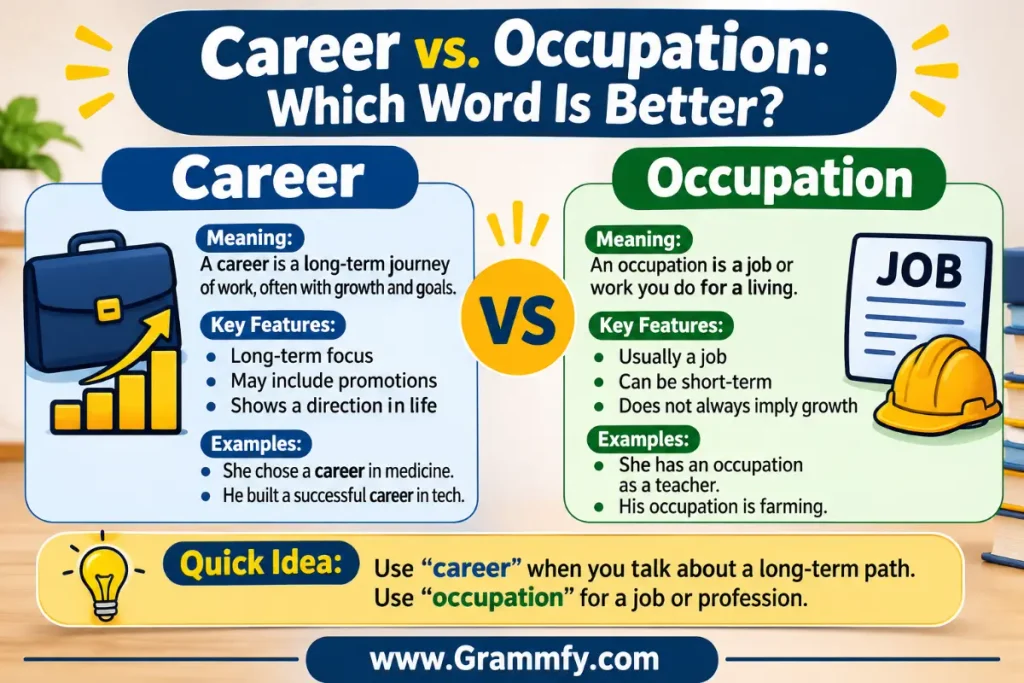
Occupation and career can sometimes replace each other, but their meanings are slightly different.
An occupation identifies what someone does for work. A career usually describes a longer professional journey.
| Career | Occupation |
|---|---|
| Emphasizes long-term working life | Identifies someone’s type of work |
| Often includes professional growth | Doesn’t necessarily suggest advancement |
| Can include several occupations | Usually describes one type of work |
| Common in discussions about goals | Common in forms and official records |
Examples:
- Her career in medicine began after graduation.
- His occupation is listed as an electrician.
In the first example, the focus is on professional development. In the second, the sentence simply identifies someone’s work.
Quick tip: When someone asks, “What is your occupation?” they want to know what type of work you do. When someone asks about your career, they may be interested in your broader professional journey.
Career vs. Job: When Should You Use Each Word?
People often use job and career as if they mean the same thing. However, the distinction becomes important when discussing professional plans.
A job is a specific position. A career can include many positions over time.
Consider these situations:
- You work as a cashier at a supermarket. That’s your job.
- You plan to become a retail manager and eventually manage several stores. That’s part of your career plan.
- You accept another position at a different company. That’s a job change.
- You move from retail into business management. That may represent a career change.
Both words are useful, but they focus on different aspects of employment.
The Common Mistakes When Using Career
Even after learning the correct spelling, writers sometimes make mistakes when using the word in sentences.
Here are some common problems and their corrections.
1. Writing Carrer Instead of Career
This is the main spelling error discussed in this guide.
- Incorrect: He wants a carrer in engineering.
- Correct: He wants a career in engineering.
Why it happens: The two forms look similar, so writers sometimes leave out an E.
2. Using Career When You Mean One Specific Job
Career and job are related, but they aren’t always interchangeable.
- Less accurate: I applied for a career at the company.
- Better: I applied for a job at the company.
A job application is for a particular position, not an entire professional journey.
3. Confusing Career With Profession
A profession is a specific occupation, while a career describes a broader working path.
- Less precise: My career is medicine.
- Better: Medicine is my profession, and my career began at a local hospital.
The second sentence clearly distinguishes the field from the person’s working journey.
4. Using Too Many Formal Synonyms
A common writing problem is choosing complicated words when simple ones would communicate the message more clearly.
For example:
- Overly complicated: He initiated an occupational trajectory in education.
- Natural: He started a career in education.
Simple language is often more effective, especially in emails, resumes, and everyday writing.
5. Treating Every Job as a Long-Term Career
Not every paid activity represents a long-term professional path.
A temporary assignment, summer position, or one-time freelance project may simply be a job or gig.
For example:
- I accepted a summer job at a bookstore.
- She is building a career in publishing.
The first describes temporary employment. The second suggests a broader professional direction.
6. Confusing Career With Career Path
These expressions are related, but they have slightly different purposes.
- Career: The broader working life of a person.
- Career path: The direction or sequence of roles someone follows.
Example:
She has enjoyed a successful career, and her career path has included teaching, management, and educational consulting.
When Should You NOT Use Career?
Although career is a useful word, it doesn’t fit every employment-related situation.
Avoid using it in these cases:
- For a single vacancy: Use job or position instead.
- For a temporary assignment: Use temporary job or contract work.
- For unpaid household responsibilities: Work or responsibilities may be more accurate, depending on the sentence.
- For a particular professional qualification: Use qualification, certificate, or credential.
- For a person’s daily duties: Use responsibilities or tasks.
- For a company opening: Use business, company, or enterprise.
The goal is not to replace every employment-related word with career. It’s to select the expression that communicates your meaning accurately.
Antonyms of Career
Career doesn’t have one exact opposite because it describes a broad professional journey rather than a single quality.
However, some words can express contrasting ideas in particular contexts.
| Opposite or Contrast | Meaning | Example |
|---|---|---|
| Unemployment | Being without paid work | Unemployment affected his plans. |
| Joblessness | The condition of having no job | Joblessness increased in the region. |
| Idleness | A lack of activity or work | He struggled with long periods of idleness. |
| Retirement | Leaving employment permanently | She enjoyed retirement after a long working life. |
| Inactivity | A lack of action or progress | Professional inactivity slowed his development. |
| Career stagnation | A lack of professional progress | Career stagnation made him consider a change. |
Remember that these aren’t exact dictionary antonyms. They’re contrasting terms that work in specific situations.
For example, retirement isn’t necessarily the opposite of a successful career. It can simply mark the end of someone’s working years.
Is Career Spelled Differently in American and British English?
No. Career has the same spelling in standard American and British English.
However, pronunciation differs slightly between the two varieties.
| Feature | American English | British English |
|---|---|---|
| Spelling | Career | Career |
| General pronunciation | /kəˈrɪr/ | /kəˈrɪə/ |
| Meaning | Professional or working life | Professional or working life |
| Plural | Careers | Careers |
| Adjective | Career | Career |
How Do Americans Use Career?
In American English, career is commonly used in education, business, job applications, and discussions about professional growth.
Common expressions include:
- Career goals
- Career opportunities
- Career development
- Career change
- Career counseling
- Career advancement
Examples:
- She’s exploring career opportunities in technology.
- The university offers career counseling to students.
- He wants to advance his career in finance.
How Do British Speakers Use Career?
British English uses the same spelling and similar expressions.
Examples:
- She’s considering a career in teaching.
- He received career advice from his university.
- The company offers career development programs.
Some surrounding vocabulary may differ between regions. For example, American speakers commonly use resume, while British speakers often use CV for a document listing professional experience and qualifications.
However, these regional differences don’t change the spelling of career.
About Other English-Speaking Countries
Countries such as Canada, Australia, and New Zealand also use career in standard English.
The spelling remains the same. Differences may appear in pronunciation, workplace terminology, or related expressions.
For international readers, the safest approach is to use career regardless of the English variety you’re writing in.
What Are the Best Tips for Remembering the Correct Spelling?
If you regularly confuse these two spellings, a few simple techniques can help you remember the correct form.
1. Remember the Double-E Pattern
The easiest trick is to remember that career contains two Es together.
Break the spelling into smaller parts:
C-A-R-E-E-R
Say each letter slowly as you write it. Paying attention to the two Es can prevent the common mistake.
2. Connect Career With Professional Growth
Think of a career as a road that continues through your working life.
You may start with one position, learn new skills, and eventually move into another role.
This mental picture connects the word’s historical meaning with its modern use.
3. Use a Memory Sentence
Create a short sentence that includes the correct spelling.
For example:
- My career needs careful planning.
- Every career has its own challenges.
- Education can improve your career opportunities.
Writing the same correct form in meaningful sentences helps reinforce its spelling.
4. Practice With Related Expressions
Learn common combinations rather than memorizing the word alone.
| Expression | Example |
|---|---|
| Career goals | My career goals are clear. |
| Career change | She is planning a career change. |
| Career path | He chose a career path in science. |
| Career growth | Training supports career growth. |
| Career advice | I need some career advice. |
| Career opportunities | The company offers career opportunities. |
| Career development | Career development requires effort. |
| Career success | Hard work can support career success. |
These combinations also help you write more naturally.
5. Check Your Resume Before Sending It
A spelling error in a resume or cover letter can affect the impression you make on an employer.
Before submitting an application:
- Check the spelling of career.
- Review your professional summary.
- Read your work experience section carefully.
- Check headings and subheadings.
- Use a spellchecker as an extra step.
- Read the document once more before sending it.
A spellchecker is helpful, but a final human review is still important.
6. Practice With a Short Spelling Test
Test yourself with the following sentences. Choose the correct spelling for each blank.
Spelling practice
0/5 answered
1. She wants to build a successful ___ in medicine.carrercareer
2. My brother is planning a ___ change.careercarrer
3. The university offers ___ guidance to students.carrercareer
4. He has had a long ___ in engineering.careercarrer
5. She is interested in new ___ opportunities.carrercareer
Check my answers
Practicing with short sentences is an effective way to strengthen your spelling habits.
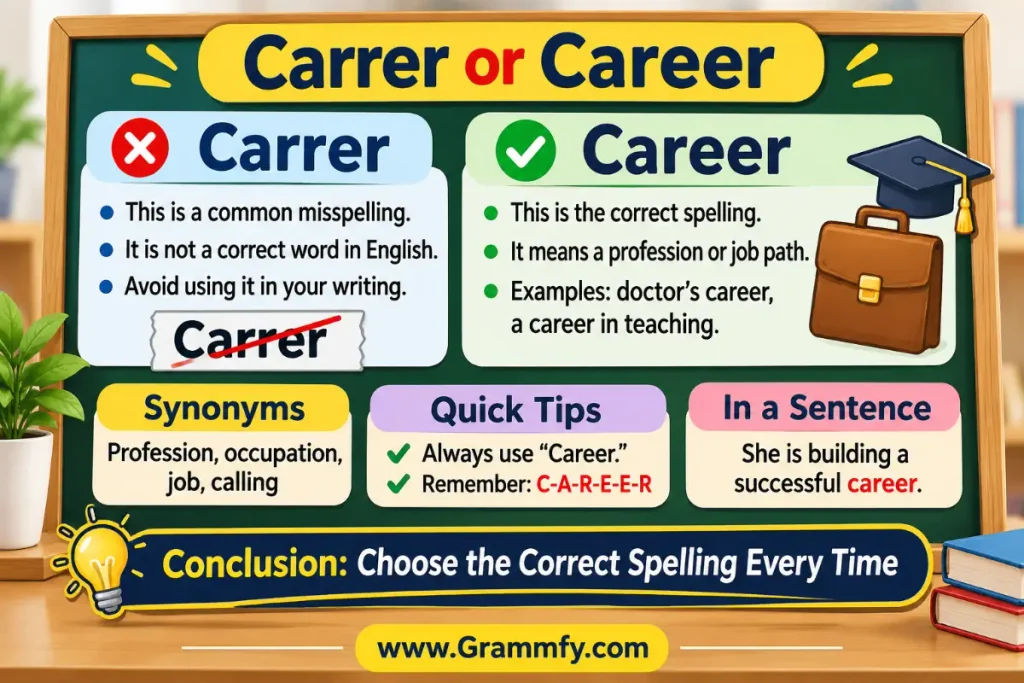
Conclusion: Choose the Correct Spelling Every Time
Choosing the right spelling makes your writing clearer and more professional. Although Carrer or Career may look like two possible forms, only career is the standard spelling when discussing someone’s profession, occupation, or working life. The incorrect version often appears because writers forget the second E.
Remember that a career can include different jobs, professional achievements, skills, and long-term goals. Words such as profession, occupation, and vocation can sometimes replace it, but each has its own meaning and purpose.
A simple spelling trick is to remember the two Es in career. Practice using the word in everyday sentences, check your writing before submitting important documents, and keep improving your English vocabulary. Small spelling habits can make a real difference in confident communication.
Frequently Asked Questions
Is Carrer or Career the Correct Spelling?
Career is the correct spelling when referring to someone’s profession or working life. Carrer is a common spelling mistake and should not be used in standard English writing.
Why Do People Spell Career as Carrer?
People often make this mistake because the two spellings look and sound similar. Forgetting the second E is the main reason for this error.
What’s Another Word for Career?
Profession, occupation, vocation, employment, and working life are common alternatives. The best choice depends on the sentence and the type of work you’re describing.
Is Career a Noun or an Adjective?
Career can function as both a noun and an adjective. As a noun, it describes someone’s professional life. As an adjective, it describes something related to employment, such as career advice or career opportunities.
What Is the Plural of Career?
The plural form is careers. For example, “The students are exploring different careers before choosing their university subjects.”
Is Career the Same in American and British English?
Yes. Both American and British English use the spelling career. The pronunciation differs slightly, but the meaning and spelling remain the same.
How Can I Remember How to Spell Career?
Remember that career contains two Es together. You can also connect the word with professional growth and common expressions such as career goals, career path, and career development.

Tylerbrooks is a US-based English grammar writer and contributor at Grammfy. He writes helpful articles about grammar, spelling, commonly confused words, and vocabulary. His goal is to explain English topics in simple language with clear examples and practical tips. Through his articles, he helps readers improve their writing and everyday English skills.