
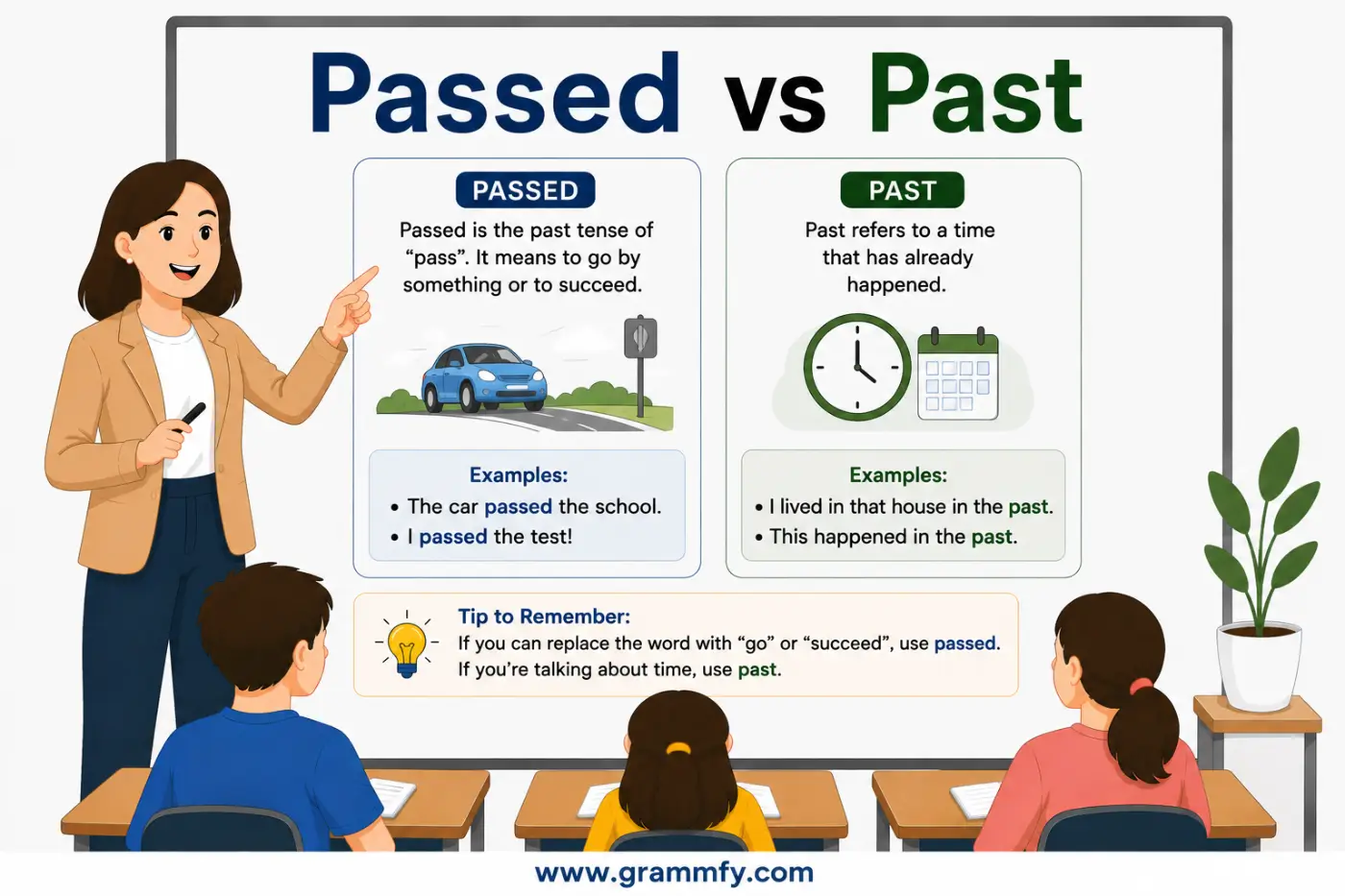
Have you ever finished writing an email, essay, or text message and stopped because you weren’t sure whether to use passed or past? You’re not alone. The confusion between passed vs past is one of the most common grammar mistakes in English because the words sound the same but have different meanings and grammar rules.
Whether you’re writing for school, work, or everyday conversations, knowing the difference helps you communicate clearly. A single wrong word can change the meaning of your sentence or make your writing look less polished.
Quick Answer
Passed is the past tense of the verb pass, while past is usually a noun, adjective, adverb, or preposition that refers to time or position.
By the end of this guide, you’ll understand passed vs past, learn easy memory tricks, explore dozens of examples, discover their origins, and know exactly which word to choose in every situation.
You may also want to learn the difference between [personal vs personnel].
What Is the Difference Between “Passed vs Past”?
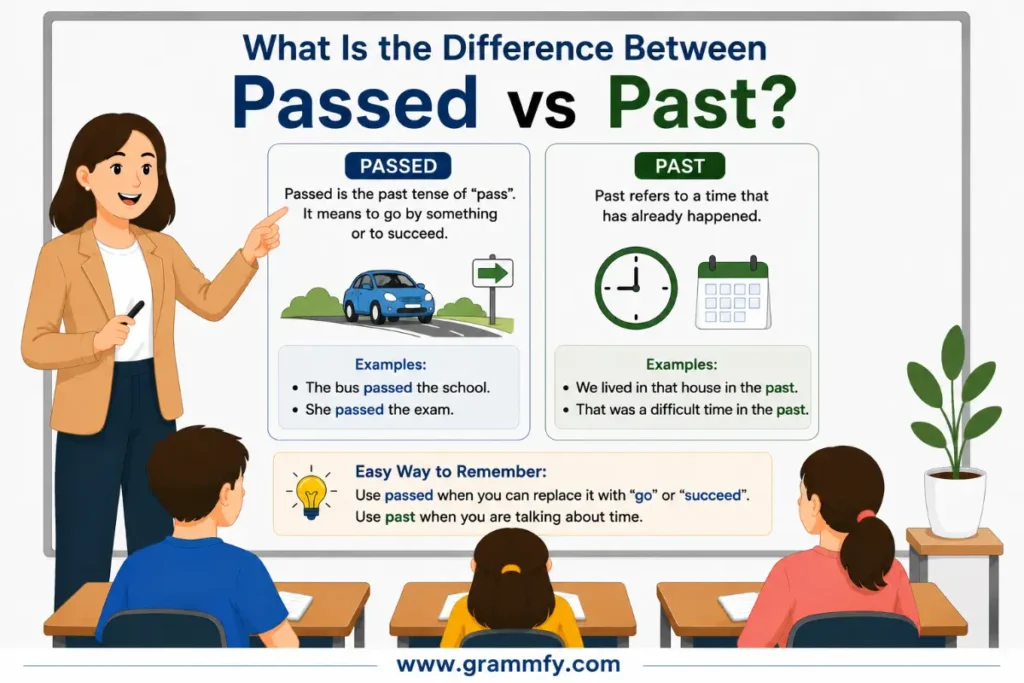
Understanding passed vs past starts with one simple rule.
| Word | Part of Speech | Meaning | Example |
|---|---|---|---|
| Passed | Verb | Moved by, succeeded, completed, or handed over | She passed the test. |
| Past | Noun, adjective, adverb, or preposition | Earlier time or beyond a place | We walked past the school. |
Here are a few examples.
- He passed the driving test.
- We walked past the library.
- Time has passed quickly.
- Let’s forget the past.
An easy trick is this:
If the word shows an action, use passed.
If the word talks about time or location, use past.
Why Is “Passed vs Past” So Confusing?
Many English learners confuse these words because they are homophones. That means they sound exactly the same but have different meanings and spellings.
People also confuse them because:
- Both relate to movement or time.
- Both appear in everyday writing.
- Their pronunciation is identical.
- Spellcheck doesn’t always catch the mistake.
Once you know the grammar behind each word, choosing the correct one becomes much easier.
“Passed vs Past” Meaning Explained
Let’s break down each word in simple English.
What Does Passed Mean?
Passed is the past tense and past participle of the verb pass.
It always describes an action that already happened.
Examples include:
- passed the exam
- passed the ball
- passed the car
- passed away
- passed the salt
- passed a law
- passed inspection
- passed the finish line
Example sentences:
- Sarah passed her science test.
- The train passed our station.
- He passed me on the highway.
- Grandma passed away peacefully.
- The teacher passed the papers around.
Notice that every sentence includes an action.
What Does Past Mean?
Past usually refers to time before now or a position beyond something.
It can be several parts of speech.
Examples include:
- the past
- past midnight
- past experience
- walk past
- years past
- past events
Example sentences:
- We drove past the park.
- Forget about the past.
- It’s past bedtime.
- The movie is now in the past.
- She walked past my office.
Unlike passed, past does not describe an action performed by someone.
Where Do “Passed vs Past” Come From?
Learning the history of these words makes them easier to remember.
Origin of Passed
The word passed comes from the Old French word passer, meaning “to move” or “to go.”
English borrowed the verb centuries ago, and today it has many meanings, including:
- move beyond
- succeed
- complete
- transfer
- spend time
- approve
Whenever someone performs one of these actions, passed is usually the correct word.
Origin of Past
The word past comes from Old English and originally meant “gone by.”
Its meaning gradually expanded to include:
- earlier time
- previous events
- beyond a place
- finished period
Today, it still carries those same ideas.
How Do You Pronounce “Passed vs Past”?
Both words are pronounced exactly the same.
passed → /past/
past → /past/
Because they sound identical, context is the only way to know which spelling is correct.
How Can You Remember “Passed vs Past”?
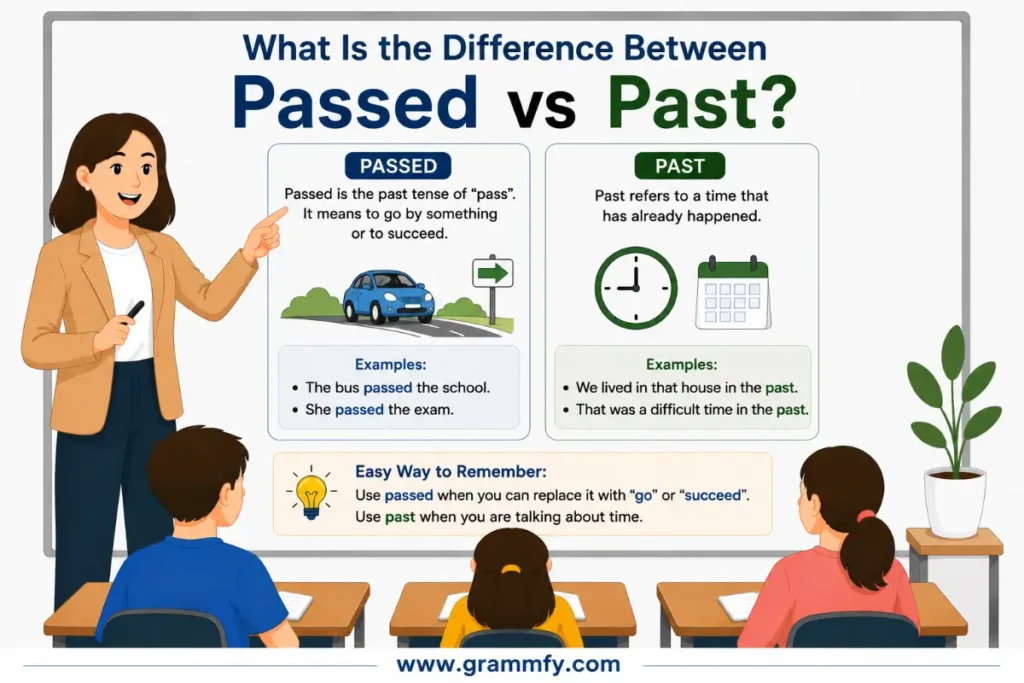
Here’s a simple memory trick.
Remember the Double “S”
The word passed has two S letters.
Think of the extra S as standing for something happened.
Actions happen.
Verbs show actions.
So if someone did something, choose passed.
Examples:
- passed the ball
- passed the exam
- passed the house
Remember Time and Place
The word past has one S.
Think of it as describing time or place.
Examples:
- past midnight
- past history
- past mistakes
- walked past the bank
This simple trick works in most situations.
“Passed vs Past” in Everyday English
You’ll see these words almost every day.
Here are common expressions.
Common Uses of Passed
- passed away
- passed the exam
- passed inspection
- passed the ball
- passed a bill
- passed the driving test
- passed the finish line
- passed the message
- passed the interview
- passed the checkpoint
Common Uses of Past
- past experience
- past mistakes
- past midnight
- past year
- past events
- walk past
- drive past
- look past
- move past
- in the past
Learning these common phrases makes writing much easier.
Master Synonym List for Passed
Simple Synonyms
| Word | Meaning | Tone | Example |
|---|---|---|---|
| moved | went by | Simple | The car moved ahead. |
| went | traveled | Simple | He went home. |
| crossed | went across | Simple | She crossed the road. |
| cleared | succeeded | Simple | He cleared the exam. |
| finished | completed | Simple | They finished the race. |
| gave | handed over | Simple | She gave me the book. |
Everyday Synonyms
| Word | Meaning | Tone | Example |
|---|---|---|---|
| succeeded | achieved | Everyday | He succeeded in school. |
| completed | finished | Everyday | She completed the project. |
| delivered | handed over | Everyday | He delivered the package. |
| transferred | moved | Everyday | Money was transferred. |
| approved | accepted | Everyday | The proposal was approved. |
| advanced | moved forward | Everyday | The team advanced. |
Formal Synonyms
| Word | Meaning | Tone | Example |
|---|---|---|---|
| proceeded | continued | Formal | The meeting proceeded. |
| progressed | moved ahead | Formal | Work progressed quickly. |
| conveyed | delivered | Formal | Information was conveyed. |
| transmitted | sent | Formal | Data was transmitted. |
| authorized | officially approved | Formal | The request was authorized. |
| validated | confirmed | Formal | Results were validated. |
Informal Alternatives
| Word | Meaning | Tone | Example |
|---|---|---|---|
| got through | succeeded | Casual | I got through the exam. |
| made it | succeeded | Casual | She made it. |
| went by | moved past | Casual | Time went by fast. |
| got past | moved beyond | Casual | We got past traffic. |
Master Synonym List for Past
Simple Synonyms
| Word | Meaning | Tone | Example |
|---|---|---|---|
| earlier | before now | Simple | earlier years |
| previous | before | Simple | previous week |
| former | earlier | Simple | former student |
| old | from before | Simple | old memories |
| before | earlier | Simple | before lunch |
| beyond | farther than | Simple | beyond the gate |
Everyday Synonyms
| Word | Meaning | Tone | Example |
|---|---|---|---|
| gone by | earlier | Everyday | days gone by |
| last | previous | Everyday | last month |
| earlier | previous | Everyday | earlier meeting |
| yesterday | recent past | Everyday | yesterday afternoon |
| behind | beyond | Everyday | behind the store |
| afterward | later than | Everyday | afterward we left |
Formal Synonyms
| Word | Meaning | Tone | Example |
|---|---|---|---|
| preceding | before | Formal | preceding chapter |
| prior | earlier | Formal | prior approval |
| historical | from history | Formal | historical records |
| former | previous | Formal | former employee |
| bygone | long ago | Formal | bygone era |
| antecedent | earlier | Formal | antecedent events |
“Passed vs Past” by Intensity
Passed Synonyms by Strength
| Level | Synonyms |
|---|---|
| Mild | moved, went |
| Medium | passed, crossed, completed, delivered |
| Strong | proceeded, transmitted, validated, authorized |
Past Synonyms by Strength
| Level | Synonyms |
|---|---|
| Mild | before, earlier |
| Medium | past, previous, former |
| Strong | historical, bygone, antecedent |
What Part of Speech Are “Passed vs Past”?
Understanding grammar makes passed vs past much easier.
| Word | Part of Speech | Example |
|---|---|---|
| Passed | Verb | She passed the exam. |
| Past | Noun | Learn from the past. |
| Past | Adjective | past experiences |
| Past | Adverb | Time flew past. |
| Past | Preposition | Walk past the door. |
The biggest clue is this:
If the word is doing something, it’s probably passed.
If it tells you when or where, it’s usually past.
Is There a Difference Between “Passed vs Past” in US and UK English?
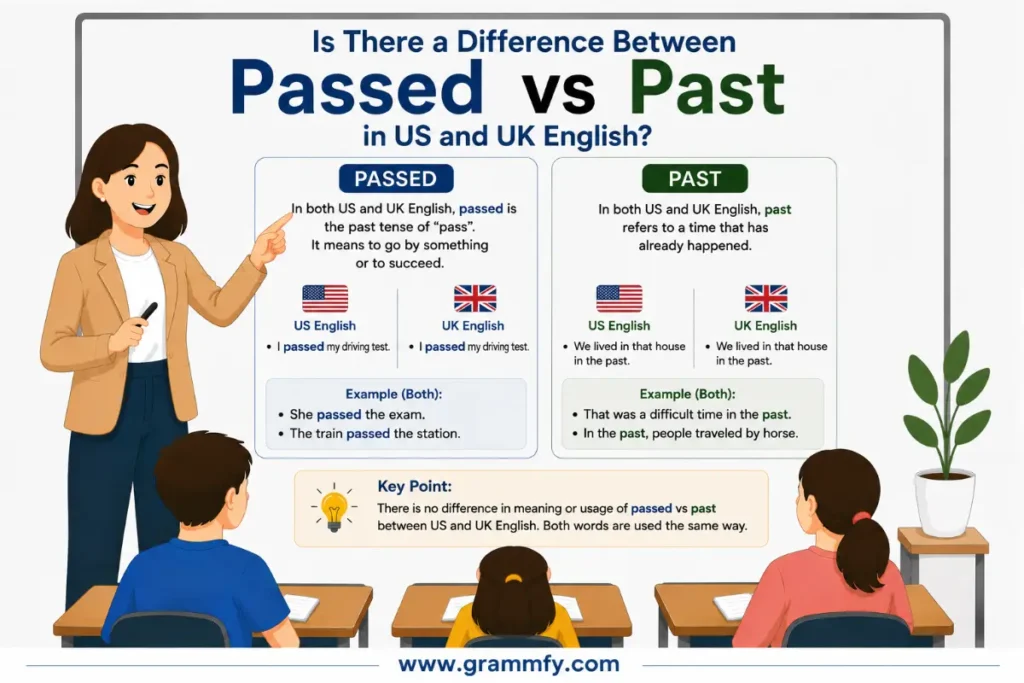
The meaning of passed vs past is the same in American English and British English. Both varieties follow the same grammar rules.
The only differences you may notice are in spelling or vocabulary around the sentence, not in the words passed and past themselves.
Examples:
- US: She passed the driver’s test.
- UK: She passed the driving test.
Both are correct.
Which Word Should You Use on a Resume?
Choosing the correct word on your resume helps you look professional.
Use Passed for Achievements
Use passed when talking about exams, certifications, training, or qualifications you completed successfully.
Examples:
- Passed the CPA examination.
- Passed first-aid certification.
- Passed company safety training.
- Passed all onboarding assessments.
Example sentence:
I passed the AWS certification exam on my first attempt.
Use Past for Previous Experience
Use past when talking about earlier jobs, responsibilities, or achievements.
Examples:
- Past employment
- Past experience
- Past projects
- Past achievements
- Past leadership roles
Example sentence:
My past experience includes five years in customer service.
Which Word Should You Use in an Essay “Passed vs Past”?
School essays often use both words.
Use passed when describing actions.
Examples:
- The student passed the exam.
- The law passed last year.
- Time passed quickly.
Use past when discussing history or earlier events.
Examples:
- The past teaches valuable lessons.
- Past civilizations built impressive cities.
- Past mistakes can become learning opportunities.
Which Word Should You Use in Text Messages “Passed vs Past”?
Text messages usually contain short, everyday sentences.
Examples using passed
- I finally passed my driving test!
- She passed me on the highway.
- We passed your house.
Examples using past
- I’m already past your street.
- Let’s leave the past behind.
- It’s past midnight.
Which Word Should You Use in Emails “Passed vs Past”?
Business emails often include these words.
Use Passed
- I passed the certification.
- The proposal passed committee review.
- Your package passed customs.
Use Past
- Based on our past conversations…
- During the past month…
- Looking past today’s issue…
Which Word Sounds Best in Everyday Conversation “Passed vs Past”?
Ask yourself one simple question.
Is someone doing an action?
If yes, choose passed.
Are you talking about time or position?
If yes, choose past.
This simple habit will help you choose the correct word almost every time.
More Than 15 Real-Life Example Sentences
Examples Using Passed
- Emma passed her English exam.
- The train passed our station.
- He passed the basketball to his teammate.
- Time passed more quickly than we expected.
- The teacher passed out the worksheets.
- Our proposal passed without changes.
- She passed the interview.
- We passed several restaurants on our trip.
- My grandfather passed away peacefully.
- The runners passed the finish line.
Examples Using Past
- We walked past the museum.
- Don’t let the past control your future.
- It’s already past noon.
- She looked past the crowd.
- His past experience helped him succeed.
- The dog ran past the fence.
- During the past week, sales increased.
- That’s all in the past now.
- We drove past the airport.
- Past events shaped today’s decision.
Passed vs Went By: What’s the Difference?
Many people wonder if passed and went by mean the same thing.
| Passed | Went By |
|---|---|
| Can describe many actions | Mainly describes movement or time |
| Formal and informal | Mostly informal |
| Used in many situations | Limited to specific contexts |
Examples:
- Time passed quickly.
- Time went by quickly.
Both are correct.
However:
- She passed the exam. ✔
- She went by the exam. ✘
Past vs Previous: What’s the Difference?
These words are similar but not identical.
| Past | Previous |
|---|---|
| Can refer to time or place | Refers only to something before another |
| More common in everyday English | More common in formal writing |
Examples:
- My past experience helped me.
- My previous job taught me leadership.
Both are correct, but previous sounds more formal.
Common Mistakes with Passed vs Past
Mistake 1: Using Past Instead of Passed
❌ I past the exam.
✅ I passed the exam.
Mistake 2: Using Passed Instead of Past
❌ We walked passed the library.
✅ We walked past the library.
Mistake 3: Forgetting That Passed Is a Verb
Remember that passed always comes from the verb pass.
Examples:
- passed the ball
- passed the test
- passed inspection
If there’s an action, use passed.
Mistake 4: Confusing Time with Action
Incorrect:
- Time past quickly.
Correct:
- Time passed quickly.
When Should You NOT Use Passed?
Don’t use passed if you’re describing:
- an earlier time
- history
- previous events
- location beyond something
Incorrect:
- the passed year
- passed experience
- passed mistakes
Correct:
- the past year
- past experience
- past mistakes
When Should You NOT Use Past?
Don’t use past as the verb.
Incorrect:
- She past the exam.
- He past the ball.
- They past the checkpoint.
Correct:
- She passed the exam.
- He passed the ball.
- They passed the checkpoint.
Antonyms
Antonyms of Passed
- failed
- stopped
- remained
- stayed
- missed
- rejected
Examples:
- failed the test
- stayed home
- missed the deadline
Antonyms of Past
- future
- upcoming
- coming
- present
- current
- modern
Examples:
- future plans
- present situation
- current events
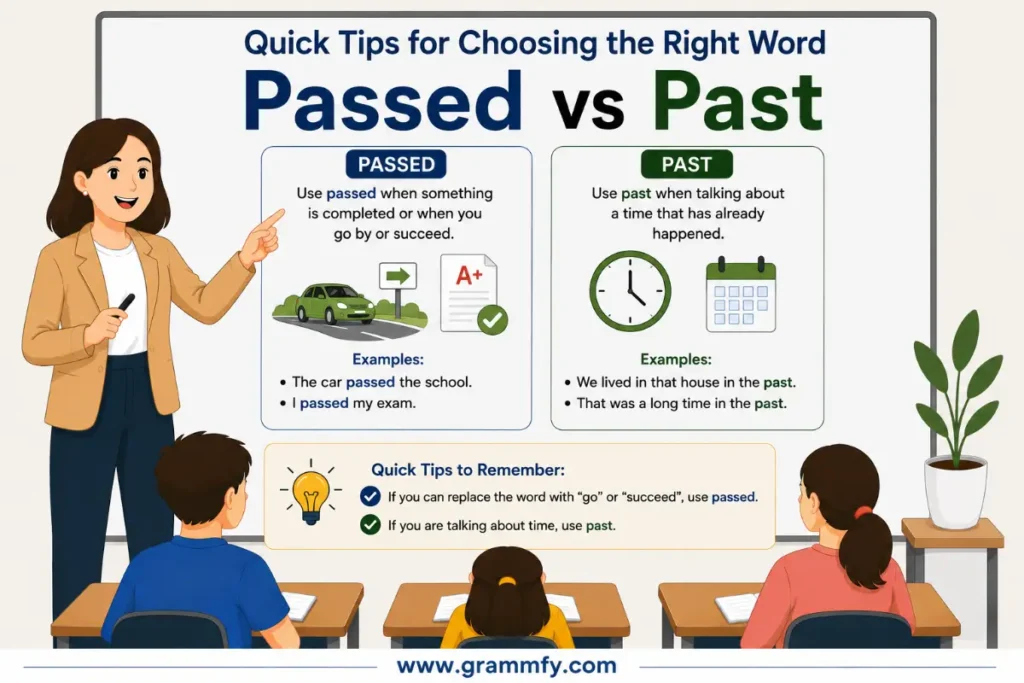
Quick Tips for Choosing the Right Word “Passed vs Past”
Remember these simple rules.
- If someone performs an action, choose passed.
- If you can replace it with went by, passed is often correct.
- If you’re talking about earlier time, choose past.
- If you’re talking about location beyond something, choose past.
- If it’s a verb, use passed.
- If it’s a noun, adjective, adverb, or preposition, use past.
Five-Second Memory Trick
Think of the extra S in passed.
The extra S reminds you that something happened.
No action?
Use past instead.
Conclusion
Understanding passed vs past becomes much easier once you remember one simple rule: passed is a verb that shows an action, while past usually refers to time, direction, or something that happened before now. Even though the two words sound exactly the same, they play different roles in a sentence.
Whenever you’re unsure, ask yourself whether someone is doing something. If the answer is yes, use passed. If you’re talking about an earlier time, a previous event, or moving beyond a place, choose past. With regular practice and the examples in this guide, you’ll quickly master passed vs past and use both words with confidence in emails, essays, conversations, and professional writing.
Frequently Asked Questions
Is it passed or past the store?
Past is correct because it shows location. You walk past the store, not passed the store.
Is it passed the exam or past the exam?
Passed the exam is correct because passed is the verb showing the action of succeeding.
What’s another way to say passed?
Depending on the sentence, alternatives include completed, succeeded, crossed, moved beyond, advanced, and finished.
What’s another way to say past?
Common alternatives include previous, earlier, former, before, prior, and gone by.
How do I remember passed vs past?
The easiest way to remember passed vs past is to check whether you need a verb. If there’s an action, use passed. If you’re talking about time or place, use past.
Can past be a noun?
Yes. Past can be a noun, as in “Learn from the past.”
Why do people confuse passed and past?
They sound exactly alike, making them homophones. That’s why checking the grammar of the sentence is the easiest way to choose the correct spelling.
