
Have you ever paused while writing an email, school essay, work report, or even a quick text because you weren’t sure whether to write weather or whether? You’re not alone. The question of weather vs whether confuses many English learners and native speakers because the two words sound exactly the same but have completely different meanings.
English has many homophones—words that share the same pronunciation but have different spellings and meanings. Since weather and whether are perfect examples, it’s easy to choose the wrong one if you’re typing quickly or relying on spell check.
Quick Answer:
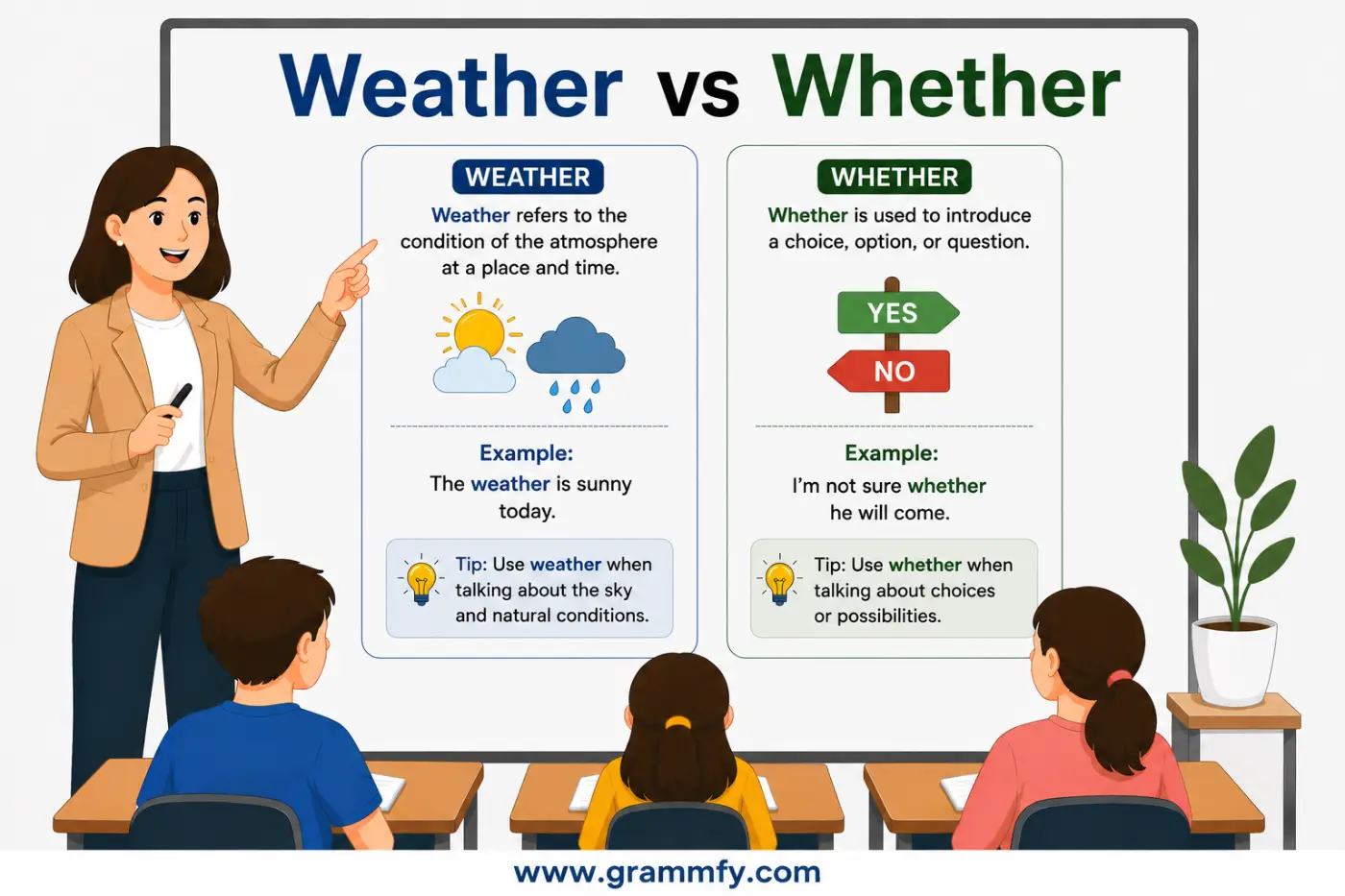
Weather is a noun that refers to atmospheric conditions like rain, sunshine, wind, or snow. Whether is a conjunction used when talking about choices, possibilities, or uncertainty. They sound alike but have different jobs in a sentence.
In this guide, you’ll learn the meaning of each word, where they came from, easy memory tricks, synonyms, real-life examples, common mistakes, and tips for choosing the correct spelling every time.
Another pair that can be easy to confuse is [altar vs alter].
What Does “Weather vs Whether” Mean?
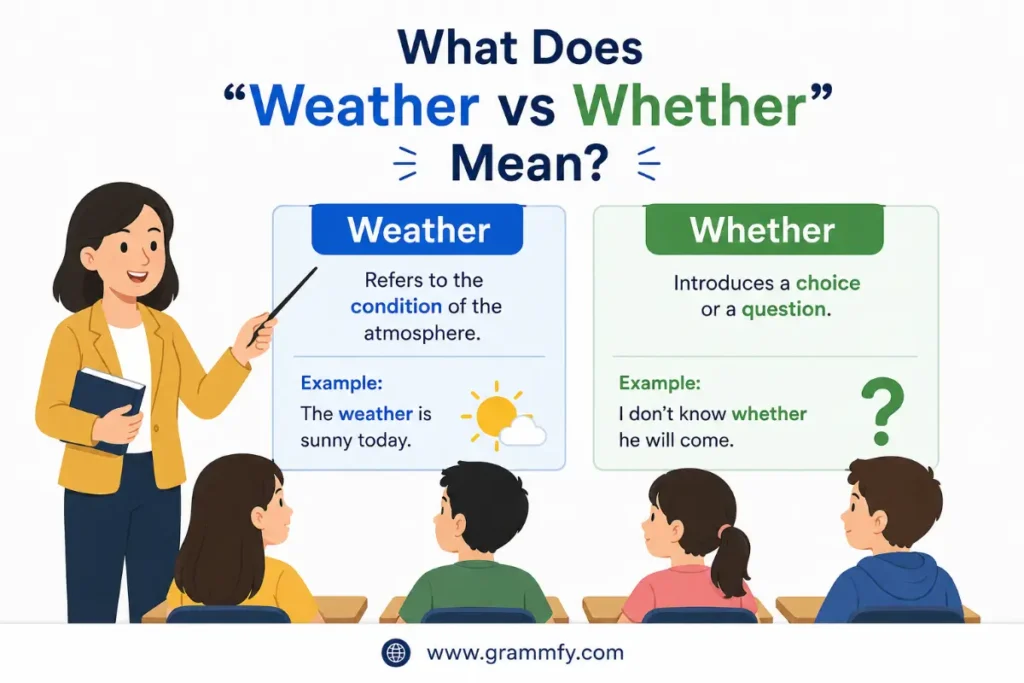
The question weather vs whether is about choosing the correct word based on what you want to say.
Here’s the simplest way to remember the difference.
| Word | Meaning | Easy Memory Trick |
|---|---|---|
| Weather | The condition of the atmosphere | Think of sunny or rainy weather. |
| Whether | Expresses a choice, possibility, or uncertainty | Think of choosing between two options. |
Weather Meaning
Weather refers to the condition of the atmosphere at a particular time and place.
It includes things like:
- sunshine
- rain
- snow
- wind
- clouds
- storms
- temperature
- humidity
Examples:
- The weather is sunny today.
- Bad weather delayed our flight.
- The weather forecast predicts rain tomorrow.
Whether Meaning
Whether is a conjunction used to introduce choices, alternatives, or uncertainty.
You’ll often see it in sentences that include:
- whether…or
- whether to
- whether or not
Examples:
- I don’t know whether she’ll come.
- We haven’t decided whether to travel.
- Tell me whether you agree.
Where Did “Weather or Whether” Come From?
Many grammar guides explain the meanings but skip the history. Understanding the origins makes these words easier to remember.
Origin of Weather
The word weather comes from the Old English word weder, meaning air, sky, storm, or season.
Over hundreds of years, the meaning became more specific and now refers to the atmospheric conditions we experience every day.
Today, we use it in phrases like:
- weather forecast
- severe weather
- cold weather
- warm weather
- weather report
- weather conditions
The idea has always been connected to the atmosphere and nature.
Origin of Whether
The word whether comes from the Old English word hwæther, meaning “which of two” or “which one.”
That original meaning explains why whether is still used when talking about choices or uncertainty.
Examples include:
- whether to stay
- whether it’s true
- whether you agree
- whether or not
- whether he arrives
Unlike weather, this word has nothing to do with rain, snow, or sunshine.
Weather Meaning in Plain English
Think of weather whenever you’re talking about what the sky or atmosphere is doing.
You can picture:
- sunny skies
- rain
- snow
- fog
- storms
- hot temperatures
- cold temperatures
- windy afternoons
Common Expressions with Weather
- weather forecast
- bad weather
- good weather
- severe weather
- weather report
- weather warning
- weather conditions
- weather station
- weather map
- fair weather
- stormy weather
- extreme weather
- weather pattern
- weather alert
Every example relates to the atmosphere or climate conditions.
Whether Meaning in Plain English
Think of whether whenever there’s a choice, decision, or uncertainty.
You can often replace it with the idea of “if” or “which option.”
Common Uses of Whether
Making Choices
- whether to leave
- whether to stay
- whether to buy
Showing Uncertainty
- whether it’s true
- whether she knows
- whether he’ll arrive
Comparing Two Options
- whether now or later
- whether by car or train
- whether online or in person
Formal Writing
- whether the policy changes
- whether the evidence supports the claim
- whether permission is required
The word always connects to alternatives or uncertainty.
Master Synonym List for Weather
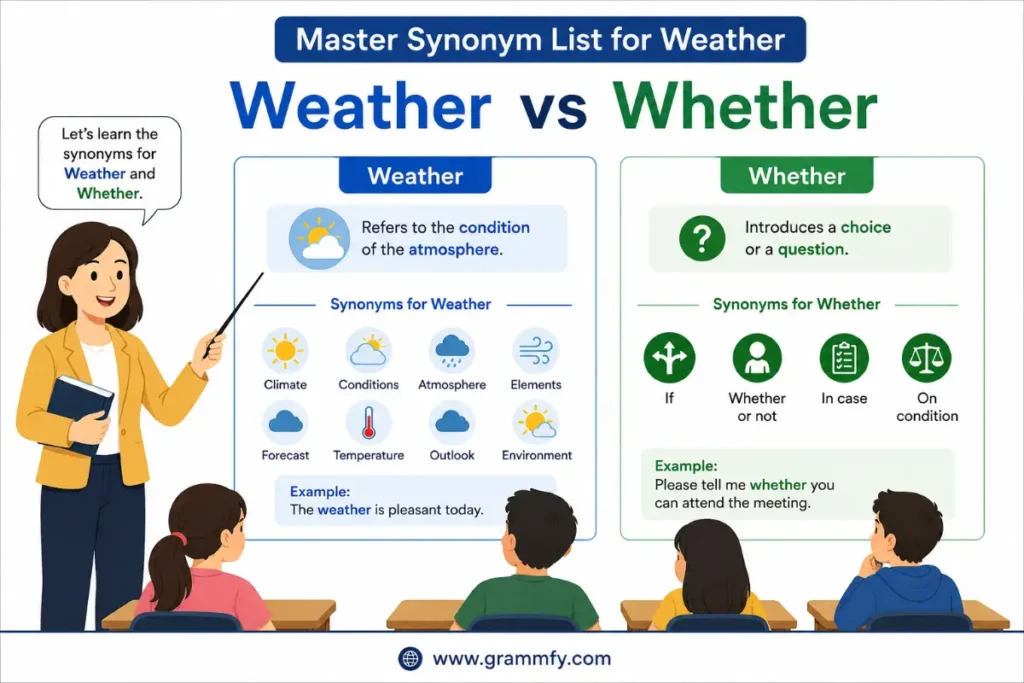
Because weather has more than one meaning, its synonyms depend on context.
Simple and Everyday Synonyms
| Word | Meaning | Tone | Example |
|---|---|---|---|
| climate | Long-term weather | Everyday | The climate is warm. |
| conditions | Atmospheric state | Everyday | Road conditions improved. |
| forecast | Weather prediction | Everyday | Check the forecast tonight. |
| temperature | Degree of heat | Everyday | The temperature reached 90°F. |
| sunshine | Bright sunlight | Everyday | We enjoyed the sunshine. |
| rainfall | Amount of rain | Everyday | Rainfall increased this week. |
| snowfall | Falling snow | Everyday | Heavy snowfall closed schools. |
| breeze | Gentle wind | Everyday | A cool breeze arrived. |
| storm | Severe weather event | Everyday | The storm lasted all night. |
| skies | Visible atmosphere | Everyday | Clear skies are expected tomorrow. |
Formal Synonyms
| Word | Meaning | Tone | Example |
|---|---|---|---|
| atmospheric conditions | State of the atmosphere | Formal | Atmospheric conditions improved. |
| meteorological conditions | Scientific weather term | Formal | Meteorological conditions changed rapidly. |
| climate conditions | General environmental conditions | Formal | Climate conditions affect farming. |
| environmental conditions | Surrounding natural conditions | Formal | Environmental conditions remained stable. |
| meteorology | Study of weather | Formal | She studies meteorology. |
| forecast outlook | Future prediction | Formal | The outlook predicts sunshine. |
| weather system | Large weather pattern | Formal | A weather system moved east |
Casual Synonyme
| Word | Meaning | Tone | Example |
|---|---|---|---|
| outside | Outdoor conditions | Casual | Nice outside today. |
| skies | Sky conditions | Casual | The skies look dark. |
| forecast | Expected weather | Casual | What’s the forecast? |
| rain | Wet weather | Casual | Looks like rain. |
| sunshine | Sunny conditions | Casual | We’re finally getting sunshine. |
Master Synonym List for Whether
Since whether expresses choices or uncertainty, its alternatives depend on sentence structure.
Simple and Everyday Alternatives
| Word | Meaning | Tone | Example |
|---|---|---|---|
| if | In some situations | Everyday | I don’t know if he’ll come. |
| whichever | No matter which | Everyday | Choose whichever works. |
| regardless | Without considering | Everyday | Go regardless of the outcome. |
| either way | In both situations | Everyday | Either way is fine. |
| no matter if | Without concern | Everyday | Go no matter if it rains. |
Formal Alternatives
| Word | Meaning | Tone | Example |
|---|---|---|---|
| irrespective of whether | Without considering | Formal | Proceed irrespective of whether approval arrives. |
| regardless of whether | In either case | Formal | Continue regardless of whether it succeeds. |
| in the event that | If | Formal | Contact us in the event that delays occur. |
| contingent on | Depending on | Formal | The plan is contingent on approval. |
| depending on | Based on | Formal | Costs vary depending on demand. |
| subject to | Conditional upon | Formal | Subject to final approval. |
| provided that | If | Formal | Proceed provided that everyone agrees. |
Casual Alternatives
| Word | Meaning | Tone | Example |
|---|---|---|---|
| if | Conditional | Casual | Let me know if you’re free. |
| either way | Both choices work | Casual | Either way is okay. |
| whatever happens | No matter the outcome | Casual | We’ll finish whatever happens. |
| no matter what | Regardless | Casual | Come no matter what. |
| depends | Outcome isn’t certain | Casual | It depends on the weather. |
Synonyms by Intensity (Mild → Strong)
Choosing the right synonym depends on how formal or specific you want to sound.
If You Mean “Atmospheric Conditions”
| Mild | Medium | Strong |
|---|---|---|
| skies | weather | atmospheric conditions |
| breeze | climate | meteorological conditions |
| forecast | weather pattern | environmental conditions |
If You Mean “Choice or Uncertainty”
| Mild | Medium | Strong |
|---|---|---|
| if | whether | regardless of whether |
| either way | depending on | irrespective of whether |
| whichever | contingent on | subject to |
Synonyms by Part of Speech
Because weather and whether belong to different parts of speech, they have different kinds of synonyms.
Weather as a Noun
| Synonym | Meaning | Example |
|---|---|---|
| climate | Long-term weather patterns | The climate is mild year-round. |
| conditions | Atmospheric state | Road conditions improved after the storm. |
| forecast | Weather prediction | Check the forecast before traveling. |
| atmosphere | Air surrounding Earth | The atmosphere remained calm. |
| temperature | Degree of heat or cold | The temperature dropped overnight. |
| rainfall | Amount of rain | Rainfall increased this month. |
| snowfall | Falling snow | Heavy snowfall closed the highways. |
| breeze | Light wind | A cool breeze made the afternoon pleasant. |
| storm | Severe weather event | The storm arrived after sunset. |
| skies | Visible atmosphere | Clear skies are expected tomorrow. |
Whether as a Conjunction
| Alternative | Meaning | Example |
|---|---|---|
| if | Expresses uncertainty | I don’t know if he’ll call. |
| whether or not | Regardless of the outcome | We’ll leave whether or not it rains. |
| whichever | No matter which | Choose whichever works best. |
| regardless of whether | In either situation | Continue regardless of whether they agree. |
| depending on | Based on a condition | The trip depends on the budget. |
| subject to | Conditional upon | Approval is subject to review. |
| provided that | If | You may enter provided that you register. |
| contingent on | Dependent on | Success is contingent on planning. |
US vs. UK Usage Notes
There is virtually no difference between American and British English when it comes to weather vs whether.
Both countries spell and use these words the same way.
Examples that are correct in both US and UK English include:
- weather forecast
- severe weather
- whether to stay
- whether or not
- whether you agree
- whether it’s possible
The only differences you may notice are in punctuation or writing style, not the meanings of these words.
“Weather vs Whether”: Which Word Should You Use in Different Situations?
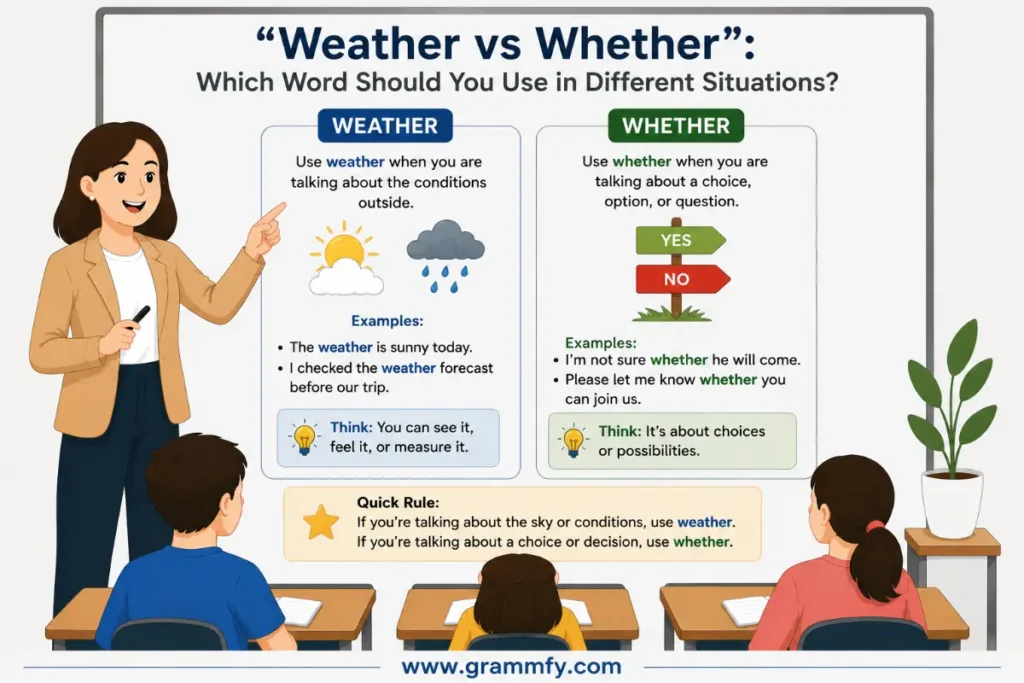
The correct word depends entirely on your sentence.
Best Word for a Resume
Most resumes don’t use weather unless the job relates to meteorology, aviation, farming, or outdoor work.
Whether is also uncommon because resumes usually avoid uncertain language.
Examples:
- Worked outdoors in all weather conditions.
- Adjusted schedules based on severe weather.
Best Word for an Essay
Essays commonly use both words.
Examples:
- Scientists study how weather affects agriculture.
- Researchers examined whether the treatment was effective.
Always ask yourself if you’re discussing the atmosphere or expressing uncertainty.
Best Word for Emails
Business emails often use whether.
Examples:
- Please let me know whether you can attend.
- We haven’t decided whether to move the meeting.
Use weather only when discussing forecasts or outdoor conditions.
Example:
- The event may be postponed because of bad weather.
Best Word for Text Messages
People often confuse these words when typing quickly.
Correct examples:
- I don’t know whether I’ll be there.
- The weather looks great today.
- Check the weather before leaving.
- Tell me whether you’re coming.
Because both words sound identical, spelling matters.
Best Word When Speaking
Since weather and whether are pronounced the same, listeners rely on context.
For example:
“Whether we leave now depends on the weather.”
Although both words sound identical, the sentence is perfectly clear because each has a different meaning.
Original Example Sentences of “Weather vs Whether”
Here are real-life examples showing both words naturally.
- The weather was sunny all weekend.
- I don’t know whether she’ll accept the offer.
- We checked the weather before our camping trip.
- Tell me whether you need any help.
- Cold weather can damage delicate plants.
- They couldn’t decide whether to drive or fly.
- The weather forecast predicts thunderstorms tonight.
- I’m unsure whether the package has arrived.
- Warm weather attracts more tourists.
- Please confirm whether you’re attending the meeting.
- The weather changed suddenly during the hike.
- Nobody knew whether the game would continue.
- Extreme weather caused several flight delays.
- She wondered whether the answer was correct.
- Farmers watch the weather closely during harvest season.
If vs Whether — What’s the Difference?
These words are closely related, but they aren’t always interchangeable.
| If | Whether |
|---|---|
| Often introduces a condition. | Introduces alternatives or uncertainty. |
| Common in everyday speech. | More common in formal writing. |
| Cannot always replace “whether.” | Works in more situations involving choices. |
Examples:
- I don’t know whether he’s coming. ✔
- I don’t know if he’s coming. ✔
But:
- Whether you agree or not… ✔
- If you agree or not… ✘
In many formal situations, whether is the better choice.
Climate vs Weather — What’s the Difference?
People often confuse these words.
| Climate | Weather |
|---|---|
| Long-term average conditions. | Day-to-day atmospheric conditions. |
| Changes over many years. | Changes every day or even every hour. |
| Covers a region or area. | Describes current local conditions. |
Examples:
- Florida has a warm climate.
- Today’s weather is cloudy.
Common Mistakes to Avoid About “Weather vs Whether”
These mistakes are very common in essays, emails, and social media posts.
Mistake 1
❌ I don’t know weather she’ll come.
✔ I don’t know whether she’ll come.
You’re expressing uncertainty, so use whether.
Mistake 2
❌ Check whether before leaving.
✔ Check the weather before leaving.
You’re talking about atmospheric conditions.
Mistake 3
❌ Bad whether delayed the flight.
✔ Bad weather delayed the flight.
Flights are delayed by weather, not whether.
Mistake 4
❌ We haven’t decided weather to stay.
✔ We haven’t decided whether to stay.
This sentence expresses a choice.
Mistake 5
❌ The weather or not doesn’t matter.
✔ Whether or not doesn’t matter.
The phrase is always whether or not.
When Should You NOT Use Weather?
Don’t use weather when expressing uncertainty, alternatives, or choices.
Wrong:
- weather to leave
- weather or not
- I don’t know weather
- tell me weather you agree
Correct:
- whether to leave
- whether or not
- I don’t know whether
- tell me whether you agree
When Should You NOT Use Whether?
Don’t use whether when talking about the atmosphere.
Wrong:
- whether forecast
- hot whether
- severe whether
- whether report
Correct:
- weather forecast
- hot weather
- severe weather
- weather report
Antonyms
Opposites of Weather
Since weather is a noun describing atmospheric conditions, it has no true direct antonym. Depending on context, related opposites may include:
- indoor conditions
- shelter
- protection
- controlled environment
Opposites of Whether
Because whether introduces uncertainty or alternatives, context-based opposites include:
- certainty
- definitely
- certainly
- unquestionably
- without doubt
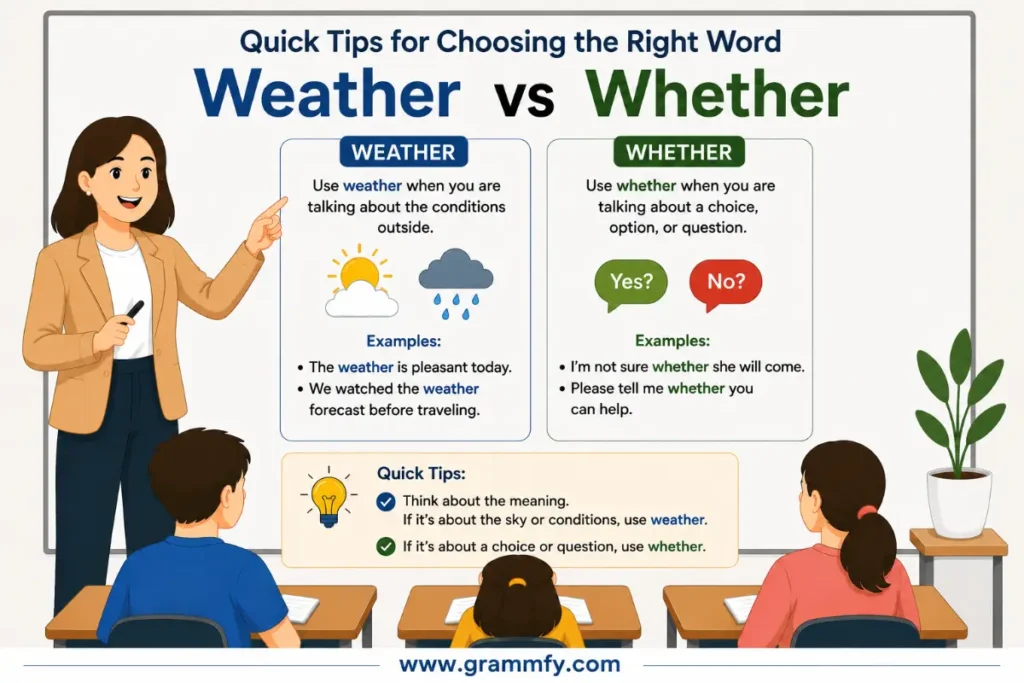
Quick Tips for Choosing the Right Word “Weather vs Whether”
- Use weather when talking about rain, sunshine, snow, wind, or temperature.
- Use whether when introducing a choice or uncertainty.
- Remember that weather is usually a noun.
- Remember that whether is a conjunction.
- If you can replace the word with if, whether may be correct.
- Think of a weather forecast when you see weather.
- Proofread your writing because spell check won’t catch this mistake.
- Read the sentence aloud and ask if you’re discussing the atmosphere or making a choice.
- Practice writing both words in complete sentences.
- With regular practice, you’ll stop confusing weather and whether.
Conclusion
Understanding weather vs whether is much easier once you know the job each word does in a sentence. Use weather when you’re talking about atmospheric conditions like rain, sunshine, wind, snow, or temperature. Use whether when you’re expressing a choice, uncertainty, or two possible options. Even though they sound exactly the same, they have completely different meanings and can’t replace each other. Before sending an email, submitting an essay, or posting online, take a moment to check which word fits your sentence. A quick proofread can help you avoid a common spelling mistake. Keep the simple memory trick in mind—weather relates to the sky, while whether introduces a choice—and you’ll confidently use weather vs whether correctly every time.
Frequently Asked Questions
1. What is the difference between weather or whether?
The difference in weather vs whether is simple. Weather refers to atmospheric conditions like rain, wind, and sunshine, while whether is a conjunction used to express choices, alternatives, or uncertainty.
2. Is it “weather” or “whether” I should go?
The correct word is whether because the sentence is asking about a choice or uncertainty. Example: I don’t know whether I should go.
3. What does “weather” mean?
Weather means the condition of the atmosphere at a certain place and time. It includes sunshine, rain, snow, wind, clouds, humidity, and temperature.
4. What does “whether” mean?
Whether is a conjunction used when discussing alternatives, possibilities, or uncertainty. It often appears in phrases like whether to, whether…or, and whether or not.
5. How can I remember the difference between weather or whether?
Think of a weather forecast whenever you see weather. If the sentence is about making a choice or expressing uncertainty, use whether instead.
6. Can I use “if” instead of “whether”?
Sometimes, yes. In informal sentences, if can replace whether. However, in formal writing or before phrases like or not, whether is usually the better choice.
7. Why do people confuse weather or whether?
People confuse them because they are homophones. They sound exactly alike but have different spellings, meanings, and grammatical functions.
8. Is “weather or not” correct?
No. The correct phrase is whether or not because it introduces two possible outcomes or choices.
9. What’s another way to say “whether”?
Depending on the sentence, alternatives include if, regardless of whether, provided that, depending on, and contingent on.
10. How do I use weather vs whether correctly in a sentence?
Ask yourself whether you’re talking about the atmosphere or a choice. If it’s about rain, sunshine, or temperature, use weather. If it’s about alternatives or uncertainty, use whether.
