
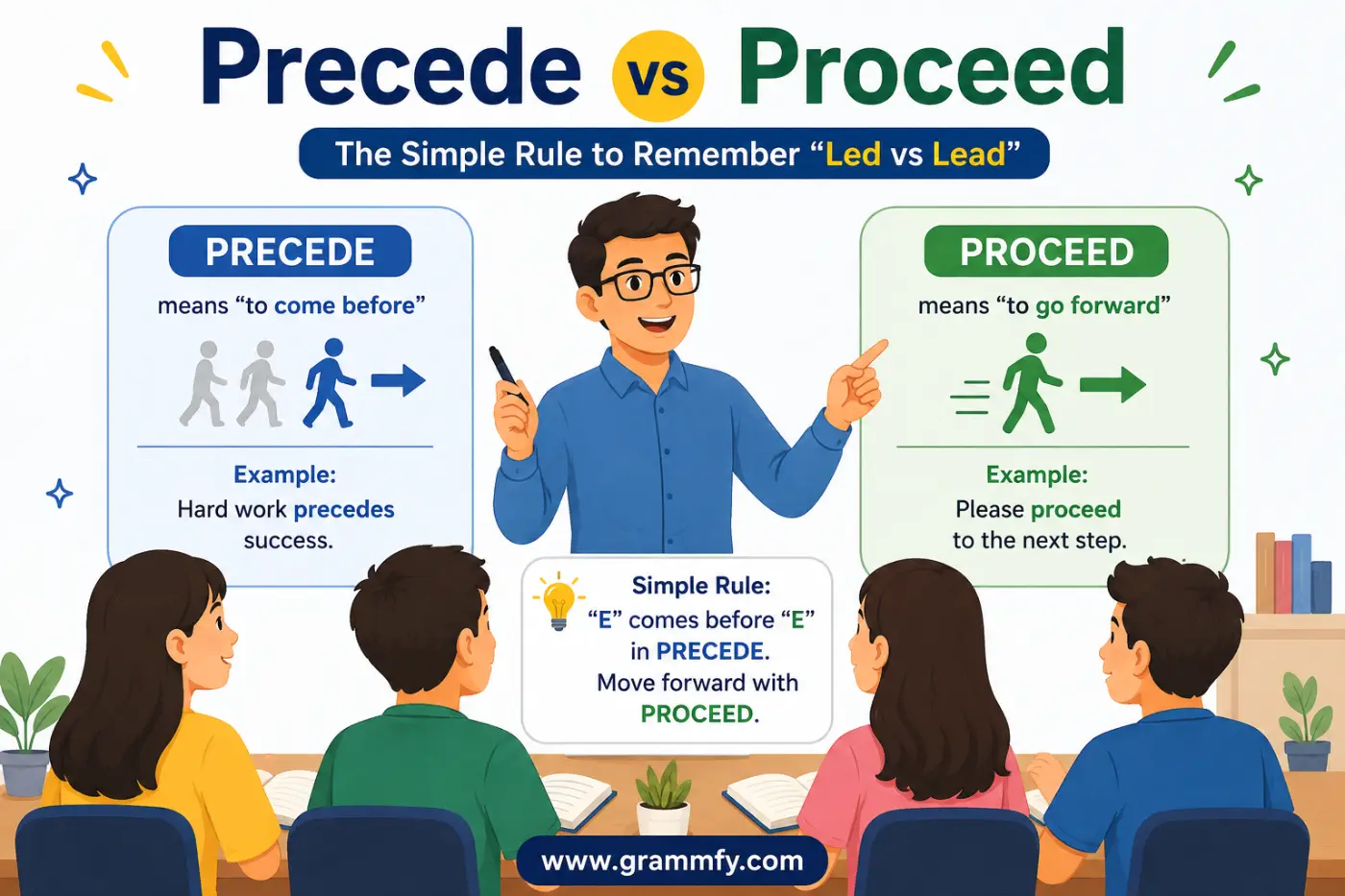
You’re writing an email, finishing an essay, or checking a resume, and you suddenly stop at one sentence: should it be precede vs proceed? These words look and sound similar, but they have different meanings. Using the wrong one can change the meaning of your sentence.
Precede means to come before something in time, place, or order. Proceed means to continue, move forward, or go ahead.
Quick answer: Precede means “come before,” while proceed means “continue or move forward.” Think precede = before and proceed = go forward.
The confusion is understandable because both words begin with “pre” and have similar spellings. The easiest way to tell them apart is to focus on the action. If something comes before another thing, use precede. If someone continues or moves forward, use proceed.
In this guide, you’ll learn the difference between precede vs proceed, see clear examples, learn an easy memory trick, and find out how to use both words correctly in everyday writing.
If you’re working on choosing the right word, explore [seal or seel].
What Does “Precede” Mean?
Precede is a verb that means to come before something in time, order, or position.
Think of it as meaning “happens first.”
Examples:
- A short introduction will precede the presentation.
- Dinner usually precedes dessert.
- The title page precedes the first chapter.
- Heavy rain often precedes a thunderstorm.
In every example, one thing comes before another.
What Does “Proceed” Mean?
Proceed is also a verb, but it means to continue, move forward, or carry on.
Think of it as meaning “keep going.”
Examples:
- Please proceed to the next room.
- After checking your ticket, you may proceed.
- The meeting will proceed as planned.
- Let’s proceed with the project.
Here, the action is about continuing instead of coming before.
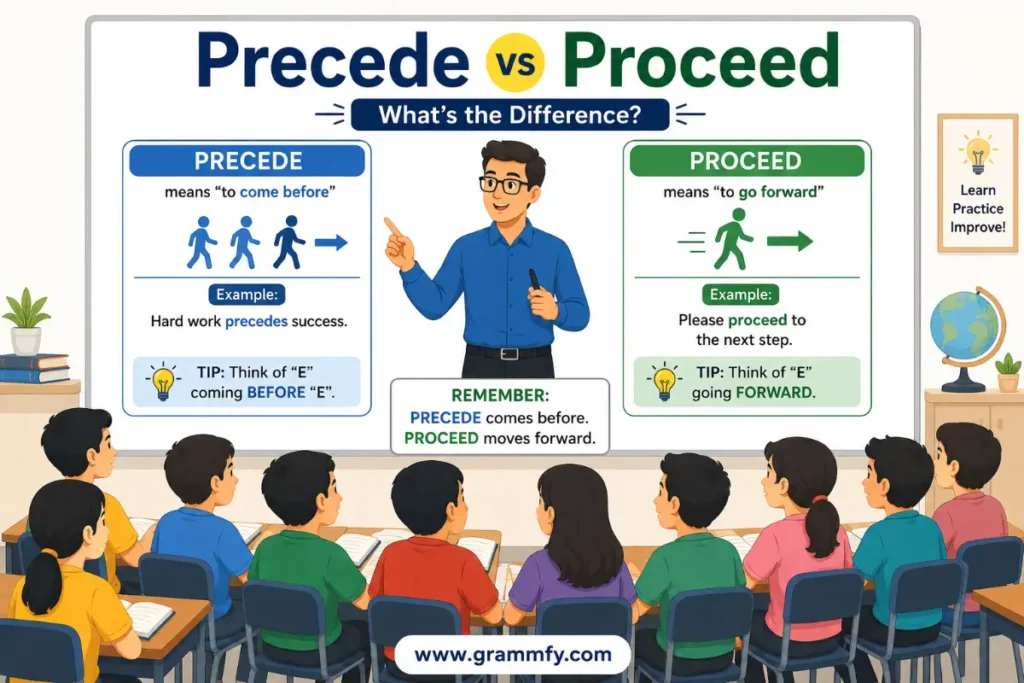
“Precede vs Proceed”: What’s the Difference?
When comparing precede vs proceed, the easiest way to remember the difference is this:
| Word | Meaning | Easy Memory Trick |
|---|---|---|
| Precede | To come before | Pre = before |
| Proceed | To continue or move forward | Pro = forward |
If something happens first, use precede.
If someone continues after a pause, use proceed.
Word Origin and Plain-English Meaning of “Precede vs Proceed”
Most articles stop after explaining the meanings. Knowing where these words came from makes them much easier to remember.
Origin of “Precede”
The word precede comes from the Latin word praecedere.
It combines two parts:
- Prae = before
- Cedere = to go
Together, they literally mean “to go before.”
That meaning has stayed almost unchanged for hundreds of years.
Plain-English Meaning of Precede
In simple English:
Precede means something happens first.
Examples:
- Spring precedes summer.
- Chapter two precedes chapter three.
- Practice precedes improvement.
Origin of “Proceed”
Proceed comes from the Latin word procedere.
It combines:
- Pro = forward
- Cedere = to go
The original meaning was “to go forward.”
Modern English still uses that same idea.
Plain-English Meaning of Proceed
In simple English:
Proceed means to continue moving or continue doing something.
Examples:
- Proceed to checkout.
- Proceed with caution.
- Please proceed when ready.
How to Remember the Difference Between “Precede vs Proceed”
These simple tricks work well because they connect each word with its meaning.
Remember “Precede”
- Pre means before.
- Think of preview, preschool, or preheat.
- All of these happen before something else.
Memory sentence:
Precede = before.
Remember “Proceed”
- Pro reminds many people of progress.
- Progress means moving ahead.
Memory sentence:
Proceed = continue forward.
Master Synonym List for “Precede”
The best synonym depends on your sentence. Here are common alternatives grouped by tone.
Simple Synonyms
| Word | Meaning | Tone | Example |
|---|---|---|---|
| Come before | Happen earlier | Simple | Breakfast comes before lunch. |
| Lead | Go first | Simple | The guide led the group. |
| Go before | Move ahead | Simple | She went before everyone else. |
| Arrive first | Reach earlier | Simple | He arrived first. |
| Start with | Begin using | Simple | Start with the basics. |
| Introduce | Present first | Simple | The host introduced the speaker. |
Everyday Synonyms
| Word | Meaning | Tone | Example |
|---|---|---|---|
| Happen before | Occur earlier | Everyday | Sunrise happens before noon. |
| Be ahead of | Be in front | Everyday | One chapter is ahead of another. |
| Come ahead of | Be earlier | Everyday | The preview comes ahead of the movie. |
| Lead into | Prepare for | Everyday | The opening leads into the story. |
| Go first | Take the first turn | Everyday | You go first. |
| Open | Begin something | Everyday | The remarks open the meeting. |
Formal Synonyms
| Word | Meaning | Tone | Example |
|---|---|---|---|
| Antedate | Exist earlier | Formal | The records antedate the war. |
| Predate | Exist before | Formal | Dinosaurs predate humans. |
| Herald | Signal something coming | Formal | Dark clouds herald rain. |
| Introduce | Present first | Formal | The chair introduced the proposal. |
| Foreshadow | Hint at future events | Formal | The scene foreshadowed trouble. |
| Preface | Begin with | Formal | The report is prefaced by a summary. |
| Announce | Make known first | Formal | The notice announced the event. |
Informal Alternatives
| Word | Meaning | Tone | Example |
|---|---|---|---|
| Kick off | Begin | Informal | Let’s kick off the meeting. |
| Start off | Begin | Informal | Start off with an example. |
| Set up | Prepare first | Informal | The joke sets up the ending. |
| Lead off | Begin first | Informal | She led off the discussion. |
| Open up | Begin talking | Informal | He opened up the conversation. |
Master Synonym List for “Proceed”
Simple Synonyms
| Word | Meaning | Tone | Example |
|---|---|---|---|
| Continue | Keep going | Simple | Continue reading. |
| Carry on | Continue | Simple | Carry on with your work. |
Everyday Synonyms
| Word | Meaning | Tone | Example |
|---|---|---|---|
| Follow through | Finish completely | Everyday | Follow through on your promise. |
| Resume | Start again | Everyday | Resume after lunch. |
| Press on | Continue despite difficulty | Everyday | Press on through the rain. |
| Keep moving | Continue walking | Everyday | Keep moving forward. |
| Get going | Begin moving | Everyday | Let’s get going. |
| Continue ahead | Move forward | Everyday | Continue ahead carefully. |
Formal Synonyms
| Word | Meaning | Tone | Example |
|---|---|---|---|
| Advance | Move forward | Formal | The army advanced. |
| Continue | Keep progressing | Formal | Continue the investigation. |
| Pursue | Continue toward a goal | Formal | Pursue higher education. |
| Execute | Carry out | Formal | Execute the plan. |
| Conduct | Perform | Formal | Conduct the experiment. |
| Perform | Carry out | Formal | Perform the procedure. |
| Undertake | Begin responsibly | Formal | Undertake the project. |
Informal Alternatives
| Word | Meaning | Tone | Example |
|---|---|---|---|
| Keep at it | Continue trying | Informal | Keep at it—you’ll improve. |
| Stick with it | Continue | Informal | Stick with it until the end. |
| Push ahead | Continue forward | Informal | Push ahead despite delays. |
| Roll on | Continue naturally | Informal | Life rolls on. |
| Move along | Continue | Informal | Move along, please. |
Synonyms by Intensity
Sometimes you need a stronger or softer word than precede or proceed.
For “Precede”
| Intensity | Word |
|---|---|
| Mild | Come before |
| Mild | Go first |
| Moderate | Lead |
| Moderate | Introduce |
| Strong | Predate |
| Strong | Herald |
| Strongest | Foreshadow |
For “Proceed”
| Intensity | Word |
|---|---|
| Mild | Go on |
| Mild | Continue |
| Moderate | Carry on |
| Moderate | Move forward |
| Strong | Advance |
| Strong | Pursue |
| Strongest | Execute |
Synonyms by Part of Speech
Precede
Verb
- precede
- lead
- predate
- herald
- introduce
- preface
- foreshadow
- come before
- open
- begin
There is no commonly used noun form that replaces precede in everyday writing.
Proceed
Verb
- proceed
- continue
- advance
- move forward
- carry on
- pursue
- resume
- perform
- execute
- undertake
Related nouns include:
- progress
- continuation
- advancement
- procedure
- progression
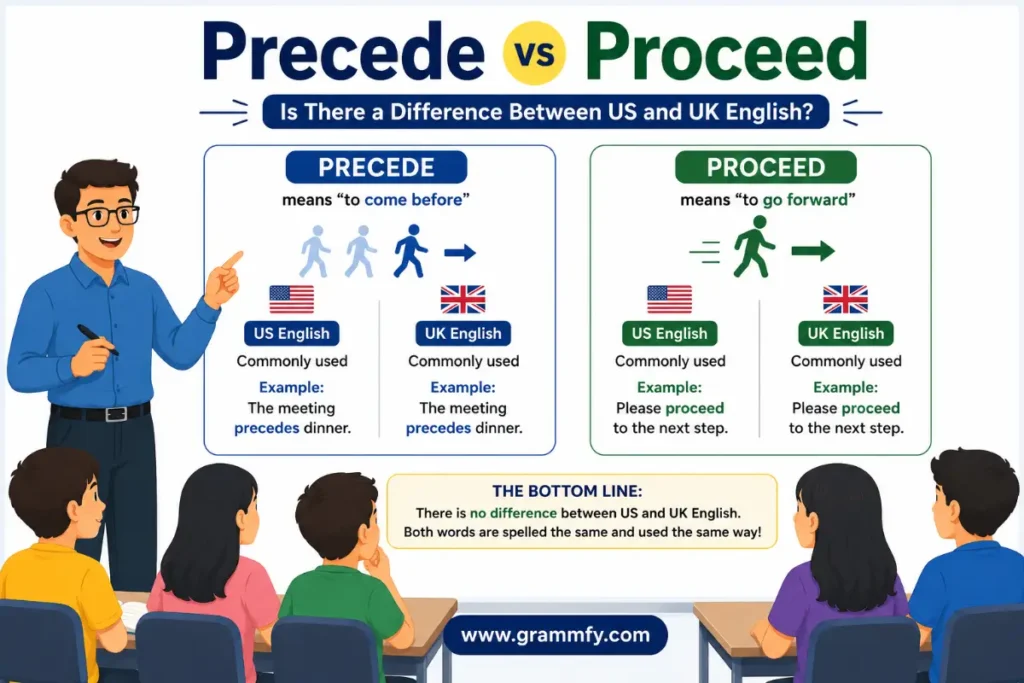
Is There a Difference Between US and UK English?
Good news—there isn’t much difference.
Both American English and British English use precede and proceed with the same meanings and spellings.
| Feature | US English | UK English |
|---|---|---|
| Precede | Standard | Standard |
| Proceed | Standard | Standard |
The only small difference is style. British writers may use slightly more formal wording in official documents, but the meanings remain exactly the same.
Can You Use “Precede vs Proceed” Interchangeably?
No. Even though they look and sound similar, they describe different actions.
Correct:
- A welcome speech preceded the awards ceremony.
- After the speech, the guests proceeded to dinner.
Incorrect:
- A welcome speech proceeded the awards ceremony.
- After dinner, dessert preceded.
A simple test is to ask yourself:
- Does it happen before? Use precede.
- Does it continue or move forward? Use proceed.
Quick Summary of “Precede vs Proceed”
Here’s what you’ve learned so far:
When comparing precede vs proceed, think about whether you’re describing something that happens first or something that continues.What’s the Best Word to Use in Different Situations?
Best Word for a Resume
On a resume, proceed is uncommon unless you’re describing a process or procedure. Strong action verbs usually work better.
Good alternatives:
- Managed
- Led
- Completed
- Executed
- Advanced
- Coordinated
Examples:
- Led a team of five employees.
- Executed daily quality checks.
If you need to describe a sequence, precede can work.
Example:
A safety inspection preceded every equipment test.
Best Word for an Essay
Essays often discuss events, history, or logical order.
Use precede when explaining what happened first.
Examples:
- The Industrial Revolution preceded many modern inventions.
- Careful planning should precede major decisions.
Use proceed when describing the next step.
Examples:
- The experiment will proceed after approval.
- The discussion proceeds from simple ideas to complex ones.
Best Word for Emails
Business emails usually need clear and direct language.
Examples with precede:
- The agenda will precede tomorrow’s meeting.
- A confirmation email will precede your appointment.
Examples with proceed:
- Please proceed with the payment.
- You may proceed once the manager approves your request.
Best Word for Text Messages
In casual conversations, people often choose simpler words.
Instead of precede, many people simply say:
- come first
- happen before
Instead of proceed, they say:
- go ahead
- keep going
Examples:
- You go first.
- Go ahead without me.
Best Word for Speaking
When talking in everyday situations, natural language is usually the best choice.
Examples:
- Please proceed to the front desk.
- Let’s continue.
- Go ahead when you’re ready.
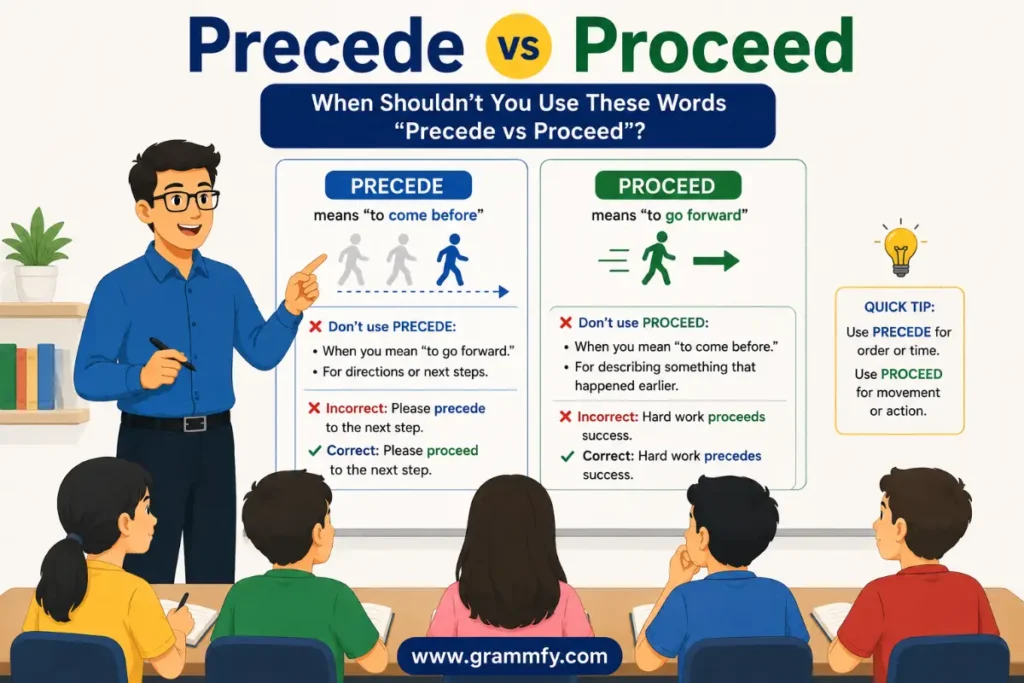
When Shouldn’t You Use These Words “Precede vs Proceed”?
Sometimes a simpler word sounds better.
Instead of:
Please proceed eating.
Say:
Please continue eating.
Instead of:
The first page precedes the second page.
You can simply say:
The first page comes before the second page.
Choose the word that sounds most natural for your audience.
What’s the Best Word to Use in Different Situations?
Choosing between precede and proceed depends on what you’re trying to say. Here’s how each word fits different types of writing.
Best Word for a Resume
On a resume, proceed is uncommon unless you’re describing a process or procedure. Strong action verbs usually work better.
Good alternatives:
- Managed
- Led
- Completed
- Executed
- Advanced
- Coordinated
Examples:
- Led a team of five employees.
- Executed daily quality checks.
- Advanced several process improvements.
If you need to describe a sequence, precede can work.
Example:
A safety inspection preceded every equipment test.
Best Word for an Essay
Essays often discuss events, history, or logical order.
Use precede when explaining what happened first.
Examples:
- The Industrial Revolution preceded many modern inventions.
- Careful planning should precede major decisions.
Use proceed when describing the next step.
Examples:
- The experiment will proceed after approval.
- The discussion proceeds from simple ideas to complex ones.
Best Word for Emails
Business emails usually need clear and direct language.
Examples with precede:
- The agenda will precede tomorrow’s meeting.
- A confirmation email will precede your appointment.
Examples with proceed:
- Please proceed with the payment.
- You may proceed once the manager approves your request.
- We can proceed after receiving your documents.
Best Word for Text Messages
In casual conversations, people often choose simpler words.
Instead of precede, many people simply say:
- come first
- happen before
Instead of proceed, they say:
- go ahead
- keep going
- continue
Examples:
- You go first.
- Go ahead without me.
- Keep going. You’re almost there!
Best Word for Speaking
When talking in everyday situations, natural language is usually the best choice.
Examples:
- Please proceed to the front desk.
- Questions will precede the presentation.
- Let’s continue.
- Go ahead when you’re ready.
Simple words make spoken English sound smoother.
Real-Life Example Sentences
Here are original examples showing both words in different situations.
Examples with “Precede”
- A short video will precede the main presentation.
- Warm-up exercises should precede intense workouts.
- The introduction precedes every chapter.
- A warning usually precedes severe weather.
- Careful planning should precede any large investment.
- Registration will precede the opening ceremony.
Examples with “Proceed”
- You may proceed after your name is called.
- The meeting will proceed without delay.
- Please proceed carefully on the wet floor.
- Once payment is confirmed, we’ll proceed with shipping.
- The teacher told the class to proceed to the next question.
- After reviewing the proposal, the company decided to proceed.
Precede vs Proceed: Side-by-Side Comparison
| Feature | Precede | Proceed |
|---|---|---|
| Meaning | Come before | Continue or move forward |
| Part of Speech | Verb | Verb |
| Time | Before something | After or during something |
| Common Use | Order and sequence | Action and progress |
| Memory Trick | Pre = Before | Pro = Progress |
Precede vs Predict: What’s the Difference?
People sometimes confuse these words because both relate to time.
| Precede | Predict |
|---|---|
| Means something happens before another event | Means to guess what will happen in the future |
| Refers to order | Refers to forecasting |
Examples:
- Spring precedes summer.
- Weather experts predict rain tomorrow.
One describes sequence. The other describes expectation.
Proceed vs Continue: What’s the Difference?
These words are close in meaning, but they aren’t always identical.
| Proceed | Continue |
|---|---|
| Often means move forward after a pause or instruction | Means keep doing something |
| Common in formal writing | Common everywhere |
Examples:
- Please proceed to Gate 12.
- Continue reading Chapter 5.
In many situations, continue sounds more natural in everyday conversation.
Common Mistakes to Avoid
These are the mistakes English learners make most often.
Using “Proceed” When You Mean “Precede”
Incorrect:
Breakfast proceeds lunch.
Correct:
Breakfast precedes lunch.
Using “Precede” When You Mean “Continue”
Incorrect:
Please precede to the next page.
Correct:
Please proceed to the next page.
Forgetting the Meaning of the Prefix
Remember:
- Pre = before
- Pro = forward
The prefixes tell you which word you need.
Assuming They’re Interchangeable
Although the words sound alike, they cannot replace each other.
Incorrect:
The movie proceeded the discussion.
Correct:
The movie preceded the discussion.
When Shouldn’t You Use These Words?
Sometimes a simpler word sounds better.
Instead of:
Please proceed eating.
Say:
Please continue eating.
Instead of:
The first page precedes the second page.
You can simply say:
The first page comes before the second page.
Choose the word that sounds most natural for your audience.
Antonyms
“Precede”
| Word | Meaning |
|---|---|
| Follow | Come after |
| Succeed | Come after in order |
| Trail | Be behind |
| Lag | Fall behind |
| Come after | Happen later |
“Proceed”
| Word | Meaning |
|---|---|
| Stop | End movement |
| Halt | Stop completely |
| Pause | Take a break |
| Retreat | Move backward |
| Withdraw | Pull back |
| Return | Go back |
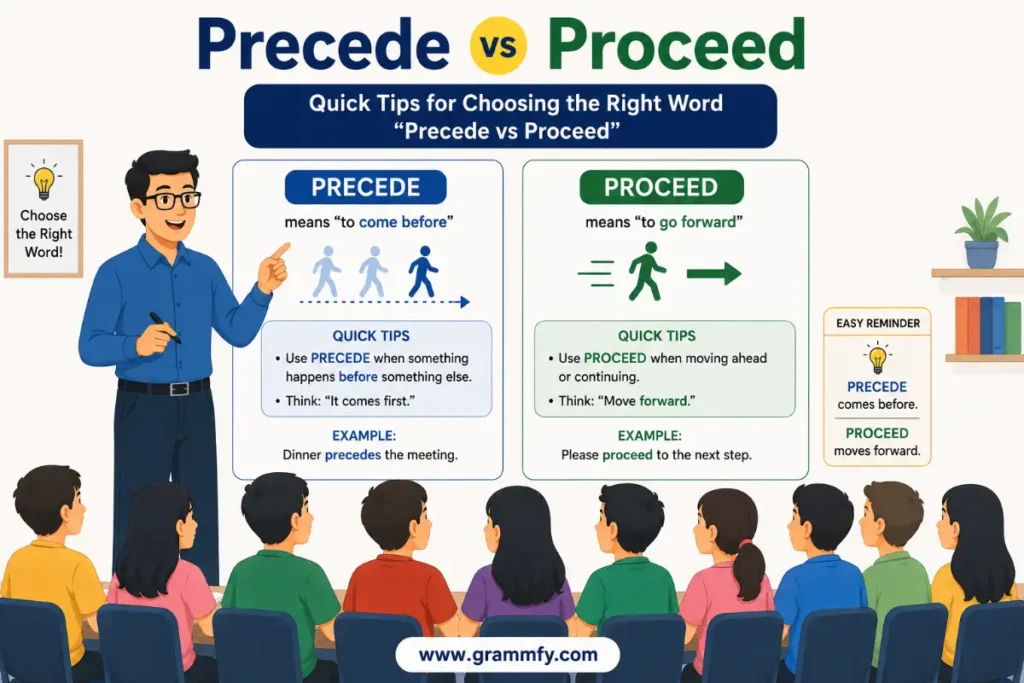
Quick Tips for Choosing the Right Word
- Use precede when one event happens before another.
- Use proceed when someone continues or moves forward.
- Remember Pre = Before.
- Remember Pro = Progress.
- If you’re talking about order, choose precede.
- If you’re talking about action, choose proceed.
- When comparing precede vs proceed, ask yourself one question: Does it happen first, or does it continue?
Conclusion
Understanding precede vs proceed becomes much easier once you focus on their meanings instead of their similar spelling. Precede is all about what comes before, while proceed is about moving forward or continuing. These words are common in emails, essays, workplace communication, and everyday English, so using the correct one helps your writing sound clear and professional. A simple way to remember them is that pre means before and pro reminds you of progress. With a little practice and the examples in this guide, you’ll be able to choose the right word naturally and avoid one of the most common English word mix-ups
Frequently Asked Questions
Is it precede or proceed?
It depends on your meaning. In precede vs proceed, precede means come before, while proceed means continue or move forward.
What’s another way to say “precede”?
Some common alternatives are come before, lead, predate, introduce, and go first.
What’s another way to say “proceed”?
Good alternatives include continue, go ahead, move forward, carry on, and advance.
How do I remember the difference between precede and proceed?
Think of Pre = Before and Pro = Progress. This simple memory trick works in most situations.
Can precede and proceed be used interchangeably?
No. They have different meanings. Precede describes sequence, while proceed describes continuing an action.
Is “please precede” correct?
Usually, no. The correct phrase is “Please proceed.” Use precede only when something comes before something else.
Is it correct to say proceed with or precede with?
Proceed with is correct when you mean to continue or move forward with something. For example, “We can proceed with the project.”
What does precede mean in a sentence?
Precede means that something comes before another thing in time, place, or order. For example, “A short introduction will precede the speech.”
