
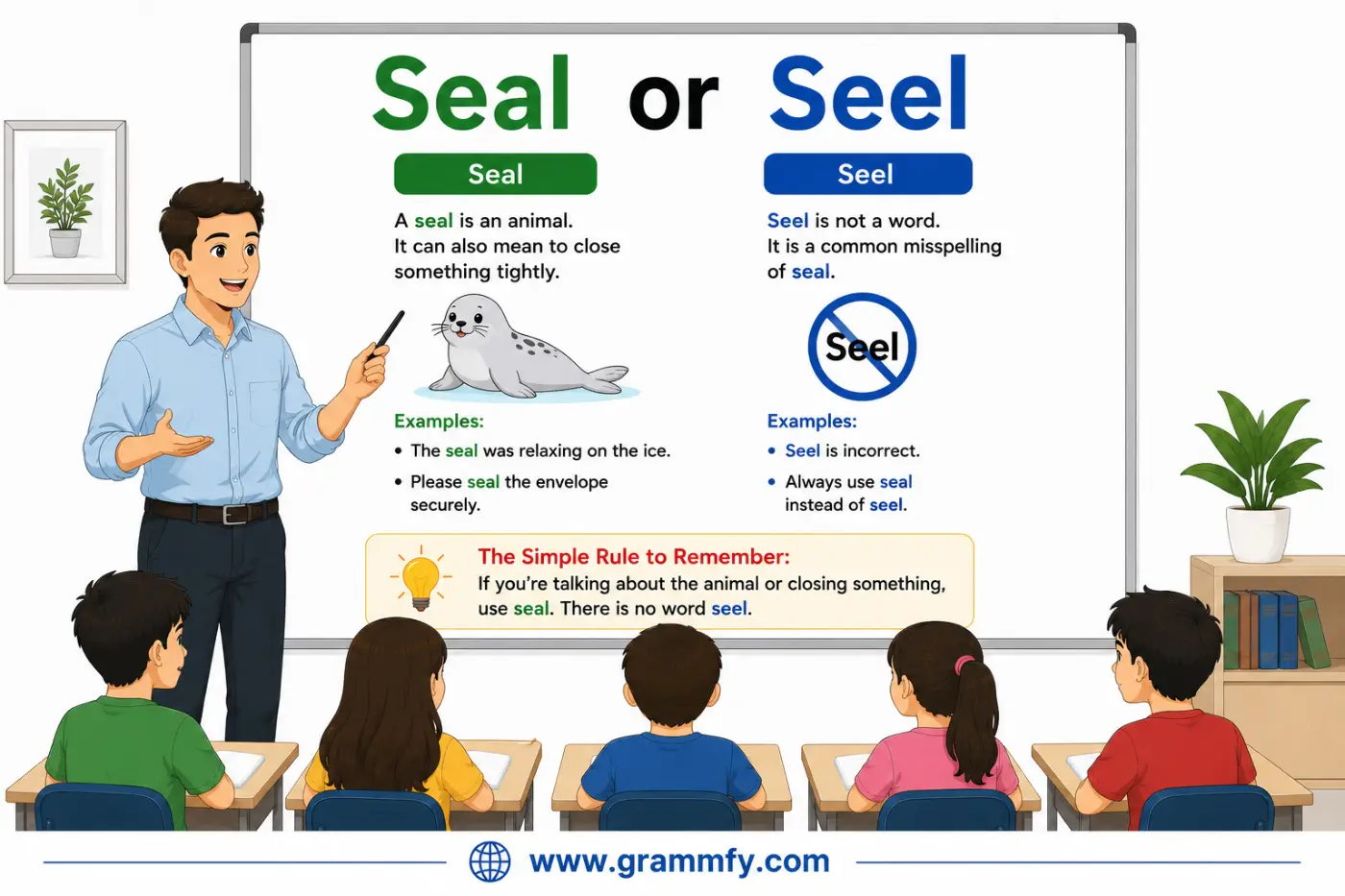
Have you ever paused while writing an email, school essay, resume, or even a quick text because you weren’t sure whether to write seal or seel? You’re not alone. Many people search for this pair because the words sound similar, but only one is commonly used in modern English.
Quick Answer:
**”Seal” is the correct English word in almost every situation. “Seel” is a rare, old-fashioned word that most people never use. If you’re choosing between seal or seel, the right answer is usually seal.
English has many words that sound alike but have different meanings or spellings. In this guide, you’ll learn the meaning of both words, where they came from, when to use each one, common mistakes, and dozens of related words that help you write more naturally.
What Does “Seal” Mean?
The word seal has several meanings in English, depending on the context.
1. To Close Something Securely
This is the most common meaning.
Examples:
- Please seal the envelope before mailing it.
- Make sure you seal the package tightly.
- The plumber sealed the pipe to stop the leak.
Here, seal means to close something so air, water, or other things cannot pass through.
2. An Official Stamp or Mark
A seal can also be an official mark that proves something is genuine.
Examples:
- The document has the company’s official seal.
- The university placed its seal on the certificate.
3. A Marine Animal
A seal is also the name of a sea mammal.
Examples:
- We watched seals swimming near the beach.
- The baby seal rested on the ice.
4. To Confirm or Finalize Something
Sometimes seal means to make something final.
Examples:
- They sealed the business deal yesterday.
- A handshake sealed the agreement.
What Does “Seel” Mean?
Unlike seal, seel is a very rare English word.
Historically, seel meant:
- to sew or close the eyes of a bird, especially a falcon
- to blind temporarily during falconry training
Because falconry is uncommon today, this word almost disappeared from everyday English.
Examples:
- The trainer seeled the hawk before transport. (historical use only)
- The old book described how birds were seeled centuries ago.
Today, most English speakers never use seel.
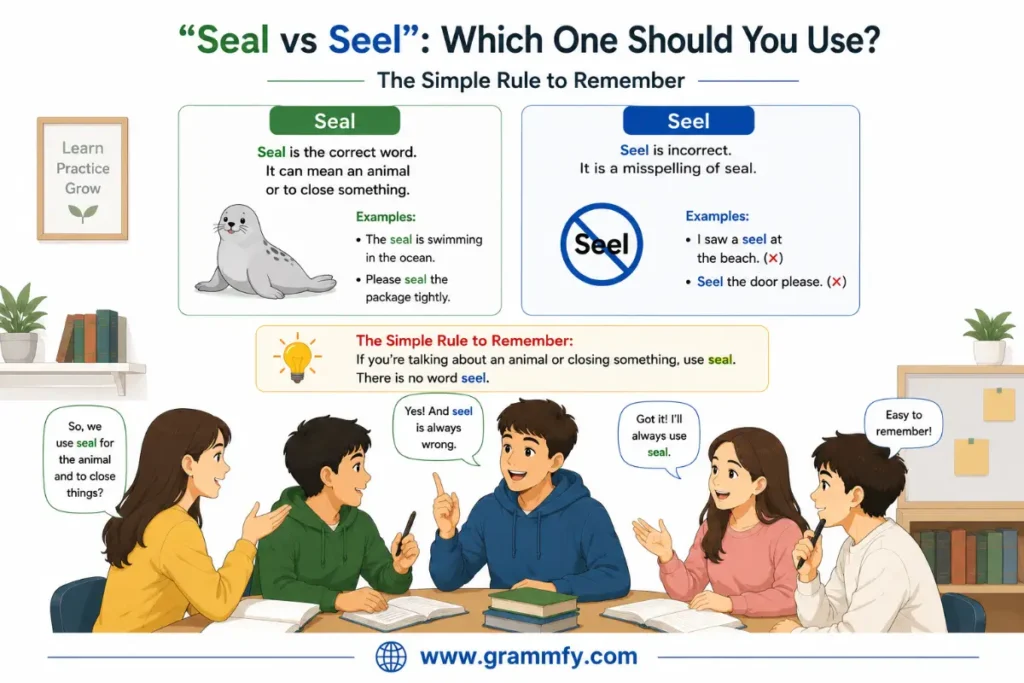
“Seal vs Seel”: Which One Should You Use?
If you’re wondering about seal or seel, here’s the simple rule:
| Word | Modern English | Common? | Should You Use It? |
|---|---|---|---|
| Seal | Yes | Very common | ✅ Yes |
| Seel | Rare historical word | Very uncommon | ❌ Usually no |
Unless you’re discussing historical falconry or reading very old literature, seal is almost always the correct spelling.
Where Did These Words Come From?
Most articles explain only the spelling. Understanding the history makes the difference much easier to remember.
Origin of “Seal”
The modern English word seal comes from Old French seel and Latin sigillum, meaning:
- little sign
- official mark
- stamp
Over time, its meaning expanded to include:
- closing something securely
- making something official
- confirming an agreement
That’s why today the same word works in many different situations.
Examples:
- seal a letter
- official seal
- seal a deal
Origin of “Seel”
The word seel comes from Old English and Germanic roots connected with closing or stitching the eyes of hunting birds.
It was mainly used by falconers hundreds of years ago.
As falconry became less common, the word almost disappeared from everyday English.
Today it survives mostly in:
- historical writing
- old dictionaries
- classic literature
Plain-English Meaning
Let’s simplify both words.
Seal
Meaning:
To close, protect, secure, confirm, or officially mark something.
Easy way to remember:
Seal = Secure.
Seel
Meaning:
An old word meaning to sew shut the eyes of a bird during falconry.
Easy way to remember:
Seel = Historical bird-training word.
Master Synonym List
The word seal has many related words depending on what you want to say. Choosing the right one makes your writing sound more natural.
Simple and Everyday Synonyms
| Word | Meaning | Tone | Example |
|---|---|---|---|
| Offer | Make something available to buy | Everyday | They offer fresh bread every morning. |
| Close | Shut something | Everyday | Please close the door. |
| Shut | Close something completely | Casual | Shut the box tightly. |
| Secure | Close or fasten something firmly | Everyday | Secure the package before shipping. |
Formal Synonyms
| Word | Meaning | Tone | Example |
|---|---|---|---|
| Certify | Officially confirm | Formal | Certify the records. |
| Confirm | Make certain | Formal | Confirm the reservation. |
| Endorse | Approve officially | Formal | Endorse the proposal. |
| Ratify | Official approval | Formal | Ratify the treaty. |
Protection and Security Synonyms
| Word | Meaning | Tone | Example |
|---|---|---|---|
| Waterproof | Keep water out | Neutral | Waterproof the roof. |
| Insulate | Prevent heat loss | Neutral | Insulate the wall. |
| Preserve | Keep in good condition | Formal | Preserve the records. |
| Safeguard | Protect carefully | Formal | Safeguard customer data. |
Agreement and Completion Synonyms
| Word | Meaning | Tone | Example |
|---|---|---|---|
| Complete | Finish | Neutral | Complete the task. |
| Finish | Bring to an end | Casual | Finish the report. |
| Conclude | End formally | Formal | Conclude the meeting. |
| Solidify | Make stronger | Neutral | Solidify the partnership. |
| Confirm | Make official | Neutral | Confirm the booking. |
Informal or Slang Alternatives
These don’t always replace seal, but they can fit casual speech.
| Word | Meaning | Tone | Example |
|---|---|---|---|
| Wrap up | Finish | Casual | Let’s wrap up. |
| Lock in | Make final | Casual | Lock in your choice. |
| Nail down | Decide firmly | Informal | We nailed down the plans. |
| Tie up | Finish remaining work | Informal | Tie up loose ends. |
| Finish off | Complete | Casual | Finish off the assignment. |
Synonyms by Intensity (Mild → Strong)
Sometimes you need a word that sounds stronger or weaker than seal.
| Strength | Word | Best Use |
|---|---|---|
| Very Mild | Close | Everyday tasks |
| Mild | Shut | Doors, windows |
| Mild | Fasten | Clothing or bags |
| Moderate | Protect | Safety |
| Strong | Safeguard | Valuable items |
| Very Strong | Preserve | Long-term protection |
Synonyms by Part of Speech
Verb (Action)
- seal
- close
- shut
- lock
- secure
- fasten
- protect
- preserve
- authenticate
- certify
- validate
- confirm
- finalize
- conclude
- ratify
- safeguard
Noun
- seal
- stamp
- emblem
- insignia
- mark
- logo
- symbol
- crest
- badge
- certification
- approval
- closure
Adjective (Related Ideas)
Although there isn’t an adjective form of seal used in everyday speech, these describe similar ideas:
- sealed
- secure
- protected
- closed
- locked
- waterproof
- airtight
- official
- certified
- validated
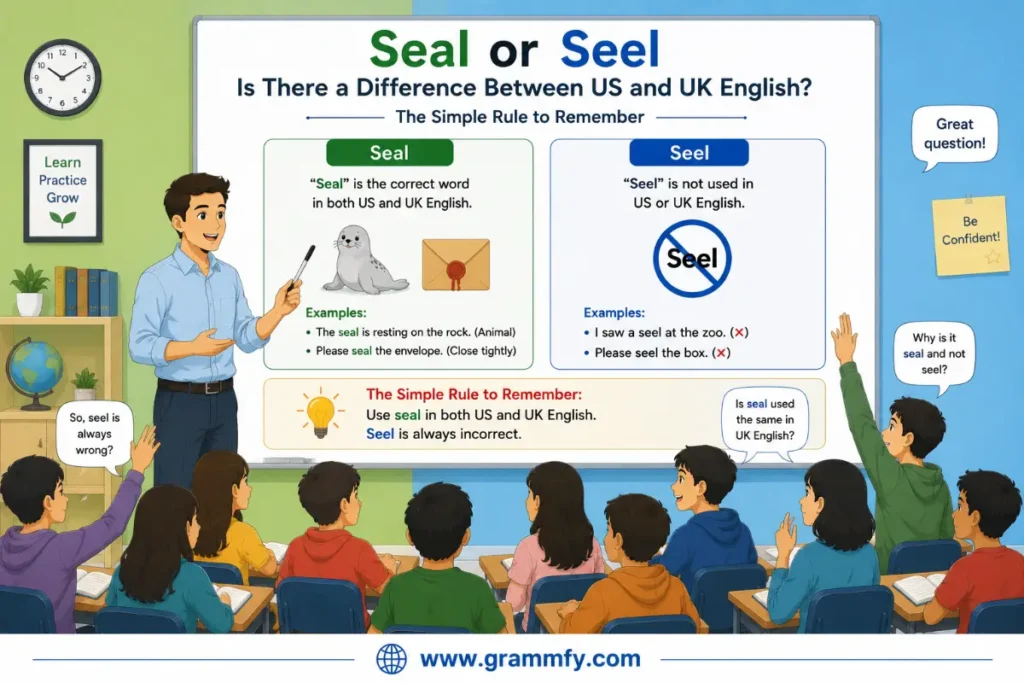
Is There a Difference Between US and UK English “Seal or Seel”?
For seal or seel, there is almost no difference between American and British English.
| Feature | US English | UK English |
|---|---|---|
| Seal | Common | Common |
| Seel | Rare | Rare |
Both countries:
- use seal in everyday writing
- recognize seel mainly as an old historical word
- rarely teach seel outside specialized studies
That means if you’re writing for an international audience, you can confidently use seal without worrying about regional spelling differences.
Does “Seel” Ever Appear Today?
Yes, but only in very limited situations.
You might see seel in:
- historical novels
- Shakespeare studies
- books about medieval hunting
- falconry manuals
- old dictionaries
- university research
Outside those fields, modern writers almost never choose it.
How Can You Remember the Difference Between “Seal or Seel”?
Here are a few memory tricks.
- Seal has an A, like airtight.
- You seal envelopes, jars, pipes, and agreements.
- Seel is an old word you probably won’t need.
- If you’re unsure, choose seal.
These simple tricks help you avoid one of the easiest spelling mistakes involving these two words.
When Is “Seal” the Better Choice?
Choose seal when you’re talking about:
- envelopes
- food containers
- official documents
- business contracts
- plumbing
- windows
- packaging
- legal papers
- security
- preservation
If your sentence fits one of these topics, seal is almost certainly correct.
Quick Recap Before We Move On “Seal or Seel”
Here’s the main takeaway so far:
- Seal is a common modern English word with several meanings, including closing, protecting, confirming, and official approval.
- Seel is an old historical word linked to falconry and is rarely used today.
- When choosing between seal or seel, modern English almost always requires seal.
- Knowing the word origins makes the difference easier to remember.
- Related synonyms vary depending on whether you’re talking about protection, official approval, security, or completing an agreement.
Best Word by Context
Choosing the right word depends on what you’re writing. While seal is usually the correct choice, different situations may call for a synonym that sounds more natural.
Seal for a Resume
On a resume, strong action verbs often sound better than seal unless you’re talking about security, packaging, legal work, or contracts.
Best alternatives:
- Finalized
- Completed
- Secured
- Authenticated
- Certified
Examples:
- Finalized contracts worth over $500,000.
- Secured confidential company records.
- Authenticated legal documents before filing.
- Certified product quality during inspections.
If your job involved physically closing packages or securing equipment, seal is still the right word.
Example:
Sealed and prepared more than 200 customer packages daily.
Seal for an Essay
In academic writing, use the word that best matches your meaning.
Good choices:
- Confirm
- Conclude
- Finalize
- Authenticate
- Seal
Examples:
- The evidence confirms the author’s argument.
- The treaty sealed peace between the two nations.
- These findings conclude the research project.
Avoid using seel, since readers may think it’s a spelling mistake.
Seal in an Email
Emails should sound clear and natural.
Examples:
- Please seal the envelope before sending it.
- Let’s finalize the agreement this week.
- We’ve confirmed your order.
- The documents have been securely sealed.
Professional emails usually benefit from words like confirm, finalize, or secure, depending on the situation.
Seal in Text Messages
People usually choose simpler words when texting.
Examples:
- Don’t forget to close the jar.
- Lock the door before leaving.
- I finally sealed the deal!
- Wrap it up before you come.
Casual conversations rarely require the word seel.
Seal in Everyday Speaking
When talking with friends or coworkers, choose words everyone understands.
Examples:
- Seal the box.
- Lock the gate.
- Close the window.
- Secure the package.
- Wrap the gift tightly.
Simple language is usually the clearest language.
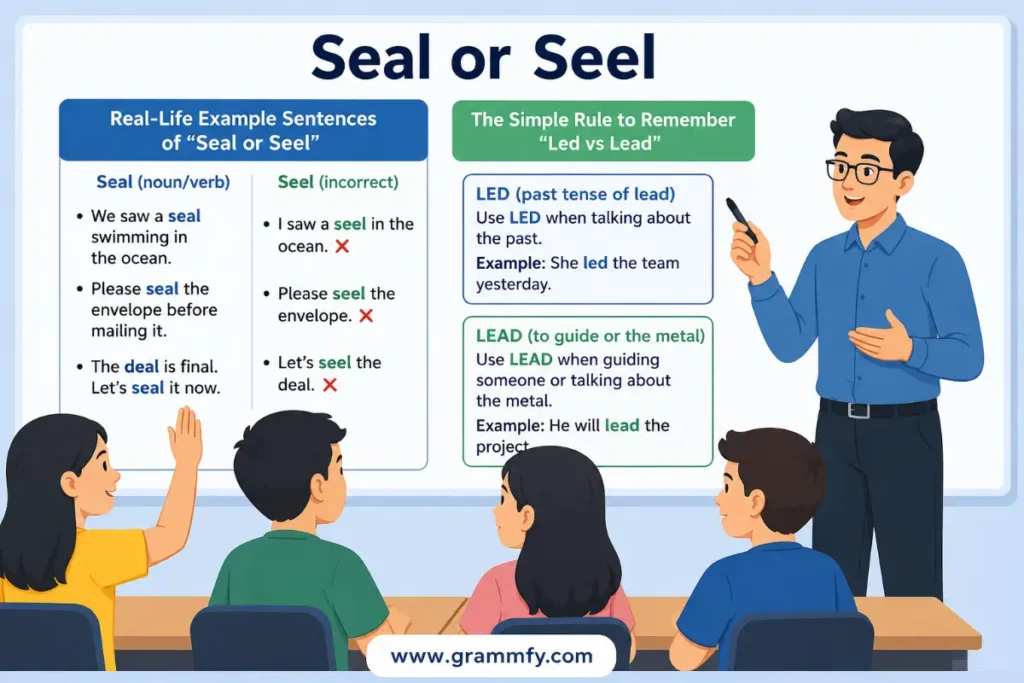
Real-Life Example Sentences of “Seal or Seel”
These examples show how seal works in different situations.
- Please seal the envelope before mailing it.
- The mechanic sealed the leaking pipe.
- The company placed its official seal on the certificate.
- Their handshake sealed the business agreement.
- We used tape to seal the moving boxes.
- The rescue team sealed off the dangerous area.
- A good interview can seal your chances of getting the job.
Historical example with seel:
- The ancient falconer would seel the bird before transporting it.
Seal vs. Close — What’s the Difference?
These words are related, but they are not always interchangeable.
| Seal | Close |
|---|---|
| Makes something tightly shut | Simply shuts something |
| Often prevents air or water from entering | Doesn’t always provide protection |
| Can mean making something official | Usually means shutting something physically |
Examples:
Close the door.
Seal the container.
A door can be closed without being sealed.
A food container is usually sealed to keep air out.
Seal vs. Secure — What’s the Difference?
Many learners confuse these words.
| Seal | Secure |
|---|---|
| Focuses on closing tightly | Focuses on safety and protection |
| Often blocks leaks | Prevents theft or damage |
| Used for packages and containers | Used for property, data, and equipment |
Examples:
Seal the package so water can’t get inside.
Secure the package so nobody can steal it.
Sometimes both words work together.
Example:
Seal the box, then secure it with strong tape.
Common Mistakes to Avoid
Here are the mistakes people make most often.
Using “Seel” Instead of “Seal”
Incorrect:
Please seel the envelope.
Correct:
Please seal the envelope.
Thinking They’re Modern Alternatives
They aren’t.
Seel is an old historical word.
Seal is the standard modern spelling.
Using Seal When You Mean Close
Sometimes “close” sounds more natural.
Example:
Close the notebook.
Not:
Seal the notebook.
Using Seal for Every Situation
Different contexts need different words.
Instead of:
Seal the meeting.
Better:
Conclude the meeting.
Instead of:
Seal your homework.
Better:
Finish your homework.
When Shouldn’t You Use “Seal”?
Avoid seal when you’re talking about simple actions that don’t involve securing or making something official.
Examples:
❌ Seal your eyes before sleeping.
✅ Close your eyes before sleeping.
❌ Seal the TV.
✅ Turn off the TV.
❌ Seal your book.
✅ Close your book.
Choosing the right verb makes your writing sound much more natural.
Antonyms of Seal
Sometimes you need the opposite meaning.
| Antonym | Meaning |
|---|---|
| Open | Make accessible |
| Unseal | Remove a seal |
| Unlock | Remove a lock |
| Expose | Leave uncovered |
| Reveal | Make visible |
| Loosen | Make less tight |
| Disconnect | Separate |
| Unfasten | Undo something fastened |
| Separate | Pull apart |
| Break | Damage or open forcefully |
Examples:
- Please unseal the package.
- Unlock the gate.
- Open the container carefully.
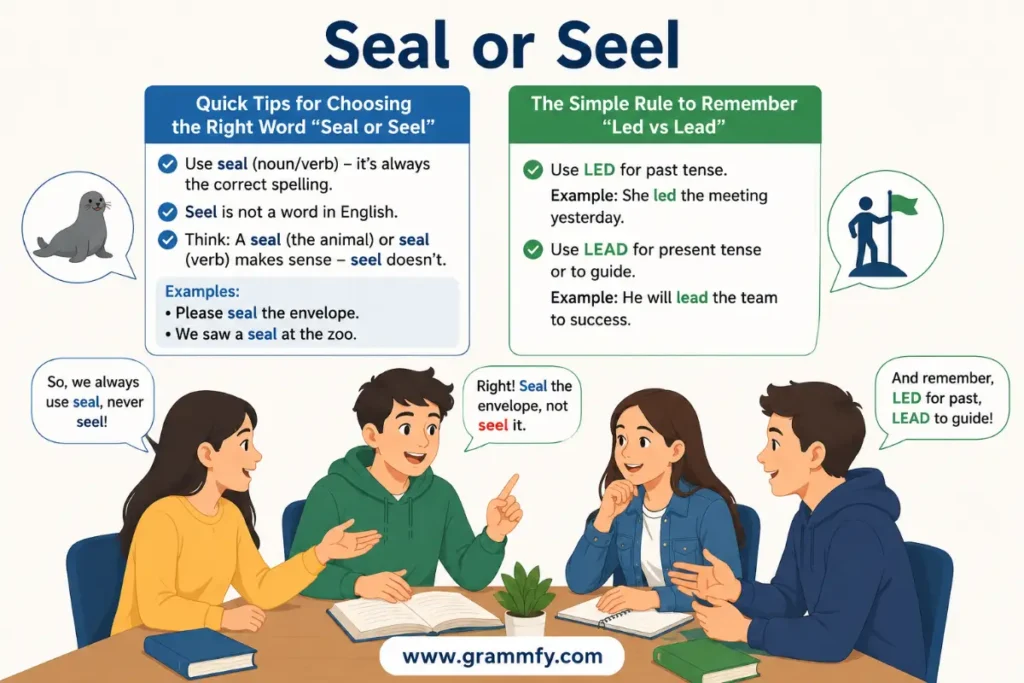
Quick Tips for Choosing the Right Word “Seal or Seel”
- Use seal when something must be closed tightly.
- Use close for everyday objects like books and doors.
- Use secure when safety is the main idea.
- Use confirm for appointments and information.
- Use finalize for projects, plans, or agreements.
- Use authenticate for official records.
- Avoid seel unless you’re discussing historical falconry.
- If you’re unsure between seal or seel, choose seal in modern English.
Conclusion
Choosing between seal or seel is much easier once you know the difference. Seal is the standard word used in modern English for closing something tightly, protecting it, making it official, or confirming an agreement. Seel, on the other hand, is a rare historical term connected with falconry and almost never appears in everyday writing or conversation. If you’re writing an email, school assignment, resume, business document, or text message, seal is almost always the correct choice. Remember to think about your context, pick the word that matches your meaning, and don’t be afraid to use simple language. Clear writing is always more effective than complicated writing.
Frequently Asked Questions
Is it seal or seel?
Seal is correct in almost every modern situation. When deciding between seal or seel, choose seal unless you’re writing about historical falconry.
What’s another way to say “seal”?
Common alternatives include close, secure, lock, fasten, confirm, finalize, and authenticate. The best choice depends on your context.
Is “seel” a real English word?
Yes. Seel is a real but very old English word related to falconry. Most modern English speakers never use it.
Can I use “seel” in everyday writing?
No. In normal writing, seal is almost always the correct spelling.
What’s the difference between seal and secure?
Seal means to close something tightly, while secure means to make something safe or protected. Sometimes both actions happen together.
How do I remember the difference between seal or seel?
Remember that seal is the everyday English word you’ll use for envelopes, containers, agreements, and official documents. Seel belongs mainly to historical texts.
