
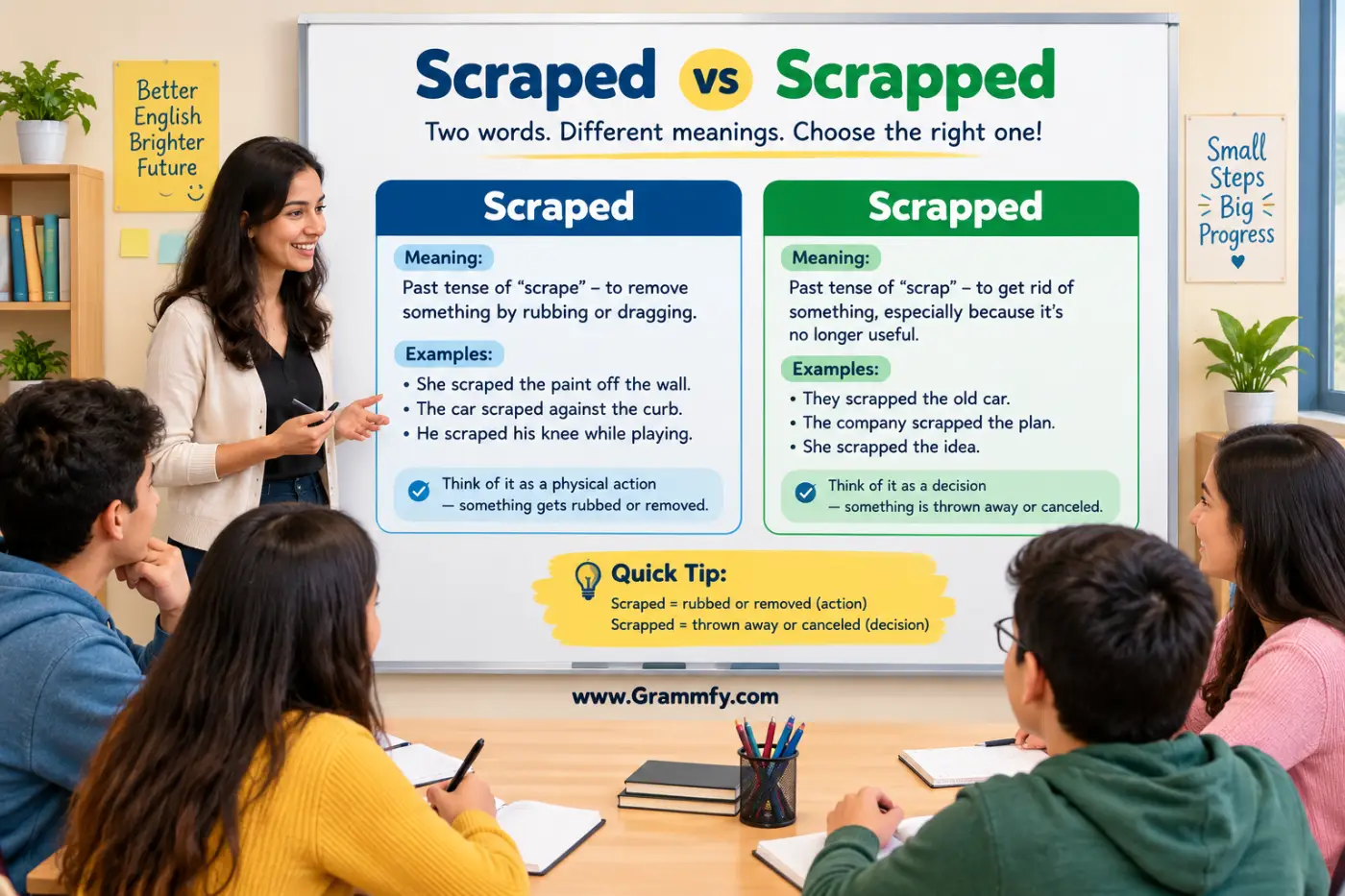
When you’re writing an email, essay, report, or text, Scraped vs Scrapped can be confusing. The two words look almost the same, but they come from different verbs and have different meanings. Using the wrong one can change your sentence completely.
Scraped usually means rubbed against something, removed something from a surface, or collected information. Scrapped usually means canceled, abandoned, thrown away, or broken up for parts.
- Answer box: Scraped means rubbed, removed, or collected, while scrapped means discarded, canceled, or abandoned. The key difference is that scraped comes from scrape, while scrapped comes from scrap.
The spelling difference is small but important. Scraped has one p, while scrapped has two. Once you understand what each verb means and how its spelling works, choosing the right word becomes much easier. This guide explains their meanings, origins, synonyms, examples, regional differences, common mistakes, and the best choice for different writing situations.
These words are easy to mix up, so read our guide to the difference between Forward vs Forwards to see their meanings and examples side by side.
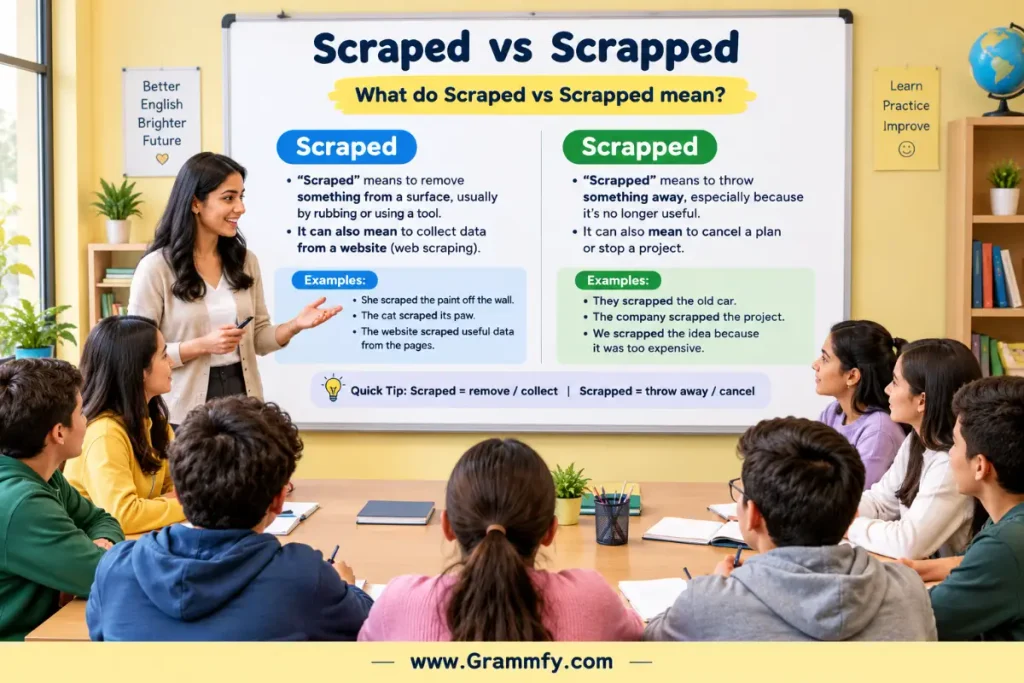
What do Scraped vs Scrapped mean?
The simplest way to understand Scraped vs Scrapped is to look at the verbs behind them.
- Scraped is the past tense and past participle of scrape.
- Scrapped is the past tense and past participle of scrap.
They describe very different actions.
| Word | Base verb | Basic meaning | Example |
|---|---|---|---|
| Scraped | scrape | Rubbed, removed, or collected | She scraped paint from the wall. |
| Scrapped | scrap | Discarded, canceled, or abandoned | The company scrapped the project. |
What does scraped mean?
Scraped means that something was rubbed against another surface or removed by rubbing, dragging, or using a tool.
For example:
- I scraped my knee on the pavement.
- She scraped the mud off her shoes.
- He scraped the paint from the door.
- The car scraped against the wall.
It can also have meanings connected to collecting or obtaining something with effort.
For example:
- The researcher scraped data from public websites.
- We scraped together enough money for the trip.
- He scraped by on a very small income.
So, scraped doesn’t always involve physical contact. Its meaning depends on the context.
What does scrapped mean?
Scrapped means that something was thrown away, canceled, abandoned, or removed because it was no longer wanted or useful.
For example:
- The old machine was scrapped.
- They scrapped the original plan.
- The company scrapped the project.
- The government scrapped the proposed rule.
The word can describe both physical objects and ideas.
A broken car can be scrapped because it is no longer worth repairing. A project can be scrapped because it is too expensive or no longer needed.
Why are scraped and scrapped easy to confuse?
The confusion comes mainly from spelling and pronunciation.
Both words begin with scrap-, and both describe actions in the past. However, their base verbs are different:
scrape → scraped
scrap → scrapped
There is also an important spelling clue:
- scraped = one p
- scrapped = two p’s
The silent e in scrape helps explain why the past form is scraped. The verb scrap does not end in silent e, so the final consonant is doubled before -ed.
Compare:
- scrape → scraped
- hope → hoped
- bake → baked
- scrap → scrapped
- stop → stopped
- plan → planned
This spelling pattern is one of the easiest ways to remember the difference.
Where did scraped come from?
The word scrape has a long history in English. It comes from Middle English and is related to older Scandinavian and Germanic forms associated with rubbing, scratching, or removing material from a surface.
The basic physical idea has stayed fairly stable. To scrape something is to move something hard across a surface, often removing a layer or leaving a mark.
Over time, English developed several figurative uses.
For example:
- scrape together means gather something with difficulty.
- scrape by means manage to survive or succeed with very little.
- scrape through can mean barely succeed or pass.
The modern word therefore has both physical and figurative meanings.
Where did scrapped come from?
The verb scrap is connected to the noun scrap, which can mean a small piece or leftover bit of material.
For example:
- a scrap of paper
- a scrap of metal
- a scrap of cloth
From the idea of something being treated as unwanted material, scrap developed the verb meaning to discard or abandon something.
That gives us:
scrap → scrapped
Today, scrapped is commonly used for old equipment, plans, projects, rules, proposals, and ideas.
In informal British English, scrap can also mean to fight. Therefore, scrapped may sometimes mean fought.
For example:
- The two boys scrapped after school.
This use is much less common in American English, where fought would usually sound more natural.
How do you spell Scraped vs Scrapped?
The spelling rule is simple:
| Base verb | Past tense |
|---|---|
| scrape | scraped |
| scrap | scrapped |
Why does scraped have one p?
Scrape already ends with silent e. When you add -d, the final e remains:
scrape + d = scraped
You don’t write scrapped when you mean the past form of scrape.
Why does scrapped have two p’s?
Scrap is a short verb ending in a consonant after a short vowel. When -ed is added, the final consonant is doubled:
scrap + ped = scrapped
The same pattern appears in:
- stop → stopped
- drop → dropped
- plan → planned
- rob → robbed
- shop → shopped
This makes the spelling easier to predict.
What is the pronunciation difference?
In common American English pronunciation, the vowel sound is different.
- scraped uses the long a sound found in words such as late and game.
- scrapped uses the short a sound found in words such as cat and map.
So the words sound noticeably different when spoken carefully.
A useful listening trick is to focus on the vowel:
scraped → long A
scrapped → short A
This distinction can help you recognize the correct word when you’re listening to someone speak.
What are the main meanings of scraped?
The word scraped has several common meanings. Understanding them helps you recognize it in different contexts.
Scraped means rubbed against something
This is one of the most common meanings.
- My shoe scraped the floor.
- The chair scraped against the table.
- The truck scraped the gate.
The idea is physical contact between surfaces.
Scraped means removed from a surface
You can scrape something off, away, or from a surface.
- She scraped the ice off the windshield.
- He scraped the sticker from the glass.
- I scraped the burned food from the pan.
“Here, someone uses pressure or a tool to remove something.”
Scraped means injured by rubbing
A person can scrape a body part.
- I scraped my elbow.
- She scraped her knee while running.
- The child scraped his hand on the wall.
“In these sentences, the rough surface damages the skin when it rubs against it.”
Scraped means collected information
In technology, scraped often describes data collection.
- The program scraped product information from public pages.
- The analyst scraped data from several websites.
- The tool scraped thousands of publicly available records.
This use is common in programming, research, search technology, and data analysis.
Scraped means barely succeeded
The phrase scrape by means to manage or survive with difficulty.
- We scraped by on a small budget.
- She scraped by in the final exam.
- He barely scraped through the interview process.
This meaning is figurative rather than physical.
What are the main meanings of scrapped?
Scrapped also has several common uses.
Scrapped means thrown away
A broken or unwanted object can be scrapped.
- The mechanic said the old engine should be scrapped.
- They scrapped the damaged equipment.
- The factory scrapped the defective parts.
The object is usually considered useless or not worth keeping.
Scrapped means canceled
A plan, event, or proposal can be scrapped.
- The school scrapped the old schedule.
- The company scrapped the launch.
- Officials scrapped the proposal.
In these examples, scrapped means the idea was stopped rather than physically thrown away.
Scrapped means abandoned
You can scrap an idea after deciding not to continue with it.
- We scrapped our original design.
- The team scrapped the first version.
- She scrapped her plan and started again.
Scrapped means broken up for materials
Old vehicles and machines are often scrapped so their metal and other useful materials can be recovered.
- The damaged car was scrapped.
- They scrapped the old train.
- The company scrapped several outdated machines.
Scrapped can mean fought in British English
In informal British English, scrap can mean to fight.
- The boys scrapped outside the shop.
Here, scrapped means fought. American speakers would normally use fought instead.
What are the best synonyms for Scraped vs Scrapped?
Not every synonym works in every sentence. The right replacement depends on the meaning.
Simple synonyms
| Word | Meaning | Tone | Example |
|---|---|---|---|
| Rubbed | Moved against a surface | Simple | The box rubbed against the wall. |
| Removed | Took something away | Neutral | She removed the old label. |
| Dragged | Pulled across a surface | Neutral | He dragged the chair across the floor. |
| Shaved | Removed a thin layer | Neutral | The tool shaved off the rough edge. |
| Collected | Gathered information or things | Neutral | The program collected the data. |
| Discarded | Threw something away | Neutral | They discarded the broken parts. |
| Canceled | Stopped something planned | Neutral | The company canceled the event. |
| Abandoned | Gave up an idea or plan | Neutral | They abandoned the project. |
Everyday synonyms
| Word | Meaning | Tone | Example |
|---|---|---|---|
| Scratched | Made a mark on a surface | Everyday | The branch scratched the car. |
| Brushed | Touched lightly | Everyday | Her sleeve brushed the wall. |
| Gathered | Collected things or information | Everyday | We gathered the necessary data. |
| Pulled off | Removed something | Informal | He pulled off the old sticker. |
| Tossed | Threw away casually | Informal | She tossed the damaged paper. |
| Dumped | Threw away or abandoned | Informal | They dumped the old furniture. |
| Dropped | Gave up or stopped | Everyday | He dropped the original idea. |
| Ditched | Abandoned something | Informal | We ditched the old plan. |
| Shelved | Put an idea aside | Neutral | The company shelved the proposal. |
Formal synonyms
| Word | Meaning | Tone | Example |
|---|---|---|---|
| Extracted | Removed something | Formal | The technician extracted the damaged part. |
| Abraded | Wore away by rubbing | Technical | The surface was abraded by friction. |
| Harvested | Collected data or information | Technical | Researchers harvested data from the study. |
| Retrieved | Obtained information or material | Formal | The system retrieved the records. |
| Discontinued | Stopped producing or offering | Formal | The company discontinued the product. |
| Terminated | Officially ended | Formal | The contract was terminated. |
| Rejected | Decided not to accept | Formal | The committee rejected the proposal. |
| Dismantled | Took apart | Formal | Workers dismantled the old structure. |
| Decommissioned | Removed from active service | Formal | The agency decommissioned the vessel. |
Slang and informal synonyms
| Word | Meaning | Tone | Example |
|---|---|---|---|
| Ditched | Abandoned | Slang/Informal | We ditched the old plan. |
| Junked | Threw away | Informal | He junked the broken computer. |
| Axed | Canceled or eliminated | Informal | The network axed the show. |
| Nixed | Rejected or canceled | Informal | The manager nixed the idea. |
| Canned | Canceled or fired | Informal | They canned the project. |
| Binned | Threw away or rejected | British informal | She binned the old notes. |
| Junked | Discarded as useless | Informal | The owner junked the damaged vehicle. |
| Called off | Canceled | Informal | They called off the meeting. |
These words overlap with scraped or scrapped only in certain contexts. For example, rubbed can replace scraped in some sentences, while canceled can replace scrapped when talking about a plan.
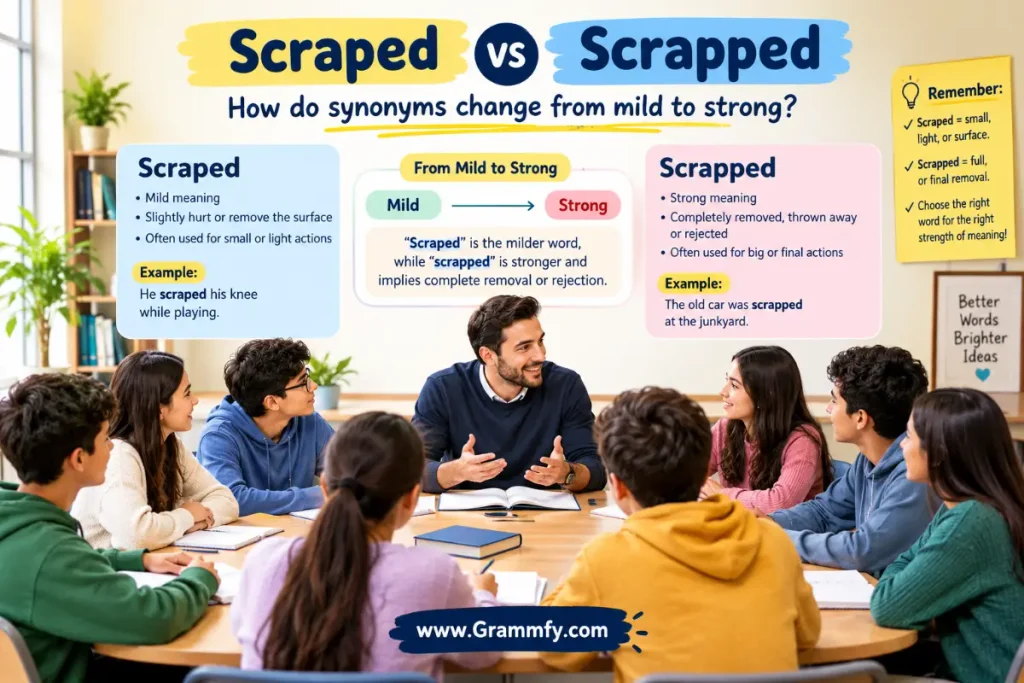
How do synonyms change from mild to strong?
Choosing a synonym isn’t only about grammar. Strength matters too.
Mild physical contact
For physical contact, the scale might look like this:
brushed → rubbed → scraped → scratched → abraded
- Brushed suggests light contact.
- Rubbed suggests repeated contact.
- Scraped suggests harder contact or removal.
- Scratched focuses on a visible mark or damage.
- Abraded sounds technical and often describes wear caused by friction.
Example:
- The box brushed the wall.
This sounds minor.
- The box scraped the wall.
This suggests stronger contact and possibly damage.
Mild abandonment to complete disposal
For plans or projects, you might see:
shelved → dropped → canceled → abandoned → scrapped
However, these aren’t perfect synonyms.
- Shelved often suggests a temporary pause.
- Dropped means someone decided not to continue.
- Canceled means something planned will not happen.
- Abandoned suggests giving up completely.
- Scrapped often suggests rejecting or getting rid of the entire idea or system.
The exact choice depends on what happened.
What parts of speech are Scraped vs Scrapped?
Both words are mainly forms of verbs, but they can sometimes work as adjectives.
- Scraped as a verb
Scraped is the past tense or past participle of scrape.
- She scraped the paint away.
- He has scraped his knee.
- We scraped the data from public pages.
- Scraped as an adjective
It can describe something that has been scraped.
- He has a scraped knee.
- The scraped surface looked rough.
In these cases, the word describes a condition.
- Scrapped as a verb
Scrapped is the past tense or past participle of scrap.
- They scrapped the plan.
- The machine was scrapped.
- We have scrapped the old system.
- Scrapped as an adjective
It can also describe something that has been discarded.
- The scrapped vehicle was taken away.
- The team reviewed the scrapped proposal.
The verb use is much more important for everyday grammar.
Is Scraped vs Scrapped more common in American English?
Both are standard American English words, but they appear in different situations.
Scraped is common when talking about:
- skin injuries
- surfaces
- paint
- dirt
- physical contact
- data collection
- difficult financial situations
Scrapped is common when talking about:
- canceled plans
- abandoned projects
- unwanted equipment
- old vehicles
- discontinued ideas
- rejected proposals
The context usually tells you which word is correct.
How are Scraped vs Scrapped used in British English?
The main meanings are the same in British English.
There is one notable difference: scrap meaning fight is more familiar in British informal usage.
For example:
- The two teenagers scrapped outside the pub.
An American speaker would more naturally say: “The two teenagers fought outside the store”.
British English also commonly uses binned to mean thrown away or discarded.
For example:
- She binned the old draft.
In American English, threw away, discarded, or junked may sound more natural.
The spelling of scraped and scrapped does not change between American and British English.
Which word should you use on a resume Scraped vs Scrapped?
On a resume, precision and professional tone matter.
Use scraped when you’re describing data collection or physical work.
For example:
- Scraped public web data to support market research.
This is appropriate if data scraping was genuinely part of the job.
Use scrapped when describing a project or process that was abandoned.
For example:
- Recommended changes that helped the team avoid investing further in a scrapped project.
However, scrapped may sound slightly informal in some professional contexts. Depending on the situation, discontinued, abandoned, or canceled may be more polished.
Which resume sentence sounds stronger?
Less formal:
- Scrapped an old process.
More professional:
- Discontinued an outdated process and introduced a more efficient workflow.
The second sentence explains the action more clearly and gives the reader more useful information.
Which word should you use in an essay Scraped vs Scrapped?
In an essay, choose based on the exact action.
Use scraped for physical removal, contact, injury, or data collection.
- The researchers scraped information from publicly available sources.
Use scrapped for cancellation or abandonment.
- The committee scrapped the proposal after reviewing the costs.
Academic writing benefits from precise verbs. Don’t choose one simply because it looks or sounds similar to the other.
Which word should you use in texting Scraped vs Scrapped?
Texting is more casual, but the meanings still matter.
You might write:
- I scraped my knee today.
This means you injured your knee.
Or:
- We scrapped the trip.
This means you canceled or abandoned the trip.
You could also say: “We scrapped the idea”.
That means you decided not to use the idea.
A common mistake is writing scraped the plan when you mean scrapped the plan.
Remember:
- scraped my knee
- scrapped my plan
Which word should you use in an email Scraped vs Scrapped?
Professional emails need clear wording.
For physical removal: “I scraped the old label from the equipment”.
For cancellation: “We scrapped the original schedule because of the new requirements”.
If the email is formal, you can sometimes replace scrapped with canceled, abandoned, or discontinued.
For example:
- We canceled the original schedule because of the new requirements.
This can sound more direct and professional.
Which word should you use when speaking Scraped vs Scrapped?
In everyday speech, both words are useful.
Use scraped for physical contact or removal: “I scraped my car against the garage door”.
Use scrapped for plans and objects that are discarded: “We scrapped the old plan”.
The quickest way to choose is to ask what happened.
Did something rub or get removed?
Use scraped.
Did someone throw away, cancel, or abandon something?
Use scrapped.
What are 15 real-life examples of scraped?
Here are examples showing different meanings.
- I scraped my knee when I fell off my bike.
- The ladder scraped the side of the house.
- She scraped the mud from her boots.
- He scraped the burnt food from the bottom of the pan.
- The chair scraped across the wooden floor.
- The mechanic scraped the rust from the metal surface.
- My car scraped the curb while I was parking.
- The child scraped his elbow on the pavement.
- She scraped the old paint off the door.
- The developer scraped public product information from several websites.
- We scraped together enough money for the repair.
- He scraped by during his first year at college.
- The tool scraped against the metal.
- They scraped the ice from the windshield.
- The researcher scraped data for a statistical analysis.
Notice that these examples cover physical contact, removal, injury, technology, and figurative expressions.
What are 15 real-life examples of scrapped?
Now compare them with these examples.
- The company scrapped the old marketing plan.
- They scrapped the project after the budget was cut.
- The mechanic said the damaged car should be scrapped.
- The school scrapped its outdated policy.
- We scrapped our original travel plans.
- The manufacturer scrapped the defective machines.
- Officials scrapped the proposal after public criticism.
- The team scrapped the first design and started again.
- The network scrapped the show after one season.
- They scrapped the damaged aircraft for parts.
- The company scrapped its plan to open another office.
- She scrapped the draft and rewrote the report.
- The city scrapped the proposed parking fee.
- The factory scrapped several outdated machines.
- The boys scrapped in the schoolyard.
The final example uses the British informal meaning of scrapped: fought.
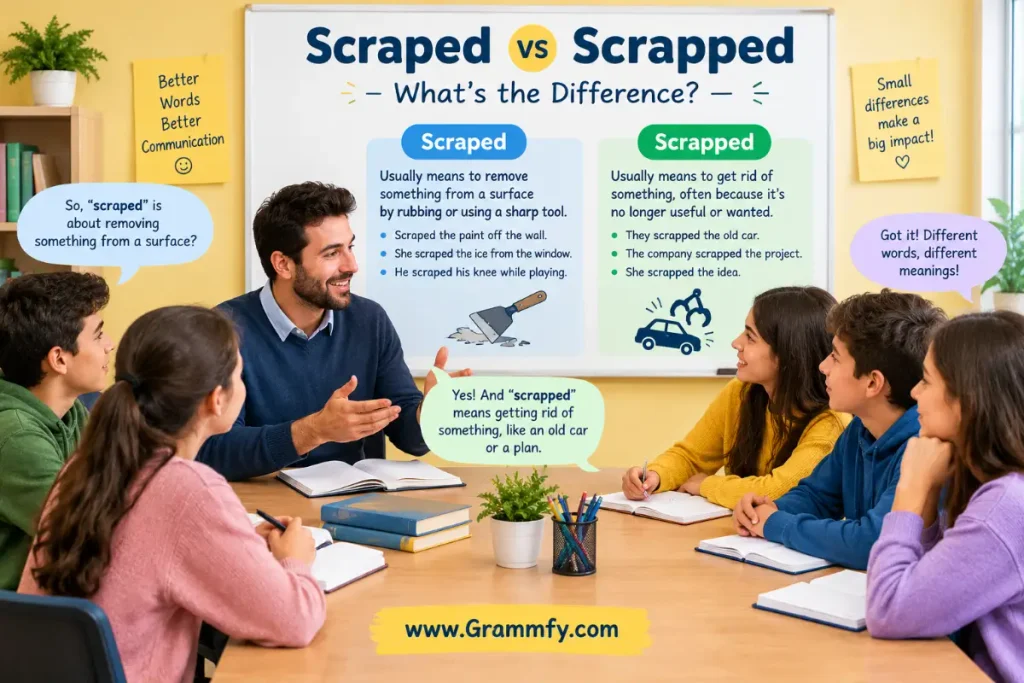
Scraped vs scratched — what’s the difference?
Scraped and scratched can overlap, but they focus on different actions.
| Scraped | Scratched |
|---|---|
| Often involves rubbing or removing material | Usually involves making a mark or cut |
| Can remove a layer | Usually leaves a visible line or mark |
| Can describe skin injuries | Can describe skin, glass, paint, or surfaces |
| Often suggests rough contact | Often suggests a narrow mark |
Compare:
- I scraped my knee on the pavement.
This suggests the skin rubbed against a rough surface.
- I scratched my knee with my fingernail.
This suggests a narrower mark caused by something sharp or pointed.
Both words can describe damage, but the type of contact is different.
Scraped vs scooped — what’s the difference?
These verbs both describe removing something, but the tools and movements differ.
Scraped usually means removing material by dragging a flat or sharp edge across a surface. “She scraped the frosting from the bowl”.
Scooped usually means lifting something with a spoon, scoop, or curved tool. “She scooped the ice cream into a bowl”.
A useful rule is:
scrape = drag across
scoop = lift out
The distinction becomes especially clear when describing cooking, cleaning, or construction.
Scrapped vs canceled — what’s the difference?
These words can sometimes mean the same thing, but they aren’t always interchangeable.
Canceled usually means something that was scheduled or planned will not happen. “The airline canceled the flight”.
Scrapped often suggests that a plan, project, system, or idea was abandoned completely. “The company scrapped the project”.
You can say:
- The meeting was canceled.
But scrapped would sound less natural unless you’re emphasizing that the entire planned activity was abandoned.
Scrapped vs discarded — what’s the difference?
Both can mean getting rid of something.
Discarded is a broad word. It means something was rejected or thrown away.
Scrapped often suggests that something was considered useless, unwanted, or no longer worth keeping. It can also suggest breaking something down for parts or materials.
Compare:
- She discarded the old receipt.
This is neutral.
- They scrapped the old machine.
This suggests the machine was no longer useful and may be dismantled or sent for recycling.
Scrapped vs abandoned — what’s the difference?
Abandoned focuses on stopping something or leaving it behind.
Scrapped often suggests a more final decision to get rid of the idea, plan, object, or project.
Compare:
- The team abandoned the project.
The team stopped working on it.
- The team scrapped the project.
The project was rejected or canceled entirely.
Both can work, but scrapped often sounds more decisive.
What are the most common mistakes with Scraped vs Scrapped?
Mistake 1: Writing “scrapped my knee”
If you mean that you injured your knee by rubbing it against a rough surface, use scraped.
Incorrect:
I scrapped my knee.
Correct:
- I scraped my knee.
Mistake 2: Writing “scraped the plan”
If you mean you canceled or abandoned a plan, use scrapped.
Incorrect:
- We scraped the plan.
Correct:
- We scrapped the plan.
Mistake 3: Forgetting the second p
If you’re using the verb scrap, remember that its past form is scrapped.
Incorrect:
- The project was scraped.
Correct:
- The project was scrapped.
The first sentence could be interpreted as saying someone physically scraped the project or collected something related to it, which probably isn’t what you mean.
Mistake 4: Using scrapped for every kind of removal
Scrapped does not simply mean “removed” in every context.
For example:
- She scraped the paint from the wall.
This is correct because the paint was physically removed using a scraping action.
You wouldn’t normally say: “She scrapped the paint from the wall”.
That changes the meaning.
Mistake 5: Assuming scraped always means physical contact
In technology, scraped can refer to collecting data.
- The software scraped information from public websites.
This doesn’t mean the software physically rubbed a website.
Mistake 6: Using scrapped when canceled is clearer
Sometimes canceled is the better choice.
- The flight was canceled.
This is clearer than:
- The flight was scrapped.
Scrapped is better when you’re talking about abandoning a plan, proposal, project, system, or idea.
When should you NOT use scraped?
Don’t use scraped when your intended meaning is simply “canceled.”
Incorrect:
- The company scraped the project.
If you mean the company abandoned the project, write: “The company scrapped the project”.
Also avoid scraped when you mean “threw away” unless an actual scraping action is involved.
When should you NOT use scrapped?
Don’t use scrapped when something physically rubbed against a surface.
Incorrect:
- I scrapped my elbow on the wall.
Correct:
- I scraped my elbow on the wall.
Also avoid scrapped when you mean ordinary physical removal by scraping.
- He scraped the mud off his shoes.
Not:
- He scrapped the mud off his shoes.
What are the antonyms of scraped and scrapped?
The opposite of each word depends on its specific meaning.
Antonyms for scraped
When scraped means physically removed:
- applied
- added
- covered
- coated
- attached
- restored
Example:
- He scraped the paint off.
Opposite idea:
- He applied a new coat of paint.
When scraped means collected data, possible opposites include:
- ignored
- left uncollected
- excluded
There isn’t one universal antonym for every use.
Antonyms for scrapped
When scrapped means discarded:
- kept
- retained
- preserved
- stored
When scrapped means canceled:
- approved
- continued
- adopted
- implemented
- maintained
Example:
- The committee scrapped the proposal.
Opposite:
- The committee approved the proposal.
How can you remember the difference quickly?
Use this simple memory trick:
Scraped: Think of scraping paint off a wall.
Scrapped: Think of scrapping an old plan or a broken car.
One P: scraped = scrape
Think of a surface.
scrape → scraped
Imagine scraping paint from a wall.
Two Ps: scrapped = scrap
Think of something being thrown away.
scrap → scrapped
Imagine an old car being sent to the scrapyard.
You can also remember:
- Scraped = rubbed or removed.
- Scrapped = rejected or discarded.
That short rule handles most everyday situations.
What should you check before choosing the word?
Ask yourself these questions:
- Did something rub against a surface?
Choose scraped. - Was something removed by rubbing or dragging?
Choose scraped. - Was information collected from a website or source?
Choose scraped. - Was a plan canceled or abandoned?
Choose scrapped. - Was an old object thrown away or dismantled?
Choose scrapped. - Did someone fight, especially in informal British English?
Scrapped may mean fought.
This quick test can solve most spelling and usage problems.
Can scraped and scrapped ever appear in the same sentence?
Yes. They can describe two different actions in one sentence.
For example:
- The workers scraped the paint from the old machine before the company scrapped it.
Here, scraped means removed paint, while scrapped means the machine was discarded.
Another example:
- She scraped the old label off the box before the store scrapped the damaged packaging.
Again, the first action is physical removal. The second is disposal.
These sentences show why the spelling matters. Changing one word can change the meaning of the entire sentence.
How does data scraping use the word scraped?
In technology, scraped has a specialized meaning.
Data scraping means collecting information from a digital source, often a website, using software or automated tools.
For example:
- Here, scraped doesn’t mean physically rubbing anything. It describes extracting information.
Common related terms include:
- web scraping
- data scraping
- website scraping
- scraped data
- data extraction
- crawler
- automated collection
The word is especially common in programming, data science, research, and digital marketing.
However, scrapped data means something different. It usually suggests data that has been discarded or rejected.
Compare:
- We scraped the data from public pages.
Meaning: We collected the data.
- We scrapped the data.
Meaning: We discarded or abandoned the data.
That is a major difference.
How can the spelling rule help with other verbs?
The spelling difference between scraped and scrapped follows common English patterns.
Verbs ending in silent e
Many verbs ending in silent e simply add -d:
- scrape → scraped
- bake → baked
- smile → smiled
- hope → hoped
- close → closed
Short verbs ending in consonant-vowel-consonant
Many short verbs double the final consonant before -ed:
- scrap → scrapped
- stop → stopped
- plan → planned
- drop → dropped
- shop → shopped
This is why scrapped has two p’s while scraped has one.
What are the key differences in one table?
| Feature | Scraped | Scrapped |
|---|---|---|
| Base verb | scrape | scrap |
| Past form | scraped | scrapped |
| P’s | One | Two |
| Main idea | Rubbed or removed | Discarded or canceled |
| Physical use | Very common | Possible with discarded objects |
| Data use | Common | Usually means data was discarded |
| Plan/project use | Usually incorrect | Very common |
| Injury use | Common | Usually incorrect |
| British “fight” meaning | No | Yes, informal |
| Example | She scraped her knee. | They scrapped the plan. |
Quick examples to test yourself
Choose scraped or scrapped in each sentence.
- I ___ my knee while playing soccer.
- The company ___ the project.
- She ___ the paint off the door.
- They ___ the old machine.
- The program ___ public data.
- We ___ our original plan.
- His car ___ the garage wall.
- The committee ___ the proposal.
- He ___ the mud from his shoes.
- The damaged vehicle was ___ for parts.
Answers
- scraped
- scrapped
- scraped
- scrapped
- scraped
- scrapped
- scraped
- scrapped
- scraped
- scrapped
A useful pattern appears throughout the exercise: physical rubbing or collection usually points to scraped, while cancellation or disposal points to scrapped.
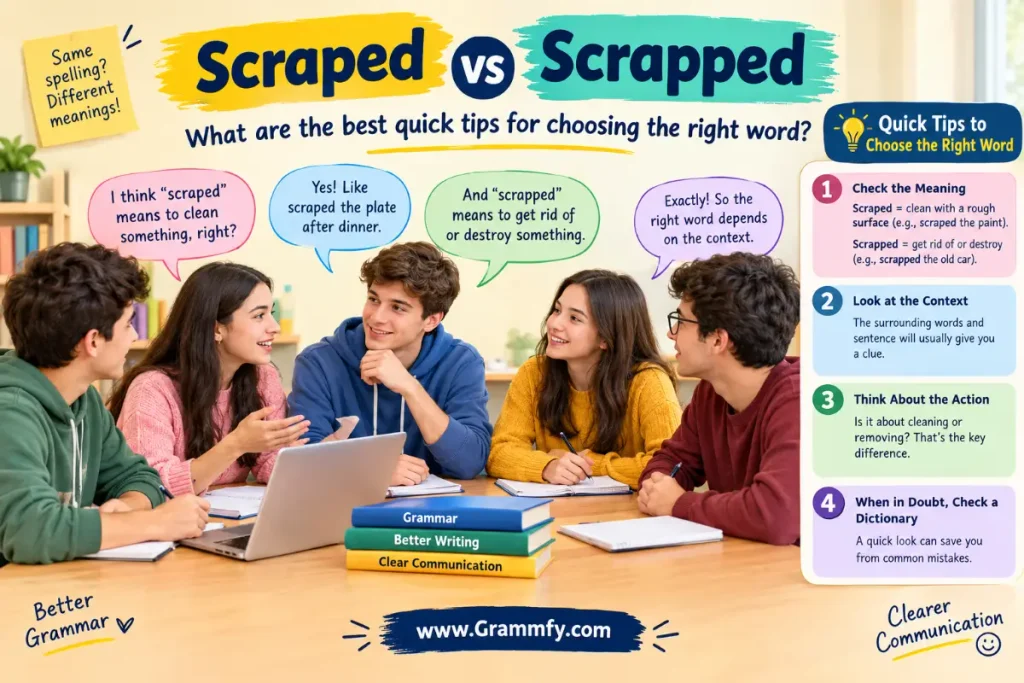
What are the best quick tips for choosing the right word?
Keep these rules nearby when you’re unsure.
- Scraped comes from scrape.
- Scrapped comes from scrap.
- Scraped has one p.
- Scrapped has two p’s.
- Use scraped for rubbing or removing.
- Use scraped for collecting data.
- Use scrapped for canceling plans.
- Use scrapped for abandoning projects.
- Use scrapped for throwing away old equipment.
- In British informal English, scrapped can mean fought.
- Don’t choose based only on how similar the words look.
- Think about the action first, then choose the spelling.
Why does the difference matter?
A single letter can change the meaning of a sentence.
Consider:
The company scraped the project.
This sounds unusual because a project isn’t normally something you physically scrape.
Now compare:
The company scrapped the project.
The meaning is immediately clear: the company canceled or abandoned it.
Another pair:
I scraped my knee.
This means your knee was injured through contact with a rough surface.
I scrapped my knee.
This is not the normal expression in American English.
The difference isn’t just a spelling issue. It is a vocabulary and meaning issue.
Conclusion
The easiest way to remember Scraped vs Scrapped is to focus on the base verbs. Scraped comes from scrape and usually describes rubbing, removing material, injuring the skin, or collecting information. Scrapped comes from scrap and usually means canceled, abandoned, discarded, or broken up for parts.
The spelling gives you a useful clue: scraped has one p, while scrapped has two. When you’re unsure, ask what actually happened. If something was rubbed or removed, choose scraped. If a plan, project, or object was rejected or thrown away, choose scrapped. With that simple distinction, you’ll be able to use both words accurately in emails, essays, professional writing, and everyday conversation.
Frequently Asked Questions
What is the difference between scraped and scrapped?
Scraped means rubbed, removed, or collected, while scrapped means discarded, canceled, or abandoned. The two words come from different verbs: scrape and scrap.
Is it scraped my knee or scrapped my knee?
The correct phrase is scraped my knee. You scrape your knee when your skin rubs against a rough surface.
Is it scraped the project or scrapped the project?
The correct phrase is scrapped the project when you mean canceled or abandoned it. Scraped is normally used for rubbing, removing material, or collecting information.
What’s another way to say scrapped?
Another way to say scrapped is canceled, abandoned, discarded, discontinued, shelved, or rejected, depending on the context. For example, “They scrapped the plan” can become “They abandoned the plan.”
Is scraped data the same as scrapped data?
No. Scraped data is data that has been collected, often from websites, while scrapped data would normally mean data that has been discarded or rejected.
Why does scrapped have two p’s?
Scrapped has two p’s because the base verb scrap doubles its final consonant before adding -ed. By contrast, scrape becomes scraped because it ends in silent e.
Can scrapped mean fought?
Yes, scrapped can mean fought in informal British English. American English usually uses fought instead.

Tylerbrooks is a US-based English grammar writer and contributor at Grammfy. He writes helpful articles about grammar, spelling, commonly confused words, and vocabulary. His goal is to explain English topics in simple language with clear examples and practical tips. Through his articles, he helps readers improve their writing and everyday English skills.
1 thought on “Scraped vs Scrapped: Simple Difference Explained”