
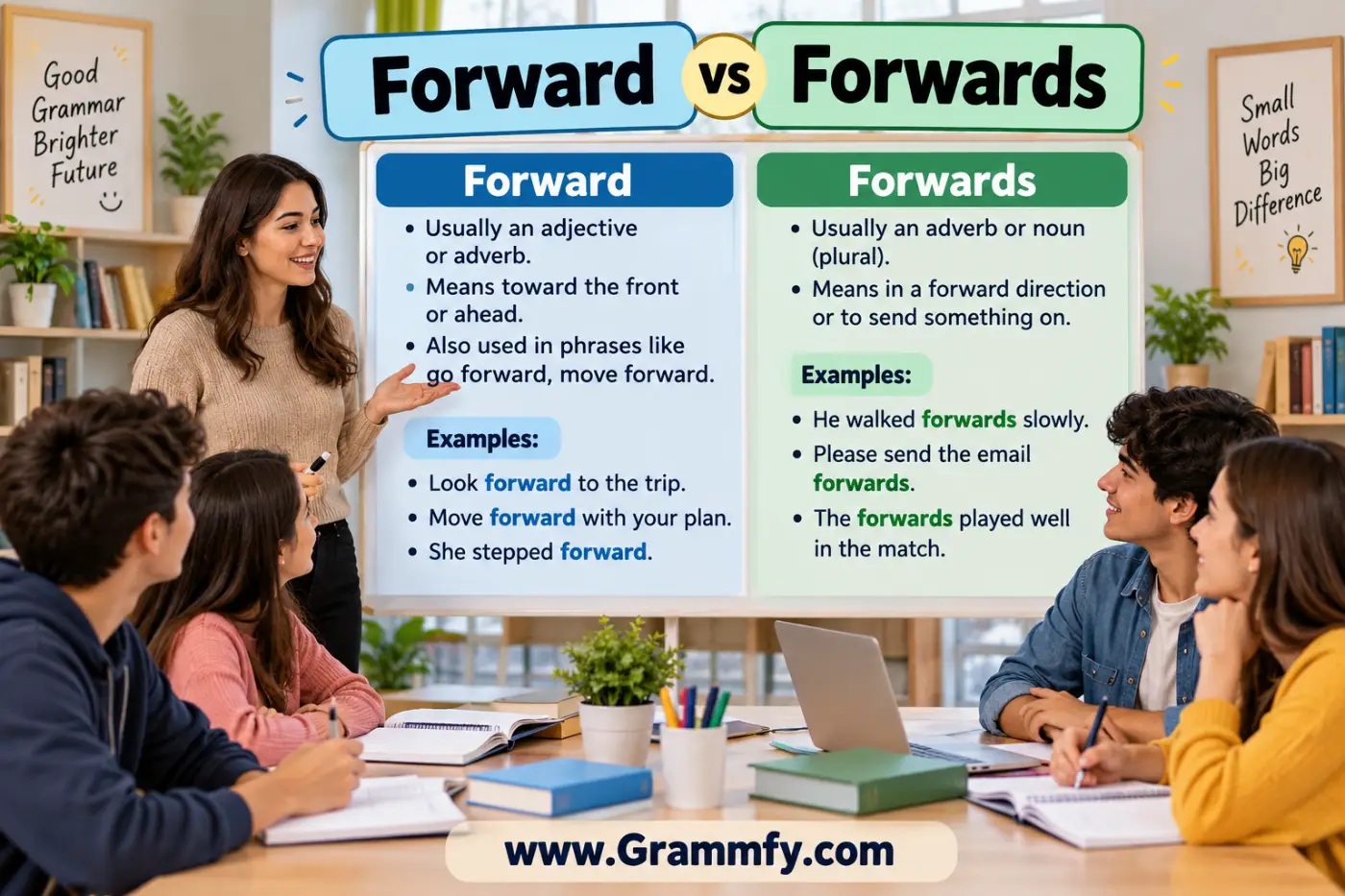
When you’re writing an email, text, or essay, you may stop and wonder whether to write forward vs forwards. Both words are common, and both can describe movement toward the front or a future point. The tricky part is knowing which form sounds natural in different situations.
Forward and forwards can both mean toward the front or toward a future point, but forward is more widely preferred in American English, while forwards is especially common in British English.
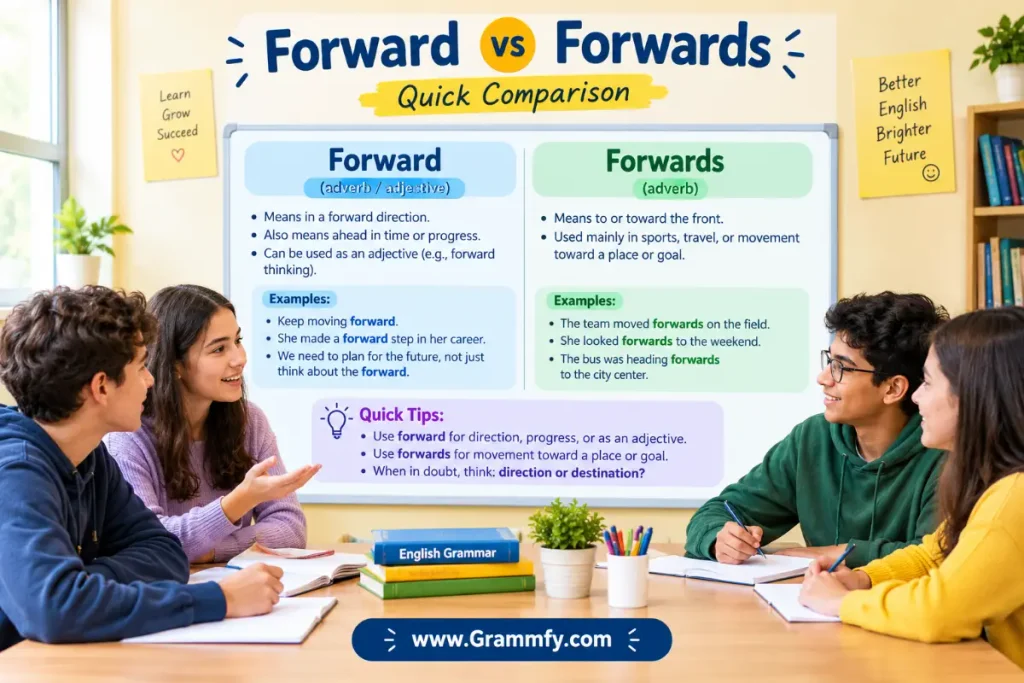
- Answer box: In US English, forward is usually the preferred form. Forwards is also correct, especially in British English, and is often used as an adverb.
The difference is usually small, but context can affect which word sounds best. This guide explains the meanings, origins, synonyms, regional differences, grammar rules, examples, common mistakes, and the best choice for emails, essays, resumes, texting, and everyday speech.
These words are easy to mix up, so read our guide to the difference between Addition vs Edition to see their meanings and examples side by side.
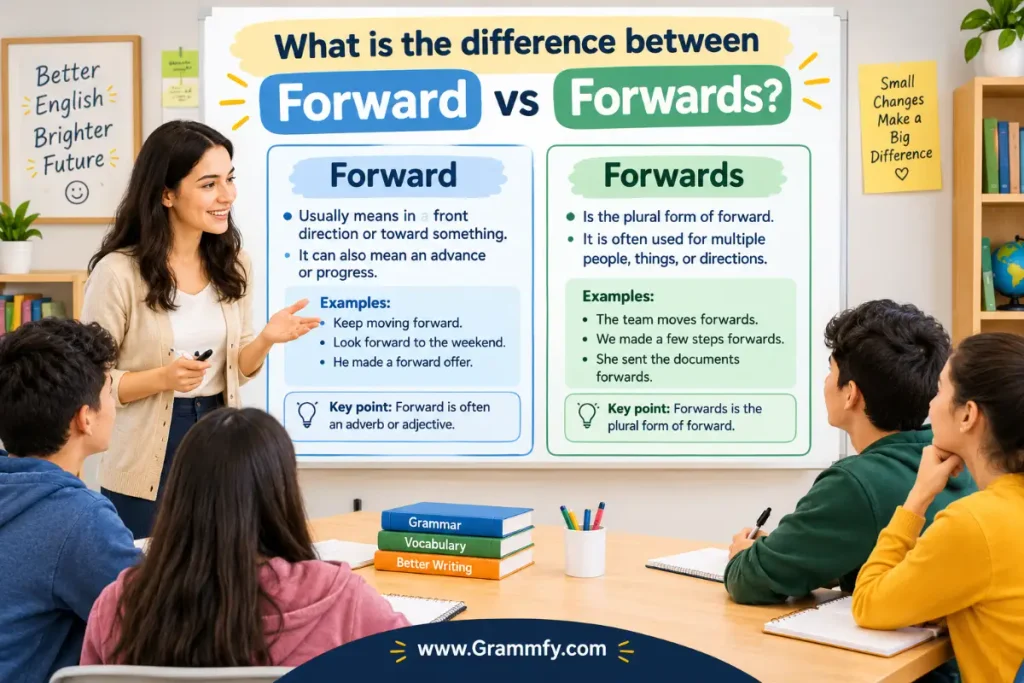
What is the difference between Forward vs Forwards?
The main difference between forward vs forwards is often one of style and regional preference rather than meaning.
Both words can describe movement toward the front.
- The child stepped forward.
- The child stepped forwards.
Both sentences can be correct.
However, forward is more common in American English. Forwards is more common in British English, although British speakers also use forward.
The words can also describe progress toward a future time:
- We need to move forward with the project.
- We need to move forwards with the project.
Again, both can work, but forward is often the safer choice for international and American audiences.
| Word | Basic meaning | Common preference |
|---|---|---|
| Forward | Toward the front, ahead, or toward the future | Very common in US and UK English |
| Forwards | Toward the front or ahead | Especially common in UK English |
Is Forward vs Forwards more common in American English?
Forward is generally the better choice in American English.
For example:
- Please move forward.
- We should look forward to the meeting.
- The car moved forward.
- Let’s move forward with the plan.
American English commonly drops the final -s from directional adverbs.
This pattern also appears in other words, such as backward rather than backwards.
That doesn’t make forwards wrong. It simply makes forward the more natural default for many US English situations.
What does forward mean?
Forward has several meanings, but its basic idea is movement or direction toward the front.
It can be an adverb, adjective, noun, or verb.
Forward as an adverb
As an adverb, forward describes movement toward the front or ahead.
Examples:
- She stepped forward.
- The dog ran forward.
- Move forward slowly.
- He leaned forward.
- The boat moved forward.
It can also describe progress:
- The project is moving forward.
- We need to move forward after the discussion.
- The company is looking forward to the next stage.
Forward as an adjective
As an adjective, forward can describe something positioned toward the front or something relating to future progress.
Examples:
- The forward section of the plane was crowded.
- She took the forward seat.
- We made a forward plan for the next year.
It can also describe someone who is unusually confident or direct, although this use can sometimes sound negative.
For example:
- His forward manner surprised the guests.
Forward as a verb
As a verb, forward means to send something onward, especially a message or email.
Examples:
- Please forward the email to me.
- I forwarded the document to the manager.
- Can you forward this message?
This verb use is especially common in email and workplace communication.
Forward as a noun
As a noun, forward has several specialized uses.
In sports, a forward is a player whose position is toward the attacking end.
In publishing, forward can refer to a short introductory section of a book, although foreword is the usual spelling for that meaning.
That distinction is important because forward and foreword are different words.
What does forwards mean?
Forwards is mainly used as an adverb.
It means toward the front, ahead, or in the direction of progress.
Examples:
- The children ran forwards.
- She leaned forwards.
- He took a step forwards.
- The train moved forwards.
It can also describe progress:
- We need to move forwards.
- The discussion is moving forwards.
- The team is looking forwards to the next challenge.
The meaning is usually the same as forward when forwards is used as a directional adverb.
Where did forward come from?
The word forward has very old Germanic roots. It developed from Old English forms connected with the ideas of being toward the front or moving ahead.
The word contains the basic concept of fore, meaning front.
That connection still appears in modern English:
- fore = front
- forward = toward the front
- beforehand = earlier
- forefront = leading position
The word gradually developed additional meanings related to progress, future movement, sending something onward, and being positioned toward the front.
Where did forwards come from?
Forwards is simply the adverbial form with -s.
English has historically used both forms, and regional preferences developed over time.
British English often keeps the -s in directional adverbs:
- forwards
- backwards
- towards
- afterwards
American English often prefers forms without the final -s:
- forward
- backward
- toward
- afterward
These differences are mainly matters of usage and style, not completely different meanings.
What are the main synonyms for “Forward vs Forwards”?
The best synonym depends on whether you’re talking about physical movement, progress, time, or communication.
| Word | Meaning | Tone | Example |
|---|---|---|---|
| ahead | Toward a place or future point | Neutral | Keep moving ahead. |
| onward | Continuing forward | Neutral/Formal | The travelers moved onward. |
| aheadward | Toward the front or ahead | Rare/Formal | The motion was aheadward. |
| forth | Forward or outward | Formal/Literary | He stepped forth. |
| toward | In the direction of something | Neutral | Walk toward the door. |
| frontward | Toward the front | Formal/Rare | The movement was frontward. |
| before | At an earlier point | Neutral | Think before acting. |
| ahead of | In front of or earlier than | Everyday | She arrived ahead of us. |
| on | Continuing | Everyday | We must carry on. |
| onward | Continuing ahead | Formal | They marched onward. |
| progressively | Gradually moving ahead | Formal | The system improved progressively. |
| progress | Move toward a goal | Neutral | The project is progressing. |
| advance | Move ahead or make progress | Neutral/Formal | The team advanced quickly. |
| proceed | Continue or move ahead | Formal | Please proceed to the next room. |
| continue | Keep doing something | Neutral | Continue forward. |
| advance | Move toward a later stage | Formal | The work advanced quickly. |
| send on | Pass something to another person | Everyday | Send the message on. |
| redirect | Send somewhere else | Formal | Redirect the email. |
| pass along | Give information to another person | Everyday | I’ll pass along the message. |
| send | Cause something to go somewhere | Neutral | Send the file to me. |
| relay | Pass information onward | Formal | Please relay the information. |
| ahead | In a more advanced position | Neutral | We are ahead of schedule. |
| forth | Forward or outward | Literary | He went forth confidently. |
| upward | Toward a higher position | Neutral | The elevator moved upward. |
| futureward | Toward the future | Rare | The discussion moved futureward. |
Not all of these words can replace forward in every sentence.
For example, proceed can replace “move forward” in a formal instruction, but it doesn’t always work when you’re describing physical movement.
Which synonyms work best in everyday English?
For everyday speech, the most useful alternatives are:
- ahead
- on
- toward
- continue
- move ahead
- move on
- pass along
- send on
Examples:
- Let’s move ahead with the plan.
- We should move on now.
- Please pass along the message.
- I’ll send on the email.
These options are clear and natural.
Which synonyms work best in formal writing?
For formal writing, you may use:
- proceed
- advance
- onward
- progressively
- relay
- transmit
- continue
- move ahead
For example:
- The committee decided to proceed with the proposal.
Or:
- The research continued to advance despite several challenges.
However, don’t replace simple words with complicated ones just to sound formal. Forward is already appropriate in professional writing.
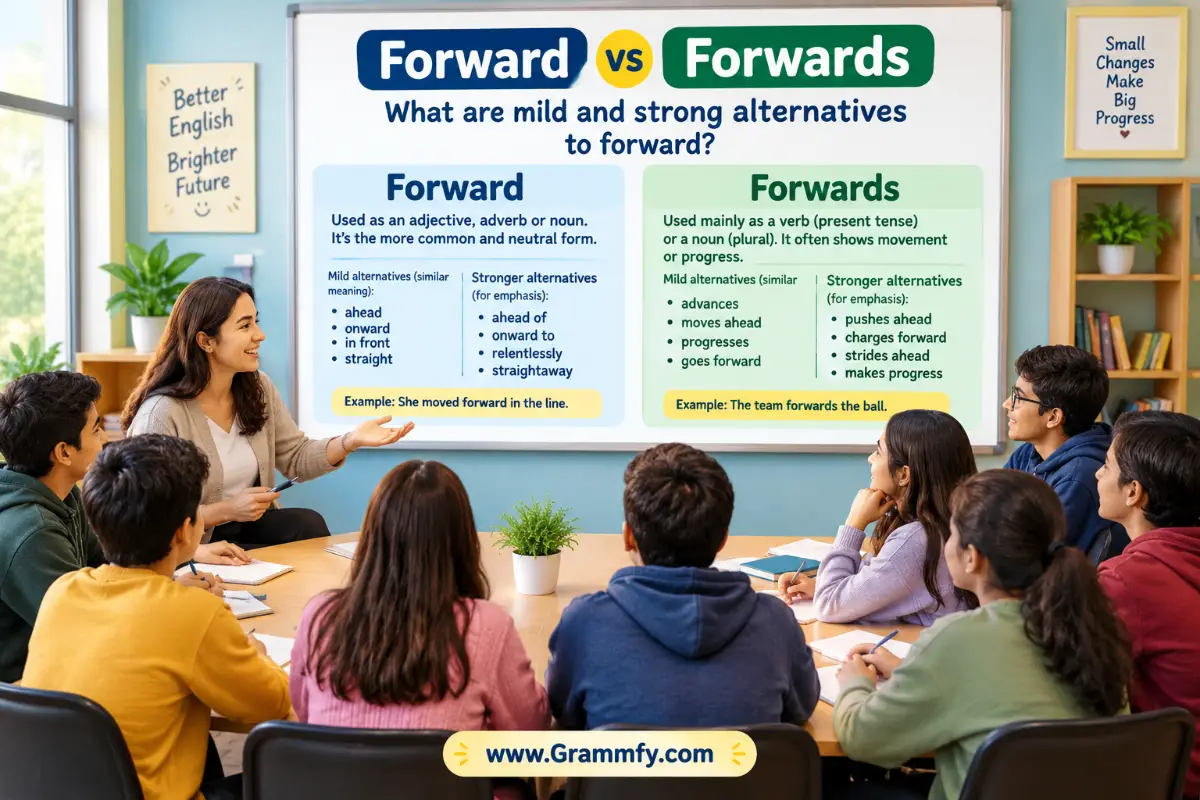
What are mild and strong alternatives to forward?
The intensity of a synonym changes the feeling of a sentence.
Mild alternatives
Use these for simple movement or progress:
- ahead
- on
- toward
- continue
Examples:
- Let’s move ahead with the plan.
- Please continue forward.
Medium-strength alternatives
These suggest noticeable progress:
- advance
- proceed
- move onward
- progress
Examples:
- The project advanced after the meeting.
- The team proceeded with the next stage.
Stronger alternatives
These can suggest major progress or a significant step:
- accelerate
- push ahead
- surge ahead
- drive forward
Examples:
- The company decided to push ahead with the expansion.
- The team surged ahead after the second round.
These phrases can sound more energetic than the neutral forward.
What part of speech is forward?
One reason forward can be confusing is that it can function as several parts of speech.
| Part of speech | Example |
|---|---|
| Adverb | She stepped forward. |
| Adjective | He sat in the forward section. |
| Verb | Please forward the email. |
| Noun | The forward scored twice. |
Forwards, by contrast, is normally used as an adverb.
This is one reason forward is more flexible.
Can forward be a verb?
Yes.
In workplace English, forward commonly means to send an email or message to another person.
For example:
- Please forward the invoice to Sarah.
Past tense:
- I forwarded the invoice yesterday.
Present participle:
- I’m forwarding the email now.
Notice that forwards does not work as the verb in this meaning.
You would not normally write:
- Please forwards the email.
Instead, write:
- Please forward the email.
Forward vs forwards in American English
In American English, forward is usually the preferred form.
Examples:
- Move forward.
- Step forward.
- Look forward to the weekend.
- The project is moving forward.
- We need to move forward with the plan.
American English also commonly uses:
- backward
- toward
- afterward
instead of:
- backwards
- towards
- afterwards
This doesn’t mean the forms with -s are automatically incorrect. It means the forms without -s are often the more natural US choice.
Forward vs forwards in British English
British English frequently uses forwards, especially when describing physical movement.
For example:
- Step forwards.
- Move forwards.
- Lean forwards.
- The car moved forwards.
However, forward is also perfectly normal in British English.
For example:
- I look forward to hearing from you.
- We need to move forward with the plan.
So British English doesn’t require forwards.
This is why forward is a useful international choice when you’re unsure about regional preference.
Is forward vs forwards better for a resume?
For a resume, forward is usually the safer choice, especially when writing for a US employer.
Examples:
- I helped move the project forward.
- My leadership skills helped the team move forward.
- I developed strategies to drive the company forward.
The word sounds concise and professional.
If you’re describing a specific achievement, an even stronger verb may be better: “Led a team that advanced the project ahead of schedule”.
This gives the sentence more detail than simply saying you moved something forward.
Best resume tip
Use forward for general progress, but choose a stronger action verb when you can.
Instead of:
- Helped move the project forward.
Try:
- Advanced the project by improving the testing process.
The second version tells the reader what you actually did.
Is forward or forwards better in an essay?
For an American English essay, forward is usually the best choice.
Examples:
- The argument moves forward by examining the evidence.
- The story then moves forward to the following year.
- Society must move forward while learning from the past.
In a British English essay, forwards can also be natural.
The important point is consistency. If your essay follows American English conventions, use forward consistently.
Which word is better in texting Forward vs Forwards?
In texting, forward is usually the simpler choice.
Examples:
- Let’s move forward.
- Just move forward with it.
- I’ll forward it to you.
- Looking forward to seeing you!
Forwards isn’t wrong, but it may sound slightly more British or formal depending on the sentence.
In casual US texting, forward is the natural default.
Which word is better in an email Forward vs Forwards?
Forward is especially useful in email because it has a separate verb meaning: to send a received message to another person.
For example:
- I’ll forward the email to you.
- Please forward the document to the accounting team.
- Could you forward me the original message?
Here, forwards cannot replace forward because you’re using a verb.
For direction or progress, forward is also a safe choice: “We can move forward with the project”.
Email example
Hi Mark,
I’ll forward the updated report to the team this afternoon. Once everyone has reviewed it, we can move forward with the next stage.
Best,
Alex
This uses forward in two different grammatical ways.
Which word is better in speaking Forward vs Forwards?
In American English conversation, forward is usually the natural choice.
You might hear:
- “Take one step forward.”
- “Move forward.”
- “I’m looking forward to it.”
- “Let’s move forward.”
- “He leaned forward.”
British speakers may use forwards more often for physical direction:
- “Take a step forwards.”
- “Move forwards.”
Both forms can be understood across English-speaking regions.
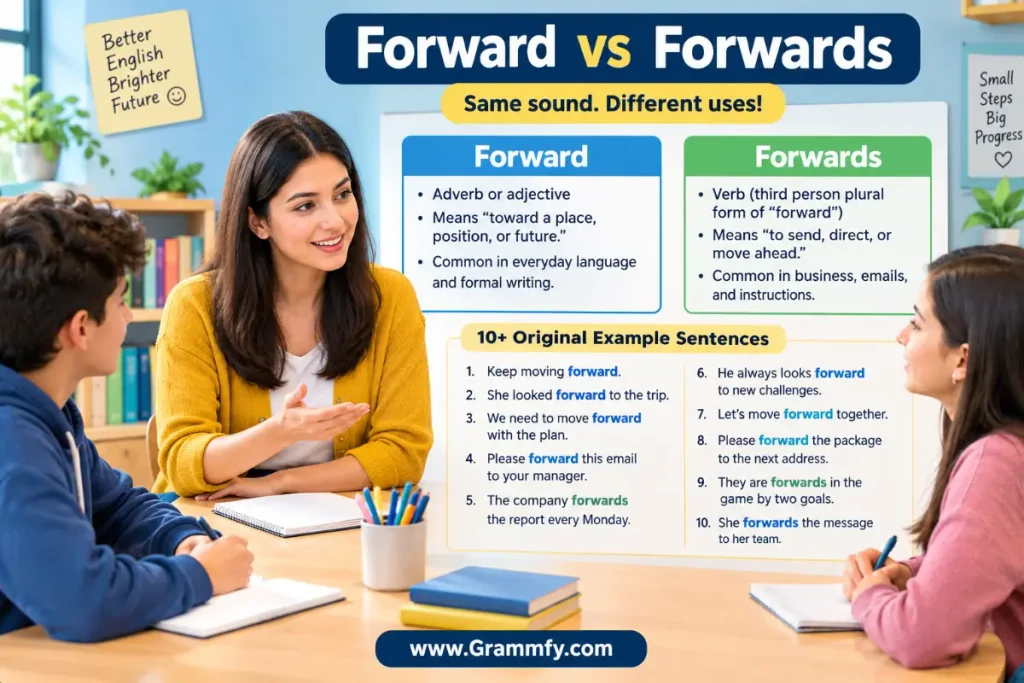
20+ original example sentences
Here are examples showing how these words work in real situations.
- Please take one step forward.
- The child leaned forward to see the screen.
- The runner moved forward after the starting signal.
- We need to move forward with the project.
- She is looking forward to her vacation.
- I’ll forward the email after lunch.
- Please forward the document to the director.
- The car slowly moved forward.
- He stepped forward and introduced himself.
- The team made progress and moved forward.
- The students leaned forward to hear the teacher.
- We can’t change the past, so we must move forward.
- The company plans to push forward with the new project.
- I received your message and will forward it to the team.
- The discussion helped us move forward.
- She looked forward to meeting her new classmates.
- The train began moving forwards.
- He leaned forwards to pick up the book.
- The children ran forwards when the gate opened.
- The cyclist moved forwards through the crowd.
- The British speaker told everyone to move forwards.
- The American speaker told everyone to move forward.
Notice that examples 17–21 sound especially natural in British English, while forward is the common US choice.
What is the difference between forward and ahead?
Forward and ahead are close in meaning, but they’re not always interchangeable.
Forward focuses strongly on direction or movement.
Ahead can describe position, progress, or something occurring in the future.
Compare:
| Forward | Ahead |
|---|---|
| Direction toward the front | Position in front |
| Movement or progress | Progress or future position |
| Common in “move forward” | Common in “look ahead” |
| Can be a verb | Usually not a verb in these uses |
Examples:
- Take a step forward.
- The car ahead is slowing down.
You can say:
- We need to move forward.
You can also say:
- We need to move ahead.
But the expressions have slightly different tones.
Move forward often emphasizes continuing after a decision or situation.
Move ahead often emphasizes proceeding with a plan.
What is the difference between forward and onward?
Forward is more general.
Onward often has a stronger sense of continuing a journey or process.
Compare:
- The car moved forward.
- The travelers continued onward.
The first describes direction.
The second emphasizes continuing the journey.
Onward can also sound more literary or motivational: “We have learned from our mistakes. Now, onward”.
In everyday American English, forward is usually more natural.
What is the difference between forward and toward?
These words are related but not identical.
Forward means toward the front or ahead.
Toward means in the direction of a particular person, place, or thing.
Compare:
- She stepped forward.
There is no specific destination.
But:
- She walked toward the door.
The door is the direction or destination.
You can combine them:
- He moved forward toward the exit.
Here, forward describes the movement and toward identifies the destination.
What is the difference between forward and onward?
Use forward for general direction or progress.
Use onward when you want to emphasize continuing from one stage to another.
| Situation | Better choice |
|---|---|
| Physical direction | Forward |
| Future progress | Forward |
| Continuing a journey | Onward |
| Motivational statement | Onward |
| Business progress | Forward |
| Formal travel writing | Onward |
Examples:
The project is moving forward.
The hikers continued onward.
Common mistakes with forward and forwards
Mistake 1: Using forwards as a verb
Incorrect:
- Please forwards the email.
Correct:
- Please forward the email.
Why? Forward is the verb. The word doesn’t take -s after “please.”
Mistake 2: Adding -s after a modal verb
Incorrect:
- We should move forwards with the plan.
This isn’t necessarily grammatically wrong, but if you’re writing American English, forward is usually the preferred form.
Better:
- We should move forward with the plan.
Mistake 3: Thinking forwards is always wrong
Incorrect assumption: “Forwards is not a real English word.”
It is a real word.
Forwards is standard, especially in British English.
The issue is usually regional preference, not basic correctness.
Mistake 4: Using forward when you mean foreword
These words are completely different.
A foreword is an introductory section at the beginning of a book, usually written by someone other than the main author.
A forward can describe direction or movement.
Compare:
She stepped forward.
The author wrote the foreword.
Don’t confuse them.
Mistake 5: Using edition-like regional rules without checking the audience
If you’re writing for American readers, forward is usually the safest choice.
If you’re writing specifically for a British audience, forwards may sound more natural in some directional contexts.
The key is to follow one variety of English consistently.
When should you not use forward?
Don’t use forward when another word gives a more precise meaning.
For example, if you mean a specific destination, toward may be better: “She walked toward the station”.
If you mean continued progress in a formal instruction, proceed may be clearer: “Please proceed to the next section”.
If you mean a future time, use a phrase that clearly expresses time: “We will discuss this later“.
Don’t force forward into every sentence simply because it can mean progress.
When should you not use forwards?
Don’t use forwards as a replacement for the verb forward.
Incorrect:
She forwards the email every morning.
This could actually be grammatical in a different structure if forwards is the third-person singular form of the verb forward, but it is uncommon and can be confusing. In modern workplace writing, clearer wording is usually preferred.
For example:
- She forwards the emails every morning.
Here, forwards is a verb because the subject is she.
Compare:
- Please forward the email.
The first sentence uses third-person singular present tense.
The second uses the base verb after please.
This is an important grammar distinction.
How do you choose between Forward vs Forwards?
Use this quick process.
Step 1: Are you using it as a verb?
If yes, use forward as the base verb.
- Please forward the message.
If the subject is third-person singular, forwards can be the verb form: “He forwards the message every morning”.
Step 2: Are you describing direction?
Both can work.
- Move forward.
- For US English, prefer forward.
Step 3: Are you writing for a British audience?
Forwards may sound more natural for physical direction.
- Move forwards carefully.
But forward remains correct.
Step 4: Are you writing professionally for an international audience?
Forward is usually the safest choice.
It’s concise, familiar, and widely accepted.
Quick tips for choosing the right word Forward vs Forwards
- Choose forward as the default in American English.
- Forwards is also correct, especially in British English.
- Use forward as a verb when telling someone to send something.
- Use forwards as an adverb when describing movement if that style fits your variety of English.
- Don’t assume the final -s makes a word incorrect.
- Check whether the word is acting as an adverb or verb.
- Use toward when you mean movement in the direction of a specific destination.
- Use ahead when you mean a position or point in front.
- Use onward when emphasizing continued movement.
- Use proceed in formal instructions when it sounds more precise.
- Keep your regional English consistent.
A quick grammar test
When you’re unsure, replace the word with ahead.
If the sentence still makes sense, you’re probably dealing with the directional meaning.
For example:
- The car moved forward.
Try:
- The car moved ahead.
The meaning remains close.
But if you write:
- Please forward the email.
You cannot replace it with:
- Please ahead the email.
That’s because forward is acting as a verb meaning “send onward.”
This simple test can help you identify the meaning you’re trying to express.
Forward vs forwards: quick comparison
| Feature | Forward | Forwards |
|---|---|---|
| Meaning | Toward the front/ahead | Toward the front/ahead |
| US English | Very common | Less common |
| UK English | Common | Very common |
| Adverb | Yes | Yes |
| Verb | Yes | Only as third-person singular |
| Adjective | Yes | No |
| Noun | Yes | No |
| Email use | Very common | Not normally used as base verb |
| Best international default | Yes | Usually not |
Which one should you use?
If you write American English, choose forward in most situations.
For example:
- Let’s move forward with the plan.
- Please forward the email .
- I look forward to your reply.
If you write British English, forwards is completely acceptable for directional movement: “Move forwards carefully”.
But British English also uses forward in many common expressions: “I look forward to hearing from you”.
This is why forward is the safest general-purpose choice.
Conclusion
The easiest way to remember Forward vs Forwards is to focus on both meaning and regional style. The two forms can describe movement toward the front or progress toward a future point, so the difference is often not about right versus wrong. Instead, it is usually about which form sounds natural in the variety of English you’re using.
For American English, forward is the safest and most common choice. British English often uses forwards for physical direction, although forward remains common there too. When you’re using the word as a verb meaning “send,” use forward as the base form: “Please forward the email.”
If you’re writing for an international audience, choosing forward will usually give you the clearest and most widely accepted option. Once you connect the word with direction, progress, and sending something onward, the distinction becomes much easier to handle.
Frequently Asked Questions
Is forward or forwards correct in American English?
Forward is generally preferred in American English, especially as an adverb of direction. Forwards is understandable and grammatical, but it is less common in US usage.
Is forwards grammatically correct?
Yes, forwards is grammatically correct. It is commonly used as an adverb, particularly in British English, to describe movement toward the front or ahead.
Is it look forward or look forwards?
“Look forward” is the standard form in the expression “look forward to.” For example, “I look forward to hearing from you.”
What’s another way to say forward?
Ahead, onward, toward, proceed, advance, and move on can replace forward in certain contexts. The best option depends on whether you’re describing direction, progress, or continuation.
Can I use forward in a formal email?
Yes, forward is completely appropriate in formal emails. You can use it to describe progress or to mean sending a message to another person.
Is forwards more British or American?
Forwards is more strongly associated with British English. American English generally prefers forward for directional adverb use.
What is the difference between forward and forwards?
Forward and forwards usually have the same basic meaning, but forward is more common in American English while forwards is especially common in British English. The choice is often based on regional style.

Tylerbrooks is a US-based English grammar writer and contributor at Grammfy. He writes helpful articles about grammar, spelling, commonly confused words, and vocabulary. His goal is to explain English topics in simple language with clear examples and practical tips. Through his articles, he helps readers improve their writing and everyday English skills.
1 thought on “Forward vs Forwards: Simple Difference and Correct Usage”