
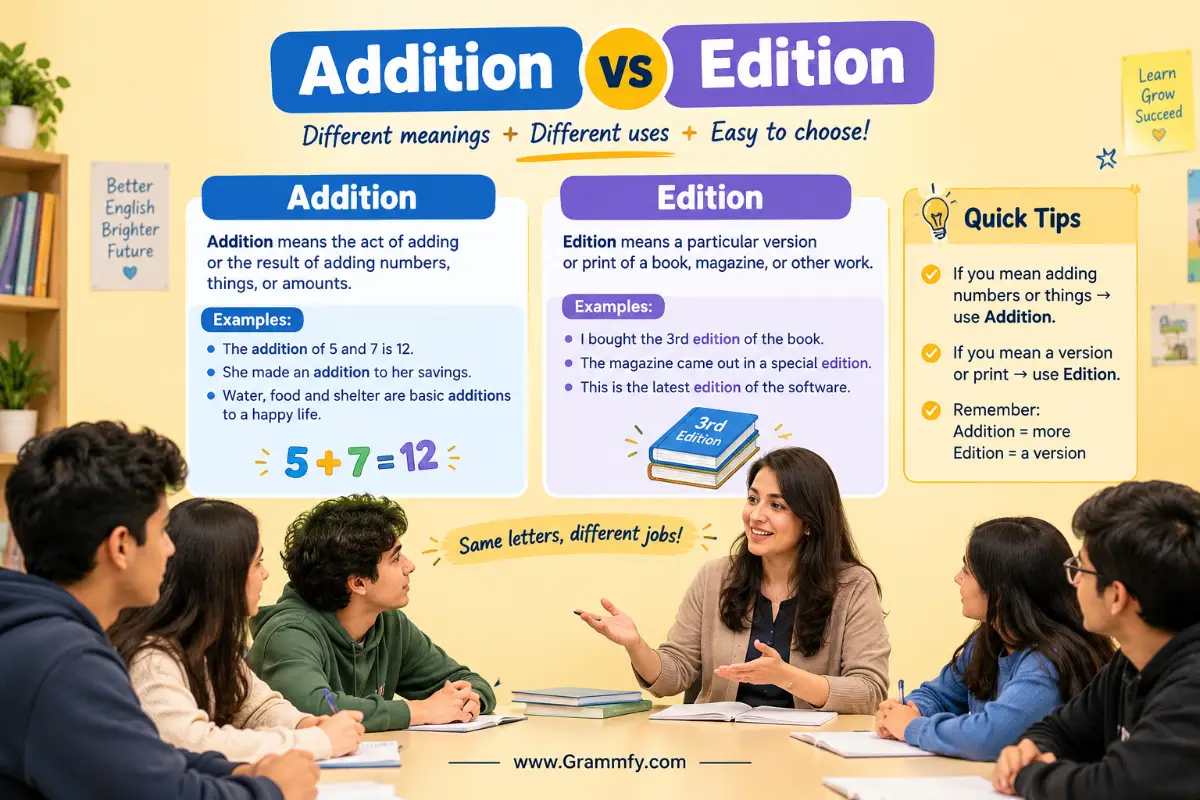
When writing an email or essay, understanding Addition vs Edition can help you choose the correct word and avoid a common grammar mistake.
Imagine you’re writing an email and want to say that a new feature was added to a project. You type, “This is a great edition,” but something feels wrong. Or perhaps you’re talking about the latest version of a book and write “new addition” instead of “new edition.” These two words look and sound similar, but they have different meanings.
Addition means something that is added to something else. Edition usually means a particular version or release of a book, newspaper, magazine, product, or other published work.
- Answer box: Addition refers to something added, while edition refers to a particular version or release of something. They aren’t interchangeable.
The difference becomes easy once you connect addition with the verb add and edition with the idea of a particular version. This guide explains their meanings, origins, synonyms, examples, common mistakes, and the best word to use in emails, essays, resumes, texts, and everyday speech.
These words are easy to mix up, so read our guide to the difference between Excel vs Accel to see their meanings and examples side by side.
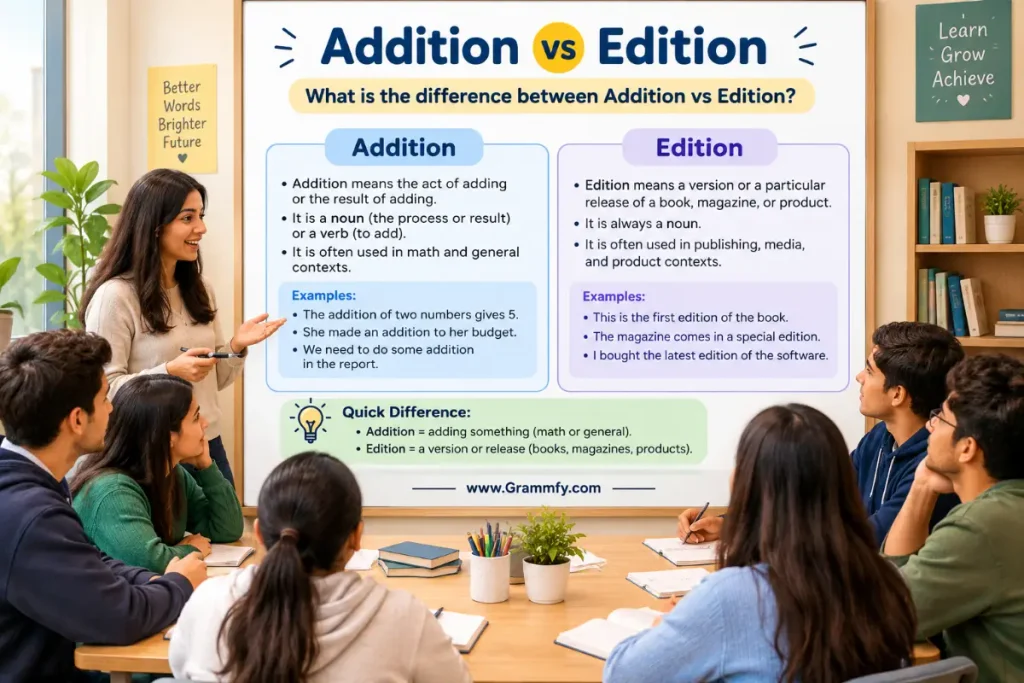
What is the difference between Addition vs Edition?
The simplest way to understand Addition vs Edition is to ask one question: Are you talking about something being added, or are you talking about a version?
| Word | Basic meaning | Common use |
|---|---|---|
| Addition | Something added to something else | Extra feature, person, amount, section |
| Edition | A particular version or release | Book, newspaper, magazine, software, publication |
What does addition mean?
Addition is a noun that comes from the verb add. It describes the act of putting something together with something else, or the thing that has been added.
For example:
- The company made an addition to its website.
- The new student was a welcome addition to the class.
- The recipe needs the addition of fresh herbs.
- We made an addition to the guest room.
- The book includes an addition at the end.
The word can also refer to the mathematical operation of combining numbers.
For example:
- The teacher explained addition to the students.
- Four plus five is a simple addition problem.
So, addition is connected to the idea of adding, increasing, or including something extra.
What does edition mean?
Edition is a noun that usually refers to a particular form or version of a published work.
For example:
- I bought the latest edition of the dictionary.
- The first edition of the book sold thousands of copies.
- The newspaper’s morning edition is already available.
- This is the third edition of the textbook.
- I prefer the digital edition of the magazine.
An edition can contain changes, corrections, new information, or a different format. However, the important point is that it is a specific version or release.
Think of edition as being closely related to version.
Where did addition and edition come from?
Understanding word origins can make the distinction easier to remember.
The origin of addition
Addition comes from Latin additio, meaning an adding or putting together. It is related to the Latin verb addere, meaning “to add.”
English uses the same basic idea today. When you make an addition, you put something with something that already exists.
That explains expressions such as:
- an addition to a house
- an addition to a team
- an addition to a sentence
- an addition to a list
- an addition to a collection
The central idea is always something being added.
The origin of edition
Edition comes from Latin editio, meaning a publishing or issuing. It is related to edere, meaning “to publish” or “to bring out.”
This history explains why edition is strongly connected with books, newspapers, magazines, and other published materials.
For example:
- first edition
- second edition
- revised edition
- special edition
- limited edition
- student edition
A useful memory trick is:
Addition → add something.
Edition → a version released or published.
Addition vs Edition: Which word should you use?
Use addition when you mean something extra that has been added.
Use edition when you mean a particular version of something, especially a publication.
Compare these:
- The new chapter is an addition to the book.
- The revised book is a new edition.
The first sentence says a chapter was added.
The second sentence says the entire book has been released in another version.
That small distinction is the key to understanding Addition vs Edition.
What are the main synonyms for addition and edition?
The two words have many related terms, but their synonyms aren’t always interchangeable. Some work in formal writing, while others are more natural in everyday speech.
| Word | Meaning | Tone | Example |
|---|---|---|---|
| add-on | Something added later | Everyday | The camera has a useful add-on. |
| increase | A rise in amount or size | Neutral | We saw an increase in sales. |
| extra | Something additional | Everyday | Bring an extra chair. |
| supplement | Something added for more information | Formal | The report includes a supplement. |
| extension | Something that makes something larger or longer | Neutral | They built an extension to the house. |
| addition | Something added | Neutral | The new room is an addition. |
| increment | A small increase | Formal | The salary rose by a small increment. |
| appendage | Something attached to a larger thing | Formal | The structure has a small appendage. |
| expansion | Growth by adding more | Neutral | The expansion created new offices. |
| augmentation | An increase or improvement by adding | Formal | The system received an augmentation. |
| extra feature | An added function | Everyday | The phone has an extra feature. |
| version | A particular form of something | Neutral | I downloaded the newest version. |
| release | A version made available | Neutral | The latest release fixes the bug. |
| issue | A published copy or installment | Neutral | I read the latest issue. |
| printing | A production of printed copies | Neutral | This printing has better images. |
| revision | A changed version | Formal | The revised edition includes corrections. |
| variant | A form that differs from another | Formal | This variant has a different cover. |
| copy | An individual example of a publication | Everyday | I bought a copy of the book. |
| revised version | A version with changes | Neutral | The revised version is clearer. |
| update | A newer form with changes | Everyday | Download the latest update. |
| issue | A particular published installment | Neutral | The July issue is available. |
Which synonyms are closest to addition?
The closest alternatives depend on context.
- For everyday writing, extra, add-on, and increase may work.
- For formal writing, supplement, extension, increment, and augmentation can be useful.
- For physical objects, addition or extension is often better.
- For information, addition, supplement, or extra section may be more natural.
Don’t assume that every synonym can replace the original word in every sentence.
For example:
- “The new employee is a great addition to the team.”
- “The new employee is a great supplement to the team.”
The first sounds natural. The second changes the meaning and sounds unusual.
Which synonyms are closest to edition?
The strongest alternatives are version, release, issue, printing, and revision.
However, these words have different uses.
A version can describe almost anything that exists in different forms.
A release is common for software, products, and published material.
An issue is especially common for newspapers and magazines.
A printing focuses on the production of printed copies.
A revision emphasizes changes made to an earlier version.
For example:
- the latest version of the software
- the July issue of the magazine
- the second printing of the novel
- the revised edition of the textbook
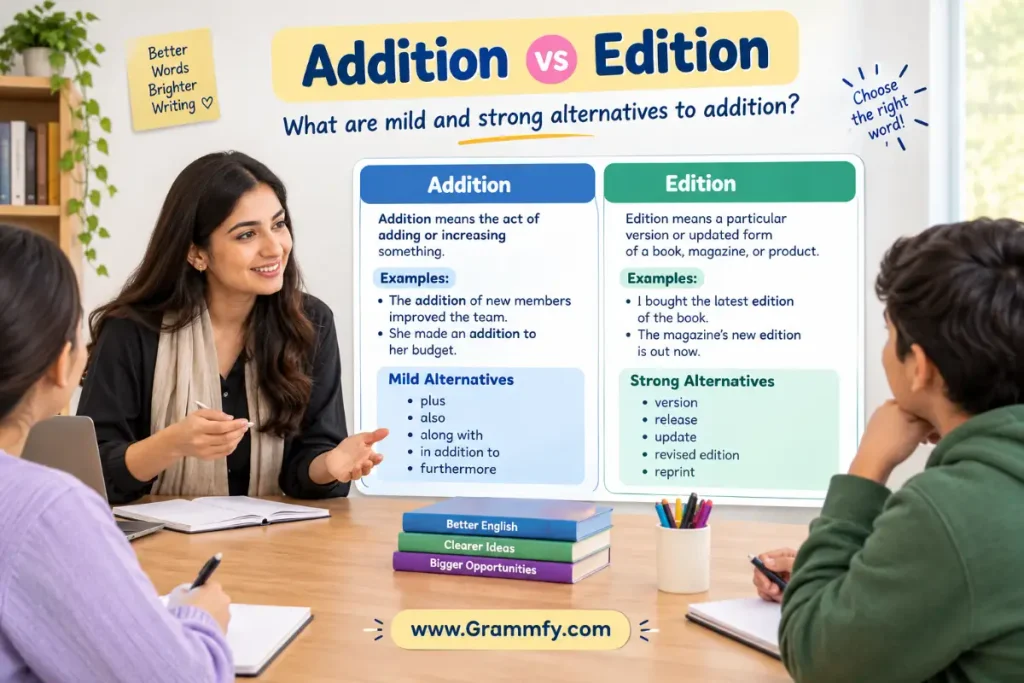
What are mild and strong alternatives to addition?
Synonyms can also differ in intensity.
Mild or small additions
Use these when something is added in a limited or simple way:
- extra
- add-on
- addition
- supplement
- small increase
- minor extension
Examples:
- We made a small addition to the paragraph.
- The phone comes with an extra feature.
- The teacher gave us a supplement to the lesson.
Medium additions
These suggest a noticeable change:
- increase
- extension
- expansion
- enhancement
- improvement
Examples:
- The building received an extension.
- The company announced an expansion.
- The software received an enhancement.
Strong additions or major growth
These terms suggest a larger change:
- major expansion
- substantial increase
- augmentation
- enlargement
- significant extension
For example:
- The project required a substantial expansion.
- The company announced a major increase in production.
The best choice depends on how much change you want to communicate.
What are mild and strong alternatives to edition?
Edition itself doesn’t describe how large a change is. The words around it provide that information.
Small or limited changes
- updated edition
- corrected edition
- new version
- latest version
Moderate changes
- revised edition
- updated version
- expanded edition
- improved release
Major changes
- completely revised edition
- expanded and revised edition
- new version
- redesigned release
For example:
- The publisher released an expanded edition with three new chapters.
Here, expanded tells the reader that additional content was included.
What parts of speech are addition and edition?
Both addition and edition are primarily nouns.
Addition as a noun
Examples:
- The addition improved the building.
- Her addition to the team was helpful.
- The addition of salt changed the taste.
The related verb is add.
Related forms include:
- add
- added
- adding
- addition
- additional
Notice that additional is an adjective.
For example:
- We need additional information.
- Please provide an additional example.
Edition as a noun
Examples:
- I bought the latest edition.
- This edition contains new illustrations.
- The evening edition is now available.
Related words include:
- edit
- edited
- editing
- editor
- edition
- editorial
This connection can help you remember that edition often relates to something that has been edited, prepared, or published.
Addition vs Edition in a resume
A resume often describes people, skills, achievements, and qualifications. When you’re talking about something being included, addition is usually the better word.
For example:
- “My certification was a valuable addition to my professional skills.”
- “The new software skill is an important addition to my resume.”
You would generally use edition only if you’re describing a version of a document or publication.
For example:
- “I submitted the latest edition of my portfolio.”
Even here, version may sound more natural if you’re talking about a digital document.
Best choice for a resume
Use addition for:
- new skills
- qualifications
- achievements
- responsibilities
- team members
- sections added to a document
Use edition for:
- versions of published books
- magazines
- newspapers
- official publications
Addition vs Edition in an essay
In an essay, addition is useful when you’re discussing something that has been added to an argument, paragraph, or body of information.
Examples:
- “This example is a useful addition to the argument.”
- “The final paragraph is an important addition to the essay.”
- “The author made an interesting addition to the discussion.”
Edition is appropriate when discussing a source.
For example:
- “I used the third edition of the textbook.”
- “The quotation appears in the revised edition.”
Which word sounds better in academic writing?
Choose addition when describing added content.
Choose edition when identifying a particular published source.
For example:
- According to the third edition of the textbook, the theory changed significantly.
But:
- The researcher made an important addition to the existing argument.
Addition vs Edition in an email
In an email, the correct word depends on what you’re discussing.
Use addition for something newly included.
- “The new employee will be a great addition to the team.”
- “I’ve made an addition to the report.”
- “Please see the addition at the end of the document.”
Use edition for a publication or specific version.
- “Please send me the latest edition of the handbook.”
- “Do you have the digital edition of the report?”
For ordinary digital documents, version is often more natural than edition.
For example:
- Please review the latest version of the report.
This sounds more natural than:
- Please review the latest edition of the report.
Addition vs Edition in texting
Text messages usually favor simple words.
Use addition when you mean something extra.
- “The new café is a nice addition to the neighborhood.”
- “That’s a great addition!”
- “We need one more addition to the list.”
Use edition when talking about a book, magazine, newspaper, or special product version.
- “I got the new edition!”
- “Which edition are you using?”
- “The special edition looks cool.”
In casual texting, version often replaces edition for apps, games, files, and software.
For example:
“Which version of the app do you have?”
That is more natural than using edition.
Addition vs Edition in speaking
In everyday conversation, addition often describes people, objects, features, and changes.
Examples:
- “She’s a great addition to the team.”
- “That’s a nice addition to the room.”
- “The extra seating is a useful addition.”
Edition is most common when people discuss books and publications.
Examples:
- “I need the newest edition.”
- “Which edition of the book did you buy?”
- “The first edition is worth more.”
If you’re talking about software or a digital product, version is usually the safer choice.
What is the difference between addition and extension?
Addition is a broad term for something that is added. Extension often suggests that something has been made larger, longer, or more extensive.
Compare:
| Addition | Extension |
|---|---|
| Something added | Something that makes something larger or longer |
| Broad meaning | More specific |
| Works with ideas and objects | Often used for buildings, time, length, or systems |
Examples:
- “The new room is an addition to the house.”
- “The house has a rear extension.”
Both can work, but extension gives a stronger sense of expansion.
What is the difference between edition and version?
These words are close, but they aren’t identical.
Version is broader.
Edition is often used for published works or distinct forms of a publication.
Compare:
| Edition | Version |
|---|---|
| Often used for books and publications | Used for many types of things |
| Can identify a specific published form | Can identify any different form |
| Common with first, second, revised, special | Common with software, documents, products |
Examples:
- the second edition of a textbook
- the latest version of an app
- the revised edition of a novel
- the newest version of a file
A book can have both an edition and a version in certain contexts, but edition is usually the more precise publishing term.
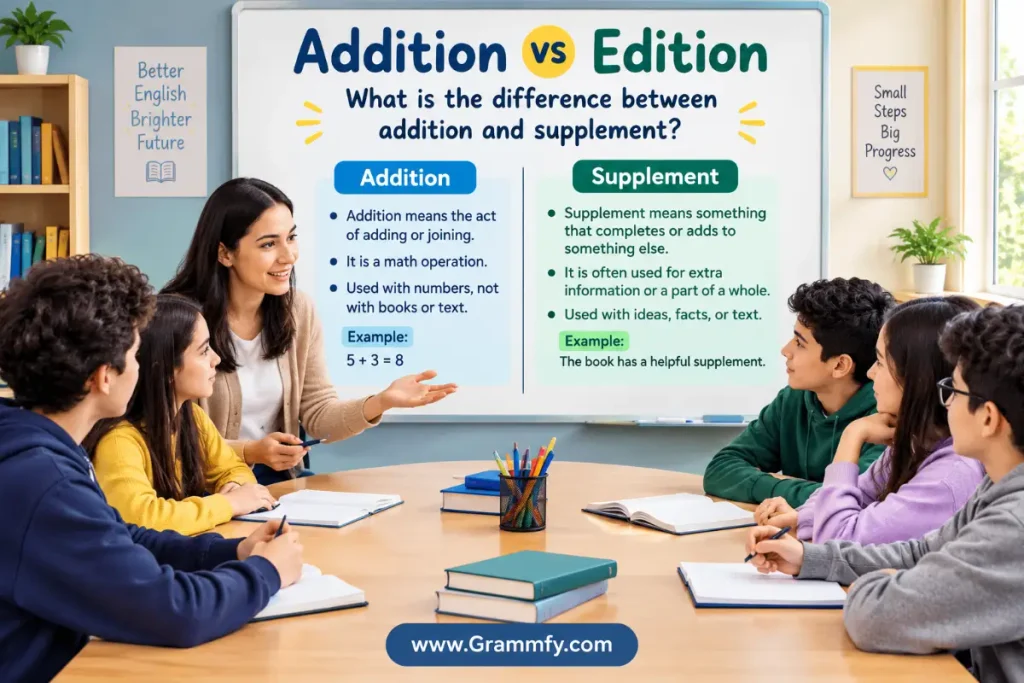
What is the difference between addition and supplement?
An addition is anything added.
A supplement is usually something added to provide extra information, support, or content.
For example:
- The author made an addition to the chapter.
This simply means something was added.
- The publisher released a supplement to the textbook.
This suggests a separate piece of material that provides extra information.
A supplement can therefore be a type of addition, but the words are not always interchangeable.
What is the difference between edition and issue?
Edition and issue can both describe published material, but they are used differently.
An issue usually refers to a particular installment of a newspaper, magazine, journal, or similar publication.
An edition can refer to a particular version or form of a publication.
Compare:
- the January issue of the magazine
- the second edition of the textbook
- the morning edition of the newspaper
- the latest issue of the newspaper
Some publications use both terms, so context matters.
15+ real-world examples of addition
Here are examples from different situations:
- The new student was a welcome addition to the class.
- The company made an addition to its website.
- We need an addition to the final paragraph.
- The new sofa is a nice addition to the living room.
- Her experience is a valuable addition to the project.
- The chef made an unexpected addition to the recipe.
- The new employee is an excellent addition to our team.
- The museum’s new painting is an important addition to its collection.
- The architect designed an addition to the building.
- The teacher made an addition to the lesson plan.
- The app received an addition that makes navigation easier.
- The final chapter is a useful addition to the book.
- We made a small addition to the guest list.
- The garden received a colorful addition of new flowers.
- The new evidence was an important addition to the case.
In every example, the central idea is something added or included.
15+ real-world examples of edition
Now look at examples involving versions and publications:
- I bought the latest edition of the dictionary.
- The first edition of the novel is difficult to find.
- This textbook is in its fifth edition.
- The publisher released a revised edition.
- The magazine’s special edition contains extra articles.
- I prefer the digital edition of the newspaper.
- The new edition includes updated information.
- The student edition costs less.
- The collector’s edition has a different cover.
- The publisher printed a limited edition.
- We need the most recent edition of the manual.
- The second edition corrected several errors.
- The library ordered the newest edition.
- The evening edition of the newspaper arrived late.
- The revised edition contains three new chapters.
In these sentences, the central idea is a particular version or release.
Common mistakes with addition and edition
The biggest mistake is using edition when you mean something was added.
Mistake 1: “The new employee is a great edition to the team.”
Incorrect:
- The new employee is a great edition to the team.
Correct:
- The new employee is a great addition to the team.
Why? The employee has been added to the team.
Mistake 2: “I bought the latest addition of the book.”
Usually incorrect:
- I bought the latest addition of the book.
Better:
- I bought the latest edition of the book.
Why? You’re talking about a particular version of the published book.
Mistake 3: “This is a new edition to the room.”
Incorrect if you mean a new object was added:
- The lamp is a new edition to the room.
Correct:
- The lamp is a new addition to the room.
Mistake 4: “Please send me the latest addition of the magazine.”
Usually incorrect:
- Please send me the latest addition of the magazine.
Better:
- Please send me the latest edition of the magazine.
A magazine has different issues or editions, not “additions.”
When should you NOT use addition?
Don’t use addition simply because something is new.
Something can be new without being an addition.
For example:
- I bought a new laptop.
You don’t need to say:
- I bought a new addition.
That would change the meaning.
Also, use increase when you’re specifically talking about a rise in an amount.
Instead of:
- There was an addition in prices.
Say:
- There was an increase in prices.
Likewise, use extension when you’re talking about extra time.
Instead of:
- We received an addition of two weeks.
Say:
- We received a two-week extension.
When should you NOT use edition?
Don’t use edition for every kind of new version.
For software, apps, documents, and many products, version is often more natural.
Instead of:
- I installed the newest edition of the app.
Say:
- I installed the newest version of the app.
Instead of:
- Send me the latest edition of the file.
Say:
- Send me the latest version of the file.
Edition works best when the context naturally involves publishing, formal releases, or recognized versions of a work.
What are the antonyms of addition and edition?
The opposite of addition depends on the context.
Possible antonyms include:
- subtraction
- removal
- deletion
- reduction
- decrease
- deduction
- omission
For example:
The addition of new material increased the length.
Opposite idea:
The removal of old material reduced the length.
Edition does not have one exact opposite. Depending on what you mean, you might use:
- original
- previous version
- old version
- withdrawal
- unpublished work
For example:
The revised edition replaced the previous version.
Here, previous version provides the contrast rather than being a strict antonym.
How can you remember addition vs edition?
Use this simple memory trick:
Addition = Add
The first three letters are almost the same:
ADDition → ADD
If something is being added, choose addition.
For edition, think:
EDITION = VERSION
If you’re talking about a particular version of a book, newspaper, magazine, or published work, choose edition.
You can also remember these two sentences:
- A new chapter is an addition.
- A revised book is a new edition.
That distinction will solve most usage questions.
Quick tips for choosing the right word
- If something is added, use addition.
- If you’re talking about a published version, use edition.
- If you’re talking about software, consider version.
- If you’re talking about a magazine or newspaper, issue may be better.
- If you’re talking about extra information, supplement may fit.
- If you’re talking about a rise in quantity, use increase.
- If you’re talking about extra time, use extension.
- If you’re talking about a changed document, version or revision may be more natural.
- Remember: addition = something added.
- Remember: edition = a particular version.
A simple comparison chart
| Situation | Best word | Example |
|---|---|---|
| Something added to a team | Addition | She’s a great addition to the team. |
| Something added to a house | Addition | They built an addition to the house. |
| Extra information | Addition/Supplement | The new section is an addition. |
| A rise in price | Increase | There was an increase in price. |
| Extra time | Extension | We received an extension. |
| A book version | Edition | I bought the latest edition. |
| A magazine installment | Issue | I read the latest issue. |
| A software release | Version | Install the latest version. |
| A changed document | Version | Send me the newest version. |
| A corrected book | Revised edition | Use the revised edition. |
| A special product release | Special edition | I bought the special edition. |
| Extra material | Supplement | The textbook includes a supplement. |
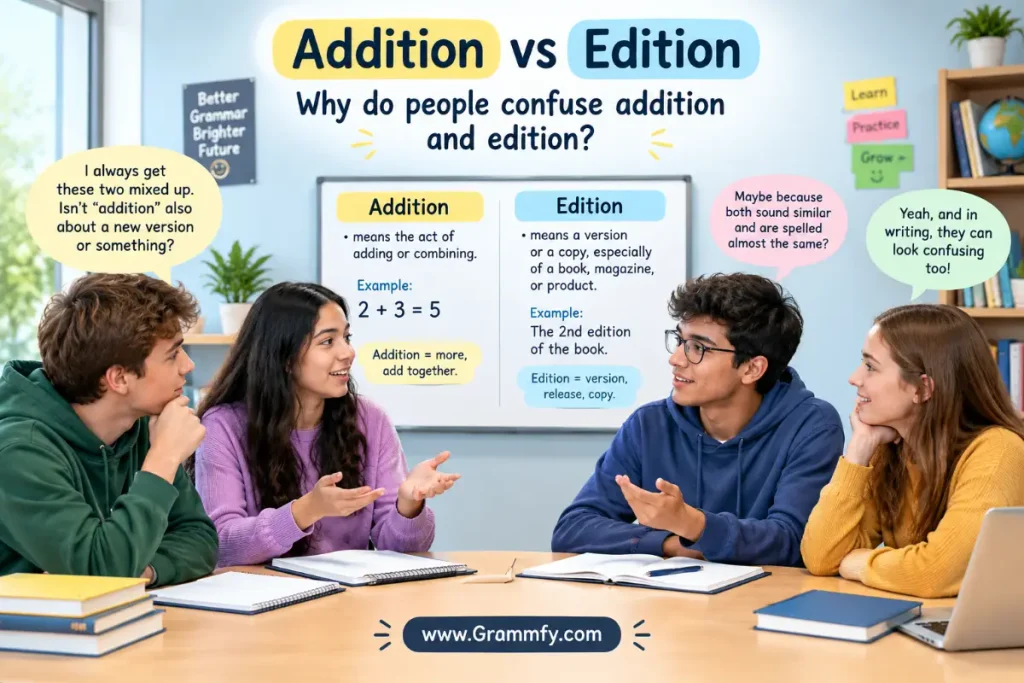
Why do people confuse addition and edition?
The confusion is understandable because both words contain similar letters and both can relate to something new.
But their meanings point in different directions.
Addition focuses on what is added.
Edition focuses on which version it is.
For example, imagine a textbook receives three new chapters.
Those chapters are an addition.
When the publisher updates the entire textbook and releases it as a new version, it becomes a new edition.
One change can therefore involve both words:
- The three new chapters were an addition to the textbook, and the publisher included them in the next edition.
This is one of the clearest ways to understand the difference.
How do these words work in formal writing?
In formal writing, precision matters.
Use addition when describing something included or added: “The addition of supporting evidence strengthened the argument”.
Use edition when identifying a published source: “The study was included in the fourth edition of the handbook”.
Don’t choose one based only on how formal it sounds. Choose the word based on the meaning you need.
A formal synonym can still be wrong if it doesn’t match the context.
How do these words work in American English?
In US English, the basic distinction remains straightforward.
Addition means something added.
Edition commonly refers to a particular version of a publication.
For example:
- first edition
- revised edition
- special edition
- paperback edition
- hardcover edition
- digital edition
American English also commonly uses version for software and digital files.
Regional differences do not usually create a major problem here. The main challenge is simply recognizing whether you’re talking about an added thing or a specific version.
What about British English?
The distinction is also broadly the same in British English.
British speakers use addition for something added and edition for a particular published version.
There can be differences in publishing terminology, newspaper terminology, and local style, but the basic meanings do not change.
So whether you’re writing for a US or UK audience, the same memory rule works:
Added thing → addition.
Published version → edition.
Conclusion
The easiest way to understand Addition vs Edition is to connect each word with its core idea. Addition comes from the idea of adding something extra, whether that’s a person, feature, paragraph, room, or piece of information. Edition refers to a particular version, especially of a book, magazine, newspaper, or other published work.
When you’re unsure, ask yourself what you’re describing. If something has been added, choose addition. If you’re identifying a particular version, choose edition. For software and digital files, version is often the better choice.
Once you learn that simple distinction, these two commonly confused words become much easier to use correctly in essays, emails, resumes, conversations, and everyday writing.
Frequently Asked Questions
What is the difference between addition and edition?
Addition means something that is added, while edition means a particular version or release. An addition changes what is included; an edition identifies a version of the whole work.
Is it addition or edition of a book?
Edition is usually correct when you mean a particular version of a book. For example, “I bought the third edition of the textbook.”
Is it a new addition or a new edition?
A new addition means something new has been added, while a new edition means a new version has been released. A revised book may be a new edition that contains several additions.
What’s another way to say addition?
Extra, add-on, supplement, increase, extension, and expansion can work depending on the context. The best synonym depends on exactly what has been added.
What’s another way to say edition?
Version, release, issue, printing, and revision can sometimes replace edition. However, each has a slightly different meaning and should match the type of material you’re describing.
Is it the latest addition or the latest edition of a book?
The latest edition of a book is correct when you’re talking about its newest published version. “Latest addition” would mean something was added to the book.
Can addition and edition mean the same thing?
No, addition and edition generally have different meanings. Addition focuses on something being added, while edition focuses on a particular version or release.
Conclusion
The easiest way to understand Addition vs Edition is to connect each word with its core idea. Addition comes from the idea of adding something extra, whether that’s a person, feature, paragraph, room, or piece of information. Edition refers to a particular version, especially of a book, magazine, newspaper, or other published work.
When you’re unsure, ask yourself what you’re describing. If something has been added, choose addition. If you’re identifying a particular version, choose edition. For software and digital files, version is often the better choice.
Once you learn that simple distinction, these two commonly confused words become much easier to use correctly in essays, emails, resumes, conversations, and everyday writing.

Tylerbrooks is a US-based English grammar writer and contributor at Grammfy. He writes helpful articles about grammar, spelling, commonly confused words, and vocabulary. His goal is to explain English topics in simple language with clear examples and practical tips. Through his articles, he helps readers improve their writing and everyday English skills.
1 thought on “Addition vs Edition: Ultimate Guide to the Difference”