
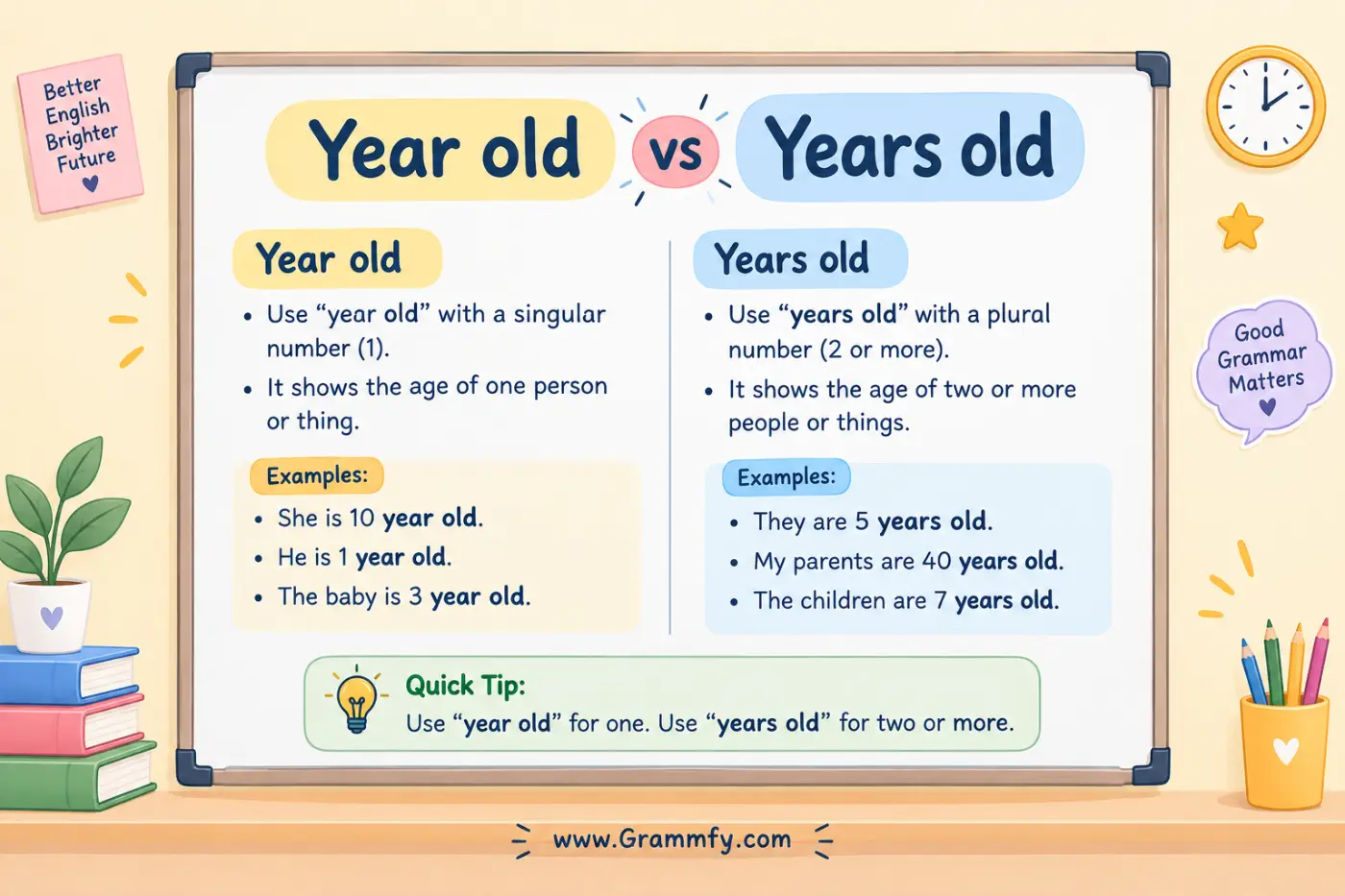
When you’re writing an email, filling out a form, preparing an essay, or sending a quick text, you may stop and wonder: should you write “year old” vs “years old”? The answer depends on the number and how the age phrase is used in the sentence.
The basic rule is simple. Use “years old” after a person’s age when it comes after a verb such as is, was, or are. Use “year-old” when the age comes before a noun and works as an adjective.
Answer box: Use “years old” after a verb: “She is five years old.” Use “year-old” before a noun: “She is a five-year-old girl.”
This small grammar difference matters in resumes, school writing, emails, biographies, and everyday conversation. Below, you’ll learn the rule, word history, examples, related expressions, common mistakes, regional differences, and how to choose the correct form quickly.
For more examples of correct grammar, check out [taken vs taking].
What does “year old” mean in simple English?
Year old describes someone’s age when the phrase is used as part of a larger expression before a noun.
For example:
“She is a five-year-old student.”
Here, five-year-old describes the noun student.
The entire expression works like an adjective. That’s why the words are normally connected with hyphens when they appear before a noun.
More examples include:
- a two-year-old child
- a ten-year-old boy
- a six-year-old laptop
- a 20-year-old building
- a 50-year-old tradition
Notice something important: even when the number is greater than one, year stays singular inside the compound adjective.
You write:
“a ten-year-old boy”
not:
“a ten-years-old boy”
What does “years old” mean in simple English?
Years old is normally used after a linking verb to state someone’s age.
Examples:
- “The baby is one year old.”
- “My brother is ten years old.”
- “She is 18 years old.”
- “The building is 100 years old.”
Here, years old describes the age of the subject rather than directly modifying a noun.
The word years is plural when the number is more than one.
So:
“He is one year old.”
but:
“He is two years old.”
This is one of the easiest rules to remember.
Year old vs Years old: What’s the main difference?
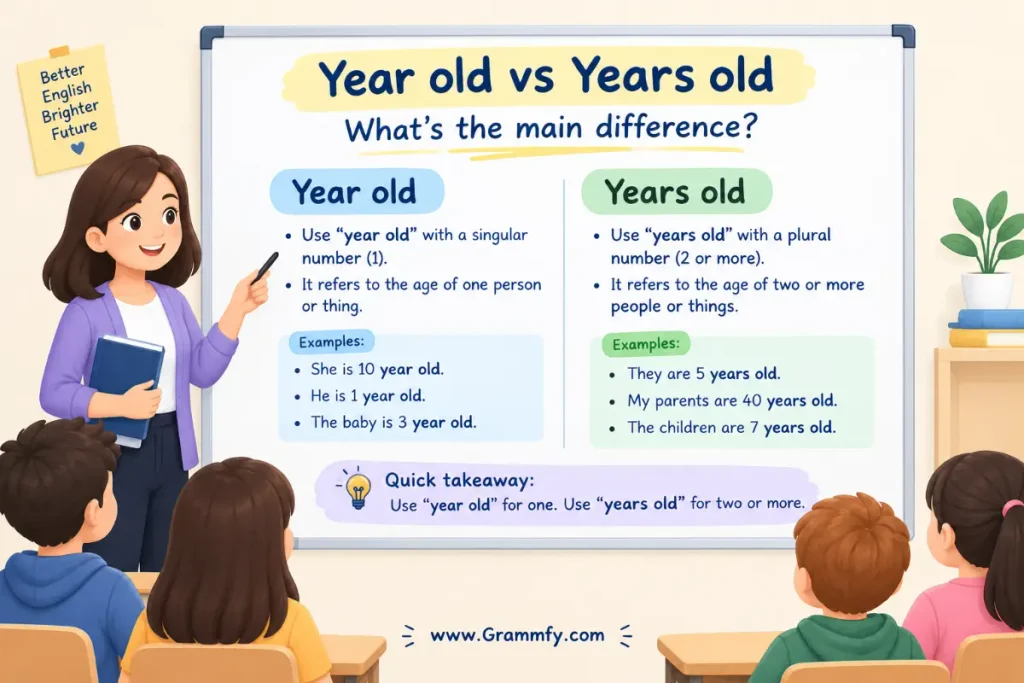
The main difference is where the age phrase appears and what job it does in the sentence.
| Form | Main use | Example |
|---|---|---|
| one year old | Age after a verb | “The baby is one year old.” |
| five years old | Age after a verb | “The child is five years old.” |
| one-year-old | Before a noun | “She has a one-year-old baby.” |
| five-year-old | Before a noun | “He has a five-year-old son.” |
There’s also a punctuation difference.
When the age phrase comes before a noun, use hyphens:
“a five-year-old child”
When it comes after the verb, don’t use hyphens:
“The child is five years old.”
This distinction is the key to understanding Year old vs Years old.
Why does “year” become singular before a noun?
English uses singular nouns inside many compound adjectives.
Consider these examples:
- a five-mile walk
- a three-hour movie
- a ten-dollar bill
- a two-week course
- a four-year program
- a five-year-old child
The number still tells us how many years, hours, miles, or dollars are involved. However, the first noun becomes part of a compound modifier, so it stays singular.
That’s why we write:
“a seven-year-old girl”
instead of:
“a seven-years-old girl”
The same pattern appears in many other English expressions.
Why are hyphens used in “five-year-old”?
Hyphens show that several words work together as one adjective.
In:
“a five-year-old child”
the words five, year, and old work together to describe child.
Without hyphens, the sentence can become harder to read.
Compare:
“a five-year-old child”
with:
“a five year old child”
The first version clearly presents the age as one compound adjective.
When should you use “years old”?
Use years old when the age comes after a verb.
Common verbs include:
- is
- am
- are
- was
- were
- be
Examples:
“My daughter is seven years old.”
“I am 20 years old.”
“They are 12 years old.”
“The house was 80 years old.”
The age phrase functions as a description of the subject.
When should you use “year-old”?
Use year-old when the age appears directly before a noun.
Examples:
“My seven-year-old daughter loves drawing.”
“We bought a 20-year-old car.”
“The five-year-old student answered the question.”
“She adopted a three-year-old dog.”
The age expression is now functioning as a compound adjective.
How does the number change the form?
The number determines whether year or years is used when the phrase appears after a verb.
“He is one year old.”
More than one
“He is two years old.”
“She is nine years old.”
“They are 15 years old.”
However, before a noun, year stays singular:
“a one-year-old child”
“a two-year-old child”
“a nine-year-old child”
“a 15-year-old student”
This is an important difference.
What is the correct form before a noun?
The standard form is:
number + year + old + noun
Examples:
- a three-year-old child
- a four-year-old car
- a six-year-old student
- a 12-year-old boy
- a 25-year-old building
- a 100-year-old tree
The word year remains singular.
The age phrase is also normally hyphenated.
What is the correct form after a verb?
The standard form is:
subject + verb + number + year/years old
Examples:
- “The child is three years old.”
- “My car is four years old.”
- “The student is six years old.”
- “The boy is 12 years old.”
- “The building is 25 years old.”
- “The tree is 100 years old.”
Here, the word year is singular only with one.
Year old vs Years old: Why does grammar change?
The grammar changes because the age expression has a different role.
In:
“She is eight years old.”
the phrase tells us the age of she.
In:
“She is an eight-year-old student.”
the phrase eight-year-old describes the noun student.
Think of it this way:
After the verb = age statement
Before a noun = adjective
That simple idea makes the rule easier to remember.
What is the word origin of “year”?
The word year has a very old history.
English year comes from Old English gēar, which referred to a cycle or period of time. The word is related to similar forms found in other Germanic languages.
The basic idea has remained remarkably stable. A year is a period connected with the Earth’s cycle around the Sun and is commonly used as a unit for measuring age and time.
When we say someone is “ten years old,” we’re measuring how many years have passed since their birth.
What is the word origin of “old”?
Old also comes from Old English, where forms related to eald were used to describe age or something that had existed for a long time.
The word has kept its central meaning.
When combined with a number, old describes age:
“She is 18 years old.”
It can also describe the age of an object:
“The building is 50 years old.”
When used in a compound adjective, it becomes part of expressions such as:
“an 18-year-old student”
What related words can describe age?
There aren’t 20–30 exact synonyms for year old vs years old because these are specific grammatical expressions. However, English has many related words and phrases for describing age, experience, maturity, and time.
Simple age-related words
| Word | Meaning | Tone | Example |
|---|---|---|---|
| Young | Having lived for a relatively short time | Simple | “She is still young.” |
| Old | Having lived for many years | Simple | “The house is old.” |
| Baby | A very young child | Simple | “The baby is sleeping.” |
| Child | A young person | Simple | “The child is six.” |
| Teenager | A person aged 13–19 | Everyday | “He is a teenager.” |
| Adult | A grown person | Everyday | “She is an adult.” |
| Kid | A child | Informal | “He’s a friendly kid.” |
| Infant | A very young baby | Formal | “The infant is sleeping.” |
Everyday age-related expressions
| Word or phrase | Meaning | Tone | Example |
|---|---|---|---|
| Toddler | A young child learning to walk | Everyday | “The toddler is two years old.” |
| Preschooler | A young child before regular school | Everyday | “The preschooler enjoyed the activity.” |
| Teen | A teenager | Informal | “She’s a busy teen.” |
| Young adult | A person in early adulthood | Everyday | “He is a young adult.” |
| Middle-aged | Neither young nor elderly | Everyday | “The character is middle-aged.” |
| Senior | An older adult | Polite | “The program helps senior citizens.” |
| Elderly | Older in age | Formal | “The service supports elderly people.” |
| Newborn | A recently born baby | Everyday | “The newborn is sleeping.” |
Formal age-related terms
| Word or phrase | Meaning | Tone | Example |
|---|---|---|---|
| Minor | A person below the legal adult age in a particular jurisdiction | Formal/legal | “The form requires a parent for a minor.” |
| Juvenile | A young person, often in legal contexts | Formal | “The law addresses juvenile offenses.” |
| Adolescent | A person developing from childhood toward adulthood | Formal | “The study examined adolescent behavior.” |
| Mature | Fully developed or adult-like | Formal | “She showed mature judgment.” |
| Adult | A legally or biologically mature person | Formal/everyday | “The course is open to adults.” |
| Senior citizen | An older adult | Formal/polite | “The center offers services for senior citizens.” |
| Centenarian | A person aged 100 or older | Formal | “The centenarian celebrated her birthday.” |
Informal and slang age expressions
| Word or phrase | Meaning | Tone | Example |
|---|---|---|---|
| Kid | Child | Informal | “That kid is really smart.” |
| Little one | Young child | Warm/informal | “The little one is asleep.” |
| Teen | Teenager | Informal | “My teen loves music.” |
| Youngster | Young person | Informal | “The youngsters played outside.” |
| Old-timer | An older person or experienced person | Informal | “The old-timer knows the town well.” |
| Golden-ager | Older adult | Informal | “The program welcomes golden-agers.” |
| Young gun | Young, ambitious person | Informal | “She’s one of the young guns on the team.” |
These words aren’t direct replacements for an age expression. They describe age groups or age-related ideas.
Which age expressions are mild to strong?
Age words can carry different levels of emphasis.
Mild and neutral
- young
- older
- adult
- child
- teenager
- senior
These are useful when exact age isn’t important.
More specific
- toddler
- preschooler
- adolescent
- young adult
- middle-aged
- senior citizen
These identify a general age group.
Very specific
- newborn
- one-year-old
- 10-year-old
- centenarian
These give a precise age or stage.
Be careful with words such as elderly, because some people may prefer more neutral expressions such as older adult.
What are the different grammatical forms?
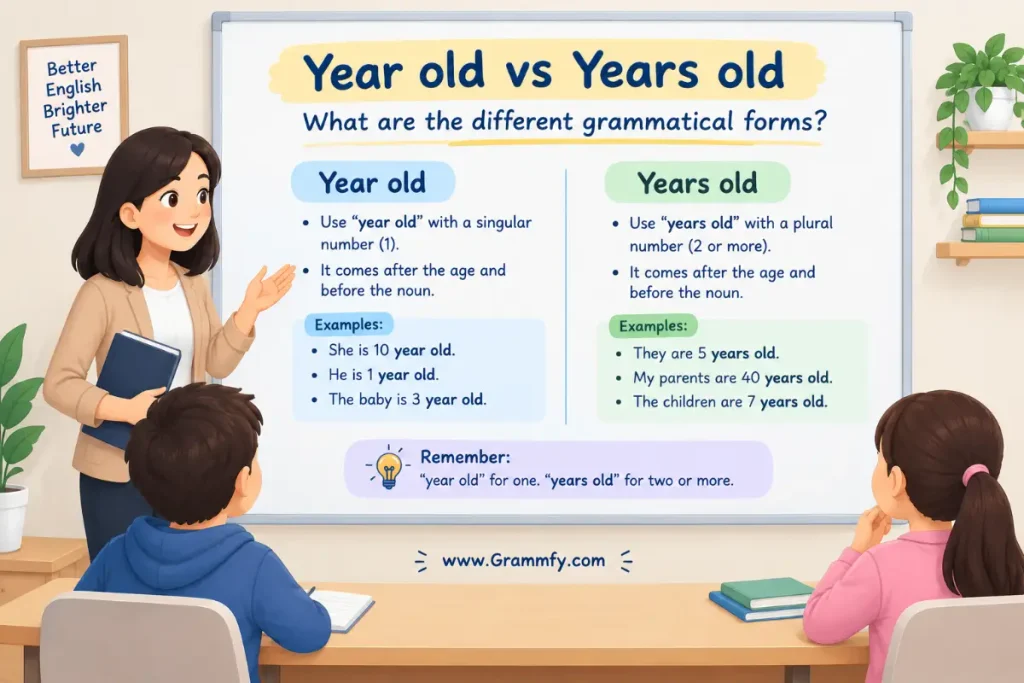
Age expressions can appear in several structures.
“She is ten years old.”
Here, ten years old is a predicate adjective phrase describing the subject.
“She is a ten-year-old student.”
Here, ten-year-old modifies student.
“The student, ten years old, entered the room.”
This is a less common construction. The age phrase is separated from the noun and doesn’t directly form a compound adjective.
“At ten years old, she started school.”
This construction places the age phrase at the beginning of the sentence.
“At the age of ten, she started school.”
This is another natural alternative.
The exact structure depends on what you want the sentence to emphasize.
Is “one year old” or “one years old” correct?
“One year old” is correct.
The number one takes the singular noun year.
Correct:
“The baby is one year old.”
Incorrect:
“The baby is one years old.”
Before a noun, the form is:
“a one-year-old baby”
Both uses contain singular year because the number is one.
Is “two year old” or “two years old” correct?
Both can be correct, but they belong in different grammatical structures.
After a verb:
“The child is two years old.”
Before a noun:
“The child is a two-year-old.”
The second form uses two-year-old as a compound noun or adjective phrase.
The incorrect form in standard writing is:
“a two-years-old child”
Is “five year old” correct?
It depends on the sentence.
Before a noun, standard writing uses:
“a five-year-old child”
After a verb, use:
“The child is five years old.”
Writing “five year old” without hyphens before a noun is generally considered incorrect or at least poorly punctuated in standard edited English.
Is “five years old child” correct?
No.
Don’t write:
“a five years old child”
Use:
“a five-year-old child”
The phrase five-year-old acts as one compound modifier before child.
Is “years-old” ever correct?
Usually, no, when you’re stating someone’s age after a verb.
Write:
“She is 15 years old.”
not:
“She is 15 years-old.”
The hyphens belong to the compound modifier before a noun:
“a 15-year-old girl”
This is one of the most common punctuation mistakes with age expressions.
Year old vs Years old: Which is correct in a sentence?
Look at the position of the age phrase.
| Sentence | Correct? | Why |
|---|---|---|
| “He is six years old.” | Yes | Age follows a verb |
| “He is a six-year-old boy.” | Yes | Age modifies a noun |
| “He is six-year-old.” | No | Missing noun or grammatical structure |
| “He is six years-old.” | No | No hyphen after the verb |
| “He is a six-years-old boy.” | No | Compound adjective uses singular year |
| “He is a six-year-old.” | Yes | Age phrase works as a noun |
| “She has a two-year-old daughter.” | Yes | Compound adjective |
| “Her daughter is two years old.” | Yes | Age after verb |
Which form should you use in a resume: Year old or Years old?
A resume usually needs concise, professional language.
If you’re describing your own age, you normally don’t need to include it unless there is a specific reason.
If age is relevant, use the standard sentence structure:
“I am 22 years old.”
When you’re describing an object or experience, age expressions can be useful:
“Managed a 10-year-old database system.”
However, a resume often benefits from focusing on measurable skills and experience rather than age.
Example for a professional profile
“I have worked with a five-year-old content management system.”
Here, five-year-old modifies content management system.
Which form should you use in an essay: Year old or Years old?
Both forms can appear in an essay.
Use years old when stating someone’s age:
“The main character is 14 years old.”
Use year-old before a noun:
“The 14-year-old character faces several challenges.”
Academic writing often benefits from variety, so you can also use:
“At the age of 14, the character leaves home.”
That structure can prevent repeated sentence patterns.
Which form should you use when texting: Year old or Years old?
Text messages are usually less formal, but the same grammar rule applies.
Correct:
“My sister is 12 years old.”
“I have a 12-year-old sister.”
Short texting may sometimes leave out words, but if you want standard English, keep the correct structure.
Which form should you use in emails: Year old or Years old?
Use the form that matches the sentence.
For example:
“My son is eight years old.”
If the age directly describes a noun:
“My eight-year-old son will attend the event.”
A formal email should use the standard hyphenation because clear writing prevents confusion.
Which form should you use when speaking: Year old or Years old?
In speech, both structures sound natural.
You might say:
“How old is your daughter?”
“She’s seven years old.”
Or:
“I have a seven-year-old daughter.”
Native speakers usually understand the distinction without thinking about the grammar rule.
What are 15 original examples?
Here are examples from different everyday situations.
- “My brother is 16 years old.”
- “She has a three-year-old daughter.”
- “The puppy is one year old.”
- “We adopted a two-year-old dog.”
- “The building is 75 years old.”
- “They restored a 75-year-old building.”
- “My cousin is 19 years old.”
- “My cousin has a 19-year-old brother.”
- “The student is 11 years old.”
- “The school welcomed an 11-year-old student.”
- “This laptop is six years old.”
- “I still use a six-year-old laptop.”
- “The tree is 200 years old.”
- “They planted a 200-year-old tree in the garden.”
- “At 10 years old, she started learning the piano.”
Notice how the same age can appear in different grammatical forms depending on the sentence.
What are examples with one year old?
Here are some common examples:
“The baby is one year old.”
“She has a one-year-old baby.”
“The one-year-old child is learning to walk.”
“At one year old, the baby could already stand.”
The number one always takes singular year.
What are examples with more than one year?
For ages greater than one, use plural years after a verb.
“He is three years old.”
“She is seven years old.”
“My car is 12 years old.”
“The company is 50 years old.”
Before a noun, keep year singular:
“a three-year-old boy”
“a seven-year-old girl”
“a 12-year-old car”
“a 50-year-old company”
What is the difference between “a 10-year-old” and “10 years old”?
The two expressions communicate the same basic age but have different grammatical functions.
| Expression | Function | Example |
|---|---|---|
| 10 years old | States age | “The boy is 10 years old.” |
| a 10-year-old | Refers to a person/object by age | “A 10-year-old won the competition.” |
| a 10-year-old boy | Modifies a noun | “A 10-year-old boy won.” |
The first is an age description. The second can act as a noun. The third uses the age phrase as a modifier.
What is the difference between “10-year-old” and “10 years old”?
10-year-old is used before a noun or as a noun-like expression.
“a 10-year-old student”
10 years old normally follows a verb.
“The student is 10 years old.”
The spelling, pluralization, and hyphenation all depend on the grammatical position.
Year old vs Years old: What changes with objects?
The rule isn’t limited to people.
You can describe the age of:
- Cars
- Buildings
- Computers
- Trees
- Companies
- Books
- Devices
- Traditions
- Businesses
- Furniture
Examples:
“The car is 15 years old.”
“It’s a 15-year-old car.”
“The building is 100 years old.”
“They restored a 100-year-old building.”
The grammar stays the same because the structure, not the type of object, determines the form.
Can you say “20-year-old company”?
Yes.
The compound adjective is:
“a 20-year-old company”
You can also say:
“The company is 20 years old.”
Both are grammatically correct.
The first puts the age directly before company. The second states the company’s age after the verb.
Can you say “20 years old company”?
No, not in standard English.
Instead, write:
“a 20-year-old company”
or:
“a company that is 20 years old”
The first option is shorter and more natural.
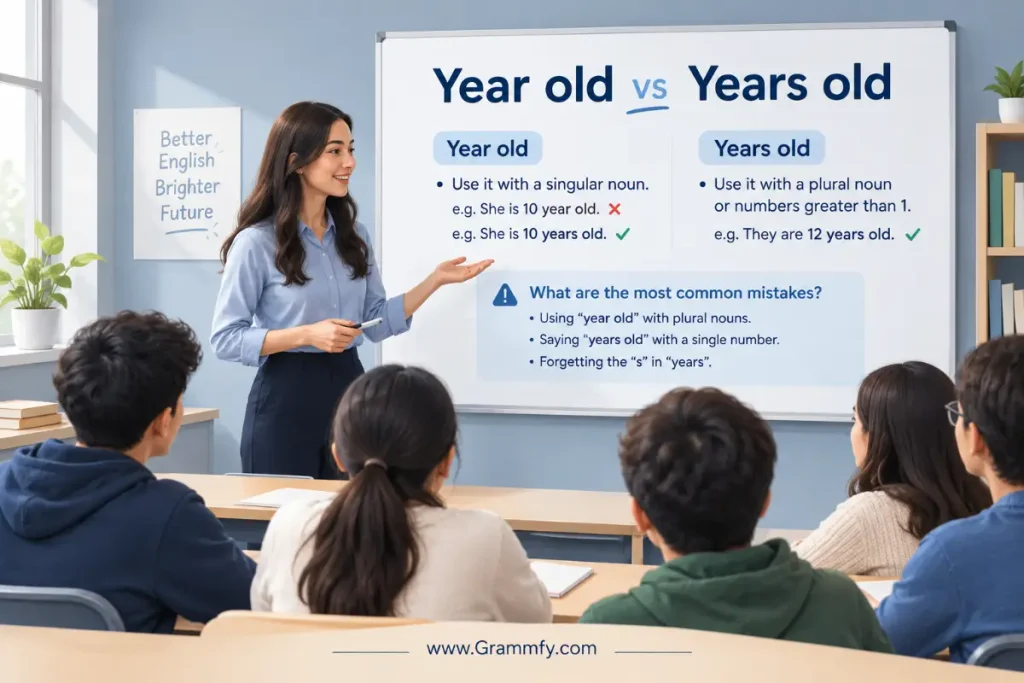
What are the most common mistakes with “Year old vs Years old”?
Mistake 1: Adding “s” to year before a noun
Incorrect:
“a five-years-old child”
Correct:
“a five-year-old child”
The compound adjective uses singular year.
Mistake 2: Adding unnecessary hyphens after a verb
Incorrect:
“She is 10-years-old.”
Correct:
“She is 10 years old.”
The age phrase isn’t directly modifying a noun.
Mistake 3: Forgetting hyphens before a noun
Incorrect:
“a ten year old boy”
Standard edited form:
“a ten-year-old boy”
The hyphens make the compound adjective clear.
Mistake 4: Using “year” with a plural number after a verb
Incorrect:
“He is five year old.”
Correct:
“He is five years old.”
Mistake 5: Using “years” with one
Incorrect:
“She is one years old.”
Correct:
“She is one year old.”
When should you avoid an age label?
Age isn’t always relevant.
For example, instead of:
“The elderly woman complained about the noise.”
you might use:
“The older woman complained about the noise.”
if the exact age isn’t important.
Likewise, calling someone a “50-year-old” may be unnecessary when their age has nothing to do with the topic.
Good writing includes details that matter to the reader.
What are alternatives to “years old”?
You have several natural options.
“At the age of…”
“At the age of 18, she moved abroad.”
This is useful in formal writing.
“Aged…”
“The athlete, aged 22, won the competition.”
This is common in some formal and journalistic styles.
“In their…”
“She is in her twenties.”
This doesn’t give an exact age.
“A teenager”
“He is a teenager.”
This gives an age group rather than a specific number.
“An adult”
“She is an adult.”
This focuses on life stage rather than exact age.
Is “aged 10” correct?
Yes.
Aged 10 is grammatical and commonly used, especially in formal writing.
Example:
“The child, aged 10, won the competition.”
You can also write:
“The 10-year-old child won the competition.”
Both are correct, but the style differs.
10-year-old is compact and descriptive.
aged 10 sounds more formal.
Is “10 years of age” correct?
Yes, although it is more formal than everyday 10 years old.
For example:
“Children under 10 years of age must be accompanied by an adult.”
This construction often appears in official rules, forms, policies, and legal writing.
In everyday conversation, you’d usually say:
“Children under 10 years old…”
Is “at 10 years old” correct?
Yes.
For example:
“At 10 years old, she started playing tennis.”
This means that when she was 10, she started playing tennis.
Another option is:
“At the age of 10, she started playing tennis.”
The second version can sound slightly more formal.
US vs UK usage: Is the rule different?
The basic grammar rule is the same in American and British English.
Both varieties use:
“She is ten years old.”
and:
“She is a ten-year-old student.”
British and American writers may differ in some style preferences, vocabulary, or punctuation choices, but this age construction remains broadly consistent.
You may also see aged 10 more often in some British contexts, especially in news writing or formal notices.
Is “years old” used for things in both American and British English?
Yes.
Both varieties can describe objects using age.
American English:
“The house is 100 years old.”
British English:
“The house is 100 years old.”
Before a noun:
“a 100-year-old house”
The structure remains the same.
What should you use in formal writing?
For formal writing, clarity is the priority.
Choose:
“The researcher is 30 years old.”
or:
“The 30-year-old researcher presented the findings.”
For a formal document, aged 30 or 30 years of age may also be appropriate depending on the style.
Avoid awkward constructions such as:
“30-years-old researcher”
or:
“30 years old researcher”
How can you easily remember the Year old vs Years old rule?
Use the noun test.
Is a noun immediately after the age?
If yes, use:
number-year-old + noun
Example:
“a seven-year-old child”
Is the age after a verb?
If yes, use:
number year/years old
Example:
“The child is seven years old.”
This quick test handles most situations.
What are the best tips for using Year old vs Years old?
- Use year with one: “one year old.”
- Use years with numbers greater than one after a verb: “three years old.”
- Use singular year in compound adjectives: “three-year-old.”
- Hyphenate an age phrase before a noun.
- Don’t hyphenate the normal age phrase after a verb.
- Remember that year-old can also function as a noun: “a five-year-old.”
- Use aged 5 as a formal alternative.
- Use at the age of 5 when you want a more formal construction.
- Don’t write “five-years-old child.”
- Don’t write “five-years-old” after a verb.
- Don’t add an extra s to year inside a compound adjective.
- Check whether the age phrase modifies a noun before choosing the form.
Quick grammar chart
| If you mean… | Use this | Example |
|---|---|---|
| Age after a verb | years old | “She is 14 years old.” |
| Age of one year | one year old | “The baby is one year old.” |
| Age before a noun | year-old | “a 14-year-old girl” |
| Age used as a noun | year-old | “A 14-year-old called.” |
| Formal age description | aged + number | “The athlete, aged 14, won.” |
| Formal age phrase | number + years of age | “Children 14 years of age…” |
| General life stage | teenager | “He is a teenager.” |
| Approximate age | in their + decade | “She is in her twenties.” |
How does this rule work in questions?
Questions follow the same basic pattern.
Correct:
“How old is she?”
“How many years old is the child?”
The first question is much more natural in everyday English.
You can answer:
“She is eight years old.”
Or:
“She’s an eight-year-old.”
The second answer uses eight-year-old as a noun.
What about “How old is your five-year-old?”
That’s also correct.
Here, five-year-old acts as a noun meaning a five-year-old child.
For example:
“How old is your five-year-old?”
The listener understands that you’re asking about the person’s child.
How does the rule work with possessives?
Possessive structures don’t change the basic rule.
Examples:
“My son is six years old.”
“My six-year-old son loves football.”
“Her daughter is three years old.”
“Her three-year-old daughter loves painting.”
The position of the age phrase still determines the form.
How does the rule work with names?
You can place an age after a person’s name:
“Maria is 21 years old.”
You can also use the compound form:
“Twenty-one-year-old Maria won the award.”
In the second sentence, twenty-one-year-old modifies Maria.
For formal writing, spelling out numbers may depend on your style guide.
How does the rule work with numbers like 21?
The same grammar applies.
After a verb:
“She is 21 years old.”
Before a noun:
“She is a 21-year-old student.”
Not:
“a 21-years-old student”
The number doesn’t change the singular year inside the compound adjective.
How do you write ages with numbers in professional writing?
In most ordinary online writing, numerals are clear:
“a 25-year-old employee”
“The employee is 25 years old.”
Formal style guides may have additional rules about spelling numbers, especially at the beginning of a sentence.
If a sentence begins with an age phrase, you may write:
“Twenty-five-year-old Sarah joined the company.”
The important grammar point is still the same: year remains singular inside the compound adjective.
Can “old” be removed?
Sometimes.
For example:
“She is 20.”
This is perfectly natural when the context is clear.
You can also say:
“He turned 18.”
These shorter forms are common in everyday English.
However, when teaching the grammar distinction, years old and year-old make the structure easier to see.
What are close comparisons with other age expressions?
“Year-old” vs “aged”
Both can describe a person’s age, but their style differs.
| Year-old | Aged |
|---|---|
| Common and direct | More formal |
| Often appears before a noun | Often appears after a noun |
| “A 12-year-old student” | “A student aged 12” |
| Natural in everyday writing | Common in formal or journalistic writing |
Neither is automatically better.
Use the one that fits your audience.
“Years old” vs “at the age of”
These structures have the same basic meaning but different styles.
| Years old | At the age of |
|---|---|
| Simple | More formal |
| Common in conversation | Common in essays and formal writing |
| “She was 16 years old.” | “At the age of 16, she…” |
For easy English, years old is usually the clearest choice.
What are common age-related antonyms?
Age itself doesn’t have a perfect antonym, but words can express opposite stages or qualities.
For young, possible opposites include:
- old
- elderly
- mature
- older
For child, a broad opposite is:
- adult
And For new, which can describe a young object, possible opposites include:
- old
- aged
- worn
- established
Context matters because old can mean either advanced age or long existence.
Why is “old” sometimes positive and sometimes negative?
The word old isn’t automatically negative.
It can describe something with a long history:
“an old family tradition”
It can also describe something worn or outdated:
“an old computer”
For people, older can be more neutral than old in some contexts.
For example:
“older adults”
is often preferred in respectful or professional writing.
How should you choose the right age expression?
Ask three questions.
1. Am I stating someone’s age?
Use:
“She is 12 years old.”
2. Am I describing a noun?
Use:
“She is a 12-year-old student.”
3. Do I want a formal alternative?
Use:
“She is aged 12.”
or:
“At the age of 12, she…”
This decision takes only a few seconds once you know the pattern.
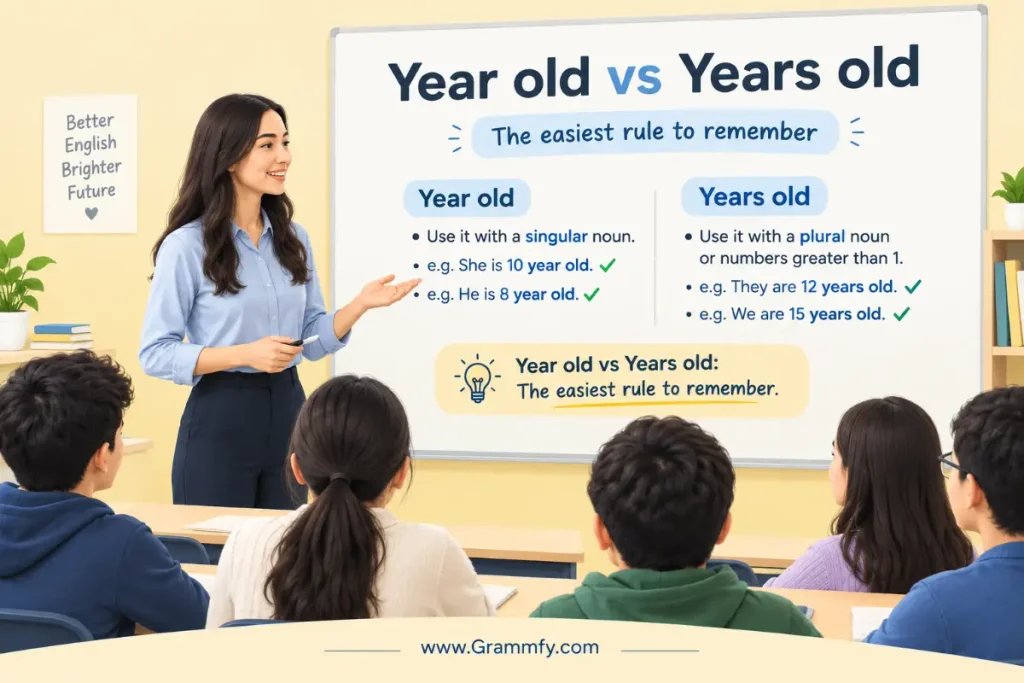
Year old vs Years old: The easiest rule to remember
Here’s the shortest version:
After a verb:
12 years old
“He is 12 years old.”
Before a noun:
12-year-old
“He is a 12-year-old boy.”
Never:
12-years-old boy
Usually never:
He is 12-years-old.
Think of year-old as one compound adjective. Think of years old as a normal phrase that states age.
Conclusion
Understanding Year old vs Years old comes down to one simple grammar idea: look at the position of the age phrase. When you state someone’s age after a verb, use year with one and years with larger numbers, as in “She is one year old” and “She is 15 years old.” When the age comes before a noun, use the singular year and hyphens, as in “a 15-year-old student.” The same rule works for people, animals, buildings, cars, companies, and other things. If you’re unsure, check whether the age phrase is directly describing a noun. That quick test will help you choose the correct form in emails, essays, resumes, texts, and everyday writing.
Frequently Asked Questions
Is it “year old” or “years old”?
Use years old after a verb for ages above one, such as “She is 10 years old.” Use year-old before a noun, such as “a 10-year-old girl.”
Is “one year old” or “one years old” correct?
“One year old” is correct because one takes the singular noun year.
Is “five year old” grammatically correct?
Before a noun, write five-year-old with hyphens. For example, “a five-year-old child.”
Should I write “10-years-old”?
No, not when simply stating someone’s age. Write “10 years old,” but use “10-year-old” before a noun.
What’s another way to say “years old”?
You can use phrases such as aged, at the age of, or years of age, depending on the level of formality.
Is “a 20-year-old” correct without a noun?
Yes. A 20-year-old can function as a noun and mean “a person who is 20 years old.”
Is the rule different in British English?
No. The basic distinction is the same in American and British English: “20 years old” states age, while “20-year-old” normally modifies a noun.

1 thought on “Year old vs Years old: The Best Simple Grammar Guide”